
Ranked the #1 DSO Podcast!
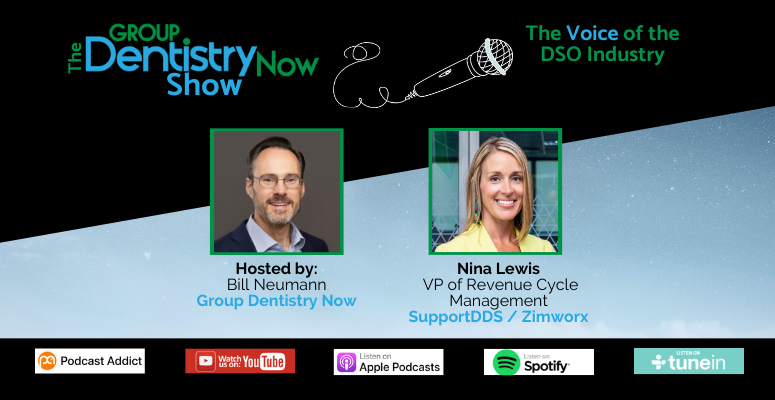
Welcome to The Group Dentistry Now Show: The Voice of the DSO Industry!
Navigating the Intersection of Technology and People in Revenue Cycle Management
Nina Lewis, Vice President of RCM at Zimworks & SupportDDS joins the show to discuss:
- RCM & its impact on cash flow
- Leveraging tech & human capital
- KPIs to measure for healthy RCM
To learn more, email Nina here – nina@supportdds.com or book a discovery call here – https://supportdds.com/book-discovery-call/
Subscribe to our channel for more episodes and stay updated on the latest DSO news, insights, and events!
If you like our podcast, please give us a ⭐⭐⭐⭐⭐ review on iTunes https://apple.co/2Nejsfa and a Thumbs Up on YouTube.
Choose your favorite listening app below and subscribe today so you don’t miss an episode! Full transcript is also provided below. See all of our podcasts HERE.
 |
 |
 |
 |
 |
 |
DSO Podcast Transcript – Navigating the Intersection of Technology and People in Revenue Cycle Management
Welcome to the Group Dentistry Now Show, the voice of the DSO industry. Join us as we talk with industry leaders about their challenges, successes, and the future of group dentistry. With over 200 episodes and listeners in over 100 countries, we’re proud to be ranked the number one DSO podcast. For the latest DSO news, analysis and events, and to subscribe to our DSO weekly e-newsletter, visit GroupDentistryNow.com. We hope you enjoy today’s show.
Bill Neumann: Welcome everyone to the Group Dentistry Now show. I’m Bill Newman. And as we move into this new year, There’s gonna be a lot of talk. I guess there was a lot of talk in 2025 and continued conversations about technology. And I think we’re at this really interesting inflection point where trying to figure out whether technology does the work or people do the work and how they work together. And I think the next guest is really gonna have a great perspective on this because it’s a challenge. There are a lot of technology solutions out there. And a lot of them are complementing what people do. Some may be replacing some tasks, but it’s like, what do you do? How do you do it? And what’s the most important to focus on? Should a person be doing this? Should technology be taking over? It’s pretty challenging, I think, for a lot of people in the audience, certainly overwhelming with all the solutions out there. So we have Nina Lewis with us. She is the Vice President of Revenue Cycle Management at Zimworks and Sport TDS. And you may have seen her at one of the many DSO shows out there. And she was on a webinar of ours a little over a year ago, but it’s great to have you back, Nina.
Nina Lewis: Thank you. Thank you for having me.
Bill Neumann: So I think this is a really, it’s probably a great thing to start the new year off with because it’s a real challenging time. And I talk to a lot of groups out there, I’m sure you do as well, and there’s technology solutions across pretty much everything in the dental industry. I mean, you’ve got your diagnostic AI, which was kind of like one of the first AIs that we heard about, right? And it’s been out for two or three years now. And now we have conversational AI, where you have people, call centers maybe, and then there’s some complimentary, whether it’s texting or whether it’s AI voice that’s either answering calls, maybe when people can’t pick up. And we’re going to talk a lot about revenue cycle management, which is That’s a pretty big ball of wax, right? The whole revenue cycle and how technology can assist there. But, you know, where is technology now? What parts of the revenue cycle can it really excel at? And where are people better fits? So before I go any further here and start asking you a bunch of questions about this, would you mind just giving the audience a little bit of your background and then talk a little bit about what Zimworks and support DDS does?
Nina Lewis: Yeah, absolutely. So I’ve been in the dental space for almost 26 years now. Started out in a dental practice, really learned the back functions and moved up from there. And then I started opening practices for organizations, working with DSOs, and really diving into the revenue portion of it all, which is fun. ever changing, but also not changing. So it’s kind of an interesting, if I look back 20 years, not much has actually changed other than the tools available. So about 2 years ago, I joined Zimworks to run the Revenue Cycle Management team. We’ve, we’ve grown immensely, but we’re just really proud of the fact that we can help support organizations with their revenue cycle needs, whether it’s full-functioning revenue cycle or just a portion of it for them. Even project-based, you know, you have a lot of groups that are just behind on something and need that extra lift for a period of time. Those are always fun to dabble in. And we’re always hopeful that that will turn into a long-lasting relationship. But ultimately, we’re here to help wherever the organization needs that support.
Bill Neumann: Excellent. Well, we’ve got, I think we’ve got a pretty broad audience. So we’ve got some of the larger group practices and DSOs here that really understand revenue cycle management. And then I think we’ve got a lot of dentist entrepreneurs that maybe have, you know, two, three, 10 locations. And a lot of times I think they’re think about when they think about revenue cycle, there’s accounts receivable and accounts payable and they don’t know what else is, you know, they might not know what the whole revenue cycle is. So can we get maybe a 101 on, you know, what the revenue cycle looks like to you? And then we can maybe talk a little bit about how support TDS works with practices. And then also really, you know, what type of technologies are out there and where people, you know, where are people still doing a better job in technology?
Nina Lewis: Sure. Well, so for me, the revenue portion of this starts with insurance verification. Now, in theory, it starts a little bit more upstream with collecting patient data. But in reality, it’s really with that insurance verification portion of things, because that kind of sets the tone for the rest of that claim. From there, it goes into submission of claims, and then payment posting, insurance tracing, so finding out what is going on with those insurance claims that are outstanding, and then patient AR. So that would be your full cycle RCM process.
Bill Neumann: Excellent. So as far as what support DDS, you pretty much cover like all ends of the spectrum from… We really can.
Nina Lewis: we can help where it’s most needed is really where we start with. So when we’re talking to a group, whether it’s one office or 200 offices, it’s really finding out that pain point for them. And I find that it’s typically they’re really behind in payment posting, or they just haven’t a ridiculously outstanding amount of insurance claims that they need followed up on. And so it’s often that there’s just no systems in place, or they are just having a hard time finding team members to take care of those processes for them. I think staffing is a pretty big issue right now across the United States. So it’s, it’s, it’s really difficult to find people to to come in and work these things for you. So that’s really where we come in. We’re just a part of your team, and we want to support in whatever obstacle you’re facing. And that obstacle can change along the way, right? So we could start in one area of the cycle for you, but then we might end up helping you in other areas as well.
Bill Neumann: And you and SupportDDS are really assisting these groups with both people and also technology as well, kind of offset those challenges they may have when it comes to the hiring for people for revenue cycle management.
Nina Lewis: Yeah, so our typical process is that we’re going to use whatever our clients are using. Now, I understand that there’s some organizations out there who really haven’t implemented anything because it’s so overwhelming. There’s so many that I do think it is just very hard to decide what’s going to work best. And until you try something out, you really don’t know if it’s going to work for your office. So we can make suggestions along the way. We can give you ones that we have found success with. I mean, we have some great case studies to share on different tools that we have used. But ultimately, like I said, we’re going to use whatever you’re using.
Bill Neumann: And so you start there, I guess you do an analysis of what the group is using, and then you look for ways to maybe compliment and make things more efficient. Can you talk a little bit about that? Because again, I do feel like this year is the year for this, like almost this collision course between people and technology and the experience that you all have, working with technology and people and seeing this evolution, you can probably be really good really provide great guidance as far as where people fit in better and where technology might be a better solution. So let’s talk a little bit about that combination of technology and people and why it matters so much in revenue cycle.
Nina Lewis: Sure. So initially, when you’re looking at even adding a tool, the reason you’re doing it, I would assume is for two reasons. You’re trying to have more quantity taken care of. So you’re trying to stay farther ahead on your insurance verifications, or you’re trying to automate postings. So you’re trying to stay as up to date on that. Where the people portion of it comes in to me is that there is a you know, computers can’t make judgment at the end of the day, right? So they can’t determine that that claim actually should have went back to the insurance company because the insurance company didn’t pay what they were supposed to, or that downgrade should be discussed with that insurance company because that is wrong. So to me, the tool is helping with the quantity that you’re trying to reach, but the human is trying to help make sound judgment and then fill the gap of what the AI tool cannot take care of. So I would say, for example, with insurance verification, in On average, I would say 80% of your insurance verification, maybe 70, 70, 80, can be taken care of via a lot of these tools that are out there. But there’s still going to be that gap that is just not possible for that tool to get for you. So you need the human element to be able to go in, finish that up, even check occasionally on those ones that are received from the tool to make sure that everything is accurate and that it’s being merged into your software the way that it’s supposed to.
Bill Neumann: You probably see a lot and you have a lot of conversations. You probably see people that are groups that are using 100% people, no technology, and then others that may be relying a little bit too much on technology. So where do you see maybe groups out there that are relying way too much on technology and not enough on people?
Nina Lewis: So I think that you see it probably more in the glamour of, of payment posting. It’s interesting that we’re, people are moving in this direction of literally eliminating the human touch to posting payments, whether it’s reviewing them, making sure adjustments are correct, or even just that the payments are being made and inputted correctly. So to me, the, I think that’s, we’re moving too much in that direction for payment posting. If I were an organization, and, and ultimately, this is how I pay my bills, I pay my team, I, I just don’t know that I would totally trust it 100%. Even if it can do all of it, I still think you have to have some type of balance and checks going on in the background with a human checking it. So yeah, that’s an area that I find to be probably too overutilized at this point.
Bill Neumann: And why do you think that is? Is that a technology that’s been around for a while and people know?
Nina Lewis: I mean, I can go back to my days of posting one hundred thousand dollars in a day. And that’s an it’s an exhausting task. And when you have these huge organizations posting. you know, a million dollars frequently, that it’s, you need a lot of humans helping with that, right? So to me, it’s very glamorized that, OK, we can get rid of that portion of it, and this, this technology can do it. Um, where I, I just get nervous with downgrades. Um, was the deductible applied? Should it really have been denied? I just think there’s a lot more to payment posting than, than the numbers. It’s, is it correct? Uh, are the fees correct? There, there’s so much more to it. So you have to have, um, confidence in, in what’s happening to, to make sure you’re getting all the revenue that you are owed. So to me, the AI tool just isn’t able to do that portion of it.
Bill Neumann: So you may be able to use a combination of technology with people backing it up or making sure there’s some checks and balances in the background that are human.
Nina Lewis: Yeah, that are human.
Bill Neumann: So on the flip side of things, what technology may actually be better than humans?
Nina Lewis: Oh, well, I think for sure anything that you have to get off of portals, and it’s simply because of the speed of it, right? So when I say that I’m referring to when you’re verifying benefits and getting breakdowns, or if you’re checking claim status, that all can be done at such a quicker rate with these tools. So I think that that’s a great resource. Now, it can’t obviously handle all of it. There’s still going to be that gap. But I do think that people are understanding that and are more clear than they have been in years. So I find it a lot where an organization’s like, Listen, I’m going to bring this tool in to help your team with insurance verification, because they’re drowning in it. And it’s a great resource. It’s a great model. They understand that that tool is not capable of getting 100% of those verifications done for them.
Bill Neumann: In your experience, do you find that groups have a lot of people maybe in revenue cycle management but they’re still struggling with revenue cycle management, and if so, why? Because you do hear some of these departments, especially with the larger groups, are massive, yet they still talk about cashflow issues from time to time.
Nina Lewis: To me, yes, that happens all the time. It’s very common to hear this. It really boils down to, I believe, that they are not finding out the true story of why their revenue is the way it is. So to me, when you’re, I’m going to use insurance aging, for example. When you’re working those claims, there has to be some type of system in place to track the root cause of what’s happening. You can work them all day long and get them paid, but if you never fix the actual reason why they ended up there, you’re gonna always have cashflow issues. So to me, it’s more that there’s not a process in place to track the root causes and no one’s fixing it from the front end portion of it.
Bill Neumann: So I think revenue cycle can be pretty overwhelming. And again, like I said, we’ve got all shapes and sizes of groups here. So we’re not saying you have to overhaul the entire revenue, so that would be great. But if there was an area that you’d recommend in this new year that a group focuses on, is there a particular area you say, hey, you could really kind of attack this part of the revenue cycle management and really make a big, big impact?
Nina Lewis: Well, it’s hard to narrow down one. But if I were, if someone came and said that they were really concerned because they constantly have cash flow issues, I would tell them to start with their insurance aging. Because it tells the story of what is going on. And clearly, they don’t know what’s going on. So this is going to help them determine that. So when we work with an organization on that task, we’re going to track everything that’s happening and why it’s happening so that we can give suggestions on areas that operationally they might not be aware of that need additional support or tweaking. Now, if you’re starting out the new year, and you really, and you don’t say that to me, but you want to make some type of impact for the year, I would also say insurance verification is a great area to start, because that sets you up for success downstream then. So it really depends on what someone says to me when I answer that question.
Bill Neumann: Sure. So kind of moving on to KPIs. So insurance aging would be one of those top KPIs for sure. Do you have any other KPIs that you would say, hey, like here are the top four or five I’d pay attention to? And then if a group might be using technology or looking to use technology, do those KPIs change a little bit?
Nina Lewis: Yeah, so I think a great KPI to track would be your DSO number, so Days Sale Outstanding. How long does it take for that claim to get paid the first time around? You really want to be in that 12 to 18 day. That’s a, that’s a beautiful number. Most organizations probably don’t track it unless they have some type of dash that they’re working with. Do numbers change based off of tools and people? Absolutely. So for example, industry-standard KPI for someone to work a certain amount of claims in a day is between 40 and 45. And this would be for, for general dentistry. When you get into specialty, these numbers change a bit. Once you have tools available to you, you really can push that number up 65, 80, depending on how comfortable that person is with that tool.
Bill Neumann: So as we kind of end things here, there’s a lot to think about. I mean, again, I think it’s one of these big, this area that’s very challenging. And like I said, the fact that you have technology available doesn’t always make it easier because you have to understand the technology. It’s constantly evolving, which is nice that Nina, you and your team at SupportDDS are really, you know, testing out and using day to day, a lot of these different technologies, depending on the DSO and the group that you may be working with. So I’m sure you’re working with a lot of different technologies now. So you can say, hey, this one seems to work better in this case, if you’re this size group, or maybe you’re doing this type of dentistry, that may be another type of technology. But what Let’s talk about like a perfect scenario with people and technology right now in 2026. What does a really healthy RCM look like?
Nina Lewis: Oh, Bill, my gosh, that is where we need the crystal ball. So to me, a really healthy revenue cycle process is that you are well aware of why your claims are in the buckets that they’re in. So, you know, if you’re a general office and you have ortho claims and you’re over 90, that’s to be expected, right? Ortho doesn’t get paid on day 30. It’s generally a claim that’s going to sit there for a while. But if you aren’t doing things like that and you have a lot of outstanding claims, that’s unhealthy, right? So to me, if you’re really touching those claims between that 20 to 30 day mark and they’re generally getting paid before 45 days, that’s healthy to me. The other part of it, I really do think having some type of tool available to your team, whether it’s your internal team, whether it’s an outsourcing team, it doesn’t matter. But I think having tools available to them is beneficial because accuracy is, is great for getting high quantity of things done. So, you know, insurance verification, there, there’s great tools out there. And if you aren’t using one to help support your, your internal team, you’re not doing them a great service. Most of your team members, I’m assuming, they were hired to actually talk to patients. Unless they’re a true RCM team sitting there, most of these individuals were meant to talk to patients and help patients and make patients feel better, not calling on insurance and finding out, you know, how much Mary Sue has left on her insurance. So I think you’re doing a disservice to everybody when you don’t have something available. So to me, healthy is some type of tool for efficiency and accuracy. And then healthy aging to me is always a big thing.
Bill Neumann: Excellent. Well, I think there’s, there are going to be some people in our audience that are going to want to have a phone call with you and consult and see how you can help them. And it is, I think it’s definitely on a lot of groups lists for 2026, as far as, you know, working on being more efficient and, and the challenges still continue to go on when it comes to finding people or to your point, You have people that should be focused on the patients and not focused on calling insurance or waiting on the phone for insurance companies. There’s a lot of that that goes on. Nina, what’s the best way for someone to learn more, maybe set up a discovery call? And then what does that discovery call look like?
Nina Lewis: Yeah, sure. So very easy. Email me. It’s Nina at supportdds.com. A Discovery Call is really me finding out where their pain points are and then taking the conversation from there. I don’t ever want to jump in and do something that is perfectly taken care of. I really do want to find out where their pain points are. And if they don’t know, you know, some people really have no clue. We’ll go through different reports that they can run within their software to help answer those questions and determine what type of support they may need.
Bill Neumann: That’s great. So it’s Nina at supportdds.com. And of course the website supportdds.com will put Nina’s email address and the URL for SupportDDS in the show notes. And this has been great. I think this is a great time of year to really be thinking about this, where it can really make an impact on the year. And I think also, I think it’ll help from a culture perspective too. We talk about freeing up people’s time to really do what they’re supposed to do.
Nina Lewis: Yeah, I agree for sure.
Bill Neumann: All right. Nina Lewis, thanks so much. And thank you everybody for watching today. Until next time, this is the Group Dentistry Now Show.
Thank you for joining us today. Don’t forget to subscribe to the podcast to stay up to date on the latest DSO news, insights and events. Also subscribe to our DSO weekly e-newsletter at groupdentistrynow.com.