
Ranked the #1 DSO Podcast!
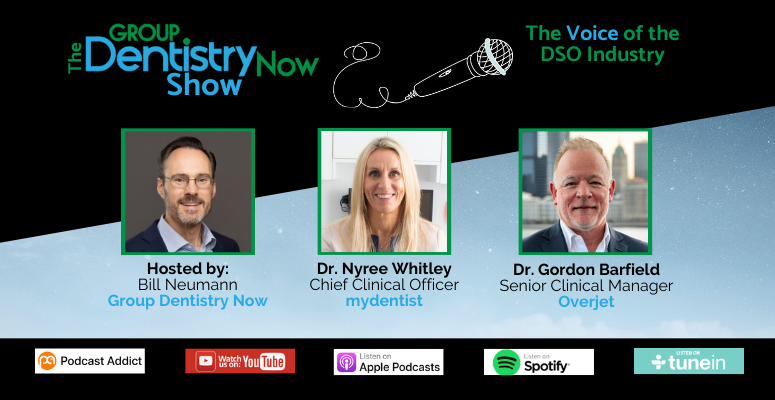
Welcome to The Group Dentistry Now Show: The Voice of the DSO Industry!
A Clinician-First Diagnostic AI Strategy. A Conversation with Overjet AI & mydentist.
Dr. Nyree Whitley, Chief Clinical Officer at mydentist & Dr. Gordon Barfield, Senior Clinical Manager at Overjet discuss:
- What a clinician-first diagnostic strategy looks like
- The dental regulatory & clinical environment in the UK
- Advice for clinical leaders evaluating AI in dentistry
- Much more
To learn more about Overjet AI you can visit https://www.overjet.com/ and book a demo or connect with Dr. Barfield on Linkedin – https://www.linkedin.com/in/gordon-barfield-dds-ms-676a9516/
To learn more about mydentist you can visit https://www.mydentist.co.uk/ or connect with Dr. Whitley on Linkedin – https://www.linkedin.com/in/nyree-whitley-2a85b85a/
Subscribe to our channel for more episodes and stay updated on the latest DSO news, insights, and events!
If you like our podcast, please give us a ⭐⭐⭐⭐⭐ review on iTunes https://apple.co/2Nejsfa and a Thumbs Up on YouTube.
Choose your favorite listening app below and subscribe today so you don’t miss an episode! Full transcript is also provided below. See all of our podcasts HERE.
 |
 |
 |
 |
 |
 |
DSO Podcast Transcript – A Clinician-First Diagnostic AI Strategy. A Conversation with Overjet AI & mydentist.
(00:03):
Welcome to the Group Dentistry. Now show the voice of the DSO industry. Join us as we talk with industry leaders about their challenges, successes, and the future of group dentistry. With over 200 episodes and listeners in over 100 countries, we’re proud to be ranked the number 1 DSO podcast for the latest DSO news analysis and events. And to subscribe to our DSO weekly E-newsletter, visit group dentistry now.com. We hope you enjoy today’s show.
Bill Neumann (00:38):
Welcome everyone to the Group Dentistry Now show. I am Bill Neumann, and as always, we appreciate you joining us today. We’re going to have a really interesting conversation. We talk a lot about AI and technology. Our audience, for the most part, is based in the us although we do have a global audience. We have people listening from Europe and the uk, Asia Pacific, but we don’t get a lot of times the perspective from other parts of the globe. So we’re going to have a nice conversation here, learn a lot about dentistry in the uk, the use of AI and technology in the uk, and learn about an organization that I remember years and years ago I was in an A DSO conference and I met a bunch of people from my dentist and it was really exciting conversation and I think there’s a lot that we can learn here in the states from what’s going on in other parts of the globe. So I’m really excited for this conversation. So we’re going to talk diagnostic AI. We’re going to talk about what’s going on in the uk, and we have Dr. Uri Whitley. She is the Chief clinical Officer at my dentist, and Dr. Gordon Barfield, senior clinical manager of overjet. Thank you both for joining us. I know agAIn, how difficult it is to get, both of you have busy schedules and you’re what, 6, 5, 6 hours apart?
Dr. Nyree Whitley (02:05):
Yeah.
(02:06):
Yeah. Well, I’ll say good morning Bill and Nyree would likely say good afternoon. I’ll
Bill Neumann (02:13):
Say good morning as well. So it’s great to have you both on Dr. Whitley, a little bit about your background. And then can you spend a couple of minutes on my dentist, the organization, and then also just a little bit about what the UK dental landscape looks like.
Dr. Nyree Whitley (02:34):
Yeah, of course. So I’m a dentist. I qualified approximately 30 years ago now. I’ve had a mixed career. I’ve worked within the NHS and Private dentistry in the uk. Also worked within the regulatory sphere over here within education and within medicolegal side of things and done a fAIr bit of facial aesthetics. I came into the DSO world about 12 years ago, something like that. And I’ve been with my dentist for about 10 years now. We, as my dentist, we’re the UK’s largest provider of affordable dental care. We’re the largest DSO. We have over 500 practices within the uk and within those 500 practices, we treat over 4 million patients a year, approximately 8 million appointments. And staff-wise, we have approximately 7,000 employees and support colleagues, but we also have almost three and a half thousand dentists, what we call dental associates that work for us as a business.
(03:37):
We’re super proud to have the UK’s biggest clinical support network of any DSO or corporate as we call ourselves over. And we also have a dedicated clinical advisory board. So that board guides my dentist on decisions that will impact clinicians. They review our strategy going forward, and then our clinical teams help support our clinicians in terms of the implementation of those strategies and just everything in their career from when they join the business to their career development for any help they want clinically, but also any support and advice within dentistry at all. We are approximately 50% revenue wise, private and 50% NHS. So the NHS in the UK is our kind of fee per term piece that is supported by the government. So copay, if you like.
Bill Neumann (04:32):
Yeah, and we’ll have to dig into that a little bit more because that is a lot different than what we have here in the States. So I don’t know how many people in the US actually understand things the way the NIH works, and I know that that can be pretty challenging from a reimbursement perspective. Is the trend Dr. Whitley towards more private, less private, or is that 50 50 balance been pretty standard over the years that you’ve been there?
Dr. Nyree Whitley (05:05):
Now? It’s certAInly within our business and within UK dentistry, there’s certAInly been more of a trend towards private, particularly over the last four or five years. If you’d have asked in our business about five years ago, we would’ve been 80% NHS, 20% private. So there’s been a real mix shift and we now very much support clinicians just to practice the kind of dentistry that they want. We’re lucky in the uk, the NHS is great. It means that everybody has access to free healthcare dentistry, however, it’s not free, it’s copay. There is some funded based upon, I guess means tested in terms of the income of individuals, but there are some really strict regulations around the type of dentistry that you can carry out and what’s avAIlable for patients and the remuneration less over the years. I guess a really simple way to have the definition in terms of what’s avAIlable on what’s avAIlable on the NHS and what’s avAIlable privately is the NHS is there purely to secure somebody’s oral health. So it’s anything that’s necessary to secure their oral health. So it’s a needs basis. It’s not a once, so it doesn’t cover any of the more cosmetic treatments. So it doesn’t cover whitening, it doesn’t cover white fillings, it doesn’t cover elective private work. It doesn’t cover implants and clinicians as they’ve progressed their careers. And certAInly with the implementation of things like AI and scanners, clinicians want to be able to practice their full scope of dentistry, which means that they want to be able to offer private care to patients as well.
Bill Neumann (06:46):
And NHS is National Health Service. So that’s what that stands for. Dr. Barfield, a little bit about your background and for maybe the two people in the audience that don’t know who Overjet is, just I’d say a high level overview of the organization.
Dr. Gordon Barfield (07:05):
Yeah, thanks, bill. It’s interesting. I am a career dentist. This is actually my 36th year in dentistry, and I have practiced and interacted in dentistry in a number of different ways, including being in the United States Air Force Military Dental Corps, of course, spent my first half of my clinical career in comprehensive general dentistry and a group practice in southwest Virginia. And then mid-career, a little bug bit me as often happens for us clinicians. And I looked up and sAId, well, what’s next? And so I actually went back and retrAIned at orthodontics mid-career, I think it was 45 at the time. And so the second half of my career practice orthodontics and a, you wouldn’t call it an OSO, but we had a corporate model, seven offices, myself and a partner. So became very, very familiar with what is group dentistry and the differences in uniqueness.
(08:03):
That is a group practice. Now, how did I end up at overjet? It’s an interesting story as well. I’ve always had a real interest in data analytics and data-driven kind of decision-making, and that extended throughout my entire practice career, but really couldn’t do a lot with that while I was busy seeing patients on the chAIr. As the audience knows, dentistry is a really, really busy place, and so oftentimes there aren’t opportunities for additional interests. But when I retired in 2022, I was kind of set free to study data analytics and data science. And I just that, and that ultimately led me to Overjet, the leader, world’s leader in dental AI. We’re a clinically led, clinically focused company. Unlike a typical SaaS company, we are driven by clinicians. And I think that’s one of the overarching themes here. That’s very, very important because as we go through this technological transformation that we literally are in dentistry right now, and undoubtedly the audience knows this will change everything that we do within dental practice over time, we need to mAIntAIn a clinical focus. And as I’m sure you’re going to hear come out in the discussion this morning, that’s a very, very important part of what led us as well as my dentist to this important partnership.
Bill Neumann (09:29):
Thank you. CertAInly, you both have interesting stories. It’s kind of amazing the trajectory of clinicians in the dental industry. How many, you start out, some stay clinicians, I think. Dr. Whitley, are you still practicing or no? Are you Completely a little. Okay. Just enough.
Dr. Nyree Whitley (09:54):
Yeah, mostly emergency care. It’s pretty difficult to mAIntAIn a list of patients when you’re working full time. They’d have to rate six months to have a dementia or something.
Bill Neumann (10:04):
Well, let’s talk a little bit about exploring AI. And it’s one of those things that everything’s AI nowadays, right? But I think in dentistry, it seems like diagnostic AI was really the first AI that became mAInstream, if you want to call it. He came in relatively early three, four years ago in the dental industry. So I think most clinicians have heard of it before, maybe have a little bit of experience. So Dr. Whitley, a little bit about when did you start looking at diagnostic AI solutions and what was that journey like?
Dr. Nyree Whitley (10:46):
We started looking at predominantly around, like you sAId, we’ve been aware of it in dentistry. There’s been a little bit of it around orthodontic treatment planning for a period of time. There has been some around voice to text, so voice, voice to notes. But it was particularly around we’d had digital radiography within the business for at least six or seven years. And radiography AI was the one that we wanted to explore the most because it was the most researched. And it was something where we really found that clinicians and patients, which is really important, would benefit from that diagnostic assistance. So what we were really clear on is that we did not want AI to take the place of the clinician that could not and should never happen. We wanted that AI to be there to assist the clinicians, not only just to AId their diagnosis, but actually just to help the patients to understand their oral health needs and to better buy into their dental care.
Bill Neumann (11:55):
Dr. Barfield, what was the conversation like early on with my dentist?
Dr. Gordon Barfield (12:01):
Yeah, that’s an amazing thing, bill, and I think it really goes toward the synergy here. When we first met the my dentist team, it was really, really clear to us that their vision of clinical autonomy, which Mari just spoke about as well as community oral health improvements, aligned beautifully with the Overjet clinical mission, which is to improve oral health for all with artificial intelligence. We immediately understood that while we would be tackling this pretty challenging environment that we’re going to talk about in the uk, which is very different than the US clinical alignment was going to be our North Star. So it became evident immediately that the alignment was, if you will, magical.
Bill Neumann (12:47):
So you’re evaluating, you’re starting the process, Dr. Whitley, you’re looking at different solutions. What were some things that you were like, we absolutely have to have this when it comes to an AI solution?
Dr. Nyree Whitley (13:05):
The biggest thing for us was that clinically driven diagnostic solution to clinicians. Yes, we needed to improve the efficiency and the workflow, but it was really important to us that our new partner shared the vision of shaping the future of dentistry, but with a clinical drive. We wanted the AI to be backed by the highest number of clinicians, and really importantly, what we always do within our business is use clinical support to introduce any new treatments or modalities. So we needed a team that had clinicians behind it that was going to help us introduce this and trAIn our clinicians in terms of how to use it the most effective way.
Bill Neumann (13:44):
And Dr. Whitley, as far as clinical excellence, obviously it’s important that that seems to be a theme here that’s at the forefront of every decision that you make, which I think it should be with every single organization, every DSO, every solo practitioner. I don’t think it seems like it’s always that way, which is a shame, but it seems like that’s a huge theme. Talk a little bit more about the reasons why that’s so important to you and your organization.
Dr. Nyree Whitley (14:18):
It’s really important to us because clinical integrity is truly the core of our business. DSOs corporates can be criticized a lot for being too business focused. And we are, yes, we’re all running businesses, but these businesses are clinically led. So the strategy and the decisions that we make around the business has to be the right decisions for our patients and for our clinicians. What we want to do, why we’re here, is to provide the best possible standard of care to our patients. And that means that every decision that we make when we onboard a new partner has to be of equal benefit to both the patients and the clinicians themselves as well as a business benefit.
Bill Neumann (14:58):
And Dr. Barfield, I mean, it seems like overjet was built with that focus in mind because to your point earlier, and this happens, it’s not just diagnostic AI solutions. I think we see this across the board with vendors in the dental industry where they build a solution and they might not necessarily be familiar with the market itself. We’ve got conversational AI solutions out there. We have all different solutions, and they don’t necessarily always understand the clinicians, the needs, the values. We’ve got a great solution here. We’re just going to kind of plug it in and go with it and don’t necessarily think about all of the implications.
Dr. Gordon Barfield (15:47):
Yeah, I couldn’t be in alignment with you more, bill. I think that why I’m really proud to be at Overjet and to be part of this mission is that we really put our money where our mouth is. We have the deepest and most experienced clinical leadership team in the dental AI space. Our clinical team has hundreds of combined years of very, very diverse dental experience from the educational space to the military and research space to public health, including specialized dentistry, and sometimes it can sound kind of altruistic, but our mission of improving oral health and not just me producing helpful technologies and the mission demands really clear, really experienced and engaged clinical subject matter experts. So super proud to be a part of this very, very deep bench here.
Bill Neumann (16:40):
I mean, I think that’s the kind of thing that, and Dr. Whitley, you can, agAIn, you’re going through the process, you’re doing the evaluation. When you ultimately decided to partner with overjet, was that one of the driving forces behind it? You’ve got the clinical support and clinical focus, and also maybe talk a little bit about the technology behind it and was it a game changer for you all? And what about the clinicians that you helped mentor and support? What was their feedback like?
Dr. Nyree Whitley (17:18):
So yeah, absolutely. With regard to I guess the functionality of overjet, we wanted the overlays to be prompt and to be clear. So they’re there obviously to support clinicians interpretations, not to replace it, but we wanted that to be be really quick and for it to be really easy for patients to understand it visually as well. Our clinicians benefit from our clinical support and ultimately our patients benefit from that enhanced patient communication and outcome to this. And what overjet did was provide us consistency of that support. So we’ve got our clinicians always making the final decision, which was critical to us, but we really wanted them to have autonomy in terms of the way that they deliver dentistry. But we wanted the AI to be able to give them that confidence to be able to talk to patients and give them their treatment options more clearly.
Bill Neumann (18:14):
Let’s talk about the unique complexity of UK dentistry and using solutions like AI. Maybe we could start with you, Dr. Barfield, from your perspective, talk a little bit about the differences that you, or some of the challenges that you had with overjet going into the UK market. It started in the US first, correct?
Dr. Gordon Barfield (18:39):
Exactly. And then Canada and now the UK Bill. And it’s interesting. I think one of my favorite quotes really fits very, very well here in terms of our journey for this partnership. And this comes from Albert Einstein, and he at once time sAId if he had an hour to solve a problem, he’d spend 55 minutes thinking about it and then five minutes thinking about this solution. This really applies here. The UK dental environment is vastly different than what we experience here in the us. And so our team really to truly understand these challenges, we really spent a lot of time understanding this environment, including traveling to Manchester on a number of occasions to really dig deep into what are the problems that organizations like my dentist face in delivering dentistry in that environment. So once we truly understand those challenges and those differences, putting in place the strategies that we’re able to help them with to overcome those differences was fAIrly well strAIghtforward. Actually, from my viewpoint as a clinician, developing this sort of customized approach for my dentist and Dr. Whitley was really the fun part about the whole project.
Bill Neumann (19:56):
So Dr. Whitley, what is this environment? What is your perspective and the differences compared to what we have in the us? It sounds like it’s quite a bit different.
Dr. Nyree Whitley (20:11):
There are a couple of key differences. So the first part is around compliance and regulation. So we’ve referenced the NHS earlier in the call. The MHS have got very strict criteria where particularly with things like the use of AI have to pass tests to say that is appropriate for the use on patients. So that is the first part. We then have a lot of regulations with regard to the general dental council that clinicians are actually registered with to ensure that they’re complying with all the standards, which is putting patients’ interest first is one of the key ones. But all of the other real differences that we have in the UK is that 90, 95% of our clinicians are self-employed. They’re not employed by us. So we have to ensure that our clinicians want to use this technology because we cannot and clearly should not enforce this technology upon them. It has to be something that they want to be able to utilize for their patients.
Bill Neumann (21:12):
So I guess there’s a learning curve for the clinicians. Why? Because I know that there is some hesitancy from some clinicians like it’s big brother watching them, and they’re worried that they’re going to get in trouble if there’s a, I see something and they see something differently. So what did that process look like to educate these clinicians and get them to look at this as something that is more of a support rather than a replacement or a monitoring of them?
Dr. Nyree Whitley (21:49):
One of the big things that we always try to do with our change management when we’re introducing anything to the business is first of all, find the early adopters. So find the guys who are the hand rAIsers who really want to utilize the technology. We will then introduce the technology to them as a pilot and give them appropriate support. They will then feedback on what they found as the positives and the negatives where they think we need to make changes. And then those guys will then help us to actually go out to other clinicians and say, why don’t you try this? And then we will have a large scale. We have our own trAIning academy, so we will utilize over Jett’s team as well as our internal teams to then trAIn the other clinicians in whatever technology it is that we may well be using. And then we will have the final people who may not be interested or may have been particularly cynical with regard to their view on things. And they usually, when they then have all the other clinicians in the practice who are utilizing it and it’s improving the way that they work and it’s improving their workflow as well as improving their productivity, they’re making more money as a result of utilizing it, they’ll usually then be happy to follow suit.
Bill Neumann (23:05):
Yep. Dr. Barfield, any thoughts around that?
Dr. Gordon Barfield (23:08):
Yeah, I was going to just add Bill. I think that it’s very interesting the journey that my dentist team is taking and the UK is ultimately going to experience is not unlike the one that the path that we’ve walked here in the United States. We just walked it a few years earlier. So I think that we have some very important lessons that we can apply from some of the hurdles that we had to overcome here in the United States in terms of adoption and utilization of AI and around the skepticism. I will also add that in 2025 and 26, I am seeing some of that skepticism clearly decreasing, at least here in the United States. I think we are kind of coming into a time where although there are still skeptics, it is becoming more and more clear that artificial intelligence is being accepted as a technology that has a lot of really, really important possibilities for mankind and that it is going to be with us here as we go forward for sure. So we all have kind of a responsibility to adapt to it and to understand it and then to utilize it for good. And in this particular case, thinking about AI being an augmentation engine for making dentistry better than it already is rather than a replacement mechanism.
Bill Neumann (24:36):
That brings up a really good point. I mean, I think we’re getting to, maybe we’re not quite there yet, but where AI is going to be generally accepted by both patients and by clinicians, I think more than ever, how do you make sure that your team is, it’s a clinical clinically focused approach first versus AI being agAIn, used for the things that we think of can be negative where it’s big brother and then it’s making the decisions instead of the clinician. Talk a little bit about that from your perspective and my dentist. I mean, that’s something that you want to ensure you continue where it’s a supporting tool. Do clinicians feel that way right now and are they getting more and more comfortable with Overjet as a solution to really help them? And then what about the patient feedback too? How are they engaging with it?
Dr. Nyree Whitley (25:41):
Yeah, so our dentists, because as I mentioned before, so they are responsible for their own decisions and they need to be as informed as possible. So they are starting to embrace AI to support that as long as they are fully confident in the tool that we’ve chosen and that they understand how to use it. And that’s where clearly Overjet is a real positive because it supports clinicians, it doesn’t diagnose, but clinicians have to have that time to review the product, become comfortable with it, and to understand how to have the conversations with patients. Because while the understanding of AI is growing and its capabilities, certAInly within dentistry are amazing, clinicians still want to make sure that they don’t lose that real and that human support for our patients. People don’t often relish going to the dentist. It can be a nerve wracking experience and particularly for more nervous patients.
(26:43):
So it’s really important that we don’t lose that warmth and familiarity that they expect from their dentist and the practice. And our clinicians don’t want to lose that on our patients don’t want to lose that either. But similarly, people are saying AI utilized in all walks of life, and I think if we weren’t introducing it as a DSO, people would question whether we are on the forefront of technology. We always say within my dentist that we want to be on the leading edge, but maybe not the bleeding edge. So we want to make sure that the technologies that we choose are proven, and that’s where we’re really comfortable with Overjet and their AI.
Bill Neumann (27:26):
That’s a great point. Dr. Barfield, where does diagnostic AI sit right now from an adoption perspective? If you had to guess a percentage, where are we right now?
Dr. Gordon Barfield (27:39):
I think that Bill, all of the DSOs obviously have an AI initiative. I think we can say that confidently. I can’t think of one that doesn’t. And the most interesting thing in 2026 for us is that we’re seeing tremendous growth in the SMB segment. In other words, the private practices, they typically were in that lagging one third that Dr. Whitley talked about before where there was more skepticism around the technology. Could it help me? Was it worth the lift? Now we’re seeing significantly increasing adoption curve in the small practices, and that’s an indicator that the confidence in the technology is improving and that it is beginning to be more widespread in terms of acceptance.
Bill Neumann (28:31):
As far as clinicians that may have either tried to evaluate diagnostic AI early on and then maybe weren’t ready, or the ones that are just evaluating it right now, do you have any tips or advice for them?
Dr. Nyree Whitley (28:51):
I think the most important thing is keeping your patients and yourself or your clinicians at the forefront of your decision making, interrogate the platform, ask lots of questions, don’t be afrAId to delve into it a little bit deeper, to question the background behind the product. Who are their support teams? Who is input into the AI? How frequently is it updated? Make sure that you have all of the research and the user cases and the clAIms validated, but really importantly, just remAIn open-minded. There is still some skepticism. We’ve spoken around that quite a lot, cynicism, if you like, around AI, but if you embrace it with curiosity, it really can be a fantastic support in the way that you deliver dentistry, and that’s really important. It’s a support. It’s not there to replace a clinician’s decision making processes there to support.
Bill Neumann (29:44):
And Gordon, any advice on somebody wanted to evaluate it for the first time or kind go back for a second look because maybe they weren’t quite ready. What advice do you have from the evaluation perspective?
Dr. Gordon Barfield (29:58):
I think Nare is spot on. I think clearly those points are the most important. I’d say, do your homework right. The technologies are not going anywhere. As we mentioned, they are here to stay. I think it’s incumbent upon all of us within the profession to understand the technology to some base level and obtAIn some level of literacy around it. This can facilitate uptake and some of the gAIns that AI can deliver, not to mention the fact that patients will ask us about it. A smart DSO leader once told me in 10 years, there will be two types of dental practices, those that are fully embracing AI and those that are struggling to survive. So I would say in my closing, I would really applaud Dr. Whitley and my dentist team for undertaking a very, very comprehensive vetting process. At the end of the day for this adoption becomes kind of a cultural change event, and the selection of a partner is crucial to driving project success in a transformation like this.
Bill Neumann (31:06):
Well, well sAId. Last question as we wrap this up, I always like to get a little bit of a crystal ball and ask about the future of the organizations and maybe the industry. So Dr. Whitley, we can start off with you. What is 2026 outlook and focus for my dentist look like and also for UK dentistry? What does that look like for 2026?
Dr. Nyree Whitley (31:32):
Okay. Recruitment of clinicians was the most challenging thing in the uk as that recruitment position improves because they’re making it easier, not easy, but easier for international dental graduates to come into the UK and practice. What the focus now needs to be on is very much patient customer. It’s not only engaging that patient customer into your practice, but it’s actually making sure that you retAIn them. And part of that retention is making sure that you have all of the appropriate tools to make sure that they feel fully engaged with our oral health and that you can advise them of all of the treatment possibilities. The other thing that we are very much focusing on is I guess changing the landscape of UK dentistry with regard to the premises that we work in. So we want to provide our clinicians the best place to work and practice.
(32:21):
Now, traditionally, within the uk, dental practices used to be set up in terrorist houses, and if you have them in the us so houses that joined onto one another, they’re often quite narrow. The anatomy of the building doesn’t lend itself to actually to changing layouts, to allowing access for all kinds of patients. Parking things is difficult, and they generally wear anything between two and four surgeries. What we now do is we are merging a number of those practices and expanding them, and we’re moving on to retAIl parks. So we are moving into 20 surgery practices. They are more, like many hospitals, they have better opening hours for patients. They have parking outside. We have clinicians with the complete spectrum of specialties for patients to access all under one roof. And it’s actually great for our clinicians because it not only gives them that modern environment where they have the radiography AI, they have the scanners, they have the CBCT, they have what we call TCO, so treatment coordinators, but they actually also are able to develop their careers because they have effectively mentors in their practice because they have people at all different stages of their career who can support one another as they progress.
(33:32):
So that very much our trajectory.
Bill Neumann (33:36):
Excellent. Thank you. And if people want to learn more about my dentist or they want to connect with you, Dr. Whitley, what’s the best way to do that?
Dr. Nyree Whitley (33:44):
They can find me on LinkedIn or we have a webpage, which is my dentist co uk.
Bill Neumann (33:52):
Excellent. And we’ll drop that URL and also your LinkedIn handle in the show notes. Dr. Barfield, what’s 2026 look like for overjet? You have any interesting things going on that you can talk about?
Dr. Gordon Barfield (34:06):
Bill, it’s amazing. It’s hard to keep up. Even for someone in the middle of this, it’s difficult to keep up. The space is changing literally every month and every quarter, but it’s very, very exciting. We’re on the tip of the spear of some really amazing things for dental care coming forward, not the least of which are concepts like multimodal inference. Instead of reading off one x-ray, we might read off multiple x-rays and multiple photographs and other clinical data that can be put into this decision making process. I think what all this wraps up toward as we move forward is the concept of a dental AI powered operating systems. Ultimately, as we move forward in time, artificial intelligence will be embedded within in every function of a dental practice in an organization. And that’s very, very exciting because as an experienced clinician like Dr. Whitley is, it’s not hard for us to see the potential for gAIn and potential for increased patient outcomes here.
(35:07):
That’s what this is all about. And utilizing technology to drive that is very, very exciting for a guy on the inside. The second thing I would say from the Overjet perspective is that we’re very excited about our international initiatives landing in the UK with such a powerful partnership. As my dentist really gets us charged up, we ultimately will expand that into other parts of the world, of course. And so being able to be a part of personally speaking, help other members of society in our world to be benefited by this technology is going to be something that I will put a final career stamp on for the last part of my career. And super, super exciting to be a part of that and just charged up for what’s coming 2026 and beyond.
Bill Neumann (36:01):
Excellent. And Dr. Barfield, what’s the best way to find out more about overjet for anybody in the audience that’s interested or if they want to connect with you?
Dr. Gordon Barfield (36:09):
Yeah, certAInly. I’m right there on LinkedIn as well. Easy to find and certAInly responsive and overjet.com, that’s where
Bill Neumann (36:18):
Easy enough. Alright, well thank you both. Great conversation. I appreciate the time and it was really a pleasure to get to understand the UK landscape and what you’re doing at my dentist. It’s exciting times in dentistry and to what Dr. Barfield sAId a couple of questions ago. I mean, you really have to take a look at these solutions. If you are A DSO, if you’re in private practice, I don’t think it really matters because you are going to be left behind if you don’t follow this closely. And I don’t think there’s any reason today where you shouldn’t be evaluating and using diagnostic AI and a lot of the other solutions out there to just make your job and the outcomes better for both patients and also for the clinicians as well. So thank you both. Appreciate the conversation and thanks everybody for watching us. Until next time, this is the Group Dentistry Now Show.
(37:24):
Thank you for joining us today. Don’t forget to subscribe to the podcast to stay up to date on the latest DSO news, insights and events. Also subscribe to our ds o weekly e-newsletter at group dentistry now.com.