

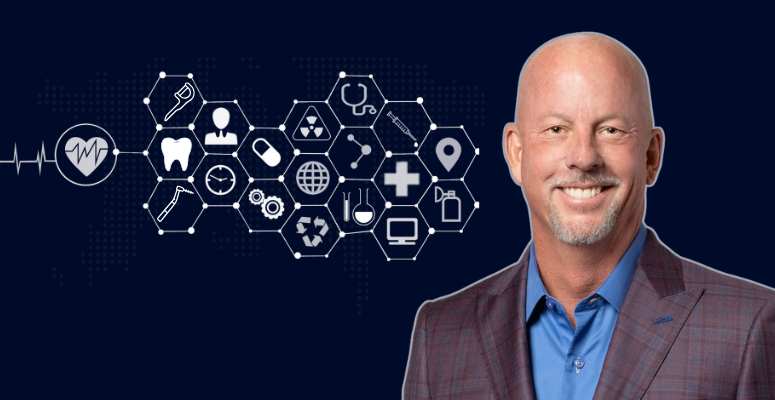
At the recent Dental VIP Summit in Chicago, Stephen E. Thorne IV, founder and CEO of PDS Health, formerly known as Pacific Dental Services, delivered a candid and forward-looking perspective on where dentistry is headed. This Fireside Chat: Convergence of Care: Medical & Dental Integration was hosted by Dr. Jeremy Krell, Managing Partner of Revere Partners.
“Medical – Dental integration is not a one-time product implementation, it is a core operating decision that DSOs will face. DSOs should seek the optimal methodology within their unique models to do so accurately, easing user journeys, and driving profitability. Looking to Steve and PDS as a framework for one model is a useful data point to help drive change management.” – Dr. Jeremy Krell
Established in 1994 and headquartered in Henderson, Nevada, PDS Health has grown to support more than 1,100 practices across 24 states, evolving from a dental support organization (DSO) into a broader dental and medical platform.
Thorne has long been recognized as one of the industry’s most influential technology advocates and champions of medical dental integration. In Chicago, his message was unmistakable. The future of dentistry will not be defined by drilling and filling. It will be driven by data, diagnostics, and meaningful convergence with medicine.
“No serious clinician disputes the mouth-body connection anymore,” Thorne said. “And the root of a lot of that is saliva.”
Why Saliva Is Becoming Standard of Care
Thorne believes saliva testing will soon be standard operating procedure in dentistry. Not a decade from now, but within the next few years.
“We swallow about a liter of saliva every single day,” he explained. “That saliva is filled with all sorts of stuff, good stuff and bad stuff.”
Over the past year alone, the number of companies attempting to bring point-of-care salivary diagnostics to market has nearly doubled. For Thorne, this proliferation signals more than innovation. It signals inevitability.
From pH levels and periodontal disease markers to A1C measurements and even cancer indicators, saliva is emerging as a non-invasive gateway to broader health intelligence.
What matters most, however, is not just the science. It is activation.
“Patients need a number,” Thorne emphasized. “They get a score and suddenly they realize they’re not as healthy as they thought. They activate in care.”
He likened the impact of modern salivary diagnostics to the introduction of intraoral cameras decades ago.
“In 36 years, it is the best thing I’ve ever seen operationally to activate patients into care.”
From Reactive to Predictive
Thorne challenged dentistry’s long-standing reactive model. For generations, clinicians have identified disease and repaired damage. That model will not disappear, but it must evolve.
“This whole concept that we look into a patient’s mouth, see destruction, and then fix it — it has to change,” he said. “There will always be a place for it. But we have to get in front of it.”
He framed the shift in three stages: reactive, preventive, and predictive.
Preventive care has long been dentistry’s goal. Predictive care, however, is the next frontier. Longitudinal data tracking — whether bone levels, bacterial markers, or systemic indicators — can identify deterioration before symptoms surface.
“If you tell a patient that two years ago they had 60% bone and now they’re at 40%, that changes the conversation,” Thorne noted.
Epic, Interoperability and Breaking Down Silos
Technology is central to this transformation. Thorne made it clear that true integration requires robust electronic health record interoperability.
Through the power of Epic’s data ecosystem, clinicians at PDS Health can view a patient’s comprehensive medical history, medication lists, lab values, and hospital encounters in real time.
“I believe the clinician and the patient should be looking at the same information at the same time,” Thorne said. “When they relate the mouth to overall health, it’s super powerful.”
The integration extends beyond visibility. PDS Health has embedded nurse practitioners and physicians into its model, creating two-way referral pathways.
“When a physician tells a patient to go see the dentist, something special happens. They show up at a much higher rate. They activate in care.”
This convergence is particularly impactful in areas like diabetes management and maternal health. Internal data analyses across thousands of diabetic patients revealed measurable reductions in emergency room and hospital visits among those receiving periodontal therapy.
“We are saving employers millions of dollars,” Thorne said. “And we’re not fairly compensated for it.”
The Insurance Model Must Evolve
That comment sparked one of the session’s most pointed moments.
“Insurance plans haven’t changed in 40 years,” Thorne said. “Why do we still have a $1,500 max and a $50 deductible? It’s nuts.”
He argued that dentistry’s value in reducing total healthcare costs must be reflected in reimbursement structures. The data now exists to prove that oral health interventions lower systemic healthcare expenditures.
Until compensation aligns with outcomes, dentistry will remain undervalued within the broader healthcare economy.
Convergence Is Already Happening
Despite systemic challenges, Thorne is optimistic. Orthopedic surgeons increasingly require dental clearance prior to surgery. Gynecologists are referring patients earlier in pregnancy. Cardiologists are paying attention to inflammatory markers tied to periodontal disease.
“We’re a siloed healthcare country,” he acknowledged. “But it is starting to converge.”
With 85% of the PDS Health workforce female and 65% of practice owners female, Thorne also highlighted the role DSOs play in supporting modern career pathways, particularly for women balancing professional and family responsibilities.
“DSOs are incredible for female dentists,” he said. “We can support their practice and their life.”
The AI and Technology Wave
Looking ahead, Thorne expressed enthusiasm for artificial intelligence, robotics, and diagnostic advancements emerging globally.
“It is crazy what’s happening right now,” he said, referencing innovations across Europe and the U.S. “What an amazing opportunity.”
He believes dentistry is no longer on the sidelines of healthcare. It is entering primary care relevance.
“Patients want providers. They want oral health. They want to come in and take care of their mouth. It’s such an incredible time to be in primary care.”
An Industry at an Inflection Point
From salivary diagnostics to predictive analytics, from EHR interoperability to systemic healthcare savings, dentistry stands at an inflection point.
The tools now exist to shift from episodic repair to proactive health management. The challenge is cultural as much as technological. Clinicians must embrace engagement. Organizations must embrace interoperability. Payers must embrace outcome-based models.
If Thorne’s perspective is correct, the next decade will redefine the profession.
“We have to converge. We have to break down those silos,” he concluded. “It is such an exciting time.”
For DSOs, technology leaders, and clinicians alike, the message from Chicago was unmistakable: oral health is no longer separate from overall health. The industry’s future belongs to those ready to lead that convergence.