
Ranked the #1 DSO Podcast!
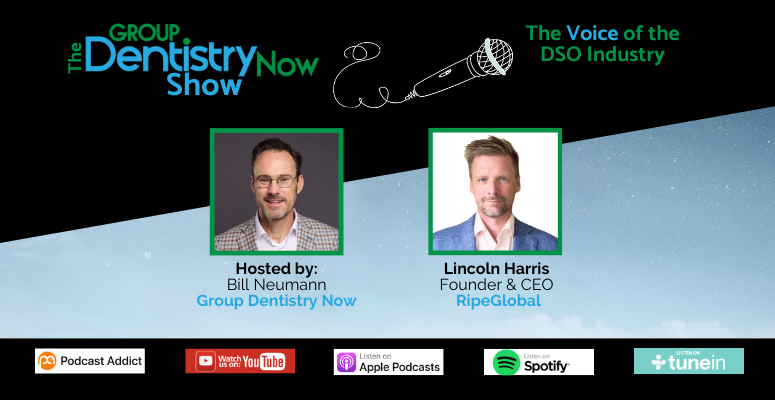
Welcome to The Group Dentistry Now Show: The Voice of the DSO Industry!
From Remote Australian Dentist to DSO Education Revolutionary: How Aviation Training Principles Are Transforming Dental Education
Dr. Lincoln Harris, Founder and CEO of Ripe Global, shares his remarkable journey from practicing in remote Australia to revolutionizing dental education for DSOs across America. He discusses:
- Aviation principles & simulation technology
- Performance-based learning
- Measuring educational success & EBITDA growth
To learn more visit https://www.ripeglobal.com/
You can also reach out to Dr. Roshan Parikh at roshan.parikh@ripeglobal.com , Dr. Lincoln Harris at lincoln.harris@ripeglobal.com or Kim Toovey at kim.toovey@ripeglobal.com
Don’t miss part two of this conversation featuring chief clinical officers sharing their real-world training results.
Subscribe to our channel for more episodes and stay updated on the latest DSO news, insights, and events!
If you like our podcast, please give us a ⭐⭐⭐⭐⭐ review on iTunes https://apple.co/2Nejsfa and a Thumbs Up on YouTube.
Choose your favorite listening app below and subscribe today so you don’t miss an episode! Full transcript is also provided below. See all of our podcasts HERE.
 |
 |
 |
 |
 |
 |
DSO Podcast Transcript – From Remote Australian Dentist to DSO Education Revolutionary: How Aviation Training Principles Are Transforming Dental Education
Welcome to the Group Dentistry. Now show the voice of the DSO industry. Join us as we talk with industry leaders about their challenges, successes, and the future of group dentistry. With over 200 episodes and listeners in over 100 countries, we’re proud to be ranked the number 1D SO podcast for the latest DSO news analysis and events. And to subscribe to our DSO weekly e-newsletter, visit group dentistry now.com. We hope you enjoy today’s show.
Bill Neumann (00:38):
Welcome everyone to the Group Dentistry Now show. I am Bill Neumann and as always, we appreciate you joining us today. Like I say, I always get excited when we have any guest on, but a new guest in particular. And I believe I met Dr. Lincoln Harris a year ago at the Chicago Midwinter meeting. I dunno if he remembers that or not, but it’s been a year and it’s been a big year for Ripe Global, the company that he founded and is the CEO of. So we’re going to talk about what Ripe does and get a download of Dr. Harris’s background. Interesting. He’s Australian. He is a practicing clinician and he’s got a company that is really doing quite a bit of work in the US right now with DSOs and I think you’re going to continue to hear a lot more about him and his organization. He’s got assembled a really cool team of people, so it’s clinical education, but I feel like it’s so much more than that. You’ve almost turned education on its head and do it in a much different way and provide a lot of statistics and things that DSOs like. They love to measure things and it’s been really impactful for not just the clinicians but also the groups that the clinicians support. So without further ado, welcome Dr. Lincoln Harris, it’s great to have you on.
Dr. Lincoln Harris (02:11):
Bill. Thank you so much for having me here today. Yes, I think it was Chicago Midwinter. I wouldn’t have had a warm enough coat. One of the things that happens when you move from a tropical area to Colorado is that you spend about a year buying warm clothes. So I am now well versed in the difference between Hurler and Canada Goose, and these are some of the aspects that you just don’t really think about when you read domicile a company.
Bill Neumann (02:38):
Yeah, that’s for sure. So you’re in Colorado now. That’s a relatively big change, beautiful state, but probably a little bit different than what you’re used to. So how about a little bit about your background, like I mentioned clinician not from the US now in the us So talk a little bit about this, your background and this evolution and founding of Ripe Global.
Dr. Lincoln Harris (03:04):
So the remoteness of the place that I lived is quite crucial to the story because I lived in a town of about three and a half to 4,000 people when I first moved there. And it was in a rural area surrounded by sugar cane fields. Coral Reef started just off the coast where we lived and there were no dental specialists. And so I started this practice very arrogantly in my just out of school with the idea that patients in my little town could get dentistry as good as anywhere in the world, but there were no specialists. And so over time I started flying to the United States and to Europe almost continuously. So there was one year where I flew to the United States eight, I think eight times in economy back and before I could afford business class. And it was to learn prosthodontics and orthodontics and periodontics because I had seen all of these procedures online, but my customers, my patients couldn’t get them.
(04:12):
I would refer them four hours drive to the nearest specialist and either they didn’t want to go or sometimes the specialist couldn’t achieve the quality level that I was seeing online. So that’s where this thirst to learn multiple disciplines. And it really started with Dental Town. I was coming and learning PS in Florida with Howard Chalin. I was learning orthodontics in several places and implantology with Jerome Smith actually originally in Louisiana plus some trips to Europe. So that was kind of the basis clinically. And so I became multidisciplinary because my patients had no other choice. Then my colleagues also, I had a large social media feed. So then my colleagues started asking me, where did you learn all of these things? And so for a while I would just give them a list of 20 or 30 courses that I’d been to and then I thought, no, I’ll teach them. So that was really the start of clinical teaching in 2013 teaching. I ran conferences at ski resorts and stuff before that. That was like from 2006 to 2010, I ran ski resort conferences at Whistler and Vail and then Tuscany.
(05:36):
But the clinical education started 2013 just for people asking me on social media, how do you learn these things? And then we had our first big, I guess evolution or innovation and that was about 2016. I was teaching people these advanced procedures and then they would send me pictures of their complications. I was going, why are dentists getting so many things wrong when I teach them? And so then I was a pilot before I was a dentist and I was thinking about how we train pilots and then how we train dentists. And I thought if we train pilots the way we train dentists, they’d all be dead. Go to lectures, watch one landing of a plane by an expert and then you hop in and you do one really slowly try and fly a plane slowly you’ll die. So that’s when I moved to making more aviation style training, 2020 COVID shut everything down. I thought, okay, let’s go really into this aviation thing. We invented simulation training, it started to grow. Next thing you’ve got software and hardware engineering teams and you’re raising capital and then you’re in America. So that’s kind of the journey from dentist in Australia to I guess entrepreneur in the United States.
(07:00):
So I’ve been here just over one year now. So that’s like a little the background story. And to some extent, once I moved here I thought, wow, why did I take so long? It’s pretty difficult building technology platforms. And so fundamentally we aren’t even a training company. We do training for DSOs, but we are a platform. We’ve built this simulation hardware and software technology platform and we’ve built it currently for one customer, which is us, to train people. Over time that will change of course, but right now that’s the journey from Australia to here.
Bill Neumann (07:48):
And so Ripe Global was founded really because I mean you were a super gp, right? Because you needed to be a super GP because you didn’t have any specialist in your area. So you went and you learned on your own, you couldn’t get the education where you were because you were remote. You couldn’t find the specialist where you were because you’re remote. So you went to the us, you flew an economy, not fun, it’s a long flight. And so you got the education, brought it back, and then thought, gosh, we can do this through it via a platform leveraging technology. And you also bring in this really interesting experience as a pilot. And when you talk about how pilots are educated, you’re talking a lot about flight simulation where there’s this repetition and they can get the experience in the air, but then they can also, they have these flight simulators where you can learn a just like you’re in the air, but virtually. So talk a little bit about that connection with a flight simulator and how you kind of brought that over to dentistry with ripe global.
Dr. Lincoln Harris (09:06):
Yeah, so there’s three parts to the aviation story. There is the simulation, but with pilots, they’re trained flying. So they do simulation and then they do flying, but they do a lot of it. And so what’s happened in dentistry is that a lot of education is very theoretical, it’s very didactic. It’s didactic heavy. And even hands-on courses are largely didactic. So when I was doing my first flying lessons, the very first flying lesson, we had no theory or didactics at all. We just hopped in the plane and we went up and then he said, here, have the controls fly for a bit. It’s basically step one is do you even like this thing If you don’t, maybe you don’t spend $30,000 getting your license.
(10:03):
So I guess the first big thing that we brought in was that experience and repetitions really matter. When you are training largely in dentistry, what’s happened is that experience and repetitions have just disappeared. And to some extent the blame for this, the foot of what we call evidence-based dentistry, where there was such a heavy shift away from experience and skill towards knowledge via scientific papers. And that was useful, but it kind of overwhelmed everything. So that experience and skill no longer matter. And so you go to a dental school and you do very few patients, you do very few repetitions on the sim lab. You go to a hands-on course for a day and half the day is a lecture and half the day is them doing a demonstration and then you doing one tooth very slowly. So the first big part of the aviation story is that if you are going to teach a procedure, you have to do heavy repetitions and you have to do them fast repetitively with a feedback cycle and kind of to some extent under stress.
(11:23):
So doing a really relaxed thing over three hours is no good. And so that relates to the second part of aviation, which is they study things called human factors and ergonomics. Human factors is how human factors and ergonomics is how the human responds to stress and how you build the environment or the training so that under stress people can still do things under stress. People’s capability drops by 85%. So that’s why you go to a course and you do after a surgical procedure on a pig’s jaw or something nice and slowly and relax and you have a buffet lunch and you have afternoon tea, you pat your friends on the shoulders and you go out for drinks at night and you have a hangover for day two. These are great. The problem is then you take that procedure back to the patient and your first patient says, I hate you, I hate dentists.
(12:15):
You’re charged too much. You were a ripoff. And then they start gagging and they’ve got a fat cheek and they won’t go numb. And so now under the stress of this procedure and you’re running late and the dental assistant is angry with you today. And so now under all of these layers of stress, you can’t actually do the procedure. And that’s why about 85% of people who go to a course that the DSOs pay for never implement anything. And then the third part of course is the simulation bit, which is if you are going to train someone, you want the environment you train them in to be as close as possible to their actual working environment. So if you are flying a 7, 3 7, the simulator looks like a 7, 3 7. If you are training someone to do a full mouth rehabilitation in their clinic, the training shouldn’t look like a hotel desk with a typo don floating in their hand and a handpiece with no water spray because it’s too messy to have in a hotel and you’re going to do one too. So that’s I guess the three parts that we’ve brought together.
(13:28):
And so the simulation, that’s why we want to train people in their dental office, their dental operatory so that visually it looks the same. The handpiece is the same, the burrs are the same, the materials are the same. Maybe they have the dental assistant, maybe they don’t, but everything about the training of that procedure is as close to their normal life as possible. And that’s step one of simulation and step two of simulation is we don’t have morning tea, afternoon tea and a buffet because it’s in your operatory. So it’s like a normal working day. Now, sure, it’s less fun than having a party and getting a hangover, but it means that your training is very, very similar to treating a patient. And so then the transfer of the skill from the training to the patient is much easier. And we can see that in the statistics.
(14:21):
Typically 15% of people implement what they learn at the course. And for our courses we are getting upwards of 60%, so four times higher. And so just on an economic basis, you have a method that is four times more effective. The dentists learn in twice as fast, so it’s twice as fast, it’s four times more effective, and it’s one quarter of the cost. That’s because one, we’re not having to pay for the building, it’s the office pays for the building. And then secondly, there’s just less travel cost, less travel cost, less time off. All of these things, it’s 75% roughly of most courses. It’s not the tuition, it’s everything else, it’s the flights, the accommodation, the loss of production and collections and the travel and so on. So that is what we put together. So it’s the method, it’s the simulation kits, it’s the software and the fact that we’re working them in an environment. And then of course there’s many benefits for particularly a group.
(15:40):
One of the most important is that if you have, let’s say you have all your materials or soul benum, and then you go to a course that’s sponsored by GC or vice versa, and it’s a resin course on resin artistry, and then the dentist comes home and they go, yeah, I went to this great course, but I now need an entire new range of resins. Now anyone who owns an office know that’s impossible. First of all, you have to throw everything else out. Secondly, the new dentist probably won’t implement anyway. Or if it’s implants, it’s even worse. They’ve gone to an implant course and it’s with no bowel and they come home and you’ve got Straumann or vice versa. So they’re learning with what they have, and we almost never recommend changing equipment or material unless it really is such an inferior product that we just don’t think they can achieve any sort of result. So if you add costs like that in it, it’s actually even more cost effective, but probably more important than the reduction in cost is do you get results? And clearly on every measure, we’re just getting extraordinary results.
Bill Neumann (16:54):
Got a couple of questions around this. One point I’ll make is I think from a perspective beyond the clinician, your procurement directors and clinical directors be very happy to hear that, right? That they’re not necessarily going out and being trained on different material that may or may not be on the formulary, and now they’re asking to use something. So then that has to be negotiated. So they’re working with something that’s they’re used to working with, number one that they’re comfortable with. Number two, it’s probably part of something that a larger group has already negotiated the best price for. So there’s that comfort level I think that the business side of the group could be very happy with at a question, since you’re talking to a lot of these groups, what do you find right now? How are most clinicians at groups getting their education? Is it here’s a stipend, go out and just make sure that you’ve got all the CE credits that you need? Or what do you find right now?
Dr. Lincoln Harris (18:02):
I can’t speak for every group. I mean, we do work with a lot. Most of them have a budget per dentist that the dentist can spend on things. So now the bigger ones, so obviously you’ve got your PDS got Heartland, you’ve got Aspen. So these very large groups often have quite large training facilities, but even then they still suffer from scale. There has never been a time in history until quite recently where you’ve had a single group that employs one, two or 3000 dentists, and it’s just very difficult to scale real estate based training at the same speed that you could scale acquisitions. What you have to do is you have to build something massive. So the really big ones have their own training facilities.
(19:02):
Even those groups are almost, well all of them are talking to us. And then the very small groups, they can’t afford to build their own training programs. So they often just use a combination of free things from manufacturers. So they get composite, composite manufacturer gives them a free course, the implant company gives them a free course, and then a lot of them have a stipend or a budget. It’s like 1000 or $2,000 per year to spend on things. The problem with this, there’s several problems that have to be tackled here. The first one is that education in a group is almost more of a change management problem than a education problem and change management theory, best practice, whatever you want to call it. But best practice in change management is never that. You try and do a little bit to everyone when you try and do a little bit of training or a little bit of service, whatever, when you try and do a small amount across a large group of people, you have no impact to get the best results with any new program or any program, you need internal advocates.
(20:39):
And that means you first start with the most enthusiastic bunch of people. You get a small group of people who are super enthusiastic and you put a lot of resources, you combine all of the resources and you put that on that small group. Now, there’s two reasons this is important. If you do a little bit of training across a whole group, you get one, you just need one person to say, this is awful. And then they will go around being a terrorist in your organization and basically undermine whatever it is you are doing. And we’ve learned this the hard way. We’ve run programs across whole groups. The groups had come in and teach all of our dentists this thing, and we taught all of them the thing. And there’s this one dentist who says, this is a terrible idea, I hate it. And then they spend their next two weeks going around telling everyone that they hate the course and the whole course just collapses.
(21:36):
So that’s what happens if you try and teach everyone a little bit. What we’ve found better is you get, you say, Hey, we’ve got this program and then it’s limited in space. So now you’ve immediately created fear of missing out. So now there’s a incentive. And when we work with groups, we spend a lot of time on incentives. How do we get everyone’s incentive aligned, fear of missing out? You focus on a narrower group and then you put a lot of resources into that first group of dentists and then they do extremely well. And now everyone around wants to be like them. So now you don’t have to sell this idea to everyone else in the organization. You have this example and you have a group of advocates, and then you let other people self-select in and slowly it spreads out. Now interestingly, you get faster change across the entire organization if you go like this, then if you try and force everyone to do everything all at once, so we’ve learned this huge amount about change and we constantly refine the change management process of rolling out education.
(22:54):
And that would be my single biggest piece of advice for any chief clinical officer or chief medical officer is a little bit to everyone will give you no result, whereas a lot to a few people will give you a big result. Now we get very interesting statistics and data from all of our groups, and one of the things that has become incredibly apparent is that, and this is often driven by the private equity companies, they’re often looking at the 500 dentists or a thousand dentists and they go, wow, we make all of our money on the top 20% and the middle 50, 60% making a small profit and bottom 20, 30%, they actually lose us money. The temptation is to put all of your resources on the people who don’t perform. Quite commonly. One of the difficult parts with our pilot studies is it’s not uncommon for a pilot study for the DSO to say to us, Hey, here’s all of our dentists who don’t perform. Why don’t you look after them? And we say, no, that won’t work. You need to give us a broad selection of dentists so that we can show you what happens with different types. Because if you get an entire cohort of dentists who are unprofitable and unproductive, they are the ones that you get the lowest return on investment for. And what shocks everyone is that the dentists who you get by far the most massive and outsized returns, it’s already the ones who are already performing the best.
(24:48):
And it’s not to say you shouldn’t train everyone else, it’s just saying that the people who are really performing well, I’ll give you an example. One dentist I was working with, he was a specialist doing implants. And when we started training him, he was doing $1,500 per hour and within two months he’d gone to three and half thousand dollars per hour. So he was single handedly generated more return than the next, I don’t know, 15 dentists in a row. But if I had presented that data to anyone beforehand, they would’ve said, no, don’t spend any money on him. He’s already a high performer, spent it all of Lopez. So they’re probably the biggest tips for DSOs. Concentrate your budget onto high performing people and then as everyone sees them and wants to be more like them than get people to select in, make sure it always seems a bit limited. So you’ve got fear of missing out. If everyone gets it, it’s not special. Make sure that every program is special. You can always make it special for more people over time. And your biggest returns come with investing in the top 80% of the dentist, not the bottom 20%.
Bill Neumann (26:07):
You have a program called Dental Associate Power Up. So this is a methodology that you use. Can you talk a little bit about that methodology and why it works so well and why I think it’s important to groups?
Dr. Lincoln Harris (26:25):
I have to thank Matt Ornstein if you know him for this one. I
Bill Neumann (26:28):
Sure do.
Dr. Lincoln Harris (26:31):
Matt. I called Matt a year ago, I can’t even remember why I called him. I said, Matt and Matt, Matt is good. He gives you advice that you need, not always that you want. So I called Matt and I go, Hey Matt, I’ve got this program. I think it’s amazing. Would you like to work with my company, invest or something like this? Okay, so he goes, tell me about your program. And I said, well, we’re generating this quite large return on investment. And he says, link A DSO doesn’t care about return on investment. They care about does it increase their ebitda. And so he says, remember, we’ve got to give 30 something percent to the dentist. We’ve got to get so much to the overheads and so on. So to pay for the cost of a course, you can’t just earn back the cost of the course in gross revenue.
(27:30):
You need to earn back many times the cost of the course so that after the dentists, the overheads and what’s left, the EBITDA itself has grown enough to pay for the course anyway, so we went away and worked on that program. And then we also worked with Dr. Fila Ani at Coliseum, and that’s where DAPA was born. And it’s designed to work with the vast majority of dentists in A DSO, not all of them, but the vast majority, and to generate rapid improvement in skill, patient treatment, patient quality and profitability. And it’s designed for large groups that have A CFO whose attention span is one quarter for all the CFOs listening, I apologize, but it’s true.
(28:28):
And so what it is we looked at what things have we done that give the most rapid uplift or improvement in dentist collections, productivity and just general wellbeing. And we have discovered that if you don’t know how to communicate and you dunno how to sell dentistry, you can’t actually learn it because for you to become good at something, you have to be able to do repetition. So daer is designed to be, we teach people to communicate with the patient and to treatment plan properly. We teach them to do crown preps on back teeth at very incredible efficiency, and we teach them to do anterior cosmetics and anterior ceramics. And we did that because the single biggest low hanging fruit in a general dental DSO is that they do too many four and five surface fillings. So if you look at all of your procedure mix and you go, how many fillings are four and five surface?
(29:37):
And you go, wow, that’s a really big number. And so one of the groups we were working, the chief clinical officer said to me, Hey, this DSO of 400 something dentists does 30 1004 and five surface fillings. Now a four and a five surface filling should be either an onlay or a crown. It should be a ceramic thing. So they said, look, if you could get the dentist to even increase the number of ceramic units by 10%, it would have a huge impact taking all of these things from things that cost 150 or $200 to things that cost a thousand dollars, that take not much more time. And so that’s where the Dapper Dental Associate Power Program came from. It is focused on the most common procedures, the vast bulk of the general dentist in A DSO, and it’s designed to get results so fast that we can demonstrate our effectiveness basically within one quarter.
(30:45):
Now, we offer many other types of courses for DSOs, but what we find is that once we’ve proven that we can generate actual outcomes, they’re much more open to working with us on other things. So we also mentor the dentist for four months with that program. So we do two days at the start. Now the two days is in person and we start in person because move people into an online platform, we’ve discovered you need to connect with them first. We also have discovered there’s no point teaching someone a procedure if they can never get a patient to do it, because then they lose their skills. So you have to teach them the procedure, but you also have to teach them how to sell the treatment plans and how to treatment plan and how to be confident and so on. Otherwise they never do enough repetitions to get any good and it just disappears. And that’s why, among other things, most people who go to courses don’t do anything.
(31:52):
And so we found that therefore now the results we’ve got from that are pretty astonishing. So we trial, the first DSO, we trialed this with the dentists, were up like 20 something, 21 or 22% over four months. That meant that the DSOs payback time on the course was about, I think 80 days, took 80 days for them to get enough increased revenue so that their EBITDA was up enough to get the money back. That particular group is running nearly 18 or 19 times return on investment. Statistically, if you’re running at about, say, 18% ebitda, they’re going to get about $3.90 back for every dollar they spend with us. The more recent group, there’s a more recent group in the United States. The dentists have lifted $155 an hour on average across a cohort of nearly 20, and that’s in four months. And we’d actually guaranteed the result. We said, your dentist will lift on average $100 per hour, or we will start giving refunds for the dentist that didn’t hit that target until the average is up to a hundred dollars an hour.
(33:32):
And that was a pretty big thing in the industry to guarantee a result. DSOs are largely used to send their dentist on a course and nothing happens. So the DAPA program, it’s guaranteed results where the results are actually quite astonishing. I think people should get pilots going soon because if the results keep going like this, we’ll need to charge a lot for more for it. We’re giving too much of the value back to the DSO. But yeah, if the most recent $155 an hour, it’s in southeast United States, they’re getting something like 17 and a half times ROI. If it continues like this for a year, it means that over the second group, over 12 months time period, they’re getting nearly $4 of EBITDA for each dollar. So I think that I would be pretty confident there’s almost no other service SaaS product program that is generating that level of return for each dollar spend.
Bill Neumann (34:49):
That’s pretty impressive for sure. So you’ve got dapper and lemme see if I can summarize this. You spend a little bit of time in person because that’s what works. You also help them with treatment planning and selling the treatment because to your point, if you know how to do something but you can’t convince patients that it’s something that they need, then it doesn’t really matter and that you feel, and that makes a lot of sense, that needs to be done in person. So you move from in-person to virtual. And can we talk a little bit about the simulation kit that you have? So then we get into this when we say virtual, it’s in their office where they’re comfortable with their, and you’re training them through the right global platform and they have this Kitt in the operatory. Is that correct?
Dr. Lincoln Harris (35:49):
Yes. So normally you take people to a hotel or a sim lab, and we want people to be learning in their office because it’s more realistic. So after the two days of treatment, planning, communication, sales techniques, all of that stuff, then the next day that we train them for DAPA is a hands-on day. We ship a mannequin to the operatory to their office, they attach it to their chair. So they’re practicing in their own environment. And that first hands-on is crown preps. It is just crown preps all day. I mean, there is didactics they need to read beforehand, but that day they will do 17 to 20 crown preps in a day, and we never give them more than 10 minutes. And the way it works is we go, okay, do a crown prep. You’ve got 10 minutes. And what we’re trying to do is break the perfectionism and the overthinking that is taught at dental school.
(36:53):
And the only way to break that is kind of like Marine Corps bootcamp. You’ve just got to strip that rifle down and put it back together a hundred times until you can do it in your sleep. So we actually call it a bootcamp, and it’s pretty much a bootcamp. You just sit there and you drill teeth all day. But what happens is that by the end of the day, the dentist can do a prep in seven or eight minutes and it’s really good, not awful. And that just gives them so much more confidence in themselves and also teaches them endurance because if you sit there and prep for eight hours and you stop for maybe 20 minutes, your ability to withstand long appointments goes up. So there’s just so many things that you can do with this method that you just can’t do in a hotel or a SIM app.
(37:39):
So we ship the mannequin, they put it on their chair, they do it with your own equipment. That’s why they’re not asking for new equipment, new materials because they’re using the stuff they have. And then we check in monthly with them. We remove roblox, we find out if they have problems. We will often call all of the dentists for the DSO. And what we also provide essentially is DSO intelligence. So we will feed spreadsheets back to the management with all of the information we’ve gathered. And it can be things like my office manager is not very good at booking my patients in, so on. So we are doing that as well. And then we come back for hands-on number two, which is usually about two months later, mannequin goes on the chair. And then the next one is cosmetic design of front teeth, interior or front teeth crown preps and making temporaries.
(38:36):
And so we find that crown preps on back and front teeth and cosmetics and learning to communicate and then checking in with people every month for four months, helping them remove any of the roadblocks in their clinics by feeding the information back to management. It’s all of those things combined that deliver this incredible result. And sometimes the chief officers don’t know, so they might not know that in one region that when a dental assistant resigns, they’re not getting replaced for several days. And so you have dentists with no dental assistant. And so sometimes those things don’t find their way up through normal channels, but we will discover that because we talk right to the dentist. So that’s really the combination. It’s not a simple thing. It’s the combination of communication, crown prep training on back and front teeth, the monthly check-ins and the feeding the intelligence that we’d gather back to the C-suite so that they can discover their own roadblocks if they haven’t already. And that program is continually refined because we learn more every single time, and we’re constantly tweaking it to how do we get more results?
Bill Neumann (39:55):
The groups implemented ripe global. You’re measuring the progress of the clinicians, but you’ve got different skill sets, right? You have younger clinicians, you’ve got more seasoned clinicians. Are there different pathways? I’ve been researching your website, you’ve got fellowships, so you can go in a lot of different directions. So you’ve covering some of the basics at the beginning, and then from there, there’s this opportunity to go in different directions based on what you want to learn or maybe what the practice or the group needs. So can you talk a little bit about that?
Dr. Lincoln Harris (40:42):
Yeah. So you get this tricky problem with courses where if you don’t make enough money, you can’t afford the course, but you can’t afford the course because you don’t make enough money. And so what dapper does is it fixes that problem because making enough money, once we’re done with them, both the DSO is making more money. So now they’re more confident to invest in their dentists, and their dentists themselves are making more money. So they’re also more confident because they’ve seen what they’re going, wow, I just did this course and my income’s grown this much. So maybe if I do more, it will grow more. So the advanced programs we have, sometimes the DSOs pay for them, sometimes the dentists pay for them, but universally, after the DPA or the productivity program, dentists end up doing more. So we have a fellowship in restorative dentistry. It takes you through back teeth, front teeth veneers, and full mouth rehab. So it runs for two years. It is backed with also a diploma, a diploma in cosmetic and complex dentistry.
(41:57):
We have a fellowship in aligner orthodontics, which is how to treat complex cases with aligners. So it’s not like a simple two day course. It’s a one year course that is how to treat complex cases with aligners, temporary anchorage devices, maxillary expanders like ies. And then we have a fellowship in Implantology where we do all of the didactic and hand skill training through our platform with our mannequins and our simulation system. And then we move to move to taking them somewhere for live patient training, because you can’t learn to do implants. They’re not within your scope of practice when you graduate. So at some point you need someone to mentor you through the live patient training with the implants. Very interestingly, we’ve developed a super cool program in the uk, and we’ll roll that out here soon where we’ve partnered with the implant manufacturer and we’ve built a thing called sponsored education or performance-based sponsorship and performance-based sponsorship.
(43:15):
Is that the way that one works? The DSO lends the dentist the money for the implant course, but they don’t give it to them. If you just give dentists things, they often don’t perform because they have no skin in the game, they have no motivation. So we strongly encourage where possible for DSOs to have some sort of performance clause in all of their training programs. So with the implant one, we train the dentist with our program. We put them through hand skills training. We put them through live patient training. We have the implant company that we work with, which is a super progressive. They spend a lot of time with the dentist to make sure the room is set up, everything is right. They’ve got all of the equipment, they will even lend the DSO some equipment to help get them moving. And then once that’s running, the dentist has six months to place 20 implants, and if they place 20 implants in the first six months, then the DSO pays for half of the course and the implant company pays for the other half.
(44:19):
So the dentist gets the course for free if the dentist doesn’t perform. So if they don’t do 20 implants in six months, then they just keep paying the course back to the DSO monthly. And the reason this is so important is that if you place less than 20 implants in your first year, you will largely never place any significant number in your career. So there’s kind of this barrier that if you don’t get over that, you’re not productive. So many of our programs we designed with the DSO where they have some type of performance clause like, Hey, here’s the money. You don’t have to pay back for three months. In three months time, you’ve got to start paying us back monthly unless you hit this average billing hour increase or this average collections increased target, in which case you don’t have to pay it back.
(45:07):
And that way the DSO is aligned. They kind of paid the check to us. The dentist is aligned, they get it free if they perform, but otherwise have to pay it back. And we’re aligned because we give guarantees on things. But yeah, we see a lot of dentists going into implants. Now what’s interesting is the rapid efficient treatment planning, which is that first two day course in person, one of the things it does is inspire dentists that they want to learn. And so a lot of the more experienced dentists who are not suitable to go into the smaller productivity power up program, they are able to, they just immediately self-select into implants or aligners. So that’s partly why we run that two day in person to, I call it lots of things. It’s like Tony Robbins for dentists or it’s like psychology for dentists, or it’s like sales for, but anyway, it’s designed to unlock the dentists from all their barriers and then get them excited to learn, excited to overcome their barriers for selling, communication, et cetera.
Bill Neumann (46:17):
Excellent. So as we start to wrap up this podcast and just to let everybody know that this is only, this is a part one here, so we’re going to have a continuation of this, and Dr. Harris, maybe you can give us a little bit of a preview for what episode two or part two has in store for the audience. And I think what I want to say is before you do that, we don’t want you to wait for episode two to reach out to Dr. Harris and his team to get a demo learn more. So maybe what’s the best way for somebody that has watched this podcast that’s interested in learning more or taking that next step? Is it to go to the right global website or to reach out to you, give them an idea, what’s the best next step?
Dr. Lincoln Harris (47:13):
Yeah, the best next step is to contact either Quentin Harrier or Roan Par or myself or Kim Tuy. All four of us are pretty responsive. You can find us all on LinkedIn or on the, you can go to the website itself. I’m happy for your podcast customers to send me a text message on my number, which is 7 2 0 6 0 1 1 8 9 1. You can send that out with the thing. Actually, maybe don’t put that in print because I’ll have every bot in the world on it then. But any of those people, which we’re at events all of the time where at almost every DICA run VIP event, we’re at VIP thing in Chicago next week, Chicago Midwinter eight or so, all of those places.
(48:09):
But there’s a couple of things I would say is the results we’re getting are quite astonishing and we guarantee the result. So there’s no risk. And so it’s just a matter of do you and I am quite confident that we’re outperforming nearly any other thing that you can do with an external vendor to increase your productivity. And then the second thing is that we’ve got quite a lot of demand. So we take on customers at a rate that we know that we can deliver a really good result. So if you decide to wait another year to see whether we’re still, you go, oh, a bit cautious or wait a bit longer, I think that you’ll go into the waiting list. That’s all we’re booked about three months ahead with DSOs right now. So it’s going, it’s growing like crazy.
Bill Neumann (49:10):
So we’ll make sure you gave a lot of contact info. We’ll put all that information in the show notes sans your cell phone number there maybe. But everything else, and there’s plenty of ways to reach out. It’s ripe global.com. So that’s the website. So that’s probably the first place you can go to. But we can drop the LinkedIn handles of all the contacts at your team. And you’re right, you’re out there, a lot of the different shows, so you’d be able to find you all as well. Don’t wait. What’s part two look like to this podcast?
Dr. Lincoln Harris (49:47):
So part two, we will have several chief clinical officers on here to discuss their experience, discuss their data. We couldn’t quite organize it for this time because some of them are traveling and some of them just they want to, before they get a lot of other people spending their money doing a program with us, they want to track the data for longer or they’ve got other things they’re busy with. So we will have several chief clinical officers on it, part two, and it’ll be more about what their experience is than us.
Bill Neumann (50:25):
Excellent. But don’t wait that. Reach out to Dr. Harris and his team and learn more about it. You don’t want to get on that waiting list. You want to make sure that you take advantage of this. Well, thanks so much. Really great conversation. You’re doing some really innovative things. I think one thing we didn’t touch on, and I’ll say this in the last 30 seconds, is clinicians that are part of groups and DSOs are looking for clinical support and education. And it’s also a great way to retain quality clinicians, offer them this education that they just don’t have access to. So I’ll leave it on that note, because it always seems to me that it’s one of the things that is missing as an offering with a lot of groups. And you don’t have to do it on your own. You can have a partner like Ripe Global really to offer that up. But thanks again, Lincoln, great to have you on, and you’ll be back on soon with some clinical leaders at different DSOs. And thanks everybody really for watching today. We appreciate you as always joining us. And until next time, this is the Group Dentistry Now Show.
Thank you for joining us today. Don’t forget to subscribe to the podcast to stay up to date on the latest DS o news, insights, and events. Also subscribe to our dsso Weekly e-newsletter at group dentistry now.com.