
Ranked the #1 DSO Podcast!
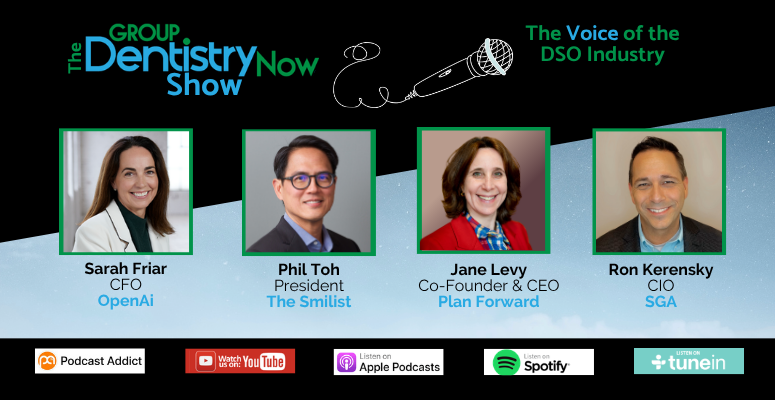
Welcome to The Group Dentistry Now Show: The Voice of the DSO Industry!
The Future of AI in Dentistry with OpenAI’s CFO, The Smilist’s President & SGA Dental Partners’ CIO
In the special episode Jane Levy, CEO of PlanForward, interviews Sarah Friar, CFO of OpenAI. Jane then speaks with Phil Toh, President of The Smilist & Ron Kerensky, CIO of SGA Dental Partners, to discuss:
- The rapid evolution of AI in healthcare & dentistry
- HIPAA compliance and data security
- Job roles evolving vs. disappearing
To learn more about PlanForward and their membership platform visit: https://www.planforward.io/ you can also email Jane Levy at jlevy@planforward.io
To learn more about The Smilist visit: https://thesmilist.com/ or connect with Phil Toh at phil@thesmilist.com
To find out more about SGA Dental Partners visit: https://sgadental.com/ or reach out to Ron Kerensky at rkerensky@sgadental.com
To stay up to date on OpenAI visit: https://openai.com/ or you can follow Sarah Friar on LinkedIn here: https://www.linkedin.com/in/sarah-friar/
Subscribe to our channel for more episodes and stay updated on the latest DSO news, insights, and events!
If you like our podcast, please give us a ⭐⭐⭐⭐⭐ review on iTunes https://apple.co/2Nejsfa and a Thumbs Up on YouTube.
Choose your favorite listening app below and subscribe today so you don’t miss an episode! Full transcript is also provided below. See all of our podcasts HERE.
 |
 |
 |
 |
 |
 |
The Future of AI in Dentistry with OpenAI’s CFO, The Smilist’s President & SGA Dental Partners’ CIO Transcript:
Speaker 1 (00:00:03):
Welcome to the Group Dentistry Now Show, the voice of the DSO industry. Join us as we talk with industry leaders about their challenges, successes, and the future of group dentistry. With over 200 episodes and listeners in over 100 countries, we’re proud to be ranked the number one DSO podcast. For the latest DSO news, analysis and events, and to subscribe to our DSO weekly e-newsletter, visit groupdentistrynow.com. We hope you enjoy today’s show.
Bill Neumann (00:00:38):
Welcome everyone to the Group Dentistry Now Show. I’m Bill Neumann, and as always, we appreciate you joining us today. It’s always great to have new guests on and returning guests, and we have a bunch on today. So I don’t know if this is the most we’ve ever had on, but it’s pretty much almost maxed out here. But a really great conversation I think we’re going to have regarding AI in healthcare in particular. And it’s just such a incredibly … It’s so topical right now, and I think it’s very confusing. And we’re going to talk to the DSO leaders about just the inundation I think we have when it comes to AI. It’s infiltrated everything. I think there’s a little bit of overload in the industry. So we’re going to get a really cool perspective here from Sarah Friar, who’s the CFO of OpenAI. So she’s going to give us, I think, a really interesting perspective that we don’t necessarily have.
(00:01:40):
We kind of look at it from the dental and the DSO perspective. Sarah’s going to give us, I think, a lot of really great … I know Phil and Rom and Jane, we were talking before Sarah jumped on and we were excited to just listen in to hear what you have to say. So we have with a Sarah Friar CFO of OpenAI. We have Jane Levy. She is the co-founder and CEO of Plan Forward returning to the show and also returning to the show is Phil Toh, president of The Smilist. And for the first time, we have Ron Korinsky, CIO of CGA Dental Partners. So welcome everyone. And with that, I am going to turn over the microphone to Jane. Jane and Sarah are going to have a conversation, and then I’ll be back on after that.
Jane Levy (00:02:33):
Thanks, Bill. That’s great. I just want to welcome Sarah. She’s someone who hardly needs much introduction, but she definitely has always impressed me. She brings this unbelievable deep financial expertise as well as operating leadership to the role of CFO. We watch you. You’ve got an incredible vantage point from where you sit and one of the clearest views into the market structure of AI and the future that your company’s actively shaping. So I wanted to start today with a general high level question. As we move from generative AI to agentex systems, how do you think the market structure’s going to change? And in the context of today’s discussion, obviously we have general models and they’ll have to specialize to incorporate the particularities of verticals like dental. Some of the concerns that have been raised is how does an organization ensure that any training that it does does necessarily benefit its competitors and that its data is siloed and protected, so it doesn’t violate something like HIPAA.
Sarah Friar (00:03:35):
Yeah. So Jane, first of all, thank you for having me on the podcast. Thanks everyone. Jane, I was delighted to get the call because it’s really fun for us to get to go deeper into a whole field like dentistry. So first of all, maybe just to set the scene and then I’ll go to your question specifically, but right now we are seeing massive uptick. I saw a survey that said 60% of survey dentists are already implementing AI in their practice. They’re using it for diagnostics, for treatment planning, but also for a lot of just the paperwork that happens in any business. What we see in our data is over 5% of all ChatGPT messages globally, and we see billions every day are about healthcare, about seven in 10 healthcare conversations. So 70% happen outside of normal clinic hours. And so this is very real. Customers and patients are having a moment.
(00:04:31):
They can use multimodal. Remember one of the amazing things about AI is you can turn on the camera and point it at a tooth or point it at anything that’s going on and ask for some help. Say, “What should I do? What question should I be asking of my dentist?” And that is very, very real. To meet that moment, OpenAI launched OpenAI for healthcare broadly speaking, and this was really to help clinicians support HIPAA compliance. So today, for example, in the hospital system, we work with customers like AdventHealth. We work with Caesars Sinai Medical Center, HCA, one of the largest hospital systems in the country, Stanford Medicine for Children’s Health, the University of California. I could keep going. So the answer is many, many large healthcare institutions are already trusting us because we’re stepping up to things like HIPAA compliance. So it’s an essential tool.
(00:05:21):
Dentistry is a high impact use case, and we’re here to help improve what a dentist’s life is like, not to replace it. So let me go specifically to your question. So you’re asking about, I think the shift we are seeing, which is we started in 2022, ChatGPT kind of burst on the scene. This is the beginning of generative AI, and it was really call and response system one type thinking. At the end of 24, we had another massive breakthrough in what we called reasoning. And that actually started to help with some of the things we’d seen like hallucinations and so on. So reasoning shifted models into system two type thinking. So they can think for a lot longer. And with that ability to do a long horizon task, because in tech we couldn’t go far without a three-letter acronym. So a long horizon task in this case, you actually started this dawn of agents.
(00:06:15):
So you could actually give the AI a job to go do. And just like the way you would give it to an assistant or to a personal helper, it would go off and take time and it would do that task. So 25, we said this is the dawn of agents. The first agent we have seen a ton of traction with is encoding, probably because coders are just naturally very tech forward. And so that has taken off like wildfire. And in fact, our product Codex just hit about three million users just in the first three months of this year. And even I who haven’t coded for about 30 years, because as my kids like to point out, I’m a dinosaur, I’m back to using a coding type tool, but I’m using it for day-to-day tasks. And so when it comes to your question, first of all, that’s where the world is going towards.
(00:07:05):
So I think dentists, just like most other jobs in the environment are going to shift from something that just answers questions to something that will actually get real work done. And so in a dental practice, that might be things like patient admin. So as you all know, when you don’t do that perfect follow-up, something falls through the cracks, it means that the patient doesn’t get the information they need. They might not get the right follow-up care. It also can mean you’re reminding them so you have fewer no-shows. Your time is money. And we know, for example, that AI reminders are already reducing missed appointments by 30%. So it’s kind of like adding to the staff that might’ve made those outbound calls. Second side that we’re seeing agents get deeply involved is going off in over a longer period of time, reviewing an X-ray, reviewing the treatment plan, and coming back and giving you, the dentist, high confidence in moving to faster treatment, both more confidence overall.
(00:08:06):
And what we’ve seen are proof points like diagnostic accuracy going up by 20%. And for me, what I get excited about is just in the end, it brings you all back to the job that you spent all those years training on, the thing you love. And probably the other piece is seeing patients get better. My brother’s a doctor who always talks about that moment where the patient actually gets better, and it gets you away from a lot of the admin and so on that probably takes a lot of your time and your money in running your business. And so that shift to agentic workflows is vital.
Jane Levy (00:08:43):
That makes a lot of sense. And so you’re definitely seeing uptake of codex, et cetera, which is great to hear. I think we’re still at the very beginning stages, obviously, and we’re still trying to figure out how agents will be used and how they’ll change workflows in the practice. And so where would you frame this? Are we even in the first innings in terms of what this technology can do?
Sarah Friar (00:09:11):
Yeah, so we are definitely just getting started and I realized you asked a question right at the end of your question too about data. So here’s how I think it evolves with all the caveats that it’s moving very, very fast. You’re going to have these large foundation frontier models like OpenAI, and there’s not going to be that many of them in the world. In fact, it’s a much broader conversation than just today as we think about dentistry, but it’s becoming almost geopolitical as well. So there’s China and then there’s US-driven labs. And why are there so few? It’s because the ingredients to make the model, it’s very big and very expensive. It takes massive amounts of compute, it takes large amounts of data, and it takes the best researchers in the world. And there are not tens of thousands of these people. They’re literally thousands.
(00:10:01):
So we’re all trying to make sure they want to come and work in our model and our model architecture. But on top of this, and I mentioned Codex, think of Codex as not just an agent for coding. Think of it as something that becomes, we call it the harness. So it effectively ties the model intelligence. So when we roll out a new model like 5.4 and we tell you how great it is to the agent itself. And so one agent might be coding, but another agent might be a dental CRM system. Another agent might be a call center agent. Another agent might be Excel for finance people. So all of these things, and they may be built specifics, but we are building agents that we’re rolling out to customers, but they also might be built by you yourself. And that’s the important thing about something like Codex is it’s turning us all into builders.
(00:10:56):
So think of that large ecosystem of agents sitting on top. So for a large dental group or a small dental office, I think it’s going to … The winning architecture in my mind is working with a strong foundational model, but then orchestrating on top. And this is where it’s very important that you feel in control of your data. So your EHR integration, your compliance, your permissions, all of the domain tuning, that’s still going to be very specialized. It’s not going to be a generic chatbot just dropped into a clinic. It’s going to get more and more specialized. And I think when data and privacy come into the picture, this is where you’re going to get a lot more control. You need to make sure that your data is your data. When we sell enterprise products, we do not train on your data. You explicitly can say, “I don’t want this to happen.” Now, some people say, “I do want you to train because I want the general purpose model to get smarter.” But I think in highly compliant environments like health, people tend to say no.
(00:11:56):
I want to explicitly keep that data very, very contained. And so that’s how we see the world unfolding, right? Strong base model, probably a lot of APIs for bigger companies that might work on that, and then a harness that allows you to bring agents into your environment safely and securely, but also allows you to build in your environment. And by the way, I get super excited about this because smaller businesses who couldn’t afford the big developer group who didn’t have all the money to buy the engineers or to pay the engineers. In particular, I work a lot with small businesses. You know as the CEO of a smaller business, you’re the CEO, the CFO, the CMO, the chief legal officer, the head of product, you’re everything. Now you’ve been given tools that actually allow you access to the best in the business, but under your direction and under your constraints, but specific to your business.
(00:12:52):
Maybe just one final thought. I would think about it like an electric grid. If you think about power, the electricity coming, it’s always something that resonates for me. So we don’t expect you all to go out and build a power plant for every dental office or every dental larger business. I know you have Smilelist on here, they’re large. Instead, we are building that and then you’re going to plug into it with the specific thing that you care about, like your workflows, your imaging, your scheduling, but we need to help you do that in a harness-driven way. And that will be the product stat you see coming from OpenAI over the next 12 months.
Jane Levy (00:13:30):
Oh, really interesting, Sarah. So in terms of architecture then, do you think that there’s a move to on- prem from the cloud? And do you think … So businesses like SGA and the Smylist that have grown through acquisition, they have heterogeneous tech stacks and many are trying to move to standardize, but that’s a huge change management challenge. So if agents can then stitch together these API calls on the fly, maybe you don’t need standardization.
Sarah Friar (00:14:00):
I mean, it’s a great question, and it’s definitely a big debate right now. You know my background, Jane, that I actually started my life as a Wall Street analyst. I covered software. So I actually made in some ways my career on the shift to the cloud. So I’ve seen these major tech shifts happen. Personally, I don’t think it’s a full swing back from cloud to on- prem because there’s just so much goodness in cloud computing, but I think we are seeing a little bit more of a hybrid model emerge. So I think the cloud is still absolutely where most of the intelligence lives. Back to the point, right? These models are huge. They’re being built on large compute fabrics in the gigawatt scale, and so that’s not going to live on premise. And if you want to get access to latest models, all the continuous improvement, we see that when something like reasoning happens as a breakthrough, again, that’s not going to happen on premise in any way, shape or form.
(00:14:54):
So the cloud is still a very valid way for you to access things. That said, I do think that for organizations, you’re going to more and more want to keep that sensitive data, the systems within your controlled environment. And in the old world where we had to standardize everything, right? You spend a lot of time if you were an acquisitive company, for example, trying to get everyone onto the same system. The great thing about this Agentic layer is it has just raw intelligence to it. So it can actually, as long as it can get connectors into your system, it doesn’t need everything to be perfectly the same. Let me give you a little bit of example from my prior life. In a world of deterministic software, if you were a retailer, and let’s say you had an e-commerce business and an in- store business, and I come into your store and I pay with my card and it says Sarah Fryer, but then online I log in as SFryer@ And then somewhere else I created another account and now I’m Fryer S.
(00:15:55):
I look like three different people, but in the next column over, you might see, oh, but it’s all going to the same address. So clearly it’s the same person, a human looking and I’ll be like, “Of course it’s the same person.” But in deterministic software, that was one of the complications is it couldn’t think. So it just looked at a table of rows and said, “Oh, three customers.” And so you spent forever doing these things that software did forever, which was trying to make sense out of the madness. The beautiful thing about intelligence, it’s just like putting a human to it. Now you can do it at scale, and that kind of intelligent approach doesn’t need the same degree of cleanup of everything. And so I think you’re actually going to be able to live in a world of more heterogeneous outcomes because the agentic layer sitting on top, as long as it has connectors down into your system and context, it’s going to be able to very quickly parse to get to the important data you all care about.
(00:16:53):
I’ll give you one other example. Just for me, I’m a CFO, I have a lot of systems that I sit on top of here at OpenAI and we spend a lot of time trying to do certain things. So one of it is RevRec. So I have thousands of customers every single day. Most of that gets stored sometimes in a PDF, sometimes in a dot doc, sometimes in God knows what else. And I was building a team whose job was to read every contract to look for non-standard language. What we realized is we couldn’t keep going on that way, otherwise we were going to have hundreds of people in our revenue team. And so we created an agent that opens up every contract at night, dumps it into, in our case, a Databricks table, and then it reads it looking for that non-standard language. So in the morning when my revenue team comes to work, they don’t read contracts anymore.
(00:17:45):
They’re out of that business, which was my numbing and nobody went to university to do accounting to do that for a living. Instead, they come to work and they look only at the “non-standard contracts” where something has gotten inserted. The AI tells them why it’s non-standard, tells them what it thinks the next best best step is. And for me, it gives me insights of what’s happening inside my financial systems because sometimes the answer isn’t about finance, it’s about going to talk to the sales team like, “Why are you inserting this clause? Please don’t do that again.” Or, “Oh, wow, something has changed in our business and customers are trying to buy a different way. We should have a new pricing system for them.” So you can really get to the insight fast. I’m giving you an example as a CFO, and clearly you all are the experts.
(00:18:32):
I think the rest of this conversation’s going to continue with true experts, but when you think about what is that same thing for a dental practice, when we think dentists, when you’re the layperson like me, you think, okay, they’ve got to get to diagnostic and teeth right away, but it’s a business. And so I suspect there’s a lot of places where today what feels like dirty data that needs to be better standardized, you’re not going to need to do that as much on premise because the intelligence layer is going to be able to do that in a much more human way. Does that make sense?
Jane Levy (00:19:08):
Oh, so much sense. Very, very interesting. I could talk to you for hours, Sarah, but one last question. Given the pace of change that you’re seeing, and you’ve got really a great seat into what’s going on in the world, how long do you think it is before we are at a point where agents are running some of the workflows and we can trust that they’re doing so successfully within any organization?
Sarah Friar (00:19:35):
I mean, this is going so fast, Jane. I’ve never seen anything like it in my career. I think in the next 12 months, we’re going to absolutely see this happening. If you think what’s already happened in coding, so a year ago we started to launch our first autonomous software engineer, which is like a big fancy term. Today, the brand is Codex. And it is incredible to me to watch even in really big companies. I have the privilege of sitting on the board of Walmart. Walmart, when I talk to the internal tech team today, 60, 70, maybe it’s up at 80% of all code is now created by tools like Codex. So it’s effectively created by agents. No human creates it. Now it does mean that humans move into things like quality assurance testing. They move into compliance, they move into the insight piece, but the actual agents are doing a lot of the underlying work.
(00:20:28):
And I know very quickly we have, not to pre-announce anything on your podcast, but we have some really interesting launches coming over the next couple of weeks for specific verticals. I can see what we’re building in around healthcare, even within the consumer app. So within ChatGPT, we have a lot coming for just pure healthcare so that you as an individual can create your health data in your own project. So I’m kind of pointing over here because in my mind it kind of sits in the sidebar of ChatGPT. It’s your data. So I find when I go for my annual physical, I now upload all of that outcome, I tell it to go back a year or back another year because I have three years of data. Finally got with the program about three years ago. And I say, for me, Sarah, given what you know about me, my age and so on, what’s going well?
(00:21:22):
So just talk in normal language, what’s going well, what’s not going well, what could be the conversation I should be having with my doctor when I go into review? And so I just find it so already acting like a personal assistant, but this is coming fast and I think the folks that get it are going to be blown away by how much it changes their business. I think the folks that don’t get it may feel a little left behind. And I think throughout this whole change, one of the things we need to do as an industry and as a company is to keep building trust. And that’s why I love to take the time and just come talk to real people about what AI can do for them positively, and then what we’re doing to make sure that we keep things safe and trusted.
Jane Levy (00:22:09):
Amazing. Thank you. Well, the thing I’m really excited to see, I noticed you were on the board of consensus as well. I want to see what’s going to be happening with the confluence of AI and crypto and what that looks like. And I’m sure you’re going to help shape that future too.
Sarah Friar (00:22:24):
Never dull
Jane Levy (00:22:27):
Sarah Friar, thank you so much. This has been fantastic.
Sarah Friar (00:22:30):
My pleasure. Thank you so much. Good luck with the rest of the podcast. Take care.
Bill Neumann (00:22:35):
Well, that was great. Thank you, Jane. You’re a natural as a podcast host. So that was a really interesting conversation with Sarah. And I would love to get both Phil and Ron’s take on what they just heard because from our seat, it’s moving really, really quickly. And I think Sarah even acknowledges that. She’s even surprised by it. So that part to me was pretty interesting. But Ron, what were your thoughts on what Sarah and Jane had to say?
Ron Kerensky (00:23:08):
Yeah, I thought it was very, very interesting. It’s a lot of what I expected to hear to try to focus us into … I like the focus on agentic AI, the solving the number one thing that I think more of us in dentistry need to really focus on the compliance part of it and where’s your data going? And in our day-to-day, I mean, I think it’s an odd day where I don’t have the word AI at all in my day. It happens, but it’s very rare. And when we actually focus on this, everybody wants to go, go, go. And we usually have to talk about segmenting off where you’re working on in the network and making sure that we have the right controls in place so the PHI and PII and other data can’t get out of that network and be fed in. I think it’s great to see that there’s a lot of thought going into the security specifically for healthcare in the Agentic AI piece.
(00:24:03):
I’m excited about it because I do think up until now, you could call some things that we have agentic AI. And I think some players in the market like Planet DS are starting to edge into that space, but having OpenAI as a brand committing to the healthcare market is incredibly exciting.
Bill Neumann (00:24:23):
Yeah, absolutely. Ron, while I’ve got you a little bit since you’re a newbie to the podcast, can you just give everybody a little bit about your background, short bio, and then maybe just get us all up to speed on SGA Dental Partners?
Ron Kerensky (00:24:39):
Sure. So I’m CIO for SGA Dental Partners. Today we’re just under 150 practices. We are doing a series of acquisitions. It’s going to dramatically increase that as well. But my background, I’ve been at SGA for about three and a half years now and first time in dental. So outside of here, prior to here, I was the CIO for a food management company. It’s actually, I think this is my fourth CIO gig in my career. So not new to being an IT leader, just learning dental. And yeah, I love the space. I think SGA, about 70% of our practices are kind of GP practices. We have specialty practices for the other 30%, mostly perio. But yeah, I mean, initially we were based in the Southeast. We’re really stretching the barriers of that, especially with some of the recent acquisitions. We’re becoming more of a national DSO.
(00:25:40):
And so yeah, prior to here, I was in food management. I did spend some time with an insurance company. I don’t like to say that with dental companies. I’ve gone to the light side of the forest, but prior to that, I was in retail and as a CIO in retail and was a CIO in the construction business.
Bill Neumann (00:26:00):
Thanks, Ron. And Phil, love to get just your feedback on what you heard from Sarah. And then also, you’ve been on the podcast before, you’re a vet in the industry, but maybe there’s a couple people that don’t know who you are. So just a little bit on your background and get us all up to speed on what’s going on at the Smiliest.
Phil Toh (00:26:21):
Fantastic. Yeah. So I’m one of the co-founders of the Smilist. We were founded in 2014. That was when we bought our first practice and we’re up to about 116 locations now. So we’re very focused on the Northeast. That’s kind of where we like to continue to build and expand. And we’ve been consistent. We had one of our biggest years last year, so we’re very proud of the team and the company and which we’ve been able to sustain that growth rate even as we’ve turned 12 years old. In terms of follow-up on what Sarah was saying, yeah, absolutely. I think we’re seeing it ourselves in terms of how quickly AI is impacting the industry and even more specifically, the smilelist. There’s almost like an endless list of opportunities in which we think we can use AI to improve the way we deliver patient service to the patients.
(00:27:28):
And a lot of it is admin, some of it is clinical. But when you think about the overall workflow of dental office, there’s a lot of things that are, like she was alluding to, things that aren’t connected. And so how do we leverage AI to connect it and then really be able to streamline a process that previously we could not streamline before? And we envision us adding a lot of value because we have some very specific workflows and the way we do things, perhaps we’re at N of one, but being able to use these tools for us to move quickly, I agree with her so much. It’s been unprecedented. Nothing like we’ve ever seen in dentistry or even healthcare.
Bill Neumann (00:28:25):
And Jane, again, thanks for being the podcast, the moderator there at the beginning. What surprised you, if anything, from the conversation you had with Sarah? And also just for the people that may not know who you are a little bit about your background, and tell them a little bit about what Plan Forward has been up to.
Jane Levy (00:28:47):
Yeah, absolutely. So I’ll start there. So Plan Forward actually celebrated its eighth birthday last week. I’ve been at the company four years. We do, for those who don’t know, membership plans for uninsured patients. And it is the one piece of software that our practices and groups use to generate ROI from day one. And so SGA is one of our biggest and best customers. They’re using it to great effect. And so just super proud to have both Ron and Phil on this podcast, because I think what both of them are doing in terms of AI and the use of AI is quite on the cutting edge. So what surprised me with, it doesn’t surprise me with what Sarah said, but I still think there is so much that’s unknown. And every week there are new changes and new breakthroughs and it’s just hard to keep up and it’s like drinking from a fire hose truly.
(00:29:46):
And so we are thinking about ways to incorporate AI within our platform, and of course that’s going to be revolutionary at some … Point, not necessarily in our platform, but just in the way it revolutionizes the workflows within groups and dental practices. But I do think that the set of decisions that many DSO leaders have today are going to be completely different in 12 months from now. And I just look forward to embracing that change.
Bill Neumann (00:30:20):
And I think we’re going to talk about that right now. Kind of talk about things just moving so quickly and how Ron and Phil are dealing with that. So let’s talk a little bit about, so now we’re going to focus on dentistry and group practice in particular. We’ve got this labor issue that’s been ongoing. We thought for a while maybe it was a COVID thing. It wasn’t. It still continues on. So there are some AI solutions out there that have been really useful and helping fill that certain issues when it comes to labor, whether it’s at the front desk. I think even freeing up clinicians when we talk about diagnostic AI, that can be helpful. So that’s one thing I think that AI can do well to a degree. And then of course, we talk about data integration. We have all these different systems out there.
(00:31:23):
They don’t necessarily play nicely with each other. So can we use AI to really pull data out of one, whether it’s a PMS and share it with another solution that we have, or maybe we have patient engagement software, and how do we pull that data out? So Ron, talk a little bit about how SGA is using AI currently and how that’s really helping you out. And does it help with labor? Is this just something we think is helpful? That’s another thing. We think it could be helpful, but is it actually helpful?
Ron Kerensky (00:31:58):
Yeah. Yeah. I think from a labor perspective, probably the biggest piece that we’ve added is the voice AI. And I think it’s a little bit of a misnomer. I don’t put voice AI on the heading of cost savings. I mean, we’re really not … Unless you’re actually overstaffed in your office, you’re not likely to be able to reduce staff because you have an AI voice agent answering the phone. Typically, we do it when it’s a missed call, but we have some places, it’s kind of a clinic disposition. They preferred it to answer first and it’s working out great in that role. But it’s really not … I mean, it doesn’t come down to being a cost solution for us because it really started a few years ago before we were even dealing with voice AI. We were dealing with text AI. We were one of the first ones to really drive that hard.
(00:32:48):
We’re a very tech forward company, and so we really wanted to drive that hard. And it started with a conversation with our COO, Miles McAllister and I. And I just asked the question, “Well, how much is a missed call worth?” And we actually sat down and I’d say put pencil to paper, but it was really an Excel spreadsheet, but we figured out using a lot of fuzzy math because not all calls are about appointments and not all missed calls are going to result in losing a patient. But the answer was about a hundred bucks. Every missed call, every call that we miss at the office, there’s nothing as a safety net behind that, it’s worth about $100. So that’s kind of where we started. It’s more about putting revenue that retention and about keeping your books full. And so for us, it was really about … There’s a ton of Voice AI out there.
(00:33:40):
We use Neurality Health and we settled on them in the sea of VoiceAI vendors out there, only because they were willing to work with us and customize and optimize the AI the way we wanted it. We’re not trying to replace … We’re not Dell computers with 70,000 person call centers. It’s not a cost savings. And every one of these folks, when you get on the phone within five minutes, we’ll start talking about what percentage of calls they can handle without handing it to a person. And I’m like, that is just the worst thing you could say to somebody who actually understands dental because that’s not what we want. This isn’t about producing a person in the office. This is about making sure that every patient who calls in gets what they need right away. And so we have them optimized for patient experience. I mean, if you’ve ever seen trying to talk your doctors and your front desk folks into implementing this, every single one of them has been stuck in an AI that won’t let them get to a human, this kind of hopeless loop that she gets stuck in.
(00:34:41):
And so we found a vendor that was willing to optimize for patient experience and not for cost savings. And so by doing that, we were able to get that done. Now we’re using AI in a lot of different ways. A lot of the tools that are out there that have AI stickers on them are really just like a sliver of AI against a really solid software package. The Agenic AI is going to unseat almost all of them.
(00:35:10):
And I think it’s going to start doing it very soon. You’re going to start seeing it first in the areas where there are going to be great things in it. I think PlantedDS is very, very forward on their agentic AI plan and their vision for that. But RCM tools, patient communication, we do a ton of that. We do a lot. We’re starting to get really a lot of data analysis. AI is way better at finding patterns in your data that could be opportunities for you than people are. And we’ve got a few vibe coding projects going on right now, which we have to make sure we’re managing well. Diagnostic AI, and we’re even starting to mess around with some … We have a project right now that’s kind of a pet project that is around visual AI. So massive restoration, being able to show somebody visually what the end result would look like.
(00:36:02):
So right now, most of our use is vended. We do have a handful of projects internally that we’re doing that are kind of internally. But yes, I mean, I think the biggest issue right now in building a genetic AI and OpenAI and others are going to learn the challenge as they get deeper into it is that understanding that we have these systems that were not built with modern kind of technologies, the ones that still have the market share. So your Dentrix core and even Dentrix Enterprise until it goes away and your Patterson, all this stuff, all the Eaglesoft stuff, all Open Dental, these are really not built to natively ingest an AI agent. And so people have to find those solutions. And so when you have a DSO that has a ton of these things, getting it integrated and keeping it running is going to be a big challenge for that.
(00:37:00):
I think folks like us, I think we’re looking at trying to condense down into an enterprise PMS, which will be a huge, huge difference for that. So sorry, I think I went on a little long. I’ll give Phil a chance.
Bill Neumann (00:37:13):
Yeah, that was great. Go ahead, Phil.
Phil Toh (00:37:16):
Yeah, no, I would say the way we think about it is not so different. A bit of even what Sarah alluded to where it’s about the evolution is getting information versus actually doing things. And so I think what has characterized largely dental tech or dental software has largely been these point solutions. “Hey, we can do this one thing or maybe a small handful of things and do it really well, but then they don’t necessarily talk across. And so our vision and what we’re working towards is really building agents that are a teammate. How can it operate more like a person because it does have these reasoning capabilities. And so it’s not necessarily, hey, I do insurance verification well or statusing or even payment posting well, but how do you have that, let’s say an RCM teammate that actually has context and understands and then is able to reason like a person would to improve that process.
(00:38:28):
Okay, we’re getting denials. Why are we getting denials? How do we move up that information chain or that process chain to really understand what’s causing those and then ultimately fix itself. It becomes this kind of self-healing kind of system, which is kind of how our current team works things now. They figure out what’s wrong and then fix it and then monitor and then find new things. And so yeah, so it is very much like that. But similar to what Ron was saying, our thinking is not necessarily, hey, there’s some cost savings. So we’re in a very fortunate position where we continue to grow at a rapid pace, both through affiliations as well as organically. And what we’ve been able to do is just really make our existing team much more effective because they have these kind of AI teammates that are doing lots of work for them.
(00:39:29):
So oftentimes it starts out quite small and then over time it kind of begins to grow. But what’s great is it has that reasoning and it has that context to be able to cut across all the different functions. So again, it’s not so much, oh, this is an RCM department type activity, and then it kind of stops there, but it’s able to cut across all departments because all different departments end up touching that patient experience.
(00:40:02):
So for us, we’re super excited about this vision, and then even the melding of a bit of the, I’ll say the labor and the people versus the systems. Ranj and I were chatting last week saying, what if the whole concept of like, let’s say a PMS doesn’t actually need to exist? Because when you meld, when you think about that practice management system, it’s an interface to a set of information and data that we have and it has some implications in terms of the workflow. And then you have these AI agents that are able to reason and do things, but they don’t necessarily need that interface. And so moving forward, Ron had alluded to vibe coding, what if there is this future where a lot of software and needs are kind of just one. It’s both the software and the labor that gets almost created on demand, or at least in a very short period of time, that’s very customizable.
(00:41:12):
So instead of the historical view of, hey, we create this particular piece of software that serves many, now there can be a lot of custom development of software that’s just for one particular kind of customer for that company and the cost of that has come down dramatically. So I think possibilities like that are super interesting in terms of how it would impact the dental and even the healthcare industry broadly.
Bill Neumann (00:41:44):
I think when we look at how quickly it’s moving and how it’s going to affect what people’s responsibilities are in certain roles and how those are going to change, I mean, I think the most obvious is the front desk person and how that role is really going to change because a lot of times they’re handling things that AI can do now or seems like they can do in the pretty much near future. So things like the, we talked about answering the calls or scheduling or even something in the revenue cycle management, whether they’re taking payments, a lot of that can be now handled via AI. So Ron, I’ll put this to you first. Are you evaluating how responsibilities and roles are going to change and are new positions being created almost where it’s not a front desk person, but maybe that role looks totally different?
Ron Kerensky (00:42:49):
Yeah, and I think it actually, probably the bigger impact of that is going to be rolling all the way back into operations. And so at SGA, we’re tech forward because we have an operations leadership team that is very tech forward all the way down to just about every director level and above, are always looking to iterate on that patient experience. But I think it’s definitely going to change. I think that my vision of this, and I hope it’s not a hallucination, is that my vision is that it’s going to change the front desk to being much more focused on the patient experience, the concierge of the patient, making sure the patients feel heard and cared for while they’re at the dentist. I think what’s interesting when most people talk about AI, they talk about all the stuff that AI can do and how it’s going to take over.
(00:43:47):
I do not have a vision of one day having an office where you walk in and you interact with an iPad and go see yourself in an operatory. I mean, maybe that’ll happen at some point in the world, but I think that that really passes over the system that really is the value add for all of our clinics, which is that human interaction, that touch, AI can help us to get that. I do think that one of my best visions of the future, and it’s something that we’re actually just starting to play with right now as an idea, is that we solve the problem where we put so much on the office that they really just can’t handle it. So I think we have one of the best provider retention in the industry, if not the best, but don’t ask me about the front desk because everybody has that problem.
(00:44:41):
We’re competing against a lot of other jobs at that level. And so when you have people come in and you train them, you get somebody perfectly trained and they leave in eight months, you’re back to square one, doing it again. And I do think that the vision is to stop making their lives so difficult. We make things very complicated. We have what I call the three compounded fallacies of clinic level reporting. Number one, we think that people are reading all these reports that we send to them and they’re not. And then number two, we think that they’re going to make the same judgment after reading that report that we in headquarters would’ve made, and they’re definitely not. And then number three, that they’re going to take the same action that we would’ve prescribed if we were in their shoes, and they’re not. I think AI has the ability for us to flip the script, and I hope this is something that comes in the next couple of years at SGA, but flip the script on that and stop giving people reports altogether and give them actionless.
(00:45:42):
Tell them what to do. And if I give you a list that says, “Call this patient on the phone and confirm with them and do this and do this and do this, these are the things you have to do to satisfy our patients, improve our profitability.” We can manage against a list. It should not feel like air traffic control when really it’s a to- do list. And I think if we can get into that mode, AI can help us get there and AI can help us iterate. So if you think about the value of a DSO in general, I think the real value of a DSO is to improve same store sales. And so are you better with us? Are you more profitable because you’re a part of our DSO or not? And anybody who can’t answer that question affirmatively with really good answers is probably not a good DSO.
(00:46:30):
So I think AI is the next wave of how we do that. The reach of our operational leadership into what happens directly translated into the offices is going to be dramatically impacted by AI, I think, in the next few years.
Bill Neumann (00:46:48):
And Phil, maybe I’ll position the question a little bit differently for you. If you were going to hire five key people, say in the next two years, what would those roles look like? And is that different than maybe what you would’ve thought a year ago?
Phil Toh (00:47:06):
Absolutely. I totally agree. I think there’s been a lot of rhetoric around how AI is going to replace and take jobs when it’s my view that it’s actually going to create a lot of new jobs. And this is kind of like the crux of your question. So the five people, it’s not necessarily five of existing positions, but of new positions. And so again, earlier we talked about knowing what are some of those specific industry specific, whether it’s institutional knowledge, whether it is a process and workflow or just the specific nuance of a particular function. And so I think the next five are going to be process experts. They’re going to be product managers. When you think about a DSO, you’re like, wait, that’s kind of crazy. Why would you have a product manager? But we have some of those roles now. We have somebody that’s responsible for insurance verification, and that’s what she thinks about.
(00:48:15):
The question we ask ourselves frequently is when we have a problem, we say, “Do we have somebody that wakes up in the morning and thinks about that particular problem?” And when the answer is no, we’re like, okay, we kind of know why we have that problem because nobody’s actually owning that particular thing. And so I think more and more we’re going to have these types of roles, whether you want to call them product managers or process experts, they’re going to know these really well, plus they’re going to be very comfortable with that technology. Sarah alluded to, they’re going to people who get it and adopt it quickly, and then they’re ones that were going to be slower adopters. We see ourselves very much in the early adopter phase, and we’re very willing to experiment. And that is very much like the role of that product manager is how to push that along and not have all the historical context of how something was being done to impact how we are using AI to reinvent it.
(00:49:23):
So whether it be, “Hey, Amazon said we’re going to do Prime and we’re going to deliver very quickly and then subsequently added all sorts of services.” Somebody owned that. And so for us, we want various product managers to own specific functions and really be able to build and reinvent together with AI.
Bill Neumann (00:49:50):
Let’s talk about the privacy and HIPAA compliance aspect of AI. We’re in an industry where there’s a ton of sensitive data that we get from patients and have to really protect that and get into some murky waters with AI solutions. And I always, I think about somebody at a front desk maybe going and taking even something as simple as creating a letter to send to a patient and putting that into ChatGPT just to make it sound better or present better. And all of a sudden, what kind of data have I shared publicly? So that’s just one thing that comes to mind. So maybe talk about, Phil, you can start this off. How are you handling that issue?
Phil Toh (00:50:40):
Yeah, absolutely. So I would be remiss if I told you we figured it all out and this is exactly how we do it and we are exploring it. It’s certainly something that we’re very sensitive of. I would say one of the first steps is making sure that we have the appropriate licenses so that we don’t have a lot of personal licenses of people that are out there trying to do something with the information. We have published policies and guidelines that say for certain things it’s okay and certain things that are not. And it’s not so, particularly if you’re not technical, there’s a lot of technical aspects to it. And so for us is making sure that I’ll say the right people are involved so that we don’t have … It’s very easy, right? “Hey, I can just start whatever vibe coding something and not realizing that I’m sharing information that I shouldn’t be sharing.” So we try and do it in a very more collaborative way so that people do know, “Hey, this is what’s going on.
(00:51:46):
” And we hold each other accountable to those privacy standards that exist within healthcare. And then other things, I would say because of that, we’ve built some solutions that are very maybe roundabout so that we’re doing things a bit more locally than we would otherwise so that we can maintain that security. But yeah, I would say that it’s something that we continue to learn and adapt, particularly when the industry is changing very quickly.
Bill Neumann (00:52:27):
Let’s talk a little bit about rolling out technology solutions. And obviously we’re focused on AI right now, but I think technology and AI are almost synonymous now, right? It seems like it anyway. I guess maybe to Ron’s point earlier, maybe not, because you talked about some of maybe the older PMS systems that really don’t work well with AI or it’s not something that it’s easily used. But this is always one of those, I think, challenges where you’ve got a really great solution. And Jane, maybe you can even chime in here because I think we hear great product of really the offering, whatever it is, it can be a great product. But if there’s not a … The company doesn’t have a great implementation and rollout solution, then it doesn’t matter. So we might have a great solution, but if we can’t educate and train all of our locations on a solution, then it fails.
(00:53:30):
And I think there are some really interesting AI specific statistics out there that AI implementations, and this is across all industries more often than not. And I think it’s somewhere in the 70% range, either stall or fail within the first year. So great solutions, can’t implement them. So then is it really a great solution if you can’t use it? Talk a little bit about your strategy, Ron, when it comes to, hey, we’ve got AI, we want to roll it out. Do we start with one location? Do you start with a region? How do you do that? And how do you ensure that that really is something that is working out for you?
Ron Kerensky (00:54:13):
Yeah. I mean, SGA is a king of pilots. We do a lot of piloting and typically we handpick something we think is going to be a good fit for that. And we’ll pick, usually pilot usually starts with one, very quickly goes to three or four clinics because we want to have a little bit of a hedge on our bet that we don’t just have a kind of a personal situation there. I mean, I think first of all, good AI vendors love scale, bad AI vendors are afraid of it. One thing I would caution you on though, there’s so much competition, especially in certain parts of AI, not so much Agenic right now, but for sure in voice and a few others that I kind of have a reputation for being a really good negotiator, but you can over negotiate very quickly.
(00:55:03):
I would caution you not to allow an AI vendor to strike a bad deal, a deal that’s bad for them, because what’ll happen is they’ll end up having to make adjustments that’ll affect quality on the other side of it. So the thing you pilot is not the thing you roll out. And so we usually do start with a small group and we’ll iterate and we’ll make sure that we have it right and that we’re kind of firing on all cylinders. And there’s a lot of iteration if you looked at the product we have today versus the product we had when we first started and the patient communication side, it’s like night and day. It’s not the same product. So we want to make sure we have people that are willing to be on the bleeding edge in those early pilots. And then the biggest thing, well, two big things I’ll add is that SGA is one of our core tenets is clinical autonomy.
(00:55:53):
Anything that affects clinical autonomy, we give our doctors the ability to opt out of a lot of things where it makes sense. On the flip side of that, it’s more of a pull. So when you show your doctors the proven effect in the numbers, answering these calls is going to result in this many more bookings, a fuller schedule for you, or we show them the effect that it has, especially for their patient because the doctors really do, most of them really do care about the patient experience more above all else. And so they’ll stand, if you show them the value they’re going to get, they’ll stand in line for it. You don’t have to ask them and push them, but be aware that like, look, what works for 140 practices might not work for 10, and that’s okay. You have to be willing to be okay with it.
Bill Neumann (00:56:44):
Phil, how do you roll things out at the smilest?
Phil Toh (00:56:48):
Yeah, we actually roll things out very similarly. I think this is just one of those lessons in change management and making sure that the people that it’s impacting, that they understand the why and perhaps even being part of the decision. So a lot of times they don’t particularly like it when things are being pushed down to them at the corporate level without having their input and really understanding how things work, their individual workflow. And when you’re able to demonstrate that and kind of going down the pilot route and then kind of a broader adoption, they all make sense, but it’s all in the execution. I think it’d be hard for you to find any DSO that they’re going to say something too dramatically different, but it’s all in the execution, making sure the right people are out there getting feedback, making sure that they’re involved.
(00:57:52):
There’s kind of good collaboration between the company, or as Ron said, to not over-negotiate something, and then you don’t quite get the same product. So it’s in the thousand little things in terms of managing change as opposed to the big broad thing of, “Oh, we’re going to do a pilot and then go from X locations to Y locations and a broader rollout.” I would say when I look back, the ones that have been successful is where we’ve gotten a good number of the team engaged and where they understand the why and kind of vested in the success of it because it impacts them.
Jane Levy (00:58:35):
Yeah, I can add a bit also they say history repeats itself or history rhymes, I guess. And I remember the rollout of internet 1.0 where people thought it was first a marketing tool. So they would put up these static websites that you couldn’t click through on. And then most companies abandoned that idea because it wasn’t particularly impactful and then came hypertext links that you could click through. And so we all think iteratively, it’s hard to see around the next corner. And so the current implementations of agents are going to look really juvenile in six months. So I think tech changes so fast and so you might try something, find it’s not to pick the impactful, abandon it, but that does equip you really, really well for the next time to try again when that new tech comes out or that new workflow needs to be automated, you’ve already got all the learnings from the original implementation.
(00:59:34):
And so I think that’s just how tech gets adopted in a step-stair fashion, and I think we’ll see that here too.
Bill Neumann (00:59:41):
Yeah, that’s a great point. As we wrap things up here, if this could be like a three-hour podcast, there’s so much to discuss. And of course, then in six months we’d have to do it all over because things have moved that quickly, so maybe we’ll do this in six months. But Build versus buy versus partner. And I think Ron touched on this when he talked about was it Neurality Health where they were a partner that was willing to create something custom for you. So you’ve got organizations like that that’ll work with you to create custom solutions. There are probably some that are a little bit more out of the box. This is kind of the offering and you kind of get what you get, which could be good for certain things. And then now there’s the option to do your own coding and build things in- house.
(01:00:31):
So talk about what your strategy there is, Ron.
Ron Kerensky (01:00:35):
Yeah. I mean, we do quite a bit of both. And so it depends where the money is. I think if we’re trying to make a decision on building something ourselves, I mean, the barrier’s lower because we can do some vibe coding. With vibe coding, people get very excited about it. I just want to put a little caution out there that that code is not always really good. It’s not always good architecturally. It’s not good for scale and it’s not necessarily good for security. And there’s a lot of … So anytime you do a vibe coding kind of scenario, which I think is a great thing to do, whenever you do that, it is smart to get a real developer to review that code and help iterate, help the LLM iterate through the code to make it secure and compliant and scalable. I think that’s kind of an important thing.
(01:01:29):
So when we do this, we’re at the very early part of this. I think another big part for us is when you have something like what OpenAI is coming out with for the medical group and we can get a BAA and it kind of describes how our data will and will not be used. I think you can get away with a little bit more. I still feel more comfortable with the local models and having it in a secured area where I know what’s going in and out and we have controls on even anything that looks like PHI shutting it down on the way out of it. Because ultimately these are tools that can have massive value, but they can also be tools of massive uncompliance very quickly. And it can go from zero to very, very uncompliant very quickly. So we’re a little bit careful about that.
(01:02:19):
But I think whether we bring it in- house or outside, it always comes down to, is this a real competitive advantage for us? And how much is it going to cost to get it there? Because if it’s going to cost us … I mean, there’s the reason why there’s so many voice AI agents out there or voice AI vendors out there is because it’s all built on the back of these libraries that already exist. And anybody can stand one of these things up fairly quickly to get that model right takes a lot of money, a lot of time and a lot of energy. And so it’s not worth it for us to try to recreate something like that. But if there’s something that creates competitive advantage and I want to create something that I don’t want my competitors to be able to immediately imitate, we’re probably going to look to bring that in- house.
Bill Neumann (01:03:05):
Excellent. Phil, your thoughts?
Phil Toh (01:03:07):
Yeah. So for us, going back to my comment earlier about what do we think of when we wake up in the morning? And I can assure you we don’t think of building software. And so I would say that the vast majority of our efforts are around partnering up with the right companies externally that can help us realize the vision that we have. So again, similar to what Ron said about some of these startups, they’re wonderful to work with. They’re very nimble, they’re quick, they’re like drinking from a fire hose, really understanding both the industry as well as smile specific requirements. And so those are the companies that we really like to partner up with to build our solutions. There’s some small internal projects here or there, but again, we don’t view that as our core competency. And so while it may address some more, I’ll say perhaps probably focus more on internal needs as opposed to something that’s kind of enterprise grade, scalable, secure, that are more for external needs.
(01:04:19):
Those, we want to partner up with the pros.
Bill Neumann (01:04:25):
Makes a lot of sense. Okay. It’s a great conversation. There’s a lot here to unpack for sure. Contact information from everybody. Jane, thank you so much for bringing everybody together first off, and thank you to Plan Forward. This has been a really great conversation. And I think the clouds are starting to part when it comes to understanding AI. So I’m actually, I feel like I’m understanding it a little bit more. I think the industry is starting to find use cases for it now, but there’s still a lot of overload. A lot of options out there, and I think it could get overwhelming. You talked about roles in the future. I mean, you could have somebody that could just be out there to evaluate technology solutions or AI solutions for you. That could be their only job. They probably never get to the point where they’d be able to evaluate everything.
(01:05:19):
So Jane, how can people learn more about Plan Forward and how can they connect with you if they want to? And then we’ll get to Ron and Phil on your contact info as well.
Jane Levy (01:05:28):
Yep. Great. So it’s just planforward.io, and I’m just J-L-E-V-Y, FayleeVentwork.
Bill Neumann (01:05:37):
Thank you, Jane. Ron?
Ron Kerensky (01:05:40):
Yeah, sgadental.com for SGA. And my email’s just R Karinsky and SJADo.
Bill Neumann (01:05:47):
Thank you, Ron. Phil?
Phil Toh (01:05:48):
Yeah. Simple. Phil at the smilest.
Bill Neumann (01:05:53):
Excellent. All right. And it’s at smilist.com, right?
Phil Toh (01:05:57):
Smiles.com, yes.
Bill Neumann (01:05:58):
Okay, cool. And thank you everybody for watching today. Really appreciate this. This is definitely, this is the best conversation we’ve had to date on AI and appreciate everybody’s time. And again, thank you, Jane, for getting this all coordinated. Until the next time, this is The Group Dentistry Now Show.
Thank you for joining us today. Don’t forget to subscribe to the podcast to stay up to date on the latest DSO News, insights, and events. Also, subscribe to our DSO weekly e-newsletter at groupdentistrynow.com.