

Ranked the #1 DSO Podcast!
Welcome to The Group Dentistry Now Show: The Voice of the DSO Industry!
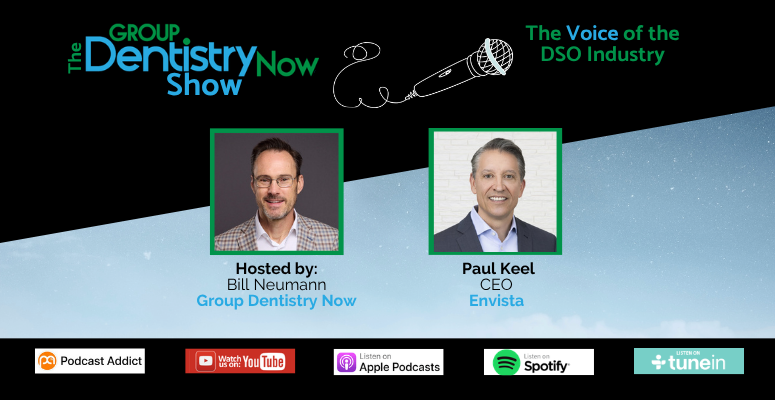
A CEO’s Perspective on the Future of Dentistry. An in-depth interview with Paul Keel of Envista.
Paul Keel, CEO of Envista with his over 20 years of experience in the dental industry, discusses:
- Digitization transforming dentistry
- The growth of DSOs and dental groups
- Despite short-term volatility dentistry remains strong
To learn more about Envista visit: https://envistaco.com/en
To learn more about Envista’s portfolio visit: https://envistaco.com/en/businesses
Subscribe to our channel for more episodes and stay updated on the latest DSO news, insights, and events!
If you like our podcast, please give us a ⭐⭐⭐⭐⭐ review on iTunes https://apple.co/2Nejsfa and a Thumbs Up on YouTube.
Choose your favorite listening app below and subscribe today so you don’t miss an episode! Full transcript is also provided below. See all of our podcasts HERE.
 |
 |
 |
 |
 |
 |
DSO Podcast Transcript – A CEO’s Perspective on the Future of Dentistry. An in-depth interview with Paul Keel of Envista.
Welcome to the Group Dentistry Now Show, the voice of the DSO industry. Join us as we talk with industry leaders about their challenges, successes, and the future of group dentistry. With over 200 episodes and listeners in over 100 countries, we’re proud to be ranked the number one DSO podcast. For the latest DSO news, analysis and events, and to subscribe to our DSO weekly e-newsletter, visit groupdentistrynow.com. We hope you enjoy today’s show.
Bill Neumann (00:38):
Welcome everyone to the Group Dentistry Now Show. I am Bill Neumann, and as always, we appreciate you joining us today. We are 250 plus podcasts in. So I like to think that we get a lot of different perspectives, but with our next guest here, I think it’s going to be a really unique perspective. We get a lot of input from people that are CEOs of DSOs and maybe smaller organizations. A lot of times it’s from the provider side of things. I’m really excited to get Paul’s perspective here. He is the CEO of Envista and they are a company that I’m sure a lot of you are familiar with. Maybe some of you aren’t, but I am sure you are very familiar and are probably using a lot of their products within your practices. So we have Paul Keel. He is the chief executive officer at Envista Paul.
(01:39):
Thanks for joining us today.
Paul Keel (01:42):
Thank you, Bill. Good to be here.
Bill Neumann (01:44):
So I’ll run through Paul’s bio a little bit here and then I’m sure I won’t do them justice. I’ll let him fill in some blanks and then he can really talk more about Envista. So Paul is the CEO of Envista. Before that, he was the CEO of Smith’s group. And what I found interesting with his bio, also spent two decades at 3M, sometime on the medical side of things, but he’s not new to dental. He was actually part of 3M. You were the president there of their specialty dental division. So he has the experience there. He spent time at GE, McKinsey, and General Mills, all very large organizations most people are very, very familiar with. And so I’ll stop there and I’ll let you fill in blanks on your bio, a little bit about your story. And then if you can get the audience up to speed on Envista, because like I mentioned, people know the brands.
(02:47):
I am sure you probably have a percentage. I’ll bet you an office can … 99% of the dental offices out there probably use one or more of an Envista Dental product or solution.
Paul Keel (03:03):
Yep. No, I think your statistic is actually almost exactly right. 90% of the dental clinics on the planet use one or more Envista product. Most people won’t be familiar with the company name Invista. That’s important if you own the stock. But as you suggested, everyone will know the brands. So ORMCO, Nobel Biocare, ImplantDirect, Kerr, Metrics, Oroscoptic, all of those. The company is one of the oldest dental companies in America. It started all the way back in 1891 with our Kerr business. And across the last 134, 35 years has expanded into other categories and other countries. So yeah, global company now, publicly traded and participates in pretty much every major segment of the dental landscape.
Bill Neumann (04:05):
And just a little bit more about your background and maybe how you ended up at Invista, because again, you’ve got a lot of experience with a lot of large organizations. When you moved over to 3M, you got experience in medical and of course in dental. So you’ve got experience across a lot of different companies, but talk maybe a little bit about your journey.
Paul Keel (04:30):
Yeah. I mean, you mentioned that I spent, call it 20 years at 3M. My first job at 3M, I was the head of strategy and M&A for their healthcare business. That is now a separately publicly traded company called Solventum. And that was back in the early 2000s. And at that time, 3M was very interested in increasing its presence in dental. So I spent a lot of my time looking at different dental partnerships and acquisitions. At the same time, another big publicly traded US company called Danaher had also focused on dental. Danaher started out as an industrial tools company, and they took the strategic decision to pivot to become a healthcare company, and they identified dental as one of the most attractive segments in healthcare. And I mentioned that because I’m at 3M looking at dental companies around the world, and Danaher is out doing the exact same thing.
(05:43):
So that was my first sort of introduction into the dental world. Then you mentioned my … I started out in dentistry leading 3M specialty dental business. At that time, the orthodontic business was called Unitech. So now I am competing with many of the businesses that now comprise Invista. This now puts us sort of the 2010 period. I went and did a bunch of other activities in the healthcare world. I worked in pharma, I worked in med devices. As you said, I worked in drug delivery. But a few years back, I got a call from a member of the Envista board, the gentleman who was buying all of those dental companies for Danaher and who was sort of an important architect in what is now Invista. And at that time, my wife and I were living in Central London and he said, “Well, would you ever be interested in coming back to dental, come back to the states?” And in fact, come back to Southern California where both in Vista and 3M’s specialty dental business at that time were headquartered.
(06:59):
One conversation led to another, and that’s how I landed here.
Bill Neumann (07:04):
Excellent. So you’ve had a lot of experience in the dental industry and you’ve seen some of the changes. Tell me a little bit about some of the things that you’ve seen in the past four or five years. And we can do post- COVID, we can even kind of go prior to that. I’ve been in the industry since 03, and I can tell you it looks a lot different than it did in 2003. And it seems like the change is accelerating. I’m sure a lot of that has to do with technology and AI and the innovations there. But can you talk a little bit from your seat what you’ve seen and just some of the trends that you think are shaping the industry today?
Paul Keel (07:51):
Yeah. I mean, if we take a five or 10-year horizon, I guess three important trends would jump to my mind and probably all of the listeners. Somewhere in that top three for all of us for dental would have to be digitization. Bill, when you and I both started out, a hundred percent of dental models and probably, oh, I would guess 80% of all patient records were analog. The anatomical models were plaster and the patient records were paper and folders. Today, I would guess that better than 75% of all anatomical models are fully digital and we must be above 90% of all patient records being digital. That digitization then manifests itself in so many other elements of the sort of dental value chain, and we’ll probably get into that in subsequent discussions. The second trend that I think everybody would point to, and a topic very close to GDN’s heart, of course, is the consistent steady improvement in clinical efficiency and efficacy that is made possible by DSOs.
(09:19):
There are, of course, very real operational, financial, and clinical economies of scale and scope that come from connecting multiple sites like DSOs do, and that has had a very material impact on advancing dentistry. And then I guess the third topic that comes to mind as I think it through is related to the prior two. It’s the ever increasing connectedness of patient care. So as we mentioned a little earlier, Envista is in so many different segments of the dental clinical landscape, and we’re in 130 countries around the world, but pretty much every dental procedure, regardless of country or specialty area, has the same three broad steps. Every dental procedure has a diagnostic step where you capture the anatomy, the patient, and you try to determine what the care needs are. There’s a second step around treatment planning, and then of course there’s the third step, which is treating the case, the therapeutic step.
(10:41):
And another important trend, both related to digitization and those economies of scale and scope that DSOs make possible is the interconnectedness of those three steps and how that leads to a better experience for the patient and a better clinical outcome and probably better economics for the different participants in that value chain. So those would be the three that come to mind for me.
Bill Neumann (11:09):
So you mentioned one of the big changes, I think, is technology, just the evolution of technology. And AI as of maybe the past three or four years, all of a sudden, I think it’s been around for a while. Now we’ve got a name and it’s being used for just about everything. So this is a two-part question. So from your perspective at Envista, how are you as an organization leveraging technology internally or at the organization? And then part two would be how are you incorporating technology and AI into your product solutions? And I’ll just say I was out about three months ago in Quakertown at Dexus just to see the technology there. So it’s kind of a two-part question for you.
Paul Keel (12:05):
Good. Let’s use that same sort of structure that we just talked about. The three steps that exist in all dental procedures, the diagnostic step, the treatment planning, and then the therapeutic step, and let’s talk about how technology impacts each of those, and then how does technology connect the three of those? So there’s a couple dental companies that are like Invista in that we participate in all three of those steps. So you mentioned the first one, the diagnostic step. We’re the largest diagnostics player in North America. The installed base is something like 300,000 connected devices. And so there’s a lot of technology across that diagnostic step. I mean, the three main modalities the listeners will be familiar with are 2D, 3D X-ray imaging, and then intraoral scanning. And all manner of technology goes into that. It typically breaks into three buckets. There’s the hardware component to the diagnostic step.
(13:19):
So this is the quality of the image capture. There is technology that goes into the rendering of that image. Today, most images are captured digitally, so you need to have processing speed to assemble those images, especially if you’re doing a complicated cone beam 3D image. That’s so much data that you need to connect all the data points into an image that our brains can recognize. And then the third bucket there, of course, is the software, which brings us into that second step. It brings us into the treatment planning step. So the main suite of treatment planning software that your listeners will recognize from Envista is called DTX Studio. It has bespoke treatment planning modules for different procedures like implant placement, et cetera.
(14:24):
And in every one of those categories, there’ll be a different type of treatment planning. Many of your listeners will be familiar with clear aligners. We have a large clear aligner business. Treatment planning there is done completely digitally. You start with the current image of where the teeth are, the current anatomy. The clinician will decide what the final placement of the teeth is in the final position. Think of it as a prescription. And then math and software calculates each step along the way in moving the teeth from the original position to the desired end state. And then the third is the actual appliances that are used to treat the case. Again, a lot of technology goes into that.
(15:16):
Probably one of the more important innovations is around customized dental appliances. That technology was originally invented by an orthodontist named Dr. Craig and Draco. And it’s that technology that enables all clear aligner solutions. It enables all of the different 3D printed brackets, for instance. All of that is software-based. Now, of course, you mentioned AI. AI can be found in each of those three steps. For example, we’re all now very familiar with AI used in 2D diagnostics to identify a patient’s care needs just from an image. Where is there the presence of caries, for instance, that’s all done with AI. The treatment planning, as I mentioned, a lot of that is done through AI. It used to be that, just stick with the clear liner example, the orthodontist would need to manually select each step or each set of trays. Now, most of that is done with math.
(16:39):
And then the appliances that come out the backend. Back when you and I started in dentistry, you would make a clear aligner by physically vacuum forming a piece of plastic over a physical, probably a plaster model. Today, that is all automated. It’s not a lot of manual touching of the actual product until it’s opened in the clinician’s office.
Bill Neumann (17:15):
So let’s move on to what I think is probably one of the more interesting topics. And I know your perspective on this, but mine is that we talk about economic uncertainty. I mean, that’s probably an understatement. There’s a lot of forces at play. We had COVID, we had a lot of money printed, and so we had inflation. So we had inflation start. We’ve got pricing going up. We also had, at the same time, we had the great resignation, people leaving their jobs and not coming back. That really affected everything, but it really affected dentistry. We have tariffs. We had that. I’m sure you were living and breathing that. So they’re kind of on again, off again. So you’ve got that going on. We’ve got war in the Middle East. So we’ve got all sorts of things going on all at once. And then we just talked about it.
(18:18):
You’ve got this rapid advancement when it comes to AI and technology. So all these different forces coming in and it affects your business. It also affects the consumers, the patients that are being treated. So talk a little bit about how you navigate these multiple challenges right now.
Paul Keel (18:39):
Yeah. I mean, a very, very apropos question for what’s going on in the world today, but maybe I’ll approach it by first setting a little bit of context. I mean, you and I have been in dentistry now for 20 plus years. I’ve had the good fortune to work and live in multiple parts of the world. I’ve lived in Japan. I’ve lived in Switzerland and the UK and in the US. And while macroeconomic and geopolitical uncertainty is certainly at an elevated level right now, if I look back across those 25 years, I mean, I frankly struggle to think of a time when there wasn’t uncertainty of that sort. I mean, you start with 2000 and the meltdown of the NASDAQ. Oh, you get to the global financial crisis of 2008, you think of Arab Spring in 2010. I was living in the UK just before Brexit in 2016, and you got COVID in 2020.
(19:48):
You got the Ukraine conflict in 2022. So I guess the point I’m making is while things are certainly uncertain right now, all of us have gone through versions of this to different magnitudes before, which I guess probably brings me onto the core of your question, which is how do you navigate that?
(20:18):
And so I guess I would come back to, again, the specifics of each of these different geopolitical shifts will be different, but the fundamentals of how you create value for your stakeholders are the same. And the key to navigating these uncertainties is having a square focus on who your stakeholders are and what is important to them. So specific to the industry that we all participate in, dentistry, there’s this wonderfully unifying common purpose, which is to provide better care for the patient. And for many of us participating or listening in this call, I think that is the North Star that helps us navigate all of this cacophony that’s buzzing around our heads, stay focused on the patient. For us, we serve professionals. So we’re not a direct to consumer business. We focus on helping the clinician serve the ultimate patient, which is the ultimate customer, which is the patient.
(21:31):
And so we focus, our North Star is serving customers. Probably a very second important stakeholder in our list to that would be our colleagues, the folks we work with day in and day out. And then the third that we spend a lot of time on is the broader dental community. Again, because we’ve been a participant in dentistry now for over 130 years, we have this shared responsibility with our customers to continue to advance dentistry globally. But then I guess the fourth stakeholder for us, the output of those first three, the customers, our colleagues and our communities is our shareholders. All businesses have shareholders, ours happen to be public. We have to be a publicly traded company, so we have a great many shareholders, but it’s that common denominator staying focused on your stakeholders that keep you moving in an organized direction, even when the world seems to be spinning around you.
(22:37):
A phrase we use a lot in Envista is focus on your customers, focus on your colleagues, and for the most part, everything else will take care of itself. Or maybe a better way to phrase it is to take care of your customers, take care of your colleagues, and let the rest take care of itself.
Bill Neumann (22:56):
Yep. Well, well put. And it’s nice. It’s relatively a simple concept, right? Maybe executing is different, but the concept is very simple. So let’s move on to the market itself, and we can look at it from healthcare and then maybe at the level in dentistry too, maybe two different … It seems more competitive than ever. Maybe it’s just my perception of things, but things have changed a little bit. We talked about 20 years ago, 20 plus years when we started, groups weren’t as in dentistry anyway. Maybe they were. And certainly in medicine, their group practice was already a thing. Hospital systems were acquiring primary care physicians. So the primary care physician that used to run their own practice was kind of rolled up into this big hospital system. That happened 20 plus years ago. It’s come to dentistry. We’re starting to see the consolidation. It’s still a pretty fragmented industry depending on who you talk to.
(24:09):
30% might be consolidated, 70% is still relatively solo, whatever that definition is. Although we still see, when we look at our numbers here, fewer dentists are working by themselves and they’re moving to working. If they’re not working for a DSO or in a multi-site setting, they’re working in a collaborative environment where it’s not one dentist working in one location, but it could be multiple dentists in one location. But things are shifting. So you’ve got some competition there. I think the dental providers feel there’s more competition. If I’m a solo, I’m competing against DSOs to a degree. Talk a little bit about how you see the landscape. Do you feel like it’s more competitive? And if so, how do you still as an organization continue to grow year over year, have that sustainable growth? Has direction changed at all?
Paul Keel (25:11):
So certainly you’re correct. I mean, listen, dental is a secularly attractive industry for all of us, and we’re fortunate to participate in it. There’s enormous unmet demand, and that has been the case for all 20 plus years that you and I have worked in it. Pick your practice area. Something like 5% of all the malaclusions on the planet get treated in any given year. Something like 4% of all missing teeth get treated with an implant. So it is a good industry, and good industries attract new entrants. That’s normal and competition is good. That’s one of the things that has helped this industry continually advance across the decades and centuries. We’ll probably come on to innovation at one point.
(26:18):
How does that manifest itself and what might be interesting strategies for managing that competition? And for the providers, for the DSOs, I think all of them would tell you at the end of the day, it comes down to that chairside experience. I mean, that is where the rubber hits the road. It’s the care that is provided to the patient, the efficacy of it, the clinical outcome, and then the efficiency of it. How can they treat more patients better with the same resources? And of course, the DSOs have shareholders too. And so the output of better patient care is hopefully a greater reward for the shareholders. So again, I think yes, it’s a competitive industry, but in the bigger scheme of things compared to the many other industries in the world, it is still highly under penetrated. There’s still much more room to grow in dentistry, I would say, relative to the patient need than most other industries I can think of.
Bill Neumann (27:28):
If we can only figure how to get that large percentage of patients that don’t see the dentist to the dentist, that would solve a lot of problems, but it’s a challenge for sure. Let’s talk about another challenge. I touched on it earlier. We had COVID hit and it might not even have started pre- COVID, but certainly we felt it during COVID, the great resignation, people left. If you think about it from a provider perspective, hygienists retired in droves, right? There was just this early retirement. They didn’t want to deal with COVID for whatever reason, fearful or just didn’t want to deal with maybe the PPE requirements. So they either retired early or they moved into a totally different profession and got out of dentistry.
(28:23):
I think we continue to see that. So challenges when it comes to staffing with providers, I think hygiene is still a challenge, maybe not quite like it was, but still is a challenge. You see it with office staff like front desk at dental practices, that is challenging as well. Can you talk about it from your perspective at Envista? And then also, because it’s not just people leaving. So we’ve got the retention challenge, but it’s even trying to find quality individuals. I think some of it is a generational thing where people used to stay a lot longer at a company and now people stay six months or three months, they don’t like it, they’re gone. It was not the way … I never was that kind of person, just never felt comfortable that way. Things are totally different nowadays. So how do you deal with these challenges?
(29:25):
And again, our audience, we’ve got a lot of CEOs and C-suites from large groups, but then a lot of entrepreneurial dentists that are running 10, 15, 20 locations dealing with those same challenges.
Paul Keel (29:37):
Yeah. I mean, you can’t have a conversation on dental and the future of the industry without mentioning COVID, like you did. I mean, it was a very important and interesting inflection point for the industry. And it has a lot of people today now, five or six years removed And asking that same critical question, has something fundamentally changed with dentistry? And so again, maybe to put it in context a little bit, consistent with our earlier discussion about this of dentistry being a secularly attractive industry, if you went back as far as you cared to collect public data on growth of US dental spending against growth of the US economy, you can go onto bls.org or bls.gov, the Bureau of Labor Statistics, and you can pick any period you want. Go pull data easy to get from the year 2000 to the present. And you’ll find a couple interesting things.
(30:49):
The first thing you’ll find is that every single year from 2000 to 2019, the dental market in the US grew more quickly than the overall economy. This was true in years of economic expansion in the US, like 2003 to 2006 or 2014 to 2018 were pretty good times for the US economy. And it was true in periods of contraction, like the global financial crisis. Even in the global financial crisis, dental outgrew the broader economy. And the reason for that is those kind of macro qualitative features of the industry that all of your listeners know so well, the unmet need, aging populations, rising middle class, ever increasing need for aesthetics, understanding of the connection between oral and overall body health. All of these things propel dentistry. But then you come on to the point you mentioned, which was COVID. COVID is the only year on record where dental contracted more than the overall economy.
(32:03):
And the reasons for that are obvious. None of us could go see a dentist for the full year of the lockdowns. And then you get to another very peculiar effect in 2021, which was an all- time record year for dental. It was true for all the manufacturers. Every one of us who report publicly had a record year in 2021. It was true for many of your listeners, many of the DSOs had record years in 2021. And then there was this question. Folks thought, okay, something has fundamentally changed with dental, that the demand for dental care and aesthetics in particular has been changed forever because of Zoom calls, et cetera. And so many of us expected 22, 23, and 24 to be even faster growth than that pre- COVID period. Now, in retrospect, we all know that that wasn’t the case. In fact, 22, three, and four were below trend growth for dental in the US.
(33:08):
Turns out the same was true for many other countries. And people come on to the reasons that you described. They look back and say, okay, well, the first piece makes sense. The dental industry essentially delivered two or three years of care all in 2021. We caught up on all of the care that wasn’t given in 2020. We delivered all of the care that was going to happen anyway in 2021. And many of those cases that we neglected in 2020 required extra care. So 2021 was even bigger. Of course, with that big bolus of care that was delivered in 21, there’d be air pocket in 22, 23, 24 afterwards. And that’s what we saw. There’s this incremental effect, which is not a demand driver, but it’s the supply driver that you mentioned that a lot of dentists exited the industry. Great many hygienists and assistants and office managers went and found different employment and didn’t come back.
(34:16):
And so the question is, today, is it a demand shortfall or is it a supply shortfall that is driving us? And then you add a third piece to the puzzle, both in 2024 and in 2025, we had similar effects. You had the underlying sort of key metrics that people look at for the health of the dental industry, consumer confidence, interest rates, GDP growth, unemployment, all looking pretty good across the back half of the year. And both the DSOs, the manufacturers, individual clinics, all getting some momentum across the back half of 24 into 25. And then last year across the back half of 25 here coming into 26, but then we hit these unexpected exogenous macroeconomic factors, which seemed to have disrupted again that underlying growth or momentum of the industry. In 2025, of course, we had the tariffs that you mentioned. You saw dental statistics all looking good across the back half of 24.
(35:35):
Q1 of 25 was a continuation of that. We all thought, great, we’re back to pre- COVID growth levels. And then Liberation Day happened and it caused this couple quarter disruption. Again, last year across the second half, numbers were all starting to get better. And coming into 2026, most of the industry reports said, “Okay, 26 is going to be great.” And then the situation in Iran happened and now we’re trying to figure out, okay, will it be a similar two quarter effect that we had to navigate like in 25 with tariffs or is this a longer term sort of impact? So it just comes back to your earlier question. The underlying dynamics of dental, I believe, have not changed. It is a secularly attractive industry. All of the things that lead to growth for DSOs, for manufacturers, for distributors are still true, but the world’s not becoming any less volatile.
(36:41):
And so we just are going to have to navigate these near term sort of blips while the overall trajectory of dental over time is unquestionably attractive.
Bill Neumann (36:53):
Let’s talk about customer expectations and how that’s evolving in the US and how Envista is adapting to some of those changes. What are you seeing as the … What do customers … And we can look at it, I guess from a couple different ways. You talked about your customers being the providers or the DSOs, but then there’s the secondary customer or the end user, the patient, and they’ve got different needs from DSOs or group practices. They seem to want more of a consumer experience. It’s not just enough now to have excellent patient care. They want it like they want Amazon, right? They want it right away and they want it done quickly. So I think that the needs of the patients are a little bit different too, but talk about things from your perspective.
Paul Keel (37:44):
So you and I have both been working with dentists for decades now. And I imagine we’d both agree that dental as a group, not just the dentists, but their staffs as well, seem to be genetically predisposed towards continuous improvement. You see this in their professional lives with this tireless pursuit, wonderfully tireless pursuit of ever superior clinical outcomes for their patients. And then as you get to know the dentists as people, you see that the exact same thing is true in their personal lives. I mean, how many dentists do you know who are also marathon runners, triathletes? They speak multiple language, they coach sports teams. It’s a very ambitious, self-motivated, continuous improvement crowd, which brings me back to your question, along with ever increasing expectations of themselves comes ever increasing expectations of their partners. And then this plays out in a number of ways. One is a phrase that we use is dentists have an insatiable appetite for innovation.
(39:05):
If there is a way to treat better or more efficiently, I’m yet to have an experience where a dentist won’t at least listen to what that is. At the DSO level, of course, not only does this play out on the clinical front, what’s a better outcome for the patient, it plays out across the system level. Okay, what is a solution? What is an innovation that we can implement at scale? It’s not enough to just have a better clinical outcome. You need a system for training the dentist and the staff in how to deliver that. And then you need a logistics solution to get the materials on time in full to support all that. A third ever rising, I find expectation of customers again is the community piece of this. I am daily reminded of despite how busy these people are, how important it is that they give back to their communities.
(40:18):
We have something called the Envista Smile Project. It’s our charitable arm. It touches, oh, I don’t know. Last year, 20,000 patients, we donate probably about $2 million a year to it, but a hundred percent of the care goes through the hands of clinicians. And in almost every case, that’s completely voluntary time. So expectations continually rising. That’s kind of a key feature of the competitive nature of the industry that we talked about earlier. And ultimately, that’s what continues to propel this thing forward, that regardless of how good a dentist is today or a clinic is today or a DSO is today, they’re religiously committed to doing better tomorrow. And of course, that’s a good thing.
Bill Neumann (41:10):
I’ve got a couple of wrap up questions here. I always like the crystal ball question, hold that off till the end. So if you’ve got a chance to look out five years, because that’s what we’re supposed to do, right? We’re supposed to plan for at least five years out. What do you think would be … We’re sure AI is going to continue and technology’s going to continue to evolve and have more and more influence on the practices that we serve, the DSOs that we serve. So that’s, I think, what that looks like. I’m not sure you might have a better feel for that, but what does the next five years in the dental industry look like and how are you at Envista adapting to what that future is going to look like?
Paul Keel (41:56):
Yeah. I mean, I would say with a high likelihood, the most disruptive force over the next five years will be similar to the conversation we just had about the last five years. And it will be the balance, the trade off, the battle between this tidal wave of long-term underlying growth that has driven dental for decades against the near term macroeconomic exogenous disruptions that come. And we talked about how that plays out in terms of the supply equation, the number of available dentists and clinicians. We didn’t directly talk about it, but we mentioned the impact that that has on material prices because of inflation. And then for the DSOs right now, they’re navigating the capital market impact of that. So again, if you go back to that record year in 2021, it wasn’t just a record year for growth and performance of the different dental industry participants.
(43:10):
It was also a record year for dental valuations. And many of the DSOs raised money back in that era at multiples that just no longer trade today. And so that has consequences for how you navigate the capital market impact of those gyrations. So I think the next five years will feel similar to that. This year, of course, we’ll certainly have to navigate the situation in the Middle East and the impacts that that’s going to have most immediately on oil prices, which then connects to anything that comes from oil, any plastic that’s going to lead to the impact on overall inflation. And then that will cascade into what does that do for those other big macro indicators for dental? What will that do for GDP growth? How will that impact unemployment? What will that mean for interest rates? And what does that mean for people’s confidence, for consumers’ confidence?
(44:14):
Those four macro indicators over time are very tightly correlated to predicting the underlying growth of dental.
Bill Neumann (44:22):
So last question for you, this is a relatively easy one, but just what can we expect from Envista? Do any of your brands, do you have any interesting new things that are coming out in 2026? What can our audience look forward to seeing from you and your brands in the new year or the not so new year, but in 2026?
Paul Keel (44:47):
Yeah. I mean, as I mentioned, Invista plays the long game. We’ve been at this for 135 years. And every couple of years, there are different trends like the ones we talked about, but our competitive focus has essentially been the same across that century plus, and that is around innovation. And that is helping the clinicians achieve their passion, their mission, which is to treat patients. So over time, if you think of some of the biggest innovations in dentistry, there’s a good chance that Invista will have their fingerprints on most of them somewhere. We invented dental implants, we invented endodontic files, we invented panographic imaging, we invented, as I mentioned, Craig Andraco Custom Orthodontics. And so the next year or two or three for us will be that same focus. Last year, if you look at the parts of our business that grew most quickly, our Clear Aligner business makes that list, our infection prevention business, which goes under the brand of metrics, makes that list our Oroscoptic Surgical Loops business makes that list.
(46:08):
All of them had particularly good growth because of the success of new product innovation. So in the case of Spark, that’s the brand we use for our clear aligner business, had a record year of new product introductions with retainers, with a solution focused on younger patients, an AI-enabled treatment planning suite that’s called StageRx. In the case of our infection prevention business, I think probably many of your listeners will be familiar with the hydrogen peroxide version of the antimicrobial that it launched has really been helping out a lot of practices. And then for Oroscoptic, they introduced a super cool digital loop called ErgoZoom. So it has particular ergonomic advantages coupled with adjustable magnification. So these are things that customers have been asking for years. And like I say, this insatiable appetite for innovation, doctors are always looking to treat patients more efficiently and more effectively. And if you listen to them and you can translate their needs into real solutions they can use, it usually works pretty well over time.
Bill Neumann (47:32):
Excellent. Well, thanks so much, Paul. I appreciate you spending the better part of an hour with us and our audience. And it’s really important to get your perspective and your insight. And if anybody’s interested in learning more about Envista, their website is EnvistaCo, so envistaco.com, Invistaco.com. And we’ll drop that link in the show notes. And then what I’ll also do is I’ll put links to the different brands under Invistico so you can learn more about each brand. Like I said, it was close. I said 99, it’s 90%. So you’re using one, if not more of their product solutions already and now you know the company behind it. And Paul, thank you so much and thank you everybody for watching or listening to this podcast today. Until next time, this is The Group Dentistry Now Show.
Thank you for joining us today. Don’t forget to subscribe to the podcast to stay up to date on the latest DSO News, insights, and events. Also, subscribe to our DSO weekly e-newsletter at groupdentistrynow.com.