
Ranked the #1 DSO Podcast!
Welcome to The Group Dentistry Now Show: The Voice of the DSO Industry!
Building a Doctor-Owned DSO: Motor City Dental Partners’ Blueprint for Sustainable Growth
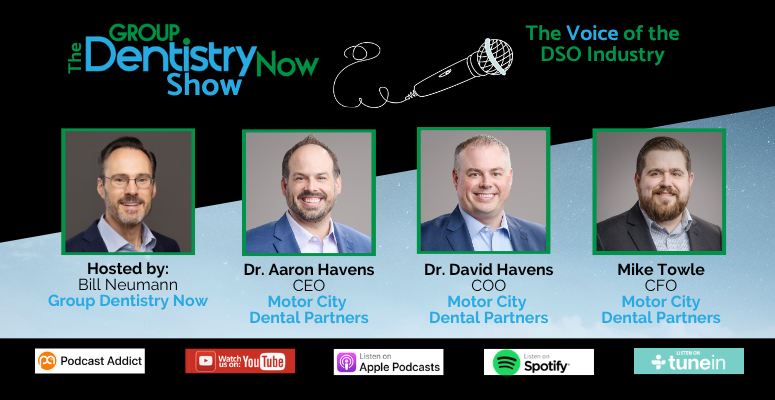
Dr. Aaron Havens, CEO, Dr. David Havens, COO and Mike Towle, CFO from Motor City Dental Partners discuss:
- Prioritizing infrastructure
- Maintaining a doctor-led culture
- Focusing on sustainable growth
To learn more about Motor City Dental Partners visit: https://www.mcdentalpartners.com/
Subscribe to our channel for more episodes and stay updated on the latest DSO news, insights, and events!
If you like our podcast, please give us a ⭐⭐⭐⭐⭐ review on iTunes https://apple.co/2Nejsfa and a Thumbs Up on YouTube.
Choose your favorite listening app below and subscribe today so you don’t miss an episode! Full transcript is also provided below. See all of our podcasts HERE.
 |
 |
 |
 |
 |
 |
DSO Podcast Transcript – Building a Doctor-Owned DSO: Motor City Dental Partners’ Blueprint for Sustainable Growth
Bill Neumann (00:00):
Hey, welcome everyone to the Group Dentistry Now Show. I’m Bill Neumann and like I always say, it’s always great to have you here. We appreciate you checking in and we’ve got 273 of these under our belt. And I just love the conversations, especially with groups that are doctor owned and led and just the stories are all so different. And I think some things are very relatable to people in the audience and for docs that are out there just maybe looking to add a practice or two. There’s some great lessons learned. And we’ve got the team from Motor City Dental Partners here, and I’ll set the stage. I was in South Carolina a couple of months back, a really nice resort, really nice. And I met their chief financial officer, Mike Towle, and he was actually on a panel discussion with me and we had a great conversation and I’ve heard of the Motor City team before and really wanted to get them on the podcast.
(01:11):
So I’m excited to have Mike on and the two founders, Dr. David Havens and Dr. Aaron Havens. Aaron is the CEO and David is the chief operating officer. So thanks guys for being on. This is going to be a lot of fun and I think it’s going to be really, really important for our audience to pay attention to this because you guys are doing what a lot of other groups are trying to do out there. And I think you’re doing it in a unique way and we’re going to talk about why you’re doing things differently. And I think it’s a good path to be on. So let’s kind of kick things off. Mike, since you kind of got everything set up here, let’s let you start off a little bit about your background and then how you ended up at Motor City Dental Partners.
Mike Towle (01:59):
For sure. Thanks Bill. And yeah, thanks for having us on. We’re excited. It was fun when we met and we kind of kicked it off, and so it’s exciting to be here. Yeah, so Mike Tom, the CFO of Motor City Dental Partners. I joined Motor City Dental Partners in 2021. Prior to that, I was with a marketing group that wanted to go to market. So I helped them get them in shape to get them to market. And even prior to that, I was with a private equity firm out in Kansas City. So when I joined in 2021 with Dave and Aaron, they had this amazing idea and a few practices and they said, “Hey, this is what we want to do and what we want to grow and how we want to get there.” And their story really resonated with me as that entrepreneur spirit who could create something amazing.
(02:41):
And we’ve kind of followed through with what they wanted to in the beginning. And so be able to hear the story from Dave and Aaron is why I want them on here is they have an amazing story and we’ve kind of been able to stick to what their thought was in the first place.
Bill Neumann (02:56):
Excellent. Aaron, why don’t we move over to you and a little bit about your background and you and Dave are brothers. So what’s it like working with your brother?
Dr. Aaron Havens (03:09):
Well, there’s trying times for sure. But no, appreciate having us on here. To echo Mike’s point, super excited to share our story, what we’re doing and what we’re building. Yes, I’m Aaron Havens. I’m CEO of Motor City Dental Partners. Historically, I’m an orthodontist. Both Dave and I are Orthodontists. We still dabble in the clinic here and there, but really have taken the leadership role since 2021 of Motor City Dental Partners when we founded it and rolled our current practices that we had at the time into Motor City Dental Partners. And it’s been a wild ride of excitement and growth and challenges as we continue scaling. At the time we had 11 to 12 practices that when the OSO boom was happening and low interest rate markets and private equity was really hot on buying dental practices and ortho practices. We looked at a different way of building a company, a sustainable company, and scaling a sustainable company without the private equity pressures.
(04:18):
And that was our original goal right from the beginning. And as we continued with Motor City, it’s what we’ve achieved. Back in the day, Dave’s four years older than I am, and I got out of ortho school. He was already clipping away at some practices. And the first Havens Orthodox practices that we owned was in 2012, so a year before I was even out. And I followed in his footsteps and we came out and practiced and the practices were smaller and we didn’t have the opportunity for two orthodontists to be in there. And so out of necessity, we grew and we grew our practices and scaled practices in a multi-location model. Because in 2009 when Dave came out, the Detroit area, it wasn’t the best times for it. The economy was having some struggles and those larger single doc offices or double dock offices weren’t around.
(05:14):
And so really our motor city was built based on the necessity for Dave and I to grow as orthodontists originally. And as the OSO boom happened, like I said, we had 11, 12 practices at the time and we looked at ways that we can not be somebody’s practices or be somebody’s number, but how do we grow to scale our own way and produce our own platform? So that’s what we did. And it’s been a great path. Working with Dave is pretty easy because you can be very frank with somebody that’s your brother versus the alternative where you may have a little bit more challenges of trying to get across points and whatnot. But Mike’s become like a third brother to us as he’s been with Motor City right from essentially the inception of our start of our platform. And it’s been a great path for all three of us, but also the team that we have behind us and the strong team that we’ve built and informed and molded over the course of years.
(06:24):
So we’ve been really excited and fortunate and great partners that have come on and believed in what we’re doing and love to share it all.
Bill Neumann (06:33):
Excellent. Well, thanks. Dave, you’re up.
Dr. David Havens (06:38):
So Dave Havens, thanks for having us. I appreciate it. Appreciate the time. Yeah, I think to echo what Aaron said, I think when I came out first and started acquiring practices, and I think we spent the early years of both of our careers looking at scalability, looking at systems and developing strong systems for our own practices. And I think a lot of those things that really led to some of the successes we’ve had at the level we’re at now, because we still focus on a lot of the same things, being highly integrated, highly system-based, and putting the work in, that’s a lot of times the hard work. It’s not always quick wins. And I think some of the controllability that we have on the offices as we’ve grown and scaled, some of those early years were some of the most important, I think, in terms of our development.
(07:27):
And I think working with Aaron, we also learned at an early age that we have different skill sets and we really leaned on those different skill sets of what we’re both good at. And then when Mike came in and the rest of the team as we built it out has only accentuated it. So it has been a fun path and we’ve continued to evolve and we’re always looking forward to the future and how we can get better and how we can better serve our partners as we come on.
Bill Neumann (07:56):
Yeah, I’m curious, this is not a question we have here, but I don’t think it’ll trip you up. How did you two as brothers decide who was going to become the CEO and who was going to become the COO? You talked about having different sets of talents. I mean, was it just a natural thing where you were more operationally focused, Dave and Aaron fit that CEO role? Who wants to handle that? Yeah,
Dr. David Havens (08:23):
I think Aaron’s always kind of been more visionary, more creative. That always aligned with his skillset, whereas I’m more linear A to B. I love working through systems and processes and I really enjoy building out things that we can deliver to our teams. And I like the organization nature of thinking and all of it. And Aaron’s always been a great creative thinker, great believer in vision and direction. And so from an early age, instead of stepping on each other’s toes, we decided, “Hey, you’re really good at this. I really like doing this.” And so we kind of divided up our tasks and it’s only made it even better as we’ve gone on.
Bill Neumann (09:05):
And as you decided to go create this motor city dental platform, you realized you needed to bring in Mike as a CFO. So was that kind of an inflection point for you when you’re like, “All right, we don’t necessarily, either one of us have that skillset.” Is that where Mike came in?
Dr. David Havens (09:23):
Well, I think there’s a couple of different inflection points that we’ve had over our career. One, when Aaron and I could no longer handle the scalability of ortho offices and we had to bring on our first associate partner from an orthodontic standpoint. Those were big steps as we grow on our team and realized centralization was even on a small scale was important. And then as we looked at Motor City in the future and really putting rocket boosters on this, realizing that team development and finding the right people to be as part of our team was going to be one of the most crucial things. And I still believe it to this day. I think we’ve been very fortunate to find awesome people and people that believe in what we’re doing and work incredibly hard to the goal to serve our practices.
Dr. Aaron Havens (10:09):
And I think a point to hit on that too is right from the start of Motor City, we built the platform before we were ready for it, before we knew that we needed it or felt that we needed it. So we invested in the mics and the HR team and from the marketing team. We invested in the platform well in advance before the scale was even there, knowing that that’s the direction that we wanted to go and we didn’t want to be caught behind the eighball of our advancement of acquiring practices. And so I think that inflection point of bringing people on and filling the roles that we were going to need in the future, but maybe not have needed right at that time, really started that. And that was where with Mike, when bringing him on from a financial side, pivoting from a typical accountant firm and going, “Well, why do we need an in-house financial?” Now seeing it five years ago, it’s like, “Oh my gosh, why didn’t we do this sooner?” But as you’re building the platform, there’s no book for it.
(11:22):
And we were figuring out on the fly, building the plane on the fly on those early days, trying to scale and trying to build that platform to be a sustainable integrated platform for practices in the future. And that’s what we developed way back in 21 and way back when we started just as private practice orthodontic office, but really took rocket boosters to our growth by having that platform and those people behind us to allow us to scale without issue. And so I think that’s been an important part of our growth is trying to do the right thing and scale the right way earlier and bring those components together on an earlier basis versus waiting on it.
Mike Towle (12:12):
And I think just to add that too, I think a lot of it’s about supporting the practices. And so Dave and Aaron’s vision always was if we build the platform and we tell somebody we’re going to do this, we have to have the team behind us that can actually do it. And so building the platform and making sure at the end of the day, you can always deliver on what you’re saying is building that platform, building that support team as step one before you can go out there and add a practice or tell somebody you can do something. It’s always like you have to have it built so when they come in, you’re hitting exactly what you told them you can do. And everything has holes in it. As you grow, you hit different levels, but I think it’s always making sure you can be there to support their practices and you can deliver on what you go out there and say.
Bill Neumann (12:53):
Well, I think this is important. It actually rolls into one of the first topics we want to talk about. It’s why you feel you’re a different kind of DSO, you’re different. Everybody says they are, right? At least that’s what we hear. And I think to a point that’s true. And I think it can be a challenge if you’re a doctor that’s looking to join a DSO. And sometimes DSOs are painted with a broad brush and it’s not good because I think most DSOs tend to operate a little bit differently, but there’s definitely some negative connotations out there. Some of it’s justified. But like you said, when you get painted with a broad brush, then all of a sudden you’re doing things that some of the others are doing. And I think what definitely stands out is which everybody’s mentioned. Most groups that I’ve encountered don’t build the infrastructure first.
(13:48):
They’re aggregating or they’re growing quickly and then all of a sudden, oh, okay, geez, now we need to put in place this person or we need to get additional capital. So they get to a point where all of a sudden they got too big and they don’t have that S, that support and a DSO in place. So I think that stands out as being pretty unique in the industry. There’s some others that have done it, but I would say it’s normally the opposite. You tend to get to a point and then realize, oh, okay, we need to plug in certain people. Maybe we don’t have the funding that we needed and we’ve got acquisitions on all of a sudden that we might have to hold off on. So that’s unique. But what else do you think guys? I mean beyond that, what else do you think you’re doing that’s a little bit different?
Dr. Aaron Havens (14:43):
I think the DSO model overall is a great model. And I think it does get a lot of bad press because some bad actors are without maybe bad intentions, but just bad operations or bad outcomes. Consolidation and group practice in dentistry is not inherently bad for where we’re going as a profession. It’s just how do you support the offices? You hit the point is you have to support the offices. And a lot of the times when the private equity boom happened, mergers and acquisitions is not the hardest part about running a DSO. That’s probably the easiest part because when the cash was flowing and doctors were coming on board, mergers and acquisitions is probably one of the easiest arms. But what they’ve really kind of underestimated was the need and level of support that each office needs to be really handheld to actually run the operations of the offices.
(15:47):
And so from the beginning, we made it kind of a mantra of what we were doing to have a fully integrated platform. Do the hard things first. Everybody says, “Oh, don’t switch your procurement. You’re not going to switch your practice manager software. You’re not going to do that.” But you have no visibility, you have no controls, you have no ability to help those offices if they have staff turnover, if they have some of the challenges on a day-to-day basis. And if you don’t have the same practice management software, the same accounting software, it’s so hard to use these bridge software, bridge third-party systems to have visibility to your offices. So I think right from the beginning of integrations, we made the tough decisions to say, and our goal was always 90 to 120 days that these offices are on board and fully operational in our platform, including the practice management software, including procurement, finance, check writing, reconciliations, RCM, all the facets of the office to really fully support the offices, including marketing too.
(16:58):
I forgot to mention there. But the doctors are coming on board not only to have a potential transition plan or to have a path for their practice life, but they also, a lot of them need and want the support and not be an individual office anymore. And that is a great thing and a great model of the DSO world is having that support, but you’ve got to deliver on it.
Bill Neumann (17:31):
Anybody else want to chime in there? Dave, just from an operational perspective, because we talk about building out the infrastructure, you obviously were pretty critical in looking at that and saying, “Hey, we need to do this before we grow too big.”
Dr. David Havens (17:50):
I think we’ve always looked at it. And I think because of Aaron and I’s history of doing the transitions ourselves, and it used to be acquiring practices of retiring doctors and Aaron and I taking over the patient care on a pretty quick basis. And seeing the evolution of that as you went from one office to three offices, you had to be somebody different every time you bought three offices because of scalability, because of centralization. And as we continued to grow those, I think we learned early on that you had to think forward-focused and not be in the rear. And so you really had to plan out ahead of what do we need to do if we’re going to do X, Y, and Z? If this is our goal for the next one year, three years, five years, what do we need this to look like?
(18:40):
And I think that kind of forward thinking’s always helped us. I think because we always wanted to run a sustainable business and a long-term solution and always controlled the interest of it. We had to have good cashflow, good margins, good control of the practices, good systems and SOPs that were tight. Like Aaron said, the more integrated and consolidated you are, the easier it is to manage and have oversight over everything. You can turn the knobs and levers. And if it’s more disjointed, it’s almost impossible to do it. And that’s what we really, as we go through the integration process with our new partners, it’s really emphasizes the whys of why we’re doing it. There are some initial pain points of just getting over to all the new software and everything else, but as they see it go through, they definitely realize the great value in the work that we put in because of the aftermath of how much more streamlined it is and how much more we can support them and all the different systems and processes from tickets to communication standpoint that we have with the offices.
(19:49):
Because of what we do, it’s allowed it to be a lot easier.
Bill Neumann (19:54):
One other big difference is that you’re doctor-owned, you didn’t take private equity. So let’s talk about that. I’m sure before Mike came on, you had 11, 12 locations. You were a platform, and I’m sure there were probably investors that were talking to you and interested in partnering private equity. So what was the decision process there to say, “You know what? We don’t want to go down that path. We want to try and do this on our own.” And what’s that journey been like?
Dr. Aaron Havens (20:28):
Yeah, I mean, at the time, I was 35, 36, Dave was 40, and we were absolutely approached. Coming out of COVID, we were absolutely approached by a lot of the name brand groups out there. Had to make some decision points and pivot points to what we wanted to do. And it really came down to our ethos of where we were at and what we wanted to do. And part of that was we didn’t want to give up control to what we were doing. We thought there was a better hypothesis to do it the way that we wanted to do it. And when we looked at the options of private equity-backed groups, we turned it down to the model that we wanted to take a group of practices and a group of partners and grow it the right way without having the influences of private equity.
(21:32):
There’s great needs and rocket boosters with private equity. And at some point that’s going to be probably in our future as we continue scaling and continue pushing forward into 80, 100 practices, 150 practices. But at the time, and currently at this time, we didn’t want the pressure to build for an exit or the decisions that are prioritizing financial decisions versus doctor clinical decisions and building the platform for partners and for doctors the way that we would do it in a private practice setting. So we’ve really tried to have those values and stay with those values so we can get to a scalable portion where those values are hard to change and they’re already integrated into the platform right from the beginning. And so it’s really created a culture of doctor forward-facing vision, and I think it’s been a great path.
Dr. David Havens (22:40):
Well, I think early on too, in my career, I started off working as a clinician working for DSOs, and I saw the things I liked, the things I didn’t. And as we formed our own vision for what we wanted this company to be, I didn’t think at the time we weren’t ready yet. We weren’t ready to lose where we were going. We were having too much fun doing this. Then I think we had some clear skies and seas ahead of us that we could do this and do this the way we wanted to. And I think that was one of the biggest reason why Aaron and I chose to continue on the path we were on instead of either taking on a partner or join another group was because we really believed in what we were doing for one. We had a good pipeline ahead of us, and we both felt like we put a lot of work in and we wanted to see it through on our own backs to see what we could do to build a team and build this up going forward.
(23:32):
So it’s been good. And I think staying true to the doctor-owned doctor operated and the high touch points of the people that they’re dealing with as partners has been really unique and fun.
Mike Towle (23:49):
And some of the hard parts there too are it’s keeping to that original ethos, it’s keeping that discipline going. You don’t want to over-leverage, you don’t want to make bad deals, but it also gives you the ability of being more creative by doing things out of the box, by being able to take advantage of different scenarios that you see. And so I think that’s where it always comes down to. And as Dave and Aaron have mentioned a couple of times, it’s just that sustainable business model is that Motor City runs as a business and we don’t need private equity. We’re able to borrow debt and have an amazing lender behind us. But our goal is always to make sure, watch our leverage, make sure that we’re running a sustainable business model and keep it that way. And so when we bring partners on, our fiduciary responsibility is to them because those are our investors, our doctors that join.
(24:36):
Those are the ones that are important to us. And so making sure that we can continue to do what we set out to do, which is create a sustainable business model of a DSO that supports those doctors and gives them what they’re looking for.
Bill Neumann (24:50):
Let’s talk a little bit more. We touched on this earlier, but the S in DSO stands for support and means different things, I think, to different organizations. But that’s why people join a DSO. They’re looking for something, whether it could be potentially an exit, but a lot of times it’s not. They’ve gotten as far as they can on their own, and they’re either looking for clinical support or non-clinical support where it’s the accounting and all the things that they didn’t teach you in dental school or didn’t want to learn because they wanted to be dentists or an orthodontist that you can provide. But talk a little bit about what that S means to you, to Motor City.
Dr. David Havens (25:38):
I think one of the most popular things that we hear from our partners is one, revenue cycle management, the management of all insurance billing and patient AR and assisting with that. I think that’s a huge burden. They’re excited to have help and alleviation from, I think, from an HR payroll systems and financial management, helping out with different recruiting things for staff and training. One of the other things that they really like about our group, because we’re so heavily doctor-focused, is doing best practices stuff and talking about what everybody else is doing from a clinical standpoint or what they’ve found for staff engagement and that kind of stuff within their teams. So from our standpoint, we look at it as centralization of all different systems. And we have a lot of automated systems that really help them out from all different aspects. But I think it’s some of the other things that are the unsung heroes that really help our platform from a doctor standpoint and from the team standpoint.
Bill Neumann (26:47):
Love to touch on a little bit more. You talked about automation, and I think it’s probably a good point to talk about that. You get inundated, we’re all inundated with AI and technology, and I think probably a lot of people just want to shut down because there’s just so much coming at you at once and it’s changing so quickly. Are there any particular automation solutions that you put in place or AI or technology that’s just been transformative for the organization?
Mike Towle (27:18):
I think in every department, I think we’ve found some really good additions to our platform. One to call out that it’s kind of overlooked, but our procurement platform using method is fantastic and having offices be able to check to make sure they receive their order all the way down that it matches up the invoice and then it automatically puts it into our accounting software. And so I think that’s every level that we look at is what can we do to develop systems that can support the offices? One, so we’re not reaching over and making sure they’re doing what they’re supposed to be doing, but two is does this create simplicity? Does it help them? And so that’s one. We have a data warehouse that we’re storing data and able to deliver them reports as quickly as possible so they can see in real time what they’re working on and what they’re doing.
(28:03):
And so I think as we’ve continued to grow, it’s making sure that we keep the platform simple. You don’t want to overcomplicate anything. And then the other part of that is just making sure that what they have is exactly what they need to support themselves. I agree. I think AI is the big topic of, well, what is everybody doing? I think in our data warehouse in the future, we’ll have more AI developed and AI go from there. But right now, a lot of it is just making sure that our platform can help grow and help the doctors get what they need as quickly as possible. And then any solutions we can find just to make sure everything is safe as simple as possible.
Dr. Aaron Havens (28:38):
I think one of those key things in automation that partners have really liked that Mike touched on was that data warehouse and the dashboards that are real time. We close the books within 15 days of the month and these dashboards at their fingertips at their own desktop, they could see the metrics of the practice in high level KPIs from HR KPIs to actual practice KPIs. But pulling that out and doing that in automated fashion so doctors can see it real time where their production is, where their overhead is, and then we can see it real time to help those problems. Instead of waiting for P&Ls to come out in three months, you’re already behind the eighball. But because we have it automated in our data warehouse and on these dashboards, it’s really allowed for great visibility to the practices from not only a support level, but also from the practice level.
(29:35):
So doctors know where they’re at at all times. They still could run reports out of Dolphin and they still could do that. But doctors get running on a routine that sometimes they don’t think about that. But when the dashboards are there, it’s right there in a graphical where you start, where your production, where your overhead is, where your overtime, where your HR, yada, yada for the metrics that we want to look at. So I think it’s been an Horton change in docs are really loving the visibility of their offices. They’ve never had the capabilities of doing it before.
Bill Neumann (30:10):
Talk a little bit about your model. You’re both orthodontists, you started out. Do you do any de novo or is it pretty much all acquisition?
Dr. Aaron Havens (30:24):
So we have done some added services to locations. We’re predominantly orthodontic offices. In the last couple years, we’ve increased our pediatric platform arm and we’ve done some added services in our ortho offices by adding pediatrics. We’ve added orthodontic offices in the pediatric offices, but not a strict de novo. Our growth plan and growth strategy is an acquisitions and partner model. I think that from an orthodontic de novo, you have to have the patient support for it in order to start those practices up. And we’ve always found it’s always been a long road on a ortho de novo, but from a pediatric startup, we’re definitely a little bit bullish on a pediatric de novo start model when the opportunities are there in communities that are underserved in the pediatric world. So definitely have seen some early success. We launched our first pediatric added service in an orthodontic office in August of last year and seen ahead of our projections and growth of that office.
(31:46):
So definitely on pace for a great year, great first year from that de novo. But from a structure standpoint, no, we’re a partner-based model.
Bill Neumann (32:01):
And you’re Midwest based. It’s interesting. There are a lot of groups that seem to have come out of the Detroit area and you have Great Expressions, of course, which was one of the biggies early on that came out of that area. A lot of smaller groups there as well. So why the focus on the Midwest? And can you talk a little bit about at this point when you started Motor City Dental Partners, you had 12 practices. How many locations do you have now? You said most of them are orthodontic, you’ve got some pedo rolled in there, but paint the picture of what you look like now. And are you outside of Michigan at all?
Dr. Aaron Havens (32:44):
Yeah. So historically we’re Midwest people and Midwest values, Midwest people. And when we started our growth and scaling, everybody was. One of the critiques to us in the early phases is why aren’t you multi-state? Why aren’t you national? Why aren’t you looking at offices in Florida and Texas? We always went back to the ethos of where we started is we have to support the offices. And you’re starting to see some of those pitfalls now when you’re too spread out over across the country and you don’t have that operational support and the structure built to really support the offices. It’s not an M&A strategy to just buy practices everywhere and then not be able to run them. So Dave and I grew up in Michigan, grew up in Detroit area. We grew up in a little town called Romeo, Michigan. Kid Rocks from Romeo is kind of our claim to fame in Romeo.
(33:46):
But really Midwest values and we wanted to stay in the Midwest. And the partners that we have have the same values and the same love for their towns and the same loves for their states. And where a lot of people are wanting to be in that national. Our philosophy is always to be penetrated, geographically penetrated in the Midwest. Currently we have 58 offices, Michigan, Indiana, and Ohio with a strong growth strategy and growth pipeline in Indiana and Ohio right now. We’re seeing our brand, our philosophy, our vision really resonating in these Midwest states because there’s not a product like us in the Midwest that is privately held, non-PE backed with the integration philosophy that we have and the growth strategy that we have. And has really been the big box stores, you have the big box commodities that partners and our doctors feel comfortable with and you’ve got some good products out there.
(34:51):
And then we’re kind of the alternative to that where we’re a little bit smaller, we’re a little bit more white gloved approach. Everybody says they’re doctor-owned, we’re actually doctor-owned. There’s no outside investors on our cap table. So our investors are, our partners, are our doctors. And it’s really resonating to fuel our growth in the Midwest.
Bill Neumann (35:23):
I’m kind of curious, you talked a little bit about your integration philosophy is what you said. So as you acquire these practices, what changes or what things do you. So who do you focus on? So who’s that ideal acquisition? And then once you acquire them and you start to integrate them, what does that process look like? What remains the same and what changes? Dave, maybe that’s yours.
Dr. David Havens (35:51):
Yeah. If Aaron wants to take the first part of probably have the ideal kind of acquisition, then I’ll take the second part if you want to.
Dr. Aaron Havens (35:57):
Yeah. It kind of goes back to the partner first vision and the partner. It’s not about the black and white of a P&L and how the practice looks in the practice profile. I know that there’s the, oh, how many shares do you have? What’s your gross revenue? What’s your EBITDA? Are you having those minimum parameters? For us, it’s a partner-driven approach. Do you have the same philosophies and vision that we do? Are you going to be a good partner with us? We’ve definitely have found partners that have a different vision and have a different outlook of what they’re looking for in their next five to 10 years that just doesn’t fit our model. And so we don’t join up with all offices and we have a selection, and that’s kind of where my role really is taken up a lot of times is really trying to identify the partners that are going to fit our partnership, that are going to be great partners moving forward and great ambassadors of what we’re doing so that we’re not being distracted by the potential noise of tougher partners and philosophies that just don’t match.
Dr. David Havens (37:18):
And then once partners come on, we have a whole white glove approach to how we transition from that mergers and acquisitions phase of the business to how we’re going to bring you on to our team. And it really starts pre-closed in terms of information gathering and that so our team can really be proactive in that. And then there’s a kind of a five stage approach that we use and it starts really with HR and onboarding of everybody. And then it works in through the procurement and finance systems. And it’s all laid out into different phases for them with information Q&As, with a whole different rollout and bleeding each team or department in at the right appropriate time. And eventually after 90 days with as minimal stress as possible on the teams and the doctors, they’re on our platform and rolling forward with all of our systems.
Mike Towle (38:12):
And I think a big change to that too is letting them preserve their culture too. A lot of DSOs are like, “Well, what’s your culture?” At the end of the day, our culture is what makes our practices great, is them being able to keep the culture that they have. Our goal isn’t to go in and make this a Motorcy Dental Partner’s office. Our goal is to go in and make sure we have a good support system where we can support them, but we don’t want to change their culture. That office has thrived and that office is successful because of the culture that doctor has built. And so we go in to help them enhance and take the support and make sure we can help them continue to grow. But we don’t want to go in and, okay, well, our culture is this, you have to do it this way.
(38:46):
It’s more of let’s keep you doing what made you successful and support you in growth and help you give the support you need, but let’s not change your culture. You’ve built something amazing. Let’s continue to support something you’ve built so we can continue to thrive on that and grow on that piece of it.
Bill Neumann (39:02):
Great. This is a great conversation. I’ve learned a lot today. As we start to wrap things up here, I always have a crystal ball question towards the end. So if we can predict out in five years what Motor City Dental Partners, what you’d like it to look like. What is that five years? What’s that? 2031? Wow. What does 2031 look like for Motor City Dental Partners? Aaron, you want to start with that?
Dr. Aaron Havens (39:31):
Yeah, great question. And right from the beginning, we didn’t build Motor City to be an exit strategy for us. We built it to be a sustainable company. And back in those grassroot days is we wanted to be a player in the industry. And in five years, we really have our goals to sit in side saddle with a lot of the name brand OSOs that are out there, DSOs that are out there as an industry leader, but an industry leader with our doctor-led culture, an industry leader with our innovation and our systems and the way we approach group practice. That has always been our beginning chapters of our book and our continuation of our book is really building upon what we’ve already built from the grassroots campaign of going from private practice model to group practice model and really being able to sit side saddle with the big groups out there that are out there today and have that innovative perspective of group practice because it’s going to continue to evolve.
(40:52):
And if we don’t evolve with it and group practice with it, the group dentistry is going to struggle. But we always have that vision of how to keep making it better, how to keep our partners happy, how to keep growing. And we don’t want it to be just an exit strategy for older doctors. We want younger doctors to come onto the platform because this is I think the future of dentistry and where dentistry is going. That’s where we really want to continue to hone our systems and our innovation to continue over the course of years.
Mike Towle (41:32):
Well, I think a lot of it is continue to penetrate the Ohio and Indiana market. I mean, in five years we went from 11 practices to almost 60 now. You look at another five years and as we continue to build the system, you’re probably doubling the growth that we can do in another five years. And so it’s keeping the egos the same, keeping that same model and making sure that we’re following the guidelines that Motor City, that Dave and Aaron set out in the beginning of let’s just continue to grow a sustainable business model. Let’s keep it localized, let’s keep it in the Midwest. So I see Ohio, Indiana. If you put our dots in Michigan, we’re kind of everywhere. And so as we do the same in Ohio and Indiana and keeping that Midwest idea of where our roots are. Midwest people for Midwest businesses is what we’ve grown into and what we’re going to continue to grow to.
Bill Neumann (42:23):
And what’s the best way if somebody’s interested in finding out more about becoming a partner, just want to learn more about the organization, what’s the best way to connect with you guys? Dave?
Dr. Aaron Havens (42:37):
Absolutely. Go ahead. Yeah, absolutely. Initially, you can find us on LinkedIn. We’re really leaning into our LinkedIn presence as we continue expanding outside the Michigan borders. We’re redeveloping our website to really create the vision of what we’re looking for and to be able to really explain it a little bit more graphically to prospective partners. We’re always available for a conversation, whether it’s right for you now or you’re just wanting to learn some information about just group dentistry. We love having open conversations with potential future partners or orthodontists about where the industry’s going, sharing our really tribal knowledge of what we’ve learned over the course of five, six years with people that are docs that want to explore. And so we really love those initial conversations. Craig heads up our M&A partner development strategy and Craig Williamson, and he’s been a great advocate for initial conversations just to learn.
(43:51):
And there’s no strings attached. There’s no anything. It’s just, let’s have a conversation. Let’s see if it is right for you. Because a lot of partners have come on going, “Oh, I’m a couple years out.” Then we start having a conversation and yeah, this is right for me. Actually, this is a good time for me. So love having those initial conversations whenever anybody’s open to it. And there’s plenty of ways to get ahold of us. We’re readily available. So we really look forward to having those initial conversations with future doctors that come onto our platform.
Mike Towle (44:23):
Excellent. And I think it’s also for other DSOs, anybody else. And it’s why I’d go to the panel that I did is sharing knowledge in DSOs of anything that we can do to continue strengthen the DSO industry, the better it is for all of us. When one DSO wins, we all win. And so anything that we can always do to anybody who’s reached out or interested, we’re always able to help out. I’d say it was hard in the beginning for us because there wasn’t a playbook. I think part of what we’re doing now and what I do with the panels is like, I can help you tell you how we did it. As they all say, as you know one DSO, you know one DSO. But I think the sharing of ideas, it isn’t a secret. Any DSO that does well is successful for all of us.
(45:05):
And so there shouldn’t be a secret playbook. We’re in Michigan, Indiana, Ohio. Our values still resonate in Arizona. So if somebody’s interested in Arizona is like, “Well, how’d you do this? Or what are you using?” Always happy to share. I think it’s what makes DSO successful and how the industry continues to be successful is we all work together to continue to grow the industry.
Bill Neumann (45:25):
Excellent. Dave, I’ll give you the final thoughts here since you’re the last one.
Dr. David Havens (45:29):
Yeah. Even to touch on what Mike was saying, I mean, we’ve met a lot of great people. When Aaron and I first got into the DSO world and MCDP came about and we thought it was going to be this huge world out there and nobody really knew each other. And it’s really a lot more closer knit than you think. And so you start to see the same faces and we’ve met a lot of friends across the industry. And like Mike says, I found it to be very collegial and everybody’s trying to exchange best practices with each other and trying to help each other out and rooting each other on. I mean, we’re all for everybody’s success. And I think that’s been one of the real surprises as we’ve gone through this process is what a cool small marketing is in this world. And everybody’s been great to meet and it’s been a great life experience along the way.
Bill Neumann (46:22):
Excellent. Yeah, great way to finish things off. Their website address, Motor City Dental Partners website address is MC, like Motor City, mcdentalpartners.com. You can find them there and we’ll drop your LinkedIn handles in the show notes. So if people want to reach out. And was it Craig Williamson? Is that who handles business development for you all? So we’ll drop Craig’s info in there as well so he can reach out to the appropriate people. But thanks guys. Great conversation, Aaron, Mike, Dave, really appreciate you taking the time out. And thanks everybody for watching the podcast. Until next time, this is the Group Dentistry Now Show.