

Ranked the #1 DSO Podcast!
Welcome to The Group Dentistry Now Show: The Voice of the DSO Industry!
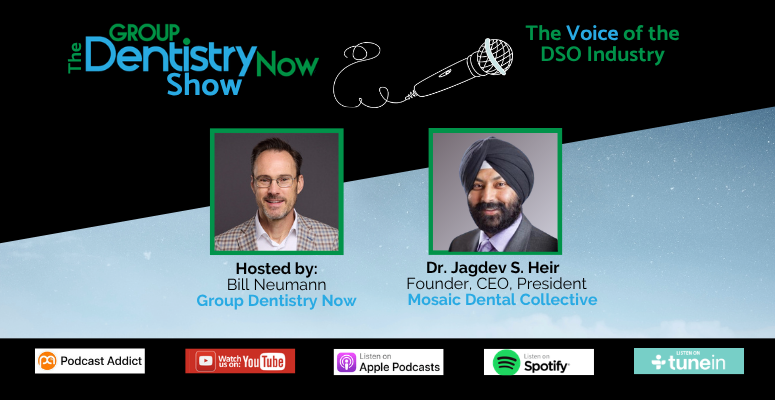
Building From the Bottom Up: How Dr. Jagdev Heir is Redefining DSO Culture with Trust and Transparency
Mosaic Dental Collective’s Founder, CEO & President, Dr. Jagdev S. Heir joins the show. Jag shares his thoughts on:
- Nearly going bankrupt
- Stepping back & trusting your team
- Real communication with your organization
To learn more about Mosaic Dental Collective visit: https://mosaicdentalcollective.com/
You can connect with Dr. Heir on LinkedIn: https://www.linkedin.com/in/jagdev-heir-md-dmd-facs-72861213a/ or via email: drheir@mosaicdentalcollective.com
Thank you to Reach for sponsoring this podcast. For all your virtual assistant needs visit https://www.getreach.co/
Subscribe to our channel for more episodes and stay updated on the latest DSO news, insights, and events!
If you like our podcast, please give us a ⭐⭐⭐⭐⭐ review on iTunes https://apple.co/2Nejsfa and a Thumbs Up on YouTube.
Choose your favorite listening app below and subscribe today so you don’t miss an episode! Full transcript is also provided below. See all of our podcasts HERE.
 |
 |
 |
 |
 |
 |
DSO Podcast Transcript – Building From the Bottom Up: How Dr. Jagdev Heir Is Redefining DSO Culture with Trust and Transparency.
Reach front desk/virtual assistants’ announcement (00:01):
Today’s episode is supported by Reach, a partner of Group Dentistry Now that helps protect your patient’s experience through dental virtual assistance. Reach provides dedicated remote team members for your front office who work inside your systems and workflows. They handle patient communication, insurance verification, revenue cycle follow-ups, and day-to-day administrative tasks so your team can stay focused on patients and your operations stay consistent across locations. If you’re hiring, scaling, or looking to strengthen front office execution, visit www.getreach.co to connect with the Reach team.
Bill Neumann (00:59):
Hey everyone. Welcome to the Group Dentistry Now Show. I’m Bill Neumann, and as always, we appreciate you joining us. This is going to be a real fun conversation. We have with us Dr. Jagdev S. Heir. He’s the founder, CEO, and president of Mosaic Dental Collective. So Jag, it’s great to have you on the show.
Dr. Jagdev S. Heir (01:20):
Yeah, it’s great to be here. Thanks for inviting me.
Bill Neumann (01:22):
Yeah, this is going to be a lot of fun. Mosaic Dental Collective was one of our emerging dental groups to watch award winners this year in 2026, so I’ve had the opportunity to get to know Jag. And of course I know Ryan Torresan who’s on his team as well there and just a great organization that Jag’s built. So we’ll talk a little bit about the organization and Jag is really creative and he’s shared a lot of the writings that he shares with his team. So we’re going to kind of dig into leadership and what leading a dental team’s all about, get his thoughts on that. We hear culture talked a lot about in the DSO dental space and the people that tend to scream loudest about culture tend not to have the best culture. I might be going out on a limb there, but I think we’ve seen that before and Dag, you can certainly talk about that a little bit.
(02:20):
But first off, why don’t you introduce yourself a little bit about your background and talk a little bit about Mosaic?
Dr. Jagdev S. Heir (02:29):
Sure. How far do you want me to go back? I can go back as
Bill Neumann (02:33):
Far as you want. Far back as you want.
Dr. Jagdev S. Heir (02:34):
All right. So I guess first generation American. I was four years old when my folks decided to come from India to make a better life for themselves and their family and obviously give me a better opportunity. Landed in Jersey, most of the family’s still there. All my education with the exception of the cosmetic plastic training was in Jersey. So I moved to Sacramento about 20 years ago. May 15th, 2006 is when I opened my surgery practice. And my surgery practice was a combination of oral maxillofacial surgery and cosmetic surgery. So we did full body cosmetic cases. We did full scope oral maxillofacial surgery. And my basic philosophy when I opened my practice was number one, I want to educate the patient. Number two, I want to educate my referral source. I’m a referral business.
(03:37):
And the reason for educating them was it’s not my decision whether someone should have surgery or not, unless it’s non-elective emergent type case, but you want to give the patient all the options and education because they become more involved in their care. The old adage of, hey, this happened and the doctor didn’t tell me, gee, the doctor must not know what he’s doing or what he’s talking about versus I’ve educated the patient and something happens all of a sudden, oh, the doctor educated me, he or she’s really smart. Obviously they said this could happen and it did. And it’s sort of creating that team. And the other philosophy was always, we say patient’s the most important part of a practice. For me, it’s the employee. It’s the team member. If I can take care of my team member, then in turn they will take care of the patient and the practice grows.
(04:42):
So when I came to Sacramento, I started with patient number one. In the surgery practice, we’ve now treated over 55,000 patients over the past 20 years.
(04:53):
And I grew it from one location to four locations. And in this evolution, it was always education and it was always, “Hey, let me educate the referral source as well.” Not out of fear. And a lot of people fear, “Well, if I educate the referral source, then they’re going to start doing the procedures.” You know what? Do whatever you’re trained to do. Just understand when you’ve reached your limit and understand case selection. And so when I formed the study clubs, it was multidisciplinary. I was one of the first ones to actually invite periodontists and orthodontists and prosthodontists into my study club instead of just being an oral surgeon and having general dentists there. And it created a lot of collaboration. Then around 2015, after I had opened a few offices, I was seeing what was happening out in the marketplace and it was a very top-down approach with DSOs coming in.
(05:58):
And a lot of these doctors were very much against DSOs. DSOs became a four-letter word, and a lot of my referral sources would say, “Hey, I’m not interested in ever joining that. I’ll close my doors before I join.” And when I went around and asked why, they said, “Well, because it’s just burn and churn. It’s a revolving door. They don’t care about patients. They don’t care about labs and supplies and these types of things.” And I looked at other businesses, other ideas because I was like, “Okay, I can continue to grow oral surgery or I could do something which is very natural to a specialist, and that is joining forces with your referral sources. No one in private practice works by themselves. I don’t care if you’re a general dentist, periodontist, oral surgeon, prosthodontist, you need each other. We cooperate with each other, yet we have individual silo practices.” So my thought was instead of a top-down approach, let’s do a bottom-up build.
(07:08):
In surgery, especially in trauma cases with the head and neck, when you have major trauma, gunshot wounds, MVAs, and you have facial fractures and you can’t find a stable point to base how you reconstruct the face, the general idea is, okay, you go top to bottom, bottom to up, and outside to inside. And so you get the major structure in place and then all the other pieces fall in place. So I sort of use the same strategy in that, what do these doctors care about? They care about their employees, they care about labs, they care about supplies, and they care about comprehensive care. So I went to my best referring doctors and I said, “Hey guys, whether we like this DSO model, this corporate dentistry model or not, it’s here to stay and it’s only going to grow and we could keep our head in the ground and just watch it come through and affect us.
(08:11):
We can join them or we could do something completely different and make it our own and make it doctor led, doctor run.” And mind you, this was 2015 and all these guys said, guys and gals, my best referring doctor said, “Jag, that’s a great idea. We saw you come into town and grow your practice to four locations. Let us know when you’re successful and we’ll join you.” So I called that Mosaic 1.0, which failed as quickly as it started. I did bring in, there was a gentleman who’s an investment banker, he’s well known in the industry, KG. I did bring KG in to speak to all the doctors and he presented back in 2015, but it wasn’t good enough, and so it failed. And I kept going and I added another practice and I had a few doctors that were interested in joining me. But around 2019, 20, towards the end of that time, end of 2019, beginning of 2020, the same doctors approached me and they said, “Hey, you know that idea, we want to join you.” And it’s kind of like right time, right place, no effort.
(09:34):
I said, “Great.” And so our journey started based on those premises, and those premises were indoctrined with having advisory boards. And those advisory boards consisted of an enterprise advisory board, which included lab supply technology, and it included the clinical advisory board, which dealt with parameters of care, standard of care. My surgical facilities are AAAHC accredited, so we have very specific guidelines similar to hospitals. So we modified them to fit the dental office so everyone is held to the same standard and the utmost care, because again, it’s about taking care of the patient, educating the patient, not cutting corners, and building something of value that we can leave a legacy with. And it’s really leaving the business and the practice of dentistry in a better place than when we found it. And so that’s sort of the mission that’s been driving this movement, and that’s why I’ve had an easy time recruiting doctors to come and join us.
(10:48):
We’ve actually have a path to partnership for our associates. We’ve had a number of associates become partners now. We have a few more this year that are going to become partners. And it’s just how do we take advantage of the business of dentistry, yet retain the ability to take care of patients and employees so that we can allow people to develop not only in careers, but also get excellent healthcare. I think that was a little long-winded way to hear. That’s
Bill Neumann (11:21):
Great. That was excellent. That paints a picture for sure. Where does Mosaic stand now when it comes to footprint? Number of locations, what states are you in? You talked about number of docs, maybe break it out, specialty and GP. What does that look like? Sure. We’re
Dr. Jagdev S. Heir (11:44):
North of 54 locations. We’re in Washington, California, Idaho. We are starting to look at other practices. We had halted M&A for a little bit and we’re starting to reengage in that aspect of it. We have roughly between doctor partners and associates north of 110 doctors recruiting another seven to eight full-time equivalents. Full-time equivalent for us is five days a week, and we have roughly close to 600 employees, including doctors between those three states. We are one-third specialty, two-thirds general dentistry.
Bill Neumann (12:34):
Got it. So you talked about education, which I think is really interesting. When you say educating the patient, what does that look like? Because I’m sure it means different things to different people. What does it mean to you?
Dr. Jagdev S. Heir (12:49):
So it really started. When I wanted to go from one location to two, I call him my second father, my second dad. You’ve heard rich dad, poor dad, that guy. Well, this guy was an accountant and he actually believed in me more than I believed in myself. Coming out of residency, nine eleven had happened and I really wasn’t getting many job offers, so I had to open my own and I was so frozen, I’m like, “Well, who would refer to me?” And this guy, his name, Richard Bogemill, he passed away about six years ago, he actually believed in me more than I believed in myself. And he said, “Jag, you’re a good guy. You’re going to do well no matter where you go. Just hang a shingle and get to work. I’ll help you on the business end.” And so I talked to him about expanding the practice.
(13:50):
He said, “Well, we’re going to need to get a loan because you’re going to need more money.” And so I had gone to a bank and the bank basically said, “You’re a $3 million risk, you’re not a $4 million risk.” And so this guy, Richard Bogemill said, “Hey, Jag, why don’t you come up here and present to this one banker, put together a business plan and talk to him?” And I said, “Well, what do you want me to talk to him about?” He’s like, “I don’t know, just your whole idea of business and so on.” And so I had put a little presentation together and it was mostly how to avoid malpractice. Doctors that spend about 90 seconds more with patients, not necessarily talking about the procedure they’re going to do or anything like that, just talking about the weather, talking about life, their kids, just 90 seconds more with a patient, those doctors almost never got sued in their careers.
(14:51):
And so if you’re spending time educating the patient, you’re showing them that you care. And where this came in time and time again, I was sort of at a turning point in my practice. May 15th, 2006, I opened my practice. In December, I was one payroll away from declaring bankruptcy. And what had happened was just wasn’t getting enough patients. It was the holidays. My referral base wasn’t that built up. And I had this gentleman walk in and he was missing a bunch of teeth. He needed a couple of teeth taken out. And so I went through my whole education of, okay, these are the teeth you’re missing. Your dentist referred you for this extraction. Did he talk to you about a restorative plan? And he said, no. I went over doing nothing versus partial denture versus crown and bridge versus implants. And I told him, these are the general costs for each.
(16:05):
These are the pros and cons for each. And at the end he said to me, so let me ask you, doc, do I need this procedure? Do I need implants? And I looked at him thinking if I don’t make this payroll, I’ll be bankrupt and have to close up come January. And I said to him, no, you don’t need this. You can get by by getting a partial denture. That’ll work just fine. You have teeth that it will hook onto. Yes, food can get stuck underneath and so on, but no, you don’t need implants. He said, great, thank you. And he left. The weekend came and went, and I’m on the phone with my folks back east and saying, I don’t think I’m going to make it. So the guy, I walk in Monday, we used to open our office at 7:15 in the morning, and at around 7:30, one of the front desk team members came up to me and said, Hey, Dr.
(17:04):
Hare, the patient from Friday’s in the waiting room, he wants to talk to you. So I went to the waiting room and he said, “Hey doc, can I talk to you?” I said, “Sure.” I brought him back and he’s like, “Okay, let’s do it.” I’m like, “Let’s do what? Let’s do the implants.” I said, “I thought you said you weren’t going to do anything and you left.” He’s like, “Well, what I didn’t tell you is I had gone to two other doctors before and both doctors said I absolutely needed implants. You’re the first one that said I did not need implants.” He’s like, “So what that tells me is I trust you and trust is a big thing.” And so that just cemented the idea of patient education. I’ve had patients come in referred for an extraction and I look at the tooth and it needs a root canal and they could do just fine with a root canal.
(17:53):
And the patients are like, “No, that’s going to be too painful. I don’t want it,” and so on. And then I actually spend the time educating them and saying, “Look, let’s get you to an endodontist, see the endodontist, see how you do, and then come back if you still don’t agree with the root canal.” And what that’s done is a few things. Number one, it’s created referrals from patients to other patients. As a specialist, we’re dependent on referrals from a general dentist, but we’re getting referrals from one patient to another because of that trust that’s built up. The other thing is the doctors that refer to me know that I have their back. Sometimes, look, we’re not perfect. We all miss something and they know that I have their back. And what this does is it just creates a great external team as well as an internal team.
(18:48):
And when the patient comes over, they’re a lot more educated or when they go back, they’re a lot more educated. So that’s how that whole theme of education came about.
Bill Neumann (18:58):
Excellent. That’s great. One of the reasons that I asked you to come on the podcast is because you and I have gotten a chance to get to know each other over the past, let’s say six months, and you shared some of your, I’ll call them writings with me, some probably some. You write quite a bit, you share a lot with your teams, which I think is probably unique, not necessarily unique because leadership doesn’t speak to their teams, but it’s what you share with your teams, I think, that’s unique. And so we’ll maybe talk through some of these writings and some of your thoughts, and I think this will be really good for the leaders in the audience to just see your approach and just reflect on it, whether their approach is similar or whether it’s totally different. But maybe start with just why you decided to share these writings.
(20:01):
A lot of them are personal reflections. Some are business oriented, but a lot of them are, I think, personal that relate to business, but you’re also relating to the people that you work with. So why did you determine, or maybe this is something you’ve always done, but you share quite a bit of personal insights with your team.
Dr. Jagdev S. Heir (20:26):
Yeah, I wish there was one singular event that initiated this. I’ve always written, I process things through writing, and sometimes I create voice notes if I’m traveling or driving. I remember when we first started Mosaic, our headquarters was in Vancouver, Washington, and I went to the office and one of the people on our accounting team said, “Hey, Dr. Hare, can I get a picture with you?” And I was taken aback. I’m like, “Why do you want a picture with me? You want to put me on a target sheet and hit me with arrows or something?” But I said, “Sure.” And he said, “I can’t wait to show this to my son.” And I was kind of scratching my head. I’m like, “Who the hell am I that he wants a picture with me?” And then fast-forward going and visiting offices and speaking to people and being introduced, it was almost like the title brings a certain level of respect, I guess.
(21:57):
And if you come to my house with my parents and my uncles and aunts, they just think I’m Jag. I’m that little kid that played basketball and fixed things around the house. They don’t really view me as a doctor, a surgeon, let alone someone that started Mosaic. And people look at my degrees and my specialties and they feel I’m different person or a different level. And yet when I look at myself, I’m like, I’m just a regular guy. I had really good people around me. I asked a lot of questions. Boy, did I make a lot of mistakes and I kept learning and just hard work, a lot of luck, a lot of grace from kind people. I met you through Ryan, otherwise we may never have met. So somehow people show up and that whole idea of are they here for a season, are they here for life and so on, that’s all yet to be determined in our lives.
(23:17):
And today’s September one, it marks eight years that my niece passed away. She was going to turn 23. Life is short. And so when we put people at a certain level, whether they deserve it or not, they’re just human beings. And so how can I relate to my team members and say, “Hey guys, there is absolutely nothing special about me. I have the same problems you do. I have children, two wonderful boys, they’re 25 and 23, that used to think I was amazing.” And then there was a period where they thought I knew nothing and now they’ve sort of turned back to, “Well, maybe dad’s right on a few things.” So I wanted to create that bond with all the team members and say, “Hey guys, I’m no different than you. I have the same problems, I have the same thoughts, but if I as a leader don’t open myself up and make myself vulnerable to be judged, to be analyzed, to be poked at, then how can I allow them the ability to say, Hey, here’s things that are working in Mosaic and here’s things that are not working in Mosaic.
(24:51):
And what this does is it just creates a certain level of trust and transparency. And so it was an evolution through that time period where I was like, one day I just started writing and I’m like, let me send this to a few people. And now it goes out organization-wide to all of our employees. My dad had fallen sick three years ago. He was in the hospital for a period of six months, and the team just wrapped around me. I was basically in Princeton for six months while running Mosaic and then flying back to do surgeries a couple days a week. And so to me, it just aligns with educating the patient. It’s just saying, “Hey guys, we’re all family. I can’t be a different person at home and a different person at work. I have to have congruency.” And for me, the only way to have congruency is to write and share things about some of the thoughts that I’ve been having.
(26:07):
For the most part, I think they’ve been well received and I’ve gotten a lot of people to share back some of their struggles, and that’s pretty amazing.
Bill Neumann (26:21):
Let me, if you don’t mind, I’d like to share maybe some of the writings with actually people in the audience, and you can dive into just some of the themes. You actually mentioned it earlier, you talked about a turning point in your business, and one of the writings was a fork in the road. And I think this is something that, especially we’re talking to groups, a lot of them are scaling up and there are these inflection points or turning points. How does a leader recognize that this is a genuine turning point rather than maybe just a setback?
Dr. Jagdev S. Heir (27:05):
Hindsight, time passing is the best. There’ve been a number of forks in the road for me in our business. One was just in myself, not having the confidence that I was a good leader, that I was also a good CEO. You come, you put a group together, and then you join forces with brilliant people. You know Ryan, he’s our chief operating officer and chief marketing officer. He’s got 20 plus years experience. He’s brilliant, right? Whatever idea I have, he makes it better. We’ve had a CFO and we just hired another CFO recently, just absolutely brilliant. From the people that started with me at the front desk and operations to now they’re heading departments. So it was just finding my own footing that, “Hey, I built this. I know what I’m doing.” Instead of saying, “Hey, I built this. I was able to bring on a financial partner.
(28:34):
They know more than I do, so I’m going to go along with what they say.” And the fork in the road was the financial partners are brilliant. No question. I’ve not met smarter people in my life. We’re all smart in our area, and I’m sure if I was in that, I’d be doing just as well, but they really understand finances and financial engineering and planning, but I understand how to build business. So it was me coming to terms that not every idea they have is going to be right, and not every idea I have is going to be right, and we have to blend the two. So that was a fork in the road, which we had a temporary setback, and now we’re on the right road again. And the reason I know we’re on the right road, time has passed.
(29:36):
Other forks in the road are bigger is not better. I mentioned that we put a pause in M&A. The reason is there was a book when I went from one practice to four, the Three Minute Monkey Manager, I think it’s called Three Minute Manager, and then Who Moved My Cheese, I read those two books. And one of the things that occurred to me is when I grew, I never changed processes. And typically you should change processes every time you triple. Well, I went from one to four, I made some modification in processes and the offices were running great. But when I went from four to 12 to 20 to 49 to 60 at one point, the processes were there, but we didn’t refine them and define them with the same vigor that I had done when I went from one to four. So we had to pause.
(30:43):
That was the fork in the road that, hey, bigger is not better. Let’s fix our internal processes. Let’s make sure there’s no bleeding occurring. And once we’ve controlled the bleeding, there’s no leakage occurring. And so once we’ve controlled the bleeding and leaking, now we’re ready to do M&A, but let’s be very judicious about the M&A. Who do we want to bring in? Who don’t we want to bring in? Buying a practice that has 30% margins but is purely doctor owner driven may not be the best for us. And the reason is when the doctor owner is there, everything’s working. Well, if the doctor owner leaves or gets disabled, then what happens to the practice? Is it sustainable and what does that do? So it’s really also looking at worst case scenarios and planning for that. So forks in the road come in different forms. Personally, fork in the road is also, hey, I’ve been able to bring the organization from a certain point to this point.
(31:54):
And now I have people like our CFO and COO, we have a great board member as well, and we have team members underneath our controller, our head of finance, RCM, our VPs and operations. It’s really letting them do what they do best, staying out of their way and blocking and tackling for them and not being the sole source. And so the value-driven model takes me and makes me less valuable to the company and makes these people more valuable. And so that was a nice fork in the road. It was sort of brought upon me, but then the more I looked at it, the better it is. And I also have perfectly clean cabinets now and throughout all the junk because I have a lot more time because I have the right people doing the right things for me.
Bill Neumann (32:56):
Now, was that difficult for you to maybe let go of some of those responsibilities or was it a matter of just having the right people and feeling confident in them and going from there? But what’s that like? Because I know it’s hard for some, especially entrepreneurs to give things up. Nobody can do it as well as you, that thought process.
Dr. Jagdev S. Heir (33:20):
Yeah. I had a chief growth officer, his name’s Jamar Jenkins, and he’s now gone on to be CEO of another company and we’re still really good friends. Someone called him and said, “Hey, Jag said he didn’t have an opinion, but when we were on the meeting, he gave his opinion.” And Jamar chuckled and he said, “Well, look, Jag’s from Jersey, Jag’s a surgeon, and he built this business from the ground up. Do you honestly think he’s not going to have an opinion?” So was it hard for me to let go? Absolutely. But what I typically do is when you, and I’ve done this with Ryan, I’ve done it in finance and RCM and so on. When you have the right people in place, you give them enough rope and you very quickly learn, are they stepping up or not? And look, no one is perfect.
(34:31):
We all have our strengths and weaknesses and we tend to focus on our strengths and not focus on our weaknesses, and we tend to hand things off to other people that we’re weak on. Rather, we should do the opposite. We should hand off our strengths and then focus on our weaknesses. So my strength is really operations and running all that. I know how to market specialty practices, but Ryan does that way better than me. My weakness is finance and financial planning and modeling. Why? I’ve never done that. So I’m in probably more meetings on the finance and accounting team than they would like, but it’s not to check on them, it’s to educate me so I can be a better partner. So we have the right team in place. They’re doing everything they’re supposed to be doing, and now I’m doing something selfish, which is get a free finance education from the team members.
(35:39):
It’s kind of bittersweet. You bring your group from nothing to what it is today. Along the way, it’s a big zigzag. But when you look backwards, it’s a straight line. When I started after college, I went to dental school. After dental school, I did oral surgery for a year. I did general anesthesia for a year, and then I did med school and finished my oral surgery. And then I went and did head and neck cancer in Portland. Then I did my cosmetics fellowship in Oklahoma. And then I sat at home for a year and a half out of fear that no one would refer to me. So if you look back, it was a lot of zigzag and wasted time, but what did all that do? By doing that year of anesthesia, I’m better at putting people to sleep. I feel more comfortable. By doing an extra year of oral surgery, the bread and butter oral surgery is easy for me.
(36:42):
The complex cases are easy for me. Going and doing a plastics and head and neck fellowship gave me more tools. So while it took more time, things got easier and looking backward, it looks like a straight path. So with all these right people in place, was I able to pick them right out the gate? No, we are four to five years into Mosaic, and it took this long to find the right people. And sometimes you do have the right people, but they’re not a fit for whatever reason with what the requirements are for the job or they get better offers and they move on. So there’s always going to be change and you as a leader have to know when to step back and when to step in. And I’m enjoying right now being able to step back.
Bill Neumann (37:40):
Communicating change. So I just want to preface all these questions. Jag, even though I did send him over the questions, he didn’t look at any of them, so he’s not really prepped on any of this. He’s digging deep for the answers to these, although I think he’s addressed a lot of these questions with some of the communication that you’ve had with your team. But communicating change as you scale up, and especially I think now when it comes to technology, there’s so much change and it seems like it’s rapid change now. A lot of that’s driven by tech, but I think we see it in our daily lives, how things just are evolving really quickly. If we think back five years ago even, how we lived our lives, which isn’t that long ago, things have changed. AI is some of that, some of it’s technology, some of it’s cultural.
(38:34):
But when you’re communicating change with your doctor partners, the associates, your team members, for the leaders in the audience, how do you go about that? You’re making a change in the organization. How do you do that in a way that isn’t people. Because people fear change. We know that. Nobody likes change. I still don’t like it. We talk about it a lot and it’s very hard to get comfortable with the uncomfortable, which is what change is.
Dr. Jagdev S. Heir (39:03):
Yeah. I read something, I think yesterday, amazing things happen on the other side of fear. So fear will either paralyze you or it will mobilize you. And what’s that tipping point? It varies for every person. How do I communicate change to the organization? Really depends who the audience is and what it is. If it’s partner doctors, it’s really, “Hey guys, here’s where we’re at, here’s where we’re going, and here’s the reason why.” Or obviously when people make a bunch of money from getting a deal done, they let their foot off the gas. And sometimes it’s just having a direct conversation. Guys, this is not what you agreed to, and are you not people of your word? And so it’s knowing the audience. I recently went up to Washington to tour the practices with our new CFO, and in one of the offices, there was a lot of turmoil and it’s very easy to say, “Hey, this is Mosaic’s doing, this is Mosaic’s fault.” So when I went up there, I got the entire staff together, multiple locations in this practice, and I got them together and I said, “Guys, here’s my philosophy.
(40:43):
Here’s why I formed Mosaic. Here’s what I want. We want to retain individual personalities and individual cultures. Nothing has changed. It’s just where you get your paycheck. We still want to work hard, and here’s what I need from you, and here’s what I’m willing to do for you.” And then I gave them the opportunity to ask any questions, and it just boiled down to communication. So when you want to affect change, you have to over-communicate and you have to communicate in multiple forms. How do we learn? Some people learn by reading. Some people learn by watching. Some people learn by doing. Some people learn by teaching.
(41:31):
I learn by seeing, doing, and teaching. I could read something a thousand times, it doesn’t matter. I’ve yet to memorize anything in my surgical text or medical text. Everything was learned because I tried to visualize what the procedure would look like or how cells form and what happens during disease states and so on. And I’ve sort of brought the same thing into the business world. So it’s really over communication in multiple forms. It’s being transparent. It’s allowing the team members to ask the hard questions and not take them personally. All these team members, look, an extra $100,000 or something like that probably won’t make a difference to a lot of the leaders in organizations, but an extra thousand dollars, $2,000 makes a big difference in the lives of our team members at the front lines. And so it’s really understanding how to make their lives easier.
(42:42):
And when we have to make a change that’s better for the organization, it’s communicating the why behind it. Obviously, technology scares a lot of people, and the idea is, well, technology may replace us. In certain cases, it could, that’s the reality of it. But in a lot of cases, it allows them more time to speak to patients and to build relationships. And in order to grow practices, building those relationships is the lowest cost marketing tool that we have. And so communication, going over the why, and being able to answer any other questions, I think is the best way to affect change.
Bill Neumann (43:32):
We could go on. You have a lot of writings. I went through quite a few of those and we don’t have time to go through all of them, although I hope that we can get you to share some of those or maybe some different content on group dentistry now. I know we’ve talked about that, maybe to get you to do some articles for us, so I’m going to hold you to it now that I’ve got you on the podcast in front of an audience. But as we start to wrap things up here, talk a little bit about the future of Mosaic and then what your future looks like there as you have more people in place now that you feel comfortable with, what does that free you up to do? So yep, just final thoughts on that and love to get your future outlook on Mosaic and your role there.
Dr. Jagdev S. Heir (44:20):
Yeah, I still feel very strongly about the mission of Mosaic and their trajectory of where it’s headed. I think we can become the best in class preferred employer, preferred comprehensive care provider to patients. We’ve gone through some growing pains and I’m certain those growing pains are not done. We’ll continue to grow through them, but we’ve also partnered with some really good people, some really good companies in technology space. We’re working with Plan Forward, we’re working with Planet DDS, we’re working with Videa AI, we’re working with a few other Zentists and so on. And all these companies are making us better. They’re making us more efficient.
(45:29):
So a lot of the things that I wanted to do, I’ve been able to do. I think as we get into M&A and grow, obviously we’ll bring on another financial investor at some point. And then when that happens, I think it’s time to bring on other people as president and lead the organization into the next chapter. I think we all have to know our limits. We all have to know what that level is. I think that I would really be good at helping the team do M&A, pushing the vision, being a spokesman for Mosaic. And I think there’s other people, especially after we’ve worked together for another year or two or so on, where they will be way better than I am at the day-to-day stuff in leading this organization to the next chapter. But I remain very, very positive on Mosaic.
Bill Neumann (46:47):
Excellent. Well, thanks so much. Great conversation. This is a lot of fun. If anyone’s interested in learning about Mosaic Dental Collective, it’s easy. It’s mosaicdentalcollective.com. That’s easy enough to find. We’ll drop that link in the show notes. And Jag, is the best place to connect with you on LinkedIn?
Dr. Jagdev S. Heir (47:05):
LinkedIn or my email, drheir@mosaicdentalcollective.com.
Bill Neumann (47:10):
Excellent. Well, we’ll put your email address in the show notes as well as your LinkedIn handle, and I really appreciate the conversation and you being really transparent and sharing all your thoughts. And like you said, his writings are really a lot of fun to read, and it’s great that you have that approach with your team members, and I think it’s reflected on the culture that you built there at Mosaic. And thank you, of course, everybody for watching and listening today. Until next time, this is the Group Dentistry Now Show. Thanks again, Jag