


Sponsored Content
By Richard Uria, President, orthobrain®
For much of the DSO industry, growth has traditionally been framed as an exercise in addition. Add practices. Add providers. Add geography. Add patients. Add services. The logic is familiar because it is visible, measurable and easy to explain to boards and investors. A new acquisition creates a new revenue stream. A new location expands the footprint. A new marketing campaign fills the top of the funnel.
But there is another form of growth that is less visible and, in many cases, more economically efficient. It comes from patients who have already chosen the practice, already accepted the brand, already crossed the threshold of trust and are already sitting in the chair.
That distinction matters because the economics are different. Acquiring a new patient requires marketing, scheduling, insurance verification, onboarding and, often, considerable effort simply to get that patient through the door. By contrast, an existing patient relationship is an asset that has already been created. The larger question is whether the organization is fully serving that relationship.
In other industries, this concept is hardly controversial. Banks do not grow only by opening new accounts; they deepen relationships with existing customers. Hotels look beyond occupancy and focus on the revenue generated from each guest. Retailers measure frequency, shopping cart size and lifetime customer value. The lesson is straightforward: growth does not come only from adding customers. It also comes from understanding more completely what existing customers need, want and value.
My career in investment banking and industrial manufacturing taught me to look first at the assets already in place. Manufacturers seek to improve the use of existing capacity before committing capital to a new plant. The question is simple: What more can we do with what we already have? Dental organizations can ask the same question of their chairs, schedules and, above all, patient relationships.
Dentistry has an opportunity to apply the same thinking.
Too often, the dental visit remains narrowly defined by the reason the patient entered the office that day. A hygiene appointment is a hygiene appointment. A crown is a crown. An emergency visit addresses the emergency. The clinical work may be excellent, yet the organization may never discover that the patient has been thinking about whitening, worried about tooth wear, embarrassed by crowding, concerned about a missing tooth or curious about options that have never been discussed.
The lost opportunity is not simply financial. It is educational and health-focused.
Patients do not always volunteer what they want. Many arrive focused only on getting through the appointment itself. They may assume certain services are unavailable. They may believe treatment would be too expensive. They may not realize that a condition they have tolerated for years can be treated. They may even be waiting for someone in the practice to raise the subject.
That is why one of the most powerful tools for organic growth may be remarkably simple: a well-designed question, asked consistently.
A hygienist who asks, “Is there anything about your smile you wish you could change?” is not making a sales pitch. A team member who asks, “Has anyone ever talked with you about the wear we’re seeing on your teeth?” is not pushing treatment. A doctor who asks, “Is there anything about your dental health you’ve been thinking about but haven’t brought up with us?” is doing something more fundamental. The practice is gathering information that would otherwise remain hidden.
This is what I think of as the economics of the second yes.
The first yes is the patient choosing the practice. It is the appointment scheduled, the visit kept, the relationship begun. That first yes is expensive. It requires acquisition, reputation, location, infrastructure, staffing and trust.
The second yes can create meaningful additional value within a relationship the practice has already established.
Yes, I would like to know more. Yes, that has been bothering me. Yes, I have wondered whether that could be fixed. Yes, I did not realize you offered that here.
That second yes is where an existing patient relationship begins to expand. It may lead to another consultation, another appointment or another service line. It may increase the number of visits a patient makes to the organization and deepen the relationship between the patient and the practice. Over time, those additional interactions can influence retention, referrals and total lifetime value.
None of this requires a hard sell. In fact, the model works best when salesmanship is removed from the equation. The most effective organizations will not train teams simply to “present more treatment.” They will train them to ask better questions, listen more carefully and identify needs that may otherwise remain unspoken.
For DSOs, the implications are significant because scale changes the mathematics.
In a single office, an additional conversation may lead to one more consultation in a week. That may not seem transformative. But when the same behavior is standardized across dozens or hundreds of locations, small changes in patient engagement can become meaningful enterprise-level results.
Consider an illustrative example. A 100-location group with two hygienists per office, each seeing eight patients per day over 220 working days, would generate 352,000 hygiene visits annually. If, hypothetically, one in every 200 visits ultimately resulted in a clinically appropriate, accepted orthodontic case at an average case value of $5,000, that would equal 1,760 cases and $8.8 million in potential annual gross case revenue. The one-in-200 conversion assumption is illustrative, not an established industry benchmark or a forecast. Actual outcomes depend on patient eligibility and interest, acceptance, available clinical capacity, collections, staffing, and treatment delivery costs. Gross revenue is not profit, and additional resources may be required.
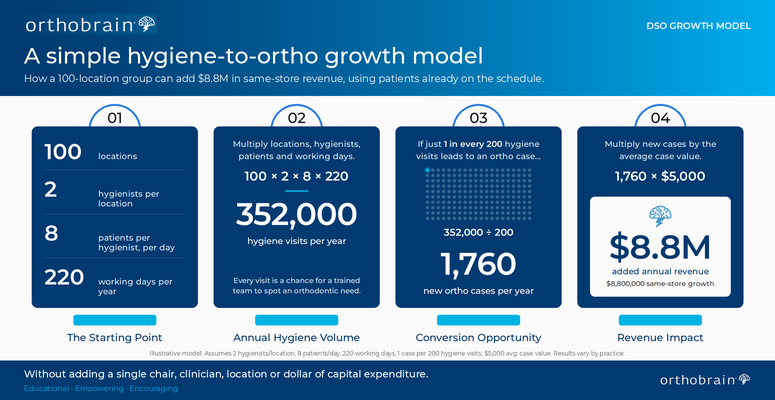
Figure 1. Illustrative hygiene-to-orthodontics growth model. The one-in-200 conversion rate is hypothetical, not a benchmark or forecast. Figures represent potential gross case revenue, not profit; outcomes and resource requirements vary.
Hygiene illustrates how these conversations can become part of everyday care. Hygienists often spend more time with patients than any other member of the practice, see those patients repeatedly over many years and occupy a position of considerable trust. They are well positioned to listen for concerns, offer patient education within their professional scope, and bring questions to the dentist. The dentist remains responsible for clinical evaluation, diagnosis and treatment recommendations. When clinically appropriate, digital scans can support education and help patients describe concerns that might otherwise go unspoken.
Yet many organizations continue to measure hygiene largely through production, periodontal diagnosis, schedule utilization and reappointment rates. Those are important metrics, but they tell only part of the story. A DSO might also ask how often a hygiene visit prompts a patient to express interest in discussing an identified concern. I think of this as a second-yes rate: the percentage of hygiene visits in which a patient expresses that interest. Referrals to the dentist, consultations scheduled, clinical eligibility and treatment acceptance should be measured separately, rather than conflated with patient interest.
Once that question is asked, a different type of operating model becomes possible.
A group could establish a small number of patient-discovery questions appropriate to different parts of the visit. Teams could be trained on language and professional responsibilities. Responses could be documented, with a consistent handoff to the dentist for clinical assessment and any treatment recommendation. Follow-up could be standardized. Leadership could then measure how effectively practices help interested patients explore clinically appropriate care.
These measures can reveal variation across locations. Some teams may be effective at initiating conversations but less consistent in following up. Others may need a clearer handoff to the doctor or treatment coordinator. Comparing the patient experience and the process—not just the number of accepted cases—can help leaders identify opportunities to improve.
At that point, same-store growth stops being an abstract financial goal and becomes an operational discipline.
Orthodontics is one example of how this can work, but it is important not to confuse the example with the larger principle. Many adult patients have lived for years with crowding, spacing, bite concerns or dissatisfaction with their smile. They may have visited the same dental practice regularly without anyone asking whether those issues matter to them. A simple question can surface an interest that has existed for years.
The same is true of implants, whitening, restorative care, sleep screening and periodontal treatment: the opportunity begins not with a product but with curiosity. The economic question for a DSO, then, is not merely how many patients it can acquire. It is how much unmet need exists among the patients it already serves.
For organizations focused on same-store growth, improving conversations within existing practices may offer a relatively low-cost opportunity compared with acquisitions, new locations or additional marketing.
From an investment perspective, acquired growth and organic growth have different economics. Acquisitions bring purchase prices, integration demands and sometimes additional debt. Sustained same-store growth, by contrast, can demonstrate that an organization is finding new ways to serve patients through its existing operations. Neither approach is inherently superior, but leadership teams should understand the costs, capacity requirements and quality implications of each.
There is also a strategic benefit. A patient receiving coordinated care within a trusted dental organization may benefit from a stronger, more continuous care relationship. The more comprehensive the relationship, the greater the opportunity for continuity, loyalty and long-term retention.
This is why I believe many DSOs should take a harder look at what might be called unrecognized patient needs inside the existing patient base. How many patients are receiving services elsewhere that the practice could appropriately provide? How many are interested in treatment but have never been asked? How many leave a recall appointment with an unidentified need simply because the right conversation never occurred?
Those questions are not about maximizing production at all costs. They are about identifying the gap between the care patients receive and the care they might reasonably want or benefit from.
The strongest growth organizations will not be those that pressure patients into more treatment. They will be those that become better at understanding them.
Growth can come from new acquisitions, markets or technologies. It can also come from serving existing patients more completely.
In dentistry, that opportunity begins with the patient relationship.
The next major opportunity for a DSO may not be across town in the next acquisition target. It may already be sitting in Operatory 5.
The patient has already given you the first yes.
The question is whether your organization knows how to earn the second one.
Richard Uria is President of orthobrain®, which partners with general dentists and DSOs to bring orthodontic care in-house. He can be reached at Richard@orthobrain.com.
Watch Richard on the Group Dentistry Now podcast: