

DSO Spotlight
Dentistry is in the middle of a significant transition.
Rising labor costs, pressure on practice margins, changing economics around acquisitions and continued consolidation are forcing practice owners to think differently about growth, ownership and what the next stage of their careers might look like.
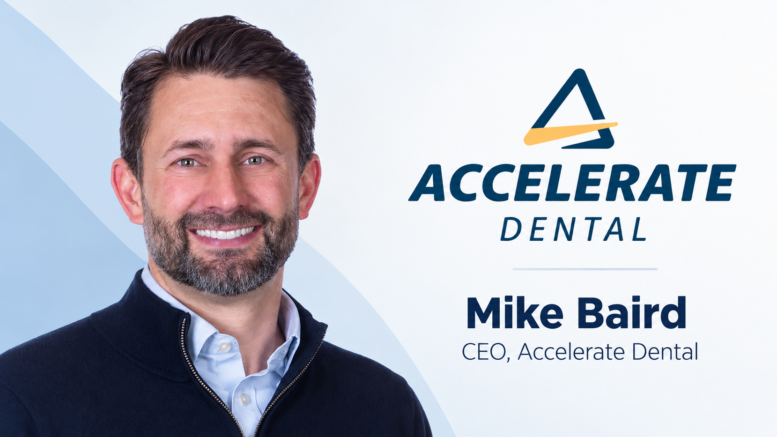
For Mike Baird, CEO and co-founder of Accelerate Dental a 2025 Emerging Dental Group to Watch winner, those changes also created an opportunity to build a dental group around a different premise.
Accelerate describes its model as a Dental Partnership Group or DPG, a structure designed to combine the resources and scale of a larger dental organization with continued dentist ownership and control.
Group Dentistry Now recently sat down with Baird to discuss his path into dentistry, the thinking behind the DPG model, the economic challenges facing independent practices and where he believes technology and consolidation are taking the industry.
From Technology and Healthcare to Dentistry
Baird’s route into dentistry was anything but traditional.
He began his professional career at Dell Computers in 1999 during the height of the dot-com boom. After earning his MBA at Northwestern University, he spent four years with McKinsey & Company, working across industries including technology, airlines and consumer packaged goods.
That experience helped shape his interest in general management and entrepreneurship.
Baird later entered healthcare technology and founded a telemedicine company that helped hospitals connect virtually with patients. He spent roughly a decade in the space and ultimately helped take the company through an IPO during the COVID era.
His transition into dentistry came when he joined Henry Schein One, where he spent three years working across dental technology and software.
That role gave Baird direct exposure to DSOs and large dental groups across the country and helped convince him that dentistry was entering a prolonged period of structural change.
“This is definitely going to be the decade of change where dentistry transforms, and it’s a really fun time to be in the space trying to carve out differentiated options for dentists.”
Baird saw parallels between dentistry and the broader healthcare industry, where physician employment and corporate ownership have steadily increased. At the same time, he believed dentistry had an opportunity to develop multiple organizational models rather than following one path toward consolidation.
That thinking became the foundation for Accelerate Dental and its Dental Partnership Group model.
Building a Dentist Owned Dental Partnership Group
Accelerate Dental was founded in 2023, a very different economic environment from the acquisition boom of 2021 and 2022.
Interest rates had risen, valuations were under pressure and acquisition activity had slowed. Rather than viewing that environment as a deterrent, Baird and his co-founders saw an opportunity to rethink the traditional dental group structure.
Before developing the model, the team spoke with more than 100 dentists about what they wanted from a group partnership, what frustrated them about existing models and what they wanted to preserve in their own practices.
Three principles emerged.
First, Accelerate would remain a minority partner in its affiliated practices.
Second, the broader organization would be substantially owned by dentists rather than relying primarily on private equity ownership.
Third, the group would be structured around a long-term partnership model rather than a short investment cycle built around a future recapitalization.
Those principles became the foundation of what Accelerate calls its Dental Partnership Group or DPG model.
Rather than positioning dentists simply as affiliated providers, Accelerate refers to them as partner doctors, reflecting the ownership structure and long-term nature of the relationship.
Baird describes the broader approach as a “perpetual model,” drawing inspiration from professional partnerships such as law and accounting firms.
“We resolved to come out with what we call the perpetual model. It wasn’t about recaps, it wasn’t affected by interest rates, and it didn’t have a ticking five-year clock where I need to sell for my investors.”
The objective is to combine some of the benefits traditionally associated with larger dental groups, including purchasing power, recruiting resources, technology evaluation and operational support, while allowing dentists to maintain greater ownership and control at the practice level.
Accelerate now has nearly 50 dentist investors, according to Baird.
Partnering Around Future Growth
The financial structure also differs from a conventional DSO acquisition.
Accelerate generally does not provide a large cash payment to acquire control of a practice at closing. Instead, its DPG model is designed around participating in future value created after the partnership begins.
If a practice has already built significant value, Baird’s philosophy is that the dentist should retain that value.
Accelerate then earns ownership over time based on growth created together.
Doctors may also exchange a portion of their practice equity for ownership in the broader Accelerate organization. Baird said these exchanges typically fall within a range of approximately 5% to 25%, allowing doctors to gain ownership exposure to a wider portfolio of practices.
Over time, Accelerate typically owns approximately 30% of a partner practice.
The organization also charges a 5% support fee that funds services including accounting, human resources, employee benefits and procurement.
The model is intentionally designed for doctors who want to continue practicing, growing and owning their businesses rather than completing a transaction and quickly exiting.
“We want to partner with you till the end of your career and then help you pass it on to somebody else. We want doctors who want to grow and they want to participate in their own growth.”
That philosophy also shapes succession planning.
Rather than requiring a dentist to exit at a predetermined time, the structure can allow an owner to gradually reduce ownership, transition equity to associates and continue practicing on a reduced schedule.
Baird believes that flexibility can make succession more closely aligned with the individual dentist’s career rather than an outside investment timeline.
Growth Through Word of Mouth
Since launching, Accelerate has also grown differently from many acquisition-driven organizations.
The company merged early in its development with a roughly 15-practice group operating under a similar partnership philosophy. Since then, Baird said the organization has added nearly 25 additional practices.
Much of that growth has come through referrals.
Accelerate does not rely heavily on brokers to source practices. Instead, Baird said existing partner doctors frequently introduce other dentists who may be looking for operational support without relinquishing control of their practices.
The earlier group also provided Accelerate with a longer operating history for evaluating the partnership model. Some practices within that organization have operated under the structure for approximately a decade, including doctors who have already transitioned into retirement.
Baird said that over a five-year period, partner practices have historically doubled collections on average. He also said practice equity has increased approximately 2.5 times on average, while doctors have typically experienced roughly a 50% increase in personal income through a combination of production compensation and profit distributions.
Those results, he said, have helped generate additional word-of-mouth growth.
The Growing Pressure on Independent Practices
Accelerate’s DPG model also reflects Baird’s broader view of the economics confronting independent dentists.
Labor costs have increased significantly in recent years, particularly following COVID-era workforce disruption and continuing challenges in hygiene and other clinical roles.
At the same time, reimbursement has not increased at the same pace as expenses.
That leaves many practices caught between relatively slow top-line growth and steadily increasing operating costs.
Baird believes scale is increasingly important in that environment.
Large groups can negotiate more effectively with suppliers, insurance companies and service providers while maintaining dedicated recruiting, technology and administrative resources.
Independent practices frequently do not have the same leverage.
Accelerate’s goal is to deliver some of those economic benefits without requiring doctors to surrender majority ownership.
Procurement is one of the fastest areas in which partner practices can see an impact. Existing group contracts can often immediately reduce supply costs.
Recruiting is another.
Accelerate maintains dedicated recruiting resources for doctors, hygienists, assistants and other practice personnel. According to Baird, the organization hired more than 50 people across its practices during the previous year.
For an individual practice owner, building that type of recruiting infrastructure independently can be difficult.
Using the Group as a Technology Testing Ground
Technology has become another important component of the group’s value proposition.
Baird’s background in healthcare software gives him a particularly strong interest in evaluating emerging dental technology, but he also sees a practical problem confronting individual dentists. There are simply too many solutions to evaluate effectively.
Categories such as AI imaging, revenue cycle management, patient communications, analytics, merchant services and AI-powered reception now contain numerous competing vendors.
A solo practice may see demonstrations but have very little ability to test multiple platforms under real-world operating conditions.
A larger group can.
Accelerate has used its practices as a testing environment, running pilots across offices and comparing operational results before recommending technologies more broadly.
The organization has already conducted evaluations involving AI imaging, merchant services and several other categories.
AI reception remains an area Baird believes could eventually have significant value, although early pilots have not yet consistently delivered the seamless patient experience he wants.
Revenue cycle management is another major area of experimentation. Accelerate has tested numerous solutions but has not yet found one that Baird believes fully solves the problem.
Despite those limitations, he remains particularly optimistic about AI.
For decades, dental practices have seen labor and supply expenses climb while reimbursement remained comparatively constrained. Baird believes AI could begin changing that equation by giving team members tools that create meaningful labor efficiencies.
The opportunity, in his view, is not primarily about replacing dental teams.
It is about helping already-busy employees accomplish more.
The Next Stage of Accelerate Dental
After spending its first several years proving the DPG model, Accelerate is preparing for a broader expansion phase.
The organization currently has approximately 40 practices and has concentrated primarily in Utah, Wyoming and Idaho.
Baird said near-term expansion is expected to remain focused on the western United States, with Arizona, Colorado, Washington, Oregon and Nevada among the markets of interest.
The organization ultimately has national ambitions, but geography still matters.
Because partner doctors are also owners in the broader organization, Accelerate places considerable emphasis on bringing them together, sharing clinical and operational best practices and creating opportunities for doctors to learn directly from one another.
That can include one dentist hosting another to share expertise in areas such as implants or CEREC workflows.
As Accelerate expands, Baird expects the organization to continue looking for entrepreneurial dentists who want the benefits of a larger platform but remain attracted to long-term practice ownership.
It represents one more option emerging in a dental industry that is becoming increasingly diverse in how groups are structured, financed and operated.
For Baird, that diversity is exactly what dentistry needs.
Rather than assuming consolidation must follow a single model, Accelerate is betting that the dentist owned Dental Partnership Group can offer another path, one built around continued ownership, shared resources and a much longer time horizon.
Watch Mike on the Group Dentistry Now podcast: