
Ranked the #1 DSO Podcast!
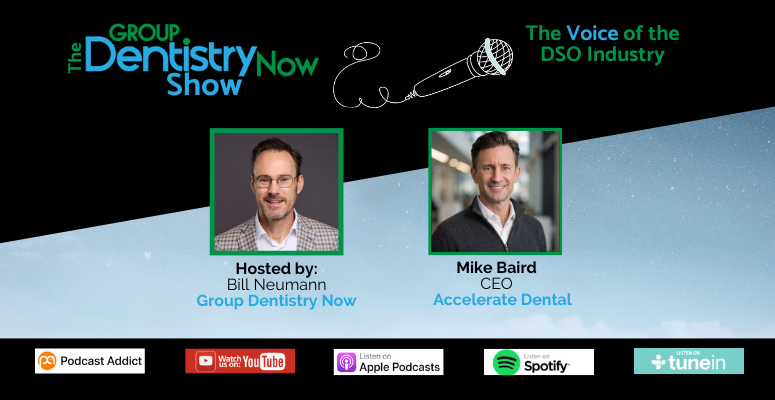
Welcome to The Group Dentistry Now Show: The Voice of the DSO Industry!
Accelerate Dental Challenges the Traditional DSO Model
Mike Baird, CEO of Accelerate Dental discusses:
- The problem with traditional DSOs
- The perpetual partnership model explained
- Industry challenges & future growth
To learn more about Accelerate Dental visit: https://www.acceleratedental.com/
To connect with Mike Baird you can find him on LinkedIn here: https://www.linkedin.com/in/bairdmike/
Subscribe to our channel for more episodes and stay updated on the latest DSO news, insights, and events!
If you like our podcast, please give us a ⭐⭐⭐⭐⭐ review on iTunes https://apple.co/2Nejsfa and a Thumbs Up on YouTube.
Choose your favorite listening app below and subscribe today so you don’t miss an episode! Full transcript is also provided below. See all of our podcasts HERE.
 |
 |
 |
 |
 |
 |
DSO Podcast Transcript – Accelerate Dental Challenges the Traditional DSO Model.
Bill Neumann (00:00):
Hey everyone. Welcome to the Group Dentistry Now Show. I’m Bill Newman and as always, we appreciate you joining us today. We have with us an emerging dental group to watch winner from 2025. Mike Baird’s the CEO of Accelerate Dental. And we’ve had Mike on the podcast once before, a bunch of years ago when he was the CEO of Henry Shine One. We had him recently on a webinar with other emerging groups to watch winners, but this is going to be a nice conversation. Learned a little bit about Mike, his background before he got into dental, how he went from where he was to Henry Shine One, and then why the heck he decided to start a group. But good to have you on.
Mike Baird (01:01):
Thanks, Bill. Super thrilled to be back.
Bill Neumann (01:06):
And we bump into each other on occasion at different group practice shows. So was it 80SO that I saw you?
Mike Baird (01:16):
That’s correct.
Bill Neumann (01:18):
Yeah. And then before that was probably when you won your award in Utah and you were there for an hour, right? You kind of hopped on stage, accepted the award, sat through the panel discussion and had to leave. I think you’re in the midst of some type of acquisition or there’s something going on with the business. Not acquisition. You
Mike Baird (01:37):
Remember well.
Bill Neumann (01:39):
Yep. You’re
Mike Baird (01:39):
Exactly right.
Bill Neumann (01:41):
Yep. Well, Mike, why don’t we kick things off with a little bit about your background? And I told you this before and it’s okay for me to ask this question. I want to start to ask my guests, get a little bit deeper into their background. So let’s start at the beginning or at least your work life beginning. So what was your first job, the first one you had?
Mike Baird (02:04):
My first paid job was working in a KB toy store at a mall over a Christmas season. This probably would’ve been in 1991 or 92 or so. And this was the Christmas of Barney. All I remember is all the parents coming in and screaming at me because they couldn’t get their favorite purple dinosaur for their kid. But it was also interesting because it was private equity owned and ended up going bankrupt. And maybe that set a course for some of my interactions with the private equity space.
Bill Neumann (02:37):
That’s funny. So you didn’t know at the time, but it actually guided your direction. KB, I remember KB. Yeah. We had Kitty City was another one that was around. I don’t know if that was in your part of the country or not, but they’re pretty much, I don’t know if any of them exist now.
Mike Baird (02:56):
That’s right. Yeah.
Bill Neumann (02:58):
Yeah. No toy stores that I know of or maybe some local toy stores. So that was like a Christmas job. And then anything else that you had? Any other jobs while you were in high school or college?
Mike Baird (03:12):
All the same kind of mowing lawns and wherever I could pick up some spare dollars. My dad actually ran a retail jewelry store and I used to work there on weekends helping out. So kind of a retail environment. Very difficult business with lots of ups and downs. And so I started off at an early age deciding I was never ever going to be an entrepreneur and we always know how that works out. Here I am having founded a couple companies since then. I
Bill Neumann (03:40):
Think retail’s a great experience though. I mean, just having to deal with the public and how interesting that can be sometimes I think. And especially as a kid, it can even be because your exposure to adults is typically your parents. And then when people that are your parents’ age or older come in and don’t act like your parents, sometimes it can be a little challenging. So you did that. And then let’s talk about the after college. What were some of your first, not that those weren’t real jobs, but your first real full-time job after you graduated?
Mike Baird (04:19):
Yeah, I actually kicked my career off at Dell Computers in 1999, the height of the dot-com boom. I’ll never forget that in my first six months there, my shares went up 300% and I though, man, this is going to be really easy. Then of course the dot-com crash came in 2000, 2001. Did business school at Northwestern, ended up being a consultant at McKinsey & Company for four years, which really shaped a lot of my career and wanted me to get into general management. Did a couple stints at a few technology companies in the video conferencing space, and then ended up starting my first business, a company called the Visia that was doing telemedicine. So we helped hospitals connect with their patients through all kinds of virtual means. That was kind of in the 2010 or so arena and spent a decade in that space, took it all the way to an IPO in the middle of COVID, which was a real fun experience.
(05:18):
Then got recruited to Henry Schein one as a former healthcare software guy and spent three years at HS1 working on all kinds of dental tech and trying to move software to the cloud. And that really got me interested into dental and that then led to Accelerate. So it’s been a fun journey.
Bill Neumann (05:37):
I’d love to talk a little bit more about McKinsey because you do see a lot of people in the industry that come from that consultancy type of work. What type of consultancy work did you do? Were you doing a little bit of everything or was it. Yeah, go ahead.
Mike Baird (05:56):
Yeah, I mean the appeal of a model like that is getting exposure to a wide variety of industries and executives in a relatively short period. I stayed there for four years, which is probably about double the norm. I had a couple sectors. I did a lot with the airline industry, did quite a bit in technology, some consumer packaged goods companies. So it was actually a mix of many things, but the appeal I think is always you get exposure to lots of different functional areas. So obviously there’s a general management executive thing because that’s the folks that you’re working with, but also having highlights into deep areas like operations and strategy and marketing, et cetera. That background tends to lend itself to folks that end up wanting to run companies someday.
Bill Neumann (06:39):
Yeah, for sure. Yeah, you definitely see that theme. So you’re at Henry Schein one, you’re the CEO there, you’re on the technology side, you’re playing around with all the different 40 or 50 different brands that Henry Schine one has. And when you were there, you were working with DSOs and group practices, you got a chance to really understand the industry. What made you make the leap from dental tech company to, hey, let’s create a group practice or some alternative to the DSO model?
Mike Baird (07:20):
Yeah, I love my time at Henry Schein one and more importantly with Henry Schein, a very important player in the dental industry. But what was interesting to me was we worked with just about every DSO in large group in the country because almost everyone’s got Dentrix somewhere. And I just recall having one of these moments, very similar when I started my last company where I felt like, wow, someday this telemedicine thing’s going to be a big deal. Now it took 10 years before that actually came to fruition in COVID, but I kind of had similar feelings watching DSOs and the larger group practices, depending on how you measure that, somewhere between, I’ll call it 20, 30% penetration. And contrasting that with my experience in the healthcare arena where roughly 80% of doctors are part of a corporate-owned group right now and feeling like, wow, this is an industry in the state of change.
(08:10):
And I think that there will need to be multiple options for where this goes. And I feel like predominantly there was one model. I know everyone says if you see one DSO, you’ve seen one DSO. But for the most part, they follow very similar themes. We bought as many doctors as we can. We have a relatively short five, seven, eight year whole period, and we want to recap and do something else. And as I talked to doctors, I felt like there was room for something else. And so my co-founders and I really wanted to start something unique and novel in the space that was different, not just in, oh, well, everyone else takes 100% ownership when we take 80, so somehow we’re different. Well, you still have majority ownership, so what actually changes? We really wanted to try to do something very different. And that really was what intrigued me was being at a state in the industry where there was going to be a lot of change.
(09:02):
And I think we feel that now. This is definitely going to be the decade of change where dentistry transforms, and it’s a really fun time to be in the space trying to carve out differentiated options for dentists.
Bill Neumann (09:16):
So Accelerate Dental founded in 2023. So interest rates at that point, it started to creep up. And there was a lot of pressure, I think, on groups that had acquired practices. Maybe that was the only way they knew how to grow was through acquisition. Then they had to deal with some issues with lenders that were all of a sudden raising their rates and holding onto a bunch of practices that maybe they paid a little bit too much for, or maybe didn’t necessarily fit the culture they were trying to build. So there was this slowdown, almost like this halt in M&A anyway. And the growth really changed from acquisitional growth to same store growth. We hear a lot about that. So you and Tom Sorber, and Tom was in the industry as well, so you both decided to start Accelerate. Can you talk a little bit about how you came up with the idea for the model?
(10:20):
How do you go. Okay, because like you said, you’ve seen one DSO, you’ve seen, but you’re right, they’re very similar the way they’re built. And so the models to a degree have been kind of not proven out, but there’s a traditional model. So you went the opposite direction. So we got to create something else. So how did you go about doing that? And tell us what that looks like now.
Mike Baird (10:44):
Yeah, I think if we go back in history, I feel like COVID was really a big catalyst moment for DSOs and large groups. And in particular, 2021, 2022, a huge influx of capital. I feel like overnight there’s 250 different private equity-backed DSOs coming into the market. And I feel like the last major investment was probably November of 2022. And suddenly 2023, everything dried up. Valuations plummeted, interest rates were high, all the things we talked about. Seems like the perfect time to start a demo group. So we started in 2023. As I said, when we looked at the models, we started off by talking to a lot of dentists. I mean, we talked to over a hundred dentists and said, “What are you looking for in the space? What are your challenges? What are you trying to accomplish?” And I think there’s a little bit of sifting between the hype of what the perfect promise is of a DSO.
(11:40):
Join a group, we’re going to get big, we’re going to recap, everybody makes a lot of money.That’s the promise. I don’t know that that really happens. And what we saw was an opportunity to do something very different. And so our focus is really along three key points. One is that we resolve to always be a minority partner in the practice. So for reference, it’s like 99.5% of groups out there are going to be majority owners. It’s pretty much a requirement if you’ve got a private equity-backed institution. And we just felt like at the end of the day, we want the dentists to be the owners. Number two, we wanted the group to be owned by dentists. We didn’t want this to be private equity backed. So while we brought some of our own personal capital in, when we really got this running, we had 25 initial dentists that invested.
(12:29):
We now have almost 50 dentists that are investors. We wanted this to be something that they owned and the benefits and returns would accrue to the dentist. So again, there are lots of groups that have dentist involvement of some sort, but we aspire to be the majority of that ownership going to dentists. The third thing that I think really differentiated us comes from that deep-seated view that I had from healthcare that as we’ve watched healthcare evolve over the last 30 years of private equity and corporate involvement, it actually hasn’t been great. 80% of clinicians, as I said, work for a corporate entity. I don’t know any general practice physicians that tell their kids to be doctors anymore. And so when I looked at dentistry, we said, “Well, do we want that model the same here?” And again, I have nothing against private equity. I’ve worked with private equity firms most of my career, but we thought, “Well, wouldn’t it be great if this was something that instead of outside forces controlling the industry, the dentists themselves could do something?” And we looked for analogs and really settled on true partnership models like law firms and accounting firms.
(13:38):
And frankly, my experience at McKinsey, which was a partnership organization where if you look at something like Deloitte, it’s owned by the accountants. You eventually hit a senior level where you become an owner, you have this fantastic career. When you’re done, you sell to another partner at the firm and it becomes a perpetual entity. And we looked at dentistry and felt like there was no one doing a model like that, a long-term partnership model. And so we resolved to come out, we call it the perpetual model, was something that wasn’t about recaps, that wasn’t affected by interest rates, that didn’t have a ticking five-year clock where I need to sell for my investors. And instead, let’s focus on an arena where we can partner with polydental practices and literally have a 50-year mindset of, well, look, we know this practice is going to go through a variety of doctors, a variety of locations as it expands and grows.
(14:30):
But if we have an eye towards really long-term hold, we think this can be quite great. And what that does is span the difference between a traditional DSO owned model where there are a lot of benefits that come with scale on best practices and pricing and things of that nature, but also the control benefits that solo practitioners really enjoy. And we though we could use something like this to empower the entrepreneurial solo practice, private practice, to then also have some of the benefits of being in a group that provides scale. And so the combination of those three things really make up what we think is a very differentiated model versus the normal, I own 51% plus and we’re going to recap in five years kind of model that you see in most DSOs.
Bill Neumann (15:23):
So you call it a dental partnership group. And again, there’s a lot of new acronyms out there, so it gets kind of confusing. And I’m sure you deal with this when you’re talking to dentists that want to become or potentially want to become partners with Accelerate Dental. Do you call them partners? Is that what you would call it? Yep.
Mike Baird (15:42):
Partner doctors.
Bill Neumann (15:44):
Partner doctor. Can you maybe take me or take the audience through this exercise? If I’m a potential doctor partner, and let’s say my practice valuation is determined to be a million dollars, we figure it out, that’s what it is, everybody agrees that’s what it is. I want to partner with you. You talk about never owning more than 50% of a practice. So there’s some investment that Accelerate makes in the practice, and then that comes from the doctor owners and probably the executives as well, the money that’s already pooled in there. Take me through where that money comes from, and then what does the ongoing relationship looks like? So once I partner with you after the transaction is done, what can I expect?
Mike Baird (16:42):
Yeah, great question. The way we do it is very different. This is not a, we come in and give you a bunch of cash to be owners in your practice. In fact, our core philosophy was we are here to build on top of what you have. So if your practice is worth a million dollars today, that’s yours, that’s your value. We want to participate in the growth that we create together. And we have a mechanism for that. We kind of build a preferred equity for our partners and measure our ownership based on the growth that we create together. We also have an element where, and so we don’t give any cash when we close with our practices. It’s really a partnership on future growth. The second element is we let them exchange some of that value if they want for ownership in the group because we wanted to have a way for them to do that.
(17:30):
And so both them being able to partner with us and us being able to partner with them, we’re typically doing somewhere between a five and 25% equity swap of some sort whereby in a tax-efficient way, they become owners in 40 other practices. It’s actually a way to diversify your practice and vice versa. Then we become owners with them. And so it’s a little bit of a different structure, but our dentists like it because one, it helps us sort out those that are looking for a quick hit. Oh, I was hoping to get $3 million and then walk away tomorrow. Well, that’s not our model. We want to partner with you till the end of your career and then help you pass it on to somebody else. And so it acts as a self-sorting mechanism. We want doctors who want to grow and they want to participate in their own growth.
(18:17):
And so on average, we end up owning about 30% of our practices over time. And again, as we grow, as we create that additional value for them. And then over time, the ongoing relationship, we charge a support fee. That’s what funds the accounting and HR resources and benefits teams and procurement and all those things. We charge a 5% support fee. Actually, it’s probably on the low end for most groups. Generally, we find that we cover that cost. So usually profit goes up after we join. So we’re able to provide those costs at a cheaper rate than what they were paying for. And then it just becomes something where we settle in together as partners to figure out how to grow the practice. The difference is that there’s not an event. They’re not waiting on some recap. It’s custom-tuned to whatever that doctor is. And that exit for them comes in one of two ways.
(19:12):
For their practice, whenever the time is right and they want to retire, we’re helping them bring in associates and eventually monetize their practice by selling to that associate. And generally, we’re getting them really nice valuations because we’ve improved the structure of that practice. It becomes a much more profitable practice. It’s usually a multi-doctor practice. And so similar to what other DSOs do, we’re creating value in the operations that that doctor is then able to monetize when they sell to their associates. And the nice thing is we can actually do that in chunks. It doesn’t have to be a, “Well, the day I turn 52, I want to be out.” It’s more like, “Well, what if I want to cut back to owning 30% of my practice and then 15 and then 10? And maybe I still want to work a week a month with my favorite patients as I retire so I can have money to travel or whatever it may be.” But we’re much more flexible.
(20:01):
We’re not waiting on some theoretical recap that may or may not be aligned with the other needs of the doctors. And so typically we’re on a time schedule for that practice that’s aligned around those doctors’ needs. The second part of it is their ownership and accelerate. We have an internal stock price. They can sell that at any point in time to other dentists in the group and/or we are willing as a group to buy it back. We use our profit proceeds to buy that back when dentists want to sell. And so again, it operates like a normal law firm partnership or accounting firm partnership. And primarily they get to hold and benefit from the assets of the firm until they’re ready to retire, at which point we generally buy them out. So that’s typically what that life cycle looks like for a dentist over time.
Bill Neumann (20:46):
Excellent. Yeah, thank you. Thanks for clearing that up. That’s much different than what the typical partnership, acquisition, affiliation, whatever you want to call it looks like. What’s the reception been like? And you started in 2023, so we’ve got three years now of feedback. I mean, is it a surprise when they hear about the partnership opportunity or do some people like I did need a thorough explanation because it’s relatively foreign to them?
Mike Baird (21:25):
Yeah, I think the biggest challenge is people have a perception of what a group is or a DSO is. And as I’ve explained, we’re very different. Yes, we’re a group, but the way we operate is just a wholly different model that’s completely unrelated to the normal valuation recap cycle that you hear from other investor-backed DSOs. And so that’s always a little different. But in terms of reception, we feel like the response has been fantastic. We found another small group that had about 15 practices that we merged with early on that had this similar partnership model. And then we’ve added another almost 25 practices since then. And again, I don’t know how others have grown, but we feel like it’s been a pretty fast clip in every one of our additions has been through word of mouth. We don’t work with brokers other things. We just find dentists that have reached a point where they’ve pushed really hard, they’ve tried to grow their practice, and they just feel like they need a little bit of help and partnership.
(22:24):
And so by partnering with us, they get exposure to best practices. They get exposure to back office help, all the things that you would see otherwise, but they’re still in the driver’s seat. We’re very fond of saying that the dentist is the CEO of the practice. And because we’re minority partners, we literally can’t force them overturn, do the things that you would typically see and/or feel. I think most groups are not coming down with a hammer on things, but they definitely would have a perspective, whereas we’re much more of a long-term partner. And what we’ve found is that that’s borne out in the results. So while we’ve got about three years as Accelerate, the group that we merged into, those original 15 practices have about 10 years now of expertise. We’ve retired several of the doctors in that group with these buyouts. We’ve been able to see that model go through completion through a retirement.
(23:13):
And what’s been great is we find that on average, if you look at a five-year window, in that five years on average, we double the collections of the practice. So we’re typically doubling the size of the practice. We’re typically taking their equity up about 2.5 X from where it was, which again, points to profit growth really. That’s what drives that increase. And typically our dentists are seeing about a 50% increase in their ongoing personal income, their pay, some combination of production pay plus profit distributions. And so those are really good numbers and dentists love it. And so what happens is then they start telling their friends, well actually, because it’ll come up eventually. Oh, have you heard about this DSO or that DSO? What are you thinking about doing? And they say, “Well, actually, I’ve joined this interesting little group and I’ve been with them for a couple of years now, and this has been my experience.” And we’ve found that to be a much better way to attract dentists and partners is through word of mouth than anything we could ever do on our own.
(24:14):
As we start to get bigger, we’re going to start pushing a little more. We feel like we’ve proven out something that’s really exciting, but that’s been the life cycle of how we find folks, the reception out there, and it’s been a really positive response thus far.
Bill Neumann (24:29):
All right. Let’s shift to the state of the industry. Definite malaise, some may call it interesting times in the dental industry for sure. We talked a little bit about some of the reason for that. We had the interest rate increase, inflation. There’s some things going on geopolitically now that I think we’ve got some hesitation from patients. You hear treatment acceptance is down in some cases. Recall is a little bit more challenging in some cases too. So there’s challenges to the industry as well. I do also think what we’ve seen is there was a negativity against DSOs. There was 10, 15 years ago, DSOs bad. And then when valuations were great and money was cheap, all of a sudden that got really quiet. We didn’t hear much about that anymore. And now we’re back to hearing that again where doctors maybe that have partnered with DSOs are still waiting on a recap or that equity that they rolled over, they’re like, maybe it’s not worth what they thought it or were told it would be worth.
(25:47):
So there’s a lot of that going on. So now there’s a lot of hesitation, I think, for doctors to want to partner with DSOs because of this new reality. So a lot of things going on all at once. Talk a little bit about how you see the state of the industry and how that affects not just DSOs and groups, but the private practitioner, really the docs that you’re partnering with.
Mike Baird (26:14):
Yeah. You mentioned a lot of the environmental things that are big pressures on practices right now. I mean, I would add labor costs have been a really big challenge, especially coming out of COVID and the departure of a good chunk of the hygiene market. And it’s not like on the insurance side that we’ve seen commensurate increases in payments, et cetera. So let’s really put a squeeze on practices. And I think, as you mentioned, focusing in on more solo practitioners, I kind of look at it a little bit. One of my clients at McKinsey was Walmart. And we talk about the Walmart effect over time, whether it’s KB Toys, whether it’s Home Depot, whether it’s Walmart, we see these expansions to groups because they get better supply costing, better insurance rates, better operational scaling and things of that nature. And so the reason that we then feel like we can help a solo doctor, most solo doctors are struggling.
(27:13):
I’ve looked at the ADA data over the last 15 years, we’ve seen something like a 15 to 22% decrease in average wages for dentists over the last 15 or so years. And a lot of that’s because the inputs coming in, assume it’s a developed practice, it’s not a de novo, it’s been around for a while. Generally, they’re seeing 2% annual patient growth, but the rates are the same. So if your top line is relatively static, but your costs and bottom line and things of that nature keep creeping up, that profit has gotten squeezed down to where most of the dentists I meet, an average dental practice in the United States is doing about 800K in production. And so most dentists that I meet that are in the million dollar range are usually running at what we’ll call a negative 5% margin, meaning they take home everything that’s there, but it’s the equivalent of 22 to 27% of production pay.
(28:13):
And we look at that model and say, “We think doctors should be making 32% production pay. So you’re actually negative margins. And we measure ourself by figuring out ways to get you to full pay and then to have profit on top of that.” And the only way that I see that in our current market is leveraging scale. And this is where I think the DSOs are incredibly good. There’s a reason why MB2 and Heartland and others are owned by top tier private equity firms. It’s because they see it as a great profit producing model. So what drives that? Can we start to get real savings implies, which has been really challenging because imagine if you are Patterson and 20% of your book of business is very large DSOs with massive negotiating scale and you’re giving them 30, 40% discounts. Well, you’re not just going to accept the bottom line that went down.
(29:05):
So where are you going to get those increases or stay static? Well, you’re going to pass it on to the people that don’t have that negotiating leverage. And so our job then is to help make it easier for those dentists. So instead of being the ones that are on the short end of the stick with insurance companies and with suppliers, et cetera, and on the labor challenges, well, now we want to get them to be part of that same club without having to sacrifice that long-term ownership and control of their office. So we’re able to get them the same supply discounts and procurement discounts to help them better negotiate with insurance companies, to figure out how to put some of those operational best in class improvements into their practices, to look at better scale in hiring and recruiting, which is really hard for dental practice.
(29:48):
I can throw something up on Indeed, but that doesn’t mean that I have dedicated recruiters that are working on my behalf every day. And so those are the things that we then think can make a solo operator start to look a lot more Or the efficiency that you see in a well-run PE-backed dental group, DSO. And so that’s the hope is that we can bring them that hybrid set of benefits without having to sacrifice the control.
Bill Neumann (30:18):
I’m curious when a doctor partners with Accelerate, is there something like a year out that they go, gee, thank goodness there’s this one thing that stood out, thank goodness you’re now supporting us when it comes to this, whether it’s procurement or recruiting, or is there one item that always kind of bubbles up to the top or is it just depends on the group or the practice that you partner with?
Mike Baird (30:48):
It definitely depends on the practice or group, but I would say there are a couple of things that are easy wins that are nearly impossible for them to do. Obviously procurement. I mean, literally on day one, we can snap our fingers, switch over new contracts, and you see an immediate change in your supplies costs. So that’s super easy. On day one, we bring in full-time recruiters that are helping bring people into your practice. So last year, I think we hired 50 some odd people across our practices. So those are associates and assistants and hygienists. And while it’s still not easy, it’s a whole lot easier when you’ve got a dedicated team going after that. And so I think that’s an area where they also feel some significant help and improvement. And then the last one that I would say is really, and we’ll talk more about this, I suspect, is technology.
(31:34):
If you are a solo dentist, it’s really hard for you to do widespread pilots and trials across the massive variety of software solutions that are on the market today. And that’s one where it sure is nice to have someone that you could just lean on and say, “Just tell me what works.” And that doesn’t mean that it doesn’t take a lot of effort on our part because we’re building pilots and working through different offices and gathering the data. But I have the ability across 40 practices to try out different solutions. And I think that’s one that is really helpful to them to get a quick opinion on, well, here’s a good merchant provider that you can use. Here’s a great call service that you can use. Here’s a great financial tool set or reporting interface or whatever it may be. That’s one that I think takes a lot of stress off our doctors right out of the gates.
Bill Neumann (32:28):
Yeah, I’d love to talk a little bit, and it doesn’t hurt that you worked at Henry Shine one too, so you had a little bit of experience when it came to technology as well. So you’re evaluating technology and you’re right. I mean, the amount of tech out there for dentistry, it’s overwhelming. And you go to any trade show now, whether it’s for solo practitioners or DSOs, and it has to be 75% are company AI, right? It’s whatever the first name of the company is with AI at the end. So there’s a ton of technology out there. So talk a little bit about maybe some of the solutions that you’re evaluating right now or just some that you’ve maybe already implemented and are super excited about.
Mike Baird (33:10):
Yeah, great lead-in. I feel like, and you’re spot on. And the problem is you’ll find 20 solutions in every category. I’ll use AI receptionist right now. That’s a very hot topic. And every show I go to, I meet five new vendors I didn’t know about, and the demos all feel exactly the same, call this number and you hear something, but how does that translate into operational performance? So if I were to look at the things that are top of mind right now, so obviously anything that impacts ongoing profits, so merchant services is a big one for us. We’ve trialed out more than a dozen different providers to find the ones that work really well or actually becoming really big fans of surcharging, which I think isn’t a surprise across most groups of putting that into play. Another area of huge focus has been AI imaging.
(33:56):
So we did a variety of tests across the major vendors. And after our pilot, we were able to pick one that we really liked and most of our practices have adopted. Of course, in our model, they have the freedom to pick another one if they want to, but at least they get the guidance of the experience we’ve seen. So AI imaging has been a big one. As I mentioned, AI receptionist I think will be huge once we lock in on a model that really works. I’ve had a couple failed pilots there where it hasn’t quite been as seamless as we’d like, and/or we’ve gotten some big complaints from customers that just felt like they’re not used to it quite yet, though I think that tipping point’s going to come a lot quicker than we think. And then another area, and obviously looking at things like data analytics and platforms, patient remarketing and communications, those are all big.
(34:47):
But probably the biggest area where I’ve seen the most amount of new entrants in the space has been on RCM and collections. And it’s a really tricky area. We still haven’t found a solution that we really love. I feel like we’ve had a lot of promises. We’ve done, oh, probably almost a dozen pilots in that arena. And I really believe that we’re pretty close to getting some great solutions there. But those are all examples of technology areas that are having a huge impact. And most of those ones that I mentioned, the receptionist, the RCM stuff, the imaging are all in that AI category. And I would say if there was anything, one of the frustrations over the last 30 years is that effectively reimbursement rates haven’t changed, and yet all the labor and supply costs and things have gone up. But if there was a positive thing going forward, I think AI is going to be a significant positive factor in dentistry because it will finally give real labor efficiency savings and help.
(35:49):
Most dental staff are working their tails off. They just need more tools to help them be more effective. And so I’m actually really excited to see how that plays out. And we’re still an early inning. I think a lot of the early tools are pretty fantastic. But just like if you look at what the internet was in 2000 and what it was in 2025, it’s a very different world and we’re going to see a lot of innovation on the AI front.
Bill Neumann (36:15):
So what does the next chapter look like for Accelerate Dental? You have approximately 40 locations. You’re Utah, Wyoming, Idaho. So where do things in the next couple of years, what’s the blueprint look like? Where are you headed?
Mike Baird (36:33):
Yeah, I mean for the first three years, we really wanted to prove that the model worked. We wanted to prove that doctors were excited about it, that we could bring them on well and get them integrated into the various tool sets and that we could exit them for those that wanted to retire. And we’ve now been through enough of those cycles to feel pretty confident about our model. And now it’s about expansion. I’d say we’re pretty focused on the West right now. We definitely have hopes to be a nationwide model as soon as we can. But right now we’re pretty focused on Arizona, Colorado, Washington, Oregon, Nevada, all the states that are out in this neck of the woods because we do believe there’s a geographic component to it. It’s really nice to be able to bring your doctors together. Because our doctors are all co-owners, they want to spend time together.
(37:18):
They want to share best practices. They want to host other dentists in their office to teach them how to do implants or to become CEREC experts. And so we’ve tried to build out from the base in that regard, but for us, it’s definitely going to be about growth and figuring out ways to identify those entrepreneurial doctors that are attracted by a non-private equity model and sort of a long-term distribution play. And we’re pretty optimistic about our growth prospects over the next couple of years in this arena.
Bill Neumann (37:53):
Excellent. Well, this has been a fun conversation, really enlightening too. I’ve really got a chance to. I though I knew your model, but now I really know it and understand it. And if there’s any dentist or somebody that might have a small group in the audience that really wants to explore the Accelerate model in greater detail, what’s the best way to do that?
Mike Baird (38:16):
Yeah, so anyone can write me anytime. I’m just at mike@acceleratedental.com. You can go to our website, Accelerate Dental. We love talking to doctors. Whether or not we’re the right partner or not, we’re pretty passionate about our model and love to share what that looks like, if it can be helpful to other groups as they try to grow, because we just think it’s a great thing for clinicians to stay owners of their practices long-term. So we’re always up for a discussion and happy to help anyone that we can.
Bill Neumann (38:45):
Excellent. Well, thanks so much. And we’ll drop your email address. It’s acceleratedental.com, so that’s pretty easy. We’ll put that URL in the show notes. And then also I want to drop the emerging dental groups to watch 2025 article also in the show notes so you can really learn about the history of Accelerate Dental. And we also have that webinar that I’ll put that in. So there’ll be a bunch of great resources in the show notes to learn as much as you want about Accelerate, and then reach out to Mike, someone on his team, and find out more. But appreciate the time, Mike. This has been really, really a lot of fun and we’ll make sure that we get you on in a year or two and find out where things are and maybe some of those new states that you’ve entered into. Maybe you even end up in the central part of the country or on the East Coast by that time.
(39:37):
But then thank you everybody for watching us or listening in. And until next time, this is The Group Dentistry Now Show.