
Clinician’s Corner – Educational Content for Clinical Directors,
Chief Dental Officers, Clinical Boards and the Entire Clinical Team.
Sponsored by Kerr
The Nuances of Restorative Dentistry
The realm of restorative dentistry is constantly evolving, driven by advancements in materials science and a deeper understanding of clinical procedures. One of the most critical components in this evolution is the development of dental bonding agents. These agents play a pivotal role in ensuring the longevity and efficacy of dental restorations, particularly when working with various substrates such as zirconia. Understanding bonding agents is essential for dental professionals aiming to achieve successful clinical outcomes.
Bonding agents are designed to create a strong adhesive bond between dental materials and tooth structure. However, the complexity of these agents can pose challenges, especially for younger clinicians who may not have extensive experience with the myriad materials available today. There is a common pitfall: the misunderstanding of how different bonding agents interact with different substrates. For example, when using an etch-and-rinse system with zirconia, practitioners may inadvertently reduce bond strength due to the competitive bonding of phosphates present in phosphoric acid etch. This misstep can lead to a false sense of security, as clinicians may believe they have adequately bonded the restoration when, in fact, they have not.
The importance of education and training in understanding bonding agents cannot be overstated. Dental professionals must be well-versed in the properties of the materials they are using, including the specific bonding agents and their compatibility with various substrates. Using a bonding agent that allows for self-etching, which simplifies the process and minimizes the risk of errors, is critical. Such agents can bond effectively to multiple surfaces without the need for additional primers or complex etching protocols, thereby reducing the potential for failure.
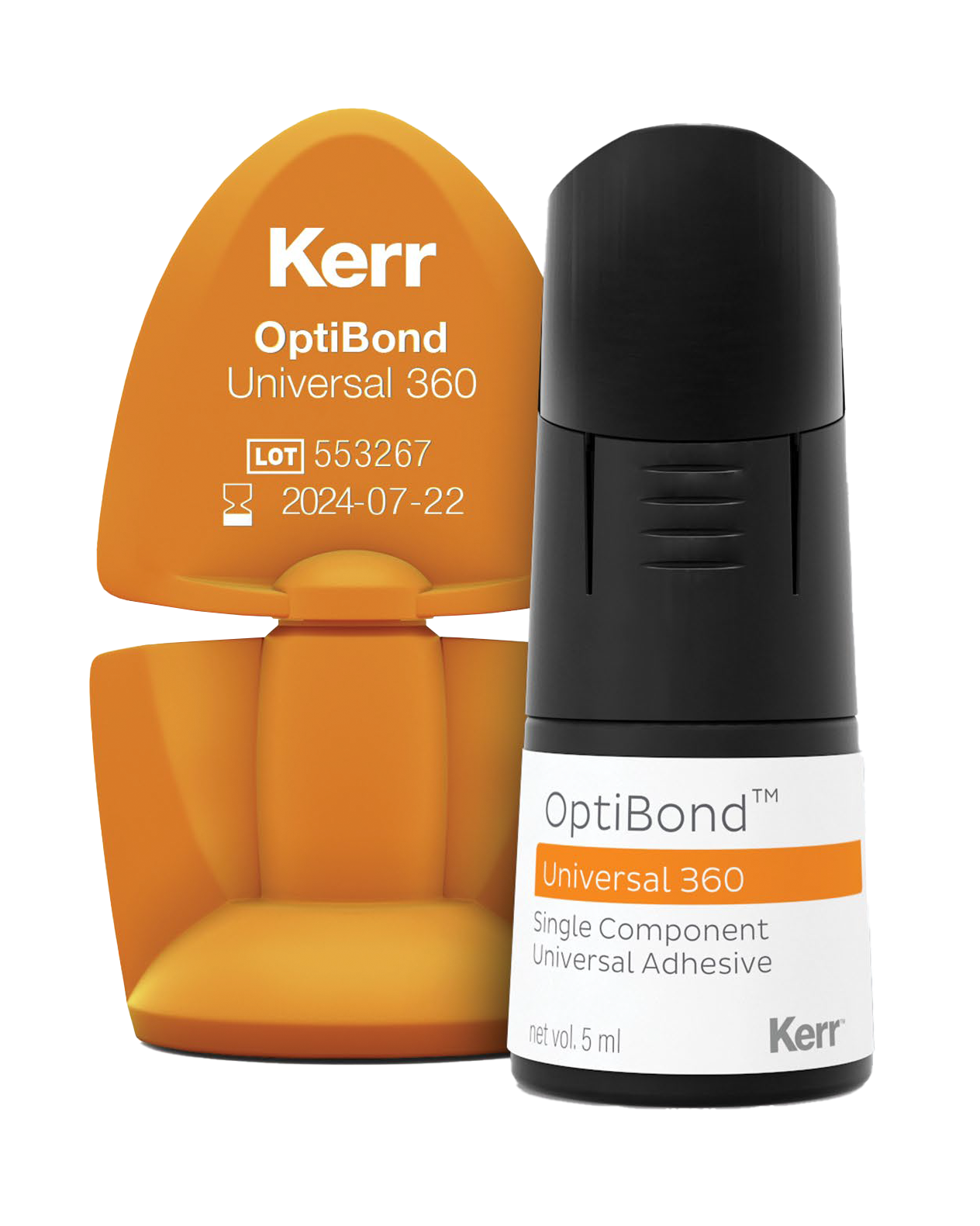
OptiBond 360 retains GPDM, Kerr’s proprietary multi-primer, preserving its ability to bond reliably across a wide range of substrates, while also incorporating MDP. Although MDP has been used in other multi-primers and bonding agents for years, this is the first time it has been integrated into Kerr’s own universal adhesive. The result is a complementary chemistry that delivers the advantages of both GPDM and MDP. Clinically, this translates to improved etchability and stronger, more consistent bonds across multiple surfaces, including traditionally challenging substrates such as zirconia and dentin. In addition, OptiBond 360 features a thinner viscosity and reduced film thickness, supporting improved adaptation without compromising bond strength.
“I find that the OptiBond Universal 360 by Kerr works exceptionally well and better than some of the others I’ve tried.” -Dr. Matthew Miller, Clinical Associate Professor at UNC Adams School of Dentistry
Innovation in the development of bonding agents.
The introduction of agents that cure quickly and effectively with high-powered curing lights exemplifies the trend toward efficiency in dental materials. The ability to achieve a strong bond in a matter of seconds streamlines the restorative process, allowing practitioners to focus on patient care rather than being bogged down by complex procedures. As these advancements continue, it is imperative for dental professionals to stay informed and adapt to new technologies that can improve their practice.
Many core buildup materials are not compatible with universal bonding agents, with only a limited number demonstrating consistent tolerance. OptiBond 360 distinguishes itself by offering true universal compatibility across buildup materials. In clinical practice, this has translated into improved reliability. For example, clinicians who previously experienced buildups dislodging with provisional restorations have reported that this issue was resolved after transitioning to OptiBond 360, reinforcing its practical value in daily workflows.
The same philosophy extends to luting cements. From an operational and clinical standpoint, maintaining a streamlined inventory is advantageous, reducing both product redundancy and the risk of material expiration. An efficient approach is to rely on a single, versatile bonding agent paired with a universal resin cement that can address the majority of clinical indications. Maxcem Elite resin cement exemplifies this strategy.
Beyond its broad clinical applicability, it offers predictable handling and efficient cleanup. The clear shade, which presents as a frosted, slightly opaque formulation rather than a true transparent, helps preserve the value and esthetics of restorations without imparting a gray hue. Additionally, its integrated primer chemistry aligns well with OptiBond systems, allowing for seamless use in combination and supporting consistent, dependable bonding outcomes.
“In a Dental Advisor study of OptiBond 360, bonding to traditionally challenging substrates such as dentin and zirconia, demonstrated exceptional performance. When failure was induced, it did not occur at the adhesive interface. Instead, separation occurred within the tooth structure or within the restorative material itself. Bond strengths exceeded 30 megapascals, well above the 25-megapascal threshold typically considered indicative of a superior bond, underscoring the durability and reliability of the adhesive under clinical conditions.” – Dr. Matthew Miller, Clinical Associate Professor at UNC Adams School of Dentistry

The evolution of dental bonding agents serves as a microcosm of the broader advancements in restorative dentistry.
Emerging trends in dental materials are increasingly centered on biocompatibility and bioactivity. While adhesive performance and bond strength have reached a high level of reliability, the next phase of innovation is focused on how materials can actively support remineralization and tissue interaction. This shift extends beyond bonding agents to a broader range of restorative products that are incorporating regenerative and mineral-releasing properties.
At the same time, material science is advancing at a highly granular level, with greater attention to filler particle shape, size, and loading. These refinements allow manufacturers to manipulate light transmission, optical properties, and overall esthetics, while significantly enhancing mechanical performance. Materials that were traditionally considered weaker, such as flowable composites, are becoming markedly stronger as a result of optimized filler design and improved stress distribution. Although these materials are not yet positioned to fully replace packable composites, current development trajectories suggest meaningful convergence in the future.
The journey toward streamlined dental materials is characterized by a focus on efficiency, collaboration, and continuous innovation. By embracing these principles, dental professionals can enhance their practice, improve patient care, and ultimately contribute to better clinical outcomes. The future of dental bonding agents is bright, with ongoing research and technological advancements poised to further refine the tools available to clinicians. As we move forward, it is imperative that practitioners remain informed about these developments, empowering them to make decisions that benefit both their practice and their patients. Through this ongoing evolution, the dental profession can continue to provide high-quality care that meets the diverse needs of patients in a rapidly changing healthcare landscape.
Learn more about OptiBond Universal 360