
Ranked the #1 DSO Podcast!
Welcome to The Group Dentistry Now Show: The Voice of the DSO Industry!
The Evolution of Dental Bonding Agents. 2026 Clinical Insights from Dr. Matthew Miller, Assoc. Professor, UNC.
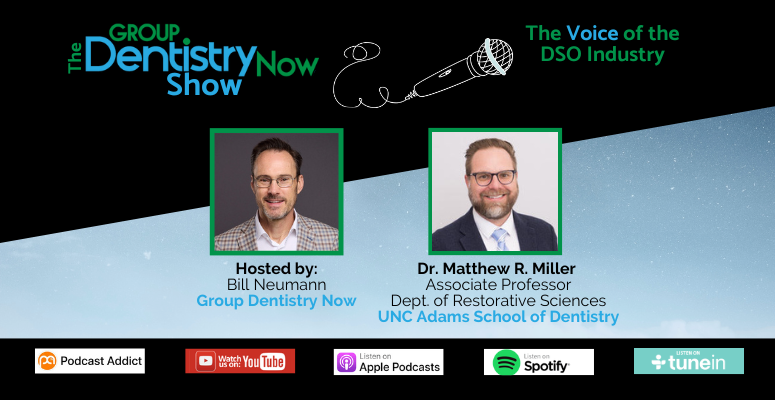
Dr. Matthew Miller, Associate Professor, Department of Restorative Sciences, UNC Adams School of Dentistry joins the GDN Show. Dr. Miller takes us through the evolution of dental bonding agents and highlights today’s innovations. He discusses:
- history of bonding agents
- simplicity, strength & universal use
- technique & education
- much more
To contact Dr. Matthew Miller:
Email: Matthew.Miller@unc.edu
Learn more about OptiBond Universal 360:
Visit https://www.kerrdental.com/en-us or go to https://dso.pub/360.
Subscribe to our channel for more episodes and stay updated on the latest DSO news, insights, and events!
If you like our podcast, please give us a ⭐⭐⭐⭐⭐ review on iTunes https://apple.co/2Nejsfa and a Thumbs Up on YouTube.
Choose your favorite listening app below and subscribe today so you don’t miss an episode! Full transcript is also provided below. See all of our podcasts HERE.
 |
 |
 |
 |
 |
 |
DSO Podcast Transcript – The Evolution of Dental Bonding Agents. 2026 Clinical Insights from Dr. Matthew Miller, Assoc. Professor, UNC.
Welcome to the Group Dentistry Now Show, the voice of the DSO industry. Join us as we talk with industry leaders about their challenges, successes, and the future of group dentistry. With over 200 episodes and listeners in over 100 countries, we’re proud to be ranked the number one DSO podcast. For the latest DSO news, analysis and events, and to subscribe to our DSO Weekly e-newsletter, visit GroupDentistryNow.com. We hope you enjoyed today’s show.
Bill Neumann: Hey, welcome everyone to the Group Dentistry Now show. I’m Bill Neumann. And again, as always, thank you for watching us or listening in. We always have a vast array of topics and conversations and guests. And I was thinking about this one as I was going through the notes. And it takes me back to about 20 years ago when I used to sell restorative materials and how far we’ve come as an industry. And I’ve got a great guest on that’s going to give us a nice history lesson on where we were when it came to bonding agents and restorative materials and where we are today and how I think this is really going to affect your clinicians in a positive way. But it wasn’t that long ago that things were a heck of a lot more complicated than they are now in dentistry. And with that, I want to make sure that the clinical directors the dentists in our audience and even the operations and procurement people that are involved in making decisions on products get a chance to really dive into this podcast. So if you’re somebody that, you know, is has somebody in mind that needs to listen to this podcast, just make sure you send them that link afterward. And we’re going to get going here now. We have Dr. Matthew Miller. Thanks, Dr. Miller, for being here today.
Dr. Matthew Miller: Oh, it’s my pleasure. I’m really excited to be part of this. Thank you.
Bill Neumann: Yeah, this is going to be fun. I think it’s going to be enlightening. I mean, you’re used to talking to a lot of clinicians and you’ve got a lot of clinicians that listen to this podcast. But we’ve got the other element of non-clinicians that are, you know, maybe different degrees of understanding the materials that their clinicians use day in and day out. And I think this is going to be really helpful. for them as well. And we have a lot of younger docs too that are working in some of the larger group practices that maybe don’t know the history of bonding agents. So go through your background a little bit and then please, if you take like three or four minutes to fill in the blanks, because, you know, you have for being in the industry, you know, being a clinician for what, about 18 years, is that right? Yes. Yeah, so you’ve got a lot going on here. So I’ll try and get through it all. I’m sure I’m going to miss a couple things. But Dr. Matthew Miller is a clinical associate professor in the Department of Restorative Sciences at UNC Adams School of Dentistry. And he also has a private group practice in Huntersville, North Carolina. Clinical ambassador and editorial board member for The Dental Advisor. I know The Dental Advisor really well. You do some work with CUR on their endodontic and restorative advisory boards. And by the way, thank you, CUR, for sponsoring this podcast. We really appreciate that. Beyond that, you’ve got a lot more, so I’m going to kind of let you kind of take it from there. I know you’re a key opinion leader and you have a lot of white papers out there.
Dr. Matthew Miller: Oh, thank you. Yeah, thank you so much. So I actually just sold my practice to my partners August 1st. So I’m in a relatively new role at the University of North Carolina, their dental school as an associate professor, and I work in the clinics with the pre-doctoral students, mostly third and fourth years, but I’m also a course director for a couple of courses at the school. So it’s been exciting. We’ve moved from Charlotte to Chapel Hill and it’s been a wonderful transition. and just a really wonderful next chapter in my career. I work with, you’re right, I work with several companies, you know, CUR being one of them. I’ve been on their endodontic advisory board for many, many years, and then their resorted advisory board, and then dental advisor for the last several years as well. I also work with other companies like Garrison, Blue Light Analytics, LaboMed Microscope. So I have my hands in a lot of different, you know, different areas. And then there’s other companies that I consult for just helping them with product development, product testing. So I love materials science. I love biomaterials. I love imaging, implants, endo, resto, you name it. That’s really kind of my passion is all encompassing dentistry. And in my clinical experience as a practicing dentist, I’ve been in small practices, I’ve been in large group practices and my practice I was at the last 13 years where I was an owner, we had four of us partners and then we had four associates. And we did a lot of complex specialty work and just all encompassing general dentistry. So we offered various interdisciplinary services and my scope of practice was predominantly complex reconstructive care and endodontics and implants. And I worked with the interdisciplinary team as well. So I tend to kind of focus more globally in my approach, but When you’re doing things like that, it’s very important to be very systematic and efficient. And it can’t just be efficient only for me. It has to be efficient for the other practitioners and clinicians and team members in the office. Early in my career, and I was in practices where, you know, we would have a special material for each individual procedure. And nowadays, you know, I guess for like a bonding agent is a great example of that. You know, a bonding for agent for direct materials and then indirect materials, then your core buildup and so on and so forth. And nowadays we’ve, I’ve been able to work with companies on streamlining their efficiency, streamlining their materials so that we can not only have better control of our inventory, less technique sensitive procedures, but also increase our outcomes and our success, not only for the practice, but most importantly, for the patients.
Bill Neumann: So I think this is where the history lesson might come in. You know, the bonding agents have been relatively complicated to use. And like you mentioned, there were certain bonding agents for certain applications or certain situations. And I think it became something that I know that a lot of times we would see failures or hear of failures and it wasn’t always the product. It was maybe the product used in the wrong circumstance or because the directions were relatively lengthy that people didn’t necessarily follow directions a lot of times because there were so many different steps. And so maybe I’ll stop there and I’ll kind of let you take it from there.
Dr. Matthew Miller: No, you’ve got the experience of it too. And you’re exactly right. The directions sometimes by the manufacturers were intentionally vague. And, you know, when we think of the principles of adhesion and bonding, they’re very technique sensitive. They can be, historically anyway. The fourth generation’s really set the gold standard with what we know as adhesion and bonding. And that’s kind of something like OptiBond FL, Kerr kind of pioneered that pathway for us. And it’s a great bond and it still is. It’s got to be used correctly and it has some limitations in its use regarding primers and so forth, but it does a great job to establish a hybrid layer and a really nice stable bond at the Denton interface, because it’s a little bit thicker. Then the fifth generations came out and they weren’t that great. There was a lot of failures with those and people kind of had some more sensitivity and more issues with them. And then the sixth generations came out and that really also is up there with the fourth generation bonding agents for being the gold standard. And the sixth generation started to introduce a better version of that self-etching primer. And now sometimes you had two bottles, sometimes you use them independently, sometimes you mix one-to-one ratios of the two, you know, bottle one, bottle two. And then manufacturers said, well, how can we streamline this and maybe make it a one bottle system? And with the seventh generations, what happened is the acid was too strong. And then we had over-etching, we had post-up sensitivities, but we weren’t getting as good of a bond as we were with the fourth and the sixth. So then the eighth generation’s really kind of stepped it up, and that’s where we have these universal bonding agents. And now we’re kind of at the 8.2. So we’ve got built-in primers for zirconia, metal, glass ceramic, composite, tooth. We have capabilities to use them in any etching modality. So you could use a total etch or etch and rinse. You could use a self-etch or selective etch. And you can also use them for multiple purposes, whether it’s as your primer, root desensitization, for your direct, your indirect, so on and so forth. Where we’ve run into problems with some of these is with some dual curing resins and the acid interface. Now the newer 8.2s are starting to have a better milder acid yet still be more effective. than some of the previous generations. So they’ve come a long way in the sense that you can use them just about any way you want and in any modality, whether it’s light curing, dark curing, primers, all of the above. And it’s taken out of the technique sensitivity that we used to always have. So now a lot of clinicians can get the same success and you don’t have to keep up with so much of an inventory or worry about the technique sensitivity to them. The other benefit to having that is it helps streamline your inventory and your costs. It just makes life easier because no tooth is the same, no case is the same, so it allows you to be a lot more dynamic.
Bill Neumann: So again, for the non-clinicians listening, you can tell just by Dr. Miller’s explanation with all the different generations and the different steps and kind of the I think that the thought process was that it was advancing in a way that was trying to do a couple of things, right? Stronger bond. less steps, you know, easier. And then I think the other issue that you brought up is the sensitivity issue. And it’s one of those things where you have a restoration done and it was pretty commonplace that you would have. And it was I don’t know what the percentage was, was relatively felt like a high percentage. People would come back with some or complain about some type of sensitivity. A lot of times it would resolve and in a relatively short period of time, another cases, it may have lasted a little bit longer. But, you know, from a patient experience standpoint, not necessarily a great thing. So we fast forward to OptiBond Universal 360. Talk a little bit about this solution and how that kind of relates to, is this an 8.2 or is this beyond an 8.2 generation?
Dr. Matthew Miller: Yeah, great question. I think it’s in that 8.2 kind of emerging trend, advancing it forward, because it does a lot of unique things. One of the things that’s nice about some of these new universals is you don’t have to refrigerate them and wait for them to warm up to temperature. And I do want to note that, you know, if used properly, the earlier bonding agents, they all work. It’s just now we’re getting to the point where we’re making it easier for it to work. So I think we have, generally speaking, a greater amount of success over, you know, across many people. With the OptiBond 360, it still has the GPDM, which is the Curve’s multi-primer. So it still bonds to all kinds of surfaces, but they’ve added in MDP. Now MDP has been around for a while. It’s in other multi-primers, it’s in other bonding agents, but this is a first for Curve to incorporate it in their own. And so we get the best of both worlds where we have the benefits of the GPDM, and then we have the benefits of the MDP. And what does that mean? Well, it means that we can get a better etchability and a better bond to multiple surfaces. So, you know, when we look at historically difficult surfaces to bond to, whether it’s zirconia or dentin, we’re getting a much higher bond strength there. The viscosity of this 360 is thinner, so it has a lower film thickness. So you don’t have to worry about, is my inlay going to fit or is my crown or my veneer going to seat down after I use this? Another thing that I think is really, there’s a couple other features that I really love about this bond that kind of separates it from some other universals. One is that it’s ultimately compatible with all materials. So I mentioned a moment ago about acid interface and some of the dual curing resins. This is universally compatible, so you don’t have to use some sort of activator or something like that. So it’s almost like typo blood, and that’s kind of how I describe it. It’s like the universal recipient kind of thing. So any dual curing resin, whether it’s your buildup, your cement, composite, it will do a self cure or dark cure as that dual curing resin is curing. So if your light can’t reach it, or maybe you don’t want to light cure it, it will cure and harden with that dual curing substance. The other thing I really like about it is the bottle design. Now, over time, I’ve used different bottles. I’ve done unit doses, but I love this bottle because it’s a very controlled dropper. And it’s not just in the beginning, it’s all the way through to the bottom of the bottle. So sometimes, you know, you shake that bottle and trying to get those drops out when you’re midway through or maybe two thirds of the way through the bottle and a lot comes out. So you don’t have to worry about waste and you don’t have to worry about, you know, too much, you know, coming out. So it’s really controlled and the cap automatically flips open. So you push a button and it automatically flips. So it’s a really ergonomic feature. One thing I was teaching on, I was giving a continuing education lecture on Friday and we’re talking and I don’t know if people realize this, but bond is expensive. You know, we sell it in the 0.5 milliliter bottle. So you got half a milliliter. If you were to have a gallon of bond, it would roughly cost $300,000. So when you put it like that, having something that is efficient to use, it’s cost savings. I don’t need a bunch of other things like primers and other, other bonding agents for various procedures. Then I have a control dropper. You know, we’re saving money and we’re saving time.
Bill Neumann: I think that is that is a great point we used to say, and I know gold’s gone up a lot in value, but we used to say that bonding agent actually was more per ounce than gold. So probably still is. So you’re right. That’s it’s no exaggeration. You want to get every single drop literally out of that bottle that you that you can because it’s expensive. Yeah. When we talk a little bit, you talked about some of the ideas of simplifying the bonding process. What’s your experience with maybe younger clinicians that don’t have as much experience with just material handling in general? Have you seen younger clinicians find this type of bond, this universal 360, easier to use than some of the older generations?
Dr. Matthew Miller: Definitely. It’s not technique sensitive. It’s, you know, these universals are HEMA based. I’ve used them like in a hygiene appointment if someone has sensitivity on the root surface, you know, I’ve used them that way. But I find that the 360 works exceptionally well than some of the others I’ve tried. I’ll give you a great example of where I think younger clinicians get tripped up. because we have so many different substrates and materials out there and zirconia is really prevalent. If we’re using an etch and rinse system, for example, like if we have to blue etch or use phosphoric acid etch, then use our primer, then our bonding agent or combination thereof, the phosphoric acid reduces our bond strength at the zirconia level. So if we’re closing the endodontic access through a zirconia crown, we think we’re doing a good job by etching the tooth and the inside of the access, and then we rinse it, and then we think we’re doing a good job by putting our primer and our bond. Well, the phosphates bond competitively to the zirconia surface. So what we ended up doing was bonding to the tooth, but we have little to no bond at the zirconia. And then if you’re going to put in a primer that’s, you know, for like a ceramic primer or zirconia primer, not all of them are indicated for use in the mouth. In fact, multi-primers typically aren’t. So you need to find a bonding agent that has it. And there are some that do, and there’s some that have the glass primer as well. So thinking of things like that and not getting tripped up in the steps, can be kind of challenging. I mean, dentistry can be kind of tricky in that way where we’re not trying to do harm or a bad job, but sometimes we think we’re doing a good job and we make a mistake like that. So what I love about this bonding agent is it bonds to everything. So I can just self-etch and scrub, you know, the surface, and then I air thin it, and then I light cure it. And it’s got a five second light cure with a high power curing light. So anything, when I say high power, I’m not talking about like on a boost mode, I mean like a thousand metal watts per centimeter squared. So that’s most curing lights on the market, like most good performing curing lights. So five second cure, so it’s quick and easy, a 20 second scrub on the application and we’re done. So I don’t have to worry about acid etch. I don’t have to worry about additional primers for the ceramic. It’s really nice in that regard where I think unless you really understand the materials and how adhesion and bonding work to their fullest potential, I think it’s easy to have areas for failure where we may not realize it. We might not know where the problem or maybe we’re using it incorrectly.
Bill Neumann: I think that’s really important. And I think it’s one of those areas that I would say bonding agents and then, of course, cements can be pretty complicated as well, too. And you’re using them hand in hand. So then it becomes a multiple of challenges. And you have different materials that you’re using. So, yeah, from the standpoint of education, I mean, what are some maybe some recommendations from your perspective as a professor? If you are running a group and you are a clinical director and you’re trying to manage or limit failures when it comes to bonding agents, do you have any thoughts on how you could train Dennis better to really just anticipate you know, how to use different materials in different situations, especially when it comes to, you know, bonding agents and the different materials, whether it’s zirconia or something like that, that they’re using now. And again, it’s kind of a wide question, but education seems to be this area that is overlooked by some groups, unfortunately. And I think it’s an area where, you know, just it seems to me to be you’ve got younger dentists working there. The education might not be there. And that’s when there’s really just an opportunity for for issues.
Dr. Matthew Miller: No, you’re exactly right. And sometimes people just don’t have the time to spend educating and mentoring. That’s something that I think does take time and it’s important to do that. Where I have found maybe some simple solutions in this scenarios are to use materials that are you know, have outstanding results, right, that anybody could use in any technique in any mode. So I think having a situation like a bonding agent that I could use as my primer, it’s not super yellow, it’s not super thick, so I’m not accidentally gonna have, you know, too much material so my crowns don’t seat. I’m not going to, I don’t have to light cure if I don’t want to, right, if I’m worried about it not seeding all the way, or maybe I wasn’t paying attention very well with my light curing and I didn’t get all the surfaces. And so having that ability of having that dual curing cement or buildup or what have you to finish the cure or polymerize that bonding agent or start and finish it is very beneficial and very helpful. So when you’re working with a lot of providers and maybe you have a busy practice, I like to have one bonding agent. I don’t want to have all these other things you have to get for your buildup, for your cement, for your fillings. And by the way, most buildups don’t tolerate universal bonding agents. There’s only two that do. But the one thing about this OptiBond 360 is it’s universally compatible. So I was talking to a dentist who was having problems with his buildups coming out with the temporary. As soon as he switched to the 360, he said, problem solved. You know, he emailed me this week. So that’s exciting to hear. Then we get to the cements. I don’t want to have a whole lot of different cements because they might expire. I’m not going to need a bunch of colors. What I typically did was we had, if I’m a clinic director, I want one bonding agent that I can do everything with. I want one universal resin cement. I typically, I love the Maxim. There’s a lot of great cements out there, but I like the way it cleans up. I liked it in the clear color because it’s not truly a clear, it’s more frosted and opaque. So it’s not going to bring the value of your restoration down by making it gray. It has the same built-in primers. So I use it in conjunction with my OptiBond. I can bond to anything with it. And then if I can’t do adhesion, like let’s say I’ve got too much saliva or too much moisture, then of course I have my RMGI. I like the aesthetics and the balance of the Nexus RMGI. And then outside of that, I have my veneer cement. My thought is if the color of the cement can change the outcome of the restoration, then my curing light can penetrate the ceramic and then I don’t have to worry about having a dual cure element. But I mentioned it, like having the MaxM, same thing with the MaxM and the NX3 are unique in that they’re dual curing, but they are color stable. So most dual curing cements have something called a tertiary amine, which over time yellows. So think about it, you’re doing veneers, you’re doing crowns in the anterior, and you want to bond them in place. Well, a couple years from now, that cement might start to discolor and turn yellow or brown, and now your restorations don’t look as aesthetic as they used to. So if I’m a clinic director, I want to have things that work right now, that are easy to use, and I can use them in any way, shape, or form. And then I want to have long-term success, right? So with my Maxim, I can also use it as a core buildup. So now I just made life easy for buildups. I’ve made life easy for cementing and for post and cores, it’s very, you know, that’s a really, uh, you know, a, a unique scenario where you usually have to get your post kit, your core, like, and you get your core buildup material, your core buildup bond, then you shift gears and get your regular bond, or maybe you keep the same one and you get your composite or your buildup material. Well, now I just scrubbed the whole canal and tooth for 20 seconds with OptiBond 360. I don’t like curate. I inject in Maxim into the canal, put my fiber post in, finish my buildup with a Maxim, cure it all at the same time, and I just did it all at once, and it was very easy. So there’s things like that where when you’re busy and you don’t have time to train, you maybe have some new auxiliary or new teammates that you don’t want to complicate the steps. Having a bond that can do everything, having a cement that can do everything, makes life a lot easier.
Bill Neumann: I mean, a lot of great points there. I mean, you’ve got, you know, you’re not sacrificing aesthetics, you’re not sacrificing strength, but you’re limiting the inventory. And I can, you know, imagine, you know, from what you’re saying, I mean, the inventory of the different cements, the different bonding agents, you know, even talked about the different posts solutions, the fiber posts versus, you know, the just injecting core buildup straight into the canal or going to a stainless steel or titanium. So we really are kind of now all of a sudden really, you know, limiting, but, you know, increasing, you know, the success rate. And also the patient satisfaction, you mentioned the yellowing. I’ve had that happen with veneers before where all of a sudden, you know, my veneers don’t look the same color that they did a year later and I don’t drink that much coffee. So it wasn’t that. So, you know, most likely it was what you were saying, it yellowed over time, the cement. You know, maybe wrap everything up here a little bit. Talk about reduced chair timing. What are your thoughts about that? Because a lot of our audience is thinking about, OK, is this is this going to save us money? Is this, you know, going to reduce the chair time? I think we’ve. really talked about it. And I think to a degree have proven that, yeah, it’s it’s it’s easier, right? Like this is going to be easier for clinicians. I think we can pretty much say that it’s going to be if it’s used properly, more successful because it’s easier. There’s fewer steps. It has more applications. Let’s talk a little bit about, you know, just what you think from a reduced chair time. I think there’d be some interest in that. How much chair time do you think you really can reduce?
Dr. Matthew Miller: I mean, I guess it’d have to be quantified by the speed of the practitioner, but I think you can reduce minutes at least because historically, Um, you know, when you’re doing these, uh, cementation protocols, it could take, you know, sometimes several minutes just to kind of etch and prep. So you still have to etch your glass ceramics. Maybe you particle abrade your zirconia. But outside of that, let’s say it comes that way from the lab. You try it in the mouth, you disinfect it or decontaminate it. You know, you used to have your one step that would take a minute, like your primer. I could just scrub my OptiBond in there. And then while my assistant’s doing that, I’m in the mouth and I’m either using air particle abrasion or Pumice or something to clean the prep or something I like is like Katana cleaner. That can be used in the mouth and on the substrate on the crown. So we can use that to clean. So while my assistant is putting on the Opti-On on the crown, I’m putting it on the tooth. I don’t have to light cure if I don’t want to. So let’s say you have a 20 second curing light or a five second curing light. Well, there’s time there. And then you can squirt in the cement, put it on, tack it up. It has a 10 second cure, but you could let it fully set after four minutes, five minutes. The cleanup is so easy, that right there saves you a lot of time. You know, where else it saves chair time that people don’t often consider is the lack of re-use. The lack of post-op sensitivity, patients coming back saying they have an issue. So, you know, when you’re looking at the totality of how does this save me time and how does it save me money? Well, I’m not having to redo stuff. I’m not having to have that patient back in to problem solve, right? Or to do damage control and, you know, but if anything, it actually builds revenue because we’re building success. We’re building referrals because patients don’t have complications. So not only in the moment, Does it save you material and steps? And they’re quicker to work with because you can use them in multiple different modalities. But in the long run, they’re saving you time and money because you’re not having to redo stuff.
Bill Neumann: Yeah, I think that’s a great point. I mean, when you think about. People coming back post-op sensitivity failures, whatever. I mean, that’s, you know, first off, you know, they’re not going to come back happy. Nobody wants to come back to the dentist. Right. They just they just don’t want to, especially, you know, when they thought something was going to work or they were told that it was going to work and then it does. Right. So that’s definitely, I think, a pretty big, when you think about it from a time-saving standpoint. Yeah, it’s also patient-saving, right? Literally, you know, the patient continues to come back because they’re happy with the results. You know, as we wrap things up here, just, I’d love to get your thoughts, because it’s a great conversation on bonding agents. I appreciate the history lesson, because it really has changed since I was, you know, actually selling these, and it’s, So it wasn’t a straight, it wasn’t a straight path to innovation. There were some challenges with the different generations. You think, oh, it’s next generation. It’s gotta be better. Well, not, not necessarily, but sounds like we’re to a point where yes, they are better for a variety of reasons. Just the simplification, the strength, you know, the, the less steps, the, uh, I think the ease of use, right.
Dr. Matthew Miller: Yeah, that’s a great point because the next generation doesn’t always mean that it’s better than the previous. And, you know, when we look at where we are now with materials, we’re basically to a point with major manufacturers of modern materials where the error and the failures come from us, either or not. getting isolation, not polymerizing with our curing lights effectively, or using the materials beyond their indications, or somehow not following the technique. And they’ve gotten so simple to use, that’s kind of hard to do. But we’re fortunate that now, the failures don’t occur with the material, the failures occur with the operator. And we did a study at the dental advisor with 360, One of the things we found was when we bonded to dentin and zirconia, and those are usually difficult things to bond to, we found when we tested it to fail, the failure never happened at the adhesive level. The failure happened where the tooth separated from tooth, And the resin, whether it’s composite or cement, separated from the resin composite or cement. It never broke or failed at the adhesion, at the adhesive level. So we were getting over 30 megapascals of bond strength. And when we think of a superior bond, anything above 25 is superior. So we’re really getting up there where the bond is, I mean, it’s strong and it’s really how we use or abuse, if you will, uh, as to whether or not we kind of get these, um, failures.
Bill Neumann: Hey, getting to a point where the bond strength is, is, is. Beyond what you, you need. Right. So that gives you that absolute level for sure. Uh, well, speaking of, you know, just evaluating products as we wrap things up, I’d love to just get your thoughts or maybe insights into what interesting things that you’re seeing out there for the future of the industry, you know, what you can, what you can tell us anyway, because I always like to get insight from people that are looking at products that aren’t necessarily on the market yet.
Dr. Matthew Miller: Yeah, you know, I can speak vaguely, let’s say, with all the NDAs. Where I think, and this is no secret, where I think that emerging trends are when it comes to materials are biocompatibility and bioactivity. You know, we’ve got great bonds, we’ve got great adhesion. How are we remineralizing at this point? So, and it’s not just bonding agents. There are other products that are on the market that are promoting regenerative types of features. And so I think that’s where, you know, we’re going to see more of remineralizing, mineral releasing, bioactivity being kind of incorporated into some of the traditional restorative materials. And then I think we’re getting down to such a granular focus on particle shapes and sizes and fill rates such that we’re able to manipulate wavelength. manipulate the optical characteristics, the aesthetics, and we’ve taken traditionally weaker materials, let’s say like a flowable composite, and then we’re making them substantially stronger. Now we’re not quite there yet to replace a packable composite with a flowable per se, but I could easily see some direction heading that way when we look at filler loads and shapes and stress distribution. That’s just an example. And then, of course, technology, AI is just being infused everywhere.
Bill Neumann: Excellent. Well, hey, thanks for that peek into the future. That’s that’s great. Great conversation with Dr. Matthew Miller. If anybody wants to actually get in touch with you, what is the best way to do that?
Dr. Matthew Miller: Yeah, the best way would probably be just to email me directly. That’s Matthew.Miller at unc.edu. And I’m happy to hear from you and answer any questions you might have.
Bill Neumann: All right, Dr. Miller, we’ll make sure you put that email address in the show notes. And if anybody’s interested in learning more, first off, thank you, Kerr, for sponsoring the podcast. If you want to learn more about OptiBond Universal 360, you can go to curdental.com, and it’s a long URL, so I’ll link to that in the show notes, or we’ve shortened it. You can go to dso.pub, dso.pub, forward slash 360, and you should be able to get right to that page and learn more about OptiBond Universal. So, thanks Dr. Miller and thanks everybody for watching us or listening in today. And until next time, this is the Group Dentistry Now Show.
Thank you for joining us today. Don’t forget to subscribe to the podcast to stay up to date on the latest DSO news, insights, and events. Also subscribe to our DSO weekly e-newsletter at groupdentistrynow.com.