

Sponsored Content
Dental Service Organizations (DSOs) continue to invest significant resources into clinical education, yet many struggle to see meaningful improvements in productivity, case acceptance, and overall clinical performance. The issue is not a lack of training opportunities. It is that most traditional education models are not designed to drive real-world results.
Dr. Lincoln Harris, founder and CEO of RipeGlobal, is challenging that model with an approach rooted in simulation, repetition, and performance accountability. Drawing from his experience as both a clinician and a trained pilot, Harris has developed a system that is increasingly resonating with DSOs focused on measurable outcomes rather than theoretical learning.
From Remote Practice to Scalable Innovation
Harris’s perspective was shaped early in his career while practicing in a remote region of Australia. With no access to specialists, he was forced to expand his clinical capabilities across multiple disciplines. That required extensive travel to the United States and Europe, where he sought advanced education in prosthodontics, orthodontics, and implantology.
As his clinical skills grew, so did interest from peers who wanted to follow a similar path. What began as informal guidance quickly evolved into structured teaching. However, Harris noticed a consistent pattern. Dentists were attending courses, but very few were successfully implementing what they learned once they returned to their practices.
That gap between education and execution became the foundation for a new model.
Why Traditional Education Models Underperform
Most dental education programs rely heavily on lectures and limited hands-on exercises. Even when practical components are included, they often fall short in three critical areas.
First, there is a lack of repetition. Clinicians may perform a procedure once or twice in a controlled setting, which is not enough to build speed, confidence, or consistency.
Second, the training environment rarely reflects real clinical conditions. Courses are often held in hotels or simulation labs that lack the tools, workflows, and pressures of a functioning operatory.
Third, there is little to no exposure to stress. In reality, clinicians must manage time constraints, patient anxiety, and operational challenges simultaneously. Without training under these conditions, skills often break down in practice.
As Harris puts it, “Under stress, people’s capability drops by 85%. If we train pilots the way we train dentists, they’d all be dead.”
The comparison highlights a key point. Aviation training prioritizes repetition, simulation, and performance under pressure, while dentistry has historically emphasized theory over execution.
Bringing Simulation into the Operatory
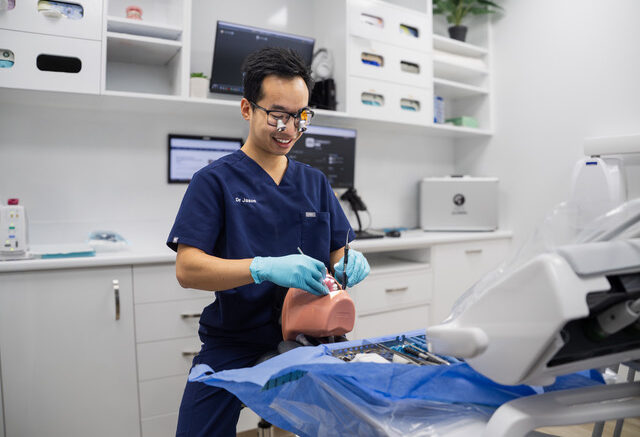
Ripe Global’s model addresses these shortcomings by shifting training into the dental office itself. Instead of removing clinicians from their environment, the program brings simulation directly to them.
Using in-office simulation kits, clinicians practice procedures in their own operatories with their existing equipment, materials, and workflows. This eliminates the disconnect between training and application. It also removes a common barrier for DSOs, where clinicians return from external courses requesting new materials or systems that may not align with organizational standards.
The emphasis on repetition is equally important. In a single training session, clinicians may complete 15 to 20 crown preparations under time constraints. This volume builds both efficiency and confidence, helping to eliminate the overthinking and perfectionism that often slows down clinical performance.
The result is a dramatic increase in implementation. While traditional education models see adoption rates around 15 percent, this approach has driven rates above 60 percent.
Aligning Education with Business Outcomes
For DSOs, the success of any training initiative ultimately comes down to financial impact. Education must translate into improved production, better case acceptance, and stronger EBITDA performance.
Harris emphasizes that point directly: “A DSO doesn’t care about return on investment. They care about does it increase their EBITDA.”
Programs are therefore designed to focus on high-impact procedures that can quickly influence revenue. One example is the overuse of large multi-surface fillings. In many cases, these procedures could be replaced with crowns or onlays, which offer better clinical outcomes and significantly higher production value.
By improving both clinical decision-making and patient communication, clinicians are better equipped to present these treatment options confidently. This combination of skill development and case acceptance training creates a direct link between education and financial performance.
A Performance-Based Model with Measurable Results
A key differentiator in this approach is the use of performance-based accountability. Training is not simply delivered. It is measured, tracked, and in some cases guaranteed.
Programs often include ongoing coaching, monthly check-ins, and data reporting back to leadership. This provides DSOs with visibility into both clinical progress and operational challenges that may be limiting performance.
The results have been significant. Some organizations have reported productivity increases exceeding $100 per hour per clinician within a matter of months. Payback periods can be as short as 80 days, with overall returns reaching as high as 17 to 19 times the initial investment.
This level of accountability is a departure from traditional continuing education, where outcomes are rarely tracked beyond course completion.
The Role of Change Management in Clinical Training
Even the most effective training model will fail without the right implementation strategy. One of the most common mistakes DSOs make is attempting to train all clinicians at once with limited resources.
A more effective approach is to start with a smaller group of highly motivated clinicians. By concentrating resources on this group, organizations can generate strong early results and create internal advocates for the program.
These early adopters become proof points for the rest of the organization, driving organic interest and participation. Over time, this creates a more sustainable and scalable model for change.
Harris reinforces this strategy with a clear takeaway: “Your biggest returns come with investing in the top 80% of the dentist, not the bottom 20%.”
Rather than focusing exclusively on underperformers, DSOs can achieve greater impact by elevating those who are already positioned to succeed.
Building a Pathway for Advanced Clinical Growth
Once foundational skills and productivity improve, clinicians often seek opportunities to expand into more advanced procedures. This includes areas such as implantology, aligner orthodontics, and full-mouth rehabilitation.
Ripe Global supports this progression through structured fellowship programs that combine simulation, mentorship, and real patient experience. These programs are also tied to performance metrics, ensuring that new skills are actively applied in practice.
In some cases, DSOs are implementing performance-based sponsorship models, where clinicians earn subsidized or fully covered training based on achieving specific production milestones. This further aligns incentives and reinforces accountability.
A New Standard for DSO Education
As DSOs continue to grow in size and complexity, the limitations of traditional education models are becoming more evident. Lecture-based courses and centralized training facilities are difficult to scale and often fail to deliver consistent results.
Simulation-based, in-office training offers a more practical and scalable alternative. By focusing on repetition, realism, and measurable outcomes, this model aligns clinical education with the operational and financial goals of modern dental organizations.
For DSOs looking to improve clinician performance, increase retention, and drive meaningful growth, the evolution of training may prove to be one of the most important strategic shifts ahead.
At Pacific Smiles Group, our partnership with RipeGlobal has been a game-changer in how we develop and support our clinicians. The impact has been clear both clinically and commercially, making a tangible difference in confidence, productivity, and overall engagement.” -Troy McGowan, Pacific Smiles Group