
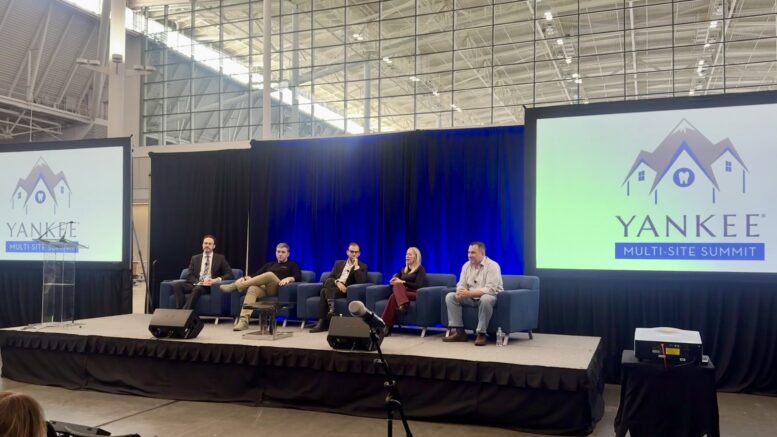
Didn’t make the Yankee Dental Congress Multi-Site Summit? No worries! We’ve got you covered. Listen to the entire DSO C-Suite panel discussion here.
A Candid Look at DSO Leadership in 2026
Held at the Yankee Multi-Site Summit on Friday, January 30, the panel titled “Inside the C-Suite: Growth, Innovation, and Integration in the Modern DSO” brought together a powerhouse group of executive leaders representing multiple C-suite disciplines and operating models. CEOs, operations leaders, and marketing executives from some of the most active and thoughtful DSOs in the country shared an unfiltered view of how they are navigating growth, technology adoption, operational discipline, and cultural alignment in a rapidly evolving dental landscape.
Moderated by Bill Neumann, CEO, Group Dentistry Now, the discussion featured Alyssa Carlin, Director of Dental Operations, Simply Dental Management, Dmitry Burshteyn, CEO, Progressive Dental Management, Ryan Torresan, Chief Marketing Officer, Mosaic Dental Collective and Adam Richichi, CEO, Archway Dental Partners. Collectively, they offered a 360-degree perspective on what it takes to scale responsibly, remain profitable, and continue delivering high-quality patient care amid economic uncertainty and accelerating innovation.
What emerged was not a single playbook, but a set of shared principles grounded in discipline, operational clarity, and a renewed focus on organic growth.
Click play below to listen the original recording of the panel discussion:
Setting the Stage: A Diverse C-Suite at the Same Table
One of the defining strengths of the panel was the diversity of roles represented. Two CEOs, operations leadership, and a combined CMO/COO provided complementary viewpoints on the same core challenges. While their organizations vary by geography, ownership structure, and growth trajectory, the panelists agreed on one thing early: 2026 will reward focus, efficiency, and execution more than sheer scale.
The panel also reflected geographic diversity. With several New England–based DSOs alongside a West Coast platform, the conversation surfaced both regional nuances and universal pressures, from labor constraints to patient affordability.
Founder-Led Flexibility and the Efficiency Imperative
Dmitry Burshteyn, CEO and founder of Progressive Dental Management, opened with a candid reflection on his path into leadership. Rather than being hired into the role, he built his organization from the ground up, launching the company in 2010 and growing it into a multi-specialty platform across general dentistry, pediatrics, orthodontics, and oral surgery.
Burshteyn was direct in his assessment of what matters most in 2026.
“The number of locations doesn’t matter if you’re not productive in the chairs you already have. Efficiency is what actually drives profitability.” — Dmitry Burshteyn, CEO and Founder, Progressive Dental Management
Efficiency and productivity, he argued, outweigh the optics of scale. The number of locations on a map may look impressive, but profitability is determined by how effectively chairs are utilized and how consistently teams perform. Fixed costs such as rent and supplies can only be controlled so much. Culture, workflows, and operational discipline, on the other hand, are fully within leadership’s control.
For founder-led organizations, flexibility becomes a strategic advantage. Without the constraints of private equity timelines, Burshteyn emphasized the ability to buy, sell, and reposition offices as needed, always with an eye toward operational performance rather than raw growth.
From Regional Practice to Multi-State Platform
Adam Richichi, CEO of Archway Dental Partners, offered a complementary but distinct perspective shaped by nearly 25 years in dentistry. What began a decade ago as Dental Associates of Connecticut, a four-location partnership-driven practice, has evolved into a 40-plus location, multi-state DSO operating across Connecticut and New York, with expansion into Massachusetts underway.
Richichi emphasized that rebranding to Archway Dental Partners was not cosmetic, but strategic. As the organization grew beyond its original geography, the brand needed to reflect its broader vision and partnership-driven culture. Today, approximately 35 percent of Archway’s dentists are equity partners, reinforcing alignment between clinicians and the organization.
“Growth only works when doctors are aligned with the organization. Partnership has been a big part of why we’ve scaled responsibly.” — Adam Richichi, CEO, Archway Dental Partners
Growth, Richichi noted, has been fueled by a balance of organic expansion and disciplined M&A. The platform’s success over the past decade, he said, stems from resisting shortcuts and maintaining a clear value creation thesis for every practice brought into the fold.
Operations in a Multi-Specialty Environment
Alyssa Carlin, Director of Dental Operations at Simply Dental Management, brought the operational lens to the discussion. Her background in orthodontics, training, and development positioned her to help Simply Dental expand resources during the COVID era and later broaden its dental scope.
Simply Dental is a privately owned, multi-specialty organization encompassing general dentistry, pediatrics, orthodontics, oral surgery, endodontics, and periodontics. Since stepping into her expanded role, Carlin has focused on integrating these disciplines operationally while preparing the organization for a slower acquisition environment.
“Once providers can actually see the P&L and understand utilization, the conversation shifts from blame to ownership.” — Alyssa Carlin, Director of Dental Operations, Simply Dental Management
In 2026, Simply Dental is prioritizing same-store growth over acquisitions. That shift has placed greater emphasis on transparency, accountability, and technology adoption. One key initiative involved sharing true P&Ls with providers, particularly hygienists, to help them understand chair utilization, daily averages, and how their decisions directly affect practice performance.
The result was a more engaged clinical team and improved alignment around productivity and patient care.
Marketing Meets Operations on the West Coast
Ryan Torresan, Chief Marketing Officer and Chief Operating Officer at Mosaic Dental Collective, represented the West Coast perspective while underscoring how intertwined marketing and operations have become in modern DSOs.
Torresan’s career spans more than 15 years in dental marketing, beginning at Great Expressions Dental Centers and continuing through multiple DSOs before joining Mosaic. Along the way, he discovered that effective marketing cannot exist in isolation.
Understanding scheduling, provider capacity, and clinical workflows, he argued, is essential to making marketing dollars perform. Without operational readiness, increased demand only exposes bottlenecks.
“You can’t market your way out of operational problems. If the schedule isn’t ready, demand just exposes the cracks.” — Ryan Torresan, CMO and COO, Mosaic Dental Collective
At Mosaic, this insight has driven tighter integration between marketing systems, scheduling tools, and practice management software. Online scheduling, AI-supported call handling, and real-time attribution tracking allow the organization to follow a patient journey from first click through case acceptance.
Torresan was blunt about the need to challenge outdated assumptions. Patients, he noted, increasingly expect Amazon-like convenience. Resistance from teams who believe their patients “don’t behave that way” must be addressed with data, pilots, and mindset shifts.
2025 in Review: A Year of Noise and Adjustment
When the conversation turned to recent performance, the panelists agreed that 2025 was anything but predictable.
Burshteyn described the year as noisy and confusing, even for seasoned leaders. Conflicting signals from the economy, labor markets, and patient behavior required constant recalibration. His response was to tune out distractions and refocus on clear KPIs, culture, and controllable variables.
Richichi expanded on why experiences varied so widely across organizations. Wage inflation, staffing shortages, payer mix differences, and regional economic conditions affected DSOs unevenly. Early 2025 showed strong demand and profitability, but momentum slowed mid-year as patients delayed elective treatment amid economic uncertainty.
Despite the volatility, both leaders emphasized preparation over prediction. By staying lean, monitoring leading indicators, and remaining flexible, organizations can better absorb shocks and capture opportunity where it appears.
Internal Referrals and Specialty Integration as Growth Engines
Carlin highlighted how Simply Dental responded to post-COVID normalization by strengthening internal referral pathways. As external lead flow softened, the organization focused on keeping patients in-house by expanding specialty access.
Adding periodontists and leveraging traveling oral surgeons proved to be a game changer. General dentists were held accountable for internal referrals, ensuring patients received comprehensive care without leaving the ecosystem.
This approach not only supported revenue stability but also improved patient experience and continuity of care, priorities that will continue into 2026.
Technology, AI, and Cutting Through the Clutter
Few topics generated as much discussion as technology and AI. With the exhibit floor overflowing with solutions promising efficiency gains, the panelists acknowledged the challenge of separating signal from noise.
Burshteyn, who advises and invests in select technology companies, stressed that relevance to dentistry must be the primary filter. Tools must demonstrate a deep understanding of clinical workflows, operations, and patient behavior, not just impressive pitch decks.
He pointed to solutions focused on chair utilization, same-day dentistry, scanning, and patient experience as examples of technology that directly impacts outcomes. AI, he noted, is a means to an end, not the end itself.
“AI has to solve real dental problems. If it doesn’t improve chair utilization or patient experience, it’s just noise.” — Dmitry Burshteyn, CEO and Founder, Progressive Dental Management
Richichi echoed the sentiment, drawing a parallel to earlier waves of digital dentistry. While AI garners attention, foundational advances such as digital workflows, on-site manufacturing, and 3D printing have delivered lasting operational impact. Leaders, he argued, must evaluate technology both as operators and as investors, assessing real-world value creation.
Augmenting, Not Replacing, the Human Touch
The panel also addressed concerns around automation and patient communication. While all agreed that human connection remains essential, technology can augment teams rather than replace them.
Torresan described how AI tools are used at Mosaic to reduce missed calls, automate follow-up texts, and integrate scheduling directly into practice management systems. By capturing patients who might otherwise be lost, these tools improve access without eliminating live call centers.
Carlin raised thoughtful questions about maintaining authenticity while leveraging AI, reflecting a broader industry tension. The consensus was clear: technology should enhance efficiency and consistency, freeing teams to focus on higher-value interactions.
Organic Growth as the Ultimate Test
As the discussion shifted toward the future of growth, the panelists converged around a central theme: organic growth is the true measure of organizational health.
Burshteyn dismissed the notion of shortcuts. Sustainable growth, he argued, comes from hard work, honest self-assessment, and relentless focus on patient service. Culture, accountability, and execution matter more than financial engineering.
Richichi reinforced this view, noting that Archway typically targets mid-to-high single-digit organic growth annually. Achieving that requires aligned providers, expanded access through additional clinicians and hygienists, improved case acceptance, and thoughtful payer strategies.
“Organic growth tells you the truth about your business. You can’t hide operational issues when you’re growing from within.” — Adam Richichi, CEO, Archway Dental Partners
In a market where acquisition activity has slowed and valuations have normalized, the ability to grow existing practices has become the defining competitive advantage.
Key Takeaways for DSO Leaders
The “Inside the C-Suite” panel offered a rare, candid look at how experienced leaders are thinking about 2026. While strategies differ, several shared lessons stood out:
• Efficiency and productivity outweigh sheer scale
• Culture and controllable variables deserve constant attention
• Organic growth is the clearest indicator of long-term success
• Technology must serve dentistry, not distract from it
• Marketing and operations must function as a single system
• Specialty integration and access drive both care quality and growth
For both emerging groups and established platforms, the message was consistent. The future belongs to organizations that stay disciplined, invest wisely, and never lose sight of the patient experience.
As DSOs continue to shape the future of dental care delivery, the insights shared by Bill Neumann, Alyssa Carlin, Dmitry Burshteyn, Ryan Torresan, and Adam Richichi offered a timely roadmap for navigating what lies ahead.
Click play below to listen the original recording of the panel discussion: