
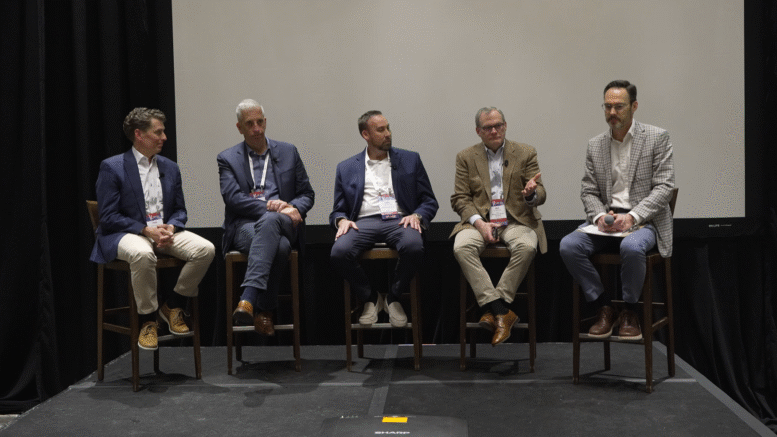
At a recent Texas meeting of the American Association of Dental Group Practice (AADGP), four industry leaders took the stage for one of the most candid discussions in recent memory about ownership structures, capital strategy, governance, and the five-year outlook for dental group practice. (The full panel discussion video is presented below.)
Moderated by Bill Neumann of Group Dentistry Now, the panel featured executives representing three distinct DSO models:
-
Bill Becknell, CEO, Mortenson Dental Partners
-
John McClure, Co-Founder & Chief Development Officer, Aligned Dental Partners
-
Dr. Chris Steele, Chief Clinical Officer, Park Dental Partners
-
Pete Swenson, CEO, Park Dental Partners
While each organization operates under a different capital structure — ESOP, minority private equity, and public markets — the conversation revealed a shared commitment to doctor leadership, long-term stewardship, and disciplined growth.
Three Ownership Structures, Three Strategic Paths
Mortenson Dental Partners: ESOP + Doctor Ownership
Model: Minority ESOP (33%) + Doctor Ownership (67%)
Footprint: 156 practices across 10 states
Revenue: ~$300 million
Founded in 1979, Mortenson has built a culture centered on patient care, community engagement, and team ownership.
MDP is a doctor-centric organization, and that commitment begins at the top. Its nine-member board includes seven practicing doctors, ensuring that clinical perspectives directly shape the organization’s direction and priorities.
The board has also established a highly engaged Clinical Committee composed of three board members and more than 70 clinical team members serving on subcommittees. This structure enables MDP to guide clinical initiatives thoughtfully while keeping doctors at the forefront of decision-making and overall clinical strategy.
The ESOP Advantage
Mortenson implemented its Employee Stock Ownership Plan in 2005. Today:
-
The ESOP trust owns approximately one-third of the company.
- All ownership resides at the TopCo level, where every shareholder participates equally in the same structure. This model aligns outcomes across the organization while providing the greatest opportunity for returns and long-term diversification.
-
Doctors own roughly two-thirds.
-
Employees receive stock through company contributions.
-
An independent trustee represents ESOP participants.
-
Annual third-party valuations determine share price.
Becknell emphasized that team members are called “owners,” not employees. Strategic planning begins with team input, reinforcing shared accountability and long-term alignment.
Growth capital comes primarily from debt facilities rather than equity dilution. Mortenson leverages a $160 million credit facility and long-standing banking relationships to fund expansion.
Aligned Dental Partners: Minority Private Equity, Group-of-Groups
Model: Minority Private Equity Investment
Footprint: 59 locations, targeting ~100 by end of 2026
Aligned evolved from a consulting platform into a DSO in 2023 through the merger of nine group practices.
The “Group of Groups” Strategy
Rather than centralizing operations under a single brand, Aligned functions as a holding company:
-
Divisions retain operational identity.
-
Equity rolls up to a TopCo structure.
-
Back-office services are centralized.
-
Performance is measured at the division level.
In February 2025, Aligned completed a minority recapitalization, selling roughly one-third of the business to a private equity partner.
Governance and Control
Aligned operates with dual boards:
-
A doctor board overseeing clinical governance and new group approvals.
-
A corporate board that includes private equity representation.
Founders maintain control through structured governance rights and economics. McClure noted that private equity typically seeks:
-
Minimum of $8–10 million in clinical EBITDA, or a clear path to reach it, in order to make an initial capital investment into a new platform.
-
Strong management infrastructure.
-
Organic growth plus scalable M&A capabilities.
-
Meaningful doctor equity participation.
The minority structure provided growth capital without sacrificing long-term control or doctor alignment.
Park Dental Partners: The Return of the Dental IPO
Model: Public Company (IPO December 2025)
Post-IPO Ownership: ~85% doctors and team members
Footprint: 86 locations, 200+ dentists
In December 2025, Park Dental Partners completed an IPO — one of the few public listings in the dental space in recent decades.
Founded in 1972 in Minnesota, Park’s IPO was not designed as a liquidity event. It was structured to position the organization for the next 50 years.
A Doctor-Centric Public Structure
Unlike the IPO wave of the 1990s, Park’s governance model protects clinical leadership:
-
Seven-member board.
-
Three board seats appointed by practicing doctor-owners meeting quality benchmarks.
-
Majority independent board to meet Nasdaq standards.
-
Continued heavy insider ownership post-offering.
The company raised approximately $20 million while preserving strong doctor and team equity ownership.
Dr. Steele emphasized that practicing clinicians remain embedded in leadership, ensuring that boardroom decisions reflect real-world patient care dynamics.
Shared Themes Across All Three Models
Despite structural differences, several themes emerged consistently.
1. Doctor Leadership Is Non-Negotiable
All three organizations stressed that sustainable growth requires meaningful doctor ownership and governance participation.
2. Culture Drives Structure — Not the Reverse
Capital models must reinforce clinical culture. None of the leaders framed their structure as an exit strategy; instead, each described it as a long-term alignment mechanism.
3. Long-Term Thinking Wins
Each capital decision was the result of multi-year strategic planning — not opportunistic timing.
4. Capital Is a Tool, Not the Mission
Growth capital enables expansion, technology investment, and recruitment — but patient care remains central.
2026 Capital Deployment: Disciplined Growth
As interest rates stabilize and the aggressive “land grab” era cools, each organization outlined a thoughtful capital strategy.
Mortenson: The “Project Care” Framework
Mortenson organizes investment into three growth lanes:
-
Project Care 1.0: Organic growth within existing practices — equipment upgrades, technology, workflow optimization.
-
Project Care 2.0: Expanding existing locations — adding operatories and providers.
-
Project Care 3.0: Strategic affiliations and acquisitions.
With 8–9% organic growth over the past three years, acquisitions serve as fuel for a repeatable internal growth cycle: acquire, optimize, expand.
Aligned: Chunky M&A and Equity Rollovers
Aligned expects 2026 to be investment-heavy:
-
~40 additional locations targeted.
-
$50–75 million in projected capital deployment.
-
3–4 new divisions of 5–20 practices each.
Their focus:
-
Division-led tuck-in acquisitions.
-
Significant doctor equity rollovers.
-
1–2% of revenue reinvested into CapEx.
-
Heavy investment in education, AI, and infrastructure.
Aligned prioritizes strong clinician-operators over geographic consolidation.
Park Dental Partners: Land and Expand
Post-IPO, Park is focused on:
-
Building density in existing markets.
-
Expanding specialty services.
-
Selective de novos.
-
Strategic entry into new states, beginning with Arizona.
Park’s philosophy: enter thoughtfully, build long-term density, and protect cultural continuity.
De Novo vs. Acquisition: Realism Over Hype
Across all three groups, de novos are viewed as complementary — not primary — growth vehicles.
Common observations:
-
Success depends on the right doctor and team.
-
Demographics and patient flow matter significantly.
-
Experienced clinicians outperform early-career associates in greenfield settings.
-
Many prefer acquiring a base practice and then expanding.
As one executive noted, if predicting de novo success were easy, everyone would build more.
Technology & AI: From Pilot to Platform
Technology emerged as a major driver of organic growth.
All three organizations discussed scaling diagnostic AI platforms such as Overjet, reporting benefits including:
-
Greater diagnostic consistency.
-
Improved patient education and case acceptance.
-
Support for younger clinicians.
-
Earlier detection of preventative care opportunities.
Additional AI applications include:
-
Automated perio charting.
-
AI-powered documentation and scribing.
-
Call center optimization.
-
Revenue cycle automation and denial management.
Mortenson, for example, reduced insurance and collections headcount from roughly 80 to 40 team members while nearly doubling its practice count — largely through automation.
The consensus: AI works, but only with proper workflow integration and strong vendor partnerships.
The Five-Year Outlook
When asked what their organizations would look like in five years:
-
Park’s long-term goal is 7-10% compounded growth and multi-state expansion.
-
Aligned expects continued recapitalizations approximately every 30 months.
-
Mortenson aims to double the business while preserving its ESOP and doctor ownership foundation.
Despite different structures, the strategic vision is remarkably similar:
-
Sustainable, disciplined growth.
-
Doctor-led governance.
-
Operational sophistication.
-
Cultural continuity.
Final Takeaway: Structure Matters — Alignment Matters More
The session closed with reflection on the 52-year legacy of the AADGP and the uniquely American access to capital — from banks to private equity to ESOPs to public markets — that enables diverse growth models.
There is no single “correct” DSO structure.
-
ESOP models can drive deep employee engagement.
-
Minority private equity can accelerate scalable growth.
-
A thoughtfully structured IPO can create long-term access to capital while protecting doctor influence.
What ultimately determines success is alignment — between ownership, leadership, clinicians, and patients.
In an evolving DSO landscape, the organizations that thrive will treat capital strategy not as a replacement for culture, but as an extension of it.
Watch the entire panel discussion here: