

A boardroom-ready perspective on why local dental office brands must become
fast, structured, and AI-readable before high-value patients move past them.
By Dr. Roshan Parikh, GDN Editorial Board
THE SHIFT |
Patients are asking AI engines for recommendations instead of browsing results pages. |
THE RISK |
The uncited office disappears before the consult ever begins. |
THE VALUE |
One high-value implant case can justify years of site and GEO investment. |
Picture the patient every growth team wants.
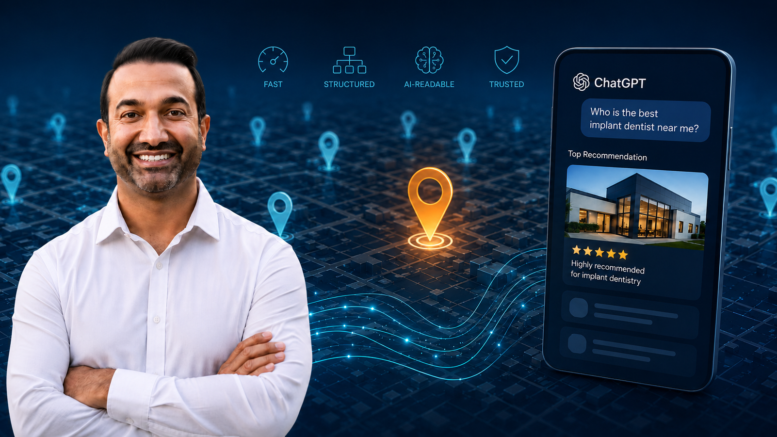
She is 54, insured, and finally ready to fix the failing implant and bridges that her family dentist placed more than a decade ago. The case may be worth $25,000 to $40,000. She opens her phone, but she does not type into Google. She asks ChatGPT: “Who is the best implant dentist near me?”
That single question is changing patient acquisition faster than most DSO operators realize. She is searching for the local office, not the DSO. The answer may decide whether one of your offices ever gets the consult.
This is the shift from SEO to GEO, or Generative Engine Optimization: making each office website fast, structured, and authoritative enough for ChatGPT, Perplexity, Gemini, and Google AI Overviews to understand and cite. For DSOs, it is already showing up in the funnel.
The Office Brand Is the Brand That Matters
Most DSOs are B2B brands. They matter to investors, recruiters, vendors, lenders, and management teams. Patients rarely think that way. They search for the practice on the door: “implant dentist in Tampa,” “Invisalign near me,” “best dentist in Scottsdale.” Every branded office is its own discoverability problem.
Operators like Heartland Dental and MB2 keep acquired offices under their original local names; every acquisition adds another B2C brand whose visibility has to be earned independently. A group with 50 locations does not have one GEO challenge. It has 50. The umbrella brand can look healthy in a dashboard while the patient-facing office brands remain invisible in generative search. That is the blind spot.
The Search Result Has Collapsed Into One Answer
Gartner projected that traditional search engine volume will drop 25% by 2026 as users shift to AI chatbots and virtual agents. Already, 58.5% of U.S. Google searches end without a click. ChatGPT now handles more than a billion queries every week. Google’s AI Overviews already answer “best dentist near me” at the top of the page, often without the patient ever clicking a link.
For a patient asking, “best implant dentist near me,” the funnel has collapsed from ten blue links into one or two recommended names. The cited office wins attention. The uncited office does not enter the conversation. One full-arch case can be worth $20,000 to $50,000. One additional consult per quarter, per office, can justify years of website investment. At portfolio scale, the upside compounds quickly.
“The cited office wins attention. The uncited office does not enter the conversation.”
Why Most Office Websites Are Invisible to AI
Most office websites were built for an earlier search era. AI crawlers have limited patience: if a mobile page takes too long to load, they may never fully read it. Many groups are paying for Google clicks and sending patients to slow, outdated office sites. The click still bills. The patient still bounces. The same technical weakness that hurts paid conversion hurts AI visibility.
Speed is only the first issue. The structural signals language models need are usually missing too, and the site may look acceptable to a patient while looking like noise to a language model.
Attribute |
Pre-GEO Office |
GEO-Ready Office |
Mobile time-to-hero (LCP) |
8 to 22 seconds |
Under 2.5 seconds |
Schema.org structured data |
None or minimal |
LocalBusiness, Dentist, Physician, Service, FAQ |
llms.txt file |
Not published (404) |
Published at root, per office |
Local service pages |
One generic page per procedure |
Distinct page per service per city |
Provider bios |
Unstructured marketing prose |
Tagged author entities with credentials |
A Case in Point
Consider a recent teardown of a five-studio dental group in the Northeast. On mobile, the website took 21.9 seconds to render its hero image. Families were watching a blank phone screen at the exact moment a $4,000 to $25,000 treatment plan was about to be scheduled. After a rebuild, mobile time-to-hero dropped to 2.5 seconds, the Lighthouse performance score moved from 29 to 92, and GEO foundations were added. Estimated lift: about 15 new patients per studio per month, roughly 75 across five studios, on the same ad spend. For a DSO running individually branded offices, that exercise has to happen per office, and the cumulative upside is correspondingly larger.
The New Audit Every DSO Should Run
01 |
Check AI citation |
Search the way a patient searches, not the way the DSO reports. |
02 |
Check mobile speed |
If the main content appears after 2.5 seconds, the office is leaking demand. |
03 |
Check AI readability |
Structured data, provider entities, service pages, and llms.txt make the site legible. |
Run this audit on 10 representative offices. For citation, ask ChatGPT, Perplexity, and Google AI Overviews the way a patient would, by city and category, not by DSO name. For speed, run each URL through Google PageSpeed Insights: Largest Contentful Paint under 2.5 seconds, Interaction to Next Paint under 200ms, Cumulative Layout Shift under 0.1, Lighthouse score above 90. For readability, view the page source for “application/ld+json,” check that the domain returns a real llms.txt rather than a 404, and run any page through Google’s Rich Results Test.
How to Fix It at Portfolio Scale
DSOs can engineer this work centrally and deploy it locally.
Start with performance: compress images, serve WebP or AVIF, lazy-load below-the-fold assets, and replace bloated themes. Then build the foundation per office: structured data, llms.txt, credentialed provider entities, and a distinct landing page for each service in each city. Schema templates, location page systems, provider structures, and llms.txt frameworks can be built once and rolled across the portfolio.
Paid AI Will Reward the Same Foundation
Paid placement is coming quickly. Perplexity has introduced sponsored placements. Google is integrating ads into AI Overviews. OpenAI is building commercial pathways. Within 12 to 24 months, dental groups will pay for AI visibility the way they pay for Google. But paid AI will not rescue a weak destination. The organic GEO foundation is what makes future paid AI dollars convert.
The Bottom Line
The patient journey has changed. Patients are no longer only searching. They are asking. For DSOs, the next advantage will not come from polishing the corporate brand. It will come from making every office brand in the portfolio fast, structured, and AI-readable. GEO is not a replacement for SEO. It is what SEO is becoming.
When a patient asks ChatGPT for the best implant dentist in your city, is your office in the answer? Or is your competitor’s?
About the author: Dr. Roshan Parikh is a dentist, entrepreneur and industry strategist with extensive experience helping dental organizations grow and improve performance. He is also a partner at WTM Studio, which built checkmydso.com, a free diagnostic tool designed to help dental organizations evaluate their digital presence and identify opportunities for improvement.