
Ranked the #1 DSO Podcast!
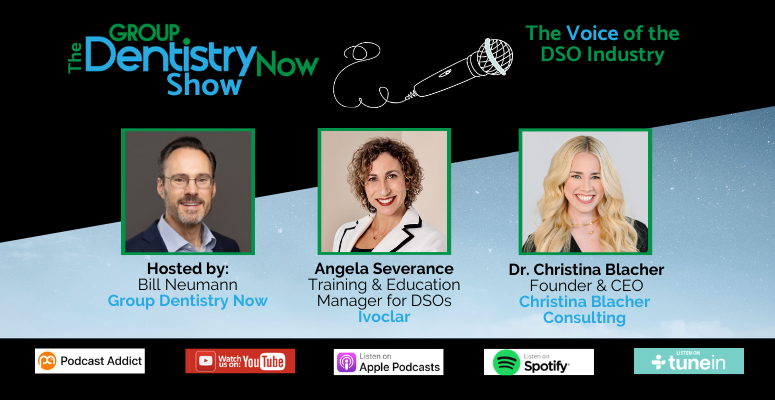
Welcome to The Group Dentistry Now Show: The Voice of the DSO Industry!
The Clear Path: Mastering Aligner Therapy in DSOs with Dr. Christina Blacher & Angela Severance RDA
Dr. Christina Blacher, Founder of Christina Blacher Consulting & Angela Severance, RDA, Training & Education Manager for DSOs at Ivoclar discuss:
- Education as a strategy not an event
- Standardizing treatment planning & materials
- Digital workflow integration
- Clear aligner therapy focused on function & oral health
Access Ivoclar’s Learning Pathways: free on-demand webinar series for DSOs – https://dso.pub/4jtCvNj
Email Angela Severance, RDA: angela.severance@ivoclar.com
LinkedIn: https://www.linkedin.com/in/angela-severance/
To learn more about Dr. Christina Blacher or to contact her you can visit her website: https://www.drchristinablacher.com/
LinkedIn: https://www.linkedin.com/in/christinadean/
Instagram: https://www.instagram.com/queenofinvisalign/
Subscribe to our channel for more episodes and stay updated on the latest DSO news, insights, and events!
If you like our podcast, please give us a ⭐⭐⭐⭐⭐ review on iTunes https://apple.co/2Nejsfa and a Thumbs Up on YouTube.
Choose your favorite listening app below and subscribe today so you don’t miss an episode! Full transcript is also provided below. See all of our podcasts HERE.
 |
 |
 |
 |
 |
 |
DSO Podcast Transcript – The Clear Path: Mastering Aligner Therapy in DSOs with Dr. Christina Blacher & Angela Severance RDA
Welcome to the Group Dentistry Now Show, the voice of the DSO industry. Join us as we talk with industry leaders about their challenges, successes, and the future of group dentistry. With over 200 episodes and listeners in over 100 countries, we’re proud to be ranked the number one DSO podcast. For the latest DSO news, analysis and events, and to subscribe to our DSO weekly e-newsletter, visit groupdentistrynow.com. We hope you enjoy today’s show.
Bill Neumann (00:38):
Hey, everyone. Welcome to the Group Dentistry Now Show. I’m Bill Newman, and as always, we appreciate you joining us. We are going to talk about a topic that I think has been the focus of DSOs and group practices. For the past two or three years, everybody seems to have gone from a focus on acquisitional growth to organic growth and trying to figure out solutions to grow each individual practice organically. Easier said than done sometimes. But we’re going to really focus on clear aligner therapy today and how you can use that to grow your practice, your group practices, and also talk about some techniques and some challenges when it comes to really educating younger clinicians and also just challenges when it comes to consistency and predictability. But we’re going to have fun with this. I think there’s a lot of opportunity and we’re going to talk to two experts who really understand the strategies that can really help you all out.
(01:44):
So we’ve got a returning guest here. We have Angela Severance. It’s great to have you back, Angela. She is training and education manager for DSOs at Ivaklar. And for the first time ever, and she might be familiar to you, especially if you’re on Instagram. Apparently she is the queen of Invisalign on Instagram. You can tell I’m not an Instagram person, but you have 24,000 followers, which is crazy. And we have Dr. Christina Blocker on. She’s the founder of Christina Blocker Consulting, practicing clinician at Ideal Dental and Orthodontics in Frisco, Texas. And they’re part of Dental Work. So it’s great to have you on for the first time, Christina.
Dr. Christina Blacher (02:31):
Thanks for having me. I’m excited to be here. Yes. I kind of have five jobs besides being a practicing clinician. I practice in DECA Dental Group with Ideal Dental one day a week. I also am still in private practice one day a week. So I see both sides, which is really interesting. And then I travel around the world teaching dentists how to do Invisalign. I’m on Invisalign’s global faculty. That’s where my passion comes in. I love teaching. I love helping other doctors grow. I do online support. I set up cases for doctors specifically for Invisalign. And then I’m a mom. I’m a mom of two. I have a two-year-old and an eight-month-old. And so I’m pretty busy every single day, but I love it. It keeps me going.
Bill Neumann (03:19):
Well, maybe we should step back a little bit. You’re doing a lot. Like you said, you have five jobs. We can only fit one of them under your title. So in your share notes, we’re going to include everything else. But what got you into really the education and the training side of dentistry? So it sounds like you graduated dental school and started out as a clinician, right? And then how all of a sudden did you kind of veer off and, “Hey, I want to actually educate and get people excited about clear aligners.”
Dr. Christina Blacher (03:52):
Yeah. So it’s funny because so many people ask me, “Oh, where did you do your speaker training?” And I’ve never actually had professional training when it comes to being a teacher, speaker, motivational leader, whatever. I was just a normal dentist. I’m a normal general dentist. I was practicing full-time doing dentistry. And then I found a love for me specifically. I love Invisalign. And so I just wanted to do more and more and more of it. So I became really successful with it. And then they actually approached me and said, “Hey, what are you doing differently than everybody else? Would you share your story?” And so that led me into teaching where I was just sharing what I genuinely did in my practice and how I was able to grow. And what we found is everyone I would teach would then also grow their practices. And so there was something to it.
(04:40):
And I teach things around obviously clinical things around clear aligners, but also case acceptance, how to grow your practices, how to have the conversations in hygiene. And then that led me to find my true passion. So I actually backed off on practicing to only one clinical day a week and then teaching the rest of the week because I get so much fulfillment seeing another doctor grow. When a doctor texts me and says, “Oh my gosh, we just closed another case today or we just did our 50th case this year.” I get excited. I celebrate with them. And so teaching has been something that is so rewarding for me. And it led me to create my own courses, my own online platform because I just wanted to give dentists something easy, something kind of on a silver platter. So when I first started teaching, I teach a lot of live events.
(05:33):
I’ve taught up to 3,000 people. I think that was my largest event at the Heartland Winter Conference. And I teach at the Invisalign summits, but I realized a lot of doctors can’t come to these big events. A lot of doctors don’t want to take two days out of their practices and pay thousands of dollars to go to a course where they have to shut down the office and lose production. And so I actually created online content. I created online courses that you can do sitting on your couch with a glass of wine after bedtime and still get CE with it and make it short, easy to digest modules. So any new provider, any DSO doctor, anyone who already has a lot on their plate can still learn and gain the confidence without having to travel somewhere.
Bill Neumann (06:18):
Excellent. So 3000 people, that’s a pretty large class. And that was done virtually, I’m assuming, no? Or it was- How do you do that?
Dr. Christina Blacher (06:29):
That was intense. And it’s so funny because the doctors who were in that audience didn’t realize this, but I was sick and I was fighting a sinus infection. And if you’ve ever had to speak in front of a group sick and went to sinus infection, you’re like gasping for air the whole time. And so it was a big one, but it was a lot of fun.
Bill Neumann (06:47):
Pretty cool. We want to make sure we give Angela her credit too. Angela’s been in the industry a long time, 15 years clinical experience, actually probably a little bit longer than that. And you really have a unique position with Ivoclar and we’ll talk about this in the discussion because Ivoclar has a real focus on education. I think I said this on the last podcast we did, Angela, but when I worked for another competing company and I would come up against the Ivaklar sales team, I was always very intimidated because the level of clinical knowledge the sales team had was second to none. It was just amazing. And so I was always a little intimidated by the Ivaklar people. Not so much now because I work with you, which is great, not against you. But Angela, talk a little bit about your role at Ivoclar and also your background, how you kind of came into this educational role at Ivoclar.
Angela Severance (07:57):
Yeah, of course, Bill. So you’re right by clinical, 15 years clinical in the industry for 25 years, and the last 10 for sure, have been solely focused on education and implementation of workflows into dental practices. My background is digital dentistry in CAD/CAM, but regardless, anytime you’re implementing something new into a practice, change, everybody loves change. No, we don’t want change. If it works, if it’s not broke, don’t fix it type situation. So I just really felt empowered about digital dentistry. And so I’ve taken that passion and that’s what’s brought me into education, implementing into practices. So now taking that background that I have and working with Ivoclar, and now specifically in the group practice space, I’m really diving deep into understanding how groups operate and how do you create a workflow that’s scalable. Me in a private practice, I can teach my dental assistant groups as a lead dental assistant, this is how our products work together, this is the workflow, and this is what we’re going to do day in and day out, and that works.
(09:24):
But when you’re doing it in maths, like when you’re doing it across 10 locations, 40 locations, 1200 locations, what does that look like? And so Ivoclar really views education as a strategy. So education in the group space is a strategy, it’s not an event. And that’s how we view being that support as a manufacturer, because our systems are only as good as the support. Our materials are only as good as the education to utilize those materials in the practice and then make it scalable across multiple locations. So you can see my passion come through. I get excited about education and really excited to be here with Dr. Blocher today. We’ve met just within the past, well, I guess it’s been a little over a year now, but her energy is just very, very genuine and the information that she delivers, she’s so organic and that really aligns with Ivoclar.
(10:36):
We want our clinicians to organically choose us not to be forced to. And we believe that with our quality products and then our support will sell itself to clinicians to take a look and go, “Okay, well, I’ve been using this, but let’s take a look at that and then see what that support has to offer to really implement that
Bill Neumann (11:02):
Change.” I like your statement, see if I get it right, but it’s pretty on point where you said education for DSOs and groups is a strategy and not an event. So you’re right. I think a lot of times you say, “Okay, we’re going to do … ” If there is even one singular event or even a series of events to educate, it is so much more than that. And then in a lot of cases, maybe we’ll get to this later on in the conversation. Some groups really don’t have events or a strategy. It’s just, “Here’s a stipend, go out and get your education, and that’s that. ” And then we’ve run into the consistency issue, which we want to talk about, but I really like that. It’s a strategy. It’s not an event. Okay. Let’s get into some of the Q&A now. I mentioned it earlier at the top of the podcast, there’s a huge focus on organic growth when it comes to DSOs and groups, and it changed when interest rates started to rise and they couldn’t acquire their growth anymore.
(12:09):
So they had to look deep within their practices and say, “Okay, what are we doing at each individual location and how can we grow the business?” Whatever that is at each individual location. Clear aligner therapy is popular. I think different groups probably attack it differently or address it differently. Some might not focus on it much. Some probably would like to and don’t necessarily know how. So let’s talk about that as a driver for group practices. And Dr. Blocher, we can kind of start with you. You practice once a week, but still, you’re at a group practice, you’ve worked with Heartland, so you obviously know, and probably a lot of others, that there’s a need for it. And there are probably a lot of clinicians that have different levels of skill when it comes to clear aligner therapy. So talk a little bit about how some of the groups in our audience can maybe give them some strategy and some tips on how they can start to address this clear aligner need and how they can really level their clinicians up.
Dr. Christina Blacher (13:21):
Yeah. So like you said, I actually work with almost every single DSO partner out there through my partnerships with Align and obviously with Ivoclar as well. And so something is really consistent between all groups. And if a group really wants to grow with Clear Aligners, the most important thing is creating something that’s replicable, creating systems. Because if you don’t have those systems in place, it’s going to seem like this huge ordeal to do all these Clear Aligner cases because obviously you’ve got doctors who are brand new, you have doctors who are well experienced, you’ve got people who will treatment plan a hundred different ways. How do you keep the outcomes the same? And so one of the most important things that I value is creating those replicable systems that can be used across the board. So let me give you an example. A lot of groups will use something called treatment planning services, and that’s something I do a lot with so many different partners, basically where their doctors can send in a case and I can work it up for them or a clinician can work it up for them.
(14:21):
And so they have predictable results even if their confidence ability isn’t there yet. And so a lot of groups use something like that. A lot of groups use the same educational platform, but creating a system where everybody is treatment planning the same way, everybody is diagnosing the same way, because I know a lot of groups still work with orthodontists as well. And I still refer tons to orthodontists as well. And so it’s just creating those systems that I think drives the growth because a lot of people get scared that clear aligners are not profitable or they waste too much chair time, but you have to learn how to create those efficiencies in the practice. And then in my practice, it’s the total treatment from start to finish, including visits and follow-ups is about at one hour of doctor chair time. Yes, my team does a lot too, but my actual chair time for a full case is about an hour.
(15:14):
And so for me, that’s very profitable. So I think it could be something super profitable for every group out there.
Bill Neumann (15:20):
Do you have an idea of what maybe an average practice might have as far as typical doctor chair time? You’re saying you can get it ideally efficiently to that hour. What do you see out there before you start to work with them?
Dr. Christina Blacher (15:38):
Well, I’ve seen it in both DSO and private practice. A lot of doctors are just wasting time. They’re just wasting time bringing the patient back for an extra visit to look at their treatment plan before they say yes. They’re wasting time with several follow-up visits because they didn’t treatment plan it appropriately. And so maybe things aren’t tracking appropriately or efficiently. And so it’s just learning how to save yourself that chair time from the beginning by setting a case up for predictability, getting a case up so you can trust it. A lot of the patients I only see once in the whole time of their treatment because I know that the way I’ve treatment planned it is set up for predictability.
Bill Neumann (16:18):
And you kind of mentioned this. It’s not just about the time that the doctor’s spending in the chair doing adjustments. You talked about treatment acceptance too, right? They may have to come back a time or two to get the buy-in, I guess, or to really feel comfortable that this is going to work for them.
Dr. Christina Blacher (16:36):
Yes. And me personally, I don’t recommend that because I will … Let me share you with my flow in my practice. So we use digital scanners. I use iTero in my practice, and we scan every hygiene patient. So every single hygiene patient gets a scan as part of their exam. It’s kind of like an overall wellness scan. And so we’re not using that to technically diagnose orthodontics, but we always see things that need to be addressed. So we use it to educate our patients on their oral health. We use it to diagnose restorative. We can diagnose perio. We just make it part of their exam. And then that leads us to having conversations about what’s going on in their mouth. And then ultimately, we have a lot of conversations about function and about occlusion. 95% of the orphan that I do is not for aesthetics, and the aesthetics become a bonus.
(17:25):
And so once we diagnose that, we explain the process, we go through the treatment plan, and that’s usually when we get the yes. So I don’t spend extra chair time working up a treatment plan, bringing them back in for a consult because it just wastes time and money, in my opinion. And so we get them excited. They say yes on the spot, usually coming out of hygiene, and then we see them to deliver at the next visit.
Bill Neumann (17:50):
So predictability is super important. And I guess ideally what you would do is you would take the most efficient clinician, the one that is most adept at clear aligner therapy has been probably doing it the longest, maybe not necessarily, and then somehow replicate that across all your locations. So you’ve got this challenge, you’ve got multiple locations, you have different skillsets, you’ve got some younger clinicians, right? Some that have probably done a lot of Invisalign cases, some that have done zero or have just started. So how do you do that? And maybe talk about that from a digital workflow and technology perspective, because there’s a lot of different variables, but maybe let’s start with digital workflow.
Dr. Christina Blacher (18:40):
Yeah. So one of the things that I see is incorporating the scanning into your overall exams. You can share treatment plans between providers, especially if a group has a lead or has somebody who’s the expert. That person can actually develop an algorithm even for your DSO specifically. I mean, I work with Invisalign. So using Invisalign as an example, I have my own algorithm. And so I give that to certain DSOs that I partner with, and that way they can actually submit all their treatment plans through my algorithm, which will give them a predictable outcome. So then that’s how we kind of scale the predictability without having to worry about how doctors are going to set up cases. Then obviously they have the option to work one-on-one with the clinician when setting up their treatment plan further. Then obviously everything is done digitally. So the nice thing about groups is patients can be transferred, cases can be shared.
(19:35):
And I will say it’s really overwhelming for a new doctor joining a DSO to inherit a lot of cases because I see that all the time. A doctor will have 20 cases going on, exit the company, brand new doctor comes in, they get handed 20 cases, and now they don’t know what to do with these cases. And so that’s one of the biggest struggles that I see and that I teach to is how to still reinforce that by replicating treatment planning and getting the support that you need, whether it’s inside of the company or outside of the company, but that is what I see works the best with DSOs.
Bill Neumann (20:12):
So that’s a great point. So you’ve got some turnover potentially. A doctor leaves, a new one comes in or is there and has to pick up these cases. So I get if that training is in place and it’s consistent, that’s probably easy, but what does that handoff look like? I mean, how does that typically transpire? And have you seen it where patients have to come back in for almost another … The new doctor has to have another look at the patient, and then how does that make the patient feel?
Dr. Christina Blacher (20:50):
Yeah. So I’ve seen cases, unfortunately, that I have to help a doctor clean up a little bit. Maybe somebody didn’t treatment plan it the right way, or the new doctor doesn’t know the advanced skills at which it was treatment planned. And so a lot of the times it’s getting a mentor, a support system, somebody who can look at treatment plans for you, somebody to set it up. But it happens all the time, especially in DSOs, is where a new doctor will inherit 20 cases, and then that’s where I come in, I help a lot of these doctors, they’ll send me an email, “Hey, can you help me look at this case, see where it started, see where it’s at now, see what we need to do to finish it. ” My biggest thing is always maintaining the trust with the patient. So keep in mind, I get transferred cases to me all the time, even in my DSO from doctors who don’t quite know how to finish it.
(21:38):
And so the first thing I always tell a patient, and I would recommend this for anybody, is I always tell a patient, “You know what? I got your back. I’m here. We’re going to make sure that you are happy at the end. Whatever it is you’ve been through, I want to make sure that you know that I have your back and I’m going to work with you. ” So I say that to all my patients and I say that to my doctors as well.
Bill Neumann (21:58):
So on the theme, still keeping with that theme of consistency and predictable outcomes, how important is it for you to have materials? And I think the techniques go along with those materials that you can … A lot of times clinicians like to use the materials that they learned with at school or maybe the last practice they were in very, very comfortable. A lot of times it can be a challenge with a DSO, right? Because then you’ve got 20 different materials and 20 different techniques that can go along with those materials. So that’s really hard, especially if you have different clinicians maybe that are touching that patient or like you said, you have that handoff. So how do you ensure that DSOs tend to work with the materials, have these predictable outcomes with the materials and be really consistent? I mean, is that something that is doable?
(22:56):
Do you see it happen at a lot of these groups? And do you help educate and train when it comes to materials as well?
Dr. Christina Blacher (23:03):
Yeah. So I will be the first one to speak up. I will be the first one to speak up if we are not using a material that is up to my standards because I do not want to deliver something to my patient that I wouldn’t have in my mouth. And so I’m going to give Ivoclard Angela a little shout out here because I have been an Ivoclar user … Actually, I started in dental school. I went to Midwestern University and we actually were spoiled with having Ivoclar products in our dental school. So that’s all I knew and that’s all I used in my practice because it’s the best. And so that’s what I use for Invisalign, which is what’s so funny because when Angela and I first met, I actually told her, I said, “You don’t have to convince me to love Ivocore because I genuinely use it in my practice for my ortho cases, for my restorative cases.” And then I’ve met Angela and we developed a partnership and obviously I teach their products because I truly believe in it.
(23:55):
It’s what I genuinely use in my cases, but Angela, I’ll let you add to that.
Angela Severance (24:02):
Thank you. And I keep hearing these words consistently as we’re discussing, and it’s predictability and consistency. Predictability and consistency, predictability, I mean, that’s the whole message here. And so when we bring in variability, variability does not equal consistency and predictability. So really the answer is so simple and thank you, Dr. Blocher, for the Ivaklar shout-out, but you also mentioned something about patient experience. And I think that that’s really important that we have to remember on the other side of all of this predictability, inconsistency, and how do we make this change over scalable across practices? We also have to remember that that patient experience is part of that consistency and predictability because it also affects your brand, your brand protection. Because if that patient sees one clinician in your practice or then goes to another practice that is also part of the group and they’re having different workflows, different treatment, different treatment plans, that’s not going to make the patient feel very comfortable, correct?
(25:30):
With that, like, “Oh, well, I went to … ” Think of it like a chain that you choose to go to. Let’s just say in and out. Why is in and out so popular? Well, because it’s consistent, right? It doesn’t matter which one you go to, you’re going to get the same exact experience. And so that’s how I feel and partnering with Dr. Blocher, partnering with Ivoclar, you get that consistency and predictability through workflows, through materials. So the more you add in variability and materials across multiple locations, that consistency and predictability is going to drop. It’s just inevitable to really … And it comes from the leadership down within the practice. So I do appreciate being able to work with Dr. Blocher because she sees that vision. And like I said, it’s so simple. If you don’t want variability across multiple locations, then be consistent in the materials and the systems that you implement into your practices.
Bill Neumann (26:39):
Let’s switch the topic quickly and then we’ll get back to materials because I want to talk more about that specifically, the materials that Ivoclar has that can help with clear aligner therapy. But since you’re both involved in education, this is a topic that I think is misunderstood by a lot of DSOs and groups. And I don’t mean the clinicians there. I mean, the leadership a lot of times, I think it’s a missing element with a lot of group practices. And so what I see, and I want to really get your impressions and what you’re both seeing, you see some groups that are pretty dialed in on clinical education, for sure. They have their own university set up and they’re offering it up through the DSO itself. And then there are others out there that don’t really have any structure at all. So the education that the clinicians are getting is the same education that they received when they were solo practitioners.
(27:48):
So they’re going to … There’s nothing wrong with it, but they might be going to Chicago midwinter and getting their CE or they might be going online and getting it, but totally inconsistent because one clinician’s getting it somewhere and then the other one that practices in the same location is getting it in a totally different way. So it just seems like there’s a lot of hit and miss as far as education and it’s not a top priority with a lot of groups. Let’s put it that way. So then we get back to the issues with consistency and predictability. If you don’t have consistent education, then I can’t imagine that you’re going to have the same outcomes from different clinicians. So what are you both seeing as far as the DSOs that you work with? Is it all over the board? And is there a way that you feel you can help them with your solutions, Dr. Blocher, and of course what Ivaklar offers as well.
(28:44):
So Dr. Blocher, if you kind of want to kick that off.
Dr. Christina Blacher (28:47):
Yeah. So I would say so many DSOs want to hold their doctors accountable. We want to hold them accountable for goals, for things that we’re doing. And if you don’t have that education platform in your systems, then there’s no way to hold your doctors accountable and say, “Okay, well, why did you do something this way when we teach it this way?” And so accountability comes into play as well, just like predictability and consistency, which was what we’ve been talking about. So me specifically, let me just give you an example of one of the groups that I work with. I work with Apex Dental Partners, and we have created a system where all of their doctors, when they join, they go through my courses, it’s basically their onboarding. They go through my courses, so their leadership knows everybody’s getting the same material, everybody’s getting trained the same way, and they’re going to also get with the content, they actually get my algorithm applied to all their treatment plans, and they have partnered with me as a TPS provider, treatment planning services.
(29:49):
So that way when their doctors are in the middle of treatment or are setting up treatment plans, they can send me their cases, I can look at it. So I’ve partnered with them to be able to give them a start to finish Finish workflow mentorship opportunity that they’ve got me because maybe they didn’t feel that like they had somebody inside the company that could be that leader for them on the MISLIN side. So that is one of the ways that we’re driving not only clinical confidence, team training, but consistency across treatment plans and then the entire treatment workflow from start to finish. So that’s one example of a group that I’m working with, but I do that with so many groups across the board that they then have me as their resource. I talk to their, it’s one of their CFOs every single day. And so it’s a nice partnership to have because again, I get to celebrate with them when they grow.
Bill Neumann (30:42):
We’ve recently had Dr. Lohman on the podcast, not the long journal. Yeah, that I have a car sponsored. So thank you. I have a car again for that. That’s great. What about on your side of things, Angela, what do you see from the DSOs that you work with? Because you’re working with some real small groups out there as well as the larger DSOs. Is there a lot of inconsistency with education and what type of LMS and education does Ivoclar provide for these DSOs?
Angela Severance (31:19):
Yeah, you’re right, Bill. It is inconsistent. It’s all over the board really. So I’ll speak to where we find success because I’m here to give answers. I want to be the solutions provider. We, as IvaCar, want to be the solutions provider. We’re not here to compete clinically. We know that there are other products on the market that do a great job. What I feel that IvaClark does very, very well, I mean, top-notch and we pride ourselves is systems. We’re here to elevate that systems conversation because systems equals consistency and predictability. So because again, that we view education as a strategy, we’ve created us personally an online learning platform. So it’s called the Learning Pathways. And it’s a free program. It’s currently to date a nine-hour on- demand webinar series. And this is where, to piggyback and really compliment what Dr. Blocker’s saying is we’ve created a mentorship program for our group practices so that when for onboarding, for new materials, new system workflows, implementing into the practice, team turnover, big buzzword and pain point.
(32:46):
So it’s there for team turnover and it’s there for those new doctors that are coming out of school. That’s what this platform is used for. So this program is on direct and indirect restorative pathways. We partnered with Dr. David Rice, and he’s the one that did the first part of this series, this nine-hour program. And it currently is focused for the dentists and the dental assistants on the direct and indirect restorative pathway. So it’s a very high level starting off on the first program is all about the entire course. So what we’re going to cover over the entire course. And then we break it into the pathways and we dive deeper and we funnel into direct restoratives, posterior, anterior. In the indirect, we funnel deep into the direct, or excuse me, the indirect restorative workflow and then materials and cementation protocols and then advanced interiors.
(33:41):
We have case acceptance, another pain point and buzzword. So making sure that this is great for the entire team so that the team can speak to treatment plans and then drive that case acceptance. So having that platform already in place for the groups is a huge value add. And this is what we have to offer. Now, and we understand that IvyCloud is not only offering online virtual education, we know that just one event is not going to actually implement the change. There have to be multiple touches along the way. So Ivoclar also sees the highest success rate when then you, in addition to, kind of think of a college course, like the online learning pathways, on- demand CE series is your prerequisite to our hands-on programs that then compliment all those programs that the doctors, the assistants, the team have already been watching. So when you have that, that is that system, that consistent messaging that every single team member is hearing across multiple practices.
(34:50):
And we offer this to all of our groups. That’s where the real true change can start to take place because everyone’s hearing the same message, they’re seeing the same workflow, and that’s highly, highly impactful. So when I see success in groups that are actually wanting to implement change and they’re wanting, of course they offer autonomy to their clinicians, but the true to really have that consistency across the groups, they need to pick two or three systems that they work with, and then that’s what all of the offices use so that the patient experience can be the same. They’ve got the predictability and the final outcomes, but that Ivoclar is a leading in the industry knowing that we are there to support you and that we already have the infrastructure in place. And I have one more thing to add to that is that within these learning pathways, we just implemented this at the end of last year.
(35:50):
We now are in 2026, and I’m already planning 2027’s additional courses that we’re adding to this because of course right now it’s for the dentist and the dental assistant. Just next week, we’re going to be launching Dr. Blocher’s learning pathway on clear lineer therapy workflow. So what she’s doing, it’s like this is the prerequisite so that now you can start working with her in your group practices so that you can implement this consistent workflow. We’re also adding in CAD/CAM so that there’s a pathway on staining and glazing and zirconia handling, hygiene, so prevention and care learning pathways. So when you partner with a manufacturer that believes so strongly in education as a strategy to support that change management at scale, I mean, it’s a win.
Bill Neumann (36:41):
So plenty of opportunities for education. I think that’s what the message is. So there’s no excuse for groups and DSOs not to be able to offer something to their clinicians and provide that. Again, this is like, we’ve said this a hundred times consistency and predictability, right? Those two orders, if we went through the transcript, we’re going to see that bubble up to the top as far as something we’re focused on for sure. So we’re talking about clear aligner therapy. And a lot of times when we think about clear aligner therapy, we think about the clear aligners, the system itself, but there’s a lot more to that. And I think we want to talk a little bit more about why it’s so important to have a trusted partner, a materials partner that can really sit alongside that clear aligner system really to support that and just make it so much more, the outcomes more predictable and successful.
(37:38):
So maybe Dr. Blocher, we could start with you. And then Angela, I’m sure you want to talk a little bit about some of the offerings that you have. But Dr. Blocher, how important is that? Again, I think the focus tends to be on the clear aligners, which is certainly, certainly important, but what about the materials that go along with that? Because there are some choices out there that you have. And then you talked a little bit about understanding and feeling very comfortable with Ivoclar because that’s what you learned with those, you were comfortable with that solution in dental school.
Dr. Christina Blacher (38:13):
Yeah. So I use both of the composites that Ivoclar use for Clear Aligners. There’s a flowable and a packable Tetriqo flow. I use our translucent shade because my patients love it on their attachments specifically for clear aligners because it’s translucent. You can’t see it. And if Fluoresce is under a black light. So when I am cleaning up excess material or when I’m removing attachments, even if I’m just doing composite work, if it fluoresces under blacklight, it makes it really easy for me to make it perfect. So I use Tetra Evoflow, the translucent, and I also use Tetriq EvoSerum aligner, which is their packable. And both of them work. And I have assistants, some of her prefer the flowable, some prefer the packable, but that’s what I use genuinely in my practice every single day. And they’re both Ibokar products. So that’s why I wouldn’t choose anything else.
Bill Neumann (39:02):
Angela, any other products that Ivoclar offers that you think are helpful when it comes to clear aligner therapy?
Angela Severance (39:10):
Yes. And Dr. Blocher uses both of these. So the Optrigate two, so that’s our intraoral retractor. I mean, that’s an absolute must. You have to keep those lips and cheeks retracted. It is affordable. It’s one of those things that’s always part of my setup. When I’m working in that anterior sextant, it just has to be there. And then the other shout out product that I want to give attention to is our adhesive universal VivaPen. So the Veeva Pen is our adhesive and the delivery system, it’s a clickable pen. And I’m just going to speak to my clinical background because when I came out of dental assistant school and I started working at practice, we weren’t taught why with materials. We were taught what this is for what comes next in essence. We were taught workflow. So the blue stuff, rinse, dry, put drops into a little dish, mix it around, hand over the microbrush, but we didn’t understand why.
(40:24):
Well, those drops that you put in there, we weren’t taught only that this is really expensive material. Make sure that you only use a couple drops. And if you need to get out a new dish and add some more, you can. But I don’t remember what they say, but a gallon of this stuff is like, I’m going to be facetious here and say it’s like a bazillion dollars. It’s like the most expensive liquid on the planet. So when you have that adhesive in a delivery system that’s clickable, so one click is for per application and the VivaPen, it’s up to, I believe it’s like 187, we’ll just say 180-ish applications, and it’s not going to be contaminated with saliva.That right there is so huge because that’s going to be predictability in your attachments so that they’re not going to pop off. It’s also efficiency, it’s cost savings, and those are all really important pieces in a workflow, not just in a group practice, but in a private practice as well.
Dr. Christina Blacher (41:29):
I love the Vivapen. It’s something I use every single time, even on restorative procedures, because like Angela said, it actually still bonds a moist environment. So many doctors get frustrated with the workflows because their attachments are popping off. And honestly, since using the Vevapen, I never have an issue with attachments.
Bill Neumann (41:51):
And I know we’ve done at least an article or two on the Viva Pen before. And again, in my previous life, the company that I worked for had several bonding solutions and they are very expensive and there’s always waste and a lot of the manufacturers count on that for sure. But I just think that the nice thing about the Vivapen is just ease of use, right? And I think you kind of touched on it too, and the fact that you’re not wasting material, which is huge. So final question here, I like to finish up the podcast with basically get out your crystal ball and tell me a little bit about the future. And we talk about the future of clear aligner therapy, and it can be in 2026 or a couple years out, but do we see, and we could start with you, Dr. Blocher, do we see more general dentists doing clear aligner therapy?
(42:51):
Do we feel that the solutions out there make it easier in the education, of course, that you’re providing and Ivoclar’s providing? Do we just see it becoming easier for clinicians to do? And do we also see a shift potentially from traditional orthodontics to more clear aligner therapy as you can do more and more complex cases? Again, I’m spitballing here. I don’t know the answer, but you go ahead and let me know what your thoughts are.
Dr. Christina Blacher (43:24):
I would say ask any doctor out there or anyone in DSO leadership who has found the growth that comes with it, and they will tell you time and time again they wish they had done this sooner because the growth that can happen in just a very short period of time, once you get education on board and the clinical treatment planning on board, once you have it all set up into place, I mean, the growth is exponential. And so those clear aligners inside of a DSO group practice, I mean, there’s so much opportunity there for you. There’s so many people that think Invisalign or Clearliners is just for aesthetics. It’s not. It’s for function. It’s for the bite. It’s for all the clinical reasons, even for perio reasons. I mean, I can go on and on. That’s a whole nother podcast, but there’s so many people who need this genuinely in your practice.
(44:14):
You don’t have to do any marketing. They’re already sitting there in your practice. We use it for functional and oral health reasons. A lot of adults need it and want it. So it’s way more than just growing and teenagers. And I feel like Clear Aligners are truly replacing the traditional ortho route because it’s so easy to integrate into your own lifestyle. I’ve been through Invisalign myself, and so it’s easy to integrate. It doesn’t take that much time, it’s predictable. And so our patients are getting such a positive experience and our doctors are growing their practices without having to add locations, without having to add chair time, without having to add another doctor. It’s something you can easily integrate into your everyday workflow.
Bill Neumann (44:56):
And Dr. Blocher, if people want to learn more about you and what you do, what’s the best way? So we already said you’re big on Instagram. So if you actually are on Instagram, it is the Queen of Invisalign. Yes, it’s the Queen of Indisalign. So that’s pretty easy. And what about LinkedIn? I’m sure you’re on LinkedIn as well.
Dr. Christina Blacher (45:19):
I’m on LinkedIn. You can also email me directlyblocker.com or Dr.visinablocker.com is actually my website. And then you can email me drcristitablocker@gmail.com. Pretty easy to remember, but Queen of Invisalign. I respond to every message, everything I get. So no doctor is ever left out there not knowing. So I’m very responsive and I truly love to work with them.
Bill Neumann (45:42):
Excellent. And we’ll drop all those links in the show notes. And Blocher is spelled B-L-A-C-H-E-R. If you happen to be just listening to this, you should be watching it, but we’re okay if you’re listening too. Angela, if people, final thoughts from you, of course, and then just let us know, let the audience know how to get in touch with you and find out more about Ivoclar and your educational platform and how you work with DSOs.
Angela Severance (46:10):
Yes. So to wrap up with what Dr. Blocher was speaking to, as far as do you see more groups, more practices adopting clear aligner therapy workflow? And my crystal ball says yes. The more procedures that you can keep in office, the better. And Dr. Blocher actually teaches, because I’ve been fortunate enough to be able to be in one of her courses or the course that she taught for us that’s going to be available for all of you here very shortly. She speaks to the cases like skiing, so ski hills. And although I’m not a skier, I have skied, so I understand blue, green, black, and I don’t know what the shapes are, but I know it’s blue, green, and black. And I know I do not want to go down a black diamond. I would love just to stay on the bunny hill like Dr. Blocher likes to and just hang out.
(47:11):
I love my knees and my lower back, so I still want to get out there, but I just want to do the heels that I like. And that’s how she speaks to cases. If you love those black diamonds, they’re going to take a lot more time, they’re complex, maybe there needs to be some surgery, maybe there needs to be some restorative, and so that becomes much more complex. I foresee the bunny hills that more general dentists group practices keeping those procedures in- house that are predictable because the predictability is what we’re looking for for consistency and efficiency. And yeah, so that’s where I definitely see that a growing space. So where you can get in touch with me is my email. It’s angela.severance. And severance is like a severance package or the show severance. I get that asked all the time when I give my last name, they’re like, “Do you watch the show?” It’s like the next question that comes to me, whereas I used to talk about the severance partner.
(48:23):
Yeah. So S-E-B-E-R-A-N-C-E @ivaklar.com. And I would love, go ahead, email me. I would love to share with you the learning pathways, and maybe that’s something that I can give to you, Bill, a link so that they can access it because like I said, it is free for all groups, but I guess probably easier just to contact me and then I can walk you through the program. But I would love to do that, have a conversation on how we can support implementation and consistency into your groups. Excellent.
Bill Neumann (48:59):
Grow your Clear Aligner cases and earn one-hour free CE!
Register for Ivoclar’s newest on-demand Learning Pathway, Clear Aligner Case Selection, Workflows, and Case Acceptance: https://dso.pub/LearningPathwaysClearAligner