

Ranked the #1 DSO Podcast!
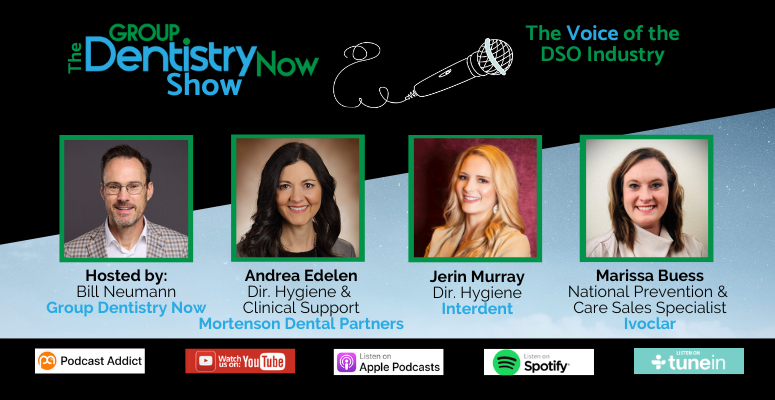
Welcome to The Group Dentistry Now Show: The Voice of the DSO Industry!
Elevating Clinical Hygiene: Insights from Industry Leaders at Interdent and Mortenson Dental
Marissa Buess, National Prevention & Care Sales Specialist at Ivoclar, Andrea Edelen, Director of Hygiene & Clinical Support at Mortenson Dental Partners and Jerin Murray, Director of Hygiene at Interdent discuss:
- The journey from clinical hygiene to leadership roles
- Mentorship and support for hygienists
- The importance of partnerships in the DSO industry
To learn more about Ivoclar and their group dentistry program you can reach out to Marissa Buess – Marissa.Buess@externals.ivoclar.com
To learn more about Cervitec Plus visit – https://www.ivoclar.com/en_us/shop/search/products?text=cervatec
You can connect with Andrea Edelen – andrea.edelen@mdpweb.net or learn more about Mortenson Dental Partners – https://mortensondentalpartners.com/
You can connect with Jerin Murray – murrayj@interdent.com or to learn more about Interdent – https://www.interdent.com/
Subscribe to our channel for more episodes and stay updated on the latest DSO news, insights, and events!
If you like our podcast, please give us a ⭐⭐⭐⭐⭐ review on iTunes https://apple.co/2Nejsfa and a Thumbs Up on YouTube.
Choose your favorite listening app below and subscribe today so you don’t miss an episode! Full transcript is also provided below. See all of our podcasts HERE.
 |
 |
 |
 |
 |
 |
 |
 |
DSO Podcast – Elevating Clinical Hygiene: Insights from Industry Leaders at Interdent and Mortenson Dental
Welcome to the Group Dentistry Now Show, the voice of the DSO industry. Join us as we talk with industry leaders about their challenges, successes, and the future of group dentistry. With over 200 episodes and listeners in over 100 countries, we’re proud to be ranked the number one DSO podcast. For the latest DSO news, analysis and events, and to subscribe to our DSO Weekly e-newsletter, visit GroupDentistryNow.com. We hope you enjoyed today’s show.
Bill Neumann: Welcome, everyone, to the Group Dentistry Now show. I am Bill Neumann. And as always, we appreciate you watching us today. We are continuing our series of podcasts sponsored by Ivoclar. They always have great topics of discussion and bring us great guests. And this podcast will be no different. So I’m excited to dig into this. topic that is always a focus and a challenge in the industry when we discuss clinical hygiene. And we have three thought leaders in the clinical hygiene space with us today. So, I’m excited to talk about this. First off, thank you to Ivoclar, like I mentioned before. I’m going to introduce Marissa Buess. She is the National Prevention and Care Sales Specialist at Ivoclar. Marissa, thanks for sponsoring this podcast and really focusing in on this discussion on clinical hygiene today.
Marissa Buess: Thanks for having us, Bill.
Bill Neumann: And so the other two guests that we have with us, we have Andrea Edelen. She is the Director of Hygiene and Clinical Support at Mortenson Dental Partners. I’ve known Andrea for quite a while. We used to attend the Scaling Up Symposium that Mortenson used to put on way back when and really miss that meeting. And Mortenson’s just done a great job educating the industry. So it’s great to have you, Andrea. It’s good to see you again.
Jerin Murray: Thanks, you too.
Bill Neumann: And we have Jerin Murray. She is the Director of Hygiene at Interdent. Hi, Jaren. Thank you for joining us.
Jerin Murray: Thanks for having me.
Bill Neumann: Excellent. So Jaren, why don’t we start with you a little bit about your background and then discuss, tell us a little bit about Interdent, get us up to speed. Interdent’s been around for a while, but just a little bit about what’s going on at the organization today.
Jerin Murray: Happy to. So Interdent has about 160 offices in eight states, primarily on the West Coast. We are, you know, we’ve gone through some organizational change. Very exciting, you know, in the past couple of years, we’ve got, you know, new COO leadership, we have new CFO leadership, and we just got a new VP of clinical operations. So very exciting time to be at Interdent. You know, I have been with the organization for six years and I have been a hygienist for, I don’t know how this happened, but about 22 years. So, you know, my journey has been quite interesting. I started in private practice for about 15 years, you know, I moved across the country and was fortunate enough to always find a really great place to work. And then I entered the DSO space with Aspen Dental back in 2016. Enjoyed the organization. I was a Territory Manager of Hygiene Support for Tennessee. And then my husband and my family, we moved to Las Vegas. And at the time there were no Aspens and I was lucky enough to work at Interdent Chairside. And I was very happy to walk into this leadership role about three years ago. So it’s been a fun ride and I really enjoy the effect that I’m able to have on patient outcomes at scale in this organization, in this position. So it’s been great.
Bill Neumann: Thank you. Andrea, a little bit about your background and tell us what’s going on at Mortenson. Mortenson’s been around for quite a while and love to kind of get up to speed on what’s going on at the organization.
Andrea Edelen: Yeah, so we started in 1979. So we have been around for a while. We’re up to about 150 practices, definitely in growth mode right now. We are having a lot of fun. And currently, I am the Director of Dental Hygiene and Clinical Support. But a little bit about me, I started with the company almost 18 years ago as a full-time practicing hygienist. loved everything that Mortensen Dental Partners was about. At that time, we were starting to really be interested in growing and I started looking for opportunities within the organization to Whatever was, I mean, you know, a growing company, there are a lot of opportunities just to plug in in different ways. And so I started mentoring hygienists, working with hygienists, and over time as the company evolved, my role has evolved.
Bill Neumann: That’s great. Thank you, Andrea. And Marissa, again, so everybody here is an RDH, highly credentialed. We didn’t have enough room for all the letters next to your names, but it is nice to have the RDHs here so we can really have a true clinical hygiene discussion. And Darren kind of mentioned it, especially at scale, some of the challenges there and maybe a little bit of fun, but, and certainly, you know, the challenges that the day-to-day. Marissa, a little bit about your background and how you ended up from being a hygienist to now working at Ivoclar.
Marissa Buess: Yeah, so I knew from the time I was a sophomore in high school that dental hygiene was the path I wanted to take. I had great mentors along the way. Graduated from the University of Louisville in 2018, so Mortensen was in my backyard. And then I worked in private practice for the office that Jenkins and worked there for about four and a half years in clinical hygiene. And my family, we are a military family. So when it came time for our first move, there was a unique opportunity with Ivoclar to be a prevention and care advocate. So I had always had this creative side to me and, you know, really enjoyed Lunch and Learns or when vendors would come into the school and thought, I’d like to try that someday. And stepping into this side of dentistry, there were all kinds of doors of opportunity and knowledge that As a clinical hygienist, I didn’t know existed. So I’m very grateful to Ivaclar for opening up this opportunity for hygienists. And so now what I do is mentor the team of prevention and care advocates and it’s just really fun to see people who are fresh out of clinical hygiene or still working clinical hygiene, getting to kind of dabble in new skill sets and become educators and build connections outside of the walls of their operatory.
Bill Neumann: Excellent. And I missed the part what you said you were practicing. What was that first practice that you were at? I think we missed you there.
Marissa Buess: Yeah, it was Designing Smiles, Dr. Dennis Jenkins, and so I worked there for about four and a half years and then joined Ivoclar and kind of just took my love for educating patients to now educating my fellow clinicians.
Bill Neumann: It’s some great points. There really are a lot of opportunities beyond clinical hygiene if you have that RDH and you have that experience. I think it’s so important. You can get into sales and support roles. You can work on the DSO side of things with mentorship and on more of the clinical operations side of things. So there really are quite a few opportunities for hygienists. So maybe we’ll talk a little bit about the inspiration behind these transitions. Andrea, why don’t we, we, we discuss that, you know, everybody started Chairside and then they transitioned over. What was, what was the inspiration behind that?
Andrea Edelen: Yeah, well, so first and foremost, I love clinical dental hygiene. I have to be involved in clinical dental hygiene, and I never made a decision to necessarily leave the chair, if that makes sense. As I mentioned earlier, when I joined Morton’s and Dental Partners, I don’t know if I mentioned, but I joined as a full-time practicing hygienist. I loved everything about Mortenson from the start. We had processes in place. We had technology, clinical support that I had never experienced before prior to joining Mortenson. So I absolutely love it. As we started to grow, as I mentioned, opportunities were there to, you know, because while I was newer to Mortenson, I, you know, had been practicing dental hygiene for quite a while. So I started mentoring hygienists, I started putting some, you know, different protocols together, SLPs and some things like that. And as a company grows and evolves, as I mentioned, my career did as well. And so while I didn’t necessarily decide to leave clinical hygiene, I kept saying yes to the opportunities that were there. And that is how my role continued to evolve. While, like I said, working in clinical operations, I feel like I’m still involved in clinical dental hygiene care, even though I’m not necessarily in the operatory. But the way that I am supporting clinicians and working toward our initiatives, I’m still involved in clinical care, which I’m very passionate about.
Bill Neumann: Let me ask you, Andrea, and then Jaron, I’d love to kind of get your feedback, too. So, what is the day-to-day like for you, Andrea? As you say, you really are still kind of involved with the clinical side of things. What does that look like? Does it look like mentorship? Are you making a lot of decisions from a hygiene product perspective?
Andrea Edelen: Yeah, so it’s kind of funny I laugh at the day to day and operate well in dentistry in general, but definitely in operations, you wear a lot of hats right and you you wear the hat that you need to for for that, you know, particular. occurrence that’s happening. But truly, I am mentoring, whether it is an individual hygienist, for various topics, different areas of, you know, whether it’s metrics or verbiage, things like that. I still do mentor a lot of hygienists, but I have a team of clinical support here. So I work with every hygienist, with, they’re kind of like the boots on the ground for a lot of things. And then I also work with, we have a dental hygiene clinical subcommittee that I work extremely closely with, as well as a clinical affairs team. Our clinical affairs team is made up of doctors and they help us drive decisions and they all bring different perspectives to help us understand anything and everything that we’re looking to, whether it’s pilot or we we’ve gone past the pilot or trial phase into implementation, we have varying clinician perspectives to help us understand the impact that what we’re doing will have on not just our providers, but our patients.
Bill Neumann: Thanks. Thanks, Andrea. Jaron, is that typical where you’re wearing a lot of different hats and it varies on the day or the challenge? And why did you decide to make the decision to leave, you know, chair side and become, you know, more of a director, manager, mentor?
Jerin Murray: So like Andrea, and I’m sure Marissa, you know, you’re once a hygienist, always a hygienist, you don’t go to hygiene and not love patient care, right? So, but being able to empower other hygienists by mentorship, right, and help them develop, you know, professionally and clinically, you know, help them with their confidence and ability to deliver comprehensive care. It’s very fulfilling, right? So that’s, you know, what drove me in my previous organization to go into the territory management position. At Interdent here, you know, every DSO looks a little different, right? So when this opportunity came open about three years ago, you know, I thought it was a great opportunity to really give hygiene a strong voice inside the organization. The way we are structured is I am the hygiene leadership department. So we do have leaders in our regions who will train new hygienists and but they’re working chair side. primarily. So we, you know, rely heavily on our clinical advisory board, right? You know, the group of doctor leaders that implement policies and protocols based on science, data, and research that we implement organizationally to ensure that our patients are getting the best care. So the hygiene perspective is It’s really fun here because I am able to work closely with my local regional directors of operations and really educate them about hygiene and why, you know, for example, you know, while scaling and replanting isn’t just a cleaning. And I feel like our whole organization has really come together to elevate the patient experience. And it’s been really rewarding.
Bill Neumann: That’s great. And Marissa, how about you? You actually took a different track. Instead of actually staying with a dental group or a dental practice, you went from chair side to actually working for a manufacturer.
Marissa Buess: Yeah, so for me, it was more so a season of life change. And unfortunately, the the burnout did hit me, I will be completely honest about that. But you know, going back to when I was a senior in college in my DH4 year at UofL, I was getting ready to embark on my career. I was getting ready to get married in the same year and just sat back and kind of thought about, you know, I’d always dreamt of working in this one practice forever with my mentors. And I’m so grateful for that experience. But, you know, it did cross my mind with my husband’s career, what does it look like to move around as a hygienist? What does it look like? to do hygiene in a government setting or a group dentistry setting. And so for me, I did have a lot of skills that I wanted to pursue outside of clinical hygiene. And so this Again, this opportunity was just very unique. It was a season of life where, you know, I had my young child at home, we were moving a lot. And so it just didn’t make sense for me to try to commit to a hygiene position. But I still wanted to keep my foot in dentistry and I was really hungry to learn. learn new skills. And so I was familiar with Ivaclar. But what I found is most of the time, dentists and assistants are very familiar with Ivaclar. But hygiene has often never heard of us. And there was a entire line of products that we’ve had for a long time, that just didn’t get the attention that they deserved. And so Ivaclar said, you know, let’s use hygienists to educate their peers. And Ivaclar is very much about education. And so I took that opportunity. I’ve been allowed to grow within the organization and mentor hygienists now in a different way and give hygiene a stronger voice. and make sure that hygiene is getting solutions just like dentists and assistants are in the practice. So I have thoroughly enjoyed it. I love the company and the owner family. of Ivoclar, this is something that they’re really passionate about as well. And they made the statement that if we do really well in prevention and the restorative side of our business begins to decline, that’s something they’d actually be very happy about and would consider that a win for humanity. So that is something that I want to continue to pursue with them and continue to bring other hygienists along and just kind of spun. I had that phase of burnout, but coming onto this side of dentistry, it just makes me appreciate clinical hygiene even more.
Bill Neumann: Great. So this question is for Andrea and Jaren. From a standpoint of hygiene initiatives, especially for large groups, a lot of decision makers, a lot of people, can you talk a little bit about the process to really determine what that initiative is and then how do you communicate that and then make sure everybody’s sort of following that initiative. It’s a lot. That can be a real challenge. And I’m curious if you have any newer initiatives that you’d like to share. Andrea, if you want to kick things off.
Andrea Edelen: Sure, that’s a really great question because I think the larger an organization becomes, the more layers there are, right? And so I think anything that you do has to start with alignment and clarity. So for us, I mentioned before, we have a dental hygiene clinical committee, we have a clinical affairs team. Prior to, well, and first, even before that, We listen to feedback. At Morton’s and Dental Partners, we are consistently asking for feedback, good or bad, right? And I think we have really conditioned our clinicians especially, but everyone, to share feedback with us. So we have a process in place where anything at all that they’re interested in, they can submit that and we review it. That doesn’t mean that we move on every single thing, but I think it starts with understanding what your clinicians are interested in. But prior to taking anything to our executive team, I work with those clinical committees and the clinical affairs team to better understand, as I mentioned, what’s the impact on patients? Because patient care, first and foremost, is extremely important. But next, what does this look like for our clinicians? So we really want to understand that. And so before I go to the executive team to talk about any type of initiative, I really have a pretty good understanding of what’s in it for the patient, what’s in it for us, how will this look like for our clinicians in the day-to-day. That helps, you know, so once you can gain some alignment and clarity there, that helps with execution because we know in dentistry, there are a lot of competing priorities. And so if you don’t have a good execution plan, there are a lot of great initiatives. There are a lot of great products, a lot of great technology, all kinds of things, right? And so, but if the execution plan isn’t clear and fairly streamlined, you’ll run into some roadblocks there. From there, again, we mentioned, you know, regional leaders, Jaron mentioned, you know, director of operations. So whether it’s clinical operations or business operations, those leaders are critical. They’re in the practices day in, day out. So they have to understand, you know, the goal, the messaging from, you know, top to bottom. And then you have to continue to when you launch and people are excited about something, that’s when you get a lot of, yay, that sounds great. But you have to continue to follow up with consistent communication, reminding people about the why. Because even if you have a streamlined process, any change to workflow, is, can be challenging. So consistently reminding people of the why, backing that up with, you know, data metric support. We currently, well, we’re on the call with, you know, Avoclar, but Servotec Plus is one of our, not recent, we’re in it. So we are working on Servotec Plus as one of our initiatives. it being a great product. But to Marissa’s point, Ivoclar historically in dentistry has really been known for their restorative products. And here they have this amazing product for hygienists to have in their toolbox, which lots of patients will benefit from. But it’s been important to kind of educate our hygienists on not just the product, but the why behind it. So we’ve been working through that whole process that I just kind of went through with the clinical affairs team and the dental hygiene committee, trying the product, giving feedback. What does verbiage look like? What does the workflow look like? So we’ve been working through that currently.
Bill Neumann: Great. Jaron, Jaron, how about you? Tell us a little bit about, you know, this hygiene initiatives and working with different decision makers at your organization. And I’m just I’m kind of curious, is it is it similar to Andrea’s experience?
Jerin Murray: Somewhat similar. First off, we have to have patience, right, in implementing anything new at scale. You know, once, you know, we receive, we have a similar process as Andrea’s team. You know, we have a QR code where our clinicians can request a product they saw at a trade show or or such, you know, be evaluated. So I partner closely with the Clinical Advisory Board, or CAB, and our operations leaders. Once we have buy-in there, we have our materials testing team test this product on patients. They evaluate patient outcomes, and they report all of that information to our CAB, where they circle back around and vote on implementation. Once implementation is approved, we go ahead and start tracking, training, and setting clear expectations for the field. Continuous messaging regarding a new initiative is key. You know, as Andrea said, right, you know, changes to workflow, the teams need to be reminded of the why. And so we have a bunch, you know, monthly hygiene meetings where we’ll have early adopters come on and talk about what they’re seeing in their chairs, you know, the results they’re getting on their patients. And then, you know, it’s a little different when a fellow clinician, you know, down the street is seeing results in their patients rather than leadership saying this is something new we want you to do. So that, you know, real clinician buy-in and testimonial is key to getting these off the ground.
Bill Neumann: Thanks, Jaron. Moving on, we hear a lot of talk about partnerships, and I kind of feel like there are certain terms that are used loosely sometimes. You know, there are vendors that are just vendors, and then there are partnerships, and sometimes they’re not really partnerships. I’m going to start with you, Marissa. Like, what does a partnership with a DSO mean to Ivaclar? You know, what are the different pieces that go along with, you know, a true partnership versus something that may be a little bit more transactional.
Marissa Buess: Yeah, so, you know, Jaren hit on patience. Patience in our chair, but also having patience in a rollout. And Ivoclar is all about education. And so we really like to partner through education, especially working with hygienists. Like I said, we’ve had these products for a very long time and hygiene is all about asking the why. And so our education is about the why for clinicians. Why does this product make sense? How does it work? What’s the research behind it? How does it benefit my patients? But also for the organization, we want to sit down and come up with customized training and find out their why. And I love working with hygiene leadership because when you ask them their why, As a manufacturer, I think you’re always expecting ROI is ROI or ROI is faster workflows. And the answer that I get 99% of the time from hygiene leadership is better patient care. And so I truly love diving in with hygiene leadership on what makes sense for your team, what can we do to customize this and to be with you every step of the way throughout a rollout so we do ultimately have better patient care and we have happy clinicians.
Bill Neumann: That’s a great point to focus on the patients, right? Makes a lot of sense. Normally, it’s more the focus a lot of times can be on, you know, from a vendor and not the partnership side of it is how do I get the business? And then I worry about the implementation, the support, the education. everything else after the fact, and that doesn’t necessarily work all the time. Jaren, what does Interdent look for when it comes to a partnership? What are you looking for?
Jerin Murray: In our initial conversations, you know, with Marissa and team, you know, we’re looking for a clinical purpose, great patient outcomes, and a business win, right? You know, a trifecta of a great initiative. Because I am the hygiene leadership team at Interdent, I rely heavily on partnership with my vendors. You know, the in-office demonstrations, the trainings, the implementation supplies, and then the ongoing monthly, you know, new clinician trainings that, you know, Marissa’s team has offered have been crucial in really getting this initiative to to take root, so to speak. And, you know, without the partnership from the vendors, it would be a really heavy lift to get the implementation success that we’ve gotten. You know, the relationship doesn’t just stop after the rollout, right? You know, you continue to partner and problem solve and collaborate on new training materials. You know, Ivoclar has been really instrumental in tailoring, you know, their training materials for our team. For example, we have a hygienist in Arizona who is just killing it with the Cervatec+. So I went down there, I was like, hi, what are you doing? Please, can I record, you know, testimonial? Let’s see what you’re doing. And I want to share it with Avoclar. So I shared the video with Marissa’s team. They were able to customize our training deck and include that video. So every time we have a new hygienist, they are seeing one of the peers. you know, testimonials about this product. So from day one, our hygienists are getting excited about it. So I really appreciate, you know, just the attention to, you know, the training and continuous support.
Bill Neumann: Yeah, that’s a great idea to actually use one of your own people. And that’s very successful. It just makes it a lot more relatable. And I’m sure you’re wondering, you know, how are they doing it? What are they doing? What are they doing differently? Andrea, any feedback from you on partnerships? Does it differ at all from what, you know, Jaron and the team at Internet look at? I mean, it seems to me like it’s With groups in particular, it’s less about the product and more about the overall support and education and implementation.
Andrea Edelen: Yeah, I mean, we all know there are a lot of great products out there. And really, a true partnership wants to build with you and not just sell you a product. And my experience with Avoclar has been very similar to what Jaren said. And I think if a vendor partner does not spend the time getting to know, not just the person that they’re working with, so myself, Jaren, or other leaders in the organization, but really understanding the organization, what they’re about, what their mission and values are, what’s their culture like, as we mentioned. I mean, groups are very different. And I think that really sets partners and partnerships apart when a, you know, vendor partner or vendor is willing to do that.
Bill Neumann: So even though it might not necessarily be, you know, a hundred percent about product, you know, it’s, it’s the other things that make the partnership so important. There’s a reason why we’re talking about Cervatec. There must be something about this product that we’re on the podcast to discuss. And Andrea, talk a little bit about why you decided to partner with Ivaclar specifically on the Cervatec solution.
Andrea Edelen: Well, and this goes back to the customization that we were talking about earlier. There are a lot of use cases for Server Tech Plus. And specifically for us, and I knew about the product, but as we all know, in the past couple of years, we have a certain patient demographic that is asking about alternatives to fluoride. And that was, you know, navigated that how everyone is, right? But truly, it sparked to me that we already have access to a great product that is really great for patients that is fluoride-free with the Cervatec+. And so, Marissa and I started chatting about it, and I said, hey, I really think that we have an opportunity here, while we already had Cervatec on our formulary, to really kind of hone in on this specific area that we, as hygienists and all dental professionals, are getting questioned probably daily about fluoride, which I’m still, you know, fluoride’s a gold standard, so I don’t want to imply that it’s not. However, we do have some patients that are looking for alternatives. And that really sparked for me to get with Marissa. And Marissa immediately, you know, jumped on, let’s look at this and look at this specific barrier that you’re seeing and how we can plug ServoTech Plus in. And it’s really been, you know, a great alternative in certain areas, but also for all of the other uses.
Bill Neumann: Excellent. Yeah, that’s a great point. There’s a lot of talk about fluoride and especially now, and I’m sure you’re getting feedback from patients that are asking you questions or are just dead set against it and so you need an alternative. Jaron, are you seeing that as well in the interdent practices?
Jerin Murray: Yes, we are definitely hearing that as well. But, you know, we really fell in love with the protection from gingival inflammation, caries risk protection, and then the sensitivity relief that Cervatec Plus provides. Our materials testing team tested this product on both our implants our patients with implants and also natural dentition. And they were very surprised at the disruption of biofilm that led to much healthier gum tissue that it provided. And also, I mean, the sensitivity relief has been huge. The good thing is, I hear weekly from our hygienists, they’re seeing the same thing in the field. So it’s a non-invasive, easy-to-use solution that really delivers great results. So it’s kind of a no-brainer.
Bill Neumann: That’s great. Marissa, how does Ivoclar really support these initiatives at Interdent and Mortensen? What’s the process like?
Marissa Buess: Yeah, so like Andrea mentioned, you have to sit down and you have to understand the organization. You have to understand what’s important and what drives their clinicians to make that change. And so we do have a lot of different ways that we customize education. So, you know, kind of what we did with Jaren and her team was, we started a regional rollout and then it quickly turned into a company-wide rollout through virtual training sessions along with the support of our field team checking in on the offices. And so I’m on a monthly calendar for Jaren’s team and it’s great for those new hires that they’re not gonna miss this training because if they’re coming from somewhere else, maybe they didn’t have Cervatec as an option for treatment in their toolbox. So our rollout with them has looked a little bit different than our rollout with Mortensen. And with Mortensen, we utilize a key opinion leader to talk specifically about fluoride alternatives, because that was the big use case for them. And so we have offered lunch and learn trainings to their locations with the help of our field sales team, with myself as a prevention and care advocate. And so the dentistry is not a one size fits all. Patients aren’t a one size fits all. What’s great about Cervatec though is There’s a lot of indications for use. So, you know, different groups use it different ways. And we can come behind with that customized training and offer a lot of options. And being the manufacturer, it’s nice that we can focus on the education. One of our field sales reps said, you know, I’m not here just to sell the product. We’ve already sold our product to distribution. We’re just here to teach you about this, to stand beside you as you begin to change this workflow.
Bill Neumann: Thanks, Marissa. As we start to wrap up this conversation, it’s been a great conversation. I think something that we haven’t focused on here, clinical hygiene as much as we should. It’s so important to the organization and obviously to the patients. What have you learned, Andrea, I’ll start with you, through this partnership and maybe something that you might want to share with people listening? We’ve got a lot of emerging dental groups and some larger groups as well. And then just any final thoughts you have would be great.
Andrea Edelen: Sure. Well, we’ve mentioned a lot about customization, getting to know each other. And I would say, not just from this partnership, but from several that I’ve had, I think from the beginning, early on, be upfront on both sides. So from the dental group, the vendor partner, from the beginning with the expectations, because the partner cannot customize whatever you need, whether it’s education, key opinion leaders, rollout plans, and those types of things, if you’re not upfront from the beginning on what your end objective is. So I think the sooner you can kind of work out those details, the more seamless everything else will follow. And also, you want to manage expectations because, for example, if Marissa is expecting, we’re going to tell our hygienist that every patient gets a Cervitec recommendation, which we wouldn’t do that. That’s not how we manage that. But I’ve heard that from other vendors that I’ve worked with. And I think up front early, this is what our end goal is. And then the partner can have the opportunity to customize and also weigh in. They might have some really great ideas that we hadn’t thought of. And so I think the earlier the transparency with those conversations, the better the rest of the process is going to go.
Bill Neumann: Thank you, Andrea. Jaren, final thoughts and anything you’ve learned through this partnership?
Jerin Murray: Yeah, so you truly do have a partner. There’s no need to recreate the wheel with training materials. A lot of this can be mostly done for you by a great vendor partner. You know, this partnership isn’t a set it and forget it. You know, when questions come up from the field, you know, oftentimes I pick up the phone and call Marissa and we collaborate on additional use cases for this product. So I feel, you know, as Andrea said, You know, it’s important to be aligned and upfront with your expectations early on, but really just lean into, you know, the materials that are provided for you, customize them as yours and over communicate with your partners. And they’re going to continue to be great partners and tailoring their content to fit your DSO, leading to great success and increased utilization.
Bill Neumann: Thanks, Jaron. Marissa, if people want to find out more about a partnership with Ivaclar or learn more about Cervatec Plus or any of the other products, whether they’re hygiene or restorative, what’s the best way to do that?
Marissa Buess: Yeah, so reaching out to Sean Finn, our Director of Group Dentistry Partnerships. Also reaching out to myself if you’re in a hygiene leadership position, or even your local field sales manager. We have a Ivoclar rep finder where you can type in your zip code, get their information, and they will get you connected to the most appropriate person to start having those conversations.
Bill Neumann: Excellent. And it’s ivaclar.com. That’s a pretty easy one. We’ll put that in the show notes so you’ll have access to that. Marissa, would you mind shouting out your email address if people want to reach out to you?
Marissa Buess: Yes, it is marissa.boos at externals.ivaclar.com.
Bill Neumann: Okay. And we’ll put that in the show notes so you don’t have to write that down. You can just click on it and it’ll take you right there. Jaren, if people want to learn more about Interdent or get in touch with you, what’s the best way to do that?
Jerin Murray: Yeah, I’m on LinkedIn, Jerin Murray, Director of High Hygiene and Interdent. And if you’d like to learn more about our organization, we are the only interdent out there. So yeah, look us up. We’re always hiring, looking for great team members. So reach out to me directly and I can connect you.
Bill Neumann: Sure. And we’ll put your LinkedIn handle in the show notes and the interdent. URL in there and Andrea, how about you? I know you’re on LinkedIn as well and Mortensen has a website, but it’s, you know, what’s the best way to get in touch with you?
Andrea Edelen: Yeah, I’m pretty easy to find as well. And just like Introdent, Mortensen Dental Partners, we’re always looking for great talent. I practiced here as a hygienist. I think that we do a lot of great things. So I would love to hear from anyone. And underneath our Mortensen Dental Partner umbrella, we do have other brands. So if you are in an area and you think, We don’t have a Mortenson. We have several brands underneath the Mortenson Dental Partners umbrella. So we do have a website, as you mentioned, and I can be found easily on LinkedIn.
Bill Neumann: Excellent. Well, thank you all. Really appreciate it. Great conversation. And thank you, everyone, for watching the show today. Until next time, this is Group Dentistry Now.
Thank you for joining us today. Don’t forget to subscribe to the podcast to stay up to date on the latest DSO news, insights, and events. Also subscribe to our DSO weekly e-newsletter at groupdentistrynow.com.