
Ranked the #1 DSO Podcast!
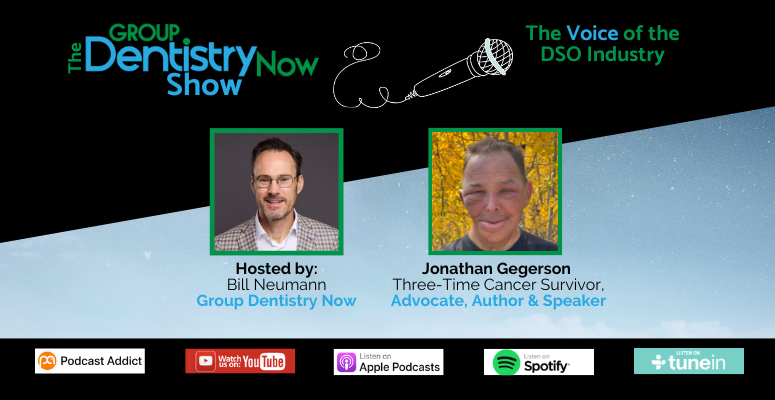
Welcome to The Group Dentistry Now Show: The Voice of the DSO Industry!
Overcoming Adversity: Jonathan Gegerson’s Journey as a Three-Time Cancer Survivor
Jonathan Gegerson, a dental industry veteran and three-time cancer survivor joins the show. Prepare to be inspired as Jonathan shares his journey which includes:
- His diagnosis & treatment
- Healing & family connection
- Establishing a retreat for survivors
Please support Jonathan by purchasing his book, Perspective-C. The proceeds from this book go to establishing a retreat for cancer survivors and their families. You can buy Perspective-C on Amazon here – https://dso.pub/PerspectiveC
You can reach Jonathan at jonathangegerson@gmail.com
Subscribe to our channel for more episodes and stay updated on the latest DSO news, insights, and events!
If you like our podcast, please give us a ⭐⭐⭐⭐⭐ review on iTunes https://apple.co/2Nejsfa and a Thumbs Up on YouTube.
Choose your favorite listening app below and subscribe today so you don’t miss an episode! Full transcript is also provided below. See all of our podcasts HERE.
 |
 |
 |
 |
 |
 |
 |
 |
DSO Podcast Transcript – Overcoming Adversity: Jonathan Gegerson’s Journey as a Three-Time Cancer Survivor
Welcome to the Group Dentistry Now Show, the voice of the DSO industry. Join us as we talk with industry leaders about their challenges, successes, and the future of group dentistry. With over 200 episodes and listeners in over 100 countries, we’re proud to be ranked the number one DSO podcast. For the latest DSO news, analysis and events, and to subscribe to our DSO Weekly e-newsletter, visit GroupDentistryNow.com. We hope you enjoyed today’s show.
Bill Neumann: Hey, everyone. Welcome to the Group Dentistry Now show. I’m Bill Neumann, and as always, we appreciate you joining us. We always have great topics and great guests. This next guest I found on LinkedIn, and I don’t think I was connected to Jonathan on LinkedIn at the time. There must have been somebody else in the dental industry that was commenting on his posts. that I was connected to and so I saw his posts pop up and I was really intrigued and a lot of passion. Jonathan Gegerson’s been through a lot and he was diagnosed in 2019 with salivary duct carcinoma. and he’s been sharing his story about that. Let me know if I get this right, Jonathan. He’s a three-time cancer survivor, 200 plus chemo cycles, 67 sessions of radiation, and seven major surgeries. So he’s been through a lot and we’re going to really let him take us through his journey and how he’s so darn positive. It’s great to see and I really enjoy what you’ve done on LinkedIn and continue to share. So thanks for being here, Jonathan. Appreciate it.
Jonathan Gegerson: Oh, I’m happy to be here. Thanks, Bill. It’s great to be here.
Bill Neumann: And the one thing I failed to mention is I think the reason I found Jonathan was he’s been in the dental industry for quite a long time, probably over 15, 16 years. Right, Jonathan?
Jonathan Gegerson: Correct. That is correct.
Bill Neumann: So, and I also, he has a book, which we’re going to talk about, so I can get this in front of the camera the right way, that I picked up probably about six months ago, but he really goes through his story in a lot of great detail. And I picked this up on Amazon and it’s a great read. Somebody that we had on our webinar, Jonathan, you’ll appreciate this, Dr. Brent Gilbert. We had him on a webinar about a month ago. And as I was reading your book, I had forgotten he actually did your forward. So that’s great to know that Dr. Gilbert, and he did a great job with the forward as well as you did an awesome job with the book. But I’ll stop talking and I’m going to let you give the audience a little bit of your background and maybe you can kind of take us up to 2019 when you were first diagnosed with your cancer?
Jonathan Gegerson: Sure. Yeah, absolutely. Well, like Bill said, I worked in the dental business for about 15 years, 16 years. I was a global trainer for a major dental company. And I live a very healthy lifestyle. I live here in Colorado. So I’m a big skier and exercise, big on nutrition. Happily married 29 years. I have four kids. And they’re all awesome. And my wife is amazing. And honestly, I was living a very healthy lifestyle. And things are going great. Things are wonderful. And I happen to be in Australia on a work trip training our Australian team. when I noticed I had a bump on the right-hand side of my neck. And at first I thought, oh, it’s nothing to worry about. But when I get back to the States, I’ll go to the doctor. Well, nine days later I came back to the U.S. and when I went to the doctor, my primary physician, she felt around my neck where I had the bump and Some of the immediate questions were, have you had any careful work done? Have you had a root canal recently? Have you had any kind of sinus infections recently? And the answer was no to all of those. So she proceeded to tell me that it could be cancer, but we don’t know. And that was in 2019. So up until then, I was a healthy individual, had no ailments, very, very active. And then in 2019, when she said it could be cancer, That’s what started the journey of getting the ultrasound, biopsy, PET scan, CT scan to then confirm that it was cancer. We weren’t sure what type yet, but we knew it was cancer at that point in 2019. And thus that started the journey of getting opinions on what I need to do, deciding courses of treatment, and making a decision with my wife on how we’re going to tackle this along with who are we going to tackle this with and what providers. And so in 2019, I was diagnosed, and that started that journey, Bill, of going through the initial treatment to what I’ve had to go through since then.
Bill Neumann: Thanks, Jonathan. If someone is recently being diagnosed with cancer, I mean, you talked a little bit about some of the process, right? You find out and you’re working with your spouse or your partner to come up with a plan. Maybe some recommendations on things that you would say, hey, you find out you’re diagnosed with cancer. This is what we did that worked out well. Maybe these are some things we would have done differently.
Jonathan Gegerson: Yeah, so initially when I discovered I had cancer, it was, okay, let’s just go, go, go, go. Let’s get rid of it and run with it. Fortunately, my wife, she’s like, you know, I think we should get a second opinion. And I don’t think we just go down the first path. And I have a cousin who at the time was a surgeon in Houston. And he actually made a contact telling me, I think you should go get an opinion at MD Anderson here in Houston. go to a specialist that this is all they do before you go down in the treatment course. And so once I heard that, we made the decision to go down to Houston. I live in Colorado, and we proceeded to meet with the doctors there. And after we met with them and after meeting with doctors in Colorado, we made the decision for my initial treatment and subsequent treatments to be in Houston. So my advice is when you hear cancer diagnosis, which nobody ever wants to hear, don’t freak out. Try your best to stay calm. Know that the body is a very complicated biomechanical machine. And just because of one person’s outcome does not mean that’s going to be your outcome. Okay? So what I mean by that is, if you’re being told certain things, One, get a second opinion. Two, know that doctors are gonna do their best based upon what they know. And they’re gonna share with you what they know from statistics and scientifically what they’ve been able to discover. However, the body is not a statistic. Your biomechanical body is not a statistic for each individual. So therefore, you can’t just take the statistics and things being shared with you by your doctor as that’s 100% gonna be true for you. So I share from a positive standpoint that if you ever get diagnosed or want to get diagnosed, keep positive. In my case, my diagnosis was such a rare cancer. I was told by my oncologist that out of about 4 million people, 10 to 15 people get this type of cancer each year. Based on that, There were no statistics, so it’s completely unknown. So I would share, definitely I would share comments of, we don’t know, we don’t know if this is gonna work. We don’t know lifespan, it could be short, it could be long, we don’t know. So rather than dwelling on the pessimistic side, I had to choose to what I call bind the diagnosis, meaning lock it up and say, hey, you know what? I’m not buying into this unknown. Life span could be short. I’m not buying into the aspect that this is a doomsday diagnosis. Instead, I’m going to walk out and proceed with what my doctors and I feel comfortable with treatment. And I’m going to choose to say the unknown is a good thing. Because that means I believe that I have an amazing, amazing opportunity for survival and to thrive. So when you first get diagnosed, don’t think, oh, I just got to do the first course. definitely take a little time and make sure you are mentally prepared, you get a second opinion, and you choose your provider who you believe is gonna have the best course of action that you align with. And then keep positive throughout the entire process. Do your best to not buy into this is over, no matter what the diagnosis is. Could be something I wanna share with everyone.
Bill Neumann: Great, thanks, Jonathan. Regarding cancer screening, any thoughts around people self-screening, any tips around that?
Jonathan Gegerson: Oh yeah, the bill. And you know, coming from the dental industry, I work for a company called Inbrista. You know, they are very well known. You know, if you’re in the dental business, you know them. With Texas, Cavo, Kerr, I work with all of them. So screening is a big deal for me, especially from the dental world, because I did go to a dentist regularly. However, I wasn’t being screened as well as I wasn’t doing my own screening. My cancer could have been caught sooner by a simple screening, which may have resulted in not nearly the amount of treatment and surgeries I’ve had to go through. So one of the things somebody can do for self screening is through a palpation test and just feeling around your neck, all through here, back of the neck, anywhere on the jawline, searching for bumps. Is there anything out of the ordinary, a lump, some type of bump? In dental school, this is dental school 101, every dentist is taught to do a cancer screening on every patient. And it’s literally a feel and a visual screening. Because they can catch many oral cancers, they could have caught eye cancer, head and neck cancer, much sooner. And we know in the cancer world, the sooner it is caught, the better of an outcome you can have. So at home you can self-check, but when a person goes to the dentist or the hygienist, that healthcare professional should also be doing a screening. And even today there’s other tools, there’s intraoral cameras, where cats can actually take pictures of inside of the mouth to see anything. But like that in there, we can help people and catch cancers early. In fact, coming in January, Dr. Brett Gilbert, myself, are publishing an article that’s coming out in January in many of the dental publications, and it’s a two CE unit course all about the screening process and how to screen the patient. Just to bring attention, most dental professionals are doing this already. They know they should screen people. But there’s some who may not be. And so we just want to bring attention to it again with the goal to save lives. And so screening is absolutely important. And you can do this at home as well as with your health care professional.
Bill Neumann: Excellent. So Jonathan, when is that course going to come out? You said it was sometime early next year? January.
Jonathan Gegerson: January, yeah. The publication, it’s been written and approved and it comes out in the winter publication. So many dental journals and even endodontic magazines as well.
Bill Neumann: Excellent. We’ll make sure we find that when it’s published and link to it on Group Dentistry now as well, because you’re right, I think screening is one of the most important things. And clinicians, whether they be primary care physicians or dentists or, like you said, even yourself, right? Self-screening is super important. Take us through a little bit. Again, I read it quickly and I want to say it again because the numbers are big. 200 plus chemo cycles, 67 sessions of radiation, and seven major surgeries. Do you mind taking us through a little bit of that journey and process and just maybe talk about the way you felt after some of the surgeries and treatments and how you have such a positive outcome and you’re now an advocate and you’re doing public speaking on this. I mean, you have been through a lot. So I wanna make sure that you get the chance to really talk a little bit about that experience.
Jonathan Gegerson: Sure, Bill, thanks. Yeah, no problem. I’m smiling because whenever I hear somebody say those numbers back, I’m like, wow. Yeah, it really was a lot. Because I tend to not think about it a ton, but I share it. from a standpoint that I want people to be inspired by it, to understand that we can overcome so much that the body wants to heal and that we can endure a lot of suffering and still come out positive on the other side. But yes, I have gone, and still to this day, I still get a monthly treatment because of my unknown diagnosis and there’s not enough information. I still get a monthly treatment of an infusion called Inhertu. and it is a targeted therapy with chemo. I have my initial treatment was a surgery to remove the tumor where I had a parotidectomy and they removed my parotid gland, that’s where the tumor was, as well as a neck dissection on the right. and then I went through 33 sessions of radiation and at the same time with chemo all in Houston. When the cancer came back a second time, this time it was a matter of where it came back was in the lymphatic system of the skin on the right hand side of my neck, as well as it showed up in the lymph nodes on the left hand side of my neck. Therefore, I ended up going through a left neck dissection and a right flap, meaning they removed the skin on the right-hand side of my neck, took a chunk out of my leg, and put it up on my right-hand side of my neck. They then radiated fat 34 times, and I went through chemo again at the same time. Then when the cancer came back again, we started another treatment to hit the chemotherapy, hit the cancer, which worked. It was a treatment called Quetzalcoatl. And I was on that for a very long time. And once again, that’s a chemo with a targeted therapy attached to it. And I was on that. However, due to all the radiation, and chemo and, you know, I had a surgery where they had to go and remove lymph nodes from my kind of clavicle area here, do the radiation, My right clavicle bone died and just on a whim one day it broke. And so since it wouldn’t heal, they had to go in and remove my right clavicle bone. So I no longer have a clavicle bone on my right hand side. That happened. But also, I got lymphedema. And so I was in PT to remove my plastic fluid because a lot of massage and things that they can do to help drain the fluid that your body produces naturally. And then I ended up having to go to the intensive care unit twice. Because of lymphatic fluid got so bad that it blocked my breathing. So I got rushed to the ER, where then they had to put me on O2, give me tons of steroids to try to bring it down. And that happened to me twice. So therefore, I had to go, it was recommended that I talk to the surgeon, Dr. Dayong in New Jersey, who he specializes in lymphatic transplants and what’s called the lymph venous bypass. And with head and neck patients, there was only one other person who went through a surgery like this in the United States. And Dr. Dayan was the one who did it. So, um, by way of one of my doctors knew him, I got in touch with him and, um, with a not 100% sure if it would work or not work, but we knew I was at risk of one day waking up and can’t breathe. So in a sense, I wouldn’t wake up. And I went through a 20-hour surgery where they removed everything from my neck, all the skin, where there were also cancerous cells, all the scar tissue. and they took lymph nodes from my abdomen, put them all up in my neck, as well as did a lumbinous bypass, which is where they basically take a vein and they reroute a vein to help fluid drain. And that was in New Jersey. So it was a 20-hour surgery, and I spent six weeks in the hospital last year over Thanksgiving, and I got home two days before Christmas. And the surgery was a success in the sense that my eyes have cleared up, my eyes are even swelling shut, my cheeks came down, and my airway opened up. What didn’t happen is my tongue still swells up, but it goes down, and my lips swell up. So that’s why I still look a little swollen, because this is lymphatic fluid. This actually looks good. I take about 30 minutes every day where I have to massage my tongue and my lips to get the lymphatic fluid to go down. But like I said, you know, I went through all of that with a very positive outlook from the beginning when I said, I’m not accepting that this is it. And I’m willing to do whatever it is I need to do to overcome this. And the reason is, honestly, is, you know, I have such an amazing life. I have four amazing children. And life in itself, I find so precious. I found my precious even before cancer. But now I find it even more precious, just like a lot of cancer survivors do. And that life is worth living, even if you have to go through a ton of suffering. And even me, I mean, as of right now, Bill, I cannot chew. I cannot chew regular food. I was left in a feeding tube for seven months after my last surgery. And I had to work very diligently to a point and come up with recipes of things that I can eat so I could get off the feeding tube. But today, I can’t sit down and have a meal that everyone else is having. I have to do my own thing. But I can still sit down at the table, eat what I have to have, and still be with everybody. So I look at food as nutrition. I don’t look at it as, oh, I have to taste that. It’s comforting. I’m like, this is about nutrition. And so I still would much rather Deal with the things I deal in a hundred pound backpack. We all as cancer survivors tend to wear, we all put on this hundred pound backpack each morning. I would still rather wear a hundred pound backpack each day. knowing that I’m still waking up, seeing the ones I love, being able to experience life, and being able to help others. Because life is worth living. It just is. And so I’ve just decided, and I’ve told myself that, that hey, whatever it is I need to do, I will do. And when my time comes, whenever that is, I don’t know when that is, just like nobody knows when that time is. But when the time comes, whenever that is, At least I know that I’ve done everything I can possibly do and a little bit more, and that I went out with a positive attitude, and that people who are important to me know that I love them, I care about them, and that’s what’s important. as well as saving other lives. And that’s why I want to do this podcast. And that’s why I speak. It’s very hard for me to speak. It takes a lot of energy. It takes a lot of energy to do this podcast. But life is so precious that I want others to be inspired, whatever they’re going through, to say, you know what? It’s worth it. Because, you know, Bill, we become stronger through our suffering. That’s something I talk about in the book, is embracing the suffering. And that’s because when we embrace it, we say, okay, I have to go through this. This is something I have to deal with. This is something I have to do. When we decide to embrace it, we allow for a victory to be had at the end, which is we become stronger in some way, we become better. And so I always tell people, I go, listen, I get it. Nobody wants to go through suffering, but when you know you got to go through it, embrace it and have the mentality that I’m going to be better because of it. And so it’s just an important aspect of life is worth living. No matter what you gotta go through, life is worth living.
Bill Neumann: Well, I think this story is going to inspire a lot of people that are watching this podcast. And, you know, everything that you’ve gone through, you still had the time again to do your book, right? You know, you had all that time. It’s called Perspective C. So you’re not feeling well. You’re going through these surgeries and these treatments, and you had time to write this book. Tell us about the reason why you wrote the book. I got it on Amazon. Probably other ways to get it, but that’s the way I bought it. It’s very inexpensive. Right now, it’s $8.99 on Amazon. So I encourage people, and we’ll drop a link in the show notes, to go and order the book. because it’s not so much about Jonathan and he’s taking this money and he’s looking to establish a retreat. But I’ll let you kind of talk a little bit about why you wrote the book and then talk a little bit about this retreat that you’re trying to establish.
Jonathan Gegerson: Sure, Bill. Thank you. I appreciate that. Well, I wrote the book because I felt moved to help people. You know, when I just felt like here I am going through all of this. And I know there’s other people who are going through it too. And I felt moved to say, you know what, if I can write where my words help not only people who are going through it, but also to help people to understand people who are going through it. Because the book was written not only for the person dealing with a long-term illness, but it was written for anybody who knows anybody. And they just want to benefit and understand and be inspired of how can I help this person? What should I do? And so, yeah, so I was moved to share a little bit of my story, you know, my mentality, but also just to empower people and to inspire them that, that yeah, I have been through a lot, that yeah, physically, mentally, I’ve been changed, but I will tell you mentally, I have been changed so much for the better because of this. Physically, I’m still here and I’m still able to do many of the things I did before. Some are limited, but I can. I want people to know that there is life. If you’re living with cancer or after cancer, there is life. And so I wrote this book to help and to help people understand the power of love, time, the words you speak. And the power of suffering. And how all of these things come together that when you understand them, of how you can use it all to your advantage for victory. And so that’s why I wrote this book. And it’s It’s available on Amazon, yep. You can also go to your local bookstore and order it if they have it on the shelf. So it is available through those channels. And purposely, I wanted to keep the book very, very affordable, because I wanted everybody to read it, because I wanted to help people. And I wrote the book and the ultimate goal is through proceeds from the book as well as we are starting other avenues to start raising funds. One of the biggest things, Bill, was for me is after I went through my initial treatment of cancer, I was longing so much to reconnect, not only with my kids, but with my other family, my brothers, my nephews, my mother, my father. And I wanted to see everybody. And it was so important to me. that shortly after my treatment and I recovered, I was able to get with them all and see them all again. And I was filled with tears. I mean, tears of joy, just, I’m getting to see you all again and hug you and be with you. And so, that was so important to me, and it helped me reconnect, and it helped me reunite with my family, and it helped me reset, just reset of who I am now, and there’s still a ton of life to live. And so my wife and I, our ultimate goal is to here in Colorado, we want to have a retreat where cancer survivors or a family who’s going through cancer They can come, spend some time on this retreat, or they can experience the reuniting with their family, reconnecting with who they are, and reset to know that there is life still left to live and plenty of it. Or they can just rejoice, have fun. find laughter again, be inspired, and experience a positive atmosphere that helps them take their mind off of cancer and focus it on what’s important, and that is family, and living, and life, and everything around them that they enjoy. So we want to provide that free of charge where we provide everything. The goal is to provide travel, transportation, places to stay, food, activities, To be able to provide everything for someone for five days, they come out, they spend five days at a retreat, and they just get to, with their family, and they just get to enjoy life and experience what still wonderful things are ahead of them. And so that’s our goal. And so we, we are taking off proceeds from the book and putting it to the side, as well as soon we’re going to be starting other fundraising campaigns so we can make this dream happen and we can impact even more lives and save more lives.
Bill Neumann: Thank you, Jonathan. This has been, this has been a wonderful, really, really great conversation. I appreciate getting to know you a lot more. And I think the audience is going to be really moved by this. And what I recommend to everybody watching or listening is, Link in with Jonathan Geggerson. I’ll put your LinkedIn handle in the show notes so people can connect with you there and message you. He does post quite a bit on there, so you’ll be able to keep up with him. We’ll drop the Amazon link for Perspective C. That’s his book. I bought it back in March of 2024. So it’s been out a little while, but it’s a perfect five-star rating. So He’s got a lot of reviews and they’re all five stars, which is great, 899. So that’s a way really to help Jonathan and his family as they start to build this retreat where cancer survivors and their families can reunite, recharge, and reset. And then what we’ll also do, Jonathan, is we’ll keep everybody Just kind of up to date with what’s going on. Again, you said January, you’ve got that 2CE course with Dr. Brett Gilbert that you’re doing. So we’ll make sure that we provide links to that when that’s available. And just really been a pleasure today. Is there an email address or the best way beyond LinkedIn for people to touch base with you?
Jonathan Gegerson: Yeah, I’m always open. I’m an open book. And I’m open for anybody to reach out to me if I can help. I like to say, I do my best to be sincere and authentic and real. I tell people, yes, I’m positive. But of course, I’ve had my moments of tears. And I’ve absolutely had my moments of down times where The questions come in and I get concerned. But overall, I keep positive. And so, yes, you can reach me on LinkedIn. I’m also on Facebook. I’m John Gakerson. My email is my first and last name, Jonathan Gakerson, at gmail.com. I keep it simple. and you’re welcome to email me and reach out to me. You’re welcome to DM me on LinkedIn, Facebook. I also have Instagram, I’m on there. And all I do is I just, many times I just share my thoughts for today and what’s come about and something like, you know, somebody built asked me the other day with my lips and my tongue being so swollen and not being able to chew. Man, you must miss eating so much and sitting down. And I said, you know, at first I did. I missed, you know, being able to sit down and eat a great meal with all the flavors. I go, but that’s not what I miss the most. And they kind of gave me a puzzled look and they said, what do you miss the most? I said, not being able to kiss my wife properly. I said, that is actually what I miss the most. And they just kind of looked at me like, what? I go, yeah, because that can be so taken for granted. Just like eating can be so taken for granted. Oh, I get to eat, you know, like this. But that’s what I miss the most. And it’s like, you think about that, it’s like, wow, you know, I never thought that would be something I would possibly miss the most, but it is. And so many times over things that I post, as well, I’ll post my story, encouraging words, But people are always welcome to reach out to me and I’m always happy to give an honest response. Always.
Bill Neumann: Thank you, Jonathan. And the one last thing I wanted to mention is Jonathan is a public speaker, motivational speaker. So if there are any dental companies out there that are looking for somebody like Jonathan to have at one of their meetings, he’s a speaker. He does a great job and great podcast. So I appreciate your time, Jonathan, and I appreciate everybody in the audience for taking the time to watch this podcast. And make sure you get Jonathan’s book, Perspective C. Again, we’ll drop a link to that in the show notes. And until next time, this is the Group Dentistry Now Show. Thanks for watching.
Thank you for joining us today. Don’t forget to subscribe to the podcast to stay up to date on the latest DSO news, insights, and events. Also subscribe to our DSO weekly e-newsletter at groupdentistrynow.com.