
Ranked the #1 DSO Podcast!
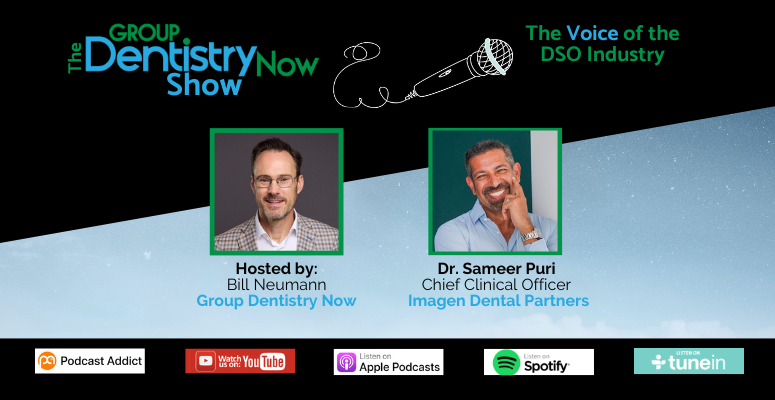
Welcome to The Group Dentistry Now Show: The Voice of the DSO Industry!
Dr. Sameer Puri, Chief Clinical Officer of Imagen Dental Partners Shares his Story and Leveraging Diagnostic AI.
Dr. Sameer Puri, Chief Clinical Officer of Imagen Dental Partners joins the GDN Show. He discusses:
- The Rise of Imagen Dental Partners
- Piloting, Evaluating & Implementing Diagnostic AI
- The Future of Technology & AI in Dentistry
Thank you to Overjet AI for sponsoring this episode. To learn more about Overjet visit – https://www.overjet.com/ or schedule a demo here – https://dso.pub/OverjetDemo
To learn more about Imagen Dental Partners visit https://www.imagendentalpartners.com/
You can also reach out to Dr. Puri for more information on both Overjet AI & Imagen Dental Partners here – spuri@imagendentalpartners.com
Subscribe to our channel for more episodes and stay updated on the latest DSO news, insights, and events!
If you like our podcast, please give us a ⭐⭐⭐⭐⭐ review on iTunes https://apple.co/2Nejsfa and a Thumbs Up on YouTube.
Choose your favorite listening app below and subscribe today so you don’t miss an episode! Full transcript is also provided below. See all of our podcasts HERE.
 |
 |
 |
 |
 |
 |
DSO Podcast Transcript – Dr. Sameer Puri, Chief Clinical Officer of Imagen Dental Partners Shares his Story and Leveraging Diagnostic AI.
Welcome to the Group Dentistry Now Show, the voice of the DSO industry. Join us as we talk with industry leaders about their challenges, successes, and the future of group dentistry. With over 200 episodes and listeners in over 100 countries, we’re proud to be ranked the number one DSO podcast. For the latest DSO News, analysis and events, and to subscribe to our DSO weekly e-newsletter, visit groupdentistrynow.com. We hope you enjoy today’s show.
Bill Neumann (00:38):
Hey, welcome everyone to the Group Dentistry Now Show. I am Bill Neumann and happy New Year to everyone. I hope you all had a great holiday season and we are really happy to have everybody back. Everybody’s got their business plans in place and they are ready to go for the new year. So we’ve got with us, we’re going to talk about AI. We’re going to focus on clinical AI, diagnostic AI, but we’re also going to talk to a group that it’s the first time we’ve actually had anybody from the group on our podcast. And I’m kind of ashamed of that because they were our 2022 emerging groups to watch winner. So I don’t even know if Dr. Purry, you even knew that, but-
Dr. Sameer Puri (01:23):
I did not. Yeah.
Bill Neumann (01:24):
About three years ago, Mike Augens picked up the award. We had it in Nashville and he received the award for Imagine, but we have with us Dr. Sameer Puri. He is the chief clinical officer of Imagen Dental Partners. And we finally have somebody to talk to from the organization on the podcast. So thanks for joining us.
Dr. Sameer Puri (01:44):
Hey, thanks for having me. Glad to be here. And yeah, I had no clue that we had won that award and glad we survived the last, I guess, three and a half years to kind of maybe have that come to fruition as that we deserved it.
Bill Neumann (02:01):
Yeah, for sure. Well, I mean, I look at your activity. We track every single month. We track, we call it the DSO deal roundup. So all of the M&A activity in the space. And you all seem to be on that list for acquiring a practice or two or a small group. I just saw one. It might have been a couple of days ago and was it Florida? Was it California? Somewhere warm. I remember it was-
Dr. Sameer Puri (02:30):
Yep. That was our largest acquisition, great future partner. We’re excited to have him on board. And yeah, look, we’ve been active. That’s an active strategy of ours to stay current in the acquisition mode. We see some news on some other groups that are kind of shutting down their acquisition engines. This is a growth play for us. We’re committed to it. And through thick and thin, we’ve persevered and done well. So yeah, we’re going to continue in 2026 with our acquisition strategy.
Bill Neumann (03:02):
Yeah, that’s good to hear. You’re right. There have been a lot of groups that have been, what do they call it? Pencils down, right? So there has been no deals done in the past couple of years. And for quite a few of the groups that I think were on a tear, probably maybe a little too much when interest rates were low and now they’re trying to digest all the acquisitions they’ve had over the past X amount of years. So it’s good to see that you’re out there strategically making acquisitions when it’s a good.
Dr. Sameer Puri (03:34):
For sure. Yeah. Yeah. Our model is different. We are very disciplined in how we do it. I think we have a partnership model, which is different than some of the other groups. So every partner that joins Imagine, we try to be very diligent and make sure that they join the Imagine family in a thoughtful manner. And it’s been … I guess everyone keeps saying, oh, you guys are growing so fast. Our goals are certainly internally higher, but we should certainly look to celebrate our successes because this is not an easy endeavor to be involved in. Yeah.
Bill Neumann (04:14):
Yeah. You’re right about that. It’s definitely doesn’t … It used to seem easy. And again, I think a lot of things looked easy when money was cheap. And now you realize the organizations like yours that are still able to acquire and the ones that maybe aren’t, maybe the strategy was, you probably had great BD people, some organizations, but as far as internally, what was the culture like? And did you actually build something that was built to last instead of built to scale and sell? And now a lot of people haven’t been able to sell their groups, I think, in a lot of cases.
Dr. Sameer Puri (04:52):
Yeah. Look, I think that’s been a problem. Obviously, we know of the free money that’s happened. I think one of our keys is that we are, like I mentioned, we’re disciplined. We do have a plan that we try to stick to and we’ve said no to deals and sometimes to the detriment of our budgets and our goals. But if the deal is not right, if the partner is not a good fit, if the practice is not a good fit to our model, we’ve had to say no at the last minute. And in the long run, I think that’s going to be the right call for us because then we’re not burdened with practices that don’t necessarily share our long-term philosophy.
Bill Neumann (05:36):
Well, before we get started and have our conversation about AI, and first of all, I’d like to thank overjet for sponsoring this podcast and giving us the opportunity to speak with you, Sam. Can you give us a little bit of background, your bio, and then how you came aboard? Imagine, did they acquire your practice and then how did you end up in the chief clinical officer role? So it’s a long … But give us a couple minutes on your bio.
Dr. Sameer Puri (06:06):
Yeah, no, certainly happy to do it. So I was in private practice in Los Angeles. That led to a couple of side projects. One of them being, I started an education company with a former partner and we were training on CEREC. So that turned into what is today called CDOCS. So as one of the founders of CDOCs, we were acquired by SPEAR Education. So I actually sold my practice and moved to Scottsdale to run CDOCs full-time. And through training on CEREC for 20 plus years and working at CDOCs and Spear, I met the two founders of Imagine, Michael Loggins and Rizwan Mongi. Rizwan’s our CEO, Michael Loggins is our executive board member and had a great run with CDOCs. We were acquired by private equity, had a lot of fun training over the years, grew that business. I used to teach every single workshop and then had built up a faculty of, I think, 14 or 15 great teachers.
(07:09):
Many of them are still there. But after 17 years, I was just looking to maybe do something different, just wanting to explore what else was out there. And so Rizwan and Michael had started Imagine in 2020. I knew them. I had known them for years. I actually was one of the original investors in Imagine. So my wife and I actually sold our house. It’s a funny story. We sold our house and we put the money in Imagine. We were looking to move residences. And so the market had done well in housing. So we took that money and we invested in Imagine. So I was a passive investor, kind of a bystander for the first couple of years when you mentioned in 2022, we won that award. And then late 23, 24, we had a new CEO at Spear. Things were going great, but I just kind of wanted to do something different.
(08:05):
Imagine happened to be looking for a chief clinical officer. And I thought, why not give this a shot? I have a vested interest in seeing the company succeed. And actually put together a resume for the first time in my life because I’d never applied for a job before. I was kind of self-employed and self-created and went through the interview process and got the job and joined on in February of 2024, where I’ve served as the chief clinical officer and have had hopefully some good input into the company and tried to steer it in the right direction in some of the clinical initiatives that we’ve taken on. So that’s kind of a brief version of how I ended up at Imagine.
Bill Neumann (08:48):
No, that’s great. I did not know that. So that’s a pretty cool story. And you sold your house basically and invested in Imagine, right?
Dr. Sameer Puri (08:56):
Yeah. Yeah. That’s the actual truth. In fact, to me, it was a no-brainer because I believed in the leadership team. I believed in the business model. I knew some of the early partners that were going to join. So I had known these folks for a long time. Now, what I didn’t know was like every other startup, every other new group, like Imagine had its struggles in the beginning, no surprise there, but I was oblivious to that because I was not involved in the day-to-day. And so when I came on, I said, oh wow, we’ve really done a lot over the years to overcome a lot of early group practice hurdles. And here we are in 2026, over a hundred practices strong and growing, continuing to add to our growth engine, very low leverage, no outside funding, no private equity funding in our organization. So very excited about where we are headed as a group in the future of our company.
Bill Neumann (09:58):
So I think your partners were like the, if you look at the profile of a potential partner at Imagine, they seem to be very tech-forward practices, right? So maybe can you talk a little bit about what that profile looks like?
Dr. Sameer Puri (10:15):
Yeah. Look, I think from our early on, from my history of teaching CEREC, knowing Michael Loggins, who was the former president of Serena, who helped bring CEREC into the US, Rizwan Manji, who was the president of SPEAR where we taught a lot of CEREC. So our ecosystem, our network of people that we knew were all tech forward, all tech savvy, all believed in digital technology, whether it be chair slide milling, 3D printing, conebeam technology. So our early practices, our early partners that joined us were from that ecosystem. They were from that network of going to the DS world meeting or the SIRA world meetings over the years and all the SEREC trainings that we did. So a lot of our early partners from that. So that’s been a core of ours that we believe in technology, we believe in implementing the right technology, and we don’t consider it an economic burden.
(11:13):
We consider it an investment. Now, that takes a lot of caveats into play that it’s the right technology and we’re just not buying things for the sake of buying things. We do go through a pretty thorough evaluation now of what scanner are we going to use, what milling unit are we going to use? What 3D printer are we going to use? So a lot of that is built into our DNA. Our doctors are very comfortable with technology, and that’s kind of just grown from there. Now, that doesn’t mean that partners that are joining us must use a CRAC or ConenVeam. We have partners that don’t necessarily utilize that technology and we work with them. And if it makes sense to implement that in their practice, we’ll do it. If they’re comfortable doing it the traditional way, we certainly don’t force any technology on someone. So while our core is tech forward doctors, I think today we are a little bit broader than that and we welcome all people, but we certainly look to technology to grow our organization, our practices.
Bill Neumann (12:21):
So it’s not out of the ordinary that when diagnostic AI comes to fruition three, four years ago, it’s been around for a little while now when you think about it, that you probably started to evaluate that. So talk a little bit about the evaluation process and technology and everything’s AI nowadays. It all sounds great, but at the end of the day, there has to be a reason behind why you would choose to use something.
Dr. Sameer Puri (12:50):
Yeah. It’s funny you mentioned that because I went to a recent Daikema, the last Daikema conference, which is a big group conference. And I mean, if the Booth, the companies that were with the Boost there didn’t have AI in their pitch, something was wrong. There’s millions of people crawling through the woodworks and everything is AI now. For us, I was actually in looking at … We use Overjet in our organization. It’s a great product and very happy with it, but Overjet was implemented and decided upon before I came. I actually had no input into whether we were going to use Overjet or one of the other providers that was already here. Now, what I did do was Riswan, our CEO, challenged me one day and said, “Hey, I heard we’re power users in Overjet, AI.” And I was like, “I don’t know that we are.
(13:49):
” So I kind of did some phishing. I did some talking to some of our partners and, “Do you use Overjet?” “Yeah, we use it, but I don’t really know. I don’t know if I trust it. There’s some false positives here and there. “And so as I dug in, I realized that while we had decided on utilizing Overjet that we really hadn’t launched it properly in our company. So we went through a process over the last few months where I got deep into the software, started talking to the Overjet team about features that I would like to see and analytics and reports from my perspective that I would love to see. And I thought I was coming up with some brilliant ideas of things that the Overjet team could implement to make the product better. And they’re like, ” Well, no, this is all right here.
(14:35):
You want a report of incipient lesions in every Imagine office, here you go. You kind of do these three clicks. So as I started to go through that process, I realized we really had not utilized it properly. So we have really started to go through and build out a protocol. So for example, the morning huddle, to me, the morning huddle is the most important thing. And you ask every office, “What do you do in the morning huddle?” And 90% of the time it’s regurgitating the patients that are coming that day. We are putting together a protocol on utilizing Overjet for the morning huddle. So go through every patient like you normally would, but tell me what Overjet says on what is recommended or what Overjet the AI sees in that patient. Now, to be clear, that doesn’t mean that we act on every single recommendation that the AI gives.
(15:30):
This is up to the clinician, this is up to the provider to validate the findings. And yes, there are findings that they don’t agree with. Absolutely. Remove them, get them out of the system. In fact, it trains the AI so that the recommendations get better, but there’s a lot of things that we can do in the morning huddle that if we systematically go through the recommendations, agree or disagree, you’re going to find there’s a lot of dentistry that the patients need was just slipping through the cracks. So that’s one example of how we’ve changed how we work with Overjet in our practices.
Bill Neumann (16:07):
You touched on something I think pretty important and it just doesn’t apply to AI, clinical AI, any kind of AI. I think it’s any type of product or solution out there. It’s really the training side of things, the educational component. And so you can have incredible solutions, give it an AI solution or a clinical product, a bonding agent or something like that or a cement. But if you don’t have support from the organization, you don’t have education, onboarding, ongoing education too, right? It’s not just bringing something new on, it’s supporting the clinicians. You could have the best solution in the world and it’s not going to work. And I think you kind of alluded to that with, “Hey, we’re getting some false positives or whatever you might have mentioned.” And it’s like, “Well, maybe we need to learn how to use this correctly.” And then things kind of flow from there.
(17:07):
And I know that’s a big part of your background as the training and education side of things. So talk a little bit about how you train, whether it’s imagine and you training people on Overjet, and maybe also talk a little bit about the support that Overjet offers you as a group. Because I think we hear this all the time from both DSOs and I think vendors a lot of times are, so they want the sale, but they don’t always have the support behind it. And I think the support sometimes can even be more important than the product itself.
Dr. Sameer Puri (17:48):
Yeah. Look, just a general comment before I talk about the support. I think we have doctors that say, “I don’t necessarily trust it. ” And my job isn’t to force anyone to use any technology, it’s just to help them understand that today AI, whether it’s dental, whether it’s you’re using ChatGTP or Gemini or anything, it’s the worst it’s going to be today. Tomorrow’s going to be better, the day after’s going to be better. Every day, we’re seeing massive improvements in the technology. So you need to be the ultimate validator of the information that you’re getting. You need to make sure that what the AI is telling you is accurate. And if you don’t agree with it, mark it off, it trains the system, you get a better result next time, but it’s up to the doctor to determine. So it’s not my job to say, “Hey, Overjoy is saying there’s 800 crowns in your practice that need to be done.
(18:38):
Go do 800 crowns.” My job is to say 800 crowns are being done. How many of those are accurate? And instead of us spending money marketing for new patients in the practice, how about we just take care of the actual work that needs to be done in our offices? So that’s one comment. With regards to the support, I mean, Overjet’s been great. Now, as I came into my role, we were already using Overjet. Certainly I was being courted by the other companies, the other major players out there, and they all have good products. I’m not here to say one or what is better or anything. They’re all good, right? But focusing on Overjet, I think the support that we have gotten is exceptional. I would kind of put some of that in the sense that I have become engaged, my clinical leaders and our clinical directors and our company have become very engaged with the product and the Overjet team has been very responsive to address our needs.
(19:34):
So a simple example would be there’s a false positive. I have a direct line into the director of product at Overjet that we can just send them the x-rays say, “Hey guys, what’s going on here? Take a look at this. ” And they’re able to use that to kind of train the model and get better. Their marketing team has been working with us. We’re putting together an Overjet Bible that we can give to our doctors on how do we do the morning huddle? How do we do a hygiene visit? How do we do a new patient exam utilizing Overjet? They’ve been very cooperative and in working with us and helping to develop this kind of Bible. So the support that we received from Overjet has been fantastic, but part of it is being proactive and reaching out to the company and saying, “Hey, the product is great, but we need X, Y, and Z.” To their credit, they’ve been very responsive in delivering X, Y, and Z.
(20:30):
One of the things that some of our doctors were looking for was a notation like voice to text in terms of charting and such. Talked to the Overjet team. They’re like, “Hang tight, we’re working on it. ” I think it’s public knowledge now. They acquired a company, then they’re integrating that into the software. What I’ve really been impressed with is how quickly they are implementing the changes. We’ve asked for several updates and features and couple of weeks they’re like, “Here you go, it’s done.” It’s like, wow, that’s pretty cool that a big company like this can be so agile and can help improve the process of improving their product based on their customer feedback.
Bill Neumann (21:19):
Yeah. And you’re right. It was Dentalby was the acquisition. Yeah. So that was public just a couple weeks ago. So yeah, that’s great news there.
Dr. Sameer Puri (21:30):
Sometimes I have to be careful because I learn about these things. I’m like, “What can I share?” You’re right. It is public now, so that’s good.
Bill Neumann (21:38):
Yeah, no, I saw that. So you’re good. You’re okay. So do you typically build out for, again, your background being an educator, do you typically build out a Bible or a playbook for different technologies or implementations of things? I mean, if I’m a new partner that comes in to imagine, do you normally have some type of standardized training or how does that all work?
Dr. Sameer Puri (22:06):
Yeah, so work in progress, we are certainly better today at that than we were two years ago. So one of the things that we have implemented is protocols on the Imagine Way. So an example of the first one we did was using Curadon. So why Curadon? Because I think it’s a great product. It seems to work very well. The science is excellent behind it. We did a search in our Overjet database of all of the incipient lesions that were there in our offices that were untreated. And why were they untreated? And I get it. I practiced energy for a number of years. You have a very small lesion. No dentist wants to drill unnecessarily. So you kind of keep an eye on it, you watch it, quote unquote. And what usually happens to that small incipient lesions, you watch it turn into a larger filling or something bigger.
(23:02):
So with CureDont, treat it. So instead of watching it, let’s treat it. Well, that is a great opportunity to take care of patients, but in running a business, that’s a revenue opportunity as well. And anything that we do in our organization, it has to improve patient care, but we should also be growing our practices. So when I ran that analysis, there was tens of thousands of lesions that were there in Overjet that were incipient lesions. Well, how do we treat that? We treat it with Curadon. How do you use Curadon? So what I did with my team was create a full protocol on step-by-step of what Caradon is, what’s the billing process on it, how do we utilize it? How do you apply it inapproximately? How do you apply it to a flat surface? And by doing that, we were able to roll it out to all of our doctors.
(23:53):
So now they have a step-by-step PDF of the Imagine Way. So we have now done that with several other different things and we’ve got a whole lineup of different protocols that we’re creating called the Imagine Way. Overjet is one of them. Now, because to me, the implication of utilizing AI properly is so massive in our organization, the opportunity to do better dentistry and more comprehensive dentistry is so massive. That particular version, we’re actually creating a larger manual that will go out to every single new partner that joins, every provider, every associate, front desk, hygiene that gives them the why of why we use Overjet, how we use it, and what it can do for the practice. And again, we’re not saying that everything that comes out of AI is you have to treat it like gospel, that it is the truth. It is not. It is an opportunity to do more comprehensive diagnosis by having an AI partner, but it is up to the providers to validate whether they agree with those findings or not.
(25:01):
And over time, as we utilize it more and more and we train that model, it’s going to become more and more accurate. So that’s kind of how we’re building out playbooks of the Imagine Way. But in Overjet’s case, it’s a little bit of a bigger initiative in terms of getting a really big manual that we can give to our … We have 1,700 employees now in our organization, so give it to everyone that is touching the software.
Bill Neumann (25:31):
Wow, that’s a big initiative.
Dr. Sameer Puri (25:34):
It’s a big initiative, but it’s worth it because there’s a lot of opportunity. If we have all of our offices that there’s one crown per week that is diagnosed, that was not going to be diagnosed because you have an assistant helping you, an artificial agent helping you. One crown per week per practice, I mean, you’re talking about a lot of revenue, but more importantly, you’re taking better care of your patients. And that always comes down to that.
Bill Neumann (26:08):
Yeah. So that actually leads into a great question. Have you seen, and if so, what’s that impact that you’ve seen now using Overjet, well, since before you really joined the organization, but can you point to more treatment planning, acceptance, some organic growth, and any numbers that you’ve seen that are directly related or even indirectly related to using Overjet?
Dr. Sameer Puri (26:34):
Yeah, I think the Overjet team probably has those numbers better than I do. I have not done that analysis just yet simply because we’re in the process of relaunching Overjet in our organization. So while we’re using it, we’ve got a whole plan that once this manual is done, we’re going to relaunch it to every single partner with webinars and then we will start tracking. I can tell you that the offices that have fully embraced it, they’re diagnosing more thoroughly. Revenue is up and patient care is improved. Hygiene is a big opportunity here. We as dentists tend to not treat perio appropriately. And now that you have the validation of not only the probing depths in the mouth, but now you have x-ray validation, you have artificial intelligence validation of showing you that there’s significant bone loss here. You can’t just do a prophy. It’s just easier to educate patients.
Bill Neumann (27:31):
I’m kind of curious your perspective on things now that this type of solution, this clinical AI has been out on the market for what, three years now probably. Does that sound about right at least?
Dr. Sameer Puri (27:43):
Sounds about right. Yeah. Maybe a little longer. I don’t
Bill Neumann (27:46):
Know. Yeah. Yeah, maybe it’s four years, but it’s been around for a little while and it’s obviously continues to get better and smarter and more accurate. From a dentist perspective, do you see more adoption because there’s a little bit of hesitation initially for various reasons, right? It’s, “I don’t want Big Brother watching me. I don’t trust it. ” Do you see that those barriers are kind of breaking down and do you have some clinicians embracing it to almost look like, “Hey, this helps me out. It makes my job
Dr. Sameer Puri (28:21):
Easier.” Yeah, I think you have to look at two different groups. One is the group practice that we would fall into. One is the private practitioner. I don’t see how both those groups, first of all, don’t utilize some sort of artificial intelligence. Like I said, the advantages drastically outweigh any disadvantages, and the only disadvantages that it gives you a false positive, which you should be validating regardless. I think what I don’t … I have heard some groups that are dictating treatment from the support center. They have their analysts that are looking at x-rays and then calling the doctor say, “You need to do this treatment.” We don’t do that. I don’t necessarily believe in that at all. So from our perspective, we want to utilize it as an aid to the doctors. We want to utilize it that they have somebody helping them to diagnose better, and that’s how we’ve kind of implemented.
(29:23):
For the private practice, doctor, I think the reality is I’ve heard some of my colleagues who are not necessarily in a group say, “Oh, I don’t believe in it. It’s not accurate.” And they just kind of poo-poo it. Again, I go back to the thing, yes, it may not be 100% accurate today, but it is getting better every single day, and it’s more accurate than it’s not. And if it helps you to treat patients to do dentistry that you otherwise just wouldn’t have done, and now you have a feeling that you missed or decay that you missed that now turns into a crown later or now needs Is endo. Are we really doing that patient a service by allowing that lesion to go untreated? I think it’s a must. To me, it’s like if I was to go out into private practice today, this would be something that I would absolutely have in my practice.
(30:19):
I could not imagine practicing without it.
Bill Neumann (30:23):
Well, as we look into the future, we’re at the beginning of 2026, but as we maybe look out through the next couple of years, what do you really see the future of AI in dentistry, whether it’s clinical AI or even we’ve talked, there’s conversational, like you said, you go down the aisle at Dykema and everything’s AI. Everything’s. That’s good and sometimes not so good. But from a clinical side, what does the future look like from your perspective?
Dr. Sameer Puri (30:57):
I mean, I just see it getting more accurate. So I’ll give you one specific example. Again, this is Overjet. The other big players, I’m sure they have something similar that they’re working on. But I can only speak on Overjet because that’s the team I’ve been working with and that’s the product that we use, but have evaluated everything. I’ll give you one example in that. I mentioned the false positives a couple of times. You’ll have it on an x-ray, there’s a lesion, and when you check in the mouth or you check another x-ray, it’s not there. So that’s part of improving the software, improving it better. So one of the things that Oberjet is doing is that if right now it looks at each individual x-ray and it makes a determination of whether there’s a lesion there or not, whether there’s something that needs to be treated.
(31:46):
Coming out, and by the time this is published, it may already be out that if there’s, for example, a set of bite wings where you have the same tooth on two different images or FMX where it’s on multiple images, you might have a bite wing, you might have other x-rays that are taken, the software is now going to look at multiple x-rays, multiple images to validate that whatever lesion is there is actually there. So that’s going to reduce the level of false positives. Now, that might seem like a simple thing, but this is where the software is going to evolve, where you’re going to get more accuracy in the clinical diagnosis. I think the image processing is going to get better in that you look at an image from whatever your imaging software is and you look at it in Overjet, the images appear clear.
(32:37):
They have a really good algorithm for processing those images. I see that improving so that we get better diagnostic ability just with our naked eye, without the AI overlay. I see AI becoming more involved in our treatment planning. So you give it a set of x-rays, you give it a set of photos. And today, my time at CDOCs and Spear, we were really big into treatment planning, coming up with a comprehensive treatment plan for the mouth. That requires a lot of knowledge, a lot of input from the doctor. I can see AI really automating that and simplifying that where you feed it x-rays, where you feed it the photos of the patient, and it gives you a comprehensive treatment plan. Now, I think we’re going to have to go through that same learning curve where initially it’s going to give you a bunch of stuff.
(33:25):
You’re like, “I don’t agree with what it’s saying, but it will improve over time.” So I don’t think AI is going anywhere. I think it’s going to become more ingrained. I haven’t even talked about front desk, having an AI assistant helping to answer your phones, an AI assistant helping with your billing and insurance claims, an AI assistant doing your ordering for your supplies where it knows what you need. All of those things, putting that aside, I think the clinical nature, it’s not going anywhere. I think it’s going to become more and more embedded into our clinical workflows, those doctors that do implants. Right now, we have to plan our implants and we order the implant, then we order a surgical guide, throw that information into the AI and it automatically spits out the treatment plan. It orders your implant for you. It prints your surgical guide.
(34:19):
It’s tied to your 3D printer. It’s going to become more immersive in our clinical practices. It’s not going anywhere. So those of you that are on the fence, embrace it. You’re just going to see more of it.
Bill Neumann (34:35):
Yeah. Yeah. I think that’s spot on. Yeah, it’s going to become more intertwined and more seamless and better. I think that’s- Integrated. Yeah. Yeah, that becomes more accurate. How about the future for Imagine Dental Partners? What does the future look like for your team?
Dr. Sameer Puri (34:55):
Everybody asks us that. Everybody keeps saying, “What are you guys going to do? ” Look, our goal is to continue to grow as we have. Our goal is to continue to add great partners every single year. As I mentioned before, we have no outside investors. We have no private equity. We have no institutional funding. Our organization is majority owned by our partner dentists. Other than to just grow our organization, do great dentistry, take great care of our patients and provide an awesome place to work for our partner and associate doctors. We have no plans to sell the company, flip the company or anything like that.
(35:42):
We’re over 120 practices now. If we just continue to grow at our pace, we will continue to grow at a nice, reasonable pace with great partners and continue to just create shareholder value for our doctors. So I wish I had something more exciting to say that, “Hey, we’re going to be selling the company in six months, and no, we have no intention of that. ” We have a long-term vision. We’ve always had a long-term vision. We want to continue to grow our organization and be as independent as we can be so that we can make clinical decisions and not be dictated by outside influence. That’s kind of our plan.
Bill Neumann (36:24):
I think it’s nice to hear long-term when you’re in an industry where three to five years- A lot of short-term self. Yeah. Yeah. So I think that’s actually a really encouraging thing for the industry as a whole and for clinicians to know that there are going to be groups that are going to be around for the long-term and they’re not in for, again, three to five short-term windows.
Dr. Sameer Puri (36:49):
Yeah. Look, I think the zero interest days really … I don’t know if that’s reality, if that ever will be reality again, where we have interest rates so low where companies are going in and out of groups and flipping practices all the time. I think that was a little bit unhealthy. There was a lot of turmoil. There was a lot of groups that got into trouble with too many practices and too fast growth and too much debt. Our debt is minimal compared to our EBITDA. Our leverage is minimal compared to many of the other groups out there. So look, we control our own destiny. We have a long-term vision, like I said, and hopefully we do set a good example for the industry.
(37:37):
We’re not a DSO. We’re a DPO. We call ourselves a dental partnership organization. And for me, people ask, “Well, how did you get involved with a group?” Well, I wouldn’t necessarily be involved in any group, but the right ones, the ones that have the right vision, the right kind of ethos in them and the right thing that they want to do long-term and create a standard in the industry. Maybe I’m being a little optimistic, but I’d like to think that we are doing things a little bit differently than everybody else. And while we had to prove ourselves through the early years, I think we’ve established ourselves that we have a model that we like and we’re going to continue.
Bill Neumann (38:23):
Well, if people want to learn more about Imagine Dental Partners, what’s the best way for them to do that?
Dr. Sameer Puri (38:31):
Look, certainly go to our website, imaginedentalpartners.com. You can always email me Spurri@Imagine Dental Partners. I’m on LinkedIn. I try to be active and if I can help answer any questions, whether it’s on Overjet, whether it’s on our organization, whether it’s on anything. I think one of the things I’ve enjoyed over the last 20 years is I’ve educated a lot of people, done a lot of courses and have had to give some advice over the years to folks, and hopefully it’s been good advice. So I’m always happy to share whatever I can and help improve our entire profession and contribute in the way that I can.
Bill Neumann (39:12):
Excellent. Thanks so much, Dr. Samir Perry. Great to have you here. What we’ll do is we’ll drop your LinkedIn handle in the show notes, your email address, imaginedentalpartners.com. We’ll make sure that URL is also in the show notes. And then of course, thank you Overjet for sponsoring this podcast and long overdue conversation with the 2022 Emerging Groups to Watch Award winner. And you can go to overjet.com and then on the top right side of their website, you can book a demo, but it’s super easy. Overjet.com, imaginedentalpartners.com. It’s really easy to get in touch with both Imagine and the team at Overjet. So appreciate your time, Samir. It’s been great. And thanks everybody for watching us today and listening. And again, happy New Year. We’ll look forward to seeing Imagine Grow in 2026 and beyond.
Dr. Sameer Puri (40:11):
Thank you very much. Appreciate it.
Thank you for joining us today. Don’t forget to subscribe to the podcast to stay up to date on the latest DSO News, insights, and events. Also, subscribe to our DSO weekly e-newsletter at groupdentistrynow.com.