

Sponsored Content
How upstream insurance inconsistency quietly disrupts every downstream metric
When revenue cycle performance slips, most organizations look downstream—at claims, denials, follow-up, and collections.
That’s where the symptoms appear.
But for many DSOs, the root cause shows up much earlier — long before a claim is submitted or an account hits A/R.
Revenue cycle performance is shaped upstream, and one of the earliest dependencies is insurance verification accuracy.
The Revenue Cycle Is a System, Not a Set of Tasks
The revenue cycle is often discussed in stages: scheduling, billing, claims, and A/R.
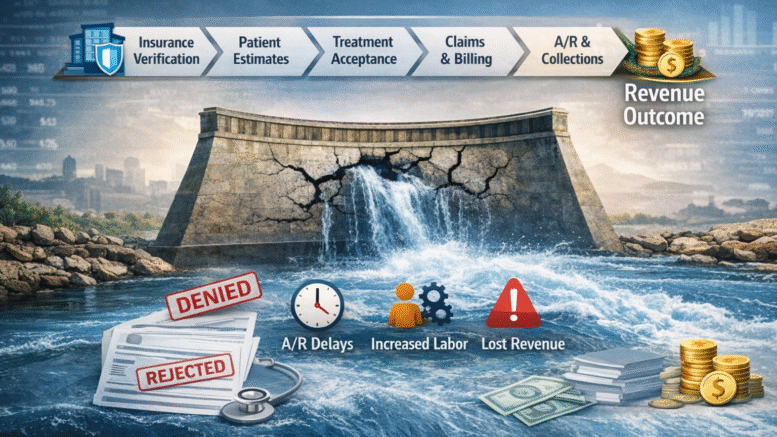
In practice, it behaves as a single, interconnected system. Early uncertainty doesn’t stay contained. It travels.
Insurance verification sits at the front of that system and directly influences everything downstream:
Verification accuracy → Patient estimates → Case acceptance → Clean claims → Cash velocity → Labor efficiency
When verification is inconsistent or incomplete, downstream teams inherit ambiguity they didn’t create—and are expected to resolve it later, at higher cost.
How Upstream Inconsistency Shows Up Across the Revenue Cycle
When insurance verification is unreliable, the impact rarely shows up in a single metric. It shows up everywhere:
Scheduling & Pre-Visit
- Estimates are hedged instead of trusted
- Financial conversations feel uncertain
- Patients delay or decline treatment
Clinical Handoff
- Treatment plans are approved based on assumptions
- Financial responsibility is clarified after care, not before
Billing & Claims
- Eligibility and benefit discrepancies surface late
- Claims require rework or appeals
- First-pass yield declines
A/R & Collections
- Follow-up volume increases
- Cash conversion slows
- Refunds, write-offs, and patient A/R rise
RCM Leadership
- Performance varies across locations using the same systems
- Labor productivity plateaus
- Root causes are difficult to isolate
Because these effects are distributed, they’re often attributed to execution rather than upstream signal quality.
What the Evidence Consistently Shows
Across DSO operating experience and industry analysis, eligibility and benefits accuracy emerge as a persistent contributor to revenue cycle friction:
- Eligibility and benefits issues contribute to 20–30% of dental claim denials
- Eligibility-related denials take longer to resolve, extending days in A/R
- Multi-location DSOs often find 5–15% of front-office and billing labor tied to re-verification, estimate correction, and eligibility-related rework
On a smaller scale, institutional knowledge absorbs inconsistency.
On a larger scale, that knowledge becomes impossible to standardize. Each practice develops workarounds. Centralized teams inherit exception volume. Performance variance grows—even with shared systems.
These costs are rarely labeled “insurance verification.” But they originate there.
At scale, they stop behaving like isolated exceptions and become systemic drag.
Why Revenue Cycle Teams End Up Fixing Problems They Didn’t Create
Many DSOs assume insurance verification is handled because it’s automated.
Automation removes manual execution. It does not guarantee accuracy, completeness, or consistency.
When teams don’t trust upstream insurance answers, they compensate:
- Front-office staff double-check coverage
- Billing teams correct errors and manage rework
- Experienced employees become informal validation layers
Labor doesn’t disappear. It shifts downstream—where it’s more expensive, harder to scale, and harder to measure.
From an RCM perspective, this creates a structural challenge: Teams are held accountable for outcomes driven by inputs they don’t control.
Where the Inconsistency Enters the Revenue Cycle
Most automated verification today relies on EDI clearinghouses.
Clearinghouses were designed to route transactions—not to deliver consistent, decision-ready insurance information across multi-location organizations.
In clearinghouse-based models:
- Insurance data is interpreted through intermediaries
- Responses vary by payer and format
- Normalization happens downstream, in workflows or by staff
- Interpretation is distributed across locations
As a result, two practices may verify the same plan and receive different answers. Both verifications are automated. Neither produces a reliable foundation for the revenue cycle.
At scale, this variability compounds across every downstream function.
What’s Changed: Treating Insurance as a Revenue Cycle Input
Leading DSOs are re-evaluating insurance verification — not as a front-desk task to automate, but as a foundational input to revenue cycle performance.
That shift starts with a more fundamental question:
Where does the insurance answer come from?
Historically, most insurance verification vendors relied on EDI clearinghouses or intermediary data feeds. Those approaches automate retrieval, but they interpret insurance information indirectly, often forcing revenue cycle teams to validate or re-check results when accuracy matters.
Today, leading DSOs are prioritizing insurance verification vendors built to connect directly to payer portals and payer systems — bypassing clearinghouses to retrieve insurance information from the same authoritative sources staff already rely on when they need definitive answers.
This distinction matters.
Direct payer connectivity means insurance information is:
- Sourced directly from the payer system of record, ensuring insurance answers are current and authoritative
- Retrieved programmatically through direct integrations — not through intermediary interpretations or secondary data feeds
- Aligned with the same coverage logic teams rely on during manual verification, reducing the need for double-checking
Critically, this information is then normalized and standardized before it reaches operations.
- Normalization resolves payer-specific formats, terminology, and benefit structures
- Standardization ensures that coverage concepts mean the same thing across plans, payers, and locations
In this model:
- Insurance logic is resolved at the source of truth, not downstream
- The same payer rules apply consistently across every practice
- Revenue cycle teams receive usable, comparable insurance information — not raw or interpreted responses
- Downstream validation, double-checking, and rework are significantly reduced
This approach doesn’t eliminate insurance complexity.
It prevents revenue cycle teams from having to absorb, interpret, and reconcile that complexity themselves — where it becomes costly, inconsistent, and unscalable.
Why Revenue Cycle Systems Need a Single Source of Truth and Better Technology
Accurate insurance information only improves revenue cycle performance if it can be used consistently across systems and locations.
In most DSOs, insurance information flows through scheduling, patient communication, billing, claims, and reporting. Even when the original insurance answer is accurate, problems arise when that information is handled differently by each system or each location. As organizations scale, those differences compound.
This is why revenue cycle systems need both a single source of truth and better technology to use it.
Modern insurance verification platforms use API technology to take accurate insurance information and feed it directly into the systems that run the revenue cycle, ensuring the same insurance answer is used everywhere — across workflows and locations — without re-entry or reinterpretation.
With APIs in place:
- Scheduling, billing, patient communication, and reporting all operate from the same insurance information
- Coverage rules don’t change as data moves between systems or teams
- All locations apply insurance answers consistently
- Scale doesn’t introduce new manual work or variability
The impact isn’t technical — it’s operational.
When accurate insurance information flows through the revenue cycle via APIs:
- Teams spend less time double-checking and fixing issues
- Workflows move faster with fewer exceptions
- Labor costs decline
- Performance becomes more predictable across locations
A single source of truth without API technology doesn’t scale.
API technology without a single source of truth just moves inconsistency faster.
Revenue cycle performance improves when accurate insurance information can be trusted and used consistently — everywhere, at scale.
The Impact on Revenue Cycle Performance
When insurance information is accurate at the source and consistently applied across systems, DSOs often see:
- Higher first-pass clean claims
- Fewer labor hours spent on rework
- Faster cash conversion
- Reduced performance variance across locations
From an RCM perspective, this isn’t about optimization. It’s about preventing avoidable disruption.
How RCM Leaders Are Evaluating This Shift
This isn’t a rip-and-replace conversation. It’s an evaluation conversation.
RCM leaders increasingly ask:
- Do identical plans produce identical results across locations?
- How much labor exists solely to validate or correct insurance answers?
- How much revenue risk traces back to eligibility and benefits uncertainty?
- As we scale, does verification become more standardized—or more exception-driven?
When these questions are difficult to answer, upstream inconsistencies are already affecting downstream performance.
Final Thought
Revenue cycle performance rarely breaks at claims submission. It breaks when early insurance assumptions quietly flow through the system unchecked.
Insurance verification influences patient estimates, claim denials, labor, cash flow, and scalability simultaneously.
For revenue cycle leaders, understanding how verification behaves upstream is no longer optional—it’s foundation.
Schedule a 20-minute diagnostic call to discuss how verification accuracy impacts your denials, labor costs, and cash flow—and whether changes to your approach would deliver measurable results.
Request a Diagnostic Call →