
Sponsored Content
Your individual locations may be marketed brilliantly, your clinical teams may be the best in their regions, and your regional managers may be high-performers. Yet, across the portfolio, the patient experience can still feel inconsistent, follow-up can lag, and booking outcomes remain unpredictable from one site to the next.
In 2026, performance gaps in emerging DSOs are rarely caused by a lack of effort; they are caused by operational friction. For a mid-size group, friction is the “silent tax” on your EBITDA. The data from the 2026 State of Dental Best Practices makes the root cause clear:
Practices using AI agents see 84% more bookings
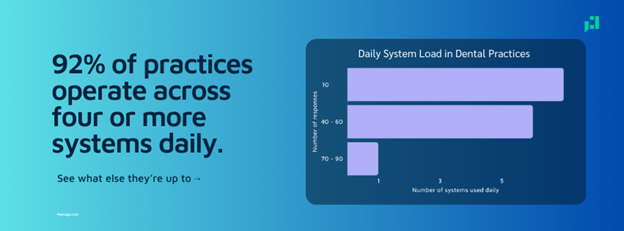
92% of practices operate across four or more systems daily.
These two data points represent both the opportunity and the obstacle at the same time, because one shows what’s possible when patient communication becomes faster, more consistent, and less dependent on a perfectly timed human moment, while the other explains why even great teams can struggle to deliver that experience consistently, especially when every patient interaction requires switching tools, searching for context, and piecing together what happened last.
In 2026, the groups that feel stable will not have locations that are magically better staffed, and they won’t be the ones relying on heroics to get through the day. The data from 2025 indicates that the most successful practices will be those that build workflows capable of holding up under pressure, that create visibility where other practices rely on assumptions, and that reduce friction at the source, while other practices keep patching symptoms and wondering why the same problems keep coming back.
That’s what makes the 2026 State of Dental Best Practices so clarifying. When we looked across thousands of practices, the numbers told the story of the modern front office reality: the opportunity is massive, but so is the operational load. Practices are being asked to deliver a modern, consumer-grade experience while operating in a fragmented environment that was never designed for speed, consistency, or omnichannel communication, which means even strong teams can end up stuck in reactive mode simply because the system around them makes follow-through harder than it should be.
Key Data Point #1: Practices using AI agents see 84% more bookings
An 84% lift in bookings is not incremental improvement, it’s a competitive advantage, and it reinforces something many practice leaders already know in their gut: the front office is no longer “support,” it’s the engine of patient conversion and patient experience, and it’s increasingly difficult to meet modern expectations without systems that protect the first mile of communication.
Patients do not behave like “business hours” consumers anymore, because they call between meetings, they text while running errands, they ask questions through digital channels, and they submit forms after hours, all while expecting speed and clarity in return. Their tolerance for friction has dropped, and that shift is exactly why AI agents are showing up as such a meaningful lever in booking performance, not because automation is trendy, but because consistency matters most at the exact moment when human teams are the most overloaded.
What this actually signals
AI isn’t improving bookings because it’s trendy, it’s improving bookings because it prevents opportunities from disappearing in the gap between “patient intent” and “patient follow-through,” which is where practices quietly lose demand without realizing it.
When the first response is delayed, inconsistent, or unclear, patients do what consumers always do: they move on.
Why “speed” is really about trust, not urgency
It’s easy to frame this as a speed problem, but in dentistry, responsiveness is about more than being quick, because speed is one of the first ways patients decide whether they trust the practice. When a patient reaches out, they’re often trying to solve a real problem, whether that’s pain, scheduling constraints, insurance confusion, or anxiety about treatment, and the practice that responds clearly and quickly creates confidence before the first visit even happens.
That’s also why the front office experience is now part of your brand, whether you want it to be or not. Patients may never see your internal workflows, but they feel the effects immediately when they’re left waiting, bounced between channels, or forced to repeat themselves, and that experience shapes whether they book, whether they show, and whether they stay.
What high-performing practices do differently with AI
The practices seeing the best outcomes aren’t layering AI on top of broken workflows, they’re using AI as a workflow layer that can carry the first mile of communication with consistency, so the team is not constantly interrupted and forced into reactive mode.
In practice, that usually means AI is responsible for responding quickly, handling common questions consistently, and moving patients toward a next step that is actually measurable, whether that next step is scheduling, confirming, rescheduling, or routing to the right team member with context attached.
What that looks like operationally:
- AI handles common questions with consistent answers, so patients aren’t getting different information depending on who picks up
- AI responds quickly during peak windows, which protects patient intent when the front office is already stretched
- AI reduces manual chasing and callbacks, because it keeps the conversation moving instead of pausing it
- Humans step in when nuance is needed, not as the default, which protects the team’s time and reduces cognitive load
The goal isn’t automation, it’s completion.
AI performs best when it can support the full loop from inquiry to booking, rather than creating a half-step that still requires the team to reconstruct the conversation and take over midstream.
When practices treat AI as a true workflow layer instead of a partial add-on, the result is not just “time savings,” it’s fewer interruptions, fewer dropped handoffs, and more booked appointments without requiring the front office to work at maximum intensity all day long.
Key Data Point #2: 92% of practices are operating across four or more systems daily
When 92% of practices are operating across four or more systems daily, context switching is no longer an occasional disruption; it’s the environment the front office lives in, which means even routine tasks can take longer than they should simply because the team is constantly moving between tools, platforms, logins, and sources of truth.
Scheduling, patient records, phone calls, texts, follow-ups, messaging, and intake workflows are often spread across multiple systems that were added over time to solve individual needs, and the problem is not that those tools are “bad,” it’s that they were never designed to work as one coordinated operating system. When systems don’t share context, teams are forced to serve as the connective tissue, which increases mental overhead, creates more manual work, and makes sustaining consistency difficult, even for strong teams.
This is why front office friction is structural, not human, and why the practices that are struggling most are often the ones with the most well-intentioned people, because intention can’t compensate for fragmentation forever.
The cost is not just time; it’s enterprise visibility. When data is spread across four systems, the C-suite cannot get a “single source of truth” on group performance. You end up patching symptoms (like hiring more people) instead of fixing the source (fragmented workflows).
What system overload actually costs
The cost of operating across four or more systems is not just time; it’s missed opportunity, because every extra handoff, every manual workaround, and every “I’ll call them back later” creates a gap where the patient experience becomes inconsistent, and outcomes become unpredictable.
This is where practices quietly lose demand, because when systems don’t coordinate, the practice is more likely to miss a follow-up, delay a response, or drop a next step, not due to neglect, but due to volume, interruptions, and the simple reality that humans cannot keep perfect track of everything while switching contexts all day long.
The issue isn’t the number of tools, it’s the lack of orchestration.
It also explains why practices can feel like they’re doing everything “right,” while still feeling like the day is chaotic, because when teams are forced to manage complexity manually, consistency becomes the first thing to break, even when everyone is working hard.
What the most stable practices do differently
The best-run practices don’t necessarily have the smallest tech stacks, but they do have something many others don’t: workflows that assume reality. They assume interruptions will happen. They assume demand will spike at inconvenient times. They assume patients will reach out through multiple channels. Then they design operations that can hold up anyway.
Instead of asking teams to “remember,” they make next steps visible. Instead of relying on one person to keep everything together, they create shared visibility. Instead of expanding the stack, they prioritize integration, shared context, and clearer handoffs.
Best-practice moves that reduce friction fast:
- Orchestrate systems instead of adding more tools, prioritizing integration and shared context over expansion
- Centralize insight, not just data, so teams can see what matters without hunting across platforms
- Design workflows that assume context switching, so performance doesn’t depend on perfect conditions
- Reduce reliance on memory, making key information and ownership visible by default
This is also where leadership teams can have the biggest impact, because the solution is not asking the front office to “try harder,” it’s designing an environment where consistency is easier to deliver.
The bigger takeaway: stability is now the growth strategy
When you put these two numbers together, the direction of dentistry becomes clear. Practices are being asked to deliver a modern patient experience while operating under heavy system load, and the practices that win in 2026 won’t be the ones working the hardest, they’ll be the ones reducing friction and creating systems that make follow-through more automatic.
AI agents drive 84% more bookings because they stabilize the first mile of patient communication and protect patient intent, while the reality that 92% of practices operate across four or more systems explains why consistency breaks down under pressure, even in well-run offices.
Best practices don’t happen by accident. They’re designed.
A simple next step you can take this week
If you want to apply this without overhauling your entire practice, start with one measurable workflow and build from there, because the fastest improvements usually come from small changes that remove friction at the point of highest volume.
Three practical ways to start:
- Track response time and booking outcomes across one channel (calls or texts) for two weeks, so you can see where intent is being lost
- Align your team on what counts as a “missed opportunity” and what “resolved” actually means, so follow-up becomes measurable instead of subjective
- Map what happens after a missed call or message, identify where the handoff breaks down, and assign ownership so the loop is consistently closed