
Ranked the #1 DSO Podcast!
Welcome to The Group Dentistry Now Show: The Voice of the DSO Industry!
Quality, Efficiency, and Risk Management: The Case for Single Patient Use Instruments in Dentistry
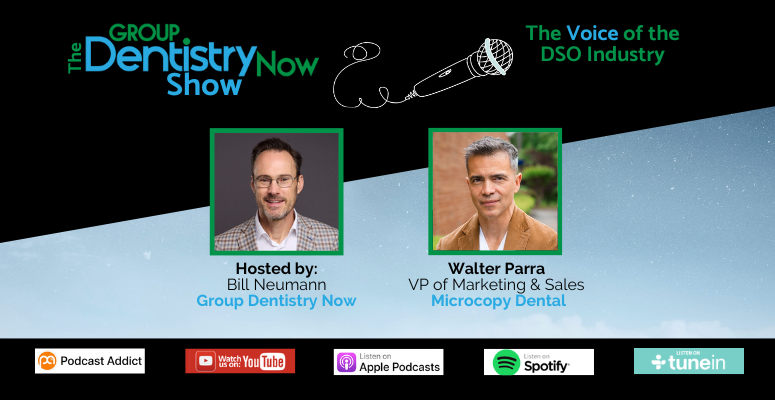
This is a must episode for clinical directors, dentists, dental assistants and hygienists. Walter Parra, VP of Marketing & Sales at Microcopy shares his thoughts:
- The Evolution of Single Patient Use (SPU) Products
- Quality and Customer Service as Differentiators
- Understanding the Needs of Group Practices
To learn more visit https://microcopydental.com or contact Walter Parra at walter.parra@microcopydental.com
Subscribe to our channel for more episodes and stay updated on the latest DSO news, insights, and events!
If you like our podcast, please give us a ⭐⭐⭐⭐⭐ review on iTunes https://apple.co/2Nejsfa and a Thumbs Up on YouTube.
Choose your favorite listening app below and subscribe today so you don’t miss an episode! Full transcript is also provided below. See all of our podcasts HERE.
 |
 |
 |
 |
 |
 |
DSO Podcast Transcript – Quality, Efficiency, and Risk Management: The Case for Single Patient Use Instruments in Dentistry
Bill Neumann:
Welcome everyone to the Group Dentistry Now show. I’m Bill Neumann. And as always, we appreciate you tuning in. We are to have a conversation, clinically focused, but it really does impact dentistry from a business perspective as well. So I would say if you’re on the business side of dentistry and you are listening to this podcast, please bring in your clinical directors and bring in anybody on the clinical side, but also make sure that you have a listen to because I think this is going to be an important conversation. We have with us the Vice President of Sales and Marketing at Microcopy Dental, Walter Parra. Walter, it’s great to have you here.
Walter Parra: Oh, thank you, Bill. Great to be a part of it.
Bill Neumann: Yeah, this is going to be fun. And if you all don’t know who Microcopy Dental is, I mean, they’ve been in the industry for quite a long time. I have a history of working with them that probably goes back close to at least 15 years. It might even be before you started there, Walter. But I just remember working with Microcopy, one of the the leaders in diamonds and burs, and they actually have a relatively robust portfolio. So it’s not just diamonds and burs, though I do think a lot of people associate microcopy with burs and diamonds. A little bit about Walter, and then I’ll let him have a say here about his background, but he started in that sales and marketing role at Microcopy in January of 2025, which I think is when we started to work together, Walter, maybe a little bit before that we started. But he’s been with the organization for over 14 years. He was involved as the director of business development, worked a lot with dealers on the growth initiatives there, and then also with strategic relationships like DSOs and emerging dental groups, worked not just domestically, but with their international markets as well. So, Walter, that was a brief bio, but why don’t you talk to the audience a little bit about your background and then talk a little bit about microcopy dental.
Walter Parra: Absolutely. Yeah, as Bill mentioned, I started with the company back in November of 2011, which seems like yesterday, but man, has everything changed in dentistry, not only within microcopy, but outside of it as well. My background prior to getting into the dental industry was in real estate. I spent several years working for a real estate developer here in Atlanta. And then obviously the 2007 crash happened and things quickly changed. And like most of us, you have to pivot when you’re faced with certain obstacles. So the opportunity that arose back in 2011 to join the microcopy team was interesting because at the time, Perry Park was the CEO, and Bill, I know that you know Perry very well. Perry had a different approach when it came to hiring. And so, and it’s one that we actually, to this day, have instituted and continue to follow in that. When someone interviews, they don’t just interview with the department head. We have them interview with multiple people, and not necessarily in the executive side of the business. And so, I remember that first interview taking quite a while, or the process. I jokingly talk about how he had me interview with just about everyone in the building and outside of the building. But ultimately, yes, I was able to join the team. And Perry had a no-nonsense approach. He himself would often make time to even step into production and join the production line. The culture of this company has always been that. You have to be willing to get in the mix and roll up your sleeves and do whatever it takes to make sure that we satisfy the customers and their needs. It’s something that I think makes microcopy really special. I started out, as you suggested or mentioned, as a dealer sales manager and that ran the gamut. I mean, I was answering phones, answering requests for samples, doing mailers, admin work, clerical work, you name it. And then yeah, over time that shifted and I was given other opportunities. I found myself joining the international side of the business, which was interesting because As part of my background, my family is originally from Columbia, South America. And so my parents had a very sweet rule in the house where in the house, we spoke only Spanish and outside the house, they would only let me speak English. So I’m fluent in both. And so it pivoted well and played well into this potential new role that I was offered to work internationally in Latin America. And so spent a few years doing that and then decided to scale it back and come back to North America and focus solely on Canada, the US and Mexico. And then, yeah, last year, the opportunity to run the marketing and sales team opened up and I found it to be a worthy and interesting challenge. And that’s what it’s been. You have a team here that is, microcopy is very marketing driven. And so you have a team that is always stood out. I think if there’s anything about microcopy that stood out has been its marketing. And so to make sure that I carry that torch is something, in a proper way, it’s something that I’ve made my focus. And so, yeah, that’s a bit of the backstory and how I got to here. One of the initiatives that I tasked the team with was becoming more informed and more educated on DSOs. And so, hence why we are now working so closely with your organization, Bill.
Bill Neumann: Yeah, and thank you for that. And you’re right, the marketing side of things, I mean, microcopy has always stood out. As an organism, so like I said, I think you’re known, and correct me if I’m wrong, for really like burrs and diamonds. But you do a lot more than that. And I think you’re really innovative when it comes to the types of burrs and diamonds that you offer. And we’ll talk a lot about single patient use and really the benefits there for DSOs and groups when it comes to risk management and compliance. Yeah, you I think it’s an organization made. Burrs cool from a marketing perspective, and it’s maybe not so easy to do sometimes. It’s dentistry, right? So. But yeah, you’re right. Marketing-driven organization always did a lot of sampling to put product in clinicians’ hands so they got a chance to actually use it before they invested in the diamonds and burrs. Beyond that, so talk a little bit about the microcopy portfolio, if you will.
Walter Parra: Sure, sure. So you mentioned the burrs. So we have three hero products or flagship products. Our neodymium brand, which is per SDM data, the leading brand in the SPU space for the diamond burr industry. We have our neoburr brand, which is our carbide, our single use carbide brand. that has grown nicely over the years. And then we have Neodrys. Neodrys are the parotid saliva absorbent. And those form our three hero products. We have some other ancillary products that we’ve brought on board to book in the portfolio, the Neoshine polishers. A little over a year ago, we introduced our IPR strips. And then this year is really cool. We actually have a product that I would bet most of dentistry considers a dinosaur or a dying product in the bite tabs, the bite wing bite tabs. Our brand is known as the flaps product. And this year we celebrate, believe it or not, our 55 year anniversary with that product. So while, you know, Everyone in the industry is moving more to high-tech digital components to collect images of the oral cavity. There are still a lot of dentists and practices that use these little foam bite tabs. And so, yeah, this year we are celebrating the 55th year of the introduction of that product. So we are much more than just burrs. Although, as I said, we do have three flagship products, hero products, and the birds are definitely what pays the bills, I guess.
Bill Neumann: So you’ve had a lot of experience at microcopy with your previous role working with distribution in international markets and now starting to work more closely in the group space with the large DSOs as well as the emerging dental groups. With that experience that you’ve had over the past 14 plus years, talk a little bit about maybe the way you think about group dentistry today and maybe some of the evolution that you’ve seen.
Walter Parra: When I started back in 2011, you could feel the change. You could feel the shift. And so it definitely was something that we put on our radar, but we lean heavily into our distributor partners. And so a lot of the nuance that is group practice, DSOs, whether small, mid-level, or large, we relied heavily on our distributor partners, whether it was the larger ones that we all know, like Henry Schein, Patterson, Van Gogh, or smaller, more regional distributors. And so what we found is that while that served us well in the beginning, I think what plays well to some of the smaller to mid-level DSOs is our flexibility. Whenever anyone calls microcopy, they actually get a person that answers the phone. It’s not an AI agent. It’s not, you know, a digitized operator. It’s a live person. And we’re here Monday through Friday. We have some members of our team that are remote, but I think it plays well to what some of the needs are of that space. Obviously, The model of the DSO is ever changing. There’s some consolidation that’s going on right now in our industry. And so we are, I would say, even though the shift in dentistry happened many years ago, I feel like we’re still relatively new. And so I don’t want to be dishonest and say that, you know, I’m able to identify each area that we’re going to be able to help in this space because we’re still learning. In fact, we attended our first DSO meeting, as you know, just last year at the DSO Dental Forum. And so as a team, I think we’re still collecting all that information and making sure that we make an informed approach to that segment to make sure that we are covering all our bases because we don’t want to offer something that isn’t of need or solving a problem for these organizations.
Bill Neumann: Yeah, and I think to your point, the industry really is continuing to evolve. And what we’ve seen here at Group Dentistry now is we track kind of the M&A throughout the years as a slowdown in the growth of the larger DSOs. their focus has changed from acquisition and de novo—again, I’m generalizing, but in general I think that’s true—to an organic growth focus or kind of taking a look at each practice individually and looking how they can make improvements both on the clinical side and, of course, I think on patient acquisition and treatment acceptance and things like that. So there have been a lot of changes. And I think there’s also a focus more on making sure that the clinicians have the tools that they need in order to be successful, because there have been issues with turnover in the industry. And I think there’s just looking at ways to continue to make sure that their clinicians are given what they need in order to feel comfortable and be successful. And of course, provide that patient care that will continue to get the patients to come back. So.
Walter Parra: Exactly.
Bill Neumann: And there are a lot of, and this is one of the things that happens, and I’ve seen it happen in the industry, and there are a lot of burr companies out there, and it tends to be looked at a lot of times, and I don’t necessarily think it’s correct, but it is what it is, a commodity. So one burr is just like another burr. So let’s talk a little bit about what you think sets microcopy apart. You talked a little bit about the customer service that you offer and the hands-on, you’re speaking to an individual, which is very important. And it still is important, even to DSOs and group practices, that if there’s an issue, they want it to be solved right away. And you can do that if you’re actually talking to somebody. But beyond that, what else do you think sets microcopy apart?
Walter Parra: No, I think that’s a great question. And there’s several answers I could give. I’ll try to limit it to maybe two or three bullets. You mentioned the level of customer service that we provide. I truly believe that one of the major differentiators for microcopy is our culture. We are, at any given time, between 50 and 54 employees. So we’re not a very big company. And that gives us a lot of flexibility. At any time, If I need to reach out to the CEO and have a decision made, whether it’s at the level of, let’s say, a chargeback or rebate or some sort of a concession, it doesn’t take me days or weeks. I can pretty much get that answer relatively quick. And so, yeah, I think that’s definitely a benefit of working with microcopy and one that sets us apart. You mentioned earlier that You know, the portfolio microcopy was much more than Burr’s. I would like to touch on the fact that while that is true, we are not like some of our competitors. We don’t have three, four thousand SKUs. in our rotary portfolio. We instituted a philosophy early on that we wanted to offer the most popular shapes for the regions that we were going to provide these tools in and then couple that with quality. And so we have maybe 400 plus SKUs between the diamonds and carbides. And it’s served us really well. We know exactly who our target audience is. And I think it’s why we still control the largest share market. You know the old expression, if you try to be everything to everyone, you’re not really anything to anyone. And so I think it’s served us really well. I think another one, and I know that I kind of glossed over it real quick, is our quality. We constantly have our products not only evaluated internally by our R&D team, But outwardly, we seek voice of customer constantly, whether it’s in our backyard here in Atlanta, Georgia, or with clinical reviews by very well known advocates and KOLs in this space. we’re seeking constant feedback on our offering and the instruments that we try to provide because it is important. The DSOs are running large, large operations, and they need to run as efficiently as possible. And you can’t have any gaps in your supply chain with products that provide hurdles for the clinician. So I think the quality is definitely something that I would highlight. And then, so I think I covered all three there, if I’m not mistaken.
Bill Neumann: You sure did. I’d like to focus in on single patient use. And my backgrounds, years and years ago, I worked for a company that manufactured diamonds and carbides. And at the time, they didn’t have any single patient use. So they were reusable. But it’s certainly a direction that makes a lot of sense. And in fact, I even remember again 15 years ago that – we were being asked for that solution. And so talk a little bit about that because it’s not necessarily new, but I think there seems to be some momentum behind single patient use diamonds and carbides. But maybe talk a little bit about what is driving that and then what are the benefits?
Walter Parra: No, absolutely. And it’s definitely not new. We launched Neodiamond as a single patient use alternative back in 1989. So you are correct. What are the benefits of single patient use? I would say, first and foremost, consistency. If you know that you’re going to be using a diamond or a carbide one time, you know that the end result will be consistent because you’re not using an instrument that is no longer sharp or clogged. And so I think at the top of the list would be that, just providing predictable outcomes due to the consistency of the instrument. You’re getting a brand new instrument each and every time. I think it’s also going to add a level of efficiency You know, you’re eliminating the need to track the amount of usages you’ve had on a burr or the wear and tear each burr has had. So, yeah, you become much more efficient as a clinic by just knowing that you’re popping out of the pouch a brand new instrument each and every time. And then lastly, I would say risk management. You know, you are mitigating the possibility of cross-contamination by using one of our pre-sterilized single patient use BIRs each and every time. You’re not having to worry about whether or not the sterilizing of the BIR by the staff at the clinic was done correctly and following all the protocols of that practice. I would say those are probably three of the biggest benefits of doctors shifting their focus to single patient use.
Bill Neumann: Yeah, and I think that last one in particular, just that, you know, the fact that you know that every burr that you are, you know, taking out of that package is sterile, hasn’t been used before. And then the fact that it’s gonna, you’re gonna have that cutting consistency, right? Because you’re always cutting with a fresh burr. So it’s, yeah, it’s really important, I think. I don’t know if you have any numbers that you can share or just even just thoughts on the shift away. I mean, do you continue to see the market grow for single patient use? I mean, you kind of go back to maybe when you started compared to now. I mean, how much do you feel it’s grown?
Walter Parra: I don’t have any exact numbers. What I can tell you, though, is just by observation. I’ve seen a shift. When I started in 2011, I would say the majority of the people that I would meet that were solely using SPU instruments were of a older demo. And I know that I don’t want to sound ageist, but that was just an observation that I made in real time. And we all attended. Most people in the dental industry attend the Greater New York meeting. And that was just a few months ago. What I noticed again by observation is the demo, the people that are actually seeking information on single patient use. is now moving towards that younger demographic, which tells me that it’s spreading. It’s no longer just the dentists that are coming towards the tail end of their career that are really advocating for this or seeing it as a benefit in their practice. Now you’re seeing younger dentists interested in looking to apply it in their practices and in their day-to-day.
Bill Neumann: And I recall, we talked about this right before we started the podcast, even back 15 years ago, that Canada, in particular, seemed to have had a big push. And we believe it’s Quebec that has instituted single patient use, BIRS. But there always seemed to be a heavy push there. for – from a movement away from multi-use to single patient use, really from I think the fact that the sterilization standpoint, right, that it was always sterile. But that seemed to be a push there first, and I guess it started to kind of come down here as well, right? We see that.
Walter Parra: Yeah, the VA now, Veterans Affairs, they now implemented a single patient use instruments in their clinics. So it is something, it’s something that expanding and it’s definitely growing.
Bill Neumann: How about with dental group practices? Have you seen more of an interest at least from groups or does it vary on the group?
Walter Parra: Yeah, so again, because we’ve always managed that business through our distributor partners, I can’t speak fully informed on that end. I can say, though, that based on the customer feedback and the input that I got when I attended the DSO Dental Forum, we were very much a very well-known brand. within those people, or within those organizations. They were just buying the products through our distributor partners. So I think there is a shift. I think there is a shift. What that is in terms of the overall pie, I can’t speak to that. Not from an informed standpoint, because I don’t have that information at this time. But as I said earlier on, in early 2025, we set out to become informed, start to understand this space a bit more, And we’re doing that. And so I’m hoping that in the coming months, I’ll definitely have a better understanding of what that looks like at that level.
Bill Neumann: Yeah, absolutely. And I think anybody in the audience on, if you’re a clinical director or a clinician that has their own group or working at a DSO, it’d be great to get your input too. So feel free to shoot us an email or ping me or Walter on LinkedIn and let us know your thoughts on single patient use. Are you using it? Is it consideration? So I love getting feedback from our audience. Always get a lot of people that reach out and kind of let us know what’s going on. So I think we’ll get some nice feedback for you, Walter. That would be excellent. So let’s talk a little bit about, as you’re starting to have these conversations with DSO and dental group leaders today, Talk about maybe some of the operational and clinical challenges that you’re hearing from them. Are there any themes? And just kind of curious as you get out there and start to talk more and more to these groups, what you’re hearing.
Walter Parra: Yeah, I think they just, most important for them, I think, is as they’re scaling, is to make sure that they’re not losing any customers meaning patients due to lack of quality. I would say that that’s ultimately probably at the top of the list. As you’re trying to scale and become much more efficient, sometimes quality can go by the wayside. And so we have a very strong business. We opened our doors in 1970. And as I shared earlier, we have products that are now in the market for over 55 years and thriving. And our quality is something that we truly believe in. You brought up earlier the fact that microcopy has always believed in sampling. You know, the company at any given time, as I said earlier, has anywhere between 50 to 55 employees. And so our outside sales force is the US Post Office. And what I mean by that is, at any given time, someone will call or make a request via our website or through a distributor rep and say, hey, look, I’d like to try out your zirconia cutting burrs. I would like to try out your ceramic polishers. We’ll bag those up, put them in the mail, and mail them out. In essence, the U.S. Post Office becomes our sales team, but we feel very strongly in continuing to do that as a strategy to get our products out to the marketplace because of our quality. So I would say that at the very top of that, I guess, funnel, And pyramid would be quality, you know, making sure that as you’re trying to scale these businesses that they don’t lose that. And so in microcopy and within microcopies products, that’s something that they’ll never have to worry about.
Bill Neumann: Walter, as we start to wrap up the conversation here, I did want to make sure that we spent a little bit more time talking about risk management and compliance with larger groups in particular. And I think with most groups and clinicians, it’s really important. With the larger DSOs out there, they have, you know, people out there that are compliance managers, right? They have people that handle, you know, positions that that’s their only job is to, you know, make sure that whether it’s clinical compliance or, you know, that they’re super focused. So, Can you talk a little bit about, again, the advantages that you feel single patient use, births, diamonds and carbides have compared to that traditional? I know we talked a little bit about, you know, the reasons, but I feel like it’s important to kind of hammer that home.
Walter Parra: Absolutely. Yeah, from the risk management and in compliance side of the house, single patient use, the births, offer, I think, a clear advantage over the traditional multi-use burrs. At a ground level, I think they eliminate variability and potential errors associated with the sterilization process, autoclaving the burrs, for instance. With reusable burrs, every instrument has to be tracked. With our stuff, you’re using it once and you’re throwing it away. So that aspect pretty much removes that question from the equation. Another advantage to our using a single patient use BERT over a multi-use BERT is traceability. You know, you’re having to constantly track and retrace your steps with the amount of usage you’re getting out of these BIRs, where with single patient use BIRs, it’s clear, it’s simple. You know that you’re using a new BIR each and every time. And then, you know, lastly, I would say you’re mitigating risk because of the potential for cross-contamination. You know, with single patient use BIRs, you don’t have that variable to account for. Where with multi-use spurs, you do. You have to autoclave the spurs. You have to store them. You got to make sure that they’re cleaned. And so I think it’s a clear advantage to use a single patient use spur in those regards over a multi-use spur.
Bill Neumann: I, I, I agree. I think what we’re going to continue to see is, you know, this direction away from multi-use towards single patient use. And for all the reasons, you know, we’ve, we’ve discussed Walter a great conversation. Uh, I really appreciate you taking time to, um, you spend, spend some time here on the group dentistry now show talking about your background, what you’re seeing in the group practice space, uh, And we look forward to seeing you at more DSO meetings. I know that you and your team are out there quite a bit at a lot of these different shows, whether they’re the traditional shows like Yankee, Chicago Midwinter, but also spending more and more time at the DSO group practice-specific meetings. there are any clinicians or groups that are interested in learning more about microcopy, maybe getting a sample or two, or just learning about the programs that you have for group practices and DSOs. What’s the best way to get in touch with you and learn more about microcopies offerings?
Walter Parra: Absolutely. So first and foremost, if you’re wanting to become more informed just at a high level on our products, I would direct you to our website. Just go to microcopydental.com, and there you will find all of our offerings, all of our categories. If you want more specific information, you can reach out to me directly. My email address is walter.para, that’s P-A-R-R-A at microcopydental.com.
Bill Neumann: Well, thanks so much, Walter, and thank you everyone for listening to the podcast today. Until next time, this is the Group Dentistry Now Show. We appreciate you.
Walter Parra: Thank you. Bye-bye.