
Ranked the #1 DSO Podcast!
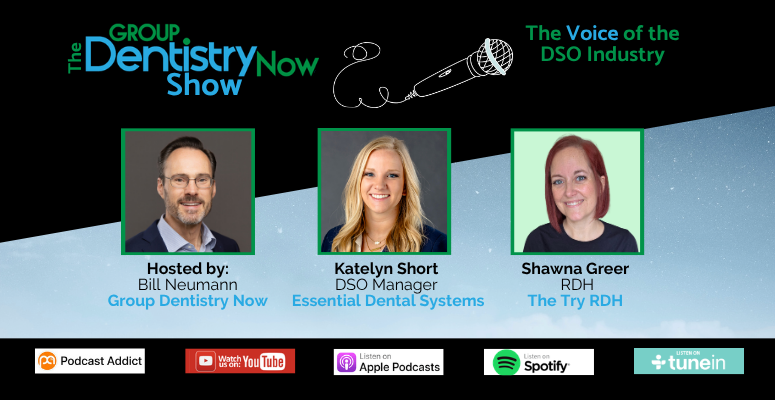
Welcome to The Group Dentistry Now Show: The Voice of the DSO Industry!
Revolutionizing DSO Hygiene Workflows with TurboCR: The Game-Changing Calculus Remover.
Katelyn Short, DSO Manager at Essential Dental Systems & Shawna Greer, RDH of The Try RDH explore:
- Hygiene workflow
- Reduce scaling time with TurboCR
- Standardization across multiple locations
To learn more about Essential Dental Systems and TurboCR visit: https://www.edsdental.com/ and https://edsdental.com/Turbo-CR/index.html
If you would like to connect with Katelyn Short you can email her at KShort@edsdental.com .
If you have questions or would like to connect with Shawna Greer, RDH you can email her at TheTryRDH@gmail.com or follow her on Instagram at https://www.instagram.com/thetryrdh/ .
Subscribe to our channel for more episodes and stay updated on the latest DSO news, insights, and events!
If you like our podcast, please give us a ⭐⭐⭐⭐⭐ review on iTunes https://apple.co/2Nejsfa and a Thumbs Up on YouTube.
Choose your favorite listening app below and subscribe today so you don’t miss an episode! Full transcript is also provided below. See all of our podcasts HERE.
 |
 |
 |
 |
 |
 |
DSO Hygiene Podcast Transcript:
Welcome to the Group Dentistry Now Show, the voice of the DSO industry. Join us as we talk with industry leaders about their challenges, successes, and the future of group dentistry. With over 200 episodes and listeners in over 100 countries, we’re proud to be ranked the number one DSO podcast. For the latest DSO news, analysis and events, and to subscribe to our DSO weekly e-newsletter, visit groupdentistrynow.com. We hope you enjoy today’s show.
Bill Neumann (00:37):
Hey, everyone. Welcome to the Group Dentistry Now Show. I’m Bill Neumann, and as always, we appreciate you joining us today. I love doing these podcasts. I come from a clinical background. I worked for a dental manufacturer and worked with a lot of restorative hygiene, some endodontic products, and love to geek out about different solutions, and we’re going to talk clinical. So if you are a dentist or hygienist or a clinical director, or if you’re on the business side of dentistry and you’re working in procurement, or want to learn more about dental products, this is definitely going to be a great podcast for you going to learn a lot today. So we have with us two guests, actually two new guests to the show. We have Katelyn Short, and she is the DSO manager for Essential Dental Systems. You might know them as EDS Dental. And we have Shawna Greer.
(01:42):
She is an RDH, a registered dental hygienist, and she has a lot of experience working in a group practice or a DSO setting. So Katelyn and Shawna, thank you both for being on today. It’s great to talk to you both.
Katelyn Short (01:59):
Yeah, thank you for having me.
Bill Neumann (02:02):
Well, great. Katelyn, why don’t we kick things off with you? If you wouldn’t mind just filling in the audience about your backgrounds and maybe what you did prior to joining EDS and what your role is at Essential Dental Systems.
Katelyn Short (02:20):
Yeah, absolutely. So I actually started in the dental field working as a chairside assistant for several years. And then in 2022, I transitioned over to EDS and I’m their special markets account manager. So in this role, I really enjoy working side by side directly with DSOs, onboarding and educating their clinicians on innovative solutions that enhance clinical outcomes and practice efficiency. And it’s been really, really neat to see both sides of the dental field and utilize that experience as a dental assistant in this current role.
Bill Neumann (03:01):
Yeah. And it’s great that you have that clinical background. I’m sure that gives, I think, you an edge as a salesperson. And I think it resonates with a lot of clinicians. Sometimes you get somebody that maybe is really good at sales, but maybe doesn’t necessarily have that clinical background where you understand the actual applications the day in and day out with the solutions that EDS, Central Dental Systems has. Shawna, she’s a hygienist and she’s actually worked in several DSO settings and group practice settings. So Shawna, thank you for being here. Can you talk a little bit about your experience and background?
Shawna Greer (03:48):
Absolutely. I graduated from dental hygiene school in 2016, and I worked for the same office since graduating. And we were previously one DSO and then another DSO bought that DSO out. So I’ve essentially worked for DSO my entire career, and I’m really excited about this conversation. I’m really passionate about real world workflows and anything that helps make our clinical days easier. So working clinically and as an educator, I feel like this is really important for hygienists to know and understand why products like these exist.
Bill Neumann (04:29):
Thanks, Shawna. Katelyn, for the people in the audience, I think a lot of clinicians probably know essential dental systems, probably some don’t. A lot of times they know the products, but not necessarily the company behind the solution. So can you talk a little bit about Essential Dental Systems?
Katelyn Short (04:49):
Yeah. So Essential Dental Systems or EDS, we’ve been around for over 50 years. We are created by two endodontists that started this company, and our mission has always just been to provide innovative, high quality dental products that make clinicians’ lives easier and just improve patient outcomes overall. So we focus on creating solutions that streamline workflow, reduce chair time, and maintain the highest standards of care. And DSRs are a big part of that because they operate on efficiency and consistency across multiple locations. So our goal is just to help them achieve that without compromising the quality.
Bill Neumann (05:38):
And I know we’re going to talk about a specific clinical solution that you have, a clinical product, but can you run through some of the products that Essential Dental Systems manufactures that maybe some of the clinicians in the audience may know or may even be using?
Katelyn Short (05:58):
Yeah. So our most popular products I would say is our Flexipost. Glovencare is a big one that they don’t really know that EBS is the company that created Glove and Care. And I think the whole office really loves that. And then we have several different just endodontic products as well as restorative and now and hygiene.
Bill Neumann (06:23):
Yeah. And as somebody that worked for a competing dental manufacturer, and we sold a post system, several post systems, Flexipost has a loyal following. And I remember that that was a very difficult product to get anybody to switch from. If they were using Flexipost, they tended to stick with it. So I know Flexipost really well. So let’s also talk a little bit about what you think Katelyn sets apart EDS from maybe some other dental companies, dental manufacturers.
Katelyn Short (07:04):
Yeah. So I would really say it’s just our commitment to listening to clinicians and what goes on behind the scenes, what issues they’re dealing with. So we don’t just create products in a vacuum, so to speak. We work closely with the dental professionals to understand their pain points, and that’s how innovations like TurboCR come to life.
Bill Neumann (07:30):
Yep. And we’re going to talk about that right now, which I’m really interested in talking about, and I think it’s going to be really impactful for the audience. I think that what I’ve noticed from EDS is that you’re present at a lot of the group practice and DSO events, your team is, and you also have some incredible training and support, which I think is critical. I think especially when it comes to DSOs and group practices, one of the biggest challenges is not so much the clinical solution. It might be a good solution, but is can an organization onboard and educate and train? And that’s why they have obviously people like you, Katelyn, to do that. And having that dental assisting background is great. So let’s talk about the TurboCR calculus remover. Talk about why you think this is such a big deal and why it’s so innovative.
Katelyn Short (08:33):
So TurboCR, it’s a calculus softener or calculus remover designed to really just make scaling faster, easier, and more comfortable for you and for your patients. Some key points that I really think make it stand out, I would say it truly helps with the efficiency of the office. It’s a simple one-minute procedure that helps to remove the calculus significantly faster than your traditional hand scaling and ultrasonic methods. It’s really easy to integrate TurboCR seamlessly into any existing workflows. So there’s really no steep learning curve with it, which is great. It’s entirely safe for the patient, so you don’t have to worry about any contraindications with that. It’s really gentle on both the enamel and the soft tissue, reducing the risk of damage. And then in addition to all of that, it’s purely cost-effectiveness. It’s huge by helping cut down share time and improve your profitability in your office.
(09:46):
And just from what I’ve heard of clinicians who have actually tried it, they just say it’s a game-changer for both the productivity in the office and then also for your patient comfort, which is huge.
Bill Neumann (09:59):
Well, Shawna, what’s your feedback since you’re the one that would be using this?
Shawna Greer (10:09):
I love having it in my toolbox when I have a difficult patient that I know I’m going to really have to get in there and put a lot of extra effort into. So those big chunk calculus patients, I can grab the TurboCR and place it. And like Katelyn said, in under a minute, have it to where it’s softening the calculus and it helps everything. The patient is not as anxious because I’m not really using a lot of pressure to try to remove the big amounts of calculus and it’s easier on me because less hand fatigue. It just really helps with those cases.
Bill Neumann (10:46):
Interesting. Okay. And Katelyn, how about feedback from your perspective? What are hygienists saying at the different group practices and DSOs that you’re working with? What’s the feedback been like? And I know one of the challenges is like, oh, you’re adding another product or this is something that may upset the hygiene workflow. It sounds like Sean had really talked about it just being something certainly simple that you can add in. It’s only on a certain number of patients where it might actually shorten the amount of time that it takes to do the hygiene treatment on that patient because you’re using this one-minute procedure. But what’s the feedback then like, Kayla?
Katelyn Short (11:35):
Yeah, we really haven’t had negative feedback at all, which is not common in, I think, our field. We’ve had all positive responses and truly with adding, you had mentioned adding one more step into their already packed schedule sounds like a lot, but it is just a one-minute procedure and it’s actually decreasing the amount of work that you’re having to do. So it is making lives for hygienists, from what I hear, way better. And then as for just DSOs and the office in general, I think the biggest feedback that we’ve gotten is that they love the consistency of the product. When you have multiple locations, standardizing care is critical. And so TurboCR really helps to achieve that because it’s easy to train on and it delivers predictable results.
Bill Neumann (12:33):
And Shawna, maybe you could give a little bit of feedback on this, but from the patient experience perspective, I mean, this seems like it is a nice option where you have somebody that has really, really heavy calculus where you’re doing hand scaling and ultrasonics and you really have to go at it pretty hard. Is this better from a patient experience perspective?
Shawna Greer (13:00):
Yes. I’ve had patients that have mentioned that they’ve had deep cleanings in the past and they’re very anxious. It was very painful. It was a long process. And so we’re talking about all of this before I even get into their mouth and I pull out the TurboCR and use that and they’re like, “Wait a minute, where has this been? How come that’s never been used before?” That didn’t seem as intense. So patients are absolutely telling a difference between if we use it or not or if I use it or not. And I’ve even had patients that have come back after their deep cleaning and are like, “Hey, are you going to use that stuff again?” And I get to tell them, “No, because you don’t have the amount of calculus that you had before.” And they’re kind of like, “But it was really nice when you used that. So there’s a whole conversation that we’re having about it.
Bill Neumann (13:49):
And from a workflow perspective, Sean, I mean, beyond just adding this one-minute procedure, is there anything additional? I mean, is it really … I would ask the question, is it disruptive? Is it relatively easy to train hygienists on how to use it? What’s the procedure like?
Shawna Greer (14:12):
It’s very easy. I was able to show the hygienist that I work with in my office once I brought it to the office, how to use it, and that was it. I didn’t have to come in and they didn’t have questions. “Wait, I forgot how this step is. I forgot what to do with this. “It was easy. The most complicated thing I think was attaching the gun because as a hygienist, we don’t really use those retractor guns. I’m not sure what they’re called. So that was the hardest part. But after that, we each have our own and it’s fine. And anything that only takes me a minute that can knock off five minutes of me using my hand instruments and everything, I am a fan of that.
Bill Neumann (14:56):
Yeah. Yeah. I’m sure and sure the patients appreciate it too. Yes. How about, Shawna, from your side of things, what’s it like when you’re onboarding new clinicians? I mean, you see that this is a relatively easy process and what’s that look like, especially if you’re doing it across multiple locations?
Shawna Greer (15:19):
So as a DSO hygienist, we’re always taking courses that are offered to help with workflow. So not just throughout the office, but specifically within the hygiene appointment. So really focusing on how we can deliver the best care to our patients without sacrificing quality. And Turbo CR is very easy. I think it would be very easy to onboard a whole hygiene department because it really is. It’s just explaining the process of what Turbo CR does and then showing the hygienist how to use it. And that’s it. There’s not 17 steps to remember and a whole verbiage of science to go behind it. It’s very easy. And the patients like easy, especially when we are already talking about so much new stuff in an appointment, something that we can explain very simply to them and then use it and they see the difference is really cool.
Bill Neumann (16:22):
And Shawna, back to you, as far as why you think TurboCR would be a good fit for a group practice, for a DSO in particular, are there some takeaways, some things that if I’m maybe somebody that’s running 10, 15, 20 locations and I have a group of hygienists, what are the things that would really benefit me? And maybe even from a business perspective, what’s the value?
Shawna Greer (16:52):
Well, they’re going to want to know, is the product reliable? Is it easy to use? Will it require a lot of training or are there additional certifications that have to be met or do you have to pay for the certifications? Is it cost-effective? Overall, will it save time in the appointment or is it just, I don’t want to say gimmicky in a bad way, but or is it just something that is not necessary, I guess?
Bill Neumann (17:21):
You kind of touched on this earlier, Shawna, you talked a little bit about, hey, if this can save me five minutes of hand scaling or using an ultrasonic or doing a deep cleaning, I mean, is this a big issue for hygienists? And again, I think the hygienists probably know this, but I’m also talking to people in our audience or I’m asking you the question so you can direct it to people in the audience that are maybe on the business side of things that don’t necessarily understand some of the challenges that hygienists have.
Shawna Greer (17:57):
Yes. I know hygienists struggle a lot in offices about being able to get the correct amount of time to complete the treatment that is needed. So some offices are only allowing hygienists 45 minutes to complete a recall or an hour to complete two quads of SRP. And when it comes down to that, products like this can kind of help alleviate some of the stress, the anxiety of not having enough time because it will give you back a little bit of time. I don’t think those amount of times are anywhere near the time that we need, but I know it’s a struggle for hygienists out there.
Bill Neumann (18:43):
Katelyn, I’m going to ask you a wrap-up question here and also you, Shawna, as well, just to get final thoughts. But one thing that we really didn’t talk a lot about and its question that’s going to come up is it’s going to save time. It sounds like it’s going to say it’s going to be a better patient experience. It’s easy to train and onboard. We like all those things. Is the additional cost minimal? What’s the cost on this? Because you don’t necessarily have to give me a dollar amount, but just in general, because that’ll be another question I think groups are going to want to understand.
Katelyn Short (19:28):
Yeah, I feel like cost is always going to be at the top of mind for anything in the office. And with that, I mean, like you said, there’s no dollar amount that I can put on it because it’s going to depend on how much you use of the product per patient to determine how long the life is going to last, but it’s going to be entirely minimal. I mean, pennies on the dollar if that can give you any sort of insight just because your patients are going to be way more comfortable in their chair. They’re going to be way more relaxed in an already tense environment that they’re probably not wanting to be in. And then at the same time, you’re helping your hygienist out. They don’t have quite as much fatigue with it. They’re saving time to do more notes or to squeeze in another patient or whatever that your guys’ schedule may be.
(20:29):
But then with that, the minimal costs that may be including another product into your office is really minute in comparison to what you’re getting out of it.
Bill Neumann (20:40):
Yeah. And I think what’s the value of saving … If we don’t look at just one point, what’s the value of five minutes of time of Shawna’s time as a hyenist, whether she can do something else or it’s just that stress and strain that’s alleviated. And so I think there’s a lot of different things to take into consideration. But it sounds like a really interesting Z, and we don’t see a lot of … I don’t know, this is an innovative, different hygiene solution that you just don’t really see a lot of innovation, I don’t think, and Shawna, maybe you can correct me if I’m wrong, with hygiene products. So I really kind of think that this is uniquely placed and one of the most important, if not the most important part of dentistry is that hygiene check that they are supposed to get every six months.
(21:43):
So Katelyn, final thoughts from you and also contact information. If people want to find out more about Turbo CR or if they want to contact you, what’s the best way to do all that?
Katelyn Short (21:59):
Yeah. So we are always offering free complimentary demos. If that’s something that someone was interested in, they’re more than welcome to visit our website. That’s just edsdental.com, or they can always reach me by email, and that’s just kshort@edsdental.com. And you can always reach out to us at either one of those places.
Bill Neumann (22:26):
Okay, great. And we’ll make sure we put all the contact information in the show notes. So again, it’s EDS, so edwarddavidsanedsdental.com. And Katelyn’s email is kshort@edsdental.com and request a demo for sure. And you’ll see Katelyn attends a lot of the group practice and DSO meetings. So if you see her there, make sure you grab her, but don’t wait for that. Reach out to her via email. Shawna, how about advice from your perspective for DSOs that are considering new hygiene solutions or different … Just any advice at all from the clinician?
Shawna Greer (23:19):
As the clinician, I would say talk to your hygienist. Ask your hygienist if they’ve heard of products, if they are struggling with something and see what kind of technology is out there. I feel like there’s technology for everything nowadays. Just talking with them and seeing where they’re struggling, I think is a huge, huge consideration.
Bill Neumann (23:44):
Yeah, absolutely. Shawna, if people want to just contact you to learn more if they have any questions specific to hygiene, what’s the best way to get in touch with you?
Shawna Greer (23:56):
I’m on social platforms as the TriRDH. And if you aren’t on social platforms, you can email me at the tryrdh@gmail.com.
Bill Neumann (24:10):
Okay. Well, great. Well, thank you, Shawna and Katelyn. And thanks everybody for listening to this podcast. Again, we will drop links in the show notes. Again, it’s ebsdental.com. TurboCR is the product. And yeah, it’s nice to talk about a solution for hygienists. And this is, I think, something that really is. It’s simple. It’s simple to implement, and I think it’s going to make a really big impact on not just the patients, but also on your hygienist. Wouldn’t it be nice to have your hygienist? Thank you. So with that, this is The Group Dentistry Now Show. Until next time, I’m Bill Newman.
Thank you for joining us today. Don’t forget to subscribe to the podcast to stay up to date on the latest DSO News, insights, and events. Also, subscribe to our DSO weekly e-newsletter at groupdentistrynow.com.