
Ranked the #1 DSO Podcast!
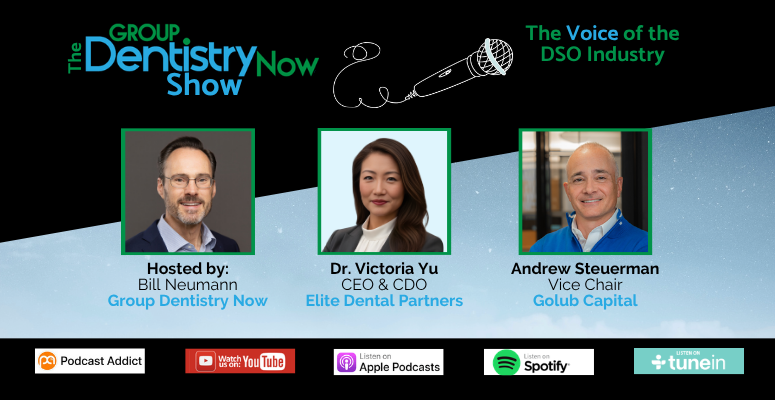
Welcome to The Group Dentistry Now Show: The Voice of the DSO Industry!
Elite Dental Partners’ Revolutionary Path to Ownership: EliteVantage Changes the DSO Game
Dr. Victoria Yu, CEO of Elite Dental Partners, and Andy Steuerman, VP of Golub Capital reveal how they’re disrupting the dental industry with EliteVantage – a groundbreaking program that offers dentists 51% ownership without writing a check. We explore:
- The evolution of DSOs
- The challenges facing new graduates drowning in debt
- Creating a modern path to equity & practice ownership
To learn more about Elite Dental Partners & the EliteVantage program visit: https://www.elitedentalpartners.com/
Thank you to Reach for sponsoring this podcast. For all your virtual assistant needs visit https://www.getreach.co/
Subscribe to our channel for more episodes and stay updated on the latest DSO news, insights, and events!
If you like our podcast, please give us a ⭐⭐⭐⭐⭐ review on iTunes https://apple.co/2Nejsfa and a Thumbs Up on YouTube.
Choose your favorite listening app below and subscribe today so you don’t miss an episode! Full transcript is also provided below. See all of our podcasts HERE.
 |
 |
 |
 |
 |
 |
DSO Podcast Transcript – Elite Dental Partners’ Revolutionary Path to Ownership: EliteVantage Changes the DSO Game
Today’s episode is supported by REACH, a partner of Group Dentistry Now that helps protect your patients’ experience through dental virtual assistance. REACH provides dedicated remote team members for your front office who work inside your systems and workflows. They handle patient communication, insurance verification, revenue cycle follow-ups, and day-to-day administrative tasks so your team can stay focused on patients and your operations stay consistent across locations. If you’re hiring, scaling, or looking to strengthen front office execution, visit www.getreach.co to connect with the REACH team. Welcome to the Group Dentistry Now Show, the voice of the DSO industry. Join us as we talk with industry leaders about their challenges, successes, and the future of group dentistry. With over 200 episodes and listeners in over 100 countries, we’re proud to be ranked the number one DSO podcast. For the latest DSO news, analysis and events, and to subscribe to our DSO weekly e-newsletter, visit groupdentistrynow.com. We hope you enjoy today’s show.
Bill Neumann (01:23):
Hey, everyone. Welcome to the Group Dentistry Now Show. I’m Bill Neumann, and thanks for joining us today. Always have such great conversations and excited about this one. I have known about Elite Dental Partners actually. I think Elite was founded, and I might be corrected here, but I don’t think so, in 2014. So that’s right around the time that we actually founded Group Dentistry Now. We both kind of started in the group practice DSO space at the same time, which if you look at the industry and how it’s changed in the past 12 years, and we’re going to discuss the changes that Elite’s gone through, and then also I think the industry’s gone through. It’s a relatively short period of time. I think the industry’s really matured. So I’m really excited to have Dr. Victoria Yu with us. She is the CEO and Chief Dental Officer at Elite Dental Partners.
(02:21):
Victoria, thanks for joining us today.
Dr. Victoria Yu (02:24):
Thanks, Bill. Thanks for having me.
Bill Neumann (02:26):
Yep. And we also have with us Andy Stuarman. He is the Vice Chair of Direct Lending and Golub Growth at Golub Capital. So Andy, thanks for jumping in here as well.
Andy Steuerman (02:38):
Thank you for making me an honorary dental provider.
Bill Neumann (02:42):
There you go. It’s good to have you here. It’d be great to get your perspective on things as well, Andy. Victoria, why don’t we start with you, maybe a little bit about your background prior to joining Elite, what drove you to join the organization, and then talk a little bit about your roles there.
Dr. Victoria Yu (03:02):
Yeah, thank you, Bill. I am a general dentist by trade. I think I’ve held a lot of the jobs a dentist would desire to have. I started out as an associate at a regional or actually at a fee-for-service dental office and really believed that DSOs were evil because that’s what we were taught in dental school. And then quickly learned that DSOs are not evil because I went to one subsequent to that and found a lot of mentorship success and my passion for giving patients utmost of care. Then that merged with the largest DSO in the land, was able to provide care there and started a de novo practice. Then grew my own practices in the state of Maryland where I live, merged those two with a small budding DSO that started out Bill in Philly.That’s where we were headquartered. We had 15 sites when I joined as chief clinical officer.
(04:09):
And by the time we’d exited, we’d gotten to 600 sites across the nation. A lot of great work by the exec team, a lot of wonderful partners, very talented people. Subsequent to that, I went to run the dental clinics for Walmart, had the pleasure of being there alongside some world-class leaders, and then came over to Elite after I think I had just one conversation with Andy, really.
(04:38):
What a wonderful organization and what wonderful partners I have and a leader, I have Andy and the Golub team.
Bill Neumann (04:49):
Well, that’s great. So Andy, you can kind of take it over from here. Why are you on the podcast? Golub must have something to do with Elite Dental Partners.
Andy Steuerman (04:59):
I’m a little bit concerned. I’m not going to have as impressive an opening as Vicki had, but Golub Capital is the majority owner today of Elite Dental. For those who don’t know Gallop Capital, we’re one of the largest private credit investors in the world. And as part of our mandate, we invest mostly senior secure debt across many industries, including healthcare. Elite Dental was one of our loans. And unfortunately, between underperformance and COVID, the company underperformed to a level that it was in the best interest of the company for Golub to take over control of the company, which we did probably right around the end of COVID. And happy to go into it now or happy to do it later, but maybe for your audience, typically when a lender takes over a company, it’s not in the best shape, both operationally and culturally. And I think since the time we took it over, Gallo did working very hard to bring the company to a better place.
(06:04):
And I think anyone that’s ever been part of this type of situation will understand the challenges, but I don’t know how detailed you’d like to get on that and I’ll leave it to you to ask you your audience better and how detailed they want to be on something about how we gotten from A to B.
Bill Neumann (06:25):
Well, I think Andy, it’d be great for the audience to understand a little bit more about what transpires when somebody like Gallup actually, and you called it kind of taking over, becoming more invested in the organization and kind of helping guide it. Take a look back and you kind of look at the founding in 2014 of the organization, and then we looked at the incredible growth in the industry. Consolidation really started in, I’d say 2017-ish and seemed to peak in around 2022 and interest rates started to climb. So I think what a lot of clinicians saw in the industry was this incredible consolidation. DSOs are taking over the industry, and then all of a sudden it stopped. We hit the brakes on M&A pretty abruptly. And so I think for just a lot of our audience being solo practitioners, younger clinicians and small groups out there, from your perspective, probably Elite was in the same situation a lot of groups were, where there was a lot of consolidation and then all of a sudden interest rates hit and things just stopped.
(07:42):
Can you talk a little bit about what that looked like?
Andy Steuerman (07:46):
Sure. So you’re right. There was a lot of consolidation. I think DSOs provided a really strong value proposition to older dentists. How were they going to monetize the investment they made in their practice? And many didn’t want to go through apprenticeship program and passing it on to others. And private equity and the DSO model was a very effective way for that transfer of ownership. And I think you used the proper word, roll up. Many of the practices or the DSOs, including Elite, were on a very, very aggressive acquisition strategy, sometimes in market, sometimes in random markets. And for most of them, and I know you said the capital ran out, but beyond capital running out, they didn’t integrate very well. And I think that’s one of the challenges in the industry. There was a lot of purchases, but it was kind of a confederation of unaffiliated practices with not very good shared practices, shared operations.
(08:46):
And when COVID hit, it stressed the system. So Elite was having those challenges heading into COVID where we had lots of locations, lots of different accounting systems, lots of different patient management systems, no coordination, no real culture and no cohesive vision. And COVID happened and that stressed the system where many of the tenured doctors decided to leave the industry. It was a good time for them to retire. And that started to create some shortages in the dental market, which exacerbated probably beyond the interest rates going up, what I would call wage inflation at the practice level, both at the physicians, the dentist, the hygienist, and the office staff. I think Golub stepped in and had a vision of anytime we don’t take over many companies, it’s a very narrow set of companies that sometimes we have to take over that’s kind of more … Not many, let’s just leave it at that.
(09:54):
We really believe that when we have to take over a company, the first thing you need to do is have a strong foundation. You cannot rebuild anything on a poor foundation. And we spent many years in different trials and tribulations really getting to what should be the right elite dental foundation. And when we started talking with Vicki, one of the things we realized is we have a great name, Elite, and we really wanted to have an elite dental practice. And what is an elite dental practice? And that’s really having top clinicians, top office staff, top corporate, top patient care, and comprehensive patient care. And it has to be cohesive. And even though our practices aren’t labeled elite across the board, if one patient moves from one location to the other, even if it looks like they’re separate entities, they should be treated the same way and have high standards.
(10:45):
So we’ve worked really hard to change the culture that requires both accountability and also a mission and vision to what it is to offer an elite dental experience and to provide elite dental experiences. And Vicki working with our team and her C-suite team have worked really hard to set that foundation for what we’re thinking is our next stage now for rapid growth.
Bill Neumann (11:10):
Right. Thank you. So this is great insight. Vicki, how about from your perspective? I mean, Andy kind of touched on it where you’ve got all these practices, they’re doing things differently at just about every practice. So you want to build some centralization. You probably also want to build a culture as well because when you’re doing everything differently, you don’t necessarily have a cohesive culture. So Vicki, can you talk a little bit how you’ve worked on that past couple of years?
Dr. Victoria Yu (11:42):
Yeah, well, love to. And to your question, Bill, Elite has really seen a quite comprehensive cultural and structural change. And it hasn’t been without its challenges. We’ve upgraded talent, but we were hard at work really building the foundation that the practices out there, the field out there requires so they know how to operate like an elite office. So being a clinician myself, having a clinician first culture just makes sense. That’s what I’ve been championing for since day one, because I am a dentist, but in addition to a business person, because we believe at Elite Dental Partners, that the business results of what we do is carried through and because of the comprehensive care that we give. So what we do at Elite is really give a lot of clarity to how we want things to operate. So standards of operating procedures, everything clearly defined. We’ve invested heavily in a learning and development department that is in charge of education and continuous reengagement, really, because we do believe that we have some of the best clinicians and professionals in the industry and busy providing comprehensive care.
(13:16):
So if we desire for them to do something a little different or up level in a certain way, then it’s up to us to educate them, to reengage them, to hear from them how we should change as an organization. As we’ve strengthened our culture, really, really excited to tell the industry that we have a solid foundation now. We do have an elite culture here. Retention is up, a lot of great applicants applying to be a part of our organization, but in addition to that, we’re here to talk about something that we believe will disrupt the industry, and that’s EliteVantage.
Bill Neumann (14:01):
Yeah, I’m going to hold off on that for just a couple of questions longer. But yeah, we had a chance to talk about this last week on a prep call, and I was pretty excited about EliteVantage and what you’re doing there. And I think it’s great that we’re having this conversation and the industry and a lot of the docs that are listening can get a real feel for what you’re building in Elite because it’s not easy to bring practices together, centralize, create a cohesive culture, and then offer something like EliteVantage where you’re really offering something super unique in the industry and for clinicians that I think are really looking for options. The landscape of dentistry has changed so quickly, a combination of, I think, things like incredible student debt, both undergrad and dental school, and that old, “Hey, I’m going to graduate dental school, hang a shingle.” That really is not an option for a lot of people anymore, and nor maybe is it a path that a lot of clinicians even want.
(15:13):
So I think you’re kind of putting together something that’ll be really appealing. We’ll hold off on that for a second. What are you seeing, and Victoria, can maybe start with you, just dentistry as a whole. So we talked about the evolution at Elite, but what about the industry? What have you seen and what’s the doctor perspective? Because you’re talking to a lot of clinicians, younger clinicians that maybe are interested in joining the organization, so what are you hearing from them?
Dr. Victoria Yu (15:42):
I talk to a lot of clinicians. Some are graduating with a crushing amount of debt, at least half a million dollars. And if you went to a state school that was a little cheaper, maybe a little less, but anywhere from half a mil to a million is not unheard of. A lot of economic pressures coming for our dentists because they have college loans as well, making them really feel the pressure of having to repay debt to produce, not even be able to think about a long-range plan where they get to really see and bring to fruition the best part of dentistry, which is we are artists, scientists, doctors, and we could be business people. And I think that is unparalleled as compared to our medical counterparts and primary care, et cetera, because the ability to be a pillar of the community and to own or be part owner of your own business that you’ve poured your career into, I think is an American dream, an American dental dream that I wish that clinicians can still realize.
(17:04):
So that is kind of the genesis of where EliteVantage and Andy, this is Andy’s baby, came from, because I think to have chosen a clinician who is also a business person instead of a business person to run an organization, then from that perspective, you know the clinician’s voice will be first and foremost. A clinician first culture will be had because we have a clinician who’s gone through running her own practices and being a chairside dentist, understand that intimately. And really, I think we understand what clinicians desire most intimately. They say they wish it could someday own their own practice, but because of so much debt, they don’t know that that’s possible anymore. And from their eyes, when I speak to them about that, I see a sadness that we desire to help overcome.
Bill Neumann (18:04):
I think that’s important, Andy. From your perspective?
Andy Steuerman (18:08):
Yeah, I’m not a dentist. I’m not a medical professional and I talk to a lot of people in other medical areas, but at dentistry, I think the challenge is demand for high quality dentist services is high. We’ve done a bunch of studies and there are people retiring faster than people coming out and the US population’s increasing every year. So demand’s pretty high. And at Elite and at other DSOs, I think that, or even private practice, dentists are being asked to do more. And I think yourself and Vicki did a pretty good job of talking about the burden of student loan, but also there’s a high cost of operation, there’s a high cost of scale, insurance, technology, finance, it’s complicated, payer contracting. So we’re asking a lot and I think the industry is asking a lot of people who are being treated like salary employees. And I think part of this is when you’re asking people to do more and they feel like you’re just treading as a salaried employee, you tend not to get the best of them.
(19:16):
And I think people really look back to how dentistry was like 30, 40, 50 years ago and they long for it. But as a finance person, I know that I’ve been asked in my career to work long and hard and I expected to be rewarded for it. And we’re seeing some of that same grind because there’s just ton of demand for their services and we need more dentists. So I feel for the people who really care about a patient and want to help them and not have anybody be in pain or have bed oral health, but they only have so much time.
Bill Neumann (19:53):
And Victoria touched on this earlier where she talked a little bit about DSOs being evil, right? That’s what you said, I think in your intro that you were like, “Hey, until I went to work for one and realizing that that’s not necessarily the case,” when you’re having these conversations, are there still some clinicians out there that are trying to determine working for private practice or starting their own private practice versus a DSO? When you’re having these conversations, is that still something or do they look at it and say, “I’d love to do private practice.” Just can’t ever see myself being able to afford that, or I don’t necessarily want to go through setting up my own practice and having to manage the HR and hire and fire and negotiate with insurance companies.What’s the feedback that you’re hearing?
Dr. Victoria Yu (20:46):
Yeah, from the conversations that I’m having, dentists still desire the upside of ownership, the commitment of that there. And these are some extremely intelligent individuals who’ve gotten chosen to get the education to become a dentist, but they are all saying it feels impossible because none of the dentists were educated on negotiations with payer contractors. They don’t understand operations. They don’t understand the finance part of dentistry, nor do they have time after seeing patients for 10, 12 hours a day to then handle the complicated HR issues that arise in an office. So because folks are more aware and knowledge is accessible out there, there’s certainly ways to garner that education and learn, but the people who are desiring that are a lot more aware of the complexities of opening up their own shop rather than maybe ignorance was bliss for us way back when, when we thought we have the skills and we’re good people and we’re going to work hard, then hang a shingle and we can go into business.
(22:13):
People who are graduating today are aware, are leery of in addition to having loans. So again, becoming a part of a DSO that will teach you that, that will undertake that partnership discussion, I think is really important.
Bill Neumann (22:32):
And I know Andy touched on this where he talked about it’s not only the student debt or not really getting the education to run your own business because you spent the majority of your education learning how to be a dentist. And dental schools, it’s something that I’ve talked about since I’ve been in the industry and just seems like they still don’t provide much, if any, business education or if they do, it’s very, very limited. So you’ve got that going on. But then also Andy touched on the fact that overhead continues to rise. You have now technology that you didn’t necessarily need before that’s now a prerequisite, right? The patient expects this technology, this investment. So a lot of these things, you can kind of take everything and you look at all the different pressures to start your own practice, it’s a lot different than it used to be.
(23:24):
Andy, from your perspective, the idea of ownership, do you feel like it’s changed from hanging that shingle to something else?
Andy Steuerman (23:36):
I think there’s a desire for things to change. So we think the right question is, are the key stakeholders in your business aligned for the success of all parties? So private practice is the ultimate entrepreneurial model. And as we’ve been discussing, that comes with high financial risk, lack of colleagues in a network effect, limited scales, you’re on your own. And alternatively, DSOs are mostly a corporate career. There are some, I think you went over the evilness of DSOs. I think DSO is a broad brush that you can paint. I think lots of DSOs, it’s kind of a legal description, but everyone has their own culture and approach. But most of them, the commonality is they’re mostly corporate and there’s limited ways for you to be entrepreneurial, limited ways for leadership, and it’s less fulfilling because you feel like a salaried employee. And even some of those with JVs, someone has to write a very, very large check for a very small percentage of their practice.
(24:46):
So we think the answer, given what we talked about, that private practice is hard, DSO is less satisfying. We think our elite vantage model provides the best of both models. It has the incentives of a private practice that we’ve designed with a support and scale of an aligned DSO network, and as we think the best DSO network, the elite DSO network. So we think providing that best of both worlds should really give dentists what they want and what they need and what they’re desiring in a way that’s good for them and less risky for them. So it’s actually good for their long-term, less risky for their short-term. And I think the key is it aligns with our goals. We’re aligning with the dentists. We’re not in confrontation with them or adverse to them.
Bill Neumann (25:38):
Well, Andy, I know this is your brainchild, the elite vantage. So I want you to really kind of hone in on what that is. You call it a modern path to equity for today’s dental leader. So let’s talk about what that means. And this is really unique in the industry, so this is important. Go ahead, Andy. Okay.
Andy Steuerman (25:59):
Well, I’m honored to have the ability to do this. So we kind of came up with a guiding principle and our guiding principle is how would this been 50 years ago if someone owned their own practice? What do they want? And we said, really what people want to do is have the majority of the economic incentive in their business. And if I’m working hard and I’m doing a lot, in the old days, the local dentist would work very hard. If they wanted three vacations, they worked extra days, they wanted four vacations, they worked extra days, they hired additional people in their practice, they had apprentices. They were really great to their staff because they were happy being a leader. Their huddles were motivating because they were happy. The patients were happy because the same person was in the community for decades and it worked really well.
(26:53):
So we’ve fumpled a model that we’re offering this to really all of our current dentists and we’re going to hopefully offer it to people who come in and we grow with. But if you perform and you come in and you meet certain thresholds of what we consider a well-performing office, and I will tell you, it’s not a threshold that’s above any industry standard. We’re not breaking the bank. Actually, a fair amount of our practice already meet that threshold. If you do that, you earn points and once you achieve a certain amount of points over a certain number of years, you have 51% of the economic interest, both in the excess profits and in the long-term equity value in the practice. You don’t have to write a check. All you have to do is perform. So there’s no upfront investment. It’s really alignment and a sweat.
(27:46):
I don’t want to call it a sweat equity. People have called it a sweat equity plant, but it’s not dissimilar to a junior dentist who would have to apprentice for a more senior dentist that more senior dentist moves on, that junior dentist takes over the practice and there’s an economic arrangement between them and sharing. And that’s our guidepost. And we think it works in the best of both worlds. We think we’ve always had clinical autonomy, but now we’re aligned. So when we go and talk about goals and maximizing the patient outcome, we’re talking as partners, not as a DSO and a salaried employee, not as someone asking to do more for maybe a slight higher percent of your collection. This is really, we are tied together economically. We win together, we lose together, and we think this is unique in the market because most other companies either don’t offer this or they make you buy in after you already have all the loans and you’re already under financial pressure and you want to buy a house and you want to get married and you want to have kids.
(28:49):
And if you’re working, we think this model works really well for those who really desire that entrepreneurial, that leadership role, but also value the support of a DSO like a lead without the risk of all that infrastructure. So we’re pretty excited to bring this to the market and we’re hoping there’s a line at our door of people who’d like to join us.
Bill Neumann (29:10):
Yeah. I mean, no writing a check is a big deal for sure.
Andy Steuerman (29:15):
Vicky, correct me where I messed up.
Bill Neumann (29:17):
Yeah. Yeah, Vicki, it’d be great to get your feedback on, so what are the docs saying to you about this program?
Dr. Victoria Yu (29:28):
We are getting a line out the door. We unveiled this just a few weeks ago to the industry at a convention. So talk to a few doctors and our internal doctors are just beside themselves. Some of them who have been here said that, and we quote, “This is what I been here and waiting for. ” I feel like all the years I’ve worked this hard, this is a They sent from above. Other doctors are thinking through how this can transform their lives and the lives of their families. They’re just very excited alongside us. And we’re already starting discussions with them to go through P&Ls, to go through the business side of dentistry, which love the transparency that brings forth. And our doctors are well engaged and excited to make minor tweaks to what we’re doing already to provide even better comprehensive care because they know this is building, not only serving the communities that they reside in, but also building something that their career build here is going to net them something down the road.
(30:55):
So just super alignment and the culture is going to get boosted, hyper boosted even from there. So Andy and I are actually very busy talking through what kind of gifts we’re getting for people, how we’re going to celebrate first wins. So it’s great to have discussions like that.
Andy Steuerman (31:18):
I mean, Bill, just to focus, we talked a lot about what you don’t learn in dental school. So when we talk about people having to put their time, meet certain standards, it’s becoming upon Vicki, her team, Golub. We’re not just turning them loose. Our job is to help them, train them. And for those who really want to be a leader and be entrepreneurial, our job’s to, before they get turned loose, when they have that 51% economic interest and they’re really writing to grow this business faster even than what it took to get to that 51% threshold, our job’s to help them and train them just like they would’ve had an older doctor do so years ago. So this isn’t a sink or swim. This is a partnership between the elite leadership team and Dolub Capital and the clinical staff. And there are certain people that will get there sooner.
(32:15):
It definitely is easier for our more experienced doctors and the ones who had their own practice prior. They’ll have a little bit easier time. It’ll be faster. But they’re super excited to help too because they know the benefit of this, but this is really a career. This is really a career we’re investing in. And I think that’s what we’re excited about because
(32:43):
We want people to succeed.This is for success and we’re trying to put guardrails, so make sure everyone succeeds with us.
Bill Neumann (32:52):
I think with EliteVantage, you’re going to see this. This is the next phase of growth really for Elite. So how are you going to maintain clinical autonomy and then also keep that culture that you’ve been so busy building the past couple of years really? Because Yara, I think that this type of program is going to supercharge some growth and get a lot of interest from people that may be trying to figure out who to partner with. Certainly 51%, no cash or no check written is really appealing. So talk a little bit about how you plan on maintaining that autonomy and then also the culture.
Dr. Victoria Yu (33:37):
Yeah, of course. I’ll take this one first, Andy, if that’s okay. At Elite, we’ve always celebrated clinical autonomy. And having been the chief clinical officer in prior roles, continue to champion that. It’s about setting forth standard of care that is industry defined and holding quality at the forefront. And of course, as a businessperson, we want the results and the numbers, but understanding that that comes from giving our clinicians utmost autonomy, educating the heck out of them, putting them on tracks of courses that not only elevate their clinical prowess into desired arenas that they want to get into, might it be implants, aesthetics, all fours, whatever aspect of endodontics, whatever aspects of dentistry they want to gain more knowledge of, having tracks of courses that we pay for internally so that they can get into partnering with very strategic national education platforms so that it’s not just us, but really they have access to the best of the best, and then ensuring that we foster their growth through support from a clinical and operational perspective.
(35:07):
So when our doctors are now trained in implants, our operators are well-trained in having discussions with patients and guiding them to say yes to the treatments that they need and deserve. So that’s how we handle clinical autonomy with a very focused and large and well-invested learning and development team and a very focused compliance team where we’re ensuring all the support that they get are practicing at the top of their licensure as well. So we’ve worked on our mission and vision here at Elite being one of focused comprehensive care, and that will be carried through the celebration of clinical autonomy.
Andy Steuerman (36:02):
Yeah. Bill, if I could just touch on culture, because we have lots of companies. Golub itself is a large company. Culture is not something you change with posters or newsletters or monthly meetings. It’s just not. So culture really requires clear direction, being clear what you stand for, what you don’t … Behaviors you reward and applaud and behaviors you don’t, and really supporting those who are aligned in shared success and in both growth and in economic reward. And if we fall back on our mission and ask ourselves, everything we do, is it good for our goals of our mission and our vision? We can scale to a larger company. Just to give Vicki, when we’re talking earlier about foundation, when she joined the company, she set a vision and she went around talking to lots of clinicians about the vision of really top-notch comprehensive care. And unfortunately, we had some people that just wouldn’t rise to the standard.
(37:09):
So not only do you have to have a mission and vision, you have to be able to talk to talk and you have to have standards. And as painful as it is to sometimes move on from people, there are certain things we can’t sacrifice. And top-notch comprehensive care is one of them, and there is no compromise there. So I think that the C-suite has very clear goals that they’re working with the doctors, working with the staff. And I think we walk the walk and we talk the talk. We say we’re going to do something, we do it. We’re in the trenches with people, but we have a culture. And I think for those who really want to succeed and work in a great environment with top-notch clinical care and where you’re aligned, and there’s expectations of you, you’re accountable to your patients, you’re accountable to your staff, you’re accountable to your colleagues and other offices.
(38:06):
This is a great place. If you’re looking to hide and you don’t want to be seen and you want to just skate by and you don’t want to work, you’re required hours, this is not where you should be. So we have a culture of shared success, win, play hard, win hard, share hard, and we’re going to walk that and we believe in it.
Bill Neumann (38:31):
Let’s start to wind down the podcast. I’ve got a couple final questions for you both. Vicki, maybe we can start with you on this. Do you have any advice for dentists that are early in their career just to … They might be trying to figure out their path, how to pay down some student debt, who to work for, how to gain some clinical experience and find a mentor. I know these are kind of really important things. Any advice you can share for any of these younger clinicians?
Dr. Victoria Yu (39:01):
Yeah. Bill, what a great question. Something that’s very true to what we stand for. Well, obviously advice one is if you’re in a state that we’re in, come and work for us at Elite Dental Partners. We’re in 10 states in the Midwest and we have an aggressive growth plan here. So happy to have discussions and see how we can move a great clinician to one of our offices. But sometimes having a DDS degree or DMD degree at this point, we’re new grads. It feels like that DDS doesn’t stand for Doctor of Dental Surgery. It stands for drowning in debt specialists. We have to pay back the loans. And in dental school, they didn’t teach us how to even talk to patients. We were just told know how to drill the teeth, know how to get perfect contacts, know how to be one millimeter away from the apex when you’re doing a root canal.
(39:59):
But there’s I think an important component to look for in a new DSO to join or somewhere to partner with is are they willing to teach you? Do they have a clinical and operational infrastructure leaders who care about you enough to want to educate you and walk alongside you and meet you where you’re at? What we like to do in our recruiting department is ask the million dollar question. Doctor, as you sit in front of us, where do you want to be in three to five years? A lot of our doctors end up say they want to be master implant specialist. Dream up whatever it is, docs, that you want to do, even including how much money you want to make someday to pay back the wonderful loans that we have so we can be doctors and provide the care. So be candid about what you want and then see how the DSO or the office you’re applying for replies to that.
(40:57):
Do they have tracks to help educate you? Do they have leaders? We have regional dental directors. These are some of the most experienced, kind humans you’d ever want to meet. And we have five of them who are amazing and have weekly discussions with the dentist they preside over. We have an extremely experienced operator who’s our current VP. She knows how to get your schedules where they need to be and how to guide you on your path and how to curate it for you. So I think those questions are important for you to ask a new DSO or someone you’re wanting to go to. And understand that if someone were to offer you anything less than 51%, start being scrutinizing and asking the questions, “Is that what I really want or is that I have to write a check for 500K for 20%? Or is that just golden handcuffs that someone’s trying to put on me?
(42:00):
” Because you guys understand that without you, without our doctors, there is no DSO, there is no dental industry. So you guys should be the most important people to that organization. And just paying lip service to a clinician first culture is not enough. Ask them to show you what that actually means.
Bill Neumann (42:23):
Yeah, some great advice for sure. Final question for both of you, this is always the crystal ball question. So what does the industry look like? So the dental industry, I’d say in the next five, 10 years, if you could look out, what do you see for the industry and then what do you see for Elite Dental Partners? So two-parter, Andy, we could start with you.
Andy Steuerman (42:50):
So for the industry, I think if I put my crystal ball, AI is going to come to dentistry as much as it’s going to come anywhere else. So I think we’re constantly looking at ways and we’re watching to how AI can help us advance clinical care, how we can improve care and how we can improve our operations. So I do think that’s something, it’s going to be another leap forward that this industry is going to have to deal with. I think from the industry too, I’m going to plug Vicki here because she spent a lot of time educating me that even things I didn’t know, how much oral care affects your general wellbeing. And there’s a lot of focus on longevity, making America healthy again, not eating processed foods, not exercising GLP-1s for people to lose weight, but I’ve been educated that poor oral health can impact heart disease, can impact brain function.
(44:00):
And I don’t think the industry, I think dentistry needs to have a bigger seat in the medical discussion because there’s a whole bunch of discussions of let’s keep people from getting sick by preventing sickness. And I think if the industry can work hard to have the healthcare community understand the value of dentistry and it should be a more covered medical procedure instead of making it so hard for people, some of the downstream effects of healthcare could disappear just like everything else we’re going to do. From an elite perspective, we believe in our model, we believe in our company. So we believe our model that bringing people into the company, taking our own people, teaching them how to perform operational excellence so they can get to that, they can earn that 51% is the right way forward in an industry that really needs a new model.
(44:58):
And we believe this hybrid model, which is half private practice and half DSO is really the future going forward. And we at Goluber, we’re betting on it. So we’re putting our money where our mouth is. We think this is a superior model.
Bill Neumann (45:15):
Thanks, Andy. Victoria, we’ll let you have the final say here.
Dr. Victoria Yu (45:20):
Oh man, all the pressure. I agree with what all the things that Andy said. I’m going to start with in five years, I believe elite will be where clinicians go, where they get real partnerships. So gold standard of how DSOs operate and treating doctors as partners is seen here. And we take over the DSO world. We become not only the gold standard for clinical clinician-led organizations, but operational excellence is what we continue to champion. To end, really, Andy said it very well, oral health is health. In my role previous to this one, had primary and dental under one roof, we were well on our way to solving how to break the very real barrier between overall primary health, primary care health, and oral health. So understanding that and even from an insurer’s perspective, changing the way they pay instead of eradicating disease and procedure-based, that they’re now going to pay our doctors to keep patients healthy, paying for health, getting people healthier, connecting the dentist to the physicians so that we can combine our powers and our knowledge to render a healthier patient, I think will be tremendously powerful and hopefully not very far away.
Bill Neumann (47:07):
Excellent. Well, thank you both. I just want to let anyone know that if you’re interested in learning more about Elite Dental Partners, it’s easy. Their website is elitedentalpartners.com. We’ll put that in the show notes. And if you’re really interested in that Elite Vantage program, you can go to elitedentalpartners.com, click on career opportunities, and there’s a dropdown that says EliteVantage, or we can put that direct URL in the show notes. And I know both Andy and Victoria are both on LinkedIn. So if it’s okay with you both, we’ll drop your LinkedIn handles in the show notes so people can reach out to you if they’ve got any additional questions. But thank you both so much. Great conversation. I think we covered a lot and really appreciate your openness about what’s going on at Elite and how you’ve really built this new organization and you’ve … I’m really excited about EliteVantage and I’m sure we’re going to be hearing more and more about it in the near future.
(48:06):
So thank you both for being on and thanks everybody for watching us today. Until next time, this is The Group Dentistry Now Show.
Thank you for joining us today. Don’t forget to subscribe to the podcast to stay up to date on the latest DSO News, insights, and events. Also, subscribe to our DSO weekly e-newsletter at groupdentistrynow.com.