
Ranked the #1 DSO Podcast!
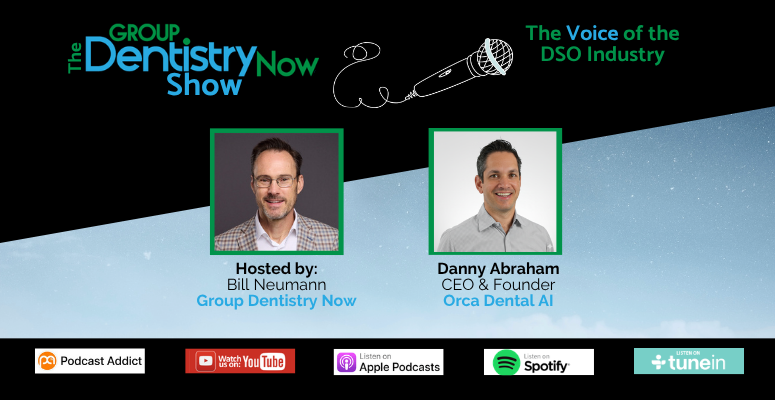
Welcome to The Group Dentistry Now Show: The Voice of the DSO Industry!
Revolutionizing Orthodontic Diagnostics: How AI is Transforming DSO Workflows and Patient Outcomes
Danny Abraham, CEO & Founder of Orca Dental AI & CephX joins the show and discusses:
- AI revolutionizing ortho diagnostics & workflow
- AI becoming standard of care in orthodontics
- ROI from efficiency, outcomes & legal protection
To learn more about CephX visit: https://cephx.com/
To contact Danny you can email him here: danny@cephx.com
Subscribe to our channel for more episodes and stay updated on the latest DSO news, insights, and events!
If you like our podcast, please give us a ⭐⭐⭐⭐⭐ review on iTunes https://apple.co/2Nejsfa and a Thumbs Up on YouTube.
Choose your favorite listening app below and subscribe today so you don’t miss an episode! Full transcript is also provided below. See all of our podcasts HERE.
 |
 |
 |
 |
 |
 |
DSO Podcast Transcript – Revolutionizing Orthodontic Diagnostics.
Welcome to the Group Dentistry Now Show, the voice of the DSO industry. Join us as we talk with industry leaders about their challenges, successes, and the future of group dentistry. With over 200 episodes and listeners in over 100 countries, we’re proud to be ranked the number one DSO podcast. For the latest DSO News, analysis, and events, and to subscribe to our DSO weekly e-newsletter, visit groupdentistrynow.com. We hope you enjoy today’s show.
Bill Neumann (00:38):
Hey, everyone. Welcome to the Group Dentistry Now Show. I’m Bill Neumann, and as always, we appreciate you joining us today. Always have such great topics and guests to talk about and talk with. We’re going to focus on orthodontic diagnostics and workflow standardization. And Danny, you can certainly chime in here, but it seems like there’s been a real big focus on DSOs bringing specialty into their practices as of late. And it’s this move from mergers and acquisition to doing more in the existing practices that they already have. And that includes doing more specialty. Orthodontics seems to be, if not at the top, right at the top of priorities for whether they have orthodontists in their groups or whether they’re looking to have their general practitioners do more orthodontic work. So it’s going to be a great conversation, I think. I’m excited to talk about it. And we have with us Danny Abraham.
(01:43):
He is the CEO and founder of Orca Dental AI. And they are the developer of the FDA-cleared CFX platform. What’s really cool about their platform and the organization is that they are in, I think I’ve got this right, over 80 countries right now. You have clinicians using the solution. So this is for all of our listeners, not just our US-based listeners, but Danny, it’s great to have here.
Danny Abraham (02:11):
Yeah. Thanks a lot, Bill. I really appreciate it. And I’m excited to share a little bit about my journey and about what Orca has to offer and the way we understand the market and hopefully the way we can contribute and help this space. Not only of the DSOs is also the OSOs, which is basically the same thing just dedicated to orthodontics, but both are obviously potential customers of ours. And yeah, I would love to, again, share my journey, share what we’re doing, and maybe just a little bit about myself and the company. Please. Yeah. So I grew up with a father as an orthodontist from sidelines. I saw my dad kind of struggle or at least the challenges of orthodontics in the whole field. And then I got my master of science degree and meshed the two pieces of knowledge together and created Cefex or Orca rather.
(03:22):
Cefex is the brand name. And the company has been dedicated to AI, bringing the AI kind of evolution to dentistry in general, but kind of specifically to orthodontics. It started off as a technician-based kind of local solution, but then fast forward to 2017, we spun off to a technology-based company. And fast-forward to today, we serve thousands of clinicians worldwide, as you said, in 80 countries, DSOs, imaging, and PMS solutions, aligner providers, just pretty much everybody along the value chain of the space. And as you say, we’re FDA cleared in both 2D and 3D imaging have a huge dataset and are operating in 80 countries. So yeah, it’s definitely been an interesting ride.
Bill Neumann (04:29):
Well, maybe before we get started, I’m really curious to get your perspective on things. How have you seen orthodontics really change since the founding of your organization to now? It seems a lot more technology focused than it used to be. And what does that learning curve look like for some of the DSOs out there?
Danny Abraham (04:53):
Well, I would say in general, dentistry, and again, specifically orthodontics, there’s been a huge and still is a huge shift towards digital processes with regards to what happens inside the practice. So a lot of things that used to be done manually and off the computer are now done online or through software programs or different tools that allow this digital flow to take place, which makes things much more efficient on the one hand. But then suddenly there’s so much more focus on processes that are not related to chair time and they’re necessary and they’ve become kind of standard, so you have to do them, but then they create this bottleneck and also there’s a much wider scope of the way practices do things. So if you’re talking about DSOs that acquire different practices, and you’ve got a much bigger spread of systems and procedures, and it becomes a challenge of how to unify these things and centralize them and standardize them.
(06:15):
So yeah, the change has definitely been, again, internally in the practice, probably the biggest change has been the digital processes. And of course, the aligner business, which has become a huge part of the industry is part of that kind of evolution.
Bill Neumann (06:33):
Well, you mentioned efficiency, and of course that’s always one of the things that comes to mind as being one of the most important, right? Everything’s important to groups and DSOs, but in particular, they’re looking for ways to be more efficient, whether it’s consistency across multiple locations. There’s some challenges now still with staffing. We continue to see challenges there. So let’s talk a little bit about how the Cefex platform really helps with consistency in diagnostics because it’s something that these DSOs want to be, and I think emerging groups too, so not just the large OSOs out there, but a lot of the smaller orthodontic groups that exist are really looking for ways to just become more and more efficient.
Danny Abraham (07:25):
Right, absolutely. So I think the efficiency question caters is directly related to what I mentioned before. When you have multiple locations and you have all these digital processes taking place, the question is, how do you unify them? How do you get rid of the lack of standardization? How do you have access and auditing abilities? And in general, a lot of these problems can be solved with AI. So AI is, well, kind of unexpectedly an interesting tool to be able to solve a lot of these problems. So when you don’t have a objective ground truth and when you don’t have consistency and you’re subject to a lot of volatility, which is kind of tied into the human experience, we’re all subjective and we all make decisions that can change. And I think there’s even been studies that show that dentists will agree with themselves only 30% of the times if they are tested or if they look at the same case a week later.
(08:44):
So that’s a huge kind of indicator of how subjective thinking and subjective analytics or analyzing of cases and issues can change when it’s only done without any ground truth and stable system to help you out with that. So I think regarding efficiency, those are a lot of the problems that arise. And AI is just a great tool to be at a constant ground truth that doesn’t change. It doesn’t mean it’s necessarily always the way you want to go, or you definitely automatically agree with what are the results it kind of displays, but at least you know that it’s objective and you know that it’s not going to change its mind. And you know that if you feed it a case, it’s always going to give you the same objective ground truth. So yeah, it’s kind of a way to solve that inconsistency problem.
Bill Neumann (09:55):
What about things like compliance and different regulations? Does FX help out with that? Because that can be a real challenge, especially with, again, we think of the scale that groups have and the knowledge base that a lot of clinicians and non-clinicians have by practice to practice.
Danny Abraham (10:18):
Yeah, absolutely. Again, we’re seeing this trend of compliance and more stringent regulation requirements, both from insurers, but also medical legal requirements from, can be anywhere from the state to the courts and so on. The problem is that kind of efficient report taking and efficient, again, we go back to standardization, is very difficult, especially in the DSO space because the acquisition of different practices causes this fragmentation of how things are done and which systems are operating. And then if there’s a requirement that you need to now get your practitioners and your clinicians to start adhering to, it’s hard to police and it’s hard to enforce. And one of the ways to overcome that is to introduce systems that automate the whole process. So it kind of reduces the friction between the clinics and what the organization wants, and that’s where CFX and the AI procedures of Cefex help basically come in, get your records aligned, get your medical legal standards aligned.
(11:52):
And again, there’s a lot of examples for insurance and there’s NADP and CADP requirements and so on. And it can even be done without the practitioner necessarily even having to take part in the whole process. So with some of our customers, we have a entirely transparent process, which just safeguards with regarding to the requirements of these groups like NADP and CDP and legal requirements and so on, because you don’t want to be in a situation where there’s legal action against you and you’re being asked, “Have you taken all the records necessary in order to live up to the standard of care?” And you have to kind of wiggle your way out of it. And this way, using Cefex and the automation tools of Cefex, you have the safeguard, which automatically allows you to acquire these records without the friction of having to police it with your clinicians.
Bill Neumann (13:03):
Yeah, that’s a great point when it comes to insurance auditing. You can almost take the clinician out of it and kind of rely on Cefex that’s already created this record, this proof and not having to rely on, first off, the clinicians being called to search for something they may or may not have done. So this is all categorized and recorded for them. So that’s great. Another question that comes up is return on investment. So the CFOs in the audience and the CEOs are always looking, it’s like, “Okay, this all sounds good, but what does this look like from an operational and financial impact and how you think in particular AI solutions like CefEx can really help when it comes to return on
Danny Abraham (13:56):
Investment?” Sure. So Cefex has a number of vectors where we believe there’s contribution and then an immediate translation into ROI. So if we’re talking about the medical legal side, which we just discussed, you have to think of what is the cost of being non-compliant, getting audited by an insurance company and being found out that you are not up to par with the standard of care and report taking. And then what happens if you go to court? So all these have a cost, which Cefex with your monthly expenditure or annual expenditure, which is a constant, are safeguarded against and mitigated. So that’s one angle of the ROI question. Then the other thing is there is the clinical value since we provide clinical value and improve the actual treatment results, because if you’ve got better clinical insight and you’ve got better treatment planning because you have better insight, obviously results are going to be, there’s going to be more patient satisfaction, which is going to bring in more customers, and which is also going to lead to less retreatment and callbacks and time spent on actually fixing problems.
(15:31):
So that’s another side of the ROI.
(15:35):
And then so we said the legal safeguards, we said the patient satisfaction. And then the last part is what I think I mentioned in the beginning is the time spent on digital workflows. So because digital workflows have increased so much over the last few years, you’re cannibalizing chair time. So the time that is necessary in order to sit down and click whatever you have to click on your systems takes away from your chair time. And the minute you have systems which automate a lot of these workflows, you are getting more chair time, which is, again, that’s like the most obvious metric, which increases your bottom line and creates more bad for your buck, basically.
Bill Neumann (16:27):
So we’ve got these more and more complicated tech stacks. It seems like there are more and more solutions that kind of get piled on top of each other and some talk to each other and some don’t talk well to each other. So there’s those issues there. So sounds like a great solution, but adding in another solution, how does it integrate? Because we’ve got a lot of people out that are like, sounds good, but if it’s not going to integrate well with my practice management software or integrate well into my workflow, then I’m not sure this is going to be really beneficial.
Danny Abraham (17:05):
Yeah, that makes a lot of sense. And we have an increasing number of integrations, again, with a bunch of different systems. So we integrate with a growing number of PMSs. So that kind of workflow a lot of the times is entirely seamless. You just have an extra button in your PMS regarding to the patient, or you can, with some groups, we even have this entirely automated system, which is, again, transparent to the clinician or staff. So that’s one part of it. Then we have integrations also with imaging systems and planning systems such as like Soda Cloud and Vista to name a few that tie in directly to your imaging workflow rather than your patient management workflow. And then the other connection is with x-ray imaging systems. So like Planmeca and Serona and other systems also have us integrated. And those are usually the entry points into which you’re going to want to take your image and convert it into the data that we provide.
(18:28):
We also provide aligner companies and different providers in imaging labs and so on, which is a bit of a different entry point. So if you export your data to a third party and receive back information, which can be a treat and plan with aligners or can be an imaging lab that does CBCT imaging for you and so on, that’s another entry point through which we provide service, but we’re really servicing the third party providers who then pass it on to the clinician within, and then that can be within the organization as well.
Bill Neumann (19:10):
Challenges with scaling orthodontics, specifically when it comes to DSOs, can you talk about some of those challenges that you’ve seen and how you’re working to try and alleviate some of those issues?
Danny Abraham (19:25):
Yeah, sure. So again, I think the biggest challenge seems to be the fragmentation of systems just because of the way most DSOs obviously grow through the acquisitions of different customers and, sorry, different clinics. And then each clinic has their own system and procedure and staff that are used to all kinds of things. And then getting them to comply and work with your systems or the way you want it as a DSO and as a group and organization and wants to standardize things is very difficult. So I mentioned before, automated systems reduce friction and this friction between management and clinicians or clinics is obviously a challenge for DSOs. Being able to overcome that is a great way where AI really shines and manifests its advantages because a lot of things can be done, again, transparently. So yeah, I would say that’s probably the biggest challenge and one of the biggest contributors of what AI provides.
Bill Neumann (20:45):
And you touched on this briefly earlier. You talked a little bit about the clinical contribution that using an AI solution like CefEx can really just help out. And I have to think back to a lot of the OSOs and DSOs in general have some younger clinicians that maybe don’t necessarily have the skillsets because they haven’t been practicing a long time. So can you talk a little bit about how using a solution that’s AI supported can help not just younger clinicians, but maybe some of the more established clinicians when it comes to the outcomes?
Danny Abraham (21:25):
Sure. So I mean, in general, when you talk about radiography, which is a lot of the places where we, what Cefex and I think AI contributes is taking images. They can be, again, radiographic images, they can be intraoral scans, they can be images, facial images and intraoral pictures and so on. So taking that information and deciphering it as a clinician can leave a lot of missed kind of findings on the table. Again, the human condition, we’re all volatile in our decision making. Of course, our focus and attention at 5:00 PM is different than what it is at nine o’clock in the morning when we’re all fresh and so on. So it’s subject to our distraction, our focus, our just general condition at the moment, and then it leaves a lot of room for mistake. Having an kind of assistant, which shines a light on findings and floats crucial information and says, “Hey, take a look at this specific thing that we found.
(22:47):
It might be a nothing or it might be a something, but just take a look and note that it’s there,” goes a long way in improving the level of overall diagnostics. And in general, there’s a great example. We just had a recent surgeon, an oral surgeon who uses our platform, and he’s a complete veteran. He’s been around for a while and he’d done just a huge amount of cases throughout his life. And he’s used to looking at an x-ray and kind of immediately understanding what’s going on without even having to think about it too much. And then he got our results and he actually spoke to us directly and said, “Hey, your results, something’s wrong there. It doesn’t make sense.” And what turned out to be was that our AI system automatically rotated the image and aligned it according to the Frankfurt horizontal plane. I won’t go into details, but the idea is that it did some kind of automatic maneuver, which we do purposely.
(23:58):
And because that maneuver wasn’t done initially and the patient was taken, the x-ray was taken in a bad head position, it actually misled the surgeon with all his experience to come to an incorrect conclusion. And only after we realized why he had come to the wrong conclusion and why the AI had actually given him the right conclusion was a great example for us of how these automations can help even the most experienced practitioner because you’re used to taking a quick look and getting a feel for what’s going on, but sometimes your feel isn’t accurate even if you’re super experienced. So again, that kind of second opinion, that extra entity that shines the light on where things may be crucial is super, super advantageous even for experienced practitioners.
Bill Neumann (25:01):
And I think this ties into the, you talked about patient experience as well. So not only I led with, this is helpful for orthodontists both and clinicians both experienced and not really that experience, but then also even for the treatment coordinators as well, can you talk a little bit about how this assists the treatment coordinators? And then I’d like you to then take it to the next step from a patient perspective, how is this better for them? And it seems to me, and there’s this expectation now that we have as patients which are customers too, right? So we call them patients with their customers and everything, we have AI now in everything that we do. I think most people are pretty familiar with chat. We’ve got AI on our phones. So I think it’s the natural expectations that our clinicians would be using AI to help them and help us as well.
(26:10):
So are you starting to see some more of that kind of breakthrough? So I threw three questions out at you, but …
Danny Abraham (26:17):
Yeah. What we’re seeing in general, and I think this has been a known for quite a while, that in general, patient education and good patient education leads to better case acceptance. And the question has always been, what is good patient education? How do you present the current situation to the patient, where he’s at and where you want to take him and what you want to perform in the procedure? And really, what is his journey, especially in orthodontics where it’s not just a one-time treatment or it’s probably the longest journey of all. And that’s why I call it a journey because it’s not from now to tomorrow or a week’s time, it’s now to 16 months time or two years or whatever. And because that journey is complex and kind of requires a commitment to something long-term, there’s always this basic apprehension. And then the question is, how do you overcome that apprehension?
(27:28):
How do you explain to the patient what’s going on? How do you really visualize where the patient is and what you want to do? And the best tools for visualizing turn out to be AI because then you’re not just creating an animation saying, “Well, this is an animation of we want to extract a couple of teeth and move your maxilla back and do whatever.” You need to show this is you, this is properly your structure, this is your anatomy, this is what you look like right now. And on the other hand, this is where we’re going. This is what we want you to look like. This is how we want to improve your aesthetics and visuals. So the minute there’s a proper real representation, a visual representation of where we are and where we want to go, there’s better understanding. And then when there’s better understanding of the destination, there’s also better case acceptance.
(28:34):
And we’ve seen that across the board, both in regular dentistry with other providers. And again, even more so in orthodontics, just because the journey is so long and requires a more bigger emotional commitment.
Bill Neumann (28:50):
So as we start to wrap up this podcast, this is fascinating. I love technology and AI and it’s moving so rapidly. It’s really hard to keep up with things. So this is the crystal ball question for you, which might be difficult, but if we’re looking at five years out, 2031, maybe take us from the end of this year, what the progress will be to 2031, what are the changes that you see for your solution, Cefex, and then also just AI in general for dentistry?
Danny Abraham (29:30):
What I see is, first of all, ubiquity. So if today AI is something that is kind of cool and nice to have and everybody’s talking about it and it’s the industry buzzword and so on. And I think practitioners are beginning to see not only as something to show off and say, “Hey, we’ve got the newest and latest and best technologies,” but real proper value, again, both on the clinic clinical side, but also on the organizational side. So five years from now, it’s just going to be a given. It’s not going to be something that as a clinician or as an organization, you’re going to contemplate if you want to have. So I really believe that it’s going to be just a given that is part of your planning and coordinating procedures. And then the clinician will always be the decision maker and the authority and the executioner of the plan, but the tools and ability to take the data which is thus far as being available and make it accessible, and there’s a huge difference between the two, is just going to be a natural.
(30:45):
So data is going to be, the crucial data is going to be super accessible right in your face, and as a clinician, you’ll be able to make a much wiser and more predictable treatment plan. And at the end of the day, patient treatment and outcome is just going to be increasingly better. You’re going to have more satisfied patients, less recalls, and just better orthodontics and better dentistry across the board.
Bill Neumann (31:23):
Excellent. So what are you all working on? What do you have any interesting things you can talk about as far as improvements or some really, I guess, anything you can talk to us about that maybe coming down the pipe?
Danny Abraham (31:38):
Oh, we’ve got a huge amount. Our focus now is also a lot on 3D procedures. So when we say 3D procedures, we’re talking about CBCT and intraoral scans and what you can do with them and unlock the huge amounts of data that are embedded in both of them. So we’ve already got interesting tools and automations regarding these image types, but we’re actually increasing them and creating all kinds of really interesting tools also on the clinical level, on the ease of use level, on the automation level. If you take an example of imagery, even it’s the most basic example of what an orthodontist has to do in order to acquire images and put them into practice management. So he has to go through all the images he’s taken of the patient, put them usually in a specific order. Sometimes there’s a few images per patient of the same type, so you have to decide which one you want to use, then kind of upload them into your system.
(32:47):
Then you have to label them, then you have to crop them and rotate them and align them in a template. I mean, oh my God, there’s such a long procedure. And with our system, it’s just click and it’s all done automatically. So as far as time saving is even concerned above and beyond just the clinical stuff, just the time saving and ability to focus on the clinical chair time and not on the digital processes, which happen now seamlessly, there’s a lot of effort that we’re putting in to make these things happen. So yeah, both on 2D, 3D and digital processes, a lot of interesting things and automation’s coming out.
Bill Neumann (33:30):
Well, thanks, Danny. Great conversation. If people want to learn more about Orca Dental AI or Cefex, how do they do so?
Danny Abraham (33:41):
Oh, sure. Well, you can just email me directly at Danny, D-A-N-N-Y at C-E-P-H-x.com. And yeah, I’ll be happy to answer any questions or set up a demo or whatever is required.
Bill Neumann (34:02):
Excellent. And so the website address, the URL is Cefex, which is C-E-P-H-X.com. Very simple. We’ll put it in the show notes. We’ll also drop Danny’s email address. And there again, that’s pretty simple too. It’s danny@sfx.com, so can’t make it much easier. And yeah, I think we’re at the point now where a lot of these AI solutions aren’t interesting there. We’ll wait and see. I mean, I think looking at we’re there, we need to start using these to help our clinicians and help our practices out because we’re in an interesting time, I think, when it comes to group practices and DSOs, the heyday of acquisitions, that’s passed. Now we’re looking at the groups that have been built and how do you become more efficient, offer more value to your customers, and I think offer more value and more solutions to your clinicians as well. And CFX is a perfect example of something that is easily integrated into the workflow solutions that’s going to help out not only the clinicians, but give better patient outcomes.
(35:16):
And I think from the ROI perspective, it sounds like a great solution. So thank you, Danny. Really appreciate your time and thank you everyone for watching us today. Until next time, this is The Group Dentistry Now Show.
Danny Abraham (35:30):
Thanks a lot. I really appreciate the time and the platform. Thank you.
Thank you for joining us today. Don’t forget to subscribe to the podcast to stay up to date on the latest DSO News, insights, and events. Also, subscribe to our DSO weekly e-newsletter at groupdentistrynow.com.