
Ranked the #1 DSO Podcast!
Welcome to The Group Dentistry Now Show: The Voice of the DSO Industry!
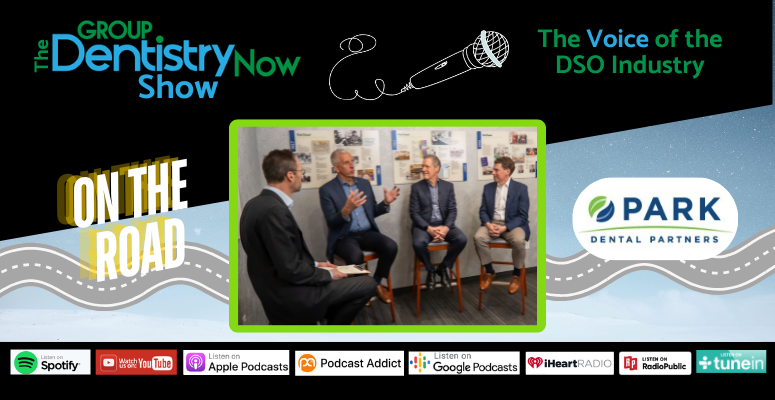
On the Road in MN with Park Dental Partners. Building a Doctor-Led Publicly Traded Dental Organization.
We take the Group Dentistry Now Podcast on the road to sit down with Peter Swenson, CEO, Dr. Alan Law, Chief Clinical Officer of Specialty, and Dr. Christopher Steele, Chief Clinical Officer of General Practice, to explore the success story behind Park Dental Partners.
Be sure to watch the video podcast version of this episode, where we visit several Park Dental practices and sit down for an in-depth interview at their resource group office.
Key takeaways include:
- Timeline: from two dentists to NASDAQ
- Doctor ownership & governance
- Long-term strategy
To learn more visit https://parkdentalpartners.com/
Subscribe to our channel for more episodes and stay updated on the latest DSO news, insights, and events!
If you like our podcast, please give us a ⭐⭐⭐⭐⭐ review on iTunes https://apple.co/2Nejsfa and a Thumbs Up on YouTube.
Choose your favorite listening app below and subscribe today so you don’t miss an episode! Full transcript is also provided below. See all of our podcasts HERE.
 |
 |
 |
 |
 |
 |
DSO Podcast Transcript – On the Road in MN with Park Dental Partners. Building a Doctor-Led Publicly Traded Dental Organization.
Speaker 1 (00:03):
Welcome to the Group Dentistry Now Show, the voice of the DSO industry. Join us as we talk with industry leaders about their challenges, successes, and the future of group dentistry. With over 200 episodes and listeners in over 100 countries, we’re proud to be ranked the number one DSO podcast. For the latest DSO News, analysis and events, and to subscribe to our DSO weekly e-newsletter, visit groupdentistrynow.com. We hope you enjoy today’s show.
Bill Neumann (00:38):
Welcome everyone to the Group Dentistry Now Show. I’m Bill Neumann, and we are on the road in Minnesota. Really excited to be here. We’ve got the team from Park Dental Partners, and it’s a snowy day here. Go figure. But we’re meeting Park Dental. And so what I want to say first off is if you’re listening to this podcast, make sure you jump over to the video, because like I said, we are on the road and we want you to get a full understanding of what Park Dental Partners is all about. Get a chance to see some of their practices, hear from some of their doctors, and of course hear from the executive team here, which we have two clinicians, and then an executive here, the CEO and chairman, Pete Swenson. We also have Dr. Alan Law, who is Chief Clinical Officer of Specialty Practices and Dr. Christopher Steele, Chief Clinical Officer of General Practices.
(01:35):
So thanks for having us. This is a lot of fun.
Dr. Alan Law (01:37):
Thank you. Appreciate
Pete Swenson (01:39):
It.
Bill Neumann (01:39):
And we came off of the AADGP. We had a nice conversation there. And one of the reasons we’re here is because recently you went public, which was big news to the industry. And you’re an organization that’s been around since 1972. So you have a long history, relatively quiet. So you’ve just been growing steadily throughout those years. And then all of a sudden you go public. So I think a lot of people in our audience are really curious why. And we’re going to talk a lot about that, but I think maybe what we can do is kick things off with some introductions. So Pete, why don’t we start with you a little bit about your background in the industry. You’ve been around for a while and then your role at Park Dental Partners.
Pete Swenson (02:22):
Yeah, absolutely. Glad you’re here, Bill. So my name is Pete Swenson. I’m CEO of Park Dental Partners. My road to dentistry started over 30 years ago. I thought I’d be around dentistry for a year or two out of college, and it turned into 30. I think we all know people like that in the industry, that once you’re in, you’re in. My father happens to be one of the founders, Dr. Greg Swenson. He partnered with Dr. Brian Mern back in 1972 to start the group. And I am not a clinician. I have an econ degree, so I’m on the business side and partner every day with our clinicians. So I’ve enjoyed the 30 plus years and looking forward to some war years ahead.
Bill Neumann (03:05):
Excellent. Yeah. They do say once you get into dental, you never leave. I guess I think that’s a good thing. It’s a good thing.
Dr. Alan Law (03:12):
Yeah.
Bill Neumann (03:12):
Dr. Law.
Dr. Alan Law (03:14):
My background is I went to the University of Iowa for dental school and my endodontic residency. And while I was doing my residency, I did a PhD in the area of neuroscience. So took a little longer to get out. My dad thought I may not make it into the real world if ever. But I ended up in … It was actually my program director that said, you got to check out Park Dental. So I came up here 30 years ago on that recommendation, thinking I’ll figure out something to do while my wife was finishing up her orthodontic training, and I never left. And for the past 23 years, I’ve been president of the dental specialists. I’m still four days a week clinical doing endodontic treatment. And the last two years I’ve been chief clinical officer, as you mentioned, for specialty practices. A few years ago, I was president of the AAE, so I got a chance to travel around the country and meet with different specialists and general dentists and see where we are and really got a chance to see how our model is something that’s pretty unique out there.
(04:07):
So we can talk about that later on.
Bill Neumann (04:09):
I’m really excited to talk about that. Dr. Steele.
Dr. Christopher Steele (04:12):
Yeah, Bill, thanks. Graduated the University of Minnesota, so a local kid. I actually grew up just a few miles away from here. Did a general practice residency out of dental school, and then I was hired 35 years ago by Pete’s dad, Dr. Greg Swanson, as he mentioned, one of our founders. And started out with a five-day week clinical practice, of which then through Dr. Swenson and given me and others, in fact, opportunities to continue with some leadership growth. Then started to integrate some of those opportunities into my career, which ultimately I think is now merged into what we’re doing now. And I’m still practicing two days a week, very similar to Dr. Law and have other opportunities within the organization. I’m working with our general doctors, looking at the clinical aspect of things as a clinical director, chief clinical officer for the general side of things.
(05:01):
Also with Dr. Law on the board of directors and also with Pete. And then the final thing that I’m involved with along with Pete is the Park Dental Partners Foundation, which is our way of giving back to the community, which is something we don’t advertise a lot, but it’s been a huge part of our growth over the last few decades. So pleasure to be here, Bill. And also, I think as we discussed yesterday, this might be your 250th podcast today.
Bill Neumann (05:24):
Yeah, we’re there for sure. Thank you. Congratulations. Congratulations. It’s a lot of talking and a lot of great information. So this is going to be great. I’m very excited and I want to make sure that we cover everything because there is a lot to cover. There’s a lot of history to cover. So Dr. Steele, why don’t you maybe kick things off with the origins of Park Dental? I mean, it goes back, we said to 1972. It actually goes back even a little bit before that, but you’ve come a long way, 1972 to December of 2025 when you became public. So where do you sit now as an organization as far as practice count, number of doctors that you manage, employees? And so maybe take us through origin to where you are at that-
Dr. Christopher Steele (06:09):
Absolutely. And these fellows can fill in some of the details also. And yeah, as you said, Bill, I mean, basically we started in 1972 with Dr. Swenson and Dr. Martin and really two pioneers we feel in the whole sort of dental world. And we’re really proud of our past because it really is percolated into what we’re trying to do or accomplish now. And with those two, they started really the first group practice in Minnesota. One could argue nationally also went back those days. In the early ’70s, this was all about solo practitioners and that whole vibe. But ultimately, they came up with the idea that if we can practice together, and I’ll use the concept of one plus one as equal to three, you get practitioners together, you get collaboration, you have an ultimate mission of trying to provide outstanding patient care to patients, and that gives you that extra leg of what we feel is a great equation.
(06:59):
And I think with the mission that’s been aligned from Dr. Swenson’s and Mern, as we revert through the years, that has been really our gold standard of which we’ve set. We’ve got to have the collaboration. We’ve got to have the doctor ingrained within the practices and leadership within our group. And also coming back to it, I think it’s all about the patient and the patient care. I think specifically about where we stand now, maybe Dr. Law, you can talk about numbers of practices, doctors, et cetera.
Dr. Alan Law (07:24):
Yeah. Well, we have over 200 doctors and that’s general practice doctors as well as specialty doctors, around 85 locations in Minnesota, Wisconsin and now Arizona. And I don’t know how many team members, but a lot of support-
Pete Swenson (07:38):
1500.
Dr. Alan Law (07:38):
Yeah. So it’s a big group, including the
Bill Neumann (07:42):
Doctors.
(07:43):
Yeah, it sure is. So I’m curious, you start off, and it seems to me like your father was ahead of his time because now this model is something I think that is more common than not as far as dentists working collaboratively. Instead of working on their own, 1972, one location, one doctor. And then we fast forward to 2026 and the majority are working, clinicians working together, whether it’s a single location or multiple locations. So 1972, that was probably unheard of. Can you talk a little bit about, and you probably have a good feel for this since it was your dad, what was the reception like? And then maybe from your perspectives, was this really unique where you’re like, wow, I haven’t seen anything like this?
Pete Swenson (08:39):
Yeah, I would say definitely pioneers back in the early 70s, former group practice here in Minnesota. A lot of us have been around partnerships. Many of them don’t work. I think with my father and Bud, Dr. Mern, it worked. They both complimented each other. My dad was the driver of growth and Bud was an incredibly good mentor, my dad as well, to all the doctors that came on board. And the growth just was continuous over the years and they played off well with one another. And as the group reached each milestone, there’s new challenges, new opportunities as you grow. And I’d say we’re at one of those junctures in 2026 here as well as we press on. So maybe you could talk about when you joined the group and- Yeah,
Dr. Christopher Steele (09:30):
Absolutely. I think one of the things you talk about is sort of that dichotomy, the difference between Dr. Mern and Dr. Swenson, which
(09:37):
Was very apparent. And with Pete’s dad really drove the growth of the organization, but Bud, Dr. Mern, Iron Ranger as we call him from Northern Minnesota, and he was all about clinical care and doing the right thing for the patient. And it’s one of those things that really permeated throughout our group and has remained today. And I think that’s one of the things that we’ve looked at over the years. And I say if we started in 1972 and some of the things that Dr. Swinson had to deal with being called out as this guy working in a group practice, there was a lot of tough early years because of the decisions he’s made, which ultimately have paid off handsomely for the profession of dentistry because it’s just a great way to practice. And obviously we’re firm believers in that. But I think in the 19, as you look our growth, Bill, over the years, the ’70s were one where we started to grow, add practices, push resources back to grow and add new practices.
(10:29):
But just as importantly, providing the standardization that occurs in our clinical practice today, and then also looking at things such as adding accreditation, which we’ve been involved with since the late 1970s. And there’s not a lot of practices within the country that are going through accreditation, but it’s a great process for our quality assurance and standardization to make sure we’re on task. And it’s a great way for us as a comparable to look at other locations saying we know along with other locations that we’re doing the right thing or at least attempting to do the right thing.
Dr. Alan Law (11:01):
Yeah. And the other big change was in 2000 … Well, in 1998 when we started the dental specialist, specialists didn’t practice from different specialties practice in the same location. You kept your own silo. You’re often a solo practitioner, so you weren’t in a group practice and you didn’t practice. I started with a periodontist in 1996, and then we formed the dental specialist in 98. It was unheard of. And even in the community, there was some concern that this model was not something that would be accepted. So in a lot of ways, that multi-specialty practice was pioneering in Minnesota and throughout the US. And that was with two of us, and I was thinking, is this going to work along with others? And now we have almost 50 specialists that really enjoy that collaboration and to the benefit of the patients as well as the referring practices.
Dr. Christopher Steele (11:52):
Mean, that was a big inflection point, I think, on our growth is that we were general and then ultimately in the late ’90s, as you said, Dr. Law, added the specialty group, which has now grown substantially. We’ve got this great integration between specialty and general care, which I think is a huge asset for our patients.
Dr. Alan Law (12:08):
And we started out, I was working in the general practices. So they worked seven o’clock to 2:00 PM. On two days a week, I’d be 2:00 PM to 9:00 PM. So I got to work with them on a daily basis, exchange patients, share the same treatment room. You learn a lot about your referring practices when they’re right there with you and what was going to work and what needed to improve to improve their patient care and the communication. So it was a great experience for me.
Pete Swenson (12:33):
I was going to say, Bill, to add to that, you mentioned accreditation. I think our founders really instilled the pursuit of excellence in our fabric. If I think about the two of you and all the team members and doctors in the organization and looking for that external validation, that’s what we look at accreditation as. It provides that shared experience of trying to drive to a goal of receiving that certification and accreditation. And Press Ganey is another example of that. If you look on our website, we’re using that external survey to make sure we’re measuring ourselves and taking that feedback and applying it to the business.
Bill Neumann (13:17):
Right. I don’t think we see a lot of that. Talk a little bit more about this. I’m curious about this accreditation because very few dental practices or dental groups actually have this type of accreditation, but maybe go into the importance of that and why you embrace that. I think it’s something we should discuss.
Dr. Alan Law (13:35):
Sure. It’s a way to show, demonstrate that you are meeting or exceeding every state national regulation, and you do that by showing your policies, your procedures, and then you have to show that you’re adhering to those. So the site visiting team will actually go out to the practices and visit our facilities to make sure we’re keeping our records straight, that the patient’s getting a great experience no matter which location they go to. And we also have to do quality improvement projects. So we have to demonstrate every year that we’re doing something to improve the way we deliver care, the way we communicate with our patients, the way we provide comprehensive care. And that’s really unique. You can do that as a practice, but to have someone come in there to your practice and actually ask you questions about it and be able to demonstrate it.
(14:23):
And you’re sitting in front of our value statements there and you can see service excellence, respect, value, integrity, collaboration, education. All those go into our accreditation process and we can demonstrate that. So we demonstrate service through the Press Ganey survey. We demonstrate our respective individuals through our team member engagement survey and our value and integrity through our quality improvement projects. So it’s one thing to say it, but it’s another thing to demonstrate that you’re doing it.
Dr. Christopher Steele (14:51):
And it’s really interesting too with the accreditation, you would think we’d be fairly static when we do these surveys every three years, but at the same time, it’s a very dynamic process because it leads to a lot of conversations between those folks that are coming in from the AAAHC and what we’re attempting to accomplish. And I think the care of patients is a somewhat static process, but the results are, but the process of getting there can change over time. And I think there’s always those conversations that take place with those folks that come in just to make sure that we’re on considering the cutting edge of where dentistry’s going and providing the best care that we can. But then as Dr. Law said, adhering to a lot of these same principles, it’s a arduous, but a really a well-worth process for us. Yeah.
Bill Neumann (15:35):
Thank you. And it’s really insightful. And I think you were talking a lot about specialty, and I wanted to bring this up because we actually had a conversation last night, had a really nice dinner. Thank you. And one of your oral surgeons, Dr. Carbon actually was talking about the way you have specialty integrated into your group is really unique. I think you coined the term comprehensive specialty, but I think when we go back to patient care and how important that is, this I think is unique and a lot of probably people in our audience are trying to figure out specialty and there are certain ways that we see that are relatively common where you have specialists that may kind of rotate into practices on a certain day of the week, but you do things quite a bit differently. Can you talk a little bit about that?
Dr. Alan Law (16:28):
Yeah. Really from day one when I started, I was working alongside a periodontist. So we both worked to those evening hours. So for me, it was great. I was learning techniques that I didn’t learn in my residency program from someone who was specializing in different areas that I didn’t specialize in, but we knew that we wanted to expand it beyond just endo and perio. So next we added an oral surgery and then we brought in prosthodontics and then pediatric dentistry and then finally orthodontics. And every time we did that, we looked at how do we build a facility, how do we build a culture where the specialists can work alongside each other? So in the conversation last night at dinner, Dr. Carbon is talking about how he’s working with an edodontist. And if that endodontist has a tooth that cannot be saved, he’s talking to Dr. Carbon, the patient’s already numb, the patient’s walking down the hallway, getting that tooth taken care of, getting out of pain.
(17:18):
And that case, in some cases, the patient can get an implied place the same day they had their diagnosis that the tooth couldn’t be saved. So you look at the benefit for the patient, for the referring practice, and actually the interaction is so rewarding for specialists to get that education, but also the collaboration, the collegiality on a daily basis. It’s something that I take for granted because I see it every day, but then you bring in a new doctor, relatively new. He’s been here for over 10 years, Dr. Carbon. To hear him describe that, it really is something pretty unique and I’m really fortunate that I get to be part of it.
Dr. Christopher Steele (17:52):
With Dr. Carbon also in our back door is Rochester, Minnesota with the Mayo system and they’re known for that. And Dr. Carbon graduated his oral surgery program and deprogram through Mayo.
(18:03):
And so he always refers to what that culture looks like down there and us trying to emulate what they’re doing. And obviously we’ve got our own ways too, but it’s been super successful. And I think the integration of specialty into our group in 1998 has been just a huge asset, huge asset. I mean, to be able to have a patient that comes in the door, I may see that patient for a hygiene exam, figure out there’s something that needs to be done that I can’t take care of, and then being able to refer it to somebody within our system, so to speak, is just fabulous. And I think ultimately for a provider within the organization, it’s a first class deal, but more importantly, for that patient to be able to seek that care and such and knowing what the results are going to be, sharing a patient record, et cetera, I think it really is, it’s an asset for us as an organization.
(18:48):
Plus we’ve got, what does that amount to just short of 30 years of experience working with specialties. So it’s a well ingrained system. Thank you.
Pete Swenson (18:57):
I was going to say, as the one non-clinician here, it is a lot of fun being around the collaboration across general and every specialty. Come to work every day thinking, what am I going to learn today? It’s just constant. As the profession evolves and we’re collaborating, there’s a lot of energy around it within the organization.
Bill Neumann (19:19):
Yeah, I think that’s important. And again, the reason I was so impressed by that conversation last night regarding comprehensive specialty is I think the industry for a while has been trying to figure out how do we integrate specialty? We hear this all the time. Sounds relatively easy, right? Well, you just simply, you’re not referring out. You hire an endodontist, you hire an oral surgeon, and then that’s it. That’s all you need to do. It’s not so simple. So to actually have them, all the specialists working together in one location from the patient perspective, you have to look at it from that perspective. A lot of times patients are fearful when they go to the dentist. So to just try and make it more convenient having all those expertise, and it’s not just Dr. Carbon is Mayo trained. I mean, you have several doctors that came from Mayo.
Dr. Alan Law (20:10):
Five doctors that are oral surgeon MDs, and most of them trained at Mayo.
Dr. Christopher Steele (20:15):
Bill, going back to that, the whole statement, we look at patient care and having specialists with that. But I look at it as my role within the general practices and even as a provider of general dentistry and the asset of having a specialty group, again, with continuing education that they provide, I think both for the community and also within our community of Park Dental doctors is huge. And I say high level continuing education. And even we’re, what is it? Once every month we’re doing our afternoon asset specialist, which is just a quick plugin 30 minute piece. And so I think it’s that relationship that one develops with the general practice doctors that also has added value to the whole equation. And again, I think even mentoring, we’ve got a lot of our doctors that work with, whether it’s Dr. Law and a number of the specialists to increase their aptitude in terms of doing procedures.
(21:09):
Our group’s no different than a lot of other groups that are out there nationally, is that we want our general to dentists to do as much as they can, whether it’s oral surgery, endodontics, placing implants, all the above, and they’re the asset to get us there. So thank you.
Dr. Alan Law (21:21):
Yeah. So we provide hands-on training for the general dentists recently in endodontics. And our philosophy is if you’re going to do the treatment, do it well, and we want to be able to help you get to that level, we can do it well. And if you can’t do the treatment, please refer that care out.
Bill Neumann (21:36):
So do you have a lot of the general dentist clinicians reaching out to specialists for that mentorship? I mean, do you see that this is what they’re looking for? They’re looking for this type of, “Hey, this is what I learned in dental school. I’ve had a couple years out, maybe I’m more comfortable doing the things that a general dentist typically does. Now I want to expand, maybe learn to do some endodontic treatments or some things that, so maybe I don’t necessarily have to call on you, Dr. Law, to actually do the endo. I can handle it myself.” So did you see that thirst for knowledge?
Dr. Alan Law (22:14):
Exactly. If you said what they learned in dental school, it’s also what they didn’t learn in dental school because of the lack of patients in some dental school programs, they don’t get a chance to do treatments on live patients. So one of the people I talked to at one of a big tent school did one root canal treatment on one canal. That was her entire endodontic experience. So now she’s going to be going out into the community and providing endodontic care. She doesn’t have that background. So just observing, and we have a shadowing program where they can come and just watch me provide care. It’s not just the technical aspect, it’s the patient interaction, the examination, making the diagnosis, the information. All that’s really important for the dentist to get if they haven’t had that experience in a dental school program.
Dr. Christopher Steele (22:56):
One of the things I would add, Bill, also with that is that we try, I’m sure a lot of other practices do the same, is that when these folks are coming out of dental school, you try to immerse them in as many different things as possible right away, because it seems like once a general dentist is into practice, they may hone their skills and get better at certain things, but the comprehensive nature starts to shrink back a little bit. And I think if we can get our doctors involved in a lot of different things right away, sort of open their eyes, almost feel like a parent, right? Your whole adage is try to give your kids opportunities in a lot of different things. And if they choose certain things- I’m able to enjoy AI. Exactly it. I think that’s kind of our role in organization is to give people opportunities and from there they can make their decisions.
Bill Neumann (23:40):
That’s great. All right. So talked a lot about the culture, sounds very doctor-led, which is important. So the decision to go public, right? So that’s a big decision. It is relatively uncommon in the dental industry, right? So can you talk, Dr. Long, maybe you could kick this off. Talk about the conversation that you all were having with the clinicians. And then of course, Pete, you can give us your perspective as well, but how do you go from being privately held since 1972 to all of a sudden being traded on the NASDAQ?
Dr. Alan Law (24:20):
Sure. Well, it didn’t happen overnight. And from the very beginning, we knew that was not the end game. It was not the final goal. It’s just a step along the way. And the big question is why? Because we had options and we discussed the options. You could go the private equity route. We could stay the way we were at that time and public markets was an option. So the why was we’ve got a good model here. We’ve got a good culture. How do we grow this? How do we get capital to invest in our technology, to expand our footprint, to provide more care? And I’ll even go back to 2015 when we did Vision 2030, which was how do we improve more lives as a leader in oral health? How do you continue to do that, that growth? And we’re just stewards of the practice.
(25:04):
How do we make sure the next 50 years we continue to do this and in a larger network? So we recognize that public markets was a way to do that with some safeguards that allow the governance of the practice to be influenced by the doctors. So we have safeguards where the doctors actually appoint directors to our board of directors. They have three seats that are appointed by the doctors through our, we call it DDS advisors where it’s doctor only, member managed a group of doctors that select a board that selects those directors. So that’s really important for us. So get the capital, invest in the technology and the people and new markets and make sure you have the safeguards so the doctors have meaningful influence over the governance and the operations of the practice.
Dr. Christopher Steele (25:57):
Well stated. Go ahead, Doctor. Well, yeah, I was just going to add, I think the governance issue is super important as Dr. Law sort of outlined. And I think the one thing not to shy away from, and I realize this is not necessarily the public response, but I think getting back to our reputation of this organization, we’re very focused on doctor engagement, doctor leadership. And I think operations is also a separate entity in addition to the governance. And so all of our, in a sense, our operations teams have a, what we call a diet bill. And again, it’s a Mayo concept. And so it’s an administrator and a doctor that are working regionally within our different practices so that doctor influence remains. So we can step back and say, okay, we’ve got doctor influence both regards to our governance, our board, and then also with regards to the operations of the practices.
Pete Swenson (26:48):
I would just add, you mentioned this, Dr. Law, it’s really important to frame the why. It wasn’t an exit, it wasn’t for just for the liquidity, it was really to set the organization up for the next 50 years. We’ve been building the business. That’s our intention is to continue to build the business. You saw us enter Arizona, a new market for us in December. That’s an example of us reaching out and deploying some of that capital into new state. So the other point might be missed is the doctors own the entire organization prior to going public. So they could make these decisions very thoughtfully over a number of years of conversation, weighing the trade offs of the options Dr. Lawley.
Bill Neumann (27:34):
Can you talk a little bit more about that? So you’re right, I kind of jumped the gun on the public side of it. Prior to going public, so the doctor partners owned part of the organization. What did that structure look like?
Pete Swenson (27:46):
So just prior to going public, we did have a management company that was owned by the doctors. So we didn’t have any outside capital in the business. Just traditional bank debt had been used to grow the business in addition to, of course, our cash from operations. So it afforded the doctors really a unique situation to make some of those determinations, the safeguards that Dr. Law mentioned. And again, took years of conversation weighing the options and thoughtfully reached that decision.
Bill Neumann (28:18):
So what was the feedback like from the doctor partners when you floated the idea that going public was an option?
Dr. Christopher Steele (28:27):
Well, I think like with anything, we’re all dealing with change management, right? And I think everybody enjoys a steady course, but I will tell you, we’ve been very fortunate over the years that with, I think our successes since 1972, we’ve built a lot of credibility within our doctor group. And I think they’ve been very passionate about following directions of where we would like to go. Obviously, it’s very important for us to be very transparent, provide information to our doctor group, but they’ve been very supportive of direction where we’ve gone over the last number of years. And so I think while there were a lot of conversations, Bill, that took place with our doctors and individual doctors, we were able to move the ball on this and proceed on with our number one, combining the organizations and the Park Dental Partners in 2023, and then move on in December and have this public offering.
(29:19):
So yeah, there were conversations, but positivity, and I think it’s a good thing as we move forward.
Dr. Alan Law (29:24):
Also, there’s been a history of innovation for the 50 years. So they were used to us looking at how do we do this better? We’ve been doing it for a while. So whether it’s adding specialty and collaboration, new technology. So this was something that we hadn’t done before, but there were a lot of things that hadn’t been done before that we had demonstrated some success with. So I think there was less trepidation. There’s always a concern about what’s going to happen the day after the IPO. Is the practice going to be different? And there hasn’t been any change. You go and you see the patients, you take great care of the patients, you collaborate with your colleagues, and that’s For the focus has been, what’s happening behind the scenes to make sure we’re successful in the long term doesn’t change what we’re doing day-to-day with the patients.
Dr. Christopher Steele (30:08):
I think that’s a question, isn’t it? People will say you’re public. We say, “Yeah, we’re a public. It’s a business decision we’ve made,” but nothing is changing in the practices at all. I mean, it is. We’ve got our mission, we’ve got our history that we’ve talked about earlier, and steady as we go with that, that is not going to change. That’s been our success, right?
Pete Swenson (30:24):
I would say I look at it as just another tool in our tool belt. It’s a way to raise capital, to continue to build the business.
Bill Neumann (30:32):
And like you said, you’ve deployed some capital. You invested in some practices in Arizona, which was kind of unique.You’re here in Minnesota, and then now all of a sudden you’re Arizona. What led you to Arizona?
Pete Swenson (30:47):
Great market, high growth. And we do have, just as an aside, we do have quite a few snowbirds. As you’re driving here today, Bill, through the snow, there’s good reason to leave to find warmer places. So we have a lot of patients in Arizona as well that winter there. So that wasn’t the primary reason. The market opportunity is excellent between Phoenix and Tucson. So I think our approach is going to be land and expand. We got our foothold. Some terrific doctors joined us down there and we’re starting to build that out. And importantly, we’re really focused on that strategy of density. As opposed to being spread thin across many states, you’ll see us really try to concentrate like we’ve done in the two states, Minnesota and Wisconsin here.
Dr. Christopher Steele (31:37):
And also build up that especially end of things also. That’s
Pete Swenson (31:39):
Part
Bill Neumann (31:40):
Of it. Yeah. Long term. So you’ve got at least short term with the Arizona acquisitions, you have a little some M&A going on. Talk about from the clinical side and organic growth opportunities within the practices. What do you see as opportunities maybe that are still untapped or things that maybe you could do better?
Dr. Christopher Steele (32:02):
Well, I think a big focus right now, Bill, has been trying to accelerate the growth of our younger doctors. So you talk about organic growth in the practices. For us, you look over the years and it’s really trying to get these doctors a curriculum that’s going to allow them to expand. Dr. Law talked about a little bit earlier with, we’re seeing graduates at dental schools now, maybe not having as many patients as they may have in the past. And we’ve got to figure out ways to get both didactic training and also hands-on training to get that core of doctors to be able to expand their services and integrate a little quicker into the practices, which allows us a little more breathing room. I think like with a lot of other practices nationally, the things that we’re doing, looking at AI, et cetera. Pete, I think had mentioned overjet a little bit earlier and ways to accelerate treatment plan acceptance rates, identifying problems within the practices, meaning clinical issues.
(32:54):
How are we going to respond to that? And just having a tighter operational system. And there’s, I think as well or good of a job as we’ve done over the years, there’s always a lot of room for improvement. So I think a lot of what we deal with with organic growth is what a lot of the country’s dealing with organic growth and how do we drive that? And how do we identify those things that we can really work on and succeed? But as I said, the big focus this last year has really been on our younger doctors and trying to accelerate our mentoring and coaching with them and also giving them information of which to improve on.
Dr. Alan Law (33:25):
Right. And then just expanding specialty. There’s obviously as Park Dental grows, there’s an opportunity to build that referral base. But we’ve discovered that if we add more specialists, we’re not just getting referrals from Park Dental, we’re getting referrals from the community. And that’s a huge opportunity for us to grow the practice.
Pete Swenson (33:40):
Bill, I was going to say, add to that, just the organic growth for us, we’ve got a long history of building de novo practices, and a lot of the growth actually comes from building existing practices, adding doctors where we have demand, where the doctor’s schedules are full, we’ll look for those opportunities. I like to say it’s kind of where we grow at the margin in each practice. And from our beginning with a group practice, that is what we’re striving to build. It’s not solo practices, but group practices.
Bill Neumann (34:13):
And as we wrap up this topic of being publicly traded, I’m sure we’ll go back to it a little bit. So the doctor shareholders, they have now shares of stock in the organization, publicly traded shares of stock in the organization. Is there an opportunity for incoming clinicians? How does that all work?
Dr. Christopher Steele (34:35):
It’s a slightly different model in the sense that I think this is a really unique opportunity for organization because we’ve got an employee stock purchase program, which we are now moving into. And so I think you look at the organization itself, you had a certain population of doctors that were shareholders, traditional model over the years, but let’s face it, you’ve got associate doctors, you’ve got team members that all put a lot of sweat equity in terms of growing this whole entity. And I think now we’re in an opportunity being a public organization where everybody can share in that. And with this employee stock purchase program, it’s a great way, I think, for people to be rewarded for the hard work that they’re putting into the practices.
Dr. Alan Law (35:13):
Right. I think about one of our team members that said, “I’ve worked for this organization for over 40 years. I walked in as an employee and now I’m walking out as an owner today.” It had a huge impact on us. And I think about a doctor, a specialty doctor who just recently joined us who from day one could be an owner in the practice, which does not happen very often. I can’t think of a good example anywhere where that would happen, whether you’re in a small practice or other opportunity with private equity. So that meant a lot to that doctor. And to share in the success from day one was, it was great for me to see that he could do that, and it was great for him that he could be part of it.
Dr. Christopher Steele (35:52):
And hopefully too, as we all are dealing with recruiting issues throughout the country, whether it’s hygiene assistance, front desk, and even doctors to a certain level, I think this is one tool in the tool bell to borrow Pete’s statement for us to hopefully also improve our recruiting opportunities. People can see that they’ve got that option or that opportunity if they join our organization, which is, we love it if we can recruit more people.
Bill Neumann (36:17):
Yeah, I think it makes a lot … And if you think about the traditional, you either have a DSO or you’re a dental resource organization, right? I like that dental resource organization. In fact, your offices here are, this is your dental resource group office, right? That’s what you call this. So as a DRO, as a traditional DSO, you typically, if you’re owned by private equity, the doctors that sell to that DSO may get some potential upside on the next turn. When another private equity firm comes in and buys them, there may be an earn-in or maybe even a dentist can invest. So I can, “Hey, I want to buy in. ” So then there’s an out- of-pocket, but you actually have the opportunity where you have shares of stock. It’s not limited to just the doctors. It can be any employee. And you can probably also, I’m guessing, it’s not a huge investment, right?
(37:13):
It’s not 200 or $500,000 investment or part of your practice is that investment. And in your case, it really could be minimal, but they still have participation in the organization and in the upside, which is really unique when it comes to dentistry. So it’s a great opportunity.
Pete Swenson (37:33):
They get to buy at a 15% discount to market. So it’s a good opportunity.
Dr. Alan Law (37:37):
And they have liquidity that you don’t have in other organizations if they choose to do that.
Bill Neumann (37:42):
There’s definitely a lack of liquidity right now,
Dr. Christopher Steele (37:45):
Obviously. You better believe
Bill Neumann (37:46):
It. DSOs. Yeah. Okay. It’s a big conversation in the industry. Everybody talks about clinical autonomy, and we hear it all the time. And first off, probably need to define what that means and more specifically what it means to Park Dental because it’s something that we hope all groups out there offer their clinicians. I don’t think that’s always the case, but you try and strive to get as close to that as possible. So what does clinical autonomy mean to you, Dr. Steele and Dr. Law? And talk about what that means to your culture.
Dr. Christopher Steele (38:23):
It’s really interesting that catchphrase of clinical autonomy, and yeah, it can be defined many different ways. I’ll go back to February, Bill, when we were down at AADGP in Austin, Texas, and listening in one of the seminars presentations, great response regarding what that really means, which I think our organization would really agree with, which is clinical autonomy is still all about what that result for the patient looks like, what that outcome for the patient looks like. It’s not using a Texas term, it’s not some maverick dentist out there doing their own thing. Absolutely not. I mean, number one, you’re setting up parameters within the organization, guideposts of which you want to follow. So you know that if you can stay within those guideposts, and that offers a little leniency, whether it’s personality driven or the way you’re treating your patients and/or team members, as long as you’re staying in those parameters, I consider that clinical autonomy because you’re still directing it towards that outcome of that patient care.
(39:19):
And I think that’s one of the things that we’ve looked at over the years, whether it’s through accreditation, standardization, or quality assurance processes. We, and there’s a lot of other practices throughout the country that have done the same thing. I think they’ve identified ways that they know that they can get to that outcome, and then it’s having those doctors following that track. All right. Now, is everybody doing the exact same thing at our practices? No. And as we discussed last night with our practices, culturally, we’re very similar, but with the personalities of the doctors or team members, every practice is going to be just a little bit different in terms of how they approach and treat patients. But ultimately, if they can end up staying within those parameters and ending up with a great outcome of patient care, that’s what I consider to be clinical autonomy.
(40:01):
Dr. Law?
Dr. Alan Law (40:02):
You’ve covered a lot of it. It’s a question we get. By the way, 30 years ago, I didn’t get this question when people were interviewing with us, but we get it more now. So clearly it’s something that there’s a concern about in our profession. And I was a swimmer. I used a lane line analogy. So we’ve given you some lane lines. It means patients have to be treated well, and we have ways to look at that. We do record reviews for accreditation. And even if we didn’t have accreditation, we doing record reviews. We have service excellence through our surveys and team member engagement surveys. So we have ways to look at, are we treating the patients well? Does the doctor fit our culture? And then within that, you have a lot of leeway. And if you stay in the lane lines, you’re going to be fine.
(40:45):
But if you’re doing things that are not in the best interest of the patient or you’re having high team turnover, we have to do a course correction. And it’s a developmental process that I look at for them because we want to maintain that high quality for our practice.
Dr. Christopher Steele (41:02):
Yeah. It’s difficult to really assume what that definition looks like. And that’s why it’s important to set the context, any conversation you’re in regarding this topic. We’re not that prescriptive. We’re going to say, for instance, endodontics, you start here, you place Novocaine there, you do that, you tell the patient this. This is the actual process that you follow to a T. There’s going to be some variation that occurs. Again, as Dr. Laus mentioned, as long as we end up with a great outcome at the end, that’s the most important thing and you service that patient well.
Dr. Alan Law (41:29):
Yeah. And the lane lines are those clinical practice guidelines that are evidence-based that are developed by our doctor work groups. So if they understand how we got to that process of developing those landlines, I think they’re a lot more comfortable with it versus just being told you have to do this without the why behind it.
Dr. Christopher Steele (41:45):
And I think professionally, you, I, and our doctors that work for our group, that’s one of the things that we subscribe to. We do like that. The systems that we’ve set up, I think work really well for us because ultimately I can go home at the end of the day and know that I treated that patient well and that crown, that root canal, that filling looks really great. And I think patient’s happy, we’re happy.
Bill Neumann (42:04):
And I think there are different ways to get the same excellent patient outcome. So depending on where you went to dental school, you probably learned with different products, different techniques. And so this kind of leads into the next question when it comes to doctor engagement and education and mentorship. So you have clinicians coming in, all different skillsets, levels of skill, learning different ways to do things with different solutions. Talk about doctor engagement and how you start to set those guideposts and just what the program looks like. So when I’m a dentist, I start day one, I come into Park Dental Partners, what can I expect?
Dr. Christopher Steele (42:46):
Yeah, I think multiple questions within that bill. And I think I’ll just simply start out with, if we’re out recruiting, hire a new dentist, and we’re fortunate to have the University of Minnesota in our back door, so we get a lot of recruits from there. But we’ve got a program, as I mentioned earlier, that we set up. And I think the biggest thing is for a doctor that is hired by our organization, you really want to get them to, in a sense, adopt to being a dentist, number one. They’ve been in school for the last eight years probably, and ultimately end up now starting to practice dentistry. Clinically, they may have some ideas of what they’re trying to accomplish. In many cases, as Dr. Law had mentioned, even working with team members or even patients themselves, I mean, that’s a whole different deal. You’re learning things.
(43:27):
And it’s difficult. I remember, quick story here when I first started with him Park Dental, I had no idea what a hygiene exam was coming out of school. And I remember I was working on my first patient and I had this hygienist tapping me on the shoulder and going, “Hey, I need you. ” And I’m like, “What do you need me for? ” And 35 years later, that’s a lot of hygiene exams. So it’s really important that we get these new doctors in, we set up a program for them, we assign them a doctor coach right away. And then also being in a group practice, we’ve got peers that are working with them at the practice level. So I think we’ve got a really nice didactic system set up. We’ve got mentoring that exists, we’ve got peers within the practice that exists to really get those doctors in.
(44:06):
And are we going to introduce leadership components at that point? Probably not. Really want to get them into the practice, getting comfortable working with the teams, the patients, getting nice results with the processes that they’re having with their patients. And then I think once they’re a few years in and they’re starting to establish themselves as having credibility clinically and the communication skillset, then we’ll start looking at leadership opportunities very similar to what I led off the conversation, having Dr. Swenson giving me opportunities and others with this. And I think maybe Dr. Law, you can take off from there.
Dr. Alan Law (44:37):
Sure. So we’ve had at least three cohorts, leadership cohorts where it’s a two-year process. They meet monthly and they go through the different aspects of the practice, whether it’s accounts receivable, accounts payable, team relations, quality assurance. They learn about all those different areas, but they also do self-assessments and they learn how to develop their own leadership skills. It’s an opportunity for them to ask their peers, how do you handle these situations? And then we have a facilitator that’s coming in to give feedback on how things are going. So it’s a great opportunity for the doctors who want to, they enjoy the clinical part of the practice, but they also might want some management responsibility to see if this is something that’s a good fit for them. And then we can give them the tools to be successful, whether it’s clinically or through leadership in the practice.
Dr. Christopher Steele (45:22):
I think that’s one asset too, whether it’s our group or other groups nationally. When you join a larger group practice, you’ve got that ability to provide clinical dentistry, but at the same time, also to maybe do additional things within the group. So I think it’s an asset to be a group in this situation and to expand one’s career. I mean, Dr. Lonaire are great examples of that where we’ve started clinically and have kind of expanded out. The one thing I also wanted to mention too, Bill, is just I think you look at our organization and doctor engagement is so critical leadership wise, as Dr. Lau was mentioning, but also just being involved in things. And I mentioned the coaching that takes place with our new doctors, but we’ve got 50 doctors within our group that are involved in some component of leadership. And again, it could be coaching, it could be work groups.
(46:07):
We’re looking at laboratory endpoints, what the crowns look like, assessing those, materials that we use, IT, technology. There’s just a lot of different things going on with dentistry. And we have doctors in every one of those work groups that are helping to expand our knowledge and then frame up what we want to accomplish moving forward. And those doctors, those 50 doctors, that’s not their only job. They’re coming back. That’s extra hours they’re spending within our organization providing an asset there and they’re still doing their clinical dentistry. And I think it’s so important that you’ve got context of being able to work on patients, knowing what that looks like, and they may able to apply some of the things you might be working through, whether it is laboratory work groups or some type of an IT work group where you’re trying to figure out, okay, where are we going in the coming years, but I still got to ground it with what my patient care looks like.
Dr. Alan Law (46:56):
Right. Knowing the decisions that you’re making are going to affect the way you see the patient the next day or the next month, the next year. Absolutely.
Bill Neumann (47:02):
Yep. So we start to wrap up the podcast, this has been great. I think we could probably do a part two, hopefully at some point soon.
Dr. Christopher Steele (47:09):
With no snow on the ground.
Bill Neumann (47:10):
Right. And there’s no on the ground. That sounds good. June, July, right? Yeah. Although I hear you have big mosquitoes here, that’s the rumor. So Pete, what excites you about the future of Park Dental Partners?
Pete Swenson (47:23):
I think the growth ahead. As we were saying, the strategy with the IPO positions us with more capital and we’ve aligned as an organization around expanding beyond the Midwest with entry into Arizona. We’re looking for like- minded clinicians around the country who maybe this conversation is resonating with. That’s important to us to have that match in the clinical philosophy and the values. And I’d say beyond that, just overall with dentistry, it’s an exciting time. If you had material science driving a lot of change in the 90s and 2000s, that was exciting. Technology has been accelerating. And I think with AI here, who knows where we’re going to be in five years, but we’re all working hard together to make good decisions on what to pursue in terms of those investments. So every chapter has been a lot of fun.
Bill Neumann (48:23):
Yeah. How about you? From a specialty clinician, whether it’s endo or whether it’s something else, what excites you about the future?
Dr. Alan Law (48:30):
Well, you saw some of it last night at dinner with one of our doctors talking to him. I’m really excited about the next generation that’s going to be the steward of the practice and the organization that we’ve set up. We’ve been able to attract not only a great doctor, but we can retain them and team members. So finding a model that differentiates us, but also really attracts high quality talent, I think is really important. That’s exciting for me because I might not be around here in 50 years.
Dr. Christopher Steele (49:03):
I think Bill, just to sort of finalize this, moving ahead, I’ve been very fortunate, Dr. Law, a similar situation to find ourselves in dentistry. It’s been a great profession and it still remains that. And you look, as Pete mentioned, you’re looking forward. And I think our goal as an organization is really to set this up for patient care, but also development of our doctors and just overall environment of what are you doing at work? And we call it work, but you really should be enjoying yourself. And again, what we’ve provided within Park Dental for me personally has been wonderful. I look back on my career and I’m just fortunate to be in the position, meaning working with Park Dental Partners that I’ve been. And I look in the coming years. I’ve got a son that’s in the second year of dental school in Minnesota, and I’m going to get emotional about this, but to be able to set him up for a career, whether it’s in Park Dental or another organization, his decision, but I look forward to his career and what that can mean to him.
Bill Neumann (49:57):
Yeah, I think it’s going to probably look a lot different than what your career looked like with technology and all the advancements. It’s a brave new world, but it’s exciting. And I think organizations like yours that are built to last and others, I just think it’s a good time to be in the industry. It can be a challenging time, but it seems like, again, you’ve been built in a way that is really built for the future. And I think that’s why you made the decision, Pete, and of course the clinicians as well, to go public and take that pathway to really grow the next generation of Park Dental Partners. So really appreciate all of you being on and great conversation. If anyone on the podcast, whether they’re a younger clinician or maybe a clinician that is looking to find a partner like Park Dental Partners to sell their practice to or as a potential acquisition, how do they do, how do they find out about you all?
Pete Swenson (51:00):
I think you can go to parkdentalpartners.com and submit, connect with us that way.
Bill Neumann (51:06):
Okay. Parkdentalpartners.com. And what we’ll do, we’ve had a bunch of recent articles that we’ve done with you all. So really just you’ve had a lot going on. I’d say in probably the past six months, probably done five or six articles. So we’ll make sure we drop links to those in the show notes. And yeah, make sure you go to parkdentalpartners.com and check out their website. Really appreciate everybody taking time with us in Minnesota to meet the team here. Pete, Dr. Law, Dr. Steele, thanks for the conversation and thanks everybody for watching us. Until next time, this is The Group Dentistry Now Show.
Thank you for joining us today. Don’t forget to subscribe to the podcast to stay up to date on the latest DSO News, insights, and events. Also, subscribe to our DSO weekly e-newsletter at groupdentistrynow.com.