
Ranked the #1 DSO Podcast!
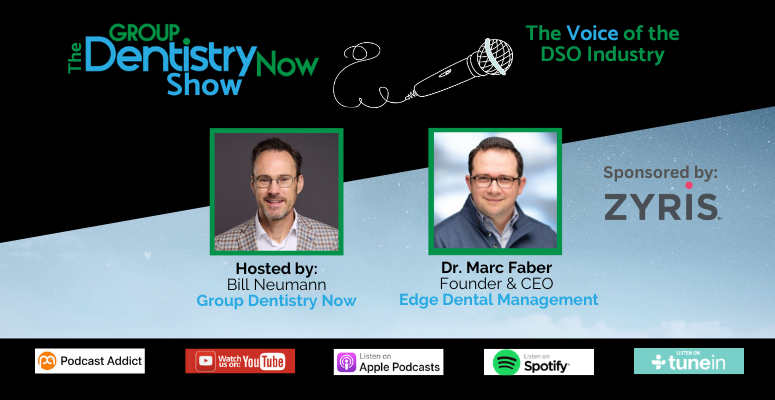
Welcome to The Group Dentistry Now Show: The Voice of the DSO Industry!
Clinical Efficiency as the Great Equalizer: How Edge Dental Management Transforms Underperforming Practices
Dr. Marc Faber, CEO & Founder of Edge Dental Management joins the show for his second appearance. Dr. Faber discusses:
- How Edge leverages clinical efficiency to create successful practices
- NYC’s newest dental school: Yeshiva University College of Dental Medicine
- Using solutions like Isolite for efficiency & patient satisfaction
To learn more about Isolite Systems visit: https://www.zyris.com/
To learn more about Yeshiva Unversity’s 3 year dental education program visit: https://www.dental.yu.edu/
If you’d like to connect with Dr. Marc Faber you can find him on LinkedIn: https://www.linkedin.com/in/marc-faber-a63706196/
Subscribe to our channel for more episodes and stay updated on the latest DSO news, insights, and events!
If you like our podcast, please give us a ⭐⭐⭐⭐⭐ review on iTunes https://apple.co/2Nejsfa and a Thumbs Up on YouTube.
Choose your favorite listening app below and subscribe today so you don’t miss an episode! Full transcript is also provided below. See all of our podcasts HERE.
 |
 |
 |
 |
 |
 |
DSO Podcast Transcript – Clinical Efficiency as the Great Equalizer: How Edge Dental Management Transforms Underperforming Practices
Welcome to the Group Dentistry Now Show, the voice of the DSO industry. Join us as we talk with industry leaders about their challenges, successes, and the future of group dentistry. With over 200 episodes and listeners in over 100 countries, we’re proud to be ranked the number one DSO podcast. For the latest DSO news, analysis and events and to subscribe to our DSO weekly e-newsletter, visit groupdentistrynow.com. We hope you enjoy today’s show.
Zyris (00:40):
My name is Dr. Elaine Bilas. I work for Innovative Dental Design in Maryland. So today you’re going to see I’m treating tooth number 18. There was a fractured distolingual cusp. And as most dentists know, tooth number 18 is my least favorite tooth in the mouth to treat because it is so far back, very difficult access and very difficult isolation. It’s still never easy treating tooth number 18, but isolate makes it much more bearable for me and my office staff. So there are many reasons. First off, isolation. It does an amazing job of keeping the tongue in cheek out of the way. It also helps suction and so anytime I’m doing a core buildup, it also illuminates the field, which is great for illuminating that very dark part of the back of the mouth. So before the isolate, me and my assistant had to be completely engaged on treating that tooth because you have to keep the tongue and cheek completely out of the way.
(01:35):
But now my assistant can actually leave the room if she wants to and I can actually treat that tooth all by myself. And so the Isolite has been a very important tool because the Isolate does all of the assisting for me.
Bill Neumann (01:54):
Hey, everyone. Welcome back to the Group Dentistry Now Show. I’m Bill Neumann and again, always appreciate everybody checking in whether you’re watching us on YouTube or listening to us on Spotify or Apple or wherever you happen to consume our content, we appreciate it. We’re going to talk about clinical efficiency, technology, operations, all sorts of fun stuff. And we’ve got a returning guest to the podcast. We have Dr. Mark Faber. Mark is the founder and CEO of Edge Dental Management. I met Mark, I don’t know, Mark, maybe do you remember the year, but it was eight / 2018 or 2019 maybe in Philadelphia. It’s been a long time.
Dr. Mark Faber (02:41):
2019.
Bill Neumann (02:41):
Yeah. We were at an event, dental event near UPenn, but it was great to meet you. Kim and I had the chance to talk to you and then we’ve been friends ever since and see you at different shows. Don’t see you as much as I’d like, but we had you on episode 83 of our podcast in March of 2022. So four years ago. We’ve got 265 podcasts plus in, so it’s been a while. And then your group was also one of the 2020 emerging dental groups to watch award winners. So that was again, six years ago. So we’ve got a lot of history. You’ve been in the industry for quite a while and I think you’ve got a really unique story. I guess all DSOs are different, but I really like your model and I’d love maybe for you to talk a little bit about your background and then what Edge Dental Management is and how you find practices to acquire.
(03:41):
You look for practices that need a little bit of help or you can kind of command, create efficiencies, fix them up a little bit and make them super performing practices.
Dr. Mark Faber (03:52):
Well, that’s the fun of it now. But just a little bit on my background, I’ve been in business now about 14 years. I bought my first practice in 2012 and since then a lot has happened. I developed a very nice business model and took on a couple of partners. But one of the things that we’ve been able to do, which has been a lot of fun, is really take these underperforming practices and turning them around. And that is what we look for. That is what we buy. We don’t buy big, we buy small, but then we end up having to spend some money to build them out. And a lot of that is a result of the clinical efficiencies that we have.
Bill Neumann (04:39):
And so how many locations do you have currently and can talk a little bit about where they’re located and anything else you want to share?
Dr. Mark Faber (04:49):
Yeah. So right now we’re eight locations. We’re a little bit over 20 doctors, close to 180 employees. We’re in the Hudson Valley of New York, about an hour outside of New York City, but the beginning of upstate New York, I want to confuse with the real upstate. And all our offices are basically 25 minutes from each other, maybe sometimes a little less, sometimes a little more. But we spend a lot of time training our doctors. So the office I’m in right now, this is our headquarters for training. It’s a 13 share office and currently we have five doctors here, maybe six doctors here actually. And we’re watching them and teaching them clinical dentistry.
Bill Neumann (05:38):
And are the docs that you have there, do they tend to be the part of the existing practice or do you pretty much bring in your own doctors to those practices? What does that look like?
Dr. Mark Faber (05:49):
Oh yeah. So when we buy a practice, we usually buy from a doctor who’s close to retirement age or is looking to just get out and we come in there and totally revamp what they’re doing. We look at the production reports and we see what is being done and also what’s not being done from the very simple things of not taking X-rays to not doing periodontals, not diagnosing or doing any type of periodontal therapy, not doing root canals, not doing … We say most doctors do crowns, but not doing extractions and bone grafts and implants. And just by diagnosing what’s there, that’s how we usually grow our practices, but we have to bring in our own doctors that we train and that leads to the similarities between our offices. All of our practitioners are kind of using the same materials, the same systems and the same techniques so everything is kind of standardized and that’s probably one of the biggest reasons for our success.
Bill Neumann (06:53):
Excellent. I’m going to dive deeper into standardization and clinical efficiencies in a second, but you’re a busy man, so not only are you running Edge Dental Management, but you are the founding advisory board chair at a new dental school, which is pretty unique. Yeshiva University College of Dental Medicine, which I learned is the first new dental school in a hundred years in New York City.
Dr. Mark Faber (07:20):
That is correct.
Bill Neumann (07:22):
Tell us about your role there and how you got involved, why you got involved, and then what makes this dental school so unique
Dr. Mark Faber (07:32):
The school reached out to me about four years ago asking about would it make sense to build a dental school and can you help us? I built dental practices, but what do I know about building a dental school? But I reached into the people that I know and I was able to find the right people and put a very cool plan in place. We got Dr. Ed Farkas who’s the dean and he is a very out of the box thinker and he proposed that the school be a three-year school. And with the help of CODA, we were able to get accreditation and guidance. And what makes the school unique is that it’s a three-year program in the heart of New York City on 34th and Broadway across the street from Macy’s. It’s a spectacular location and there’s easy access for staff and easy for doctors and everybody works there and also easy access for patients.
(08:41):
Some of the other schools in New York City are maybe not in the best locations are easy to get to, so this definitely gives it an advantage, but also the three-year program is significant considering the cost of dental education today. Just being able to get out of school a year earlier and one last year of interest, one last year of one more year of working makes such a big difference. So the school is really just starting. Classes just started this past Monday. So today’s the third day of classes. So it’s been definitely a fun ride getting the school up and running. But as Dr. Farkas will always say that our work has now just begun.
Bill Neumann (09:31):
Well, it’s exciting. What’s the size of the first class?
Dr. Mark Faber (09:36):
156 students.
Bill Neumann (09:38):
Okay. So there’s definitely a need, that’s for sure.
Dr. Mark Faber (09:42):
Yeah. And that was kind of what I said to the university four years ago, that if you open a school tomorrow, you will be filled. And this past year, they got on the portal a week before the, what’s it called? The portal closed in February, they got on January 29th. And in that week we got a tremendous amount of applicants, enough to fill multiple classes, but they didn’t think that they were going to have a class for this year and we thought otherwise we were right.
Bill Neumann (10:20):
Excellent. Well, it’s great news. It’s exciting and three years makes a ton of sense. So the costs are just amazing how expensive it is to get your undergrad and then on top of that to become a dentist. So anything in addition?
Dr. Mark Faber (10:37):
Well, in New York, New York is the only state that requires a year of residency also. So even if it’s a three-year program, to get a dental license in the state of New York, you have to go to a hospital program or hospital, an approved program for another year really of education. Again, that is where most doctors that I know, especially New York, learn more in that one year of residency and then their four years of dental school. So I’m just shocked that more states do not require residencies or GPR.
Bill Neumann (11:20):
Yeah. Well, exciting. I’m sure you’ll keep us … You’re active on LinkedIn, so you’ll keep us in the loop as far as what’s going on with Yeshiva And I wish them a lot of luck and it seems like the timing’s right and three years makes a lot of sense given the cost of everything. So let’s kind of move on to clinical efficiency and what you’re doing in your practices. And first off, we appreciate Xyres who are the creators of the Isolate System. We’re going to talk about that solution from time to time during this podcast when we talk about clinical efficiencies and how you use it in your practices and your doctors use it and the hygienists and assistants as well. But let’s talk a little bit about standardization because you say you kind of come in, all the practices are a little bit different.
(12:17):
Doc’s retiring. So you can come in and really create or centralize. You’re kind of doing things hopefully very similarly in each practice. So talk a little bit about what standardization looks like when it comes to clinical workflows. When you go in, what do you do?
Dr. Mark Faber (12:35):
Well, from the beginning, every operatory is the same, same materials in every office. We’re going to make sure, obviously, the practice management software, it should not only be that each room feels the same, but each room between offices feel the same. So if we have a doctor moving or an assistant moving from office to office, they should know where everything is without really having to do much explanation. Things should be in the same spot, simple stuff like that. Then you get to some of the technology and some of the other stuff that we use. For example, we use mouthwatch for taking pictures and we have a heavy emphasis on CEREC. We do a tremendous amount of scanning and milling. That’s again, standard for every one of our offices. We have a mill in every office with centralized design. And then one of the other things that we have to install in every single chair is Isolite.
(13:43):
We use it on every patient. Been using it for about 13 … One of the things I’ve been using for probably longer than anything else at this point, about 13 years or so. And it’s just one of the biggest advantages that we’ve been able to take to use.
Bill Neumann (14:06):
And before we jump onto some other questions, talk a little bit about, if you don’t mind, the Isolite system. It’s a pretty popular system. Most clinicians know about it, not everybody though. So really, I know it helps with a bunch of different things. So you’ve got the ability to give you visibility in that oral cavity. You’ve also got some other … It helps if you maybe, and we’re going to touch on this a little bit more with some of the challenges with staffing. If you don’t have an assistant to help you out, it can help out if you’re doing solo work, if you’re a dentist just doing the work on your own. But can you talk a little bit about maybe some of the use cases for it?
Dr. Mark Faber (14:48):
Yeah, for sure. So first of all, I was introduced to Icelite when I was in residency. They came in and did a lunch and learn. That was the first time I saw it. But first of all, it allows doctors to, like you said, have a clear view to see what they’re doing. It also allows if you do quadrant dentistry because now you have the whole area secluded. My biggest thing is safety. It prevents patients from swallowing things, prevents from hitting their tongue. It just keeps everything in the mouth, not outside the mouth or down their throat. It frees up your dental assistant to attend to your patient, provide better care, to check on other things, to make sure you have everything you need to practice for almost a different type of forhanded dentistry. It also keeps the patient quiet, meaning that there’s less movement, less talking, and you’re able to do your procedures or even more procedures in the same amount of time.
(15:59):
This is one of the reasons why we’re going to most likely be putting this out in the dental school because we feel like it’s a great way for doctors to learn. But at this point in my career and most of the doctors here, they almost cannot work without it. So it’s definitely a really big part of what we do. The other thing it’s really good for is scanning. If you’re going to scan for a crown or a bridge or whatever you can do, it keeps a saliva away. It gives you a dry field. You scan quicker. So these are all little things that I just love about Isolate.
Bill Neumann (16:45):
Well, that’s good to look at Isolate as a technology or a solution. So there’s a lot of technology. Everything’s technology now in dentistry. I guess it’s everywhere, but I think as a clinician or somebody that’s running a DSO, you’re probably inundated with solutions. And so how do you go about evaluating what you might be at a show or you might hear about something. A lot of solutions, you can’t use them all. You probably can’t even take the time to evaluate everything. So what’s the process? When you see something, you’re like, “Hey, this could be interesting.” How do you start that evaluation process? What does that look like?
Dr. Mark Faber (17:26):
Well, as me and my partners are dentists and what comes first is what’s best for the patient. It’s inside out, not outside in. We’re not trying to get things that are necessarily the cheapest. We’re trying to figure out what’s best, give us the best clinical outcome, what’s safest, and then we figure out if we can make money off because if you do the right thing for your patients, everything else kind of works out afterwards. So first thing is, is this good for our patients? Doesn’t have to do anything about money yet. Then we’ll look at, all right, so it’s good for our patients, then how do you use it? Or how do you use it to your advantage? So with isolate it’s pretty easy. Just you’re able to do things faster and you’re able to do things better. So you could get more procedures done in a half an hour or that same procedure that you’d be slotted for a half hour, you can now do in 20 minutes.
(18:34):
The clinical efficiencies I’ve always been saying is the way to combat inflation. It’s the great equalizer. It is just something that if you’re able to do more in less amount of time, you’re always going to win and that has proven us right time and time again.
Bill Neumann (18:56):
Well, I’d love to dive more into that because there’s a lot of groups I think that are focused right now on provider efficiency. Like you said, the goal is patient satisfaction, best patient outcomes, but there are things you can do to be more efficient. So what are some of the tools that you’re using or have found really can help your clinicians be more efficient and do better dentistry?
Dr. Mark Faber (19:21):
Well, I mean, the two biggest ones, again, are Isolate and probably what we’re using with CEREC. The amount of chair time that we’re saving by doing same day crowns is unconscious. It’s crazy. Just think about this. If you’re going to do a crown, take an impression or you do a crown crab, you take a traditional impression, you have to send it to a lab, so you have to make it temporary. Then you have to wait two weeks or a week and a half or however long it takes. In that time, the temporary could pop off. Maybe the patient has to come back to put the temp back on. Then when they come back, you have to take off the temp, remove the cement, and then get the crown in. The amount of time that’s being wasted on this is just, it’s almost ridiculous. I estimated it’s probably 20, I’d say 25 minutes per patient.
(20:20):
So just multiply that by the number of crowns you’re doing per year. That’s much chair time you’re saving, creating more time to see other patients or just do less work or do whatever you want. Couple that with using an isolate and your prep time is even faster. So all these things are ways to create more with less. Am I clear with that with you?
Bill Neumann (20:48):
Yeah. I think the one thing is sometimes you hear about creating efficiencies and everybody’s like, “Oh, you want to do faster dentistry, not better dentistry.” But if you’re providing better dental care, the patients don’t want to be there any longer than they have to be. So you’re actually providing a better patient experience as well. So it’s something that I think is kind of overlooked, but heck, if the patient doesn’t have to come back for one additional visit, you talked about the in- office crowns. I mean, that’s a beautiful thing. So it’s great for the practice itself. You said it’s kind of the great equalizer. I like what you said when you’re trying to combat inflation, efficiency can really help. And we’ve had our share of inflation over the past three, four years.
Dr. Mark Faber (21:33):
We tested this in our Medicaid office, which is where we do our training and this is where it works the best because the margins of Medicaid are not great, but you couple it with efficiencies, now you’ve kind of beaten in the system in a way. Now we’re able to see more patients, do more dentists. We provide better care than probably any other Medicaid office in the country and patients are happy and my providers are happy. It’s a win-win-win.
Bill Neumann (22:07):
So let’s stick to this if creating efficiencies. When you’re going into these practices that you’re looking to acquire or just for anybody in the audience that has a practice or multiple locations, what are the things that you … You talked about Sirec, the in- office milling, creating crowns in office. You talked about using Isolate. What are some other things that you’re like, “Hey, we go in immediately and these are the things that we change to be more efficient.” You talked about changing all- on-one PMS as well, so you set that up ahead of time. Anything else that you do?
Dr. Mark Faber (22:45):
Yeah, I mean, we bring in a little bit of hygiene For example, in New York State, your hygienists are allowed to use laser, we do laser bacterial reduction. Again, that’s a little bit of being able to talk to the patients about the benefits of that. A lot of it is diagnosing and treatment and showing patients what they have. So for example, if you have a patient that’s been in an office for 30 years and doctors never really said anything to them recently, they’ve taken a couple bite wings over the next last couple years, but they never haven’t taken a full mouth series of x-rays or any pictures. And now you come in and you take full amounts of x-rays, you take pictures and you put on a screen in front of them in front of their chair and you show them this tooth with this huge amalgam with cracks in it and tell them, “This tooth really needs a crown.” And they’re going to say, “But the previous doctor didn’t say anything.” Well, look at it.
(23:55):
What do you think? And I don’t say we bat a thousand percent, but we bat high on that where a lot of patients realize that there’s an issue here and they’re going to accept treatment because they know it’s right. But using, I guess the combination of using the camera and putting a screen in front of them and just showing them and even using the words that we now know, I don’t know what was going on before, but what we now know really makes a big difference. But the amount of low hanging fruit in practices like that is really unbelievable.
Bill Neumann (24:28):
So do you have to go through a process of teaching or educating your clinicians and hygienists when it comes to treatment acceptance and how do you present to a patient? I mean, is that something that you work on?
Dr. Mark Faber (24:42):
Oh, 100%. So that’s all we do. As much as teaching how to do the procedures, you have to teach your people how to talk to patients and how to get the team involved. It’s not just the doctor, it’s hygienist too and even the assistant because when the provider’s not in the room, they’re asking the assistant, “Hey, does this doctor know what are you talking about? ” So yeah, it’s all part of the philosophy of how to present, but these are the little things that make a really big difference. When you see a practice, when I look at a practice that’s say it’s doing half a million dollars a year in revenue, which again, most DSOs are not going to look at. I look at that practice and I see the lack of x-rays, the lack of diagnosed period, the lack of root canals, the lack of implants, all these things as opportunities and really that practice that’s doing half a million dollars should be doing closer to 1.5, but no one’s buttoned, but nobody … Well, the DSOs have trouble bringing in the right doctors to turn these practices around.
Bill Neumann (26:00):
Yeah, I think you’re right. I mean, we’ve talked about this before off air. It’s just there’s typically a criteria that most DSOs have for practices and they don’t tend to look at anything a lot of times even under a million and a half in production. So they’re certainly not looking at something that’s a half a million dollars or 750 or even sometimes a million dollars in production.
Dr. Mark Faber (26:25):
Well, they like to buy cashflow and the business that they’re looking at technically doesn’t cash flow yet even though everything is right there underneath, you have to figure out how to extract it and using the clinical efficiencies that we have, we’ve done this now seven times, eight times.
Bill Neumann (26:51):
So let’s talk a little bit about another issue in the industry, touched on inflation causing issues for sure, both for providers, people running businesses, and then also the patients themselves. What about staffing issues? What do you see in New York? What are you kind of experiencing and how do you leverage your clinical efficiencies to maybe offset some of that?
Dr. Mark Faber (27:19):
Fortunately, we haven’t had such issues with staffing. I think it has to do with the way our organization is run. When we come into these new offices, usually within a couple years, we have to move out and build out a much bigger office and people like working in nice places, couple that with treating your staff right and giving them opportunities for growth. We’ve been successful in keeping our staff. We don’t really have trouble finding doctors or even hygienists at this point. So we’re a litle bit blessed because I know we’re not. It’s definitely not the normal because I hear what’s going on out there. It could be the location that I’m in also. So there’s a bunch of things that I guess tie into this, but when you make it easier on the assistance with an isolate, it makes their life easier. If they’re included in the process for making the grounds, it’s a more enjoyable job.
(28:34):
So these are the little, I guess, psychological things that we’ve used that have been very helpful.
Bill Neumann (28:40):
Oh, that’s great. Good for you and probably making some people in the audience jealous that you don’t have issues when it comes to staff.
Dr. Mark Faber (28:48):
No, we definitely have some issues, but nowhere near to the issues that I’ve heard, people can’t find hygienists for three years, some crazy stuff like that. But doctors, I guess I think it’s the location that we’re in. We’re not far out. We’re kind of close to a metropolitan area, so it’s a litle bit of a drive, but from where people live in Jersey, you have a choice. You want to go into Manhattan and sit in all that traffic and it takes an hour and a half to get there or drive an hour and a half upstate or an hour upstate.
Bill Neumann (29:28):
Yeah. Yeah, that’s great. The other location probably has a lot to do with it as well. So as we start to wrap things up here, I’d like to get your … We’re about halfway through the year, I’d love to get your perspective on what you plan for Edge Dental Management for the rest of 2026, just maybe your general thoughts on the industry as a whole and anything you want to finish off with. We appreciate you being on again.
Dr. Mark Faber (29:57):
Yeah. Well, if I remember correctly, I I think we ended off four years ago. I was talking about the convergence of maybe dental and health. We didn’t even touch on AI at that point, but what I found is that if you understand the value of what you’re doing and you’re able to look at patients in the eye and say, “Hey, I could really help you. ” There’s nothing stopping you because patients are going to gravitate toward that kind of competence. Now you have to be able to back it up, but I feel like that’s what we’re trying to teach our doctors to have that kind of confidence so they could either be great to clinicians with us or even out on their own at some point.
(30:55):
Edge is going to continue growing how we’ve always grown by doing what we do and buying the same type of practices and building up the same way. Maybe centralizing and adding some specialty we’ll see, but I don’t think we’re going to go ahead and buy multiple locations. Not going to buy 10 offices in air. It’s not what we do. We like being independent and not being tied down to private equity. I’m sure someone’s going to try to get after us at some point, but as we continue to grow, we’re just having a really good time enjoying what we’re doing and changing lives.
Bill Neumann (31:33):
Well, that’s great. Well, it’s great to have you back on and congratulations on the success and also really excited to follow Yeshiva and what’s going on there. We get through that first class graduating, that’ll be really exciting for you and everybody that’s involved. I’m going to drop your LinkedIn handle in the show notes. If people want to reach out to you, Mark, they can do that. And also thank you again to Xyris. If you’re interested in learning more about the Isolite system, you can go to Xyris, which is spelled Z-Y-R-I-S and at a. Com there, Xyris.com. And we’ll drop that in the show notes too so you can learn more about the Isolite system. Thanks for sponsoring. And Mark, look forward to seeing you at an upcoming show.
Dr. Mark Faber (32:26):
It’s been too long. By the way, I still have that picture of you.
Bill Neumann (32:30):
Okay.
Dr. Mark Faber (32:33):
You’re fine. Yeah, it was a good one. But yeah, no, everybody should, if they’re not using Isolite, get on it. Don’t think twice.
Bill Neumann (32:46):
Awesome. Well, thanks, Mark. Dr. Mark Faber, he is again CEO, founder and CEO of Edge Dental Management. Thank you to Isolate or Zyris and we’ll make sure you’ve got all contact information for both Xyres and then of course Dr. Faber in the show notes. Until next time, this is The Group Dentistry Now Show. Appreciate everybody checking in.
Thank you for joining us today. Don’t forget to subscribe to the podcast to stay up to date on the latest DSO News, insights, and events. Also, subscribe to our DSO weekly e-newsletter at groupdentistrynow.com.