

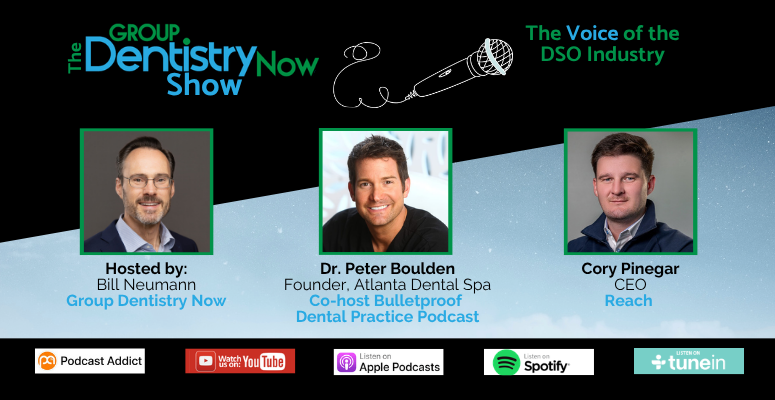
Ranked the #1 DSO Podcast!
Welcome to The Group Dentistry Now Show: The Voice of the DSO Industry!
AI, Systems & Human Capital in Dentistry.
Dr. Peter Boulden, Founder of Bulletproof Dental Practice & Cory Pinegar, CEO & Founder of Reach discuss:
- The 61 AI touchpoints in dentistry
- A systems crisis in dentistry
- Human connection in the AI age
If you are interested in learning more about Reach and their virtual assistant solutions that integrate with AI workflows visit: https://getreach.co/
To learn more about Bulletproof Practice visit: https://www.bulletproofdentalpractice.com/
To register for Bulletproof Summit on August 7th & 8th in Scottsdale, AZ visit: https://www.bulletproofsummit.com/
Subscribe to our channel for more episodes and stay updated on the latest DSO news, insights, and events!
If you like our podcast, please give us a ⭐⭐⭐⭐⭐ review on iTunes https://apple.co/2Nejsfa and a Thumbs Up on YouTube.
Choose your favorite listening app below and subscribe today so you don’t miss an episode! Full transcript is also provided below. See all of our podcasts HERE.
 |
 |
 |
 |
 |
 |
DSO Podcast Transcript – AI, Systems & Human Capital in Dentistry.
Bill Neumann (00:11):
Hey everyone and welcome back to the Group Dentistry Now show. I’m Bill Neumann and we always appreciate you checking in. Another great conversation and as you can imagine, AI is part of the conversation. It seems to be part of the conversation just about every podcast we have had for the past year, year and a half now. So I think we’re going to talk about the impact it’s having on practices, how we absolutely still need that human element, how AI and people work together, how there’s some apprehension. We’re also going to talk about operating systems and practices. I think something that’s really important to discuss. What is a hybrid team? We have Corey Pinneger to talk all about that with us. And actually Corey’s back on the show. I think this is his second or third time. We’ve had him on a couple of webinars as well.
(01:05):
So he’s a regular here at Group Dentistry now. He’s the CEO of Reach and Corey, it’s good to have you back. Thank you. Appreciate it. And I’m really excited to have Dr. Peter Boulden here. This is his first time on our podcast, however, and he’ll let us know how many podcasts he has under his belt because he’s the co-host of Bulletproof Dental Practice Podcast. And I’m looking at his bio right now. I’m not going to do it him justice, but he’s also the founder of Atlanta Dental Spa, eight practices, two bestselling books. And beyond the podcast, you also have a year-long mastermind curriculum with Bulletproof. And then in your spare time, it looks like you also have a Dental Partners AI, which is an AI native DSO. So I’m guessing there isn’t much spare time left, but it’s nice to have you on, Peter.
Dr. Peter Boulden (01:59):
Thank you. Thank you very much.
Bill Neumann (02:02):
So Peter, why don’t we kick things off with you, maybe a little bit more about your background if you don’t mind, and then a little bit about Bulletproof Dental.
Dr. Peter Boulden (02:12):
Yeah. So I think your bio hit it well and I won’t spend too long on that, but essentially I started at one. I graduated 2002, started at one fee-for-service practice, and I’ve grown those to eight over the years, mainly through my love for marketing, my love for the systems. And started a podcast with Craig Spodak, who’s out in Delray, Florida in about 2016. So we’re coming up on our… Well, I guess we are at our 10th year of doing this. There’s been about 450 episodes. Like you mentioned, we have a mastermind, so we coach about 51 dentists in a year-long curriculum. And then we have one summit a year. So it’s kind of good. I have two sides. I have a coaching mentoring program and I get to see a lot of the pulse of dentistry, if you will. And then I have my own ecosystem of operations.
(03:12):
So it’s a good mix. It’s a good mix and very fulfilling all the way around.
Bill Neumann (03:18):
And tell us a little bit about dentalpartners.ai. What is that?
Dr. Peter Boulden (03:23):
Yeah, so that is essentially the amalgamation of all the practices. I have four brands under my eight practices. And so for so many years, honestly, we have been courted and almost sold to a private equity scenario. And every time I get to that situation, it’s just like, this is not for me. I’m probably not going to be a good acquiree. And so look, my love for AI, we’re actually doing an AI summit and such is that, and I know there really isn’t a native AI DSO out there. Granted, it is a little bit bombastic. It’s not that it’s just computers running this DSO, but it’s native first, from a first principles thinking what can be done? And if it can be done now with an operation standpoint, we are deploying that in our ecosystem. So you compare and contrast, you look at the spectrum of dentistry right now, it’s some dental offices look like they might have a fax machine and others are kind of gearing towards the AI native standpoint or bringing on hybrid employees like Corey.
(04:34):
That is, in my opinion, the future of where the puck is going in dentistry. So it’s really just the Dental Partners AI was born out of an excitement for where the industry is going. And I think it’s good stuff all around for dentistry, especially with AI.
Cory Pinegar (04:55):
I’m so intrigued. And Peter, you and I haven’t chatted in a minute. What have you found as you’re building natively with AI of areas? Because there’s a bunch of studies from MIT and a bunch of things where people are token maxing and rolling out initiatives and it’s not working. There’s areas where you’re seeing a creative value too. What have you found, whether it be co-working or different agents? What is working from that kind of core first principles native perspective right now?
Dr. Peter Boulden (05:28):
Yeah. So I would say, Corey, to your point, there are some things that are clunky and I think it’s because we still have to pay atention to HIPAA compliance. We have to make sure that there’s good security around there. And so you can’t just let an agent into your PMS and be like, “Okay, go for it. Make me a bunch of money, make me busy, make me all the things.” You can’t do that. So the best processes on our end have come from a sub-agent standpoint, meaning that using from a CFO perspective, let’s just use that. Inbound and outbound feedback from an agent that is basically saying, “Hey, I’m seeing a trend line occurring here.” Through basically having all the P&Ls, all the practice data that’s loaded outside of the PMS, it’s this instant feedback. So I’m building that corpus of data there. Denials, insurance denials and things like that.
(06:29):
We’re building specialized agents, I guess, Corey. I wrote a long paper and I haven’t published it, but essentially I broke down there’s 61 processes in dentistry that really can and should be and probably will be touched by AI. And so it’s pretty granular in that.
(06:53):
But I think, Corey, where you’re going is you’re intrigued by this question because you’re basically saying it is not the silver bullet. And I would agree with you. I think it’s still early.
Cory Pinegar (07:06):
No, actually I was first interested in learning because
(07:12):
Where we’re at today in six months, I mean, at the beginning of the year, everybody was talking about open claw venue, Anthropic has grown heavily onto the scene. I was genuinely curious from where are you getting value? We obviously know Henry Ford invented the first kind of factory car line 100 years ago. Does Ford still have people in their factory? Yes. But I was curious on where are you getting value from it? Because a lot of people are deploying right now and they’re hitting and missing in different areas. And I just find it intriguing to learn from people on what’s working and what’s not.
Dr. Peter Boulden (07:49):
Yeah. So I’m having good luck, Corey, with kind of, I’m going to use the word agent probably too many times in this call, but I think that’s just I like the specificity of something as opposed to being like, “Hey, OpenCloud, just run my dental practice.” I like to control things and put them in silos and stuff. So from a marketing perspective, running autonomous processes there, website updates, SEO, LLM, GO, all the things, even ad management. So that’s working. But honestly, there are some processes that my software does really well natively, meaning I use CareStack and they are very, very AI heavy down the road. Their pipeline, their roadmap is very… So a lot of the proceses that I’ve tried to do are being done now. And that’s kind of the best case scenario because it’s inside that database. I mean, honestly, there’s so many things we could talk about right here.
(08:51):
But Claude, I think, being the front runner and in the frontier model, I should say, I’m using it more and more, especially from Claude Code perspective because it can run without direction. It doesn’t need my feedback every 30 seconds. So I’m having fun with things like that.
Cory Pinegar (09:11):
So this is totally unscripted and unplanned, but what we’ve been doing for the first six months of the year and on the 1st of July we launch it is we have licensed Claude for all of our frontline team members and we’ve built projects with all of our native training data and insights where then you can go upload a denied claim and it can tell you what exactly needs to be adjusted based on the insurance, where the letter needs to be sent. You can upload an MP3
Dr. Peter Boulden (09:42):
Of a claim. So you’re doing this
Cory Pinegar (09:45):
Coaching feedback.
Dr. Peter Boulden (09:46):
You’re doing this on the reach side, meaning you’ve created your own corpus of data that is then your own privatized LLM, if you will, right? Is that what I’m saying? Yes. So it’s helping. Okay. So this is great. What are you using interoffice communication or inter… Are you using Slack?
Cory Pinegar (10:07):
When our people are talking in – house.
Dr. Peter Boulden (10:09):
Communicating together.
Cory Pinegar (10:11):
I hate to admit it, but we use Microsoft Teams a machine.
Dr. Peter Boulden (10:14):
Well, the reason I was asking is because now there’s actually Claude tags, which you can actually just tag it using so you can loop it into the conversation, the solution. It’s really, really fascinating. We use Slack in our interoffice communication and I was really excited to see that. So I’m really kind of playing around with it there, but it can jump in as the “employee,” which it’s exciting.
(10:41):
So the space is just ever-evolving. And I think you have to be careful. Ironically, I jumped on that open claw train for a few moments and then I was like, “I see this as just being a shiny object right now.” And I was kind of a little bit right in that. Now there’s Ermi’s agents and things like that, but it’s sketchy when you get on some of these models and they have no guardrails, no off button. And sometimes you don’t know what the repercussions will be. And you can’t really mess around with that when it comes to your patient database or your practice. It’s not the place for experimentation. And I have heard horror stories already of people who have just let things go like, “Oh, just have full access to it. ” I’m like, “A, I think that’s against the law. And B, you’re probably asking for
Bill Neumann (11:37):
Trouble.” Yeah, absolutely. I love this. Bill’s coming to bring us back in. No, this is great. You could just turn my camera off and I’m just going to listen and learn. This is perfect. But I think it’s a great way to start things off because one of the topics we wanted to hit on, we talked the power of systems and a dental practice. And Dr. Bolden, you said there were, would you say it was about 61 or 60 some odd processes that you feel AI can be helpful with?
Dr. Peter Boulden (12:09):
Well, I think if we’re going to get into systems, this is actually, so on the Sunday of our summit, which Corey will be at with his company, and we are big fans of Reach at Bulletproof. A lot of my masterminders use them. But anyway, at the summit, we were having a workshop and the workshop that I’m hosting and running is an AI workshop. And essentially, Bill, the thesis behind it is yes, to teach all the tricks and tips, but what people forget is that you still have to have systems, meaning there is no easy button for that. And so what I mentioned earlier was not the 61 systems. It was actually just the places that there could be disintermediation by an agent. Now, for example, we have hundreds and hundreds of systems in my ecosystem.
(13:07):
And we actually host those on a repository called Trainual because it’s just easy to create accountability. And ironically, everyone in dentistry talks about systems. It’s funny, people throw that term around so flippantly like, “Yeah, I’ve got a system.” And I’m not sure most people know what the heck that is, to be honest. Because I actually just quizzed my mastermind. I do a weekly call with a lot of them. So there are about 30 dentists on there. And I was basically like, “Okay, what are y’all using as your deployment? You’re not using manuals anymore. No one’s using manuals, office manuals and things like that for systems. So what are you using as your reference point to tell your employees?” And you know what the overwhelming response was? What would you guess?
Bill Neumann (13:57):
Gosh, I don’t know. Corey, any guess? So were there not manuals anymore?
Cory Pinegar (14:02):
Nothing or Excel files or Word documents, but I mean we onboard a decent number of practices every single month and the lack of documentation beyond simple paperwork that is hard to find or not commonly known as consistent.
Dr. Peter Boulden (14:18):
So this herein lies the problem in dentistry. There’s so many ways, so many things I could go talk about right now. But here in lies, the problem is that everyone agrees that the office manual is outdated and done for. Dentists, we get this badge of honor around us with like, oh look, I created this office manual and it goes up on a shelf. And guess who looks at that? Nobody. Never. Ever. And so by about the time we’ve done finished it, it’s outdated. So it has to be an evergreen repository, honestly, that you’re continually acting on. You’re creating new systems all the time, you’re iterating on them, you’re modifying them. You’re maybe incorporating AI into some of them. But Corey, you nailed it. The overwhelming majority was it lives with a person on my team. That’s an existential threat right there. It lives in Google Docs or a spreadsheet.
(15:24):
So imagine the friction that comes from that. When you had a quote unquote system for an employee, do they know? They knock three times on the Google door and find the document and go through this and look through that and find the thing? No. So I would say that 90% of dental offices are operating in the absence of systems.
Cory Pinegar (15:49):
Here’s what I think’s interesting because most people then say you have the manual.
Dr. Peter Boulden (15:56):
That’s not a system.
Cory Pinegar (15:58):
No, but here’s what I’m even going… Let’s even say you have a live document. A system is only a system if it’s followed. Just like if you play the game of basketball, you run the triangle offense. It’s not that you have a playbook. It’s you live and breathe it every day. And so what I think is interesting when you really study change management is, okay, you deploy the playbook. Number one, people should be continuously learning, but then the system is returned to and reemphasized and coached and lived around weekly. And that’s where the systems become plays and the plays become points and people know where to stand and shoot. If you just have a piece of paper and nobody returns to it, does jack shit.
Dr. Peter Boulden (16:44):
I agree. Corey, the interesting thing is most employees don’t know what success looks like in their office. They get inadequate training. They don’t know what a touchdown looks like in their office. They don’t know if it’s doing a good job, doing a bad job. Because there’s been no methodology proposed of here’s the scaffolding of what you should do. And if you’re directionally correct, that’s way better than just going rogue, which most people do. They just figure it out and go rogue and then they create their own system. So that’s not scalable. And that’s what I always tell people. Most dentists who come to me, they’re looking to go multi-location or scale their operations or back out of dentistry. And it’s literally impossible without some kind of system. The other thing I’ll say to that is if you can’t train an employee through systems, then you sure as hell are not going to be able to train an AI.
(17:44):
So there will be no easy button. Oh, Claude, just let me Claude, make my systems button. It will make you some, but they will be atrocious because they will have no context of your office.
Cory Pinegar (17:57):
That’s actually fascinating. I haven’t thought about that kind of second tier. If you can’t do it here well, you’re going to have a road bar there. Well,
Dr. Peter Boulden (18:03):
It’s a skill. If you look at Claude’s skills, Corey, I know you know it pretty well, the platform. So skills are essentially just SOPs for a computer to follow. And so it’s the same kind of logic. First do this, then do this, then do this. Or here’s a script to answer the phone. You don’t have to memorize the script, but directionally, here’s how we answer the phone at ABC Dental. Not, hey, just figure it out. We’re overwhelmed. Just figure it out. Which is what most people do. Just figure it out. Just watch me. So I don’t know. It’s a lot. And dentistry is a very, very hard job. There are a lot of processes going on, which is Corey, I think probably the spirit of why you started REACH.
Cory Pinegar (19:02):
I think you go to school thinking you’re going to clinically practice every single day and then you realize running a business is a full-time job within itself and not just keeping the finances afloat and paying down your debts, building systems, building processes, enabling your team, having hard conversations, hiring and firing. And if you can pull back a few of those and drive more consistency, people can focus on what they went to school for and do what they’re passionate about without feeling like they’re doing it engulfed in their own dumpster fire.
Dr. Peter Boulden (19:36):
Right. Well, without systems, and I suffered from this too, going back to the dumpster fire. We’ve all been in periods where we have been on fire and I sure as heck have had many years like that where I call it in Bulletproof, I call it the nucleus of everything. And so throughout the day, we are exhausted and burned out when we go home, not from the dentistry that we’re doing, but it’s the thousands of decisions that had to run through them. So think of the cell going back to biology and everything has in the past this nucleus. And when you have to give the answer for where’s the copy paper and how do I fix this? And you’re the doctor, you should know everything. Yo go home exhausted and you can’t say I don’t know to anybody because you’re the doctor. And so this is where the strain happens in dentistry.
(20:23):
This is where we see the burnout. The burnout typically isn’t from, hey, I’m tired of doing crown preps. Sorry, I feel like I’m just going off on these tributaries.
Bill Neumann (20:40):
Now I’ve added more questions. I think there’s a lot of really good points here. And so we started off with AI. And I’m curious from both your standpoints, because you’re both working with a lot of different groups, solo practices and probably all different shapes and sizes. How are they embracing AI? Is it something that they’re interested in using? Have they tried it? Has it worked? Have backed off? A combination of all the above? Because everybody, we’re inundated with it in our personal lives, in business, all these AI solutions. Yo go to a dental show now and 75% of the vendors are something AI and a lot of them are sort of doing the same thing, but it’s hard to even figure out what they’re doing. And so that can be a full-time job just sifting through besides Claudes and the ChatGPTs of the world, these AI-infused or AI platforms.
(21:45):
So I’m really curious, maybe Pete, we can start with you. What are some of your mastermind people saying when it comes to AI?
Dr. Peter Boulden (21:54):
Well, most of them are using it, and I say they’re using it with party tricks, meaning they’re using it just like they would use Google as an answer engine. Only about 1% of the population is probably using AI in the agentic layer, which is your reverse prompting, meaning you’re just defining the outcome of what you want as opposed to, “Hey, ChatGPT, how many quartz are in a gallon?” Which is what most people are doing. I would say 95% of people are doing that. So prior to my mastermind, I do train a lot of my dentists in AI and how to deploy this in their life and their practice. But I would say prior to my education, they were using it just like I told you, just as like a party trick. Like, oh, look at this. Look how smart it is. They weren’t making their life easier, better, or faster.
(22:50):
But now I have dentists who are vibe coding. I have them who are transcribing. I have them who are making their own learning modules and softwares. It’s really, really cool. And that’s what I think it takes, honestly. There has to be an inflection point where you connect the dots in your life and you’re like, “Oh, this is what people mean.” Hence, that’s why I wanted to have a summit, an all – day summit where people could leave feeling like they were an expert because it doesn’t take long to become an expert, quite honestly. It just takes you sitting down and learning some best tips and tricks. It’s not like we have to learn coding anymore. No one has to learn how to code computers or coding language or anything like that. You just have to be able to talk and what tools to use and what outcome you want and be strategic and then iterate and iterate again.
(23:40):
That’s really as hard as AI is. But so many people are intimidated by going to a whole different layer so they stay at that answer engine layer.
Cory Pinegar (23:51):
Well, I mean, let’s even go back. For the last 20 plus years we’ve lived and breathed on Google and Google is bred on the ground of best cheeseburger near me. We now live in a world where to write a prompt really takes four different categories, but we grew up in a world of SEO where you wanted to say as few words as possible to get the outcome you needed. I’m sure, Peter, you use WhisperFlow or some of these other dictation tools. You actually do better with AI if you just vomit all of your thoughts.
Dr. Peter Boulden (24:22):
More context. Because the contact windows are so big now. That’s what I think you’re saying, Corey, is it used to be that you had to be succinct, but now it’s like you have million word context windows. So the more vomit you give it, these things are so smart they can be like, “I think I know what he’s saying. I think I know what she’s saying here.” And so agreed with what you just said. The context windows are so much better.
Cory Pinegar (24:45):
So where we’ve actually seen the biggest change in our own organization, every day we have a report that goes out to our executive team that summarizes the number of chats and conversations our team members had on average. And where we’ve actually seen the biggest lift isn’t by deploying more projects or adding more context or deploying more SOPs. That has been great. It’s actually by hiring a few AI enablement coaches. And so we have people who have quad licenses, but then for an hour a month, you sit down with a coach and they say, “Where do you feel like you’re wasting your time or where are you not enjoying putting your time? I hate pulling these numbers on a Monday morning to send out this report to blah, blah and blah.” Well, guess what? That enablement person then shows them, “Well, here’s what you can do.
(25:40):
” And once you solve a pain, you go, “Well, if I could do this, I could do that. ” And the problem is people are just slapping AI workflows on it when really a lot of the core issue is rewriting the user, the good people behind it on here’s how you prompt engineer, here’s what you can solve. And once people become enabled, you don’t even need all of these fancy workflows to start. You need people who are embracing it and understanding how to write a proper prompt, how to put together the outcomes that they want. And we’ve seen the biggest lift on actually driving value, not driving utilization, but more solutions, insurance verification, scheduled calls, more claims submitted, more claims paid timely by actually focusing on enabling people to use the tool by solving their own pain.
Dr. Peter Boulden (26:33):
I love that. You know what this reminds me of is I use a term in Bulletproof all the time is like where the rubber meets the road. Fancy, shiny objects are great. But if they don’t do something to create leverage in your practice, time, money, or emotion, then it’s just a fancy shiny object. So this is why I get mad when people get enamored with KPIs because these down dashboards come up, Corey, as you know, and it’s all, “Ooh, look at the thousand metrics that I can track now.” But here’s the problem. A, you don’t know what the supporting evidence that was there to make those the KPIs. Then you don’t know if the KPI is good or bad. And then lastly, if it goes wrong, do you really know how to reverse engineer the outcome to change it? And so what I love what you did in your own environment is you took something that was hated and instead of people having to go…
(27:42):
I say push versus pull. Instead of people having to go pull, pull that data and find this and find this report and oh man, you had an AI push it to your people, push it to you, giving you that information. So it’s a push versus pull. And one has sustainability in that aspect. The push. When things are pushed to you, they’re usually, “Okay, I’ll read this and ingest it. ” But when you have to go harvest that data and look around and count this and count that, not going to happen, not going to happen. So I know I just talked about two different things, but I’m trying to ram as much in this podcast as possible.
Cory Pinegar (28:19):
But I think you’re going at something interesting here where also AI is sold in the world of a full solution or elimination of humans. What if you could go back and say humans are the core. What’s the difference between AI slop and AI gold is the people that are writing and engineering the agentic structure, the prompt, the project, whatever it might be. So if you base layer with good people that are trained and educated and enabled on how they do, you’re selling steroids to someone who goes to the gym. And because of that, they feel enabled because instead of worried about AI taking their job, they’re actually finding that, “Okay, I was good before and two times one is two. But then what if I can use these projects and agentic workflows? Well, two times three is six.” And you’re going with it from the base layer of enabling people where people want to embrace it because they can provide more value instead of you’re going from the elimination and fear perspective.
(29:23):
We as an organization are really thinking about human-led support accelerated or amplified by AI. Because at the end of the day, if we can take someone scoring 10 points a game and use better technology training in AI to help them score 15 points a game, the practice has more peace of mind, more values brought, and people can earn more money across the board.
Dr. Peter Boulden (29:50):
I couldn’t agree with you more on that. And you hear this in AI and maybe to reduce employees or do that. And I can tell And I actually wrote this in our book. We just published that book called The Patient Experience. And I think dentistry going forward, the great differentiator of practices, whether that’s group or whatever, is going to be how people feel. Because in this age where we’re getting so tech heavy, people are still craving intimacy. They’re still craving relationships. We’re getting more and more. It reminds you of COVID. People just started craving a human touch. So I always say, let humans do human stuff and let computers do computer things. And really, I mean, that’s kind of the thing. It’s not to get rid of jobs, but it’s really to enhance the experience of dentistry for people. Because so many times you go in, it’s like, oh, we’re so busy with this insurance claim and our hair’s on fire and this clipboard and that clipboard, this payment, this payment.
(30:59):
As opposed to focusing on Mrs. Jones that just came in for her first time in 10 years. And she’s nervous about her dental appointment and she really wants to have a good experience because the last one she had was bad and it was a dirty office or it was a bad experience or the dentist was mean or people seem busy or not concerned. Now we can focus on the core aspect of dentistry, which I’m happy about. So AI is not in my office to reduce jobs or payroll. It’s to let us become more empathetic, more caring, more experiential.
Cory Pinegar (31:36):
But look at the data. We spend a ton of money on Facebook ads. What’s our best performing ad? It’s one that I filmed in my courtyard walking around with my phone on the FaceTime. We have a $40,000 camera our two videographers have. And our best performing stuff is authentic, is human connected. And so that connection will always exist. I fully agree. Let’s get out of the mud and let’s focus on connecting with people. The second thing is there’s three interesting metrics. 32% of all phone calls are missed. 56% of all Recare patients have never been reached out to. And $2.4 million of unscheduled treatment sits in the average practice. Those are real empathetic conversations that have not taken place because people are so overwhelmed in theo busy. So if we buy back time, we can call Mrs. Jones and say, “Hey, we know you are really worried about that root canal and you canceled.
(32:33):
Can I help you understand some things? Or Dr. Pinniger is really worried and so we want to reschedule you. ”
Dr. Peter Boulden (32:39):
Yeah. Or, “We haven’t seen you in 12 months. Are you okay? I just wanted to reach out and see what you’re doing.” I couldn’t agree with you more Gori. And I see this. I’ve had the benefit of, you see the benefit of data of practices. I actually see it from the coaching side. So I’ve coached hundreds of practices and I’d see this being a pervasive problem. We are overwhelmed. Therefore our recall, our recare, our recapture, our reappoints, all these things are suffering because we’re busy.
Cory Pinegar (33:13):
And technology has got radically better over the last 15 years. There’s text messages, there’s birthdays reminders, there’s online scheduling. The amount of missed calls has been consistent for the last 15 years. And so though we’ve deployed a lot of new stuff, we’ve not actually solved the core problem of building relationships with our patients on site and following up with the conversations and picking up the phone when it matters. And so this is our first chance of really beginning to buy time back in a way where the team can actually focus. And for 15 years, we’ve layered more onto the cake, but we’ve actually not solved the core problem of being able to capture and maximize patient opportunity.
Dr. Peter Boulden (34:01):
So Corey, you’re going to like this story I’m about to tell you because it is supportive of what you do. So when I want to use just a quick agent, I use a software called Manis. I don’t know if you’ve heard of Mannis. Basically I was looking, I was like, “Hey, do some research. Look for the best hairstyles. This is what I want in my town, blah, blah, blah, blah, blah. Get back to me. ” So it came back and it said, “Hey, here’s the barber, here’s the stylist, whatever, five star reviewed X, Y, and Z. They’re right around the corner from you. ” And I was like, “Awesome.” And then it popped up. “Would you like me to call and schedule the appointment for you? “And I paused and I said,” Here it is. That thing that Google promised that everyone would have their own agent.
(34:51):
Google announced this at 2022 at their IO conference and they gave a demo and there was massive latency in their demo. You could tell it was a computer, but this is coming for consumers. And so here’s where I’m going with this. If you don’t have a robust team answering phones, you are about to get inundated in the next 12 months by people’s agents that are going to be doing outreach because how easy is it for an agent to do outreach for you on a phone call? So you’re going to have, instead of us thinking like, oh, it’s the dental receptionist that I may need to get AI for, I want you to flip that and say, no, no, no, it’s actually going to be the consumer is going to start having an agentic layer that’s going to be reaching out. How much is your pano?
(35:40):
How much is this? And they’re going to asking questions as a proxy for all these patients and there’s minimal cost. So we’re going to get 10X the amount of calls. So you better be able to scale using, like you could call Corey, you better be able to scale your employees for this inbound. And this was something I though about the other day because we’ve been thinking like, oh, AI receptionist from the dental side. And I was like, wait a second. How am I going to fight fire with fire? If I start getting agentic calls, what is this going to do to my team? And luckily I had an answer, but it’s just something to think about. And I don’t know if the two of you have thought about that from how this changes the dynamic of commerce locally is what I’m trying to say.
Bill Neumann (36:33):
Well, I want to take over here for a second, Corey. This has been great.
Cory Pinegar (36:37):
Peter, we’re getting… Hey, Peter, come on. We’re getting… Bill’s walked in and said, none of our pre-agenda points have been touched at all.
Dr. Peter Boulden (36:44):
Bill’s like, who is this guy? Yeah. How many Red Bulls did he have before he got on this call?
Bill Neumann (36:52):
I love it. This is the least I’ve spoken on a podcast ever and it’s wonderful. So I wanted to make sure that we touched on Corey. We talked a lot about your team, but we didn’t really talk about exactly what your team is doing. I know we talked about them leveraging AI, but we talk about virtual assistants. And Peter, you touched on this. It’s like, hey, we’re not necessarily… We have AI and I think virtual assistants would be the same thing. We’re freeing up time for the doctor and for the staff to do other things which are patient facing. And I think Corey, you may have said this before where it’s like we want our virtual assistants and AI to touch anything really that’s not patient facing. So when you think about it, it’s more in the back office. It’s the things that the patients, they don’t need.
(37:49):
The virtual assistant’s not going to take the patient back and make sure that all their questions are answered before they sit in a chair. They’re not going to do the dentistry, but there are a lot of things that both AI and I think your virtual assistants can do. So can you talk a little bit about your team and what they’re really good at?
Cory Pinegar (38:08):
Yeah. So to kind of double down on what you said, the theory of what we do is things that does not require in – person interaction. What are the main roles that we fill? Scheduling, new patients, existing patients, re-care calls, unscheduled treatment calls. Next is insurance verifications. There are pieces of information AI cannot scrape by going into the portal. There is just a lot of manual work. And instead of being the person who walks into the practice and gets the, “Hey, give me one second,” from the super kind person at the front end stuck with Delta Dental on the phone, we can buy that time back to give the experience Peter’s talking about. And third is revenue cycle management, submitting claims timely, submitting them accurately so that your practice gets paid the maximum amount of dollars it’s owed in the quickest manner possible. And then all of the other business admin functions, collecting of receipts and invoices to go to accounting, maybe the posting of social media.
(39:15):
But in the practice, it should all be about delivering clinical experience that is world-class and delivering real relationships with the people you’re in front of. We help buy the time back with also not letting that slip off to the wayside because we know if you call someone on a Google listing and they don’t pick up, you call the next one. And so the dividing and conquering of the tasks allows for better experience on both sides and people to actually be focused and experts in those individual areas.
Bill Neumann (39:53):
Well, I’ve got maybe about five more minutes left here. So it was actually a great
Cory Pinegar (39:59):
Idea. Don’t give it back to Peter and I. Don’t give it back to Peter and I.
Bill Neumann (40:04):
I’m going to hand some of this back to you guys. So we’ve got a bunch of events that are coming up. It seems like when you get to the summertime, it gets a little quiet and then all of a sudden we’re into the fall and there’s a lot going on. And so what I want to start off with, I mean, we’ve got Dykema coming up. Actually, by the time this is out, Dykema will have already passed. But people have probably already seen you there, Corey and your team at the Daikema event. Let’s talk about the Bulletproof Summit because that’ll be coming up too. That’s August 7th and 8th in Scottsdale. And Peter, that’s you and your team putting that on. And then Corey will be there supporting that as well. Can you talk a little bit about, is that where you’re going to be doing this AI workshop?
Dr. Peter Boulden (40:53):
On Sunday, yeah. So typically the Bulletproof Summit for the past nine years has been a two-day event and it’s still going to be a two-day event. But this time due to there being such specificity with what I wanted to teach about it, I was like, it really deserves a six-hour kind of workshop. So it’s going to be on that Sunday. So the Bulletproof Summit is going to be August 7th and 8th, and then the workshop will be on the 9th. Additionally, we’re having deeper workshops. We have a hygiene workshop and then we have an office manager workshop. So there’s multiple tracks for that quote unquote workshop day. So yes.
Cory Pinegar (41:31):
And I’m going to pipe in here, surprising. I have been in this industry for nearly 10 years and I want to give Peter his flowers, though I actually don’t want to give Peter his flowers, that they’ve built something really unique at Bulletproof, which is a community of like – minded peers pushing towards common goals. And I think one of the accelerants of success and even de – stressors in the very lonely world of being a dental practice owner and operator is having a community of like – minded people where you can say, “Hey, just as when we started today, hey Peter, what are you doing with AI that’s actually working? Oh, great. Well, I’m going to go put that playbook into it. What’s your SOP for this? Or how have you handled this type of scenario before?” And there’s a lot of events out there today. They’ve built truly a unique community.
Dr. Peter Boulden (42:23):
Yeah. Thank you for that. And really the flowers weren’t for me because like you just said, it’s really the community that’s done something. And I think so many dentists function from this place of a lone wolf syndrome, I call it, because I did. You can’t confide in anybody. You can’t confide in your colleagues for fear that they’ll weaponize that against you locally. You can’t go tell your team there’s problems. Can’t go home and tell your wife or your husband there’s problems because you’re not supposed to have those things. So you just kind of live in this lone wolf scenario. So when you have a community that authentically is pulling for you and supporting you and giving you the best practices of what they’re doing very transparently because they’re not competing with you and supporting you, it’s amazing. So the mastermind is evidenced of that. It’s really a super supportive community and it’s probably one of the biggest joys of my life.
(43:14):
But Corey, to your point about the community at the summit, we really encourage doctors to bring their team because if I’ve learned anything in my 25 years of being a dentist or being a practice owner, it’s that the team is the biggest leverage. And so we get people to bring their team to help create some systems there, to create alignment there, to create some vision there, to create boots on the ground. When the rubber meets the road Monday morning, what are we going to do? And so it changes the trajectory of people’s practices in just one weekend.
Bill Neumann (43:48):
Well, if you want to learn more about the Summit or Mastermind or just even check out the podcast, it’s pretty easy. It’s bulletproofdentalpractice.com. We’ll put that URL in the show notes and all the contact information is there if you want to learn more again about the Summit. Or actually, if you want to read his books as well, his links there. And Corey will be there in Scottsdale, August 7th and 8th.
Dr. Peter Boulden (44:19):
Corey’s doing a big speaking gig there. Are
Bill Neumann (44:22):
You? Oh, Corey looks prized. He’s
Dr. Peter Boulden (44:26):
Like news to me. Well, the reason is so many of my masterminders use his company and we love it as our Bulletproof community. It fits into our ethos so well. So we love it. We love it.
Bill Neumann (44:40):
Excellent. And if you want to learn more about what Corey and his virtual assistants do, you can go to getreach.co, getreach.co. We’ll drop that URL in the show notes as well. And apreciate the conversation. I tell you, I started things off with we’re going to talk about AI like we always talk about AI, but we really talked about AI more so than ever. So I think – We
Dr. Peter Boulden (45:06):
Just scratched the surface.
Bill Neumann (45:08):
So I think if you get the opportunity, you should really find time to go out to Scottsdale and then get knee deep in AI on that Sunday.
Dr. Peter Boulden (45:17):
Come nerd
Bill Neumann (45:18):
Out. All right. Sounds good. Well, thank you Dr. Bolden and Corey. Great to see you again. And thank you everybody for watching the podcast until next time, this is The Group Dentistry Now Show.