


Sponsored Content
For much of the last decade, success in the DSO market was frequently measured by scale: more practices, more providers, more revenue and, ultimately, a larger transaction. As the industry starts to turn toward 2027, that definition is changing. The next generation of successful DSOs will still grow, but growth alone will not be enough. Enterprise value will increasingly be created by organizations that can demonstrate operating discipline, doctor alignment, capital efficiency, regulatory readiness, and an ability to use technology and data to improve performance at the practice level.
That was one of the central conclusions from Chapter One of The Intelligent DSO, a recent operator-led discussion among DSO executives and senior industry leaders. The message was straightforward: “Build a sustainable going concern, not a company that needs to sell.” For DSO leadership teams planning for 2027, that requires a different operating playbook.
Growth Must Produce a Better Business
The DSO market is not abandoning consolidation. What is changing is the tolerance for growth that does not translate into stronger underlying economics. Acquisitions, affiliations and de novos can all create value, but each requires different organizational capabilities, and successful DSOs will increasingly have to understand which model they execute particularly well and concentrate resources around that model. A company that is exceptional at integrating acquired practices should not automatically assume it will be equally successful developing de novos, and likewise a relationship-driven affiliation strategy may produce better returns for one organization than an aggressive acquisition strategy does for another. The discipline required in 2027 will therefore be as much about what a DSO chooses not to pursue as what it pursues.
Management teams should be asking which growth channels are truly repeatable, where the organization consistently creates value, and where resources are being consumed without generating sufficient returns. Perhaps most importantly, is growth improving the quality of EBITDA, same-store performance and provider productivity? Scale without repeatability can increase organizational complexity faster than it increases enterprise value.
Doctor Alignment Must Become a Board-Level Metric
Dentistry remains fundamentally different from many industries that have undergone consolidation because the provider is central to both the clinical product and the economic engine of the business. A DSO can centralize finance, marketing, procurement, technology, recruiting, revenue cycle management and administrative functions, but it cannot centralize away the importance of the doctor. In 2027, doctor retention, engagement and productivity should increasingly be viewed as enterprise-value metrics rather than simply human-resource measures, and leadership teams should understand not only whether doctors are staying, but whether they are engaged with the organization’s clinical and operating strategy. That distinction becomes particularly important when introducing new technology, integrating acquisitions, changing operating processes or preparing for a transaction.
Clinical autonomy also remains critical. Technology and corporate infrastructure should enable doctors to practice more effectively rather than create the perception that corporate management is directing clinical judgment. The strongest DSOs will maintain local clinical trust while providing enterprise-level resources underneath the practice. Doctor alignment is enterprise value.
Capital Optionality Will Matter More Than Exit Timing
A well-run DSO should be able to attract capital without being dependent upon it, and that distinction may become increasingly important in 2027. Capital markets move in cycles: private equity appetite changes, lending standards change, and valuation multiples change. Management cannot control those cycles, but it can control whether the company has enough financial flexibility to avoid being forced into a transaction at the wrong time.
The strongest DSOs will maintain multiple strategic options: continue operating, recapitalize, acquire, raise growth capital or pursue a strategic transaction when conditions are favorable. That means CFOs and boards should pay particular attention to leverage, liquidity, debt maturities and the quality of EBITDA. A company that must sell is negotiating from a very different position than a company that could sell; optionality itself becomes an asset.
Technology Strategy Is Becoming Capital Strategy
The dental technology cycle is accelerating. AI-enabled diagnostics, digital imaging, intraoral scanners, chairside workflows and other clinical technologies can improve patient experience and provider productivity, but purchasing technology is only the beginning. The more important question is whether providers will actually use it. The Intelligent DSO discussion highlighted an important distinction for 2027: technology adoption is increasingly a clinical leadership challenge, not simply a capital budgeting decision. AI, for example, may gain significantly more provider acceptance when positioned as clinical validation rather than clinical replacement, and the same principle applies across technology categories.
Before making a platform-wide investment, DSOs should ask whether doctors will adopt it, whether it can improve the patient experience, whether it improves provider productivity or practice economics, how adoption will be measured, and what the expected return is. Technology without an adoption strategy can quickly become expensive infrastructure.
DSOs Should Reconsider Whether They Need to Own Every Piece of Technology
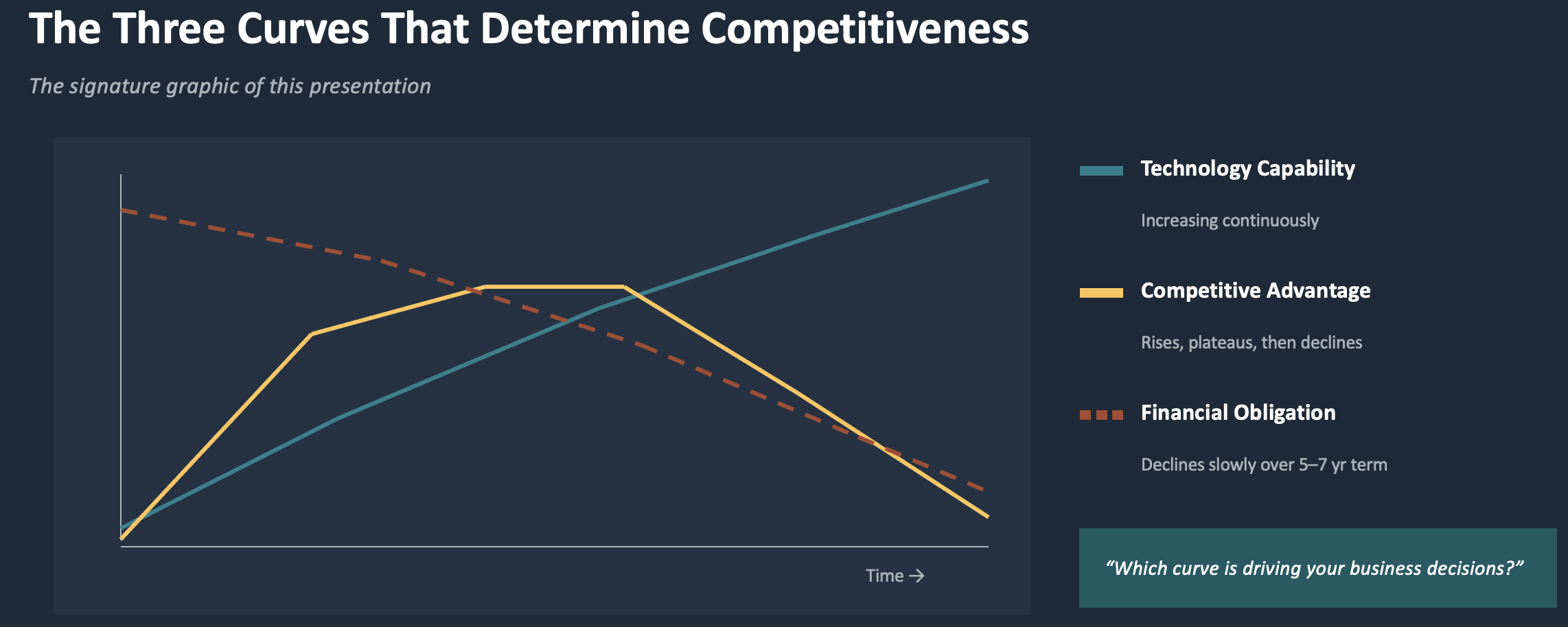
Faster technology cycles also create a capital-allocation challenge. Traditional equipment financing frequently assumes that ownership is the objective, but when technology becomes obsolete faster than its financing term or useful life, ownership can create unnecessary risk. That is why operating leases and enterprise equipment facilities can become increasingly relevant to larger DSOs. Rather than purchasing equipment practice by practice, DSOs can potentially establish a multi-location facility supporting scanner deployment, imaging upgrades, AI-enabled equipment, de novo equipment packages and ongoing technology refresh cycles. The objective is not simply financing: it is to create a technology-refresh strategy.
The Three Curves That Determine Competitiveness: technology capability keeps climbing while competitive advantage rises, plateaus and eventually declines, and a well-structured financial obligation winds down gradually over the term.
An equipment-agnostic structure can also allow a DSO to select the best technology across multiple manufacturers rather than becoming tied to a single vendor’s product cycle. Operating leases should not simply be characterized as off-balance-sheet financing; under current lease-accounting standards, many leases create right-of-use assets and corresponding lease liabilities. The more important strategic consideration is matching the financing structure to the useful life and business use of the technology. When technology refreshes faster, access can sometimes be more valuable than ownership.
Data Must Move From Reporting to Action
DSOs have spent years building dashboards; the opportunity in 2027 is to make those dashboards operational. Many organizations already have significant amounts of practice, provider and patient data, but the problem is that information frequently remains trapped inside financial reports or management dashboards rather than reaching the individual who can change the result. That needs to change.
Successful DSOs will increasingly push simple, actionable information directly to providers and operating leaders. Instead of only measuring total practice production, organizations can examine provider-level exams, observations, starts, case acceptance and other performance indicators. Provider-level scorecards can identify variations that practice-level averages often hide, and peer comparisons can create constructive performance pressure. Dashboards should increasingly tell operators what action to take, rather than simply telling them what happened. The purpose of data is no longer reporting; it is behavior modification.
AI Will Move the DSO From Post-Mortem Analysis to Intervention
The next evolution goes beyond dashboards. Traditional business intelligence tells an executive team what happened last month; AI can increasingly help organizations identify what may happen next. For a DSO, that could include identifying a decline in starts before month-end, highlighting untreated or incomplete treatment plans, identifying recall and reactivation opportunities, detecting treatment-coordinator performance issues, or finding providers who are not adopting a new technology or operating process. Instead of requiring managers to search through reports, future operating systems can push the appropriate insight directly to the appropriate person.
That is an important distinction. The value of AI in a DSO may ultimately have less to do with generating more information and more to do with helping people make better decisions earlier.
Regulatory Readiness Must Be Built Before the Transaction
As DSO structures receive increased attention, regulatory preparedness should also become part of ordinary enterprise management. MSO-PC structures, clinical autonomy, state-level approvals and healthcare transaction requirements should be reviewed before a transaction begins rather than after a buyer, lender or regulator raises questions. That requires DSOs to ensure that clinical autonomy is not merely described in agreements but is clear, operationally defensible and documentable.
For acquisitive organizations, regulatory timelines also need to be incorporated into transaction planning, since a sophisticated buyer will increasingly evaluate regulatory readiness alongside financial performance and operational quality. Transaction readiness therefore includes more than a clean quality-of-earnings report; it includes organizational, cultural and regulatory readiness.
The 2027 DSO Scorecard
By 2027, boards and management teams may find that the most important indicators of DSO health extend well beyond location count and revenue. The new scorecard should include:
- Quality and sustainability of EBITDA
- Same-store growth
- Doctor retention and engagement
- Provider productivity
- Liquidity and leverage
- Capital efficiency
- Technology adoption and ROI
- Patient experience
- Regulatory readiness
- Provider-level operating metrics
- The organization’s ability to turn data into action
These measures provide a much clearer picture of whether growth is actually creating enterprise value.
Conclusion: The Intelligent DSO Will Be More Than Bigger
The next successful DSO will not necessarily be the organization that accumulates practices the fastest. It will be the organization that combines local clinical trust with enterprise-level operating discipline. It will grow where it has a repeatable advantage, protect doctor alignment, and preserve liquidity and strategic optionality. It will deploy technology with an adoption and ROI strategy, avoid trapping unnecessary capital in rapidly depreciating technology, turn data into behavior change, and use AI to intervene earlier rather than simply explain what already happened.
The lesson for 2027 is therefore not that growth is becoming less important. It is that intelligent growth is becoming more valuable than growth alone. The winning DSO will be disciplined, clinically aligned, capital efficient, technologically modern and operationally intelligent: a sustainable going concern positioned to create value regardless of where the capital markets happen to be.
Building a More Capital-Efficient DSO
As DSOs develop their 2027 capital and technology strategies, TuaCommercial and CCA Financial can work with organizations to evaluate equipment-agnostic operating lease structures and enterprise-scale facilities designed around multi-location technology deployment and refresh cycles. The objective is simple: preserve capital for the areas where ownership creates the greatest enterprise value while creating a more flexible model for the technology that helps practices compete, providers perform and patients receive a better experience.
Contact Judith Thomas at TuaCommercial for a quote for an operating lease program for your next equipment acquisition. You can reach Judith at juditht@tuacommercial.com or visit TuaCommercial online.