

Ranked the #1 DSO Podcast!
Welcome to The Group Dentistry Now Show: The Voice of the DSO Industry!
Building to Sell: What Emerging DSOs Must Know About the Current Dental Market
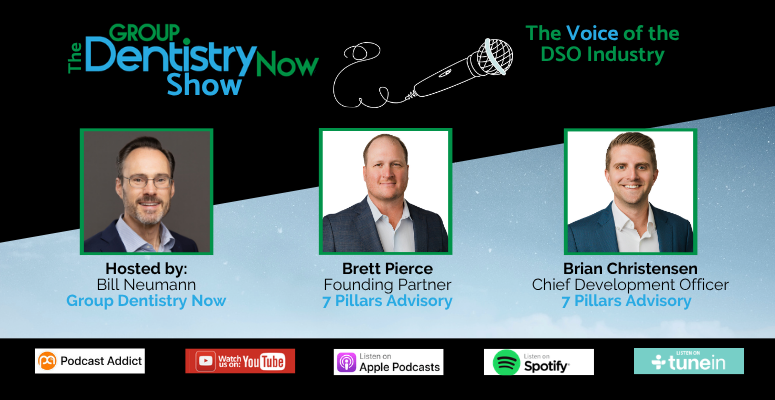
Brett Pierce, Founding Partner & Brian Christensen, Chief Development Officer of 7 Pillars Advisory join the show. This is a candid, practical overview of what it takes to build a dental group worth buying. The duo shares their thoughts on:
- What buyers are looking for today
- The rise of organic growth
- Positioning your group for a successful transaction or continued growth
To learn more about 7 Pillars Advisory visit: https://www.7pillarsadvisory.com/
Connect with Brett Pierce on LinkedIn: https://www.linkedin.com/in/brettpierce88/
Connect with Brian Christensen on LinkedIn: https://www.linkedin.com/in/brianpchristensen/
Subscribe to our channel for more episodes and stay updated on the latest DSO news, insights, and events!
If you like our podcast, please give us a ⭐⭐⭐⭐⭐ review on iTunes https://apple.co/2Nejsfa and a Thumbs Up on YouTube.
Choose your favorite listening app below and subscribe today so you don’t miss an episode! Full transcript is also provided below. See all of our podcasts HERE.
 |
 |
 |
 |
 |
 |
DSO Podcast Transcript – Building to Sell: What Emerging DSOs Must Know About the Current Dental Market
Bill Neumann (00:03):
Welcome everyone to the Group Dentistry Now Show. I’m Bill Neumann, and as always, we appreciate you listening. This is always a great conversations that we have on this podcast and we’re up to, I think 277 plus podcasts. And I always learn so much with these conversations. And there’s a lot going on in the industry and a lot of it’s good and a lot of it is not so good. And I think for a lot of our audience, the emerging dental groups, the solo practitioner that’s scaling from one, two locations and greater, you’re looking at the market and kind of wondering what should I build to? What should I expect? How should I set up my structure? There’s a lot of questions that you have, and we have a couple of gentlemen here to answer those questions, give us an idea of what the market looks like in 2026, because it looks a heck of a lot different than it did a couple years ago.
(01:08):
And I think it’s really important to position yourself in a way, whether you’re looking to sell your business in the next six months or whether you’re building it for the future and just want to build it the right way, it’s important to have these conversations. So as we sit right now in Q3 of 2026, we’re going to get a really solid overview of what the market looks like, what the opportunities are and how to build yourself. Really just put yourself in the best position. So we have with us two gentlemen from Seven Pillars Advisory, Brett Pierce, who is the founding partner, and Brian Christensen, who is the chief development officer. Brett and Brian, welcome to the Group Dentistry Now Show.
Brett Pierce (01:55):
Thanks for having us. Thank you.
Bill Neumann (01:57):
Yeah, I’m excited for this conversation and we’ve been going back and forth by email and we had a chance to talk a little bit at Dykema. First off, let’s start with some introductions. Brett, a little bit about your background. You’ve got a really interesting pre-dental background. You football player, you played at Stanford, and actually you played in the NFL. So I’d love to hear a little bit about that. And if you’ve got for the NFL fans out there, is there anything that we don’t know about being a football player that we should know? Just as a fan, we always kind of think this is the way things are, but since you’ve been there, done that, maybe there’s some insights that you can provide for us.
Brett Pierce (02:48):
Yeah. Well, most of the things, the fans probably shouldn’t know, and I think any politician would tell you that about most things about how the government works, people probably shouldn’t know either. But yeah, the Stanford days, those were a long time ago. A lot of hits in the head ago. Was fortunate enough to try my hand in the NFL for a few years, spent most of my time here in Dallas, which is where I live now. I think one of the interesting things about the NFL is that while most of the attention and most of the discussion revolves around the star players and the huge contracts, about 65 to 70% of that league is on minimum salaries, which is still a very handsome salary. But what you don’t know is, for me, for example, you sign a three-year contract, that doesn’t mean I’m on the team for three years.
(03:38):
That means they can keep me for three years if they want to. And so if you’re on the bottom half of the roster, like for my experience in Dallas, for example, I was Jason Whitten’s backup, as was everybody for 17 years, I guess in Dallas because he played so long. I would go in on every Wednesday just looking at the special team’s lineup to see if I even had a job that week. I was like, “I’m either going to play this week or I’m just going to have to move.” And that’s the life for a lot of these players. That’s not the life for the Jason Whittens of the world. That’s not the life of the Patrick Mahomes of the world. But when you look on that field at any given moment, I would say a good amount of the players you’re watching play, especially on special teams, aren’t sure if they’re going to have a job the following week or not.
(04:25):
So this is certainly not like a woe is me moment. Everybody chose what to do, but people are generally surprised when they hear things like that. So it’s just an interesting world to think about.
Brian Christensen (04:37):
You didn’t have a record breaking contract with the Cowboys
Brett Pierce (04:40):
At the time? Yeah, that was basically I’ll take what I can get until my body completely falls apart and then we’ll figure something else out.
Brian Christensen (04:48):
Of which has happened and now –
Brett Pierce (04:50):
Yeah, it’s currently happening. My body is currently falling apart. So thank you for bringing that up.
Bill Neumann (04:54):
Well, that is definitely another point that we normally don’t think about, but the lifespan of an NFL player, work span of an NFL player isn’t very long, is it?
Brett Pierce (05:07):
I think you might hit the first one right. The lifespan is probably not that long either. Kind of like dinosaurs. The bigger we are, the shorter we live. Yeah, last time I checked, it was just under three years. And when I was playing anyway, you got vested at three years and three games, which means you get the pension, means you get health insurance for a while, which means you get a variety of benefits. And I don’t think it was a coincidence that the average age or the average work life of the NFL player was less than that.
Brian Christensen (05:36):
Right at three years? It
Brett Pierce (05:37):
Was probably three years and two weeks. I mean, I played on teams where this guy was a starter and at cutdown week he got cut and then he was back the next week. And I’m like, “What happened?” He’s like, “Well, I had a $500,000 roster bonus. So if I was on the roster on opening day, they’d pay $500,000. So they just cut me, took a chance for two days and then brought me back.” And I’m like, “Really? That’s how this works?That’s cold-blooded.” But you learn really, really quickly that it’s kind of us and them. And not good or bad, you just understand that.
Bill Neumann (06:14):
So after the NFL, you transitioned over into the private sector. Well, I guess that was the private sector too, but private equity.
Brett Pierce (06:22):
Yeah. Yeah. Fortunate enough to work in a family office where we bought and sold businesses for a variety of years, got a lot of good responsibility at a young age in a variety of different sectors and industries, understood what the private equity space is looking for. Granted, private equity is a huge word. I’m not pretending that I worked for some massive private equity firm. It was a family office that made relatively small investments, but it was a lot of different entities. Understanding, getting a real close up view of what these companies look like, how the companies operate on and off the spreadsheet. There are real people involved in every one of these companies regardless of what the spreadsheet says and regardless of what the returns are. And so learning operationally first how you have to get your arms around the operations of these businesses in order to develop these great returns everybody’s looking for.
(07:13):
But all the way through, there are a number of people who are counting on you to create value for themselves. And then also thinking about the people and the possible casualties that come with that. So very fortunate to have that experience, got a lot of good learnings from that, a lot of responsibility at a very young age. And so took a lot of that stuff into what we’re doing today.
Bill Neumann (07:36):
So you made the transition to start seven pillars. Talk a little bit about making the transition for working for somebody to working for yourself.
Brett Pierce (07:46):
Yeah, so it was an interesting decision and a decision tree. It was born out of more of a necessity than anything else. And so as this DSO movement was being created and as it was becoming more and more popular, you had some decision. Do we want to get involved with this? I was working very closely with King Waters and Associates at the time, which is a wonderful business built primarily on private practice, dental practices. And so we were sitting there looking at from the purview of a independent practice, the DSO stuff was very scary, especially five or six years ago, Bill. I mean, you couldn’t say the word DSO in a group of private dentists and have them not. You probably get thrown out. And so okay, what are we going to do about this? Are we going to create our own? Are we going to create our own official DSO?
(08:40):
Are we going to create a loosely affiliated group or are we just going to help people make the right decisions? We were getting so many inquiries about what do I do about this? I got this offer or I’m talking to this private equity group and they said the term EBITDA and I don’t know what that means. And there’s a lot of people in the space that may or may not have been given the best advice or certainly not advice that is doctor first advice. And so as we looked around the landscape, how do we determine how we can help the most people? How we can help the most people is being a solid advisor to help them understand all of the risks and all of the potential rewards that they can get into by partnering with a DSO. How does that look versus them not partnering with the DSO?
(09:31):
From day one in this business, we have not been for or against DSOs. We are for whatever is best for the doctor. And at the time there wasn’t anybody who was truly in that lane. Most of the companies in the space had an interest in one side or the other, but not truly the doctor side. And so this is a very polarizing topic, the DSO topic, especially in the private space. Is it better for you? Is it worse for you? Well, the answer to that is it depends. And at the time we still are, we’re on a crusade to help the doctors understand what they’re getting themselves into and what they may or may not have left on the table and what their potential gains are. So if that’s staying private, selling privately, partnering with a DSO, running the practice for the rest of their lives, closing up shop in two years, all those things are on the table and that service didn’t really exist and doesn’t really exist today where it’s really truly about the doctors.
(10:34):
That’s why we got into this. My dad was a small business owner. My granddad was a small business owner also. I grew up kind of understanding the trials and tribulations of what owning a small business looks like, taking some of the learnings from my education, taking some of the learnings from my experience and saying, “Hey, look, I understand the problems that a small business owner incurs. I understand the questions. I understand that you’re really good at what you’re doing, but you might not be really good at understanding the opportunities in front of you. We’re here to help you do that.” And at scale, we can help more doctors at scale with that service than any other service, any other service that we’re considering.
Bill Neumann (11:12):
So we also have with us Brian Christensen. And Brian, you actually have quite a bit of experience on the DSO side of things, US Oral Surgery Management, and later at Bond Orthodontics. So can you talk a little bit about your roles at both organizations and then how you made the jump over to seven pillars?
Brian Christensen (11:36):
Yeah. I mean, long story short, unfortunately, I had to work across the table from Brett Fierce, which was – Better
Brett Pierce (11:43):
Than across the line of scrimmage.
Brian Christensen (11:45):
Better than across the line of scrimmage, for sure. Yeah. I mean, Bill, so I started my career in investment banking and saw what was going on in the healthcare space with private equity getting into multi-site healthcare, whether it was dermatology, eyecare, dentistry, veterinary, et cetera. And I thought that that would be a great opportunity to go learn. And so I was fortunate enough to join US Oral Surgery Management, which I just joined a great team at the right time when the organization was kind of hitting on all cylinders and there wasn’t a whole lot of competition in the space at that time for oral surgery practices. And US Oral Surgery just really took off like a rocket ship and they had their first recap or liquidation event at the end of 2021. And I had the opportunity to stay and continue on that journey and take on more responsibility.
(12:43):
But ultimately, I got an opportunity to join a startup and man, was it a startup. At the time, there was not a website. There were three locations and they said, “Hey, we want to build an OSO, so an ortho only group on the West Coast, and you would be employee number four.”
Brett Pierce (13:03):
There you go. And
Brian Christensen (13:04):
We don’t have a website. We have a bunch of great ideas, which was an incredible opportunity for a guy as young as me to help build out an OSO or a DSO, build out a corporate development or an M&A function and kind of start from scratch. And it was exciting, it was fun, but man, it was hard. And I left the well-oiled machine of US Oral Surgery to something where the plane was in the air and we’re still building it. And it was an incredible opportunity for me where I had helped scale it from three locations to over 50. But I had always been a little torn with helping buying small business owners businesses because fundamentally my job was to buy it for as cheap as possible and as that was the most advantageous for me as a buyer. And my dad’s a small business owner, similar to Brett’s, and I just felt pulled to go help guys like my dad in making a transition successful.
(14:14):
And we’ve talked about this a little bit, Bill, but there’s a lot of shady actors in this space where they’re trying to just sell the doctor and get a deal done. But I had actually done a few transactions with Brett and his team, and I really felt like they did it differently in trying to represent the doctors and not trying to get the highest price all the time. It was about best structure, best fit, et cetera. And so Brett called me up one day and said, “Hey, we’d love to have you if you’re open to it.” And I guess the rest is history. I’ve been here for two and a half years now and he hasn’t fired me yet, but there’s young. He
Brett Pierce (14:52):
Doesn’t check his mail.
Bill Neumann (14:56):
Well, thanks guys. I appreciate the background there. And to your point about shady characters and some great organizations like yourselves that are there to help as we’ll talk about the be a referee, so to speak. But there are a lot of options out there, more options than ever. There are more DSOs than ever. There are more DSO consultants or advisors than ever. So I think it can become really a daunting task to figure out who could be a potential partner, who can be an advocate like yourselves for the emerging DSO that’s looking for some type of partnership or some transaction. So I think let’s dig into it now. I really want to talk about what’s going on as you see it in 2026, and let’s try and position these emerging DSOs in the audience for success where they want to just stick to it and keep working on their own or whether they want to find a partner in short or long term.
(16:13):
Angle, you have to first start with trying to, and this is probably one of the most difficult things to do in our market is what’s a DSO, what’s an emerging DSO, what’s a group practice? All these different definitions. Everybody uses them a little bit differently. But when you talk about an emerging DSO, what do you all mean by that?
Brett Pierce (16:37):
That’s a fun term because you’re absolutely right. DSO doesn’t really even have a fully defined term. And now we’re talking about an emerging DSO, which is probably, well, it’s one of the most common buzzwords now in dental. Everybody is attracted to the emerging DSOs, brokers, buyers, and vendors alike, to be honest with you. And so if we were to just in general terms, how we consider what we consider emerging DSOs are obviously the big boys are off the table, the MB2s, the DCAs, the Pacifics, the Aspens, those guys are off the table. Those are considered large group. For our definitions, it’s probably up to about 20 locations. A lot of times it’s still privately held or has a minority investment associated with it. Still growing either organic growth or sometimes inorganic growth. Maybe they have a plan for what they want to do, maybe they don’t.
(17:34):
And the reason this topic is so popular now is this gold rush that happened in the early 20s of early 2020s about how money was cheap, everybody had an idea, group dentistry was trading, the multiples that group dentistry was trading at were extremely aggressive. All you basically had to do was acquire a few of your friends together and you all make a bunch of money, which that was the thesis. Well, all of that still happened. Some of the groups that had a little better timing than others productively transitioned productively found a partner, but a lot of them didn’t. And so a lot of them are here now, and what do I mean by that? Well, there’s this 15 location practice in wherever, and they expected a 5x return two years ago and they still haven’t got it. That story is extremely, extremely common. That is happening all over the country in all specialties of dentistry, and it’s a real opportunity and a real problem depending on how you look at it.
(18:39):
So an emerging DSO from our perspective is kind of in that range. You talked to different vendors, emerging DSOs could still be a hundred locations, and so it really depends on what category you’re talking about, but we’re all talking about it because there are so, so many. Almost no matter how you define it, Bill, this is the fastest growing segment of dental. Yeah.
Brian Christensen (18:57):
And Bill, I think to add to that, to what Brett said, I agree wholeheartedly, but these emerging DSOs have a little bit of infrastructure behind them. It’s not just a multi-location practice, five, six, seven locations, but it has some infrastructure. It has some shared services behind it, maybe has a little bit of a management team and a little bit of a management suite behind it. And so that’s the only other thing I’d add to that. But to Brett’s point, it’s a huge gray area. I mean, Brett and I were talking to what we would call an emerging DSO a few weeks ago, 80 plus locations, one owner, shared infrastructure, shared systems, a little bit of a mess, but that’s an emerging DSO and that’s no different. That’s in the same category as a 10 to 12 location DSO, emerging DSO that has a management team and infrastructure and all those things.
(19:56):
So it’s a very loose term.
Brett Pierce (19:58):
Unless you know what you’re called, you’re probably an emerging DSO, right?
Bill Neumann (20:04):
So you would say that when you’re considered an emerging DSO, there is some centralization, standardization of systems that’s gone on to create this moving from a multi-location practice or group of practices to an emerging DSO?
Brett Pierce (20:24):
Yeah. Otherwise, you’re just kind of a large private practice, which, I mean, that being said, that practice that Brian just talked about was 80 locations, so that’s a large private practice, depending how you want to define it. It almost boils down to, it’s something less than the DCAs of the world. It’s even something less than. I mean, if you’ve recapped, you’re probably not an emerging DSO anymore. Yeah. If
Brian Christensen (20:49):
You take on a legitimate private equity sponsor, probably not an emerging DSO anymore. Probably
Brett Pierce (20:52):
An emerging anymore. Yeah. Yeah,
Brian Christensen (20:54):
That’s
Brett Pierce (20:54):
Right.
Brian Christensen (20:54):
Yeah.
Bill Neumann (20:55):
Yeah, that definitely makes sense. So what does the entire market look like? We’ve got solo practitioners out there, we’ve got these emerging DSOs, we’ve got the large, mostly institutional backed DSOs, and then you’ve got these. Also, you talked about the multi-location where there’s no standardization. I don’t know if I missed anything, but you can package all this up. So there’s a couple different blocks or segments of the market. Do you have any idea of percentages, what that landscape looks like right now?
Brett Pierce (21:38):
I think location-wise, it’s going to be hard. I mean, the large group has thousands and thousands of locations inside of it, and private practice probably still has more. I mean, I think we’re looking at numbers between, depending on who you want to argue with, consolidation of 20 to 30% in the space, which means 70 to 80% is not consolidated. So private practice is still the vast, vast majority. Between the DSO segments, I don’t actually know what that would be. There’s more companies in the emerging DSO than the large DSO, but I think locations might be different. Yeah,
Brian Christensen (22:21):
It’s a little hard to nail down, Bill, just because I feel like just when we think we know them all, two will walk in the door tomorrow, and it’s like, how have we never heard of people? And
Brett Pierce (22:31):
They’re still being started. Yeah,
Brian Christensen (22:32):
And they’re still being started right now. There’s friends that are putting together practices and saying, “Hey, let’s put together our practices. Let’s go to Dykema, the law firm, not the industry event, but let’s go to Dykema, let’s put together our practices. Let’s create a shared structure and an organization, and then let’s have a new emerging DSO.” So that’s still happening. So I feel like just when you think the world doesn’t need any more DSOs, more started.
Brett Pierce (22:59):
And there’s some learning happening too. People are learning what to do and what not to do. They’re all going to say they’re doing it differently, but there are some people who are doing it differently, and different things matter today, Bill, than they used to matter. In early 20s, the most valuable person on your roster was your business development guy. You were the ones that were acquiring all the practices, finding amazing small practices or large practices, and you’re bringing them into the fold and helping you aggregate and aggregate and aggregate more and more EBITDA. That has shifted dramatically, almost 180 degrees, I would say. Now it’s operationally focused because what is happening now with, and we can get into this a little bit later, but the emerging DSOs and the large group DSOs, it’s all about organic growth, which means growth inside the four walls without acquisition, more wallet share per patient, more patients, better margins, all of it kind of combined.
(23:53):
So since the focus has shifted there, a lot of the groups aren’t even buying anymore. They’re just saying, “We need to get our house in order and we are looking internally.” And I actually think that’s a good plan for most of them saying, “Okay, so now the operational people are the ones who are getting hired all over the place.” Yeah,
Brian Christensen (24:13):
I think Bill, to that point, I just saw an article from PitchBook that essentially described private equity returns 10 years ago versus today, and they polled a bunch of private equity investors, and 10 years ago, over 50% of private equity returns they felt were generated by multiple arbitrage, that is when debt was super cheap. Today, it’s less than 5% is attributed to multiple arbitrage. Over 60% is operations and same store sales growth.
Brett Pierce (24:45):
Yeah. So which lends itself for the audience might want to understand what multiple arbitrage is.
Brian Christensen (24:51):
Multiple arbitrage pretty much is if I can buy it at X, I can sell it at Y. If I can buy something for $2 and turn it around and sell it for $6, that is multiple arbitrage. That was very common and normal, and a lot of people made billions of dollars of that on that idea five, six, seven years ago in the DSO space when debt was very cheap, the cost of capital was very cheap. We saw this in our mortgages, but as the cost of capital has gone up, there is not the ability to just buy for X and sell for Y.
Brett Pierce (25:29):
That’s why the population of the merging DSOs grew so quickly, Bill, is we’re going to buy everything we can find for seven and 8X, and without really doing a whole lot of integration or making vast improvements, we’re going to sell this thing for 14x without really doing much. And so at that point, who’s the rockstar? The guy who can acquire the most EBITDA the most quickly. Now it’s like, man, if you’re not showing growth, if you’re not showing organic growth, if you’re not showing efficiencies gained, there’s not really a huge market for you.
Bill Neumann (26:02):
Yeah, it’s fascinating how things have changed from you had organizations that would go out and hire the best salespeople, business development people to go out and find practices and gobble them up and then duct tape them together and sell them to the next private equity firm. And then the idea was to do that again and again and again, and of course you can’t do that anymore. So to your point, I guess I want to talk to you about this in a second about organic growth because now it’s all we hear. Any meeting you go to, it’s all focused on organic growth, and I’m just wondering how organic growth is going for a lot of groups because we hear a lot about it.
(26:48):
We also hear rumblings in the market that some of the larger DSOs maybe aren’t doing so well still. So there’s a lot of that, and that’s probably why, to your point, Brett, that they’re sitting on the sidelines and they’re not acquiring practices or emerging DSOs. They’re getting their, I think you said, house in order, which is what they need to do. Let’s go back to the emerging DSO conversation. So for the emerging DSOs listening right now, what operational challenges, because you’re having conversations with these emerging DSOs every day, what challenges when you’re having these conversations tend to surface when an emerging DSO talks to you as they’re scaling up and maybe how do they need to figure a way to fix those challenges or adapt to those challenges?
Brett Pierce (27:46):
There are a lot, and a lot of them are just very similar to small businesses, and the hardest part about owning a small business is dealing with the producers, providers, and employees. A lot of times there’s not consistency amongst the different employment contracts. There’s not consistency on pay rates and a variety of things in that area. On the smaller side, Bill, these are practices that are turning into businesses, and those are very different things. When you think of a dental practice, some of you might think of a mom and pop shop and they have a couple tricks up their sleeve operationally, and it works for them, and it’s not so many people they have to keep track of that they can do things on a handshake or they can do things on trust or whatever it is. As soon as you turn this thing into a group, and as soon as you’re trying to.
(28:39):
I mean, depends on who you’re serving, if you have investors or if you have friends and family or whoever involved, things start to change, things start to get a little bit more complicated. This is now a business, and there are things that you never really thought of that might not work at these other practices just because they worked in your practice, because most every one of these emerging DSOs, the head of the snake is a large practice that started this thing and they acquired other ones. And so maybe the processes and systems that the founding practice has don’t actually work throughout the whole group, or maybe they never really had to think about consistency of HR policies or consistency of procedures and things like that. And so a lot of the stuff is the people and the expectations. Yeah,
Brian Christensen (29:30):
And I think, Bill, to add to that, more locations does not equal higher exit multiple or returns. This is one thing that Brett and I constantly try to tell, whether it’s a single practice owner that wants to go to a second, third, fourth location, or whether it’s an emerging DSO that wants to add 10 locations next year, our biggest question is always going to be, “Hey, is your current practice Or practices maximized because that’s what they want to see. They being the eventual buyer or partner that’s going to buy your business. More locations does not equal a higher exit multiple.
Brett Pierce (30:17):
Go ahead, Bill.
Bill Neumann (30:18):
I was just going to say, I think your point’s really valid about number of locations doesn’t necessarily matter. I’m kind of curious, so with these emerging DSOs, do you find that it’s the case a lot of times where let’s say someone has five locations that they’ve got a couple of really, two or three of them are just solid performers and they’ve got a couple of practices that are dragging the entire group down?
Brett Pierce (30:51):
Almost every time. I don’t know that we’ve seen one that isn’t like that, Bill. You’re going to have your rock stars, you have your A players, B players, and C players. And a lot of times the founding practices are the biggest practices that provide the most value. And then locationally, I mean, Ortho’s famous for having lots of locations. In some cases, Ortho’s margins can justify having a lot of different locations, even if you’re only open once a month in a certain place. That’s just not the case in the other specialties. And so we see a lot of, oh gosh, Brian, almost every situation there’s a couple practices that aren’t necessarily helping. If you’re looking at valuation situations and they’re based solely on EBITDA and a practice has neutral or negative EBITDA like that, you’re effectively giving that practice away for free or you’re paying them to take it.
Brian Christensen (31:46):
Yeah. And I know we’re going to talk about expectations here in a minute, but Bill, a lot of these owners or shareholders, they need a high exit multiple and high is relative, but they need a high exit multiple in order to make the economics work for them and their shareholders. And we’re all for high exit multiples if the structure’s right and all those things. But these groups that are buying emerging DSOs or whether it’s a larger DSO or whether it’s a private equity investment directly, they’re not looking to pay a high multiple for bad locations. They’re not interested in catching the ball at night.
Bill Neumann (32:29):
So the expectation I think is probably. I want to get to that in a second because expectations are all over the place right now for sure. We talked about the multiples four or five years ago and a lot of owners of these emerging DSOs saw their peers maybe exit four or five years ago and see these crazy multiples. I mean, that’s what I would call them now, but very high multiples and those aren’t necessarily realistic today. So where do we see emerging DSOs going over the next couple of years? Are there still buyers out there for emerging DSOs? And if so, what separates? Because I know that larger groups, strategic partners could be the potential buyer. How do they differentiate which emerging DSOs they’re interested in from the ones they’re not?
Brian Christensen (33:34):
Yeah, I mean we tell clients and respective clients all the time, there will always be opportunity to sell your business, whether you’re a single practice owner or the CEO or founder of an emerging DSO, there will always be opportunity to sell your business if you have a good business. And so let’s start there, Bill. We always think that will be an opportunity for businesses that are built the right way and are doing the right things. But as far as expectation setting, I think a lot of these groups that Brett had mentioned started four, five, six, seven years ago when it was two guys in a garage putting their practices together and saying, “Hey, let’s start a DSO.” I think the idea at that time was, “Hey, we’ll do it for four or five, six years and then we will sell directly to private equity.” And that was probably the right expectation, but I think the world has changed and private equity is still interested in the DSO or dental space, but they’ve gotten a lot more pointed in what they’re looking for.
(34:48):
They’re looking for a lot of different things, same store sales growth, quality management team, legitimate infrastructure, all those things. And so I think the expectation now is, hey, there’s always a chance that you could accept a direct private equity investment, but more than likely you’re selling to a larger DSO. And that’s not something that some of these emerging DSOs want to hear, but we always want to set those expectations early so that we’re aligned with our clients. Brett, anything you want to add to that?
Brett Pierce (35:21):
Yeah, we’re seeing consolidation across the DSO space, not at the rate of the consolidation of the private practice or the private practice area, but consolidation is definitely happening in the DSO space and that’s just not by definition, that has to be DSOs being purchased by other DSOs, not just purchased by private equity. There’s so much opportunity for private equity to get involved in dentistry. There’s so many assets effectively for sale right now that just the percentages that are going to get partnered with private equity are just low. They’re just low right now.
Brian Christensen (35:59):
Yeah, and we’re seeing a lot of this consolidation happening, Bill, whether it was Smile Doctors and My Orthos, whether it was Heartland and Smile Design, whether it was Innovate32 and Floridian, whether it was US Endo and Cameo Dental, there are a lot of these emerging DSOs that are starting to sell or partner with larger DSOs, and we think that’s going to only continue if not speed up.
Bill Neumann (36:26):
So fewer buyers, the buyers that are out there are more critical of what they’re buying. Are the deal structures much different than they used to be, and what does that look like?
Brett Pierce (36:44):
Yeah, overall structures and the levers that you can push and pull are relatively similar. I will say that there’s a lot more looking under the hood than there used to be. There’s a lot more of a focus on diligence. There’s a lot more of a focus on potential risks. When the market was really competitive, when it was super competitive years ago, the buyers weren’t afforded the luxuries to do all the extra work because the doctor would just say, “Sorry, I’m going to go over here because I don’t have to deal with your nonsense. I don’t have to take the SAT and the SAT two to go to your school. I can just go.” So there’s a lot of that. The diligence piece on these businesses, these pieces are significantly more complex.
Brian Christensen (37:32):
Yeah, I mean, to add to that, Bill, five years ago, Brett could take a 10 location business to market and they would say, “Great, you have a lot of EBITDA, we’re going to give you a high multiple, 10 locations, that’s great. Now, what is every location doing?” It’s just fundamentally different than it was five or six
Brett Pierce (37:52):
Years ago. 10, honestly better. It’s better. And that’s where
Brian Christensen (37:54):
It needs to be. Yeah.
Bill Neumann (37:59):
Are there deals where, take your 10 location example where they only want nine of those locations?
Brian Christensen (38:06):
We’ve certainly seen that where they said, “Hey, we’ll buy all 10 effectively, but we’re going to shut the 10th one down.” And so we’ve seen that, we’ve lived that in one of our transactions. So yeah, I mean they said, “Hey, we’ll buy it, sure, but we’re shutting it down immediately.” So we’ve seen that.
Brett Pierce (38:26):
Carve it out, shut it down. That’s just the way it works. Now you’re not going to get a combination of practices that are all worthy. And the idea that we could loosely affiliate a bunch of dental practices and all of them are going to get the same multiple is just a little different now than it used to be. Yep.
Bill Neumann (38:51):
So this is us setting clear expectations where it’s certainly not impossible to sell now at all, but the expectation is that you really have to be running a well oiled business, you have to be centralized, you have to be focused on organic growth. And what is that expectation from the buyer when it comes to organic growth? What are they looking at? So they’re a larger DSO, they see an emerging DSO they’re interested in. They’re looking at the practice level and are they looking at the organic growth at each individual practice?
Brian Christensen (39:41):
Correct. That’s right. Yeah, they want to know how each location’s performing. More than likely a few locations are performing better than others. Why aren’t those performing as well? And so yeah, they really dig into individual location economics and growth.
Brett Pierce (39:57):
A lot of times they’re comparing it to industry index, like an industry index or how the industry’s performing in general. They’re not necessarily going to expect you to be growing at 25% if the industry’s flat, but there’s a lot that goes into not just current growth, but like any sophisticated buyer, if I’m going to give you a high value or a high multiple, I’ve already identified things that I can do once we partner that are going to help that practice grow. I’m going to pay more for the ability to grow. And so you’re identifying growth and you’re identifying areas for growth. And so we’re kind of speaking out of both sides of our mouths here. We need you to grow as best as possible, maximize your business, but at the same time, the buyer’s always going to be looking for the additional thing they can do once they partner with you to help them grow.
(40:43):
And so having that conversation ready is extremely, extremely important.
Bill Neumann (40:51):
I’ve got a couple of questions here. So the goal is for these emerging, and this should always be the case, you should always be building your business with the end in mind, whether it’s the end being next year or the end being in 15 or 20 years, what are some things that you’re both seeing emerging DSOs doing today that make an eventual transaction more difficult? And then on the flip side, what can an emerging DSO do today to just get them the most value out of a transaction?
Brian Christensen (41:27):
Yeah, I mean, I have a few and then I would love to hear Brett’s opinion, but one is systems. And I don’t mean systems in your business, I mean systems and process on the acquisitions and the deals that you do on your own. So if you have 10 partner doctors and they have all different compensation rates, someone’s paid 30%, this guy’s paid 31 and a half, this guy’s paid a day rate, this guy’s paid 35%, that is going to be a nightmare when you go to sell. So I think having a systematic approach to a, “Hey, this is our compensation, take it or leave it.” I think system of deal structure, what I mean by that is, hey, you can’t have half of your practices on a joint venture model where the doctors keep a percentage of their business and others where they don’t keep any.
(42:16):
So I think having that structure nailed down and defined ahead of time is super important. No side deals, right? I mean, so we’ve had one in the past where they had a chief clinical officer and that person was making $150,000. Well, when you go sell to MB2, they don’t need a chief clinical officer. Pretty sure Dr. B has that locked up. Yeah, probably so. And so I think we as BD guys, as M&A guys, will do anything to get a deal done. Okay, I’ll give them 33% instead of 32% on compensation, but it really creates a bind later on when you’re trying to transact. I think Brent, anything you want to add to that?
Brett Pierce (43:02):
Yeah, I mean, having a different set of deal structures is almost impossible. And it’s just like we tell our solo doctors, it’s think about the seller, just have some seller empathy, put yourself in this, I’m sorry, buyer empathy, put yourself in the buyer’s shoes. What is the buyer of your business going to be concerned about? What is the buyer of all this? What are they going to have to deal with? All the complexities that you have as an emerging DSO when you’re growing and all the contracts you’re dealing with and all those kinds of things, they’re going to have to deal with those too. So the more simple you make it, the more disciplined you make it. Discipline is hard on the business development side, and even the large groups fight this also, you’re trying to accommodate all these doctors. You’re trying to accommodate the practices because that’s who you want to join you.
(43:55):
And so if they say, “I’ve never changed my practice management software,” or whatever it is, you’re saying, “That’s fine. I really like your asset. You have two million of EBITDA. Yeah, I think we can get you to three, so I’m going to put up with that.” I think setting expectations operationally is super, super important on that set, whether it’s a practice management software, whether it’s an HR situation, looking on the front end, this happens a lot here looking on the front end on HR stuff and compensation, if you can’t keep it straight in your own mind, how the heck is the next buyer going to be able to keep it straight?
Brian Christensen (44:32):
Yeah, and they will make adjustments. They will make adjustments and it becomes a little bit of Rob and Peter to pay Paul, and it just becomes a little bit of a nightmare. The other thing that’s worth mentioning, Bill, is leverage. Man, we see so many of these groups that are bootstrapped and they’re just up to their eyeballs in debt and they’re way over their leverage covenants. And man, that is just a problem whenever you do go and sell because the debt gets paid first. Brett, how many times have we seen where great asset, a lot of EBITDA, but after the debt’s paid and you pay legal fees and all those things, there’s not much cash to go to shareholders.
Brett Pierce (45:09):
Yeah, this is something that’s probably worth the whole episode is where are you getting your money? How expensive is this money? And do you realize you got to pay it back? And no different than getting into a bad lease. If you own a sandwich shop and you have the worst rent in the world, you can’t make enough sandwiches to pay for it, to get yourself out of a bad financial decision. Same with the DSO, great same store sale growth, great margins, great HR policies, but we have this terrible debt situation that just keeps piling on top of itself. Guess what? I love that you’re running your practice the right way, but you made some bad decisions on the front side on your leverage.
(45:56):
There’s going to be nothing left for anybody because all that has to get paid off at close. And so really understanding what that means, not just taking money from anybody who will give it to you, but understanding what comes with that and really what are the goals? One of the things that I’ve been a little disappointed in this space is that sometimes we’re just growing for growth’s sake and we don’t really know why, and we just keep acquiring practices and we don’t really know why. We think they’re a good deal, but we don’t know what we’re going to do with it. And so having the end in mind is more than just a cool saying. It’s what are we actually trying to accomplish here? Okay, this, this and this, this is how we’re going to get to our goals. But in order to do that, I have to find some debt.
(46:44):
So if I find a debt under this structure, do I still get to where I want to go? And a lot of times we’re just chasing down debt and we don’t know where we’re going.
Brian Christensen (46:56):
Yeah. I mean, to Brett’s point, if you begin with the end in mind, you can almost reverse engineer how to get there. That’s what I
Brett Pierce (47:02):
Totally recommend.
Brian Christensen (47:04):
Okay, what do I need to do to create two and a half to three times equity or MOIC equity returns? Okay, I need to get this much EBITDA with this much debt. I need to have this doctor compensation model. I need to have this many locations. I mean, you can start reverse engineering where you want to get to. And if
Brett Pierce (47:24):
None of that makes any sense, maybe don’t do it to start with or find someone that can help you get through that kind of stuff. Yep.
Bill Neumann (47:35):
Well, that’s actually some great advice. Let’s talk about your role at Seven Pillars. We talk about, or Brett, you talk about it as the value of a referee. You feel like you act as a referee, and we hear from a lot of, especially smaller groups out there, emerging DSOs, and they wonder the value of an advisory firm. Do I need this? I’m getting these direct solicitations from groups. Maybe I can do it on my own. So let’s talk about your role, how you help position the emerging DSO, how you can help them avoid pitfalls and maybe making some wrong decisions with the wrong partners.
Brett Pierce (48:28):
Yeah. The beauty of these emerging DSOs is that there’s a lot of different pieces involved helping the train move forward. That’s also the worst part. That’s also the worst part and the most challenging part of these things. And they’re all different shapes and sizes, Bill, but if you think about an emerging DSO that started in 2022 because their friend got a 14 times return on their emerging DSO, they leveraged their friends and family to join their DSO. They found a couple extra players to join their DSO on a promise of a 14 times multiple with a three to four times return on their invested capital in three years. That’s a very common scenario. I didn’t just make that up out of thin air. Now we are effectively four or five years into it, and those returns are nowhere in sight. And depending on the structure of the DSO or where the money’s coming from, people are getting a little itchy and they’re starting to want to do something.
(49:38):
And so now, okay, I leverage my social currency, I leverage my actual currency, and I need to make sure that we get these great returns. Well, it turns out they might not be out there, and I got a bunch of people who have different expectations on that. So how do you have those conversations? How do you help the doctors, your key producers, your key stakeholders, your private equity sponsor? How do you help them understand all these different things that are happening without getting emotional, without getting mad at each other, without imploding the entire business because everybody’s angry at each other? Well, that’s where we provide a lot of value. It’s helping each of the individual parties understand the situation, understand the situation they’re in, and have some honest and real conversations that likely the leadership has already had with the doctors, but they just hear it differently.
(50:38):
It’s no different than I coach my son’s baseball team, we have a rule. It’s like you tell my son how to do something and I’ll tell your son how to do something because neither one of them are listening to their own dads. And so sometimes when you are the owner, the CEO, the founding doctor of that business, they’ve heard you say these things so many times and they know where you’re coming from because you have that name tag on your shirt, maybe they don’t listen quite the same way, or maybe they don’t tell you the real things that they care about. So when we get into those kind of situations, we are meeting with every single key stakeholder and we are being that moderator, we are being that referee between all of them to one, make sure they get the best deal possible, but two, try to keep them all together and try to keep from pulling each other apart.
Brian Christensen (51:29):
Yeah, I mean, it does become a very long, contentious process because we’re all selfish individuals at the end of the day and we want to know what’s in it for us. Bill, if this is a 20 location emerging DSO that has a management team and an executive suite and they’re selling to MB2 or Smile Doctors, most likely the person we’re interacting with most is the CEO and CFO. MB2 and Smile Doctors do not need another CEO and CFO. So those people are actively working themselves out of a job, but they’re very much needed to get a transaction closed and to probably get integrated. And then you have these partner doctors that expect to have very high expectations on equity returns. You have associate doctors that are looking around saying, “Hey, what’s in it for me because I need to sign a new employment agreement?” It just becomes a little bit of a feeding frenzy as to what’s in it for everyone and what’s in it for me.
(52:31):
And so I think a referee to being able to be a neutral arbiter is super important to getting a transaction across the finish line.
Brett Pierce (52:41):
They’re just such emotional. These are such emotional events in everybody’s life because you’re so close to it. Sometimes you need somebody who is an expert, but they’re not in it with you every day to make sure that both sides understand the other side of the story.
Bill Neumann (52:59):
I think that’s a great point. And to your point, it is very emotional. I mean, in a lot of cases, this transaction is someone’s or multiple people’s retirement plan. We hear a lot about that in the dental industry that the retirement is the sale of the asset for a lot of these or the money that they use for retirement in lieu of a pension or a 401k, a lot of it is the value of the business that they put together.
Brett Pierce (53:32):
Yeah. A lot of people are counting on it financially, but also I would say every transaction I’ve ever done, it’s even more than that too. It’s a lifestyle. It’s their life’s work. It’s all the blood, sweat, and tears, all the late hours, all of that stuff comes into this. You start reflecting on all of that at this moment of transition, and it’s kind of hard to think about. It’s kind of hard to think about. A lot of times, 25 years ago I started this thing and it was just me and Susie and now it’s 15 locations and I have a hard time separating that and we’ve always done it this way and it’s always worked for us. And I have a hard time separating that and I can’t do it without being emotional about it, even though I might know in my heart of hearts that this is the right thing to do for the business.
(54:21):
I can’t separate certain things. And those are really good problems I have. That means you care. That means it matters to you. Yes, it is the final number at the end of your dental career on the spreadsheet of your financial life likely, but it’s a lot more than that too. And it’s all kind of wrapped up into this big ball of it’s my life, it’s my friends, it’s my employees, it’s my financial nest egg. It’s all the stuff at once. And so you need somebody who can help you understand that. Also leveraging the other experts in the room on the financial side, on the practice management side, but you just need somebody there because you can’t untangle yourself from these things.
Bill Neumann (55:03):
Great conversation. If we have anyone in the audience that’s an emerging DSO that is interested in taking the next step, having a conversation with you, Brian or Brett, just to learn more about working with Seven Pillars, what’s the best way to do that?
Brian Christensen (55:23):
I would never want to talk to Brett Pierce, but if you wanted to talk to me, you can reach out to us at sevenpillarsadvisory.com. And Brett and I would love to have a conversation with you, whether you’re considering building an emerging DSO, you have one currently or looking at your next step, whether it’s an exit or a merger, happy to have a conversation and just tell you what we’re seeing and see how we can help you take your next step together.
Bill Neumann (55:51):
Yeah, I think that’s really important. I mean, with the way the industry is right now and how things change on a regular basis, I think it’s really good to reach out to Brett and Brian and get a real feel for is my emerging DSO on track? Are there some things that I need to do differently? It is definitely interesting times and there’s still a ton of opportunity out there too, so I don’t want to dissuade anybody from thinking there’s not great opportunity. I think if you’re built the right way, you can still command a really high multiple. And if you are not necessarily built the right way, there’s still time to make those changes in order to build yourself for the future. So final thoughts, Brian and Brett, and then we’ll sign off.
Brett Pierce (56:39):
Yeah, I think good assets will always be able to find a home. And if your asset isn’t as shiny as you thought it was, we can probably help you understand how to make it a little bit shinier. You give us a timeline, we’ll work together on you on how to reverse engineer that business to become a good asset.
Brian Christensen (56:56):
Yeah, I think to add to that, begin with the end of mind, work backwards. A little more
Brett Pierce (57:00):
Philosophical than
Brian Christensen (57:00):
Mine.
Bill Neumann (57:02):
That’s a great way to end things. And sevenpillarsadvisory.com will put the URL in the show notes and we’ll also put Brett and Brian’s LinkedIn handles in the show notes so you can connect with them. And thank you everybody for listening. Great conversation. I feel like we’re caught up to speed on what’s going on in the industry, the opportunity for DSOs in 2026 and 2027 and really appreciate your insights, Brett and Brian. And thank you again for being on and thanks for listening. And until next time, this is the Group Dentistry Now Show.