

Sponsored Content
DSOs and dental software companies face unique challenges when implementing AI into their organization or software. At this point, most can agree that there are powerful benefits to using AI; however, implementing and changing workflows can be challenging.
AI doesn’t run on pixie dust and hopes and dreams. It requires a base-layer to work and pull information from. The real questions no one asks are:
- Does dentistry need an LLM with 800B parameters (like ChatGPT, Claude and Gemini), since most of what frontier models have been trained on has nothing to do with dentistry?
- Are frontier AI models safe and secure? Are there compliance risks sending PHI to a public AI cloud that trigger HIPAA/PIPEDA concerns?
- Can my organization save money with more efficient ‘base layer’ options for speech-to-text (STT) and large language models (LLMs)?
AIzac solves these problems (and more) with dental-optimized AI STT and LLM technology tuned to clinical terminology that was built for dentistry. This approach yields higher accuracy and faster, more cost-effective inference than frontier models.
If you’re reading this, you know dentistry is different and has nuances that are different from medical healthcare. Frontier speech-to-text (STT) and large language models (LLMs) are generic, misinterpret dental jargon, and incur high costs and latency.
Generic STT & LLM Limitations for The Dental Industry
Many PMS and third-party software add AI-driven features (voice charting, note transcription, patient communication, receptionist, billing, etc) using off-the-shelf AI. However, general-purpose speech and language AI often fall short in the dental context. Cloud STT services (Azure, Google, Deepgram) and LLMs (ChatGPT, Claude, Gemini) are trained on broad datasets and struggle with clinical terms like “furcation,” “prophylaxis,” or “endo treatment.”
Moreover, any speech or note-taking AI handling patient encounters must comply with HIPAA and SOC 2. Generic cloud AI services can provide HIPAA Business Associate Agreements (BAAs), but they still necessitate careful network and data flow design. Many PMS vendors and DSOs prefer solutions they can host or embed to retain full control of PHI. This implies the need for a flexible AI offering (API, SDK, on-prem license) that meets enterprise security requirements out of the box.
Beyond technical accuracy, organizations must consider integration effort and security compliance. Building a voice AI pipeline from scratch is time-consuming and requires acoustic model tuning, developing a custom transcription workflow, and creating a frontend UI. Maintaining accuracy over thousands of dental terms (procedures, anatomy, drug names) is a major endeavor.
 Dental-Optimized STT – Denspeak™
 Dental-Optimized STT – Denspeak™
AIzac’s STT solution Denspeak™ is a speech engine trained on thousands of hours of dental audio, real clinical dictations and transcriptions, so it knows the language of dentistry. The result is higher accuracy on critical terms (tooth numbers, pocket depths, material names). In benchmarking tests, Denspeak often achieves accuracy in the mid-to-high 90% range on complex clinical vocabulary, whereas generic STT tends to fall into the 80–90% range.
Error rate vs. leading general-purpose ASR services internal evaluation: less than half the error rate of the nearest general-purpose engine on dental English.
In addition, ambient noise (drill sounds, crowded offices, multi-speaker chatter) further degrades their accuracy. Studies of medical speech recognition show that domain-specific models can significantly outperform generic ones on technical vocabulary where transcription errors can exceed 15–20%. These errors cause frustration and require manual correction, negating productivity gains.
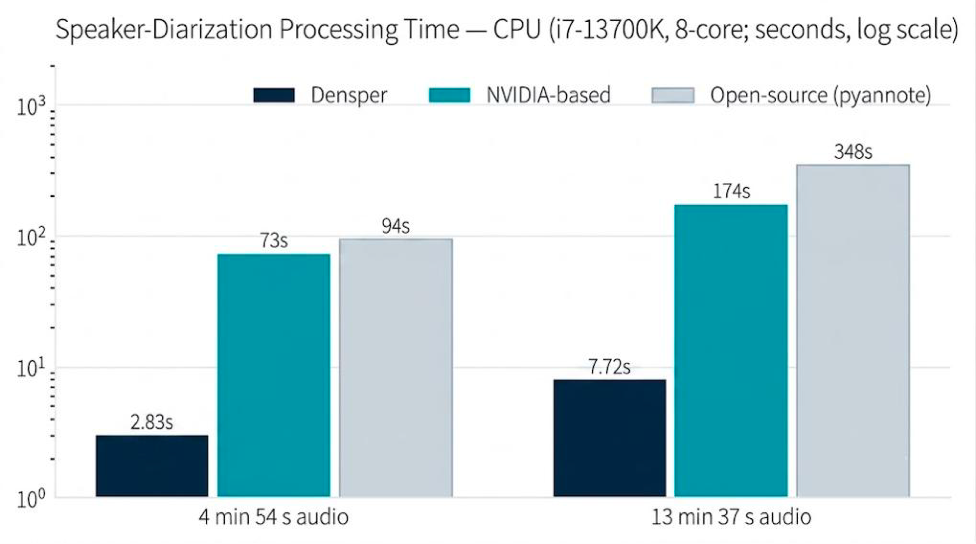 Denspeak is tuned for noisy clinic settings using advanced noise-robust models to filter out suction, drill, and chatter, keeping transcription accurate during procedures. It also supports up to 4-speaker diarization, allowing it to separate dentist, assistant, hygienist, and patient voices in a single recording. This means a single audio stream (e.g. a prophylaxis exam) can be automatically split and transcribed by speaker, preserving conversational context without confusion. Azure and Deepgram charge extra for this feature.
Dental-Specialized LLM – Densper™
Large LLMs (GPT-4, Claude, etc.) can generate human-like text but are overkill for what’s needed in dentistry. They are large, expensive, and prone to “hallucination” (inventing details) because of their size.
Densper isn’t marginally ahead. It has a double-digit accuracy advantage over the nearest model in this benchmark.
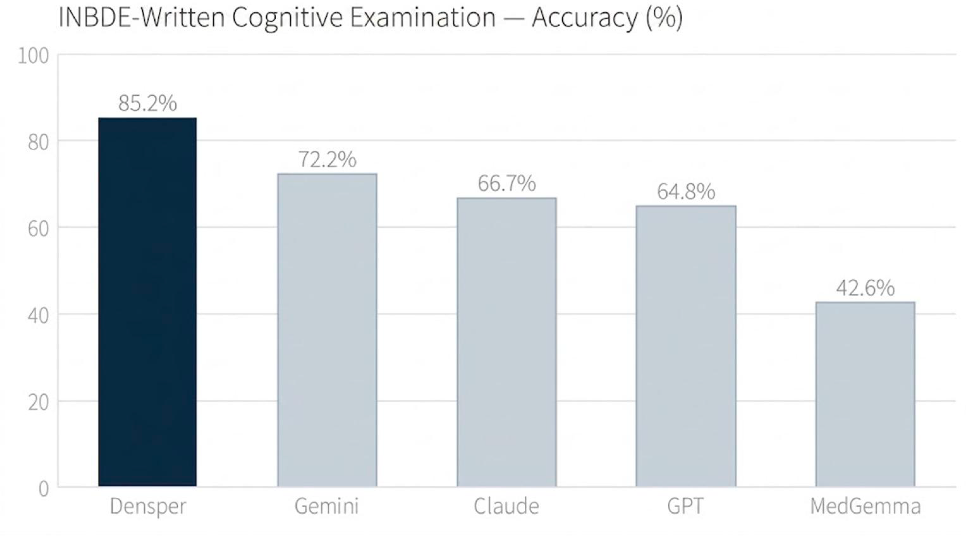
Verified clinical-cognitive accuracy
On the INBDE 160-question written cognitive examination, Densper scored 85.2% — ahead of Gemini, Claude, GPT, and MedGemma.
A dentist’s dictated SOAP note is relatively simple and factual, so a smaller model trained on dental data can produce just as accurate summaries with far less computing overhead. In practice, using a generic LLM means higher cloud costs (per-token fees) and slower response times than a lean dental LLM.
On top of speech recognition, meaningful output (SOAP notes, summaries, patient instructions) requires an LLM. Here, small and specialized beats big and generic. AIzac’s Densper is built from scratch on dental content (tens of thousands of textbooks, charts, research papers, EHR data). It contains limited extraneous knowledge outside dentistry, which yields two major advantages:
- Precision and brevity: Densper understands dental context deeply, so it generates focused, accurate summaries without hallucinations about unrelated topics. In tests, a dental note written by a dentist is summarized by Densper with only 1–2% missing information and no invented details, whereas a GPT-4 based model might omit critical clinical context or add spurious recommendations.
- Efficiency: Densper’s smaller architecture (on the order of a few billion parameters, versus tens or hundreds of billions in general LLMs) means much faster inference and lower cost. For example, running a GPT-4 query might take 1 second of GPU time per request, whereas Densper can return results in a few hundred milliseconds on the same hardware. In volume, this reduces cloud compute bills by orders of magnitude. (In practical terms, a PMS vendor could deploy Densper on dedicated GPUs or even on-prem servers at each clinic, keeping latency at <100ms per call.)
White-Label Software Products – Voice Perio, Scribe, Restorative
AIzac has developed several products to showcase our STT and LLM in real-world environments available to white-label. AI Scribe, AI PerioNote, AI Restorative combine Denspeak STT with Densper LLM to power AIzac’s cloud/SDK modules for real-time note-taking, voice perio charting, and voice restorative charting. As audio streams in, Denspeak transcribes it, and Densper immediately condenses it into structured templates (like SOAP). Key features include:
- 4-speaker summaries: It tags notes by speaker role, so the system knows who was speaking (dentist vs patient).
- 25 built-in report types: Hygienist exams, operative notes, recall notes, etc., covering the most common templates in (PMS vendors can edit or add templates via SDK.)
- Bi-directional translation: Real-time English-Spanish (and other languages) transcription. A Spanish-speaking patient can be transcribed and translated on the fly, solving communication barriers.
A crucial benefit for software vendors is the ability to white-label partner technology to keep the brand message clean. AIzac partners can embed all of our technology under their own name. This includes a full SDK/API for voice charting and note-taking, plus optional UI components. Integration typically takes weeks instead of months, since AIzac handles the core ML engineering.
Flexible Deployment Options
- Public Cloud: AIzac runs on our secure cloud – HIPAA-compliant & SOC-2 certified infrastructure.
- Private Cloud: AIzac can run in a vendor’s private cloud or through managed HIPAA-compliant services (SOC2-certified infrastructure), combining ease of updates with security.
- On-Premises: The AI stack runs within an organization’s tech stack – nearly eliminates compliance headaches, as no PHI crosses external networks.
- API/SDK: For cloud-native products, a secure API endpoint allows the PMS to send audio and receive AIzac’s system is HIPAA-ready; we sign BAAs and follow encryption best practices.
Because of these options, DSOs or dental schools with tight security policies can adopt AIzac technology. Dental schools benefit especially: they can train students using voice AI and conduct multilingual exams with built-in translation. For DSOs, a centralized deployment serves all clinics under a single enterprise license, maximizing cost efficiency.
Cost, Latency, and Accuracy Tradeoffs
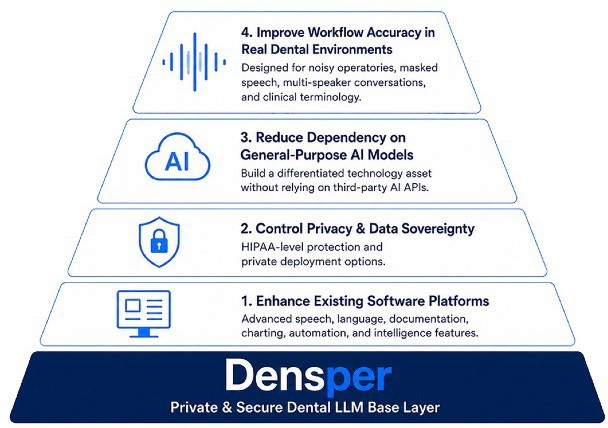
In evaluating AI models, vendors must balance accuracy, latency (speed), and cost. By choosing a dental-specific AI stack, vendors reduce total cost of ownership. Instead of paying per-minute rates to third-party STT providers and per-token fees to LLMs, AIzac offers predictable licensing fees. The white-label model also means the PMS vendor retains a software asset rather than paying external usage fees for every patient encounter.
Dental practice management software companies and enterprise dental organizations should demand domain-focused AI. Dental-optimized speech recognition and language models deliver faster, more accurate clinical features than generic solutions at lower cost. With AIzac’s suite of products, software companies can accelerate innovation without reinventing the wheel.

Learn why the future of dentistry starts with the right base layer.