
Ranked the #1 DSO Podcast!
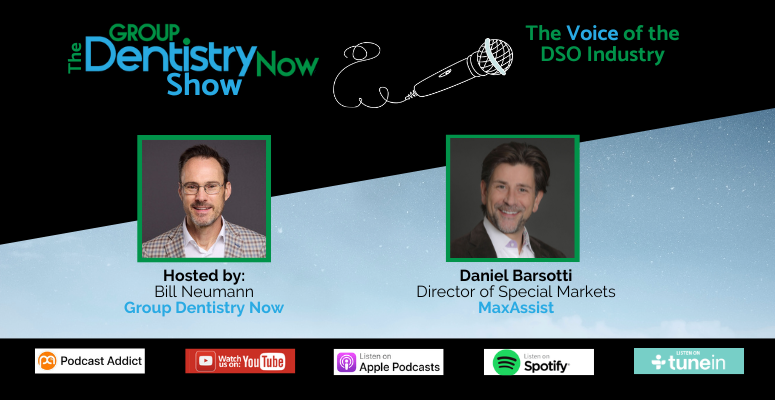
Welcome to The Group Dentistry Now Show: The Voice of the DSO Industry!
Navigating Change Management in Dentistry: Insights from Daniel Barsotti of Max Assist
Daniel Barsotti, Director of Special Markets (DSO) joins the GDN show. He shares his thoughts on:
- The Importance of Change Management
- Creating a Supportive Culture
- Data-Driven Decision Making
To learn more about MaxAssist & schedule a demo visit https://maxassist.com/
You can email Daniel Barsotti here – daniel.barsotti@maxassist.com
You can also find Daniel on LinkedIn here – https://www.linkedin.com/in/daniel-barsotti/
Subscribe to our channel for more episodes and stay updated on the latest DSO news, insights, and events!
If you like our podcast, please give us a ⭐⭐⭐⭐⭐ review on iTunes https://apple.co/2Nejsfa and a Thumbs Up on YouTube.
Choose your favorite listening app below and subscribe today so you don’t miss an episode! Full transcript is also provided below. See all of our podcasts HERE.
 |
 |
 |
 |
 |
 |
 |
 |
DSO Podcast Transcript – Navigating Change Management in Dentistry
Welcome to the Group Dentistry Now Show, the voice of the DSO industry. Join us as we talk with industry leaders about their challenges, successes, and the future of group dentistry. With over 200 episodes and listeners in over 100 countries, we’re proud to be ranked the number one DSO podcast. For the latest DSO news, analysis and events, and to subscribe to our DSO Weekly e-newsletter, visit GroupDentistryNow.com. We hope you enjoyed today’s show.
Bill Neumann: Welcome everyone to the Group Dentistry Now show. I am Bill Neumann, and as always, we appreciate you checking in, whether you’re watching us on YouTube, on the groupdentistrynow.com website, or maybe you’re listening in. We appreciate the loyalty and the strong following. We’re 230 plus podcasts into this journey, and it’s a lot of fun. We always learn a lot. And we have a new guest to the show, an organization that has been on several times and the last name may seem familiar. We have had two other Barsattis on the podcast, but we have a third now. We have Daniel Barsotti with us. He is the director of special markets at Max Assist. And Daniel, it’s great to have you.
Daniel Barsotti: Pleasure, Bill. It’s a family affair at this point. So super happy to be here.
Bill Neumann: And Daniel and I had a chance to talk a little bit in person in Salt Lake City just a week ago. So it’s actually nice. We’re going to, as he said just before we started the record, we’re actually going to have a real conversation. We didn’t have a chance to really talk for a long period of time, but it’s always nice to see and meet people in person. So, Daniel, I’m going to try your bio here and then please fill in any blanks. He is an accomplished entrepreneur. I want to learn more about that. Graduated from the University of Alberta. So, he is a Canadian. We talked about Alberta being what? The Texas of Canada, right? He spent several decades defining new markets. He’s been involved in orthopedics all the way over to clean tech, and now he’s back in dentistry, and he seems to really like it here, focused on delivering transformative solutions that enhance operational efficiency that ties into the DSOs and the groups. And of course, we want to make sure we’re improving that patient experience. Daniel, I’ll let you fill in any blanks there and love to hear your entrepreneurial background and your time maybe in clean tech, whatever that is, and orthopedics.
Daniel Barsotti: 100%. Yeah. You know, I think first and foremost, you know, I’m a second generation and my children are going through the same experience as third generation, kind of dental consultant and expert kind of focus. I come from a founding family, that is where this platform was birthed from. And my brother, who you’ve met multiple times, is the leader of our organization. And so, you know, my personal experience of things, fresh out of university with my honors degree, I jumped right into the dental industry as a junior consultant, working with the consulting firm that birthed the platform and our founder, Ron Barsotti. And so I cut my teeth right off the hop. um right immersed into the culture into the operations and flow of the dental industry and then i ventured off it’s the entrepreneur in me so i moved on into orthopedics uh joint replacement and recovery post-op recovery uh believe it or not i did a quick stint in cannabis and worked through that process with pre-legalization and the launch of the new market And then I spent some time in cleantech to really understand kind of the moving parts of the circular economy and the ecosystems that exist with conversations of landfill diversion and and cleantech energy. So what I would say though is it what that does is it creates a mosaic of background and experience and wisdom, because at the end of the day, I don’t know what it is about dentistry, but it pulls you back in. It’s Mafia, it’s quicksand. And so with the launch of the new Max Assist platform of Max AI and our new toolbar, I couldn’t resist as an entrepreneur. I wanted back in. I’m super excited for the platform. And so full circle back and excited to be back and immersed in the culture and focused on DSO.
Bill Neumann: Excellent. I think it’s before we get into the conversation, you wanted to talk a lot about change management. I think this is really important and it hits so many different segments of the industry, whether it’s technology, whether it’s the people, there’s so much and culture. I put that in quotes because we hear a lot about culture. Sometimes the people that scream the loudest about it have the least amount, but that’s a whole other discussion. But you talked a little bit about some of the changes at Max Assist. I mean, if people remember, not too long ago, it used to be Recall Max. So maybe give us a little history lesson and get us up to speed on some of the changes at the organization, if you don’t mind doing that.
Daniel Barsotti: Absolutely. Again, our platform was based out of a dental consultancy, so we’re talking 30 plus years of hands-on practice management and development. In 2012, our product was launched into market. And over the course of the last 13 years, you know, our team specifically, we’re dental geeks. And so, you know, we’ve got close to 400 years of experience and knowledge directly in the dental industry. And so our platform has evolved, you know, there’s a humorous video on LinkedIn, kind of our evolution of recall system pro, recall system maxes, and all of the jambalaya in between. But I think where we’ve really turned a corner in this last chapter of our evolution is we’ve really set the table for practice optimization and specific organic strategic growth. And so the way that we’ve incorporated our AI solution is very centric on solving front office workflow problems and then backfilling that into the analytics that are relevant, not only on a practice level, but on a DSO level. And so we’re super proud of our evolution because we’re not focused in other industries. We’re very committed to dentistry. And we have solved some pretty specific and relevant problems. And so we’re excited about that.
Bill Neumann: Excellent. Yeah, we’ve worked with the different Barsattis for quite a while, and it’s been great to see the evolution. And why don’t we start things off with really, I think, topical challenge that a lot of DSOs are facing right now. And it’s probably not just restricted to dental or DSOs. It’s probably any industry is gonna run into this right now. There’s so many technology solutions. There’s so many AI solutions. And I think from an organizational perspective, it can be so overwhelming. that you don’t know where to start and how to implement, what do I focus on first? So, let’s talk a little bit about when it comes to change management, you’ve got technology coming at you like a freight train, you know you need it, where do you start? How do you implement it? I know this could be the whole podcast, but let’s talk a little bit about that because Even Max Assist has changed probably in the last six months. You keep evolving. How does an organization just keep up with all this and then how do you figure out where to go?
Daniel Barsotti: Yeah, I think you’ve articulated a number of bottlenecks and issues that are taking place. I mean, even at our recent engagement, there’s a tremendous amount of fear and apprehension of the unknown. And I think that’s a very valid experience. And so, you know, even with being able to share with you here today, I think it’s about more of the transparency of the solutions that we’re offering. and then whether or not they actually affect the workflows within a dental practice. And so that’s kind of where I see the solution really evolving for DSOs and practices is taking the technology component incredibly seriously and with the right intention. And so what I mean by that is one of the things that I appreciated about my orthopedics background is we had designated evaluation periods. where we’re looking at all technologies that exist within the marketplace, just to keep our thumb on the pulse. So I think, you know, first and foremost, that would be one recommendation is, do you have someone within your organization that is dedicated and is obsessed with finding the right technology for your practices in DSO? And then the other thing would be just to be ruthlessly committed to the problems that you’re trying to solve. I think what’s misleading about some of the solutions that exist in the marketplace is the fact that they offer something very shiny and specific and it’s tantalizing, but is it solving a workflow problem? And if not, if it’s just rerouting the workflow problem, then in essence, you’re just setting yourself up for failure in the future. And so I think between the two processes of just being very rigorous with your search process, evaluations processes, and then let’s dovetail that into the reality of let’s try it, let’s experience it, and see what problems it actually solves.
Bill Neumann: I think that is a really great way to look at things. Don’t look at the shiny technology object solution. Is it going to solve the workflow problem? What is that issue you’re having? There might be some great solutions out there. If you’re not having a problem with that particular shiny object solution, right, then stay away from it and focus on something out there that can help you with the problems you are having.
Daniel Barsotti: Exactly. I mean, why solve a problem that you actually aren’t experiencing? If your teams are really dialed in into specific workflow processes, if you’ve got a guru at the front end, that’s just ideal for the phone, the touch points, the recall management, don’t steal that from them. how we can supercharge them and really introduce then solutions that complement your team. And I think that kind of ties into the other, you know, subtext of DSO being they’re all each and unique. We need to customize these solutions that really complement the team and the cultures of these DSOs and practices, because not each and every team is the same. And so I think that also is part of the search is you got to find the glove that fits you.
Bill Neumann: So one of the other big challenges in the industry, and it seems like it probably started pre-COVID, but COVID certainly accelerated it, is this revolving door effect, this constant challenge when it comes to finding whether it’s front office people, hygienists, clinicians, there does seem to be a lot of revolving in and out from moving from one practice to another for a 50 cent increase on the dollar. There is a lot of that in the industry and sometimes you just can’t find people. Discuss maybe some things that you’ve seen or some ideas around culture and how maybe you can help alleviate this dental talent drain.
null: 100%.
Daniel Barsotti: What I found interesting about coming back to the culture after about 15 years is Two things, I think the awareness of the front office teams experience, that’s been a common theme even 15 years later, which tells you, are there tools and technology available to actually solve these problems? And another thing that I found interesting about some of the culture that was being expressed as even as of recently is, you know, the isolation and the exhaustion and the overwhelmingness of clinical teams. And so when you just take a step back, what I found really profound, I was reading a recent article, even about front office teams and about how the position quote unquote, choose through it work through its workforce. And so when you hear alarming statements like that, I think what it does is it raises a flag for innovators like ourselves, where Max Assist is just addicted to problem solving and supporting front office teams, and how can we actually create an environment that does solve those problems. And so, you know, I would share, Bill, First and foremost, what tools are available for your teams to succeed? If you have a toolbox of options that allow your team to succeed, more than likely then, what we’re trying to do is introduce a culture that allows them to decision-make, problem-solve, and the ebbs and flows. And so if you don’t even have the tools available for your teams, both on the front office level or clinical, And things tend to be more clinically solved. But if we don’t have those tools available, we’re setting our teams up for failure. And so how can I bring and recruit and improve our candidacy, if I’m already telling you, look, I expect you to fail, I don’t have the tools and systems set up. So I think that becomes a crucial part of the conversation, which is We’re in a hospitality industry of clinical delivery. And so we have to get comfortable with pivoting, problem solving and adapting because humans are unique and they all act a different way. And so what we need to do, in my opinion, is have a toolbox of opportunities that allow us to just engage and connect with our patients, which I think will also help with the problem solving of isolation, exhaustion and overwhelmingness. We need to just create a sense of time and purpose and reconnection to our patient base.
Bill Neumann: Daniel, a little bit of perspective. What do you think it’s terms out there, DSO deliverables? You know, what does that mean? You know, you’ve got the clinician side of things, and then we’ve got, you know, the non-clinical into the business side. Do you have perspective on, you know, what that means to a DSO?
Daniel Barsotti: yeah you know i think this dovetails into personally owning franchises myself i mean regardless of the industry as you move forward with with a contractual obligation of relationship my personal experience of things is You know, I think the intention and the reason to become engaged and committed with an organization and have that contractual obligation is usually rooted with the right intentions of, you know, the shared values, the same trajectory, you want to go on the same path. When it comes to DSO deliverables, regardless of the recipe, whether no matter how you structure this relationship it is about the full transparency of deliverables on first side on both sides pardon me because there is nothing and i share this from experience there is nothing more heartbreaking than having to go back to your contract to see what deliverables you’re owed. If the relationship is progressing on the same values and intentions that it was originally created for, you see this natural organic growth of relationship and productivity. But I think if parties are involved and obsessed with their contracts, the culture, the contract, and the relationship is likely a wrong fit.
Bill Neumann: This question is, it’s tied to, I think, the first topic we talked a little bit about being overwhelmed with, you know, all the technology and also just making sure you choose the right technology, right? Looking for, you know, fix that workflow and don’t worry about the shiny objects because there are a lot of them out there. One of the most important things, though, I think is you could find the right solution, try and solve for a problem. But, you know, if it isn’t implemented correctly, then it doesn’t really matter. So talk a little bit about, you know, I would say suggestions on implementation and maybe just how does Max Assist and your team really look at implementing your solution to make sure that it actually works and that it’s, because we hear that a lot in the DSO space. Oh my gosh, you know, I went with this product and, you know, we thought it was right and just blew up in our faces.
Daniel Barsotti: Bang on, bang on. And I think that’s the transparency of organizations and vendors moving forward, which is clearly articulating the problems that we’re solving. Max assist clearly is turned a corner. And so granted, we offer engagement. We are not an engagement tool. What we are is a practice optimization and DSO optimization tool. And we do that by solving foundational workflow problems. And so it’s a mouthful, but the clarity and understanding of the solutions that we’re delivering, that’s what allows DSOs and practices to make real strategic growth decisions about their businesses. We are a backbone of the industry. We’ve been in the industry for close to 13 years now. We’re just as much of a data company at this point. We clearly and so obsessively understand our clientele. And so for us, it’s about delivering real solutions that we know will create certain consistent results. And so that I think is so powerful in this DSO space, which is we can create a concert and we can create a symphony. of consistent measurable results that allow you to do the most impactful decision making. And so that’s where I see Max really cementing itself is we’re a foundational workflow tool and we offer engagement. And so come and check it out. It’ll really shock you on how we deliver to the front office management and DSO teams.
Bill Neumann: Do you have any insights? I know you talked about data, which is, I’m a big fan of, and you’re probably collecting a lot of data across a lot of different practices, both large and small. And I’m curious if you’ve got any trends that you can share with the audience as far as, you know, is recall up? Is it down? What are some things that maybe you’re doing at Max Assist to help some of these practices or groups that may be struggling a bit with their patients coming back in for their hygiene appointments?
null: 100%.
Daniel Barsotti: You know, what’s interesting about our experience is, you know, we receive about 90 million digital touch points per year with regards to our communication with patients. And what I think will surprise most people, and this is just the way it is, so I am the messenger. What you’ll find is 5-10% of your patient base is actually responding to that automation and confirmation of digital messaging. Your bots, your AI components, all of that conversation. When there is someone actually behind that digital message, adding a custom tailored first name or maybe something that is, you know, intimate to the patient themselves, we’re going to see an increase of engagement to about 20-25%. So I would say overall, Bill, our statistics tell us you’re getting a 10% reciprocation on those communications at best. And so if you know that, and we know that, How are you engaging with the other 80 to 90% of your patient base that isn’t responding to that automation? And that’s where MaxAssist really steps in and we provide you a toolbox of solutions to really stay connected to that 90% of your patient base. Classic 80-20 rule, even if we round the statistics, and I’m happy to sit at 80-20, let’s go chase the iceberg of all the patients you’ve earned, all the patients that have already gone through an entire journey, that to some degree are loyal and are looking to come back into your practice, your schedule, your DSO. And that’s where Max Assist really kind of becomes the North Star. We’re all about the iceberg effect that exists within everyone’s practice in DSO. It is a universal problem. And although everyone is unique, everyone does suffer with hygiene. They all suffer with missed pre-appointments. They all suffer with no-shows. They all suffer with unscheduled restorative treatment. And so we’re fully aware of that, and what we’re doing is providing your front office, your whole practice, and your DSO the tools to go tackle those problems. And so that’s where we really, really understand how we contribute and add value to the dental industry.
Bill Neumann: That’s great. Thank you. That was brilliant. It’s so important to, I think, focus in on, you know, you think technology is going to solve everything. And when you’re saying it’s such a small percentage that are actually responding to, it’s still a percentage and that’s good, but to a generic text reminder, you need that human touch, you need to approach different people. There’s so many ways to communicate now. You have to communicate the way that specific patient wants to be communicated to. We create written content. We do podcasts. We do webinars. We have video. We have audio. People can consume that. We want them to consume in any way they want. We just want them to come back into the practice. We want them, in our case, to look at our website or listen to what we have to say. So it’s very, very similar. And I think, again, it’s a challenge, right? More ways to communicate than ever. We have to figure out the way that patient wants to be communicated to.
Daniel Barsotti: Absolutely. And, and not the engagement is an absolute relevant communication system that’s needed for all dental practices, or we wouldn’t offer it as part of our ecosystem. But what makes us different is we clearly understand how that’s parked of the patient experience and journey. And so automation for us is convenient. But when we’re talking about care, let’s get back down to the basics of service delivery connection, the human touch. And so Max absolutely believes in the human touch component. It’s involved in every loop of our workflow systems. And so for us, our philosophy is how can we connect with the patients? How can our managers connect with their front office teams? And how can DSO leaders connect with all of their management and productivity teams. And so that’s our kind of unique perspective is our AI is to supercharge the toolbox, which allows an opportunity and creates time for teams to really dig in and focus on the patient, problem solve, and be present to the moment. Everyone knows when they walk into a practice and they’re not a priority. Max wants to solve that problem and support teams to go back to delivering beautiful care, beautiful service.
Bill Neumann: Can you talk a little bit about I mentioned it at the beginning of the podcast, we talk about culture and some of the things maybe that you’re seeing, but when do you see culture as a deterrent? And, you know, it can be related to, you know, patient, you know, recall could be related, I think, to one of the other things we talked about, which was, you know, that constant churn of, you know, front desk and office staff. But what are you seeing out there?
Daniel Barsotti: You know, I think the first red flag for me is I think cultures become toxic or start failing when there’s an adopted attitude of that’s just the way things are. Kind of that complacent, mediocre approach of, you know, there’s nothing I can do to change it. There’s nothing I can do about it. So I’m just a cog in the wheel or a cog in the system. I think that’s where cultures really start falling apart. And so, you know, I would challenge and I would poke the bear of, you know, are you creating a culture that craves and has an appetite for change, innovation and moving the needle forward? And do you give your team members the authority and the ability to challenge those systems? Because I think if you’ve created a culture that is based in that complacency of just get it done, I’ll find someone that can handle the front office experience. We’re not problem solving anymore. Culture can be different. And that’s where I think people gravitate to different practices and DSOs because I’m a unique individual. I want to find a culture that speaks uniquely to me. And so it’s not about a standardized systematic culture, but more so does your culture live and breathe evolution along with your patient base. And so not doing anything, staying stagnant, staying complacent, it’s a decision. And I think it’s also a very volatile, harmful decision.
Bill Neumann: Let’s talk a little bit about ROI. I think everybody looks at the financial metrics and I think there’s a lot of ways that we can measure, whether it’s implementing a system like Max Assist, but what are some of the best ways you think, beyond just the financial metrics, the best way to really measure return on investment?
Daniel Barsotti: Yeah. I mean, I have a smile on my face in a sense of the ROI that our platform delivers is exceptional and it far exceeds industry standards, not only as an engagement tool, but in that practice development, optimization, DSO optimization space. And so, um, you know, happy to share more numbers on that conversation, but along with the ROI component, which is crucial, I mean, at the end of the day, it is a business. We need to deliver those results. There’s ROI, I think, also in the integration of the technology itself. So, are we solving a workflow problem that really just alleviates the bottleneck or that pressure? Are we creating an opportunity for time? And if it does exist, then where are we going to put this new opportunity in the time that we do have? The ROI can also be about bringing cultures together. And that’s something that I think our platform does very well, which is we align not only the team members within the organization, but on a DSO level, we’re aligning multiple locations and the leadership group simultaneously. So what’s the ROI when we’re talking about a shared vocabulary or a shared, you know, data set of problem solving and things that we’re intimately focused on? Where I also see the value is on a DSO level and perspective, the ripple effects of those crucial foundational steps echo throughout the organization. And so you’re also seeing exponential benefits. And simultaneously to that, though, we have to be sober to the other side of the coin, which is there’s an exponential and echoing ripple effect throughout DSO. for making the wrong decision or no decision. And so that sobriety of the echo effect, not only through your organization and your culture, also becomes quite crucial. So how are we measuring the tool and what value or number do you put to the cultural aspect, the team aspect versus the hard dollar?
Bill Neumann: Can you maybe discuss the process of if a group is maybe using a different recall system or they may be a little bit more old school where they’re still and there are a lot of them out there, you know, where they’re calling or they’re mailing out cards. We still see we see a lot of that and there’s nothing wrong with that. That can be in addition to using technology, leveraging technology. But we’re talking a lot about change management here. So if a group or a practice is going to say, all right, we’re going to make a change. We’re going to implement MaxAssist or some other platform. Talk a little bit about maybe some suggestions on how to handle that. And then also from your perspective, what’s the implementation, how do you really onboard and train not just one location when we’re talking to DSOs, how do we do that at 20 or 30 or 40 locations? And we touched on this a little bit with some of these questions. I’m asking you like seven questions there. But the idea is what’s the best way to make this change and really make it impactful?
Daniel Barsotti: Where Max really finds its greatest success is a combination of two things. We’re our own onboarding, our education departments, our customer service departments, our platinum service offering, and our consultants in the house. We have a very unified team, all US Canadian based that have a dental background. So right off the hop, You know, it’s important that our understanding and our values align. And so specifically when it comes to Max Assist, we’re prepared and we’re ready to address the issues that exist within a dental practice and DSO because we’ve experienced it, we’ve lived it. And so we’re bringing a tremendous amount of wisdom to the table. You know, the second thing that I would think is a clear understanding of, and I love this kind of new coin phrase of lift load, an intimate understanding of what’s your lift load within the practice and a clear or DSO and a clear understanding of the team members involved and influenced by this decision making. We know for a fact we are a heavy front office team member culture changer. We know this. And so part of our onboarding and learning process is really how can we deliver our education in a way that respects and supports the development of the integration process with our clients. From a client perspective, I think what’s most important is that same tenacity of clarity and understanding of your change management processes and the team members that are involved in that change management process. And also, have you created a system of awareness and the integration process. And I would also admit you need a refinement process because you can create your plan. But I think there’s a proverb out there that once you create your plan, you’re going to throw that in the garbage and then let’s execute and get to work. And so it’s really about understanding how your organization works through the integration process. Max offers a number of different learning environments, so we can train your trainers, we can work specifically in demographic pockets, we can work specifically with members you would like to you know, mix up and have a learning experience for team dynamics and growth. And so we like to customize things that’s complements the organization that we’re working with. And if you’re old school, like you mentioned, Bill, I mean, if you’re running reports, if you got a ruler and a highlighter, and you’re wondering if there’s something better out there. Yes, there is not only Max assist. I mean, I think technology is really defining itself to offer solutions. But I would push that agenda and force yourself into the uncomfortable. It doesn’t have to be a complete culture change, but introducing tools and technologies that are going to support your teams, I think is a very smart idea. Just go with the flow. You got to jump in. If not, you’re going to be left behind. And I think that’s a real conversation.
Bill Neumann: And from the perspective of the regional managers or at the DSO, the top co, the C-suites, what’s the reporting look like? Are they able to take a look and get down to the practice level? Are they able to look at a regional level and what are groups typically looking at like what are some really good, we talked about the financial metrics from the ROI standpoint, but what are some indications maybe if I’m going to run a report, these are like the three or four things that would make sense for my group to take a look at to make sure we’re on track or if we’re not, we can make changes quickly.
Daniel Barsotti: Absolutely. You know, where we’ve distilled our platform, we really focus on our heart and soul is about six KPIs specifically. And so, you know, it dovetails into the way that we’ve integrated our technology of AI, where we call it actionable intelligence. So granted, seeing the result is one conversation. But the real, real growth when we’re talking about strategic growth happens from seeing the data and then being able to actually change the outcome, implement activity to change those numbers. And so what makes Max very unique is our KPIs are directly connected to the toolbar that your front office administration teams are using. So we really focus and dial in into conversations like confirmations, missed pre-appoints, which is 20% of your patient base escaping out the back door. So we slam that door shut. It’s just something we understand and we know. No-shows. Patients are constantly lost to purgatory in the void. So Max does a very incredible and diligent job about bringing those patients to the forefront and making those real opportunities. Unscheduled treatment is also a big challenge. We really focus and provide KPIs and metrics and the toolbar supports your front office to go and achieve those goals. And then our hygiene recall tool. It doesn’t have to be a big ugly word. You don’t have to fear the giant phone book that’s in the top of your drawer. We really turn hygiene recall into something that’s positive and also empowering for the patient. And then believe it or not, Bill, we even have tools on top of that to deal with the organics of the day, dealing with short notice cancellations. If you’re using sticky notes, you need to call us, just call us. We will help you with that. There’s so much that we offer, but I mean, that is the connection that’s important about analytics. And so Max Assist, Whether you have three practices, one practice, a hundred practices, a thousand practices, not only can we give you insight into your entire network as its own ship, but we can actually now provide you data specific to each location, and even better, contributing team members. So we have full transparency from the front office to the C-suite, and who’s contributing, who’s participating, and who’s really leading the charge. And I think that transparency and that access of data that we provide is such an empowering environment for everyone that’s involved. That’s satisfaction. That’s purpose.
Bill Neumann: Well, thank you, Daniel. As we finish up this podcast here, any final thoughts? And if people want to… get a demo, have a conversation with you, whether it’s about Max Assist or change management, you’ve got your wealth of knowledge. I think a lot of that stems from some of your time outside the dental industry. It gives everybody a little bit of perspective. You know, we’re not just, we don’t have tunnel vision. You know, we can kind of look at things that maybe have worked in other industries and bring them here. But if somebody wants to demo a Max Assist, have a conversation with you or somebody on the team, what’s the best way to do that?
Daniel Barsotti: Our website is a wealth of knowledge. So you can always go to maxassist.com. You’re gonna find all sorts of links and different things, whether you wanna connect for a demo, you just wanna see how our product works on an enterprise or solo level. And then also I’m involved on LinkedIn. And so you can find me, super excited to connect with members of the industry and really just let people know our solution exists. And even if you just want to talk some shop and AI and where the industry is going, I’m happy to just be a resource and introduce our platform and how we can help.
Bill Neumann: Thank you, Daniel. Great conversation today. Really appreciate it. And I’m sure you all enjoyed this. And we thank Max Assist for supporting Group Dentistry now being a loyal partner. And we’ve enjoyed discussing the evolution of the organization and the solution. It’s come a long way and as the industry has. So until next time, I’m Bill Neumann. This is the Group Dentistry Now show. And again, big thank you to Daniel and the team at Max Assist. And thank you for listening.
Daniel Barsotti: Absolute pleasure, Bill. Thank you so much.