

Sponsored Content
The global DSO market is projected to reach $226 billion by 2026 (Precedence Research, 2026), reflecting a sector that is scaling faster than ever. But behind this growth story, a quieter financial reality is emerging: many DSOs are expanding their aligner programs while unintentionally eroding profitability.
Aligners are now one of the fastest-growing revenue drivers in dentistry. Yet for a large number of DSOs, they are also becoming a structural profit leak.
The issue is not demand. It is dependency.
For years, third-party aligner providers enabled DSOs to enter the category quickly without heavy infrastructure investment. But as organizations scale, this convenience begins to carry hidden structural costs.
1. Margin Compression at Scale
Third-party pricing models create a fixed cost base that does not improve with volume. As DSOs grow, they sell more cases but do not necessarily retain more value per case.
Even small per-case inefficiencies compound significantly across multi-site networks, directly impacting EBITDA expansion potential.
2. Clinical Variability Across Networks
Without centralized control over treatment planning protocols, DSOs often experience inconsistent clinical outputs across locations.
This leads to variation in refinement rates, unpredictable chair time usage, and inefficiencies that quietly reduce operational throughput.
3. Workflow Fragmentation
Most external aligner systems operate outside the DSO’s core digital ecosystem.
This creates fragmented communication between clinics, planning teams, and vendors resulting in administrative friction, duplicated work, and slower case progression cycles.
4. Brand Equity Leakage
Perhaps the most overlooked cost is brand-related.
When DSOs promote external aligner brands, they are effectively investing marketing energy, patient trust, and clinical credibility into an asset they do not own.
Over time, this limits enterprise brand equity creation, the very factor that separates high-multiple DSOs from fragmented practice groups.
The Profit Leak Inside Every DSO Aligner Case
Individually, these inefficiencies may appear marginal. But at scale, they create a consistent pattern:
Every outsourced aligner case carries a hidden leakage of margin, control, and data ownership.
This is why leading DSOs are beginning to reassess a fundamental assumption:
Should a high-growth category like aligners be outsourced—or owned?
The Shift Toward Ownership
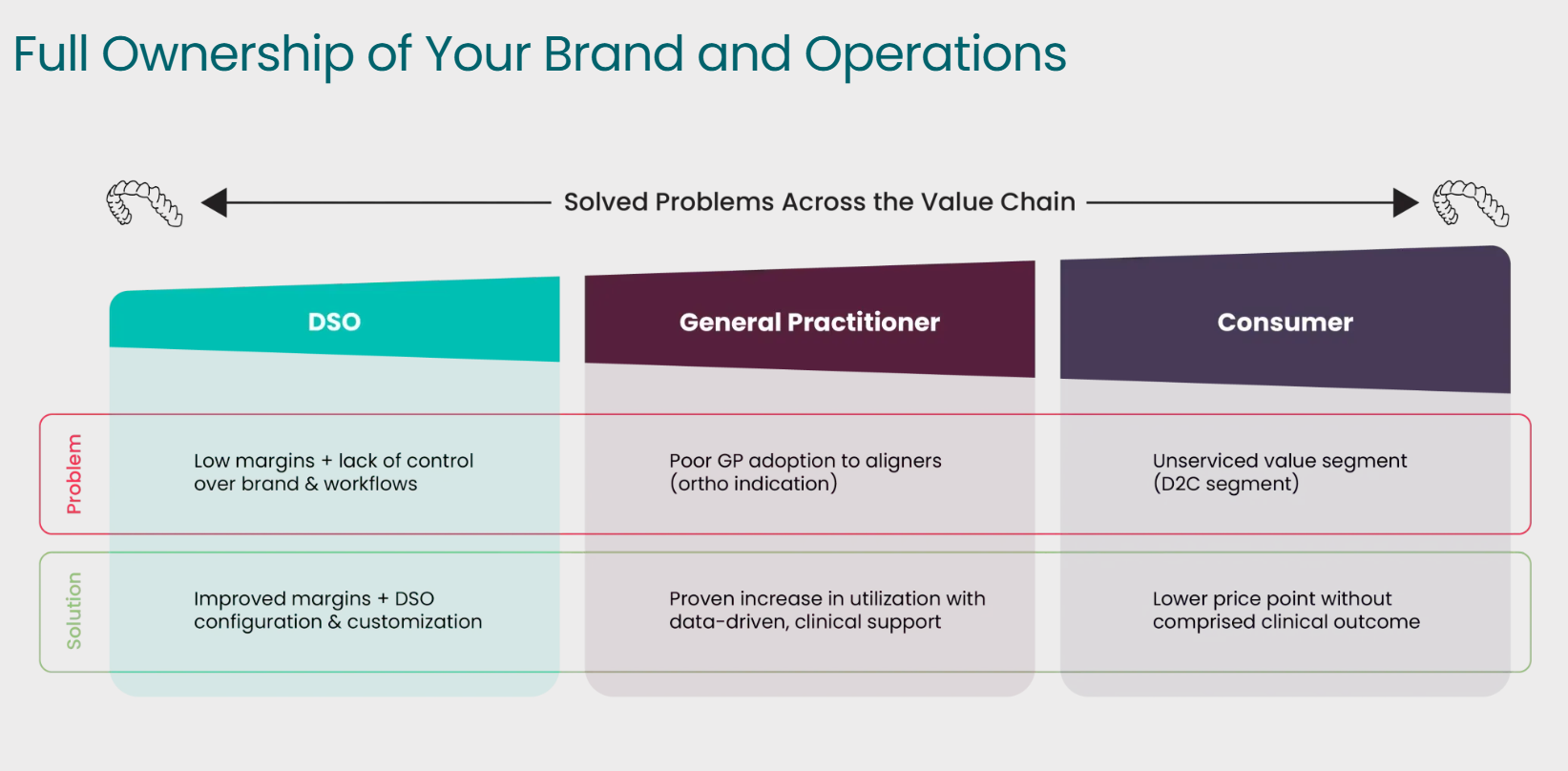
The most advanced DSOs are no longer optimizing within third-party constraints. They are moving toward proprietary aligner ecosystems, where they control:
- Pricing and margin structure
- Clinical protocols across all sites
- Patient experience under one brand
- Operational data and performance insights
- Long-term enterprise value creation
Until recently, building such a system required factories, software platforms, and large clinical operations teams.
That barrier is now being removed.
What was once complex and capital-intensive is becoming accessible without the need to build it from the ground up.
This shift is already visible in the market.
Across conversations with DSOs, a structural gap is emerging between case volume and value retention.
What is becoming increasingly clear is that as aligner programs grow, the limiting factor is no longer clinical capacity or patient demand; it is how much of the created value is actually retained within the organization.
This has shifted the conversation from operational expansion to structural design: how aligner programs are built, controlled, and integrated into the broader DSO ecosystem.
That’s where Eon Dental comes in: The DSO Aligner Engine
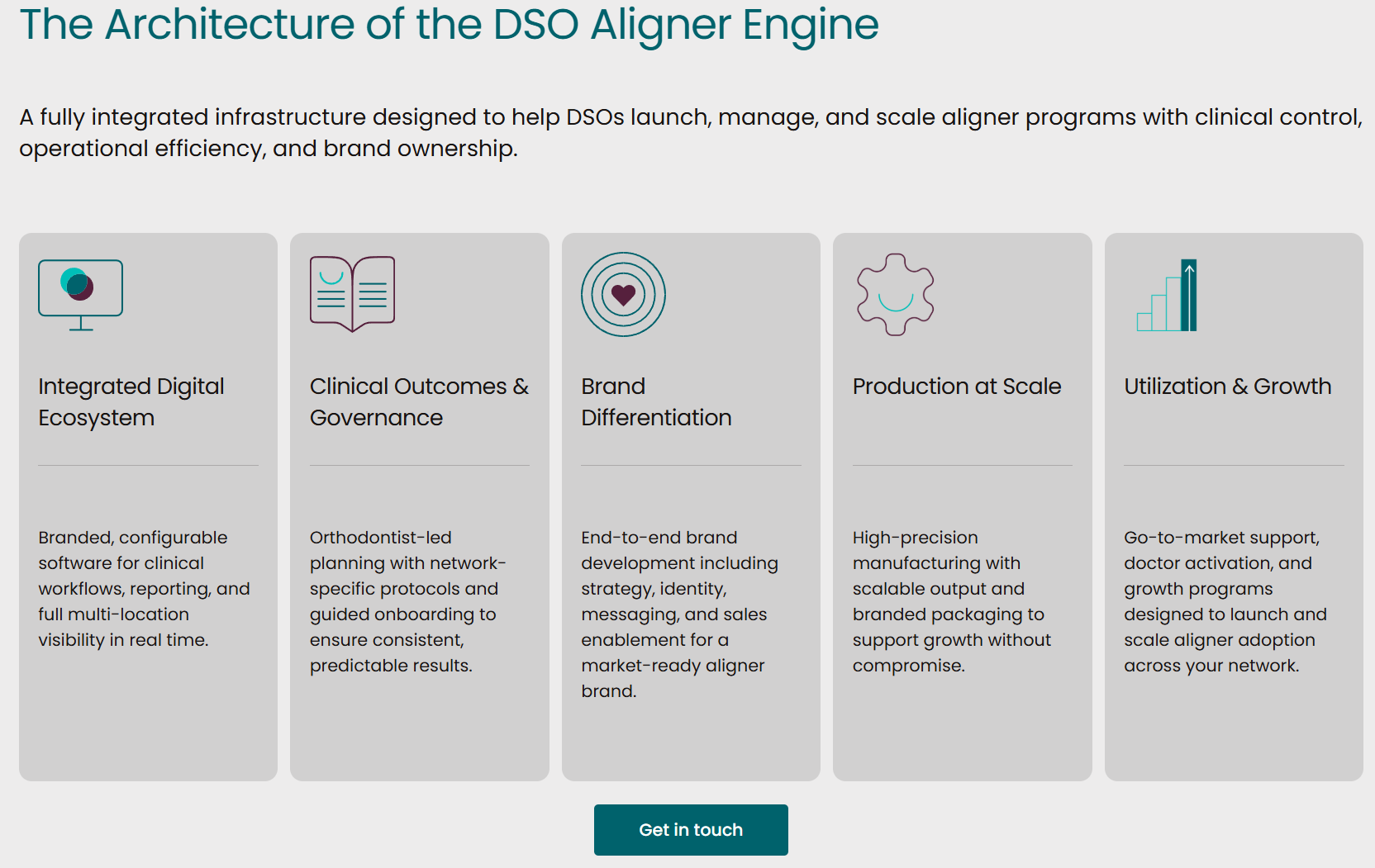
Eon Dental enables DSOs to transition from dependency to ownership without building manufacturing or clinical infrastructure internally.
It provides the full backbone of a scalable DSO aligner ecosystem:
- Premium aligner manufacturing under your brand
- Orthodontist-led treatment planning aligned to your protocols
- Integrated digital workflow and reporting systems
- Custom packaging and patient-facing brand experience
- Scalable operations designed for multi-country DSO growth
This allows DSOs to retain what matters most: margin, control, clinical consistency, and brand equity.
Success Story: Aspen Dental | Motto Aligners®
The success of Motto Aligners® demonstrates how our DSO Aligner Engine provides the sophisticated infrastructure required to scale a high-performance proprietary brand
Turnaround: 11 days from clinical submission to delivery.
Adoption: 133 new offices activated within 6 months.
Precision: 98% initial doctor approval on treatment setups.
Growth: 63% increase in monthly case volume.
“Eon has followed my clinical protocols meticulously and delivered high-quality treatment plans consistently.” — Dr. Payam C. Ataii Senior Vice President, Orthodontic Support at Aspen Dental Management
 “Eon has followed my clinical protocols meticulously and delivered high-quality treatment plans consistently.”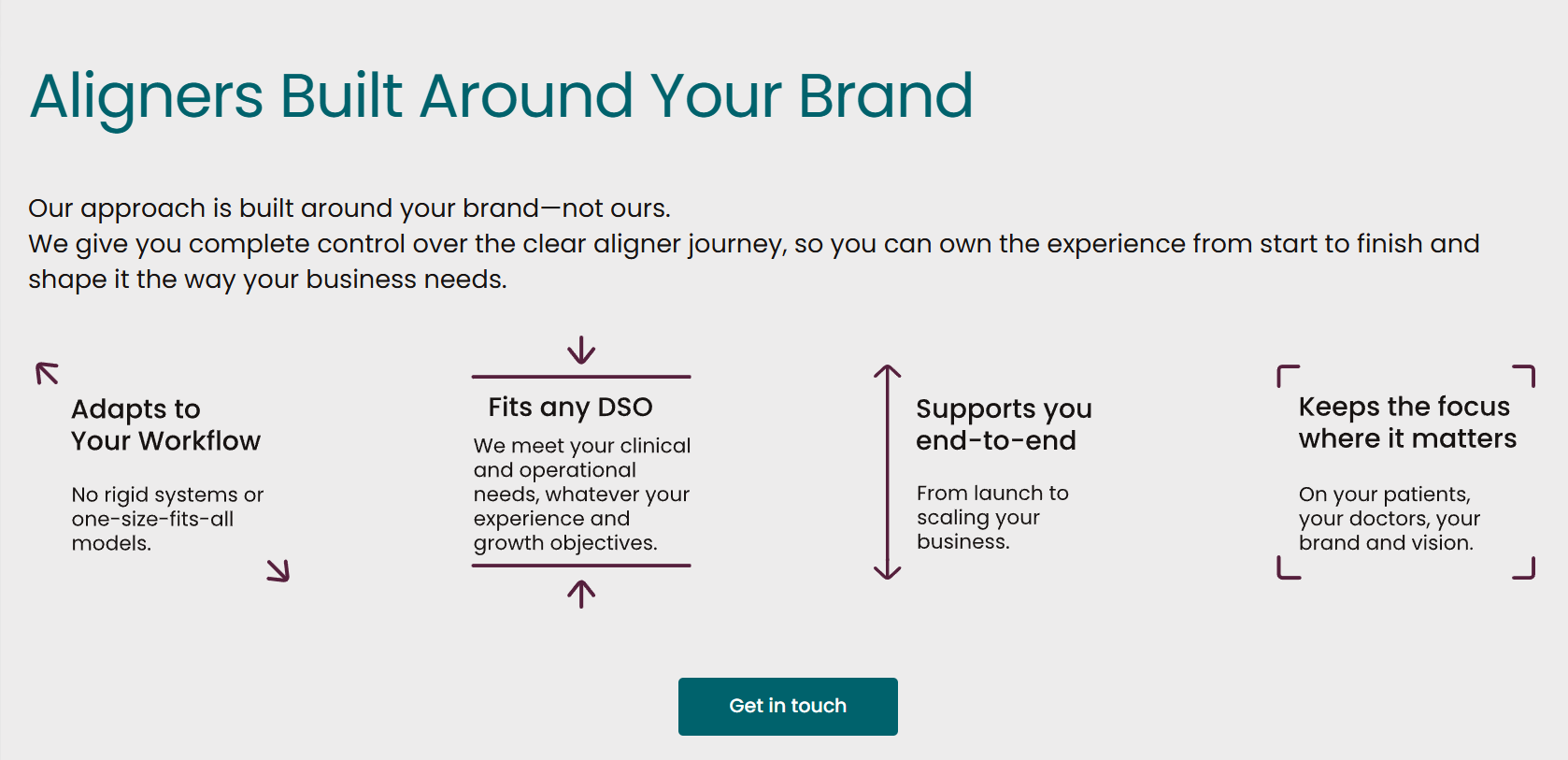
Ready to capture the value your aligner cases are creating?
➡️ Get in touch ⬅️