
Ranked the #1 DSO Podcast!
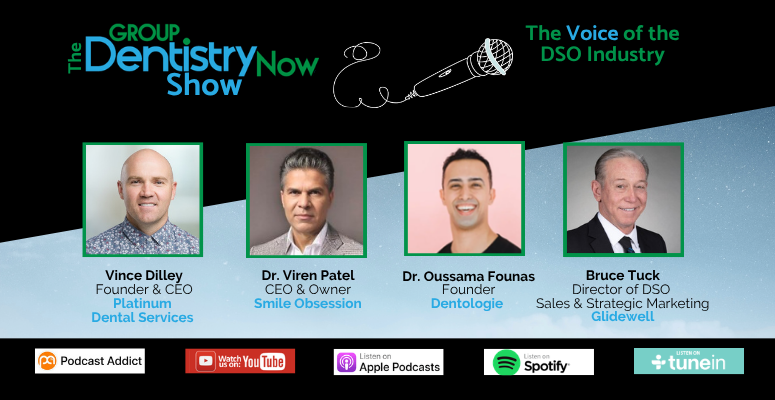
Welcome to The Group Dentistry Now Show: The Voice of the DSO Industry!
Beyond the Crown: How DSOs Are Rethinking Lab Partnerships, Data, and Digital Workflows
Dr. Viren Patel, CEO & Owner of Smile Obsession, Vince Dilley, Founder & CEO of Platinum Dental Services and Dr. Oussama Founas, Founder of Dentologie join Bruce Tuck, Director of DSO Sales & Strategic Marketing of Glidewell. The four discuss:
- Future of restorative dentistry & digital workflows
- The importance of training, education & implementation
- Key metrics & data points
To learn more visit https://glidewelldental.com/ or connect with Bruce Tuck at Bruce.Tuck@glidewelldental.com.
You can also learn more about Smile Obsession visit https://smileobsession.com/ ,
Platinum Dental Services – https://platinumdentalservices.com/
Dentologie – https://dentologie.com/
Subscribe to our channel for more episodes and stay updated on the latest DSO news, insights, and events!
If you like our podcast, please give us a ⭐⭐⭐⭐⭐ review on iTunes https://apple.co/2Nejsfa and a Thumbs Up on YouTube.
Choose your favorite listening app below and subscribe today so you don’t miss an episode! Full transcript is also provided below. See all of our podcasts HERE.
 |
 |
 |
 |
 |
 |
DSO Podcast Transcript – Beyond the Crown: How DSOs Are Rethinking Lab Partnerships, Data, and Digital Workflows.
Bill Neumann (00:12):
Welcome everyone to the Group Dentistry Now Show. I’m Bill Newman, and as always, we appreciate you joining us. It’s always a lot of fun to do these podcasts and we’re approaching number 300, so we’ve done quite a few. The gentleman that you see, if you’re watching this, and if you’re just listening to it, well, you’ll find out who they are in a moment, but they were all at Glidewell’s latest DSO summit in Newport Beach. And we were just talking before we started the record about some of the great conversations that were had there and the honesty. And so that’s what we want to share, the honest feedback. Our topic is going to be how DSOs are evaluating and leveraging lab partnerships and also navigating all this new technology when it comes to the lab space. And I think we can all say that there’s an abundance of technology out there now, probably a little too much and trying to just sort through all the options can be a real challenge.
(01:15):
So we’re going to try to do some of that here. Our guests are Vince Dilley. He’s the founder and CEO of Platinum Dental Services, Dr. Viran Patel, CEO and owner of Smile Obsession, Dr. Oussama Founas, founder of Dentology, and Bruce Tuck, who is director of DSO Sales and Strategic Marketing of Glidewell. So we’re going to kind of treat this since we’ve got a bunch of guests here as a panel discussion. And guys, feel free to interject if a question, somebody says something and you don’t necessarily agree and you want to push back a little bit, we can have a little bit of fun. Why don’t we kick things off with you, Bruce, just a quick introduction, your background and a little bit about Glidewell.
Bruce Tuck (02:01):
So been in dental space over 36 years. 30 of that was in the DSO space before DSO was even a word. I remember there was only one DSO meeting in the industry at that point, but transitioned over to Glidewell a few years back and have enjoyed the options that as Glidewell has offered. I started with a founder dentist and then went to private equity and then now back with a founder and the strategies are different and I really enjoy the things that Glidewell has to offer and how they can support different DSOs. My job the last year since I’ve been with Glidewell is so much easier because of the ways that Glidewell supports DSOs. So I’ve made some great friends and relationships along the way and wouldn’t trade them for a million bucks, but including the guys that are on this call.
Bill Neumann (02:57):
Nice. Dr. Patel.
Dr. Viren Patel (03:02):
Hi, I’m Viren Patel. I the CEO and owner of a Swyle Obsession located here in Chicago. Started it in 2020 during COVID after I found myself out of a job. Prior than that, I had sold my company to a private equity backed DSO, wasn’t happy and COVID was a pivot for all of us. So here I am today, we have 18 locations in Chicago and loving every aspect of it.
Bill Neumann (03:32):
Thanks Viren. Vince.
Vince Dilley (03:35):
Yeah, my name is Vince Dilley, founder and CEO of Platinum Dental Services. Founded the company back in 2012. We’ve emphasized in partnering with practices that have unlocked potential and improving those practices operationally and supporting doctors so that they can be the best dentist that they could be. And yeah, I’ve been doing that since 2012. We bootstrapped it to 38 locations. We brought on our private equity partner a year and a half ago and it’s been an awesome ride so far. So we’re at 50 locations and trying to add another 15 to 20 a year right now.
Bill Neumann (04:13):
Excellent, thanks. Dr. Founas.
Dr. Oussama Founas (04:16):
Yeah, Osama Founas from Chicago. Started Dentology roughly now 13 years ago, co-founded my two partners and we are Denovo. I have only been Denovo since that time. Took four locations in nine years, opened four locations in nine years. In the last few years we opened, now we’re at a total of 17 locations. So lots of learnings in that process. We are heavily big on the new patient experience. So a lot of what we do is since we’re Denovo, we are a single brand. So patients typically have an idea of who we are before they come in in terms of having certain expectations and experience as well. Today.
Bill Neumann (05:01):
Excellent. And you’re all built a little bit differently. Vince, I always say has that, he fixes practices, so he finds practices that are underperforming and fixes them. Dentology’s doing de novo. Verin, you’re doing a lot through acquisition. You probably have some fixer upper as well, right?
Dr. Viren Patel (05:26):
I do a little bit of both. I would say out of the 18 locations, we’re half and half. We’re currently building two, so nine of them were acquisitions, nine of them were de novos. Currently we have two under construction that would be de novos. And I love the M&A game, so we buy these smaller offices and do roll-ups and tuck-ins as well. So I’ve had my hands in everything.
Bill Neumann (05:49):
Excellent. So we’re going to get I think some really interesting feedback here. First question for the panel is, as you scaled up, how do you think your lab needs have changed? And then part two to that is have the labs you’ve been partnered with, because I know you probably weren’t always partnered with Glidewell, have they been able to adapt? So what are the changes as you’ve scaled up and how have your partners been able to adapt? We can start with you Usama.
Dr. Oussama Founas (06:27):
Sure. So I think what we were looking for in a lab partner, and I think maybe what you’re asking too is what’s different between when we were smaller versus as we grew. I mean, to be honest at the end of the day, I think the consistency has always been the most important thing. I would actually label consistency as probably the product over the actual crown itself, because in that you then have predictability on the schedule, predictability for doctors staying on track to what they need to do. Probably another thing that’s really important is, and this is more so now that we’ve worked with Glidewell for some time, is I mean data is king and smaller labs you work with, you can have this intricate level of service that is one-on-one, which you still can have with a big lab, but access to every doctor’s data in terms of things like remakes, time to ship out.
(07:12):
These are things that I think a lot of groups may not look into, but we do because it allows us to really hone in what we’re doing on our end as well. And then the idea of having one account, but you have 50 plus doctors, but you need to make sure everyone can access things really easily. So when you work with a group like Glidewell, I think it’s just nice that they keep up with their digital infrastructure so well that they don’t need to reach out to me about questions about their lab. They simply can log in. And I think stuff like that has really been a huge value add for us.
Bill Neumann (07:46):
Excellent. Veron?
Dr. Viren Patel (07:48):
Yeah, I echo a lot of the same sentiment as Dr. Founas. When you’re operating one or two offices, you can solve a lot through relationships. If there’s a problem, the dentist calls the lab, work stuff out. But when you’re operating a lot more than one location, let’s just say five, 10, 15, unfortunately that doesn’t scale and I learned that. So what I need now is consistency, accountability, and most importantly, data. I need the doctor in one office to have essentially the same experience as the doctor in another office. So we partnered with Glidewell about three years ago. All of our doctors use Glidewell. So for us, we need a lab partner that understands we’re just not sending out individual cases. We’re trying to build clinical systems across an organization. So as we’ve grown, we’ve become more interested in the data that the lab sees. If one doctor has a higher remake, if we’re seeing certain recurring issues, I want to know that.
(08:50):
That’s the information that helps us improve smile obsession and the organization.
Bill Neumann (08:58):
Vince, any more you want to add?
Vince Dilley (09:01):
Yeah, I’d just say scaling up a dental lab is super difficult to do, just like scaling a DSO is super difficult to do. And I think I learned that the hard way. I started a dental lab thinking, “Oh, this is great. We’ll build in a vertical integration into our business model. We’ll own a lab and we’ll be able to do the lab work for the doctors.” And aside from the political issues that arose from that, doctors feeling like they’re sending to a lab that’s owned by the organization and so forth, there’s some conflict of interest there. But what I learned firsthand is scaling up a dental lab, I mean, you’re scaling up this artistic ability. And so that’s what we experienced over and over as we were working with these smaller labs is they would do good up until a point. And then quality, as soon as we started sending a lot of volume to these smaller labs, the volume would fall off.
(09:47):
They’re trying to hire new technicians to service your account and the quality would wane, and it was very difficult to find a lab that could actually scale up with us. And then to just double click on what the other guy said is the technology infrastructure that Glidewell’s put together has made it not only scalable for the DSO, but been able to create and procure good feedback from our doctors so that if there is a qualitative issue, it’s refined quickly, it’s refined easily, and our doctors are extremely happy with Glidewell and the way they’ve done it.
Bruce Tuck (10:24):
Bruce,
Bill Neumann (10:26):
And this is not going to be a shocking question to you, but a lot of DSOs, they’re focused on price, makes sense 100%. So a lot of times when they’re starting a conversation or they’re evaluating lab partners, they start at price. Certainly important, but what other things do you find, and it’d be great to hear from everybody else too, are as important if not more important than just, “Hey, what does it cost to do a restoration? What does it cost to do this or that?”
Bruce Tuck (10:59):
So great question. You used two words there, price versus cost. And I think most of us heard that there’s a difference between price and cost. And typically the larger the DSO gets, the more focused they are strictly on price. And I think the piece that they miss typically is they are focused on price. They’re compartmentalized. They’ll look at one thing at a time, the price of a crown or let’s say an implant, and not everything that goes into that. And all three of these gentlemen mentioned something that we do that we try to focus on is the technology scalability. And most DSOs don’t look like when they start looking at pricing, they don’t look at remake rates, they don’t look at what other services and support that’s available to them. And I get that at certain point it is that we’ve always said you can’t cut your way to growth, but you can cut your way to profitability.
(11:56):
And typically they’ll get to a point where they just are so compartmentalized on one area, they won’t look at the cost of implants together with an implant crown. So they do those all separately instead of looking at the overall picture. This is why I think we do well with the smaller groups is all the other things that we do in addition to the price thing, but the support with the free implants, with the education, with the data, we try to keep all that up to speed. And as they scale, we know data’s important. And I think all three of these gentlemen have seen what we call the board. And so we try to track that stuff to detail, and if we don’t, we can create reports that will support the group or the DSO in the areas that they need. So price versus cost, there is a difference and I think we try to compensate.
(12:48):
By no stretch are we a cheap lab and we have no desire to be, but we hope that we can offset all those other things with the other support that we can offer.
Bill Neumann (12:56):
Yeah, I think it’s probably important to maybe dig into that now. We just talked about your event recently in Newport Beach, your DSO summit, but you do a ton of education. I remember Rob going over some of the numbers of courses and people that come through your location in Southern California. Now you’re opening up one on the East Coast in North Carolina as well. Talk a little bit, if you don’t mind, about the educational component because you certainly would talk about price, but then all these other things. And then I also want to get, I think the next thing is to talk about the data. Maybe we’ll save that for Dr. Founas because I’d love to know what data points are important to you all. So Bruce, first off, on the education side of things, can you talk a little bit about that?
Bruce Tuck (13:52):
Yeah, so the smaller groups typically have, they don’t have a very robust education platform. And Glidewell, as Mr. Glidewell often say, I feel like sometimes we’re an education company instead of a lab, but we do offer that with our DSO partners. We do that at no charge for multiple reasons. And I think the biggest thing is we can give them and help them. We track each dentist that comes to our event, we track by DSO, by doctor to see that if we can see it grow, they walk away and learn more and implement more. Actually, we met at the summit with Vince and Dr. Patel about the lacking areas of education in the DSO space. So we want to develop that and make it as accessible as possible. We have our events here. We will have those in Raleigh, but we also do webinars. In fact, Dr.
(14:48):
Patel’s group, we sent a course up that way and actually did one on their facility. So we really feel like education to support a DSO, to get their doctors to perform more and do more, expand their treatment options and get them better and more confident in the things that they do. So yeah, we definitely do that. And we know that all the things that we offer will vary, which is why I like having the three different groups represented here because they know what their needs are and I like their various opinions, but they could probably tell you better than I can as far as how our support from the education goes. But that’s our objective is to help the doctors be better, expand their treatment options, and make them more confident in what they do.
Bill Neumann (15:27):
I know Dr. Patel brought his whole group out there.
Bruce Tuck (15:31):
Yes, he did.
Dr. Viren Patel (15:33):
Yeah. I attended the Glidewell Summit a few years back and loved every aspect of it. And I asked Bruce and Rob, I’m like, “Hey, can you put on this summit just for my team?” And within two weeks they threw another summit together. I flew all my doctors out there and they loved every minute of it. And since then, we were with another lab and we 100% switched over to Glidewell and I stopped getting all the calls from all the doctors bitching about the lab. They’ve just stopped. Glidewell offers such a robust suite of support services and educational content, and all my stress is gone. Now my doctors are happy, I’m happy, and it’s a win-win. But yeah, I did take them all out there and it was one of the best investments I’ve made in the company.
Bruce Tuck (16:24):
So by the way, Vince did the same thing, brought his doctors out, but he gave us a little bit more than two weeks notice. And your doctor’s experience, Vince, when they came out?
Vince Dilley (16:38):
Oh, yeah. Yeah. Our doctors love it. We do an annual summit and we’ve hosted it. We’ve gone offsite and done these offsite kind of summits. And I think by far doctors like and prefer, one, the sunny weather of Southern California, but really I think what Glidewell puts together, I mean, if you’ve been to their facility, if you’ve taken your doctors out there, you see how they just roll the red carpet out for everybody. So our doctors love going down there. They love the education. I mean, I was down there for the DSO summit, and I know a few of my doctor partners are going to be down there. I came to find out, I think we had 10 doctors down there doing an overdenture course that weekend that they had just coordinated and planned for themselves. So everything from lab to technology to education, Glidewell kind of delivers just, I think, five stars across the board to where rather than us trying to have to encourage and move doctors and try to influence doctors to participate in those things, they’re autonomously choosing to be there, whether it’s at the summit that we set up as an organization or just on a weekend course that they’ve chosen to go to themselves.
Bill Neumann (17:54):
Dr. Founas, at the DSO summit, you were actually a presenter, so you were sharing a lot of really interesting data points and you mentioned data earlier. So maybe we could talk a little bit about what, again, Bruce touched on this, our audience is built around a lot of smaller group practices and groups, Dr. Owen, that are scaling up. What data do you think is really important when it comes to measuring how well a lab partnership might be for a particular organization?
Dr. Oussama Founas (18:28):
Yeah, I think the first thing is just to establish, repeating what you’re saying, but just I think the first thing is establishing what are the most important metrics to track, not only for success in terms of total output, like the number of crowns, that is I think something that is important, but the most important I would say is just being able to measure what that new partner is taking and as a percentage of revenue, how does that comparing to the rest of your P&L? So I think that one I can get crazy weedy on, get crazy details, but ultimately just being able to specifically track. And when we were starting to track early on, it was interesting because we made the switch to Glidewell not only as a lab, but we also went towards their milling units in the office. And then when Glidewell introduced the Bruxer Express, which is a DSO only invite for certain services that do come at a further discount, I think we just saw just a compounding effect where all these different ways we saw impact there.
(19:29):
The other parts that I think are really, really crucial, some of them are obvious, so you have to track things like remake rates, and by doctor. So for us, we just get red flagged immediately or even green flag. If we’re really low, people should get called out positively on that. But also if we’re noticing higher than average, which we have a benchmark for, we then can have conversations not only with the doctors, but maybe talk to Glidewell about it and see, hey, it’s more of a lab thing, is it more of a doctor thing? It’s pretty quick and easy there. I think also we’ve started measuring things like same-day visit stuff. So if patients come in for crowns and can we do it same day? Again, I think this is not going to the territory of things like mill adoption, but those are very different things that we do try to capture with that data.
(20:14):
But I can get very weedy on this stuff. It’s a fun conversation to have. And if you get doctors involved, they start looking at these things as well because ultimately if they get very efficient with their visits, then it does mean more money in their pocket and usually typically, which is always the goal is better patient outcomes.
Bill Neumann (20:33):
Can you talk a little bit more? You mentioned that you adopted the fast mill. Do you have that in each one of your locations? Can you talk a little bit about the impact that it’s had on the practices and then also just from a standpoint of patients? I’m sure obviously they’re getting their restorations a lot quicker.
Bruce Tuck (20:53):
Bill, if I could – Yeah. Sorry, Dr. Funis. Vince is a KPI kind of guy, and first time I ever saw him present, I was like, “This guy must have been in sales somewhere.” But if Vince could give his KPIs that he looks at and maybe Dr. Patel, just so everybody knows when it comes to lab work and things like that, what else do you guys look for?
Vince Dilley (21:15):
Yeah, happy to weigh in there. I mean, we look at something very similar. What is the cost of our lab costs relative to our revenue? What percentage cost to revenue does our lab make up? I think as I’ve spoken with other DSOs, they view this differently. The classifications are important in your accounting. Some of them view dental implants and supplies and not as labs, and we classify that as labs and so forth. So again, the details are important in terms of your classifications of supplies and labs. But I mean, in combination with the free implant program with Glidewell along with the negotiated rates on the actual implants, so long as they’re being scanned and not sending physical models over or physical impressions over there, I think we’ve been able to control our lab expense much, much better. We also like to look at remakes. What’s the remake percentage?
(22:10):
Again, I mentioned that I had a lab at one point in time, and it wasn’t until I owned a lab and was running a lab that I realized that most of the remakes were not lab-driven. It was usually due to your volume pressure that was set over or some type of issue with the actual impression. And I think it’s really important to be able to understand if there’s an issue with a particular doc having multiple remakes, is that a lab issue or is that a doctor issue? And you can help doctors improve their clinical quality with that type of feedback. That’s some of the information. I mean, we also super appreciate the ability to work with our finance team in terms of our payment terms and everything else. Some of those smaller labs had a really hard time with that. So those are kind of three areas that we track that are super helpful, and Glywell’s able to gather that information for us and feed it back to us in a very timely fashion.
(23:02):
Their new dashboard’s awesome as well, which we’ve just recently started to play with and they’re starting to track a lot more data there.
Bill Neumann (23:10):
Great. Dr. Patel?
Dr. Viren Patel (23:11):
Yeah, I like to separate the clinical metrics from the financial metrics. So clinically, I like to look at the remake rate, turnaround time, adjustments, stuff like that, some measurement of additional appointments related to that specific restoration, whether it be a crown or partial. Operationally though, I like looking at lab spend per provider, the digital utilization, are they scanning versus are they taking impressions? And I look at that amongst the different offices and doctors. But for me, the main metric I’d really like to get the lab’s involvement in is the chair time consumed per successful restoration, because the faster we could turn over the chair with a successful restoration, the more money we’re making. Because if a crown’s costing me, let’s say $20 less, but another appointment, it’s actually not cheaper. It’s a lot more expensive. So that’s what I’m starting to really get into in terms of KPIs.
Bill Neumann (24:23):
So I’ll stick with you, Dr. Patel. Let’s talk about standardization. I mean, as you scale up, it becomes more and more difficult. You’ve got more clinicians, different skill sets, different levels of tech adapting to new technology. So can you talk a little bit about how you try and standardize from a clinical perspective and can Glidewell help that way?
Dr. Viren Patel (24:50):
Yeah. I mean, I work for a private equity-backed DSO and I have my own practice, private equity-backed DSO, and now I’m running my own. And I think one of the biggest mistakes a DSO can make is confusing standardization with telling doctors how to practice dentistry. So for me, it’s small obsession. It’s not to make every dentist practice exactly the same way. They’re clinicians, I’m a clinician, they need to all have their own clinical judgment. What I want to standardize is everything around the doctor that doesn’t need to be different, like our tech, our materials, our lab relationships, going with Glidewell, our digital workflow. We have Glidewell scanners at every office and our expectations for quality. If every single doctor’s using different labs, because I’ve dealt with that, different materials, different workflows, it becomes very difficult to scale and almost impossible to understand where the problems are coming from.
(25:51):
So for me, when I switched to Glidewell, it helped us create that consistent platform. The individual dentist can still make the decisions, but they don’t have to reinvent the entire process. So my goal is to standardize the system, not the dentist.
Bill Neumann (26:10):
So from a standardization perspective, do you have Vince, do you have a different way to approach that or is that pretty much your approach?
Vince Dilley (26:19):
No, I love what Dr. Patel just said. I mean, I think clinical autonomy seems to be a buzzword in our industry and everybody’s talking about clinical autonomy, but I think to build a platform that truly supports clerical while also supporting the scalability, the infrastructure, the predictability of those support services is extremely difficult to do. And I think that what Dr. Patel says is exactly right. I’ve had this mantra recently. I recently ran a hundred mile race and I had some issues in my race where I thought I was going to have to quit. And long story short, I was just trying to keep up with this guy that was with me. And I learned in that race that you have to run your own race, don’t try to run somebody else’s race. And so we kind of adopted that really in terms of how we run the business is every dentist needs to be able to practice the way that they want to practice.
(27:13):
How do we build a support platform that can support them in whatever race they’re trying to run, whatever dentistry they’re trying to practice that keeps things scalable, consistent? I think, again, coming back to Glidewell’s technology, it enables that to happen, but doctors being able to practice freely the way they want to practice. And that’s why Glidewell’s not our only preferred lab. We have a variety of preferred labs, and some doctors prefer to have a local lab where they can come in and do a custom shade for a particular case. So I do think it’s important to create a variety of things that you can standardize, again, get the benefit of scalability while also preserving what I believe is necessary in dentistry, which is dentists need to be able to practice the way that they want to practice and care for patients the way that they see fit.
(28:04):
So again, it’s a buzzword, this clinical autonomy thing, but those who are actually creating a platform that can do that I think are far fewer and it’s very difficult to actually do. And I think we just keep our eye focused on that, making sure that doctors are happy. And what we found is just by default, because of the product and the service that Glidewell delivers, most of our doctors send most of what they do through Glidewell.
Bill Neumann (28:28):
Yeah, that’s a really good point. Dr. Founas, you said buzzword, which I think you’re right. I think a lot of people might look at just clinical autonomy. Everybody says that, but do they actually mean it? And how do you actually deliver that or let the clinician deliver however they think is the best way to deliver clinical care? Dr. Founas, do you run into that at all with maybe newer clinicians maybe looking to join your organization? They’re like, “Okay, you’re a big group. Am I going to be able to practice the way I want to practice?”
Dr. Oussama Founas (29:07):
So our average H4R dentist does skew a little younger. My average dentist is probably somewhere around 31, 32. So it definitely skews younger than probably the average large group where they skew older and have more experience. So I do have the luxury that adoption is typically built with less friction, and partly because when you have a brand like ours and you’re just one brand at every office, and the expectation from day one is we do things the same in most places, they typically are, how do I say, it’s on us to lose that trust from them. So they come in with a system, we’re fortunate they’re like, “Cool, this is the way you do things. Great, we’re going to keep doing that.” And then is it incumbent on us as managers to make sure that we don’t lose that trust because things are not getting sent out on time, things are coming back late?
(30:00):
So this is where we’re fortunate that that system I think has built enough good grace that other providers, when new providers come on board are typically telling them, “Just follow the system, man. It works. Don’t rock the boat.” And not even to rock the boat with management, it’s more like if you keep doing it that way, you can get very predictable outcomes. So I think we’re a little different fortunate in that regard.
Bill Neumann (30:23):
Yeah. Makes sense. You’ve invested a lot in office milling. Can you talk a little bit about the impact that that’s had at the practice level?
Dr. Oussama Founas (30:32):
Yeah, it’s been an interesting ride to say the least. So my experience with milling is very different where for the first, I would say seven, eight years of my clinical experience, I’ve always tried to look for the right system to work around my workflow. And what I mean by that is many mills that you work with require many touch points. A system has to do X, doctor has to do Y, you have to use this oven. And I’m just a firm believer that the more touchpoints that are involved with anything, the higher likelihood of error rates. I think that’s an engineering concept, but it’s just one of those things where you want to minimize touch points. And when the fast mill came about, it was definitely a big bet on our part of like, “Hey, this is a big thing to try.” And I was a part of that experiment of being a guinea pig along with two providers.
(31:22):
What we really found that was fascinating was that Glidewell’s fast mill just, and again, I don’t mean to sound like an infomercial, it’s genuinely just my experience. The technology was just adopting at a very fast rate. So the version of the mill that we had in, I think we started in 2021 is basically like a flip phone now compared to the version that they have now. It’s just because it’s evolved so much. The AI and it’s significantly faster and better. The mill time, which I really credit the team that they focus heavily on cutting down mill time. And just so everyone knows what that means, just means that what used to take 45 minutes, now it takes 30 minutes, 15 minutes of save time is massive in a group system. So seeing things like that, I think part of why we also get pretty good adoption with our doctors is we actually require it for onboarding.
(32:17):
So part of our onboarding process is an entire section on the mill, how to use, how to do X, Y, and Z, how to follow up with making sure that it takes X amount of time to get to the level of success with your cases because hey, you’re going to be learning and you’re going to make mistakes and making sure the clinical team, so outside of the doctor, including the assistants, understand how to also use the mill in their capacity. And we also took the step further of investing in a lab tech who is there for the doctors, which we deemed as, hey, is this going to be a worthy investment? But to be honest, it’s been more than worth it in the end of the day.
Bill Neumann (32:54):
You mentioned something that’s really key, adoption. And so with all this great technology, it doesn’t mean it’s necessarily going to be easily adopted. Bruce, do you have any thoughts on that maybe for people in the audience? If you’re looking at in-office milling and maybe some successful ways to implement the in-office workflow, if you’re going to invest all this time and money, it sounds great, but if you can’t get people to use it.
Bruce Tuck (33:23):
Yeah, 36 years, that’s always been the same question. I think all three of these on the call would agree. It really boils down to three things. I think it boils down to training, support, and accountability. And I think the biggest piece that becomes missing, we talked about autonomy, is the accountability part and being afraid of the accountability piece. I think the great thing about the milling, as far as we see, there’s not a lot of DSOs that incorporate milling across the board because the adoption is a thing and Dr. Founas is unique. So we have a mill because one is we feel like we’ve cut out the issues with the previous mills, but the other thing is we want to be able to meet the dentist where they’re at, and the DSO is part of the autonomy thing. If they’re going to go down this road, you find people who sell mills, they tell you, “Well, you should never say anything to the lab, do everything on the mill.” And you find people who have a lab say, never use the mill and whatever.
(34:22):
So I think we want to meet them where they’re at. And as far as the adoption, I don’t care if it’s a mill or if it’s a scanner, it’s anything at all. I would say that it boils down to the three things of support, training, and accountability. And I believe the other three may have a different opinion or have some other things, but I think that’s the three key things when it comes to adoption on anything at a DSO.
Bill Neumann (34:48):
Viren, it’d be great to hear from you. What are your thoughts?
Dr. Viren Patel (34:52):
When we’re rolling anything out, I’m a little bit different. I’m pretty much, “Hey, it’s my way or the highway. So I’m your employer, I own the company, this is what we’re doing. If you don’t like it, get out.” I’m fortunate in Chicagoland that it’s easy to recruit dentists, but my dentists have always kind of followed my path in leadership. In my previous role working at a different DSO, there was too much, “Oh, if we do this, this doctor’s going to get upset. If we do this, this doctor’s not going to like it. They might quit.” Just rip the bandaid off. If you want to implement something, whether it’s fast mill, digital scanning, we just got Glidewell’s 3D printer for night guards and we’re just telling them, “Hey guys, this is how we’re doing it. If you don’t like it, then you’re going to lose your job.” So my opinion is if you’re going to roll out anything in your DSO, rip the bandaid off and make your doctor’s hygienist assistants follow your leadership and jump on it.
Bill Neumann (35:54):
Vince, how about you?
Vince Dilley (35:57):
Yeah. Well, in terms of adoption, I think Glidewell’s very smart about the way they do things. I went to dinner with one of my doctors last week who did their trial of their fast mill and I think it was, I don’t know, 90-day trial or something like that. And so at the end of the 90-day trial, that doctor met with the CFO. It’s a capital investment, so they’re talking about, “Hey, is this technology worth investing in?” And the doctor’s response to the CFO was, “You’re going to have to pry this mill for my cold dead fingers.” So I think it speaks to the value that it brings to the practice. And certainly same day delivery of crowns, I do believe that we’re moving more towards Dr. Founas’ model of having mills in more offices, but the question’s always adoption. You don’t want to make a big CapEx investment and just have a $75,000 dust collector sitting there because it’s not being used.
(36:49):
I think something that Glidewell’s done that’s made adoption much more easy than historical mills is just the AI design process. So the AI design process gets the margins, gets the design of the crowd actually maybe 80% of the way there. And so there’s just really some fine tuning. So it’s cut down on the design time, which I think is super helpful. And then if you’re in a pinch and you need somebody to help with design, you can call Glidewell and I think for five or six bucks or something like that, then they’ll have somebody design it for you right then. That level of service enables doctors to be able to deliver care in a way that is just really unparalleled. And so I do think that that’s where the future’s moving is to bring the lab into the four walls of the practice by using something like fast mill.
Bill Neumann (37:36):
Once you get the adoption, Dr. Founas, what’s the biggest benefit of having that fast mill doing the in-office restorations?
Dr. Oussama Founas (37:47):
So it depends which angle you’re looking at it from. If you look at it from a patient perspective, which obviously is among the most important, it’s very hard for you to go the other way once you’re used to getting something that day. So I think the adoption of the mill kind of provides a level of convenience and accessibility for patients that they weren’t used to otherwise. I would say the other is from a provider perspective, it really becomes a Swiss army knife. So an example would be as doctors progress from using, this is an example, using error-driven hand speeds to electric, they kind of got to the point where and go back and use air-driven hand pieces because of the way that. And the mill is the same way where once you get used to delivering things, even if it’s not same day, you just start having this flexibility in your skillset and it becomes very versatile for many different types of things.
(38:38):
So if you’re someone who does in-lays and on lays, there’s a whole aspect to it. If you’re someone who loves using it for certain temporary stuff, it just opens up your arsenal and you become quite productive when done the right way. So we’ve noticed doctors who have adopted to it, they really go into it. And it’s nice because we have a leaderboard of our doctors where they can always review where they fall in terms of procedures or productivity. And it’s nice because of our top 15 doctors, over 80% are probably our heaviest mill users. So because they’re that productive because of that, I don’t have to sell anything to the other doctors. They see that it’s an arsenal and a tool that it really has helped those other doctors become productive.
Bill Neumann (39:22):
I’m going to put Bruce on the spot for a second here. So this is for everybody but Bruce. Is there something that you all feel a lab partner might be missing when it comes to supporting a DSO? You can be honest here. I’m sure that you’ve got wishlists, but in general, when you look at partnerships and support from labs, are there something that may still be missing or something that you’re really looking for? Veron, why don’t we start with you?
Dr. Viren Patel (39:58):
I would say the clinical and operational intelligence on the data that these DSOs have. I’ll be honest, I don’t want to just know how many crowns I bought. I want to know which doctors are doing great, which doctors I need to fire, which doctors suck at scanning, which doctors have a ton of remakes, which offices are having more problems than others. And you guys in all labs have that data, and if you guys can share it in a way that helps me run my organization better, that’s gold for me. So if you could turn all that data into intelligence or insight, you’re not just my lab anymore, you’re helping me run a better organization. That’s what I’d love.
Bill Neumann (40:45):
Great point. Vince.
Vince Dilley (40:48):
Yeah, I think Glidewell sits in a class of its own because if you’re talking about just historically what a lab is, I mean, it becomes a commodity really quick. I mean, it does become about price and chair time very, very quickly, but we don’t view Glidewell as just a lab partner. We view them as a technology partner. We view them as an education partner. And interesting that Mr. Glidewell said that, Bruce, that you guys sometimes feel like you’re an education company first and a lab second. Truthfully for us at least, the ability to help doctors start out on a clinical development path where we got vendors like Glidewell and others who’ve leaned in on the education side for us to help doctors get the continuing education that they need to be able to expand their skillset, advance their career, and become more productive, help patients get access to a broad scope of services, broad scope of care within a practice is not only great for the business in terms of growing revenue and profitability, but it’s great for doctor retention.
(41:51):
It’s great for doctors stepping in and truly having a support platform that helps them grow and develop throughout their career. And so it’s hard to say that Glidewell’s our lab partner because I mean yes, they’re that, but they are also so much more, which is why we’re partners with them. I mean, if it was literally just about the crown coming through the mail and being sat, they deliver a great product, but I mean we would be much less compelled to stay with just Glidewell if that was all the offering was. So again, it’s hard to put Glidewell just in a lab box because they’re, at least to us, a lot more than that.
Bill Neumann (42:29):
Yeah. Great points. Dr. Founas, anything more you wanted to add or anything you want to say to Bruce he needs to put on the roadmap?
Dr. Oussama Founas (42:40):
I would say so. It’s probably two or three things that jump out at me right away, and it’s obviously in conjunction with what the other two have already said, but I think reporting that’s dynamic for a group and not a single practice. So I am very fortunate where every month Bruce and his team send me reports. It’s raw data, but I take the data, interpret it how I need to. A true partner over time I think understands how it should be interpreted and gives me actionable things that I can do with it. So if one office is three times a redo rate of another office, that’s a quick actionable thing I can work on, which my team will look into, but I think that’s a huge thing for the group setting. I think additionally, we’ve talked so much about doctors, but the assistants are one that if we have a certain level of education for them and a certain workflow that’s for them, I think we will see nationally just the turnover rate just decrease significantly for that group because they just don’t have the level of support and it makes sense.
(43:34):
Doctors are obviously the ones that bring in the production. And I’d say the third thing that many groups will talk about is their concern about from a financial aspect is capital expenditure. And you’ve now seen several other labs provide the whole, “Hey, take the scanner, you don’t pay for it, but we get a number of cases, yada yada.” I think there’s a world where that starts making more sense because that is real dollars for groups who you’re skimming by in some months in some location, so it really does help out. So I think that’s the lowest, but it’s still something that I think a lot of groups are looking at.
Bill Neumann (44:10):
Yeah. Great points. Bruce, now I’ll let you ask these gentlemen any questions that you want since they picked on you a little bit.
Bruce Tuck (44:18):
No, I really don’t have any questions I’d like to ask. I do want to say that as far as what do we try to do as a lab is we really want to help the DSO. We want to meet them where they’re at and support them where they’re at, and not just the DSO, but the doctors. This is why everything we do, I mean, we’re vertically integrated to a fault. All of our digital workflows, we accept any digital scan, all of our digital workflow systems, whether it’s mills, scanners, everything we do is open platform. We have our implants. So there’s one stop shopping on the implants. This is why we make over 2,300 different implant parts. We actually make them here so there’s not extra charges. So whatever the implant system they use, the scanner system that they use, we want to be able to support that.
(45:07):
So I don’t really have anything other than, I mean, I invited these three on for a reason and I want to get there. My goal is that whatever they look at and how they decide on lab partner, whether it’s Glidewire, like Vince said, not everybody’s going to, we’re never going to have it all and we’re not the only one to go to, but maybe just help other DSOs or help other labs as far as what somebody’s looking for. I don’t have any asks of any of our partners other than keep sending us more.
Bill Neumann (45:41):
Well, let’s take a crystal ball look then, Bruce. Talk a little bit about what the next three to five years looks like when it comes to restorative and digital workflows. And I’d love to get your feedback on that, what you all maybe either expect to see or would like to see.
Bruce Tuck (45:57):
Yeah, I would say probably the way things are accelerating, I don’t think anybody really has an idea of where we’re going to land in five years. And most of the technology stuff, digital stuff you see is not related to the lab, but I do believe digital workflow, the road where we’re headed is, I think Vince said it earlier, but I do believe in eight to 10 years, Crown and Bridge will probably all be done in the office in minutes. I think as far as where we’re headed with the technology and scanning is only going to get better, but I think the digital workflow technology, and all three of these gentlemen have been to Glidewell, and I think we’ve been on the forefront of technology. I think we were the first to incorporate automation AI into the systems, and they can speak to what they’ve seen here.
(46:41):
And it’s all developed internally with Glidewell. So we try to stay advanced as possible in the processing and everything like that, but I believe all that, the automation, the AI will help in the processing and making things faster and better. Specifics, I probably wouldn’t want to make a guess, but these gentlemen can tell you what they’ve seen as far as what we’re attempting to do.
Bill Neumann (47:01):
Sure. Dr. Patel.
Dr. Viren Patel (47:05):
Yeah, I think the future is awesome. Digital’s going to be the default rather than, we’re all calling it digital dentistry now. Scanning’s just going to be how dentistry’s done, lab communication’s going to get better. What I’m seeing is I think we have a lot of different data points. We have practice management data, imaging data, let’s say scanner data, main data, laboratory data, and they’re all living in different places. And eventually, hopefully someone like a Glidewell can connect all those systems so we can all communicate better and we could help operators like me run our groups better. So I think that’d be cool eventually. I think that’s going to be coming, especially with all the AI hype that’s out there.
Bill Neumann (47:57):
Sounds good. Vince?
Vince Dilley (47:59):
Yeah, I think it was Dr. Founas actually who taught me something at that DSO summit. He gave an example of Jeff Bezos and how they think about the delivery of their packages as part of their product. Delivery is not a service, it’s a product. And I really like that idea, and I’ve though about that idea a lot. I think if you look ahead five to 10 years, the convenience demand of consumers and patients is not going away. They’re going to expect and require and demand greater convenience, fewer appointment times, shorter appointment times. And so I think if you follow the consumer, you follow the patient, you help doctors deliver care that they want to deliver in a more convenient way, I think you’re going to win. And adopting technology is going to be a key component of doing that. And for us, that’s where we’re trying to lean in is help doctors consider the delivery of care and the convenience they’re in as part of the product that they offer.
Bill Neumann (49:01):
Great. Dr. Founas.
Dr. Oussama Founas (49:04):
I would say that in terms of working with labs, particularly ones like Glidewell, I’m hopeful based on how they’ve grown that they can be a more significant part of how our doctors grow, both clinically and as the providers that they are. I’m already starting to see that with the level of education, but I think if we can get to the point where when a new doctor starts, they are kind of integrated day one and there’s a level of predictivity of where they’re headed. Additionally, the other thing is it’s a bit more tactical. The way the meal works at the moment is amazing, but when the time comes and these meal times can get down to less than 15 or 10 minutes, that just changes the entire scope of how productive an office can be and the patient outcomes, just how impressed and surprised they would be, it would be phenomenal.
(49:58):
So I think those days will come. They’re not there yet, but I think that’s technology that I think would be insane, that a crown visit can become basically 30 minutes and they’re done.
Bill Neumann (50:08):
Excellent. Well yeah, I’m sure that’ll happen, right? It’s just a matter of when. Well, great. Great conversation. Appreciate it. Glidewell.com. So if you’re interested in learning more, and we’ll drop Vince, Dr. Founas, and Dr. Patel’s LinkedIn handles in the show notes so you can reach out to them if you’ve got any questions. But thank you, Bruce. I’ll give you final thoughts and then we’ll sign off.
Bruce Tuck (50:36):
No, just appreciate everybody’s input. Anything that we can do to support, and I think the other piece that we try to do is I’ve met with Vince and several of them as far as not just the education piece, but the data points, right? That’s becoming more and more important. I think we’re seeing a difference in it and that’s really becoming the separator. But if there’s anything that we miss, we’d love to add to support it. But I just really want to be thankful and grateful to the three that are on here, willing to share and take the time. They’re very busy people and be able to cut out time for us and share their thoughts on this, and hopefully it’s helpful. And I know they’re great gentlemen, and if you reached out to them for help and support questions, I know that they’ll help, but thank you all three, really appreciate it.
(51:22):
Bill, appreciate the time.
Bill Neumann (51:24):
Yeah, thank you. And thanks everybody for watching or listening in. Until next time, this is the Group Dentistry Now Show.