

DSO Marketing
Walk into a Chick-fil-A, Costco, Bass Pro Shops, or even your neighborhood grocery store, and you will notice something almost immediately: nothing is accidental.
Every successful consumer brand intentionally designs the customer journey. These companies understand where customers are physically, emotionally, and mentally at each stage of the experience, and they adjust their messaging, displays, and service areas accordingly.
Think about the grocery store. Milk is almost always located in the back. Why? Because nearly everyone needs it. By placing it there, the store exposes shoppers to dozens of other products before they reach the milk and again as they make their way to the register. The layout is designed to encourage customers to pick up additional items before checking out.
Now think about the last time you walked into Costco. Most of us go in for one or two things and somehow leave with a shopping cart full of items we never intended to buy. That is not luck. The warehouse layout, product placement, and customer flow are intentionally designed to expose shoppers to products throughout their visit.
Dental practices should think the same way.
Every patient follows a predictable path through your office. The patient enters through the front door, checks in at the front desk, waits in the lobby, walks down the hallway to the operatory, proceeds to a consultation or checkout area, and exits through the same door.
The question is whether that journey has been intentionally designed or whether it simply happens by default.
Over the past two decades, I have had the opportunity to lead marketing and operations for hundreds of dental practices, ranging from private practices to some of the country’s largest dental organizations. Along the way, my teams conducted proprietary consumer research, performed in-office visual testing, evaluated patient communication strategies, redesigned offices, assessed patient flow, and measured what influenced trust, treatment acceptance, retention, referrals, and overall practice growth.
One lesson became incredibly clear: patients experience dental offices very differently from dentists.
I have walked through more than a thousand dental offices over the years. Within five minutes, I can usually tell whether an office was intentionally designed around the patient or whether it simply evolved over time. Patients can tell too, even when they cannot explain exactly why.
Most practices invest heavily in digital marketing, SEO, AI, websites, and online reviews. Those investments absolutely matter. However, one of the most overlooked marketing channels is the one patients experience for the longest period of time: the office itself.
The Patient Marketing Journey
Every patient moves through essentially the same journey:
- The patient sees the exterior of the office from the parking lot.
- The patient enters the building and approaches the front desk.
- The patient waits in the reception area.
- A team member escorts the patient down the hallway.
- The patient enters the operatory.
- The patient moves to a consultation or checkout area.
- The patient walks back through the lobby and exits.
Each stage has a different psychological objective, marketing opportunity, and potential business outcome.
Most dental offices are designed primarily around clinical workflow. The highest-performing practices are also designed around patient psychology. Those two priorities are not always the same.
Rather than simply decorating an office, dental leaders should think about intentionally designing a patient experience.
Here is your homework: Tomorrow morning, do not walk into your office as the owner, doctor, office manager, or marketer. Walk in as a brand-new patient.
Park where patients park. Enter through the same front door. Sit in the lobby for five minutes. Follow the exact path your patients take.
I suspect you will notice things you have been walking past for years.
Now, let’s walk through each stage of the journey.
Reception and Lobby
Many patients arrive feeling anxious. The reception area’s first job is to reduce that anxiety by creating an empathetic environment. It should reassure patients that they are in the right place, provide opportunities for both passive and active education, and help them feel connected to the practice.
Avoid clinical artwork featuring silver fillings, giant teeth, root canals, and, yes, that crocheted “Be True to Your Teeth” wall hanging someone’s aunt lovingly made in 1989. Unlike a 1989 Upper Deck Ken Griffey Jr. rookie card, this is one collectible that has not appreciated with age.
Clinical images can reinforce fear. Our research consistently showed that patients are uncomfortable discussing their oral health concerns in the lobby or at the front desk because they do not want other people to overhear them. They want the reception area to make them feel comfortable and protected.
And while we are at it, if your reception area still has the same fake ficus tree that has been collecting dust since Bill Clinton was in office, it might be time for a refresh.
Instead, use lifestyle photography, images of families and healthy smiles, examples of community involvement, and visuals that reflect your brand. Original photography featuring your patients, team, and community is even better.
A few specific recommendations include:
- Place a branded welcome plaque at the front desk.
- Keep the front counter clean and free of clutter.
- Greet each patient as they arrive.
- Create a reception area that feels warm, comfortable, and consistent with your brand.
The lobby is also one of the most valuable places for passive education, membership plan promotion, referral marketing, and highlighting the positive impact your practice has on patients and the community.
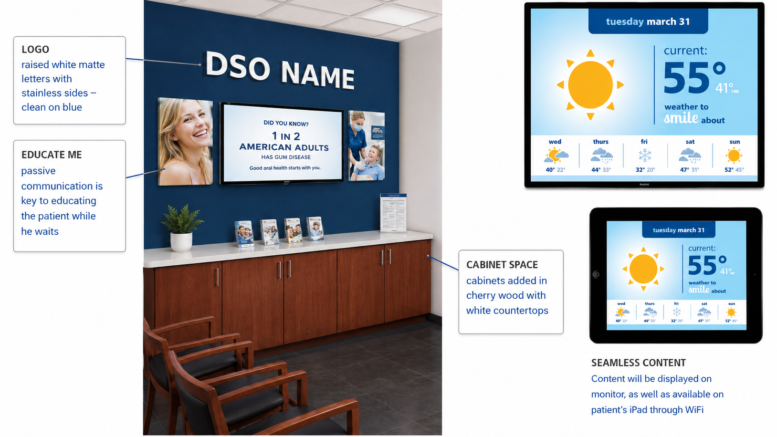
Consider installing a television with a professionally designed 45- to 60-minute content loop. The programming can combine engaging general content, such as weather, sports, and news, with dental-specific content, including:
- Before-and-after photos
- Patient testimonials
- Educational videos
- Smile makeovers
- Services offered by the practice
- Team spotlights
- Community involvement
- Membership plans for patients without insurance
- Clear aligner treatment
- Patient referral programs
The television should be a focal point that naturally draws patients’ attention while educating them during otherwise idle time.
You can modernize the experience by adding QR codes to the advertisements and messages displayed on the screen. These codes can direct patients to:
- Your website
- Doctor biographies
- Smile galleries
- Membership plan information
- Financing options
- Online scheduling
- Google reviews
- Social media channels
- Patient education videos
What should you place above and beside the television?
Consider displaying your logo above the screen to reinforce the brand. On either side, use lifestyle photography showing healthy, active people, accompanied by subtle educational or aspirational messaging. This allows you to market to patients in a helpful, unobtrusive way.
One thing I have learned over the years is that patients notice everything: the crooked picture frame, the burned-out light bulb, the dust on the fake plant, and the overflowing brochure rack.
Individually, those details may seem insignificant. Collectively, they communicate how much attention your practice pays to detail.
Hallways
Hallways are trust builders.
Patients are not walking down your hallway thinking, “I hope Dr. Smith graduated from XYZ Dental School.” However, they are subconsciously collecting evidence that tells them, “These people know what they are doing.”
Think of the hallway as a collage of trust.
Continue the visual theme established in the lobby by displaying a few lifestyle photographs featuring healthy smiles and active lives. In-office visual research has shown that patients look at hallway walls as they walk toward the operatory. They are searching for trust signals before the clinical conversation begins.
Use the hallway to display:
- Clinician credentials and degrees
- Continuing education achievements
- Professional awards
- Community partnerships
- Charitable activities
- Volunteer work
- Mission trips
- Team accomplishments
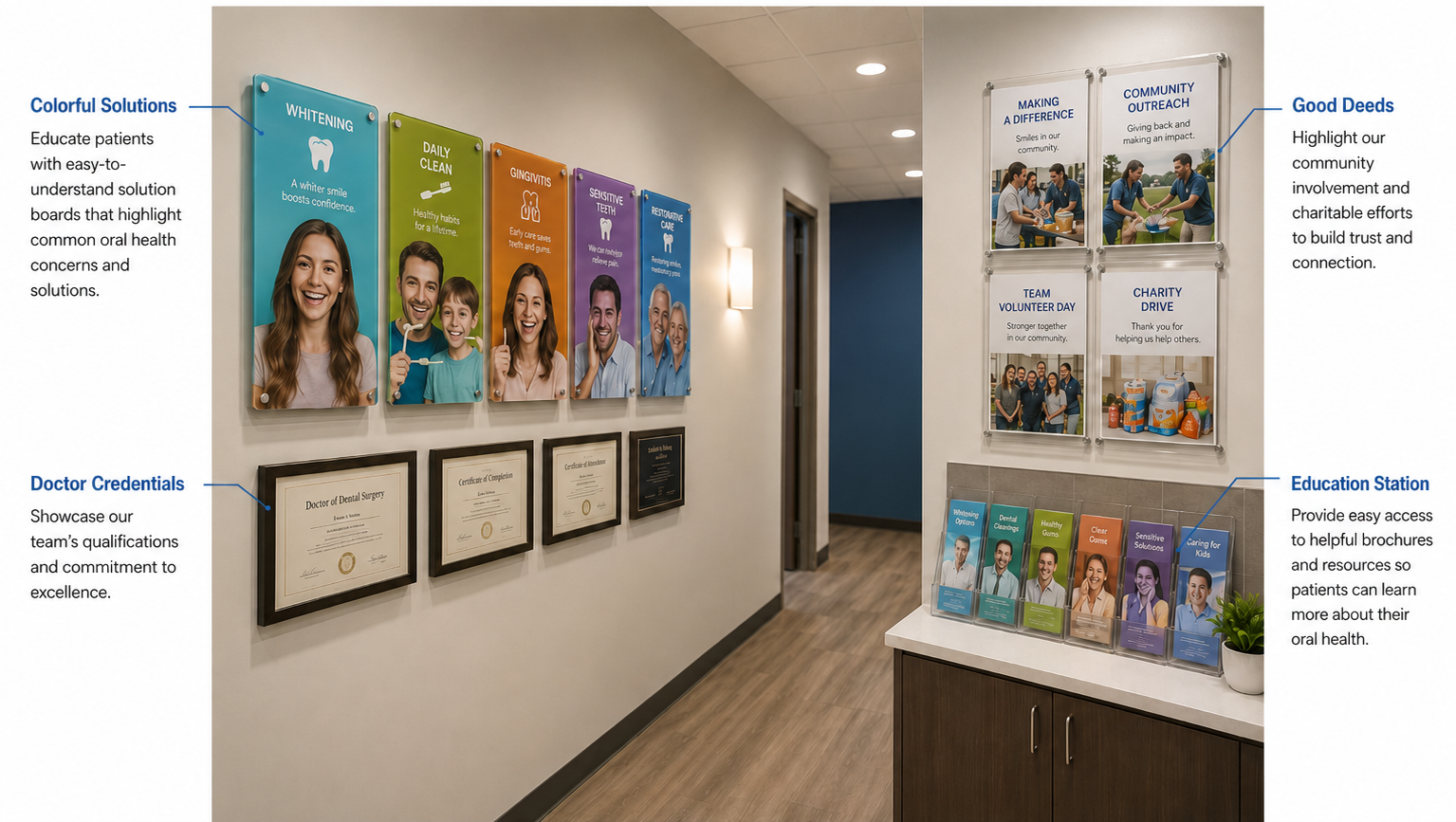
These elements reinforce your practice’s credibility, values, and culture throughout the patient journey.
Patients are subconsciously asking, “Can I trust these people?” Your hallway walls should help answer that question.
Nobody has ever said, “That hallway convinced me to accept a crown.” Still, trust is often established before the clinical conversation ever begins.
If you have a larger office and are wondering what else you can place in the hallways, consider installing a multi-brochure wall unit. I call this an “Education Station.” When space allows, it can provide patients and team members with easy access to educational materials about treatments, services, oral health conditions, and payment options.
Operatories
The operatory is where patients are typically most receptive to discussing their oral health. They are focused on their care, and the conversation is taking place privately between the patient and the clinician.
For the most part, patients expect the operatory to be clean, organized, and clinical.
They do not expect a luxury spa, but they also do not want to feel as though they are sitting in a room that has not changed since the first season of Friends.
There is still room for thoughtful patient education and appropriate product marketing.
On the walls to the right or left of the chair, consider hanging snap frames that can hold branded messages or dental education posters. One example might explain that the mouth is a gateway to overall health. Snap frames allow you to update the messages seasonally or as your clinical priorities change without making a major investment.
Chairside monitors can serve several purposes. They can display movies, calming imagery, or entertainment to help patients relax. They can also be used to show:
- Intraoral photographs
- Digital X-rays
- Treatment animations
- Before-and-after cases
- Educational videos
- Personalized treatment information
Consider keeping one or two oral healthcare products that hygienists regularly recommend within easy reach on the counter. Clear aligner models or educational materials can also be displayed when relevant.
The goal is not to clutter the operatory with advertisements. It is to make it easier for clinicians to educate patients and demonstrate solutions during the conversation.
Consultation and Checkout
After leaving the operatory, patients usually walk back down the same hallway and proceed either to a consultation room or directly to the checkout desk.
Both locations create additional opportunities to educate and support the patient.
Financial conversations should remove barriers rather than create pressure.
Consultation rooms are ideal places to introduce financing options, phased treatment plans, and in-house membership plans for patients without insurance.
For example, membership programs, including those run by or administered by Plan Forward, can help make dentistry more affordable, predictable, and accessible for patients who might otherwise delay treatment.
Educating patients before the financial conversation can significantly improve their understanding and comfort when treatment is presented. That education might begin through the lobby television, brochures, QR codes, or digital displays and then continue during the consultation.
Checkout should reinforce loyalty and make the patient’s next steps easy. This may include:
- Scheduling the next visit
- Requesting a Google review
- Recommending appropriate home-care products
- Introducing a patient referral program
- Enrolling the patient in a membership plan
- Encouraging the patient to follow the practice on social media
- Collecting an email address for the practice newsletter
Small countertop displays, such as a branded “Smile Highlight” bin, can help practices offer useful oral care products, including travel-size kits and whitening strips.
A digital tablet or QR code can simplify membership enrollment, review requests, social media follows, and newsletter registration.
Promoting Oral Care Products
We have already discussed several places where practices can promote oral care products, including the lobby television, operatory counters, and subtle messages incorporated into photography throughout the office.
This is where the marketing begins to connect across the entire patient journey.
However, this strategy is not simply about selling products. It is about educating patients on solutions that support their oral health. Said another way, it is about helping patients receive the care and tools they need.
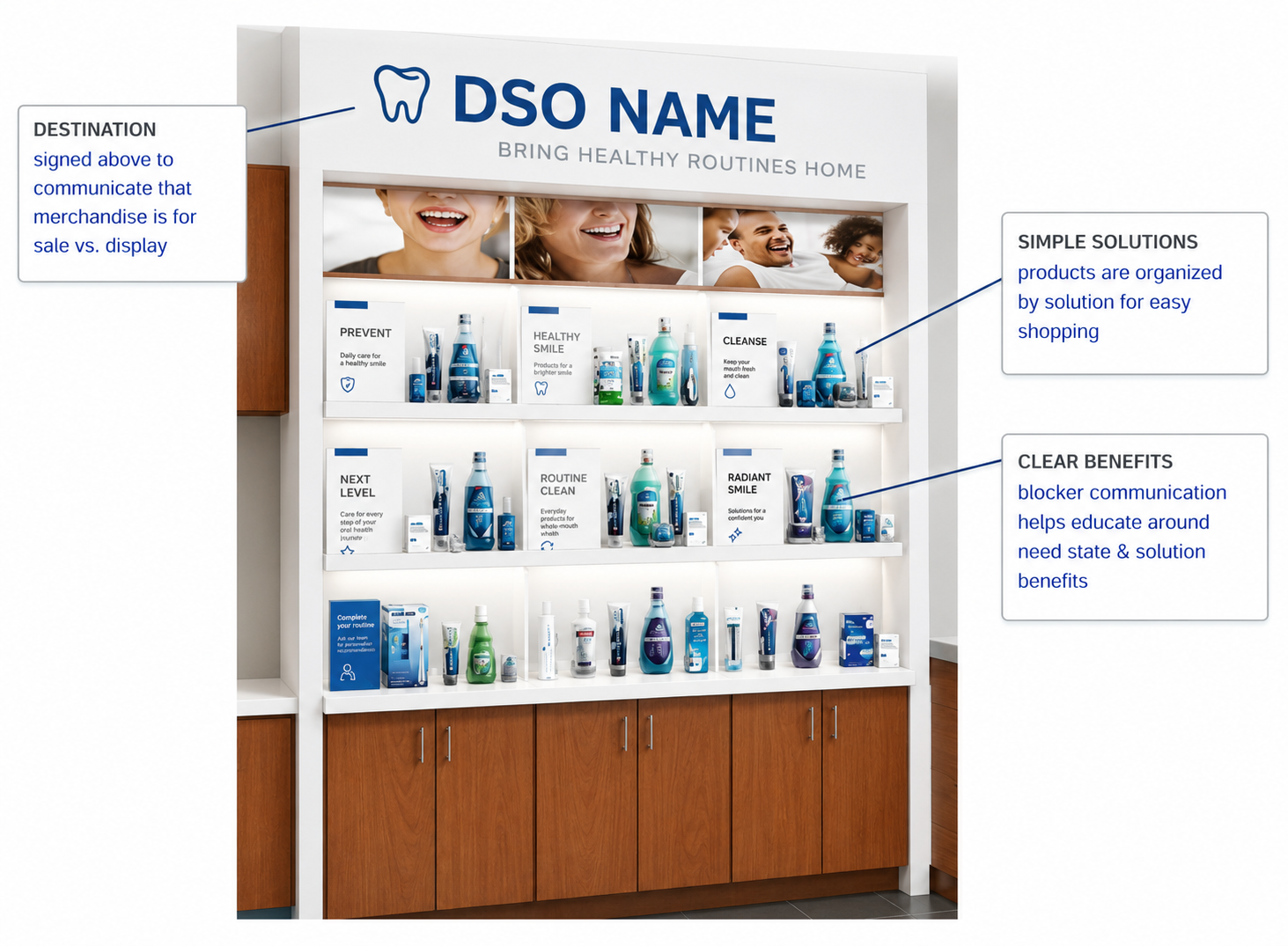
As the hygienist or doctor discusses the patient’s needs in the operatory, one of the most effective ways to reinforce recommended solutions is through a dedicated “Smile Solutions Center” in the hallway or reception area near the front desk.
Think of it as the dental equivalent of Sephora: a dedicated destination where products are organized by solution rather than randomly displayed for sale.
Unlike a basket of toothbrushes sitting beside the credit card terminal, a thoughtfully organized display helps patients immediately understand what each product does and why it matters.
For example, suppose you want to help more patients purchase professional whitening products. Create a shelf dedicated entirely to whitening and include a letter-size sign with messaging such as:
Category: Whitening
Headline: Shine Bright with a Radiant Smile
Subheadline: Professional Whitening Solutions
Place only whitening-related products on that shelf.
Other shelf categories might include:
Daily Clean
Take Your Daily Cleaning to the Next Level
Orthodontic Care
Products Designed to Protect Your Smile During Treatment
Sensitivity Relief
Solutions for a More Comfortable Smile
Gum Health
Support Healthier Gums at Home
Organizing products around patient needs and solutions makes the display easier to understand. It also supports the recommendations made by the clinical team and can contribute to greater treatment and product acceptance.
Connecting the Experience to ROI
Costco did not accidentally put televisions near the rotisserie chickens. Bass Pro Shops did not accidentally build an indoor mountain. Buc-ee’s did not accidentally become a place where people stop for gas and leave with brisket sandwiches, fudge, apparel, and a shopping cart full of snacks.
Every one of those decisions was intentionally engineered.
These companies understand something many dental practices overlook: the physical environment is part of the marketing strategy.
The building is not simply where dentistry happens. It is one of the most powerful marketing tools your practice owns.
Dental practices should think the same way.
By placing trackable QR codes throughout the office, practices can determine exactly where patients are interacting with their marketing. When implemented correctly, you can measure key performance indicators such as:
- Treatment acceptance
- Whitening starts
- Clear aligner starts
- Oral healthcare products sold
- Membership plan enrollments
- QR code scans
- Website visits generated by in-office QR codes
- Social media followers
- Google reviews
- Patient referral rates
This turns the physical patient experience into something that can be evaluated, improved, and connected to measurable business results.
Closing Thoughts
The world’s best consumer brands understand that every interaction shapes perception. Every space has a purpose. Every sign, display, conversation, and touchpoint is intentionally designed to build trust, reduce uncertainty, and guide the customer experience.
The highest-performing dental organizations think the same way.
Marketing does not end when a patient schedules an appointment. In many ways, that is where it begins.
The irony is that many practices spend thousands of dollars every month generating new patients online, only to ask those same patients to spend the next 45 minutes inside an office that was never intentionally designed to reinforce trust.
From the parking lot to the lobby, and from the treatment room to the financial consultation, every moment is either reinforcing confidence or creating doubt.
Your office is communicating with patients every minute they are inside the building.
The question is not whether your office is marketing.
The question is whether you have designed that experience intentionally.
Practices that understand this do more than create better patient experiences. They increase treatment acceptance, strengthen patient loyalty, generate more referrals, and ultimately build more valuable organizations.
Every dental office is marketing, whether it was designed that way or not.
Author’s Note
This article is based on proprietary consumer research and real-world implementation across dental organizations over the past two decades. The examples are intended to help dental leaders think differently about the patient experience, connect every touchpoint to measurable business outcomes, and unlock one of dentistry’s most underutilized growth opportunities.
For questions or comments, email me at ryantorresan@gmail.com or connect with me on LinkedIn:
https://www.linkedin.com/in/ryantorresan/
About the Author
 Ryan Torresan is the Chief Operations and Marketing Officer at Mosaic Dental Collective, where he leads the integration of marketing, operations, patient growth, and technology across a multistate dental organization.
With more than 15 years of executive leadership experience in Dental Support Organizations, Ryan has built a reputation for combining data-driven strategy with practical operational execution to produce measurable business results.
He is the creator of the MOPS, or Marketing + Operations, philosophy, which aligns marketing with the entire patient journey, from the first impression through retention and lifetime value, rather than focusing solely on lead generation.
A frequent speaker, industry advisor, and member of the Group Dentistry Now Editorial Board, Ryan writes extensively about dental marketing, artificial intelligence, patient experience, and operational excellence. His work helps dental organizations build scalable systems that improve both patient outcomes and financial performance.