
Ranked the #1 DSO Podcast!
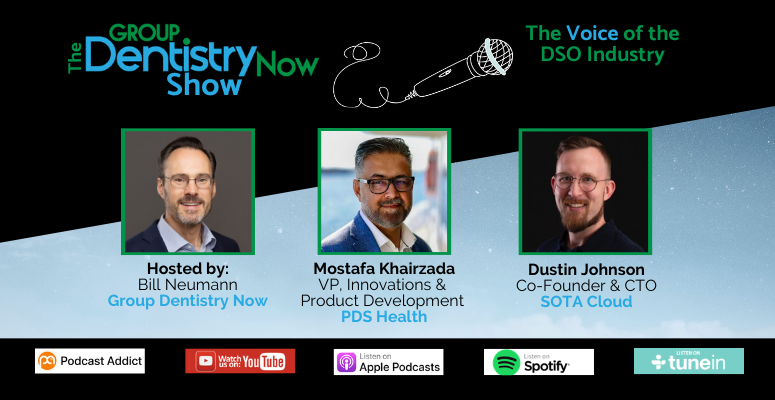
Welcome to The Group Dentistry Now Show: The Voice of the DSO Industry!
Revolutionizing Dental Imaging: The PDS Health & SOTA Cloud Partnership
Mostafa Khairzada, VP of Innovations & Product Development at PDS Health and Dustin Johnson, Co-Founder & CTO of SOTA Cloud discuss their recent partnership. They share thoughts on:
- Changing imaging software
- The importance of interoperability & integration
- Clinical workflow & user experience
To learn more & schedule a demo visit https://www.sotacloud.com/ and click the Get a Demo button on the top right.
You can also connect with Dustin Johnson on Linkedin – https://www.linkedin.com/in/johnson-dustin/
To learn more about PDS Health visit https://www.pdshealth.com/
Connect with Mostafa Khairzada on Linkedin https://www.linkedin.com/in/innovateit/
Subscribe to our channel for more episodes and stay updated on the latest DSO news, insights, and events!
If you like our podcast, please give us a ⭐⭐⭐⭐⭐ review on iTunes https://apple.co/2Nejsfa and a Thumbs Up on YouTube.
Choose your favorite listening app below and subscribe today so you don’t miss an episode! Full transcript is also provided below. See all of our podcasts HERE.
 |
 |
 |
 |
 |
 |
DSO Podcast Transcript – Revolutionizing Dental Imaging: The PDS Health & SOTA Cloud Partnership
Welcome to the Group Dentistry Now Show, the voice of the DSO industry. Join us as we talk with industry leaders about their challenges, successes, and the future of group dentistry. With over 200 episodes and listeners in over 100 countries, we’re proud to be ranked the number one DSO podcast. For the latest DSO News, analysis and events, and to subscribe to our DSO weekly e-newsletter, visit groupdentistrynow.com. We hope you enjoy today’s show.
Bill Neumann (00:38):
Welcome everyone to the Group Dentistry Now Show. I’m Bill Neumann, and as always, we appreciate you joining us today. Always have great guests on, and I really love to talk about the technology. There’s just so much going on, and I think the speed of innovation is so fast, it’s really difficult to keep up. So we’re going to talk to two people that are keeping up with technology. We have with us Mostafa Kerzada. He is the Vice President of Innovation and Product Development at PDS Health Innovations. Mostafa, thanks for joining us.
Mostafa Khairzada (01:16):
Thanks so much. Great to be here with you guys.
Bill Neumann (01:19):
Yep. This is going to be a lot of fun. And Dustin Johnson, who is the co-founder and CTO of Sota Cloud. Dustin, it’s good to have you on as well.
Dustin Johnson (01:28):
Thanks for having me.
Bill Neumann (01:30):
So why don’t we kick things off with some introductions. Mostafa, a little bit about your background and then your role. And I’m really curious. I just learned this right before we started recording that PDS Health has several divisions and the one that you’re part of is PDS Health Innovation. So I’d really love to learn a little bit more about that division of PDS Health.
Mostafa Khairzada (01:57):
Yeah, absolutely. Well, it’s going to be really fun just chatting with you guys today. I’m excited to be a part of this conversation. And my old friend, Dustin, is here chatting it up with me. He and I had a chance to meet a few years ago, and it’s just been a great meetup for me personally anyway, as another person that has this mindset of forward looking technology. So a little bit about me. Let’s see. I’ve been in the healthcare industry for about 25 years. I started at the City of Hope. I’m very excited to get into this industry because it’s a passion space for me. This is a place where we get to invent technologies that help the human spirit. We work on technologies that help human beings where sometimes they might be at their most vulnerable points in their lives. And the tech that we build, whether it’s in our primary care practices or in our dental practices, it’s designed to help human beings heal faster and progress through some of their health challenges.
(02:58):
My background is I did my graduate degree in healthcare administration with an emphasis in public policy, an undergrad in business management. And I’ve been here at PDS for nearly 10 years, PDS Health, nearly 10 years. And it’s just been a fantastic company to be a part of. And like you said earlier, I do work for PDS Health Innovations, which is a subset of PDS Health in general. And our division is tasked with something very unique. We build technologies that help in dental case acceptance and medical integration. And so we focus a lot of our tech in that space. And yeah, we build technologies, we implement them here at PDS Health, and then we also look to resell them in the open market as well. So that’s us.
Bill Neumann (03:47):
Excellent. Dustin, a little bit about your background and talk to us a little bit about Sota Cloud. I mean, that organization that has grown pretty rapidly. And I remember meeting you not too long ago when you were a much smaller company and it seems like you’re growing pretty quickly. And with this partnership that you have here with PDS Health and the conversation we’re going to have, I think a lot of people are going to be really surprised at what you have to offer.
Dustin Johnson (04:17):
Yeah, thank you. It’s going to be tough to follow up Mostafa with his long history of accolades and time in the industry. But yeah, I’m Dustin Johnson. I’m one of the co-founders and the chief technology officer at Sota Cloud. And really what I do is I lead all of our development teams. I basically also act as the chief product officer and everything that touches product and technology, whether it be coming from our database conversions team to our IT and support teams, they all kind of filter up to me. And so my day-to-day really looks like a lot of development, a lot of product planning and kind of answering some very interesting technical challenges with my development team, as well as hearing from the ground, what are the things that our customers are experiencing? What’s the experience like with our support teams? And so that’s kind of some of my background in terms of what I do at the company.
(05:26):
Now, Sota Cloud as a company really started a few years ago as a spinoff of a company called Sota Imaging. And Sota Imaging is a kind of longstanding part of the dental industry. It was an imaging company that had kind of on- prem imaging software. And while we were working on that on- prem imaging software, we identified a lot of challenges that our customers were facing, namely that nothing worked together. And when things don’t work together, when technology doesn’t work together, it frustrates customers, it frustrates organizations, and ultimately it leads to a frustrating patient experience. And so a big part of our mission is really to just unify all of these things that we identified as being problematic to the patient journey and to the clinicians that we serve. And so today we are a cloud-based imaging solution that integrates with all of the devices on the market, x-ray sensors, cameras, panel machines.
(06:36):
We’re rolling out CBCT currently and also all of the practice management systems in the market and all of the major AI systems in the market. And so we’re really aiming to be kind of the consolidated platform that addresses all of the technical needs as it pertains to imaging for organizations like PDS Health that are really, I think, facing a landscape in the market that is severely lacking in interoperability.
Bill Neumann (07:09):
Yeah, that’s definitely a theme it seems to be in dentistry where not so much in the medical side of industry. It seems like there’s much more interoperability, but dentistry seems to lag behind things seem to be siloed off and they don’t communicate together or it’s very difficult for them to communicate together. And maybe this leads into the why change question. So this is actually the first question I really have is, when you’re at scale, you have over a thousand locations, Mostafa. To make any change there is a big deal. It’s not an easy thing to do. So can you run us through why PDS Health decided to change their imaging software? What were some of the limitations you had with your previous software and what made you say, “Okay, we’re going to partner up with Sota Cloud and make the leap and switch a thousand locations
Mostafa Khairzada (08:15):
Over?” Well, I think we’ve had some of the most modern technologies in the world in the dental space here at PDS Health. This has always been what we’ve done ever since … I mean, I’ve heard our CEO, Steve, talk about stories of 2007 when he was investing in technology back then. So we’ve always had a perspective and a culture of bringing in the latest and greatest in technologies. And it wasn’t that anything wasn’t working correctly. It’s just the natural evolution that we were seeing a few years ago. David Baker, the CIO of PDS Health and I were sitting and talking about what does the future look like. And in any direction we point, it always pointed to the cloud. We always wanted to have a very agile, very flexible technology stack that really freed us from utilizing unnecessary operational team members to work on things while they could be doing far more advanced work instead of supporting smaller updates and upgrades locally.
(09:14):
So for us, it was just a natural instinctual evolution in how we looked at technology, how we wanted to deliver technology to our customer base. And then the things that we really loved about Sota Cloud, to be honest, and really, I want to have this podcast built around … I don’t want to just talk about Sota the imaging company. I think what’s important is Sota Cloud, the people. To me, that’s where the sell is, that’s where the win was, is when I got a chance to sit and chat with Albert. I don’t know if … Dustin, I think you and I might have talked about this, but one night I was kind of contemplating, what do we do next? Where do we go next as an organization? How do we even do this stuff? And I was researching stuff. Sota Cloud popped up. I started researching Sota Cloud and I sent a private message to Albert on LinkedIn.
(10:07):
He got back to me the next morning and it was just the interaction and the conversation that I had with him was so pure. It was such a great vulnerable discussion amongst people that are trying to make changes in an industry that, much like you brought up, is really not about the change. And so how do we introduce this kind of stuff to them? And then soon thereafter, I thought I got lucky meeting Albert, just good human. And then I got introduced to this guy and Dustin, when we started to really talk about tech, we have a lot in common in the sense that we both want to deliver technologies that help people. Ultimately, it’s not about speed, it’s not about accuracy in that sense. All those things I think are default things. What our passion is serving humanity. And I think that’s when I realized that Sota Cloud and the people that make this company is really what makes the product that much better.
(11:06):
To me, that was the distinction really as to why Sota Cloud? And then I kind of explained a little bit about our desire to always be at the leading edge of technology, offering technologies that give our clinicians access to be able to look at images anywhere in the world they wish to if they’re traveling or if they’re at home and they need to review their cases, they can. And this product gave us this. And then the last bit I really want to touch on is that the way that Dustin and Albert really thought about building this platform is really the beauty of it. The beauty of it is that it’s an imaging platform, but we can click in any AI intersection point within this platform. It’s flexibility, it’s ease of use, and how agile this system is really falls online with us as a company.
(11:55):
So that’s really why we did it.
Bill Neumann (12:00):
So you mentioned a couple of things you mentioned, the ability for … It’s cloud, right? So it’s cloud based, the people, I think you said that two or three times. So we’ll see the people and then the people for sure, which I think also lends itself to not just the likability and the forward thinking of the organization, but the fact that they can deliver at scale, right? Because we do sometimes … People over promise, they tend to overpromise, especially when it comes to DSOs. So there are people that are vying for large groups and they just want to get the business, but they can’t necessarily implement. And sometimes it’s the product, sometimes it’s the onboarding and implementation, and sometimes it is the product. So we see a lot of that too. So it sounds like beyond the people and being cloud based, anything else you want to touch on as far as like any other reasons you thought, “Hey, this is a platform that would work for PDS?”
Mostafa Khairzada (13:04):
I’m going to bring up a little story that’s just kind of how I roll, but Dustin and I were … It’s funny because when we met, we were finishing each other’s sentences because we’re so passionate about how we want to move technology forward. There was one bit of technology that Dustin still had under research and development. And I was kind of hinting at like, “I really want this thing, man. Can we make this thing happen? Can we make this thing happen?” And he and I talked about it very thoroughly over a couple of months. And then it was like early last year, and he’s like, “Listen, I’m going to get it to you in October.” And I was like, “All right, this is a difficult ask, man.” I’m probably not going to share what we were talking about, but it was a difficult ask. It was a complex system, subsystem that I was asking for.
(13:48):
It was in their plans to do it, but he and the team worked tirelessly. And this was something that for someone like me to observe it from a distance, I could see how much effort they were putting into making sure they hit that timeline. And I talked to Dustin a little bit, I talked to Albert a little bit too, and their concern was quality and timing the whole time. And I thought that when a company like ours wants to partner with someone, we don’t just look for the technical advantages. Yeah, that’s great. We look for the human and connection advantages. Yeah, that’s all great too. But just like you said, the delivery is where it’s at. And with these guys, I thought it was really cool. I really wasn’t expecting it to be delivered in that time period. It was within the week that Dustin had said.
(14:38):
So these little things, they build confidence. One of the things that I tell the team here is that we grow confidence from doing small things consistently, and these guys just keep doing the little things that no one’s paying attention to, and all of a sudden you get this thing that’s born from it. And I just get very excited to work with companies like that. I know for folks that are watching this, they’re like, “You’re getting some kind of a shirt that says Sota on it. ” Honestly, I don’t even have a shirt that says soad on it, but I believe in the dudes, I believe in the folks that really work so hard at this company. I’ve had a chance to meet most of the team for the most part in Vegas. It’s just a group of people that genuinely care about our industry. You can’t really ask for anything more when you’re selecting a partner.
(15:27):
The tech stuff, the interoperability, the ability to have any AI sub-component that I want in there, the fact that these guys customized it for us in areas that we asked for their assistance and then they never said no, the fact that everything just moves forward and there’s no arguments and discussions around why we’re pushing certain things. It’s that theme of partnership and the spirit of this whole thing that we did together, and this is just such a great example for other partners that want to work with us is you want to have a really great experience. This is the kind of group you got to be like.
Bill Neumann (16:04):
Excellent. Yeah. Well, that’s great to hear. Let’s talk a little bit because it sounds like both organizations are unique in their own way. And so PDS Health, you run on Epic. So you’re one of the few out there in dental. There may be some others that I don’t know about, but you’re certainly the largest by far. So that is something I think that I’d love to talk to Dustin about. Talk a little bit about the interoperability with Epic and maybe some of the challenges there. And I mean, I’m sure from Staffa’s standpoint, that was probably a must have. Since you’re Epic, you’re focused on medical dental integration. So you could take us down that path of how you really became interoperable, you created that interoperability and integrated with Epic.
Dustin Johnson (16:59):
Yeah, it’s interesting. Epic as an EHR system is very unique in the dental environment. You’re right. There’s not other organizations really using it today. It’s something that’s … We do run into it quite a bit in the FQHC and tribal health kind of environments where there’s already some mixed care kind of prevalence, but for a large DSO to be operating on Epic, I mean, it’s basically unheard of. And PDS is really leading the way in kind of integrating medical and dental care. And so from the outset, when we started the company, as I mentioned earlier, interoperability wasn’t like a bolt-on for us. It wasn’t a thing that we are kind of doing because we have to. In a lot of ways, it’s kind of the point. It’s an architectural premise of the platform itself that it’s able to be connective and work with other things and make everybody’s life easier because it can do that.
(17:58):
And so because our system was built around openness and APIs, for us to integrate into an EHR system or a practice management system usually is really straightforward. The funny thing is that in dental, because the medical integration standards, namely FHIR and HL7 are so completely just ignored, frankly, by virtually every other system in dentistry today.
(18:28):
We actually had a little bit of a challenge initially doing some of the smart on fire integrations and HL7 integrations that we had to do in order to get things working really seamlessly with Epic. But through the partnership with PES and the kind of great documentation that lives in the medical space that’s not here in dentistry, we were able to get that done pretty quickly. And so today, the integration is secure. Imaging events get triggered out of the Epic system. The patient context remains synchronized. So it’s a super effective and streamlined workflow between the two, including user authentication into the Epic system or out of the Epic system. So when they go to open up a patient and so to cloud, it seamlessly connects to our system, logs in the user, everything. And so the key thing for us is that imaging ultimately it’s infrastructure.
(19:32):
It’s something that your business depends on. It’s something that numerous other systems depends on, whether that be the AI partners that we work with or claims, revenue cycle management systems or insurance systems. We don’t want to create another 50th universe of patient data that is kind of holding its own little piece for Dear Life, hoping that nobody else ever comes to take away that piece. We want to be the underlying imaging infrastructure that integrates into that clinical workflow. And it’s so important that that’s done in the industry because I always like to say imaging is like the fundamental ground truth data that comes out of the clinical process. It’s the only real artifact that as the clinicians are working with the patient that’s generated, everything else is like a note in an EHR system or some sort of interpretation. This is the ground truth. And in the future, when we’re working with AI, that ability for the systems that are holding that ground truth data to make that data available so that patients get the best care that they can get is like the most important thing.
(20:47):
And so I think because we had that vision from the outset, and this is the direction that we think that imaging as a whole needs to move in, it was a natural kind of fit to solve some of these challenges that we’re solving, both in terms of the Epic integration, as well as the broader mission that PDS has with the integration of medical and dental, which ultimately is to the benefit of everybody.
Bill Neumann (21:21):
Stuff, anything from your side?
Mostafa Khairzada (21:26):
Yeah. So I had a talk with the team about a year ago and I said, where do you think in the grand scheme of all the enterprise applications that we have running here, where do you think imaging is ranked at? I just wanted to ask an open-ended question. I said, how important do you think imaging is? And so everybody said, it’s very important. It’s very important. Everybody used the correct terms. I said, “But how very important is it? ” The fact of the matter is that if our EMR systems go down, should they, we can always go on paper. This is kind of normal stuff, but our imaging goes down, there’s not a lot of recovery there. So this to me is the most important platform that’s running in our offices today. It’s important that we recognize this as one of the most important systems in the organization today.
(22:17):
And so to have, just like Dustin described for us, when we began talking and working with Epic, we recognized that they didn’t have an imaging platform. This, by the way, I don’t know, Dustin, if you know this, but this is the third time we’ve deployed imaging here over the last 15 years at PBS Health. So we know what good looks like and we know what easy feels like. And so far with the implementation of Sota as it’s integrated into Epic and just kind of exactly the way that Dustin described it, when the clinician is in Epic, they hit the imaging button, Sota opens up and that patient’s images are right there and the format that the clinicians are accustomed to seeing it and they can quickly interact with it and then do their case presentation from that space. For us, that’s always been a super important piece and the integration into Epic was everything for us and the most important piece of it for sure.
Bill Neumann (23:19):
So let’s move over to talk a little bit about transformation. If someone, and so most of the audience right now is using what you would call traditional dental imaging platform software right now. What does the IT infrastructure change look like? So at the practice level, what is typically required versus now versus if they switch to Sota Cloud? And how does that really affect how that practice location has to deal with IT? Is it less involved? What does that look like?
Mostafa Khairzada (23:56):
Yeah. And that’s all anyone actually needs to know. From an infrastructure perspective, there’s such a significant change in the way that we’re running this. I’ll give you two examples. The first example is that we just started rolling out Sota Cloud into our offices and fingers crossed these two deployments. And in fact, there’s one happening just right now. These two deployments have been the easiest deployments in our history when it comes to imaging. And that’s saying a lot. We’re really good at what we do. We’ve invested a lot of time in learning and understanding how these systems work. We’ve invested a lot in training and certifying our team members so that they’re incredibly talented when they’re working with our clinician population and the offices that we support. So we take this stuff very seriously, but when we look back at it, the Epic integration, the ease of use always draws me back to this one idea.
(24:55):
The way we’ve always envisioned having the offices be as light as possible with less infrastructure locally as possible. So we’ve migrated off of having a server that’s dedicated to your imaging platform in an office. Think about that. There’s a cost to maintaining and running that, there’s a cost to licensing that, there’s a cost of supporting that, and then there’s a cost to refresh it because it’s going to get … And there’s going to need to be refreshed at some point. And then you’ve got these endpoints. So in the past, over many years, when we’ve had to upgrade any of our systems, we’ve had to touch every one of our computers. And it’s very difficult to do that when you’re at a thousand offices plus. Now you’re thinking about there’s 10 computers in each of these supported offices and there’s a thousand offices. Now you’ve got to touch all these machines.
(25:48):
And then if you start thinking about your error rate, well, what’s an acceptable error rate? Well, let’s just say it’s 5%. There’s still a whole lot of machines that aren’t working correctly because they need to be physically touched. And so some of them might be in Minnesota and some of them might be in Florida and some of it might be in San Jose. And you got to sense people to go and take care of that stuff because patient care is the most important part of what we do. And so to have this thing where the whole attraction of it is the fact that it’s cloud centric. The whole attraction is that Dustin can shoot me a text message and say, “Hey, check this out in a couple of weeks or whatever, here’s the six new features we’re going to release.” And we’ll figure out the trainings and assume that the training piece is done, but all they have to do is just press a couple buttons and everybody gets the latest and greatest.
(26:39):
There’s nothing more beautiful than that when your entire enterprise is standardized instantly. And that’s what matters to us and that’s what Sota Cloud brings us.
Bill Neumann (26:51):
You want to add anything there, Dustin, especially when it comes to that change in infrastructure, is that pretty much common? I mean, is PDS’s experience being able to take that server out and not touch the office quite as much?
Dustin Johnson (27:12):
Yeah. So that part is definitely true. And it’s funny, PDS as an organization is so far ahead of everything else that we see in the industry today. I think partially because they have folks like Mostafa there who are so keen on staying on top of the latest and greatest. We kind of work in a world of PE backed organizations that are just rolling up practices left and right. And so working with PDS Health in this respect has been a breath of fresh air because they already have a significant amount of standardization across all of their locations. And I think that’s part of their great success is that they really do take this stuff very seriously. A lot of organizations pay lip service to that. I can tell you, having worked with a lot of groups in the dental industry, there is no group that I have seen that operates in the way that PDS does.
(28:11):
I mean, these guys are on a mission. So with that said, yeah, you get the benefit of having this kind of standardized interface that’s always up to date and that is kind of ready and accessible at any time across all of your locations. But one of the interesting things is that most practices, because of that PE roll-up model, within an organization, they have not just the challenge of updating all of the software and touching all the computers and touching all the servers, they also have the problem of, “Hey, we have 20 different models of sensor brands across our organization, and we have 10 different intraoral cameras that we use, and we have five different CBCT models that we use.” And with Sota Cloud, because they’re able to centralize around that kind of imaging platform as a whole, and we work with everything natively, and we track all the devices across all the organization, and we standardize the entire stack, not just from a technical perspective, but from a clinical perspective, that whole operational model changes.
(29:21):
And you go from this reactive IT firefight as you’re kind of working through the rollout into something that’s a little bit more streamlined. And then once you actually get to the point where you’re rolled out across your entire organization, you get that kind of stability and standardization and uniform experience, not just for your providers, but for your patients. And so it’s not just a technical thing, it’s a people thing. I mean, when your assistants can go from office to office and know that they’re going to have the same experience at each place that they work in, When your patients are going from office to office and the case presentation is in a standardized format because as you know, the way that most dentists are presenting cases is they pull up the images on the screen and they walk the patient through what their findings are in the x-rays.
(30:14):
And so there’s so many things that we don’t think about that imaging actually touches. And at the end of the day, all of this is going to lead to a better patient experience and happier teams, happier IT teams, happier clinical teams, and just kind of a better running organization. And to Mostafa’s point, we’re in the early stages of rolling out with PDS, and I’m not going to lie to you and say that everything’s perfect right away. We’re still figuring some stuff out, as is the case with any massive project like this. But one thing that I’m really proud of our team for is that every single person on our team is completely dedicated to the mission of making sure that we’re helping people. And that doesn’t just extend to the teams that we’re working with, like Mostafa’s team at PDF. That also extends to the fact that these are people who are treating patients.
(31:13):
And as Mostafa mentioned earlier, that patient experience when you’re kind of in that vulnerable place of having somebody working on your body is super critical. And so when all of that can work together more smoothly and run better, everybody stands to benefit from that.
Bill Neumann (31:35):
And we talked a second ago about the PDS Health using Epic, and really you’ve got this mission that’s centered on integrating dental and medical services. Can you talk a little bit about what’s the effect of having that imaging data and it’s pulled right up in those unified health records. And do you see some benefits to that, Mostafa?
Mostafa Khairzada (32:01):
Well, today we don’t use it in that specific way. I just wanted to kind of clarify that. So within our medical and dental practices, there is an integration point where we like to share the record in between. So if we have a patient in our primary office and they come into one of the dental offices, that information can come with them. The dental process of the patient sitting in, the dentist can then see a lot of information, blood pressure, HbA1c. We’re looking at all kinds of both genetic and inflammatory markers, things of that nature. And so the stuff that we’re looking at in the dental practices is very relevant in the primary care practices. And so our natural inclination was to be able to share information between these two areas so that we can look at the patient more holistically. We have a whole platform called mouth body connection.
(33:02):
This is a big component of what we do and it’s actually pretty extensive of a program, but the idea is to really get people to understand that what we may find in your mouth can and may affect your brain and can and may affect your heart. And for women during a reproductive time period, it can affect that as well. So we look at a lot of data in that sense and we pass it back and forth. When it comes to imaging specifically, we haven’t gotten there yet where we’re sharing images like in a VNA standard, but at some point I do see if the clinician wants to be able to see any kind of 3D CBCT anomalist finding that we have, that we will be able to give them access to that and have them quickly see it. The beauty of the technology isn’t how we’re using it today, but the possibility of how we can use it tomorrow.
(33:59):
And that’s the flexibility we’ve always wanted.
Bill Neumann (34:04):
Yeah, I’m sure that’s probably the ultimate vision, right? And as I think patients and primary care physicians, and we learn more about that whole body health, that oral systemic connection, we have a lot of data on that already, but it seems like it’s growing and there’s an education process, but you’re right. I think you’re positioned in a way that you can leverage technology so when everybody’s ready, you can take advantage of it. So PDS Health is not only a customer, you’re also a strategic investor in Sota Cloud. So you must have really have seen something here to not only say, “Yes, we want to use it, but we want to have a stake in this beyond just being a customer.” Can you talk a little bit about what that relationship looks like and why you made that decision, Mostafa?
Mostafa Khairzada (35:08):
Yeah. Yeah, absolutely. Just like in line with everything else, it all starts with a story. David Baker, the CIO for PDS Health and I were in Colorado. It was a snowy day. I actually was starting to get 7:00, 8:00 PM, and he and I, this is where most of our work gets done. So we sat down at a table at our hotel in the lobby and we had a bunch of pieces of paper and we just started to just between the two of us, define what the imaging platform of the future looks like for us. This is, I want to say three or four years ago. And so as we were describing it, we were talking about all the … We were talking about using AI to do compression and all this stuff. And we’re just going into all of the nitty gritty details. And so from that conversation, I think we ended that conversation around 1:30 or two o’clock in the morning.
(36:00):
I mean, we ran late going through it together and we had a general idea of what we wanted to build.
(36:08):
The concept for us was to originally build this kind of a platform. And so we knew what we wanted to build. And then as we started to really think through across over many months, do we want to actually build it? Do we want to see if there’s anyone else out there? Can we partner with anybody? Well, we had an initial partner in mind and that didn’t work out for us. And so we were a little bit on our heels kind of looking for what’s that next thing that’s going to really progress PDS Health’s imaging platform. And that’s where the story begins where it was like one o’clock in the morning. I had my guitar in my hand and I was depressed looking at my iPad going, “Oh my God, we got to figure out what are we going to do with imaging?” And when I ran into Sota Cloud, and then I … The first thing that caught my attention was really the description of Sota Cloud.
(37:03):
And it really described the human experience. To me, that’s always key. I don’t care if you’re a tech company and I really don’t care if you’re really that great. There’s a lot of great tech companies out there. There’s not a lot of great tech companies that have a lot of great people that care deeply about the human experience. So to me, my ears perked up in that moment. I was like, “This is cool.” And then we started to get to know them a little bit better. And we made a decision that we believe that imaging has its own uniqueness and we felt like it wasn’t a side dish. We thought it was a main course that required its own attention. And we didn’t think that just because you bought a piece of equipment and you get this smaller piece of software that that was going to be how we were going to run enterprise level clinical technologies.
(37:48):
And so from these kinds of thoughts, as we were going back and forth with both Albert and Dustin, we realized these guys are … I remember calling David one night and saying, “My God, look at this. Look, item one, they have it. Item two, they have it, item three.” And then on and on and on and on and on. And the couple of items that weren’t on their list that were in my mind, Dustin and I were at a restaurant in Vegas talking and I said, “What do you think of this? ” He’s like, “Yeah, we’re working on that. ” And I said, “What do you think of that? ” And he’s like, “We’re working on that too.” And so the beauty of it was, it’s just almost like sometimes just things just fit and you just get lucky to be honest with you. Sometimes you just get lucky meeting the right partner at the right time.
(38:27):
And everything else just kind of fell in place from their vision on tech to their vision on how they want to run their company to their vision on how they want to serve humanity. And all of that just hits my love language buttons. And I know that PDS Health as well appreciates that. So that’s really the beginning of it. And then once we started talking about what do we all see in the future, we kind of all saw each other together and it was just an easy thing for us to talk about. Once I really got a chance to know these guys really well and really their philosophy on their team, and if you want to know the truth, I wouldn’t really listen too much about what they would say about their company. I would listen more about what they would say about their team.
(39:09):
To me, that was the most important and how generous they were with compliments around their teams and how much they appreciated their team members. Every time I talked to them, they would bring that up. To me, that was the winner. And so, of course, I put together a pitch deck and I sat with our CIO, CIDO, that’s his correct title. And then our chief strategy officer, Dan Burke, he’s an incredible, incredible person as well. I asked them for their advice. They saw the vision and then quickly thereafter, we started to really come up with an idea of what that partnership could look like. And here we are today, we’re partners, we’re together influencing this amazing industry, we’re building tech that’s making a difference. It doesn’t get better than this.
Bill Neumann (39:55):
Excellent. I love it. Let’s move from the topic of investing in a company to … Let’s talk about the clinical experience. So we have a lot of … There aren’t a lot of groups as largest PDS Health. So I don’t want people in our audience to be, “Well, we’re not PDS Health, so Sota Cloud might not be for us.” There are so many benefits to this solution and I’d like to … So a lot of our audience are dentists that own five, 10, 30 practices, so they’re scaling up. Let’s talk about it from a workflow standpoint, Dustin. Can you talk a little bit about how Sota Cloud really makes the clinician’s experience more streamlined?
Dustin Johnson (40:49):
Yeah. So I think we should start just go through the journey of using Sota Cloud. And by the way, before I actually get into this, I do just want to say, when we decided to take investment, just really quickly going back to the topic we were on, when we decided to take investment from PDS Health, a big part of the reason that we did that is because not only did they believe in the mission that we had, but we believe in the mission that they’re on. And so that unification of priorities was ultra critical to us. And I think it really just speaks to the direction that we’re going in not just from a technology perspective, but also from a care perspective when we get to have that kind of just clear relationship with not just a customer, but an investor. And I think ultimately it’s going to benefit the industry.
(41:50):
So anyway, getting into the customer journey or the user journey once the users get started, ultimately it starts in the practice management. You open your practice management software, and if it’s one of our many API partners, the previous visits images are right there in the chart for quick access. You don’t have to leave and go through a bridge into another menu and into another menu. I mean, you open up the chart, the adonagrams right there, the images are right there next to them. You can even click the teeth that are in the Adontagram and see the images that correspond to those teeth. So this is the way that we’re integrated with the vast majority of practice management solutions that are on the market today. And that’s very unique. It’s a benefit of being a connected cloud system. And it not only saves you time, but it also makes the whole clinical journey right at the outset, just a lot easier.
(42:47):
And then you go to start a new exam and your sensor just works. There’s not a twain, there’s not a popup that’s coming up and saying, “Hey, you need to click send in order to send the image out of the twain into the practice or into the imaging software.” All the devices are just fully integrated. So as a staff member, that’s better for you because you’re able to keep that patient in the chair for less time. And as a doctor, when you come in as the clinician into the room, you’re getting a higher quality image because we have that native integration. Your AI findings, once we take the x-ray and because we’re integrated with all the AI companies that are in the market today, your AI findings from Pearl or Overjet or Videa, they appear right on top of the image in Sota Cloud immediately.
(43:27):
There’s no wait. And so you’re not having to jump out into another system. And as an organization, if you’re paying for Pearl, for example, across all of your locations, you want to know that your users are getting good benefit out of that. As you know, one of the common kind of cliches in the industry is the tool that you pay for and then it just collects dust in a drawer somewhere. We make sure that that AI system’s not collecting dust and that you’re getting good value out of it and that your patients are benefiting in the care chain because of it. And then finally, when you go to present the case, again, because all of the, not all of them, but a huge chunk of the case presentations that are happening with patients are happening in the imaging system. You have your AI findings there in color.
(44:10):
You get your patient gets a standard experience of what they’re looking at. The patient historical images are at your fingertips. So you can kind of see where they were six months ago versus where they are today. Patient education videos are available to help educate the patient in the same interface. And so in addition to that, we also have a seamless referral system. So you’ve kind of gone through case presentation, you’ve educated the patient. And by the way, not every clinician is an amazing case presenter or case kind of salesperson. I hate using that term, if you will, but it’s important that your clinicians be able to really do a good job of informing the patient on the care that they need. And if they can’t do a good job of educating the patient, then the patient’s probably leaving that day without getting taken care of.
(44:56):
And so when you have a standard clinical interface that’s not just helping to make sure that capturing the images and storing the images works effectively, but also that you can present the case clearly to the patient, everybody’s benefiting from that. And at the end of this, if you have to refer out of your practice, we have a really seamless referral system that’s built in and we have a patient portal that’s built in. And so the communication chain between you and the patient and whoever you’re sending the patient to so that they can get the care that they need, that process is working more smoothly. And not only is your practice in the loop, but the patient is in the loop, they don’t have this kind of paper slip that they go home and they lose right away. And the person that you’re sending the referral to is informed that there’s a patient coming their way and they can follow up with the patient.
(45:46):
So you’re really making sure that that patient’s getting taken care of. And ultimately at the end of the day, the big message here is everything is easier across the board, whether it’s the way that you’re working with the practice management, the way that you’re working with your hardware, the way that you’re communicating with your patient, the way that you’re referring out to other providers, everything becomes simpler because we made the platform open so that it would be simpler. We didn’t try to implement some of the things that we see in the market where, again, these companies are kind of holding all of this data tight to their vest because they think that it’s protecting their business. Ultimately, it’s just hurting patients and we’re here to help patients.
Bill Neumann (46:29):
And Ms. Stuff, what’s the provider feedback been like from your side?
Mostafa Khairzada (46:34):
Yeah. Well, let’s see if I can scoot back just a little bit. I want to touch on what you just said, Dustin. I think it’s super important. A couple things we know is that the dental case acceptance misses in the United States is a $120 billion problem. $120 billion in case acceptance isn’t done because 25% of the people don’t understand what they’re looking at. 20% of them don’t understand financially what’s being presented to them. And 17%, I mean, if I narrow it all up, have some other concerns, whether it’s anxiety or they just don’t have enough information. But in that 25% of the collaboration piece, that’s the communication piece, that’s the case acceptance piece. That to us is an area that we’re very fixated on. To us, clinical case acceptance is important. It’s not about telling your patient what you’re seeing, it’s about having your patient understand what you’re seeing.
(47:32):
There’s a distinction and a difference and it’s significant. And that’s what we strive for by presenting information in ways, in different ways, whether it’s the color images from Sota that’s being shown to them or their information that we’re presenting out to the patients. We want our patients to make decisions that are important to their health in a way that they understand their decisions. A lot of times, and our data shows that people don’t understand and people are afraid. And so we are building tech that’s helping clear up that kind of mindset. We want to build transparency in this industry and tools like Sota Cloud and being able to look at images in that easy way. I have this long story that I’m going to save you all from, but when we originally … We built an AI model here about seven years ago that we ultimately sold that looked at different pathologies.
(48:28):
We were able to identify 22 pathologies with an FN of. 86, which really puts it at close to 85%, 86% accuracy, which we thought was incredible back then. The reason we did that is because we wanted to build trust in our industry. We want to create opportunities for patients to make decisions that they understand and that the doctor telling them this is it’s important for them to accept it. So trust is the thing that we’ve been going after all along. And so what our clinicians are saying today is that the tool works really fast. I just came out of an office, in fact, probably about two hours ago that had this implemented a week ago. And I asked the docs, “How’s it going? ” And they said, “Yeah, it’s going pretty good.” You know the cool thing about when a doctor said it’s going pretty good?
(49:17):
It means it’s going amazing because if it wasn’t going pretty good, I’d be getting a long email about how it’s not going pretty good. And so the feedback from the clinicians so far is really positive. They like the flexibility. Most everyone talks about its ability to share the image across wherever they’re at. Sometimes docs want to take their work home and be able to work really effectively from home when they’re either researching their patient or understanding more of what they saw in that day, this kind of a tool gives them that. And the ease of use has been significant. The line that we have internally here at PDS Health Innovations is if we have to teach you how to use it, we suck. Just to say it simply, we didn’t do a good job if we have to teach you how to use it. No one taught me how to use my iPhone or anyone else in my family.
(50:09):
It just worked. And we’ve got to build tech like that and we’ve got to bring in tech like that. And so that is what Sota Cloud is like for us. If we can get to a place where we don’t have to teach people in long, drawn out training programs and take them away from what’s most important is serving their patients, then we haven’t done it right. And with Sota Cloud, obviously we’re very deeply committed to training our team members and ensuring that they have the correct access to information that’s relevant to them, but the Lyft hasn’t been too bad and the clinicians are very expressive about how easy it’s been so far and we’re excited about that.
Bill Neumann (50:48):
Excellent. So as we start to wrap up this conversation, I think this, I’m sure you’ve piqued the interest of a lot of people in the audience. So maybe some advice or tips if they’re thinking of evaluating their imaging solution in the future, maybe they’re in the process of looking at options right now. So we’ll start with Mostafa from your perspective, what are some things to look for as you’re evaluating vendor partners?
Mostafa Khairzada (51:20):
Don’t waste your time. Don’t be crazy. I mean, that’s probably the best advice I can give people. Don’t waste your time. Most people want to do all these crazy studies where they’re looking at these hardware driven technologies. The most important thing is serving your patients in the best way possible. And so you’ve got to focus on your patient, not on the tech. You can’t focus on figuring out who your IT department is and how many IT people you have to hire to support your platform. You’ve got to free yourself of all of that. If your office is not focused on the patient at all times, the office is focused on the wrong stuff. And if your office is focused on technology, then this is the kind of technology you would want to bring in so that they can refocus back on the patient. To me, it’s always been about patient care.
(52:06):
I’m always going to talk about patient satisfaction. And the other most important thing for us is clinician engagement and clinician satisfaction as well. So we want our docs to love this tool. And the way we know if a doc loves it is when we have them use it for a period of time and then we tell them we’re going to take it away and we watch their reaction. And if they freak out for lack of better terms, we know we did it right. And that’s the advice I have for everyone out there that’s listening. Don’t waste your time on antiquated self or focus on your patient. Bring in technologies that’s going to make your workflows easier, bring in technologies that you can upgrade as the industry changes and trends forward. Now, the dental care industry, dental health industry has been very antiquated for many, many years.
(52:55):
My mother was a dental assistant for a long period of time. I’ve been around dentists and the dental industry for 30 plus years in the last 10 years here, but seeing all of that, my best advice is focus on your patient, let the tech do its thing. And once you have it enabled, I think you’re pretty set to let it go and take care of your patients along the way.
Bill Neumann (53:21):
Excellent. And Mostafa, if anyone wants to learn more about PDS Health or they want to contact you, can they find you on LinkedIn? And what’s the best way to learn more about PDS Health?
Mostafa Khairzada (53:34):
Yeah, absolutely. So you can definitely reach out to me on LinkedIn. I try to respond to as many non-ads as possible, but I will definitely do that. And you can also go to our website, but if you have any questions around this tech or why we selected this and you just want a little bit more information, we want the industry to move forward. We want healthcare to move forward. We want patients to have access to better information for better decision making. We got no secrets. Let’s go.
Bill Neumann (54:06):
Excellent. And Dustin, any questions that you think people in our audience should be asking potential vendor partners when they’re evaluating the imaging solutions? And then also shout out your contact information and how people can learn more about Sota Cloud.
Dustin Johnson (54:25):
Yeah. I think there’s a lot of questions they should ask. Really, it should start with, what are your goals as an organization? What are the problems that you’re trying to solve? You should ask yourself those questions before you start looking at vendors. I think this is the mistake that a lot of companies make, not just when they’re evaluating solutions for imaging, but just kind of more generally. And then once you’ve done that, when you’re really looking at an imaging solution, ask yourself, what happens with that data? Where’s that data if I need it in five years when the next AI tool comes out? Is it locked into a silo that I don’t have access to? Is that data going to be made available in such a way that I can turn it into an asset for the business so that I can treat patients better?
(55:13):
It’s something that I think not just for images, but for every kind of data that businesses own these days, we have to ask ourselves, we don’t know what the future is going to look like from a technology perspective. We’re in the most exciting time, I think, in technology, basically ever. A lot of people have compared what we’re going through right now in terms of AI to the dot-com boom and the invention of the internet. I think this is way bigger than that. And in order for you to really get the full benefit of what’s happening right now in technology, the data that your business is generating, it has to be something that you have access to. So that’s the first thing. Do we have access to the data? The second thing is, and this is more specific to imaging, is how does it integrate with our practice management system and our sensors?
(56:08):
How does it align with our strategy for standardization for our practice management systems? What does the security and the regulatory kind of status look like? This is something that is kind of, I’d say it’s the opposite of near and dear to my heart. I mean, the amount of regulatory and compliance that we have to go through in order to be a medical device company is kind of crazy, but there’s a lot of companies out there that are going to try to take advantage of you and sell you systems that aren’t actually compliant, which becomes a risk to your business and to your patients because the controls that have to exist to make sure that the level of quality is there is not there. And then I think for groups in particular, what happens if we grow? If we’re expanding our group, whether we’re a … Let’s say we’re an emerging group and we’ve got 10 or 20 locations, if we double in size next year, is this going to hold us back?
(57:03):
If we adopt this other system, is that going to hold us back? Is our current system holding us back? Is it a bottleneck? And if the answer is anything other than, no, this isn’t a bottleneck, then you’re buying technical debt. And so yeah, I think those are the two main things is, are we buying technical debt with your product? And more importantly, where’s the data? Can we access it? Can we use it to the benefit of our patients?
Bill Neumann (57:31):
Excellent. And Dustin, how can people learn more about Sota Cloud and what’s the best way to get in touch with you?
Dustin Johnson (57:38):
They can learn more about SotaCloud at Sotacloud.com. We’re happy to set up a demo with you. And for groups in particular that want to give it a try, our team is particularly good at setting up sandbox environments so that you can get a chance to try it for yourself. Very rarely do we give folks a hands-on experience and they don’t like what they have. And then if you want to get in touch with me, LinkedIn is the best place. Like Mostafa, I do my best to reply to messages that aren’t advertisements. It seems like all of us get a lot more of those with these AI systems that are marketing to us now constantly. So I guess that’s the flip side of the AI technology race, but yeah, LinkedIn is the best spot.
Bill Neumann (58:27):
Excellent. Well, thank you both. I mean, I think this was a really thorough and a great conversation. I can really appreciate you both love what you do and you both, you obviously, I can see why there was not just, it’s not just a vendor partnership, but there was actually an investment from PDS’s side. So really appreciate both of your times, Dustin and Mostafa today. And thanks everybody for watching this podcast. Until next time, this is The Group Dentistry Now Show.
Thank you for joining us today. Don’t forget to subscribe to the podcast to stay up to date on the latest DSO News, insights, and events. Also, subscribe to our DSO weekly e-newsletter at groupdentistrynow.com.