

Ranked the #1 DSO Podcast!
Welcome to The Group Dentistry Now Show: The Voice of the DSO Industry!
Finding Your Perfect Partner: A White-Glove Approach to Dental Practice Transitions
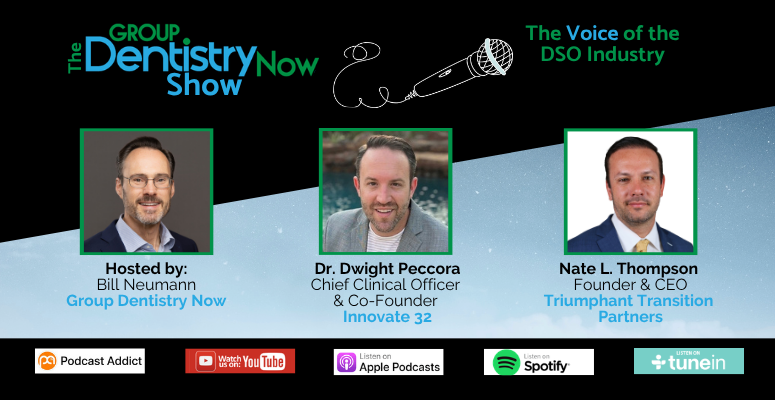
Nate Thompson, Founder & CEO of Triumphant Transition Partners and Dr. Dwight Peccora, Chief Clinical Officer & Co-Founder of Innovate 32 share their thoughts on:
- Navigating the complexity of dental partnerships
- Avoiding post-sale regret
- The M&A landscape for 2027
To contact Nate Thompson for a free practice valuation visit: https://triumphanttransitionpartners.com/get-your-courtesy-practice-valuation-today/
Try the Free Practice Valuation Calculator: https://triumphanttransitionpartners.com/calculator/
To learn more about Innovate 32 visit: https://innovate32services.com/
Subscribe to our channel for more episodes and stay updated on the latest DSO news, insights, and events!
If you like our podcast, please give us a ⭐⭐⭐⭐⭐ review on iTunes https://apple.co/2Nejsfa and a Thumbs Up on YouTube.
Finding Your Perfect Partner: A White-Glove Approach to Dental Practice Transitions Transcript:
Bill Neumann (00:11):
Welcome everyone to the Group Dentistry Now Show. I am Bill Neumann, and as always, we appreciate you joining us today. We’re going to talk today about finding the right partner. Now, what I mean by that is it could be you’re a doctor that’s looking to potentially sell or partner with a DSO or a group practice. You could be a group practice or a DSO looking to find a doctor partner, or you could be a doctor that’s looking to sell their practice or small group and they’re looking for an advisor to partner with. So we throw that partner term around quite a bit, and so I think it’s important. It’s such an important relationship, and we’re going to get into it today. I’m excited to have Nate Thompson, who is the founder and CEO of Triumphant Transition Partners. Nate, it’s good to have you on.
Nate Thompson (01:02):
Thanks, Bill. We’re happy to be here.
Bill Neumann (01:05):
And I had a chance to listen to Nate present at the AADGP meeting when we were in Austin. He did a great job, shared a lot of statistics, talked about the process, which we’re going to get into today. If you do decide to try and find that partner, what that looks like, what’s the best path forward. And then even, I’m sure you’d be able to share, hey, what does 2026 and maybe even 2027 look like if you are looking for some type of partnership? We have Dr. Dwight Coron. He is the chief clinical officer, co-founder, board member, chair of the Doctor Advisory Board of Innovate32. So it’s great to have you on. Did I get all the titles?
Dr. Dwight Peccora (01:50):
Yeah, you got it. Thanks, Bill. Appreciate it.
Bill Neumann (01:53):
Yeah. Thanks both of you for joining us. Why don’t we start things off with some introductions, maybe a little bit about your backgrounds and your roles at your organizations and a little bit about your organizations. And then the most important thing is that one thing that maybe people in the industry don’t know about you, but they should. So why don’t we start with you, Dwight, if you don’t mind?
Dr. Dwight Peccora (02:19):
Yeah, absolutely. Yeah, thanks for getting us together. It’s always good to see Nate and for sure you, Bill, I love what you’ve done for the industry and for those of us as doctors who have continued to grow and scale our own teams, but then needing more. It’s important to have this level of information that Group Dentistry Now provides. So big picture for me is just I grew up in medicine. I grew up in a world of healthcare. What a lot of people, I’ll start with what a lot of people don’t know about me is my father was a jump generation from Argentina to this country. He was one of the earlier international students that got brought into Duke Medical School. And one of the things that I saw quickly was that drive and that desire to build, not only do everything it takes to make a jump generation individual successful, but also the desire to build it off of relationships and off of people.
(03:16):
And that’s been fruitful for me to this day. I’ve been an entrepreneur at heart throughout my career. My father always taught me I needed some level of a degree to go in that. And conversational healthcare was always a part of it. I took the DAT and the MCAT at the same time thinking, “Hey, I’ll eventually find my path and see which one I’m going to end up doing.” And unfortunately, it didn’t give me as much information. I had to go and actually shadow because both those… I did great on the test and then I ended up saying, “Well, I still have a decision to make.” And I decided to go spend some time with healthcare in both dentistry and in medicine, both from following family and following others and getting an ID. And I was the first that went dental. And the reason for that was that we could build a team.
(04:00):
We could build a business more aggressively and be passionate about not only patient care, but also building something. And that’s what drew me to dentistry. So it’s been super exciting. I’ve been involved in the development of a series of other organizations along the way, even while I was in school, and I really enjoyed the process of building a team. That’s my passion, is building a team and seeing what effectiveness they can create through the hands of others than just through my own. And so it’s been really, really fun to be able to do that. I got out of dental school in 2010, and then subsequently I had the luxury of getting to build a dental group of Fort Bend Dental in the Houston, Texas area and founded about five locations there, hub and spoke model, one central hub, large facility, a very integrated healthcare model with specialty and GP support, which is a little bit more of the Mayo Clinic style model.
(04:58):
A lot of things that I had been around and seen throughout my family and all of them in healthcare and watching them that we were in an earlier chapter in consolidation, but we found a way to maybe do this better. And so we focused on group practice, group dentistry. And so our sole joy was to be able to do it together and not feel so alone as this profession can be dramatically isolating. And so the process of building that, we got to the point where we decided, “Hey, let’s just keep building. Let’s do what we can and let’s focus on what we can do together more than we can do apart.” And so through a lot of progress over perfection, I would say, we’ve really had the luxury of building something that really we were very proud of and that our community saw as a large source of success for their oral health in our community.
(05:50):
Along then came the relationship that we’ll soon talk about here with Innovate32 and founding Innovate32 alongside Nate here and the work that we got to do together.
Bill Neumann (06:04):
Thanks, Dwight. Nate.
Nate Thompson (06:07):
Well, that’s glad to be here, Bill. I don’t know how I follow that, but I appreciate getting everybody together. It’s good to see you again, Dwight, as well. And again, Bill, thanks for having us both on. Yeah, I’m Mae Thompson, the founder of Triumphant Transition Partners. I started this company about three and a half years ago with the mindset of giving back to the community in a more relational role. It’s a term that’s commonly used, but I don’t know if it’s commonly followed through. My background came here with my mother from Columbia, actually from Bogota, and me and Dwight has some synergies there with her background in cultures from South America. Came here, social worker, raised me and my little brother. And then through her mindset of continuing to go and becoming your own leader and impacting others is how I got into the entrepreneurial space, starting with my own lawn service as a 13-year-old and then slowly building this company after leaving another company, a great organization that helped build with them as well.
(07:17):
A little bit about me, I got into the healthcare space, oddly enough, sneaking into a career fair at Dwight’s alma mater there in Baylor and met a group called Henry Shein Dental and became their first intern ever, their oldest intern, I always joke, at the ripe age of 27. And through the processes and seeing how we could impact the community and bring more medicine to doctors that I’m unaware of, we built that internship program that’s now nationwide, became a top rep there, and then got introduced to the world of MNA through a DSO that I worked with for a brief moment, but very strong, good leadership there as well and realized, hey, there is a niche here. There is a void here where doctors, they don’t know what they don’t know, or maybe they do, but they’re kind of isolated to one partnership or two or where they go in the next phase of their career, whether they’re 44 years old or 64.
(08:23):
So that’s the foray and how the concept of Triumphant came about. I know we’ll talk more about that, but in doing so through the levels of my career from distribution to a DSO on the buy side, then going over to the sell side and having all those level of experiences has come to where we are today and I look forward to talking about it.
Bill Neumann (08:45):
All right. So the one thing that you’d like the audience to know about that they probably don’t know about you, Dwight?
Dr. Dwight Peccora (08:55):
I think it really just comes down to, I don’t believe in business without believing in these relational factors, and it’s kind of a general subsequent of that. I am a avid traveler. I believe in getting to know from other perspectives that I don’t have my own perspective of what’s going on. I’m passionate about realizing that medicine is different throughout the world because people have figured things out. I’m also passionate that they’ve figured out a way to live life that’s different. That comes from some of my upbringing, no doubt, that comes up from the way I was able to be brought not only… I was the first born in my family in this country, but I got to travel and be in South America and travel. And I’ve spent over 28 medical mission trips around the world. It’s been a big part of who I am.
(09:47):
It’s one of the things that I now have two boys with my wife, Amanda, that we get to, they’re nine and 11, and now they’ve started going to missions with me because I want them to gain that perspective. And I think that makes a giant impact on leading organizations that serve people. And so I never thought it would be that fruitful. It was a short passion that I started off with and it’s expanded to the point where now it’s core to every decision I make and every person I get to interact with.
Bill Neumann (10:19):
Besides Argentina, what is your favorite place to visit, to travel to?
Dr. Dwight Peccora (10:26):
Yeah, I’ve actually spent a lot of time out of Havana, Cuba, talk about a space that’s just kind of frozen in time, but has a massive amount of need. So we’ve done surgeries and support there and it’s ever so more complicated politically, but there’s still the heart of those people is very near and dear to me there. And there’s an area called La Chincha right outside of Lima, Peru, which is considered the poorest part south of the United States in this part of the world. And it is absolutely, a big chunk of my heart is there too, and I’ve gotten to be there quite a lot. And so again, those are the minds and the people that I think of when I get to serve the patients here, not only in the United States, but in around the world.
Bill Neumann (11:12):
That’s really nice. Thanks. Nate, how about you?
Nate Thompson (11:17):
Yeah, some things to know about me and to expound a little bit on Dwight’s point, I mean, we’re all here to serve others. I think anyone in healthcare in general, I choose to believe are here to provide better medicines, solutions, have an impact positively, and we all do. So definitely that doesn’t go unnoticed. Again, synergies, and I think of how Dwight and I became to partner together and throughout this journey to where he’s at today in a growing incredible organization. I’m excited to hear more about it and share that while we build this organization. It is serving others, as mentioned, with the mission trips with his family. Again, my mother was a social worker, excuse me, spent a lot of time in South America between Venezuela and Columbia, giving back to whatever level we could. So that’s always been exciting. I think that one track mindset of impacting others and really not doing it for the right reasons is how people tend to make the most ways throughout their lives.
(12:22):
Life is a marathon, so that’s what motivates me and motivates us here at Triumphant. So things about me, I mean, I was an avid soccer player, played for the Olympic Developmental Program down in Austin, Texas, and then spent some time in Virginia and Georgia playing at their programs there. I actually thought I’d be a lawyer at one point to my LSATs, but definitely took when I met the people again on the distribution side and I really just feel very blessed and fortunate to be here today. Things that people may not know about me, English is my second language. Again, I mentioned I was the first intern at the Henry Shine Dental, been a part of the buy side and then the sell side now. But yeah, kind of like Dwight, avid traveler, big on giving back. I have two young daughters myself, so we’re very active in our community as well with our church and whatnot.
(13:17):
So we go down to South America twice a year as well to reunite with our families and there’s a charity that we sponsor here that my cousin founded called Victoria de Venezuela. What they do is they help indigent children in the community of Venezuela that’s been impacted nationally and globally as people have seen with some of the stuff that’s happened behind the scenes. So for us to be a part of that, for my kids to be a part of that, for us to give back and something bigger than us is something we feel very strongly and proudly, not only here as a company, but just as humans giving back to community.
Bill Neumann (13:57):
Well, I didn’t plan on this, but when you talked to me, you both really focused in on service, the service that you provide to patients and the charitable work that you do and giving back. And so when we talk about partnerships and being an advisor, in a way, you’re doing the same thing, you’re serving others, and I think a true partnership, you serve each other. So let’s talk a little bit about your journey, Dwight. So you’ve got this group practice, it’s doing really, really well. You’ve got to a point where you decided, “Hey, I might need a partner or I want to take this in a different direction.” Take us through that and then maybe talk a little bit about how you found Nate and how that relationship started to form.
Dr. Dwight Peccora (14:48):
Yeah, I think that it didn’t take long for Nate and I to connect deeply, as you can see not only our roots and who we are, but there was something to be said for the fact that anybody who’s built a successful practice in a strong market with multi-location, it doesn’t take long for Knox to start hitting your door. And I had had several of them, but I will say that maybe to tie everything we’ve already talked about and Bo was Nate called me one day and finally he got ahold of me and we were working so hard, we were so busy, so much was going on and we were expanding and adding a new location at the time. And he said, “Hey, I just want to talk to you. I want to see what’s been going on, want to catch up to see where your business is at.” And I think he does such a good job of just listening.
(15:42):
And so that’s what he did was he stopped and he listened. I was at a place where we had grown and we were continuing to grow. We were interested in bringing on partners and doing what we needed to do. And what was most important out of everything is you can continue to grow, but it’s still all on your shoulders and it’s still all on, frankly, your family’s shoulders from a guarantee standpoint as you continue to grow and develop debt. And eventually you graduate out of certain number of banks and opportunities to be able to continue to back you as you go to a certain level. And so essentially I was talking about, I wasn’t willing to give up some of the drive and the entrepreneurial tenacity that we had as an organization on trying to serve a greater portion of the population, not only here in Houston, but elsewhere.
(16:34):
And so I was pretty passionate about underscoring that in my conversation with Nate. And I also kind of underscored the fact that I believed in our model different than the current model, that it was further along in the book as it was in consolidation in healthcare, that we believed that consolidation didn’t go so well at the start for healthcare and it didn’t go so well at the start for dentistry. And over time, what happened in healthcare was there were some unique groups that were hyper-focused on comprehensive care and on actually developing quality of care as their main KPI. And that was really what I was hyper-focused on was building that locally. And if there was any time that Nate had interacted with anybody and said, “Are there any guys out there or any firms that are willing to back a group to do that from a foundational level, please let me know.” And at the end of that conversation, typical of Nate’s desire of going around building a network and finding relationships, every other broker that knocked on my door before had said, “Hey, I’ve got 11 or 12 people I’m going to put you up against and they’re all going to fight over you.” And instead, Nate kind of looked at me and said, “Man, thank you so much for making the time to talk to me about your business and what your desires are and where you’re going.
(17:53):
Frankly, I think I know one person that you should talk to.” And it was kind of a breath of fresh air. It kind of shot me back because that’s not usually what brokers want to do. They want to compete it out, they want to throw you out there, they want to make different things happen. And for some people, that’s the numbers game of consolidating what maybe part of a check you might get or something to that degree is the core of that. It wasn’t. I was a gritty entrepreneur who wanted to go further. And so I wanted to create the new level of maybe the Mayo Clinic comprehensive care model for dentistry. And I got a chance to talk with Josh Johnson that had been brought in as CEO to start what later became Innovate32. And that was a big part of what really triggered my passion and said, “Hey, this is actually something I’d be interested in and that my whole team, not just myself, would be interested in being a part of and scaling from the founder level.”
Bill Neumann (18:54):
Nate, I’m curious from your perspective, what did you hear from Dwight that led you into the direction of not saying, “Hey, I’ve got 10 or 12 strategic partners out there that are going to fight over you,” which is what you’re exactly right, Dwight. That’s exactly what you hear, right? “Ah, they’re going to outfit each other and it’s going to be great and you’re going to get the highest valuation. “You went in a totally different direction, Nate. Why did you do that? What did you hear from Dwight?
Nate Thompson (19:21):
Yeah, no, and I appreciate you Dwight mentioning that. I had that on my cue card, for lack of better words. But I mean, to Dwight’s point, listening, look, these are very busy entrepreneurs. Like he mentioned, he’s in a very competitive market, the fourth MSA in the country. He’s still fifth location, he has a young family, multi-partners, tons of team members of patients who rely on him, et cetera. So you got to get into their mindset of what are they telling you? What are their needs? To some people maybe being chased by 10, 15, 20 people is more what they’re looking for. That’s how this company was founded and created because I was a part of shops that had that mentality. But what I heard from Dwight is like, look, we have something special. We’re doing something. We’ll continue to do something very special and give back to the community and provide the best medicine possible and take care of our patients that need the care.
(20:20):
But if there’s a way to do it maybe more efficiently, maybe more effectively, maybe provide better medicine faster, because they would no doubt about it, they would be just successful whether I had met him or not, but is how can we get there? And to Dwight’s point, after we were done with those conversations, and there were several, it wasn’t like, “Hey, that’s one conversation, let’s go.” It was multiple as it should be. I’m a big believer that things definitely need to be thorough and vetted, and the best things you work the hardest for, the ones that seem to be too good to be true, tend to be too good to be true. So as the more we talked through it, I kept thinking, I was like, okay, what can impact him? What can impact his family? What can impact to his partner? What can impact his team?
(21:04):
What can help his team’s kids? What happens to his patients, et cetera? I started thinking of a group, and Dwight honestly nailed it. I mean, I said, look, I’m not going to waste your time. We don’t do a shotgun approach here where we just farming out to 20 people. And like you said, let the highest bidder win because most times it’s honestly not the right partnership because then you get that post-sale regret and that’s something we don’t want here. We want people to be fired up. And I’m very blessed and grateful that Dwight took the time out of his schedule to come today, but I think it’s a testament of hopefully the partnership he’s built through the synergies we helped facilitate. And hearing what he needed and how he needed it, when he needed it, what he was looking to accomplish, who he’s looking to impact, we came to be where we introduced him to the right partner.
(21:52):
And the partnership seemed to align perfectly. They had the same thesis, they have the same goals, they have the same patient care in mind, and that’s critical to it. And once you know, you know. And once I took all that and digested it and though long and hard, again, it wasn’t knee jerk let me go out and just, I got one person. I was like, who will fit? You have one shot and who will fit him best? And I thought critically about it, and that’s how it came to be. And definitely you’re educating the buyer as well. And I think that’s also a testament to it. It’s not just, hey, a buyer wants to come out there or a strategic partner wants to say, “Hey, give me many practices I can purchase to grow EBITDA or to grow the company.” Because when it takes the buyer too sometime to come around to it, they were building it, they’re a young company making a foray into a new state because we worked with them in a new state to say, “Hey, this person fits Innovate32 and the way you want to build it the right way or the way you see fit in giving proper medicine and collaborating them together, again, takes quite a bit of a lift.
(23:08):
But again, Dwight and Innovate32 guys are a special group. And I’m not just saying that because we’re on this podcast, but that’s how it came to be in a really fast nutshell.
Bill Neumann (23:23):
So Nate, you talk a little bit about having this, being a white glove advisor, a different approach. And we talked a little bit about the different approach, not the shotgun, but totally different. Talk a little bit of what does that mean? What does white glove mean
Nate Thompson (23:39):
To you? Yeah, it’s a word thrown out there all the time because it sounds fancy, but what really does it mean? It’s a good question too. So again, my foray into it, and I’ll be extremely brief here, was I was in distribution, got approached by DSO, wanted a time with them, enough to have a cup of coffee, but still saw how they were pursuing practices and where the void was and how they were purchasing them and what they were promoting, I guess, or educating or even selling to these doctors. And it was a concept that wasn’t really around yet. It was more of a partnership organization versus this traditional service organization. So anyways, I saw that they’re wildly successful, left them to join the largest group in the country that represents sellers. Great company as well. Saw that, but I just kept coming back to it thinking about what if this was me?
(24:36):
I had a young family at the time, I still do, by the time I had a one-year-old, or not even, six-month-old, and then later on, another one was coming. And I said, “What impacts these doctors the most? They’re humans just like us. They have a lot going on. People when they come in don’t realize maybe some of the impacts they’re going through, firstly, professionally, and it doesn’t have to be negative, but it’s in general, the time that’s going on.” I go, “What can we do to make it easier for them?” It’s like whoever asks the doctor what they need. It’s usually, “Hey doc, this is what I need,” or, “The team member needs something.” Whoever your kids literally coach, it doesn’t matter, but who asks them what they need? I kept thinking about that. I was like, “Man, wouldn’t that be nice if we could approach a business owner and say, Hey, how can we make your life easier?
(25:28):
What are you looking to accomplish? What can make your quality of life, which is the term that’s thrown around a lot, but what can really make your quality of life better and what could set you up for the future? If you want to scale, but you want to scale properly, and do I mentioned this earlier, you can out gain a lender because you’re just growth-minded and you’re doing well, but they have their checks and balances, and sometimes that can cause some delays. So that’s how it came to be. I said, “Well, look, we’re impacting them. They don’t know what they don’t know. Sure, they get multiple offers all day, but what’s the right offer? Who has my best interest?” And I said, “Look, if we create a firm that’s seller only, we only represent sellers, there’s no ties to buyers. If we can listen to them on what their needs are and actually listen to them, who asks them, what do you need?” It’s not always pay, I want the highest price.
(26:25):
That does not tend to turn out well. They will get there on merit, good work, equity, sweat equity in general, but what do they need? Who asks them what they need? What keeps them awake at night? What’s going to set their children up? What’s going to set their children’s children up? What’s going to set their team up? And that’s how it came to be, and that’s how this company came to start. That’s why I’ve kept it lean. I’m involved in every transaction, everyone. So definitely my days can be a little stretched out, but I feel very fortunate for that. And that’s part of the service. It’s look, everybody here has been a part of this industry. We’re all doing it for the right reasons. We’re here to listen to what you want, and that’s it, not what we want. It’s what you want, and that’s how this company spawned and why we consider ourselves white glove.
(27:13):
We all touch it. We all hear it. We don’t waste your time. They don’t have enough hours in the day to be on five to 10 Zoom calls. It’s let’s get them what they’re looking for and bring it to the table and chop through the grass to get to what we need to get to. And that’s why we consider ourselves the premier white glove service in the country.
Bill Neumann (27:38):
White, from your perspective, when you were looking at the ideal partner, what were you looking for? You obviously wanted to get a great valuation. I mean, that goes with that being said, but what other things that you were looking for that maybe you couldn’t find from a traditional strategic partner, some of those other offers that are out there, those direct, the emails, probably the snail mails, the people at the conferences coming up to you, what were you looking for and how do you decide on and who is that partner? I’m sure Nate helped you there as well.
Dr. Dwight Peccora (28:18):
Yeah, I think that the most powerful thing we can focus on as dentists that are either looking for partners or things of that nature is that the world is different today. When we say that poor consolidation happened early on, both in healthcare and medicine and also in oral health, it happened because people were duct taping these MSOs and these DSOs together and basically trying to consolidate them and sell them at a high number, and it was a numbers driven mindset. Eventually what happened was, and we like to say that humanity was right in building it this way, but it actually was required of consolidation later on. And what I mean by that is quality of patient care became the KPI, comprehensive nature of care became the KPI. Why? Because now it’s no longer effective to grow a business just by pulling a bunch of practices together, nor do we believe that any consolidation of any industry was ever successful just doing that.
(29:23):
They have some synergies that increase your duty, but it makes it happen. But today, the best part of oral healthcare is that it’s consolidating over the idea that we can together create better quality of patient care. And I think that that’s what it took. It took Nate and his team to have a very quality approach and a white glove approach to be able to say, “Hey, this doctor sees the bigger picture of where we’re heading.” And frankly, I can tell you that now, Innovate32 starting with these three founder docs of 10 locations, good Lord. Just over a year ago, and now by the end of this year, we’ll end up with 70 locations, 150 dentists, 200 hygienists, over 800 employees. The rate at which we’ve grown has been based on one simple concept. Our KPIs are quality of patient care, comprehensive nature of care. All the other synergies will come along.
(30:19):
But go figure, now you don’t get a good valuation, good value of your business if you’re not building a great business, which means you’re growing organically. Some people will call that same store sales. To me, I call it comprehensive level of quality patient care and customer service. That’s who we are. And it takes the consolidation of an industry to get to a point where now all of a sudden that doesn’t grow us anymore. That doesn’t have value. And so what Nate introduced me to was Josh Johnson and the team over at Shore who was willing to back a group that said, “Hey, we’re going to go parse for parse. You’re going to get the same level equity that we do. Let’s do this together and let’s see if we can get as many doctors and their team to be shareholders and equity holders as we go along in building this thing.” But that our primary is quality of patient care and comprehensive care, and then we’re going to focus on building it that way.
(31:17):
That’s what turned me on to this group that Nate introduced me to because they had done it in other sectors in healthcare and they really wanted to do it well in dentistry. And that was their driver, but they needed… It was nice to feel needed. It was nice to say, “Oh, you’ve built this comprehensive model of GP and specialty support where we build density in certain markets and we focus on that. We don’t sit back and say, Who’s going to take our money and let’s just shotgun approach locations all across the country. We’re going to be very specific and we’re going to be very led to find hungry doctors who want to do this right and team who wants to come along and do it right. And so that was the biggest difference, not only from getting well supported and advised and understanding this at a much deeper level with Nate and his team, but also recognizing that who you build a partnership are the people you’re going to be in the trenches with for the rest of your career.
(32:17):
And I don’t see this as, oh, how can we take it to recap? This is my career. I want to build one of the largest, more comprehensive quality of care patient models that’s out there in dentistry. And Innovate32 has done an incredible job collectively by being able to do this, especially considering not just our growth. I can throw those numbers out there on how many locations. Those don’t matter as much. We have so many locations of 20 plus operatories. We have so many locations of integrated specialty, rotational quality of care where patients are a part of one system. So wherever they go, their x-rays, their systems are all unified. They get the best care possible and they get it when they need it. I think that’s the level of focus that I think is going to transform the level of quality group dentistry. And that’s what I’m most excited about and what Nate started and lit the fire in me and being able to find a way to continue the path that I was on, but doing it at scale, a scale that I couldn’t have never done on my own.
Bill Neumann (33:25):
Well, Nate, this is interesting. Dwight, you’ve got an entrepreneurial spirit, right? You said that you started some other businesses. And so Nate, I’m sure you probably, when you started to talk to Dwight, you understood that, that maybe a traditional strategic partner wasn’t going to work for Dwight anyway. So you needed the opportunity to do your own thing, so to speak, or build a group the way you wanted to build a group. And it sounds like you and some of the founding docs really had the same thought process. You mentioned something, I think it was you, Nate, you talked about post-sale regret. And then Dwight talked about the way the first generation of consolidation really didn’t go so well because you’re right, it was all money was cheap, people were just buying up groups, didn’t matter. Cultural alignment didn’t matter. Just roll them up, sell them off and let somebody else worry about that mess later.
(34:27):
So I think that’s where you get some of that post-sale regret. I think we heard DSO was a dirty word early, early on, maybe 10, 15 years ago, and then valuations were sky high and everybody was thrilled. And then of course there’s the fallout. They weren’t necessarily partnered with the right organization. And so now we’re kind of hearing that again. You start to see this DSOs not so good anymore. That seems to be bubbling up in social media. It’s coming back around again. So there’s a lot of that going on. So I throw a lot out there. So from your standpoint, Nate, how do you help somebody like Dwight and other organizations, people that are looking for their next move? How do you determine who that right partner is? Because in some cases it could be one of those 10 strategic partners, somebody maybe wants to retire in four or five years.
(35:23):
How do you determine that?
Nate Thompson (35:25):
Sure. If I had the answer, I would be at a different place. But I mean, I wish we had a silver bullet. It’s really listening to your client. Every transaction or every partnership is not the same. It just really isn’t. Sure the process is maybe similar, but what everybody needs is different, whether it’s minute or it’s something much bigger than that. It’s really understanding why they’re doing this, why they want to do it, why now, why not a year ago, why not in five years? The median age of our client is 44, so they tend to have a ton of runway. Again, we have clients that are as old as 80, not old, but as wise as 80, I guess. But it’s really understanding what they’re trying to accomplish. Again, we’re all business owners here. We all have, I’m sure, interesting goals that we want to accomplish, whether it’s for ourselves, for our families, for the community, et cetera.
(36:23):
But why? What motivates us to get up every day and continue fighting the fight? Because it can be a little bit of a battle at times. And it’s just truly understanding what do they want? Why are they here? And to be candid, it’s probably not the smartest thing, but we turn down more deals than we take on. Let’s start there. I like keeping it lean and robust. I like us all being able to touch it. I don’t want us to ever take on more than we could take on a client feel they’re not being heard or taken care of, because it’s the last thing we want to be is to turn into a transaction or transactional relationship.That won’t happen here, but it’s truly understanding what they want. And again, if it’s merely, “Hey, I want the top dollar and I don’t care,” they’re probably not the right fit for us, just to be frank.
(37:10):
We’ve turned down deals where people at 10 plus locations, but the reason they were doing it wasn’t for us, at least we felt comfortable enough. And I know that may sound silly, but we want to do a good job. We’re very organically grown. We’re organically led. You’re not going to see us on the top of searches anywhere. We definitely, we work from word of mouth and we do that by listening to our clients and what they need and what they want and bring that to the table. So for us, it’s really just understanding their wants and their needs, how we can accomplish that together. I mean, it’s synergies. It’s not like, “Hey, let’s go out and do this and we’ll be back in a week.” We talk to our clients, we talk to them daily. Dwight and I had tons of calls. It’s always weird when a transition ends and you quit talking to somebody you’ve talked to for weeks.
(38:02):
But it’s a good thing to do. It’s like they’re onto the next phase of their career to get to where they deserve. So I know it’s a long-winded answer, Bill, and just to be more concise about it, just really understanding what they want and how to get them there as effectively and efficiently and with a group that’s growing. Again, Dwight mentioned this earlier, that always does an amazing job explaining it is he’s the chairman and co-founder of this organization that’s about to be at 70 plus locations and that’s where he wanted to be. That where his vision was. He would’ve done it on his own. However, to be able to impact people with better medicine more efficiently, it’s allowed him to do that with support because we all need support and it’s finding them the support and improving their quality of life, making sure they don’t go backwards and setting them up for the future.
(38:51):
So it’s really just hitting up on those metrics and those key points that really matter the most and going out there and facilitating that. And that’s what we do daily.
Bill Neumann (39:03):
I think the audience needs a download of Innovate32. What does the organization look like? You talked about some uniqueness to the organization. And you’re right, it’s not all about practice count and that’s what we hear. Oh, how many locations do you have? How many locations do you have? But you’ve got some really, I think, unique locations. You do things that look a little bit differently. Some of them are pretty large too. You talk about the number of doctors and the number of operatories and the types of procedures you do in each location. Talk us through what does Innovate 32 look like right now in October of 2026?
Dr. Dwight Peccora (39:41):
Yeah, so right now we have just right around, I would say, right at 50 locations. I think it’s 48 is the exact count. We’re consolidating two other large groups that wanted to join us in certain markets that we’ve really, really established. Our core theology has just been partnering with doctors in strategic markets that say, “Hey, this market is not only growing, but has a desire to consolidate in a way that allows us to focus on density growth.” These are markets where, for example, the Nashville, Tennessee market, Knoxville, Tennessee, so currently our regions are those. Houston, Texas, of course. We’re right outside of Orlando, Florida, near the villages area, Ocala area, if you will. And of course also now we took on a large consolidation of consolidators. So we actually acquired a group out of called Great Lakes Dental Partners out of Indiana and Chicago, Illinois area.
(40:48):
Really, it’s kind of very dense right on that northern Indiana border right next to Chicago. So each of our markets, we’re hyper-focused on not only if we are going to enter a market, we want a strategic partner that believes in the growth of their market and making a massive impact on their market. That’s how we started Clint Newman in Nashville, Tennessee. We’ve now expanded. We’ve got over 16 locations in Nashville, and then we expanded and did the same thing over in Knoxville, Tennessee. Joined Sorrentino and the Marion Dental Group out of Ocala, Florida, did the same thing, started to expand there. Fort Bend Dental in the Houston, Texas area starting to expand there. Why did we do it? Because we actually believe that group practice dentistry is best when it’s geographically close and that we know that we can be additive to what they’re currently doing.
(41:41):
And that includes bringing on specialty. So in most of our markets, we have hub operations with large central facilities where a lot of dentistry, not just GP dentistry, but also specialty and expanded services dentistry is happening. But also we’ve got some markets where there’s so many of our locations where now we are able to enter that endodontist to come around to each location, enter those periodontists, the oral surgery. And so we are kind of at a point where this model is the model that really attracts some of the best providers and practitioners we have seen. We’ve had this giant funnel of doctors, including specialists who say, “I want to be a part of that.” Because when specialists are a part of an organization like that, first of all, there’s a close-knit community, we all work together, and that whole community is relying on us for their level of comprehensive care as opposed to getting pinballed all over the place where I started with my GP, they gave me a treatment plan, but then they sent me to an endodontist.
(42:42):
We used up all my insurance benefits over there. I come back, my GP price is different, went to get a CT over here, went to the oral surgeon over there. That creates distraction from compliance of quality patient care by the patient, and it creates distraction because frankly, an endodontist in their own practice is trying to make sure they get their work done first and the GP’s trying to get their work done first. And I’ve seen order of operations of treatment plans get out of whack because everybody’s just trying to grab onto either insurance or grab onto the patient, whatever they’re willing to spend now. That’s not quality of care. And so when we have developed Innovate32 in a way that has allowed us to not only build these current 50 locations, and we’re super excited about the two big groups that are coming along with a couple small ones added in these markets, to be at 70 by the end of the year, actually by the end of November, gives us a chance to really understand these markets are developing comprehensive care and they are being attracted to us more than ever by word of mouth.
(43:50):
I’m a part of Innovate32. Why don’t you come and check it out and see what it looks like in my office, what it feels like to not only continue to get to practice the way I want to practice, but to have an infrastructure of support that allows Innovate32 to say, “Hey, we got what you need. You focus on comprehensive patient care. And by the way, here’s a list of specialists and support structures and masterminds and these groups that allow us to really build and make you a better practitioner, make your team better at what you do with the training academy to develop your team, your hygienists, your assistants.” All these things are what it takes to build organic growth is what everybody else wants to hear, but for me, it’s to build comprehensive quality patient care. And that’s where Innovate32 has been transformally different to these communities.
(44:39):
We’re excited to bring it to more communities. By the end of the year, we’ll be in eight different states. Currently we’re in five, and so we’re really excited about what that looks like.
Bill Neumann (44:50):
Well, to get to the end of the podcast, I’ve got a lot of questions still, but I’ll try and keep it brief. For people in the audience that are curious what happens after the deal’s signed, Dwight, can you talk a little bit about that? You’ve gone through, and Nate, it’d be great to get your perspective too. So what’s the experience like once things are worked with Nate, we don’t have any post-deal regret, but what did it look like for you or what does it look like for you?
Dr. Dwight Peccora (45:25):
Yeah, I think it’s really important to be brutally honest about what this feels. First of all, change is hard for everybody no matter what. I think it would be nice for everybody to settle in after and say, “Oh, well, we’re all going to just, this honeymoon period’s going to last forever.” The most important thing was that we got to work right away. We got to work right away on focusing on how to integrate the three batches of founder practices unified together. First and foremost, you’ve got to converge to software where we can all support each other and see each other. This is the balance. Last week we had some patients that came from our Nashville offices. Their whole family of eight had actually moved to Houston, and guess what? They’re all now Fort Bend Dental patients. They were Innovate32 patients before. They are Innovate32 patients today.
(46:15):
That’s the beauty of doing things the right way. So you’ve got to do that. You’ve got to integrate your banking, you’ve got to integrate your accounting, your finance structures, all these things. Frankly, initially that’s disruptive. Your team is used to doing it in certain ways and there’s a checks and balances process, but it takes a while for the team to realize, because we’ve been doing everything, that we get to not have to do some of those things now and we get to focus just on patient care, which is really hard for a lot of people to wrap their heads around. One of those avenues that I see a lot now, even after our most recent partnerships, is revenue cycle management. When you realize I don’t have to go chase every little dollar, not only from insurance and go negotiate our fees to increase, and now that we’ve entered a dense market, go represent us to these insurance companies, you don’t have to do any of that.
(47:06):
That’s something that we have a whole department that does it and it makes a massive difference, but that change is always difficult. It just is simply because most of our practices, we’ve been doing it the same way using the exact same software for the longest time. We now put all our practices under Dendrix Ascend because it’s a virtual web-based system that helps us be more comprehensive in nature of adding technology, adding AI to our systems, ambient voice, to listening to autocontabulate our notes and our paracharts and all these other things and x-ray reading. These things are critical technologies that make us all better, but we first have to go through the integrations process. And because of that, it required a large integrations team. We became a big part of that integrations team because we did it as a founder level and now we’ve had to build that.
(47:57):
So it’s a little easier probably on the doctors today because we have such a large team today, but early on when you’re one of the founder groups, it took a lift. It took some time to be able to let go of certain things and refocus them on the vision. And for me, that was the most exciting part.
Bill Neumann (48:16):
Nate, from your perspective, what does 2026 look like from the buyer and the seller side? Valuations I think are definitely different than they once were, and so on the seller side, there has to be some realistic expectation, which sometimes there isn’t. And of course there’s a lot of emotion attached to this practice or this group of practices that you built, rightly so. So you place a real high value on that. But Nate, what are you seeing out there? And again, for people in the audience, if they’re looking to do a transaction potentially in the next six months to a year, what should they expect?
Nate Thompson (49:03):
Sure. It’s a question Colin asked things that, I hate to use the term leveled out because I don’t know if they’ll ever level out. You had the foray before COVID, then you had COVID where money was cheap, below inflation rates and now we’re some of these overpurchased me. They couldn’t support it as quickly for what they had acquired and they weren’t maybe as disciplined or as intentional as they could have been. And now things are kind of getting to where they are. So for us, again, it’s just finding the right fit, finding what they’re looking for. I mean, what we expect out there in the marketplace. If somebody’s looking to find a strategic partner, again, it comes down to the why. They need to really believe in that company. I mean, Dwight took a big risk in joining that group and trusting us to bring them the right group that’s going to, again, support him.
(49:59):
And to his point, nothing is going to… The next day, once you close it, like I said, there’s a honeymoon period X amount of months, but then reality hits and then now you’re working with a partner. And that’s what we want to do is align them with actual partners and have voices and they still have their autonomy, but there’s also going to be some changes and probably some influence there. But what they can expect is they need to really believe in who they’re going to partner with. I mean, that equity aspect of it’s always going to be a portion of the deal. These key men risk you’ll hear a lot of now is basically not relying on just one person to be the sole provider. They want to mitigate their risks and then ensure that the patient care is not just on one person, it’s separated amongst several providers as well.
(50:46):
That’s something that’s changed a lot more. It’s going to be a lot more held accountable for sellers, whether that’s through an earnout or some kind of growth bonus, et cetera, as part of the deal. So they really need to get behind that, but they really, really need to believe in who they’re partnering with. I mean, that’s something we educate all day saying, look, sure, this is going to be a component of cash. Let’s understand why you’re doing it. They’re going to help you strategically do X, Y, and Z, but you really, really need to invest in this person or this group because it is a business marriage, like any marriage. There’s communication, there’s going to be highs, it could be a little bit of lows, but it’s really understanding why you’re doing this and why you’re taking this leap of faith with something you built and going from having no influence to having partners can always be a little bit of a challenge, but it’s really understanding what you’re buying into or what you’re partnering into.
(51:43):
And that’s something that people just really need to really focus on and understand. Why am I doing this and with who? And once they understand that, it makes the process much more enjoyable. It’s not, that’s where you avoid this post-transition regret or the seller’s remorse, for lack of better words. It’s just really understanding the partnership, what they’re bringing to your table, remembering that, and understanding what you’re investing into, because that’s who you are, you are investing into them, but they’re also investing into you. So it’s more levers. You’re going to see more levers now already and into the future of, “Hey, how do we hold each other accountable?” I mean, that’s just the reality of it as it probably should though in any type of marriage or a partnership. So that’s going to definitely be much more of a key, the risk spread out between investment to the company with equity to obviously a cash component and some kind of maybe hold back or earn out or growth incentive to make sure people are still rowing in the right direction.
(52:44):
But outside of that, people are still partnering, amazing groups are still purchasing and finding good partnerships and good leaders and good doctors. So that hasn’t stopped. People ask us all the time, “Has deal flow stopped?” I said, no, not at all. Now, are deals a little bit different? Sure, absolutely. But they’re always going to change. Change is constant. So it’s something that to be fearful of, it’s just really understanding when is the right time. And we educate people through the entire process. Half our clients, excuse me, half our clients, we get to a point and we say, look, if you’re trying to get to goal X, well, let’s implement these processes or let’s focus on this for the next X amount of months and then let’s take it to market or take it back. But it’s just really understanding why and who you’re doing it with and getting behind that.
(53:36):
And I think that’s what people fail to recognize at times when they go down this process is really what they’re there to begin with.
Bill Neumann (53:45):
Thanks, Nate. If people want to learn more about Triumphant Partners, Transition Partners want to contact you, what’s the best way to do that?
Nate Thompson (53:53):
Sure. They can email me personally, nate@triumphanttransitionpartners.com or to our main email inbox, info@triumphanttransition.com, that’s singular. But also they can reach out to me directly. I handle calls all day, calls or texts at or call our main line, 512-924-8808. And we’re happy to discuss. We do courtesy consultations all the time, discovery calls all day, every day, into the weekends and nights as well. So again, we’re here to serve. We want to best understand and educate them and understand if we can help them get to their goals.
Bill Neumann (54:37):
We’ll put Nate’s contact information in the show notes, URL, email address, phone number, Instagram, TikTok, all that fun stuff. We’ll put that in there so you’ll be able to reach out to Nate. Dwight, if anybody wants to learn more about Innovate32, what’s the best way to do that or contact you?
Dr. Dwight Peccora (54:58):
Yeah, absolutely. I’ll share my contact information for the show notes as well. Make sure that it’s all in there. Dpeccora, D-P-E-C-C-O-R-A at innovate32services.com. Frankly, everybody under the sun has my number, so feel free. That’s kind of the whole point. 832-489-3333. Contact me. I mean, it really comes down to what he said, which is relationships and who you’re in the trenches with every single day, whether it’s getting an advisor to support you through this decision-making process and learning about where this industry is today, all the way to who you partner with and what you’re going to go do and what you’re going to go succeed at. It takes work, it takes grit, but at the end of the day, it’s all about the team that you’re building and has very little to do with us individually. And so this has been awesome. Thanks, Bill, for having us and giving us some support and a voice to make sure people know about our experiences.
(55:53):
And it
Bill Neumann (55:53):
Was great to have both the entrepreneurs on this podcast. It’s so cool to hear about your stories and where you come from and where you’re at now. And like you talked about being partners and this is a big small community, so dentistry’s relatively large. The group practice space is smaller, but everybody tends to know each other to a degree and for the most part works well together. And we appreciate you sharing what you’re doing at Innovate32 and Nate, your insight as to where the market’s headed. And the one thing I’ll just say, because we really didn’t touch on it, is that I don’t think you really want to go it alone because there’s good and bad out there. As a dentist that as a practice or a group of practices, there are more options now than ever, partners now than ever. That’s good, but it’s also really challenging who’s that right partner so you can use somebody like Nate and Triumph Transition Partners to help you find that right partner.
(56:57):
Because like Dwight said, I mean, he would’ve probably never found the team at Innovate 32 because everybody else was sending him in other directions. But thank you both for being on the podcast today, and thank you everybody for watching this podcast. Until next time, this is the Group Dentistry Now Show.