
Ranked the #1 DSO Podcast!
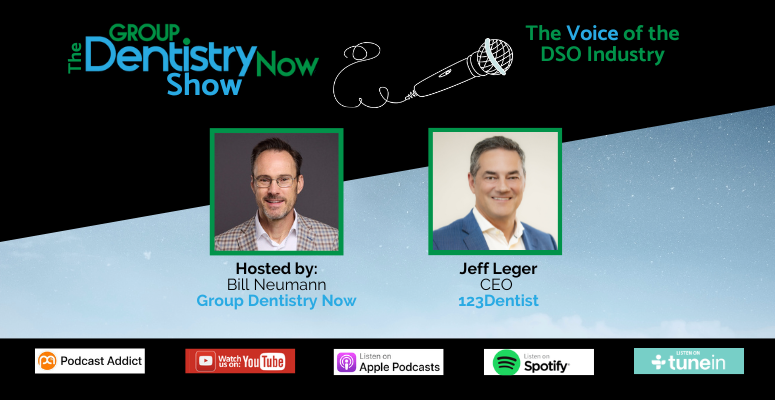
Welcome to The Group Dentistry Now Show: The Voice of the DSO Industry!
Jeff Leger, CEO of 123Dentist Talks Culture, Technology & Growth
We head north of the border to talk with Jeff Leger, CEO of 123Dentist. Jeff shares his thoughts on:
- The Importance of Culture
- Acquisitions and Same-Store Growth
- Leveraging Technology
- Much More
To learn more about 123Dentist visit https://www.123dentist.com/
Subscribe to our channel for more episodes and stay updated on the latest DSO news, insights, and events!
If you like our podcast, please give us a ⭐⭐⭐⭐⭐ review on iTunes https://apple.co/2Nejsfa and a Thumbs Up on YouTube.
Choose your favorite listening app below and subscribe today so you don’t miss an episode! Full transcript is also provided below. See all of our podcasts HERE.
 |
 |
 |
 |
 |
 |
DSO Podcast Transcript – Jeff Leger, CEO of 123Dentist Talks Culture, Technology & Growth
Welcome to the Group Dentistry Now Show, the voice of the DSO industry. Join us as we talk with industry leaders about their challenges, successes, and the future of group dentistry. With over 200 episodes and listeners in over 100 countries, we’re proud to be ranked the number one DSO podcast. For the latest DSO news, analysis and events, and to subscribe to our DSO Weekly e-newsletter, visit GroupDentistryNow.com. We hope you enjoyed today’s show.
Bill Neumann: And welcome everyone to the Group Dentistry Now show. I am Bill Neumann, and we appreciate you joining us. Happy 2026. We are always excited to have new guests on. And this is an organization that I know pretty well. I’ve followed one, two, three dentists, I wouldn’t say since their inception, but since their early days, and I’ve really seen them grow and scale up and just a great organization. I want to introduce you to a relatively new CEO. He’s been there about six months, Jeff Legere. He is with 123 Dentist. He comes in through actually retail pharmacy, and he’s a pharmacist by trade. So really interesting. I don’t know if we’ve ever had a pharmacist on the show before, but it’s great to have you here, Jeff.
Jeff Leger: Thanks for having me, Bill. It’s really great to be here.
Bill Neumann: And before we get started, I talked a little bit about, you know, knowing one, two, three dentists through a kind of throughout the years. And I’ve got a good friend who he and I, as we say, grew up in the dental industry together, both Jason Brown, who heads up, he’s the VP of your strategic sourcing. He and I started in dentistry in 2003 and spent a month in Wisconsin learning the dental industry. So I got to know Jason really well and have a lot of respect for him, what he does for your organization and have learned about. the organization through him and some of the others there. So you get a great group of people.
Jeff Leger: Yeah, Jason’s a great team member. He’s he’s from Newfoundland, Labrador, and I’m originally from Atlanta, Canada. I lived in Newfoundland as a kid. So it’s nice to to meet a friendly Newfoundlander here in one, two, three.
Bill Neumann: Yeah, it’s been being, you know, an American. I’ve heard the Newfie terminology, so I didn’t know what that was until I met Jason. He kind of filled me in, but it sounds like a beautiful place.
Jeff Leger: It is pretty spectacular, so I’m glad he gave you a bit of a view into the Newfie culture.
Bill Neumann: So Jeff, a little bit about your background. So you obviously come from outside the dental industry, but why don’t you kind of set the stage for, you know, how you, maybe you kind of, you know, you grew, you get out of the school, maybe a little bit about your early career, and then take us to, you know, current day.
Jeff Leger: Sure. I’m actually from New Brunswick and went to university in Halifax, so I’m a pharmacist. I worked in hospital pharmacy and community pharmacy in the pharmaceutical industry for many years and then ended up at Shoppers Drug Mart based here in Toronto. For those who don’t know, Shoppers Drug Mart is Canada’s largest retail drugstore chain, about 1,400 locations across Canada, $18 billion in revenue, 55,000 employees. I was there until the early spring of this year and left for this new opportunity. And I’ve known one, two, three dentists, call it for three to four years. I met our founder, Dr. Min Shivji, way back then when I was at Loblaws and Shoppers. And I was drawn to dentistry as a really great sector with really incredible fundamentals and real dedication and focus on patient care, which really It was important to me being a pharmacist and being head of a large health organization like Shoppers Drug Mart. I was excited to join on July 2nd. just shy of six months. In the first six months of my time there, I’ve been to 100 locations. I really wanted to get immersed deeply into understanding the culture, dentistry as it relates to how it’s practiced, dentists, hygienists, CDAs, admins, office managers. I really wanted to get a good grounding in kind of how things played out on the field and I come from an organization with a very strong operational focus, so it was really important to me. So I’ve met so many great teams, and I just went to my 100th location last week in New Brunswick, which is where I’m from. So it’s been really a great six months.
Bill Neumann: Excellent. So 100 locations in six months. And what’s your goal when you go to these locations? You’re obviously having conversations with the people there, but are you looking for certain things? And then what are you taking back, I guess, then to maybe make some changes or maybe to take best practices from one location and try to apply that to others?
Jeff Leger: Yeah, so the main objective is to meet the teams and understand what they do to deliver great care, what are their patients, the demographics of their patients, how does the care delivery workflow happen in the clinic. and just get some observations about what’s happening, what may be able to be improved, and bring that back to the team here in our central office. In my first six months, I was really trying to see what we needed to do for the next three to four years. This organization has been incredibly successful, 123 Dentists. It has a great culture. Amin has done an amazing job of bringing things together. They brought me on to move from about 450 locations to a much larger platform. To do that, it’s really important to understand what the operations look like, where we can become a bit more efficient, all the while delivering great care and really making sure that we’re meeting the needs of patients. That first six months in the Hunter clinics has been really great. It’s given me lots of ideas about how we can continue to create a stronger support for the clinic teams, making sure that they do what they do well, they’re the best, which is deliver care, and how do we remove some of the toil or some of the processes that may not be And the best interest is them doing versus us helping support them become more efficient that way.
Bill Neumann: So you mentioned approximately 450 locations and you pretty much span all of Canada. Are there any areas that you’re not in? I’m sure you’re probably close to population centers, but talk a little bit about the locations and where you are.
Jeff Leger: Yeah, so 450, almost 470 locations. We operate in nine provinces. Funny enough, we are not in Newfoundland and Labrador. So Jason and I need to work on that in terms of being able to get a location there. And we’re not in the three territories either. But it started out West in British Columbia. So we have a very strong presence in the Western provinces and very strong in Ontario too. and probably more opportunity to expand in the eastern part of the country, which includes the Atlantic provinces. So yeah, it’s been a really great growth story up till today, over a billion dollars in revenue, over 8,000 team members, 2 million patients served annually, which is really an incredible number. And this year, we’re proud to be ranked in this year’s Globe and Mail’s list of fastest-growing companies with a three-year revenue increase of over 214% from 2021 to 2024. It was our first year applying to be on that list, so we’re very excited about that. We were the fastest growing Canadian company that has revenues exceeding $1 billion. That was a really great accomplishment and we’re looking to obviously continue to grow more and larger.
Bill Neumann: Yeah, that’s incredible growth, especially at this size you already are. I mean, it’s easy to grow when you’re small, not so easy when you’re as large as you are. So kudos to you and the organization. That’s certainly an accomplishment and is not easy to do.
Jeff Leger: Yeah, thanks. It’s from what I’ve seen in the 100 clinics that I’ve been to, I understand why we’ve been able to grow to this degree based on some very dedicated teams in communities all across the country.
Bill Neumann: So some of that growth is through acquisitions, but I’m sure there’s a lot of focus on same-store organic growth as well. Can you talk a little bit about that?
Jeff Leger: Yeah, it is. There’s basically a two pronged approach as it relates to growth. As many people may know, there’s still lots of opportunity for some consolidation in the Canadian dental sector. And so acquisitions are very important to us and to continue to build on our base. But also coming from an organization like Shoppers Drug Mart that really focused in on consistency and predictability as it relates to same store growth. I’m bringing some of those same principles and really looking to help focus us around continuing to grow our same office growth numbers. But what I’ve seen up till now, it’s been very, very strong. We have both sides operating really well. We’re seeing great same office growth. And we’re actually seeing really good pipeline of acquisitions and bringing on a number of either small DSOs or single practices. So it’s a very good time to be in this organization. We’re seeing great growth that way.
Bill Neumann: So let’s go back to your experience at Shoppers Drug Mart. Tell us, what similarities do you feel the dental industry or your one, two, three dentists has to your experience there? And then what are some things maybe that you can potentially bring over that would make sense that maybe aren’t being implemented right now?
Jeff Leger: Yeah, so as I mentioned, about 1,400 locations across Canada, $18 billion in revenue. About half of the revenue is derived from pharmacy prescriptions and pharmacy services. The role of the pharmacist has been changing in Canada pretty rapidly due to the lack of access to family physicians and primary care. During my time there, we focused in on providing tools for pharmacists to deliver that care, clinical tools, but also operational tools to make it as efficient as possible. So, some similarities, obviously dentistry is by and large delivery of primary care, but from an oral health point of view, which we all know has an impact on whole body health. So those principles, while a different modality in terms of what a pharmacist does versus a dentist or a hygienist or a CDA, there are some similarities in the fact that people have an issue, they’re looking to get a solution, whether it’s a diagnosis or a treatment. So some of the same principles apply. One is making sure that clinicians are delivering great care and they have the autonomy to do that, which is true. and two, becoming as efficient as possible in the things that maybe are a little bit more technical like booking or scheduling or recall. All those things can become more efficient and keep us as productive as possible, which means seeing more patients, which is great when you’re delivering more care. So we spent a lot of time when I was at Shoppers focusing on those elements, booking, scheduling. We had a health digital engagement app that allowed us to communicate with patients on a frequent basis. And I think there’s some of these things that exist already in dentistry, but there’s more that could be developed, I think, to make it a bit more efficient.
Bill Neumann: Well, you talked a little bit about growth strategy, and you mentioned mergers and acquisitions and the opportunity. I’m kind of curious, what does the landscape look like? What’s the consolidation in Canada look like from the dental practices? It seems like you’ve got a couple of larger DSOs, one, two, three dentists being one. There’s Dental Corp as one of the other large ones. But then beyond that, it seems like a lot of other it’s either solo practitioners or maybe some some smaller regional groups. Do I have that right? Or is there some other larger players?
Jeff Leger: No, you’ve got it right. There’s two large players. There is Dental Corp and then there’s ourselves, one, two, three dentists. which is the fastest growing DSO in Canada. And then there’s a number of smaller DSOs that could be anywhere from five to 40 or 50 locations, but a significant reduction from where we’re sitting. And then lots of single practices or less than five groups, less than five location groups. In Canada, the consolidation is still less than 10%, so still lots more opportunity as dentists look at joining larger groups. There’s lots of reasons why people join DSOs. The one that I’ve heard obviously the most common when I’ve gone through all these clinics, why’d you join one? Why’d they choose one, two, three? Obviously because of culture and support and really a focus in on ensuring dentists are well-supported and delivering great care. but also wanting to reduce their burden as it relates to managing the practice, whether it’s the financial side of it, or whether it’s procurement, whether it’s the staff, and all those reasons make a DSO, especially one, two, three dentists, a really great choice for folks. So there’s lots more room to grow for us being less than 10% consolidated in Canada.
Bill Neumann: What is the talent landscape look like in Canada right now? It’s, it’s a challenge down here. Maybe not quite like it was during COVID, but it’s still pretty challenging when it comes to hygienists and assistants and office staff and, you know, pretty much all across the board. You know, it’s, it’s not easy, not just to find quality talent, but to retain them as well.
Jeff Leger: Yeah, that’s a great, great question. And I dealt with this to some degree with shoppers during, certainly during the pandemic or post-pandemic, where there is more shortages of health care resources. So I’d say that we have a lot of practices that have great continuity. They have either a strong dentist partner in the location and good stable high hygiene or hygienists and CDAs. And those are the areas that maybe are out of urban areas or that have a little bit more of a challenge. But I would say that the whole element of recruitment is getting better. I would say that in some areas, significantly better, in other areas, cautiously better. But we’re finding some success in telling our story about why you’d want to join one, two, three dentists. And then there’s other areas where it requires a bit more work in terms of being able to get the folks that we need. We’ve been able to see our turnover go down too, which means we’re retaining people. We’re creating a great environment for them to practice their profession. and give great care to patients, and that’s really, really important to us. I think that focus has been very helpful too. I’d say overall, in most areas getting better or slightly better. Some areas, certainly more rural and outside of the urban areas where we need a bit more help to manage it, but we’re feeling pretty good. It’s still sustaining our growth in a good way from the same office growth point of view.
Bill Neumann: So you start in July and in mid-October, you have a pretty sizable acquisition of MCA Dental Group, Ottawa-based, 27 locations. Talk a little bit about that acquisition and why MCA was a fit.
Jeff Leger: Yeah, we’re very excited about bringing the MCA group on to the 123Dentists platform. It’s largely geographically located in Ottawa and Ottawa and certain other small communities in Ontario which were important to us where we were underrepresented, so that helps kind of build out our network in those geographies. It also came with six locations in Quebec, and Quebec has been a really good market for us in terms of growth, so it was nice to see that addition too. We feel that the group is certainly like-minded in terms of our philosophy around prioritizing great patient care and and obviously helping remove the barriers to deliver that for the individual clinics. So it was very exciting to see that sizable acquisition come in and continue to feel that growth, but also to bring on like-minded clinicians is really, really important to us.
Bill Neumann: I guess you’re just at the front portion of that integration right now. What does that look like for some of the MCA practices and the people that work, whether they’re clinicians or office staff?
Jeff Leger: Well, first and foremost, from a clinical service or patient care point of view in the short term, it hasn’t changed anything. They’ve been continuing to deliver great care. In the back end, some systems have changed, obviously financial and operational, but we’ve done it, I think, in a way that’s actually largely ahead of our expectations in terms of the timelines. with very little impact, if not any, to patients or to the clinicians, which is, I think, something that I’m very proud of. We have a very good business development and corporate development group and operations team here, the organization, and everybody internally really rallied around this project to make this a very big success.
Bill Neumann: Yeah, I think that’s a lot of our audience are, whether they’re established DSOs like yourself, or even a lot of the smaller Dr. Owns, you know, 5, 10, 20 locations, I think integration is probably one of the biggest challenges out there. You know, patient care aside, you know, the assumption is that everybody lets their dentist do their jobs, which is, you know, again, you’re there to support them. But on the operation side of things, that can be a real challenge, too, because you’re using different systems. And, you know, so you may be working with an office manager that’s used to using a certain you know, communicate, practice management solution or recall system, and, and you make a change like that, that can be challenging, to say the least. So there, you’ve got a team that kind of comes in and helps kind of alleviate these, the stressors that are involved in that.
Jeff Leger: Yeah, there was a lot of pre-planning that happened between our operations group and our business development group to make sure that day one, day 30 were going to be great for the clinics. And once again, our primary interest was to make sure that patients can continue to be seen with the same care that they have before. and make it as painless as possible for the teams. I think by all measures, we’re off to a very good start with the group. It’s very impressive how our team has done a good job as it relates to integration and how the MCA group has just been excited about joining the group very early on. I’ve visited a number of the clinics already in the Ottawa area. I’ve had a chance to meet with our main dentist partners and our operations groups. It’s been very positive in terms of bringing them on and felt very like-minded right away. It was very good. It was very positive.
Bill Neumann: So you talked about really not a lot of consolidation in Canada right now. I’m curious, obviously MCA was a really nice fit for a lot of different reasons. What do you typically look for and for, because we do have a lot of Canadian groups, and I would say a lot of solo practitioners in our audience. What are, what are you looking for? And what should, you know, these practices do if they’re interested in partnering up with a DSO? And kind of what are the attributes and the traits that, that 1-2-3 Dentists looks for when they, they partner with a clinic or, you know, group of clinics?
Jeff Leger: Well, for anybody that’s interested, they certainly can reach out to me directly and I’ll get you connected with their business development team if anybody has an interest in doing that. But I would say, by and large, we’re looking for like-minded dentists and clinicians or partners. We’re looking at well-positioned clinics in certain geographies. We’re looking for clinics that can continue to grow. Growth is really important to any organization, but we’re really focused on doing that. And folks that want to be able to be part of an organization that really focuses on culture and focuses on driving great patient care. Those are some of the main principles we’ve met. We’ve done a really good job of bringing on a lot of folks that fit that model and are feeling great about really now only focusing on delivering care as opposed to having to do a lot of the management side of things, especially when you consider the dentist owner that we were bringing on.
Bill Neumann: What’s your outlook on all these changes when it comes to technology and how it’s influencing? I’m sure it influenced you when you were at Shoppers Drug Marts. Maybe talk a little bit about some of the technology that you leverage there, but then I’m curious what your thoughts are on technology advances, maybe some things that 123Dennis has either implemented or is looking to when it comes to that. AI is everywhere, so we know that’s one of these things that’s probably thrown around a little bit more than it should be. But I’m just curious to hear your experience with technology. if you’re a former company, and then what do you think one, two, three dentists can really use to leverage technology?
Jeff Leger: Yeah, so at Shoppers, from delivering primary care services, we focused in a lot on digital health engagement. So how do you continue to speak to Canadians that are seeking services from you, whether it’s vaccination or testing, or prescribing for minor ailments or other things like that. You need to have a platform to be able to encourage this ease of interaction. When I was there, it was a web and an app situation where you could book services and you can interact that way. That also allows you to have a longer-term engagement with patients, which I think is really important, especially when you’re delivering care to patients, you want to have some continuity. So we focused a lot on that around the care delivery, and then there was a number of technology solutions that we used to drive just efficiency, whether it was in our supply chain or in the prescription filling through automation, things like that. So those are some of the examples that I have from my time at Shoppers, and I think they’ve They really invest in class in that regard. Now, the things that I’ve seen over the first 100 days, I’m very encouraged and excited about the future from a dentistry point of view. There’s lots of great innovation happening around imaging. So whether it’s digital imaging inside from an oral health point of view to help detect issues that need restoration, or if you’re looking at cosmetic or other alignment solutions, I think we’re just starting to see what some element of, and I agree with you, AI is overused, But if you think about the power of the imaging that you’re having with digital pictures plus the x-rays and you apply AI to that, it’s going to open up a world of opportunity from a diagnosis point of view and really help patients understand their overall oral health better by seeing it. And I’ve attended a number of education sessions over this period of time just to get myself up to speed. So I think there’s lots to be said about the power of that and how it will change and help enhance patient care and make communication, treatment acceptance for patients that much better and that much easier for the teams. in terms of their practices when they’re helping patients understand their options. That I think has been incredible. There’s lots of options or lots of opportunity to improve documentation or transcription and scheduling all through more automated solutions that allow people to then really just once again, I think the objective is, can you get your clinical teams to spend as much time as possible with delivering care and doing what they’re good at and removing some of the things that can be better done by some of these tech solutions around automation that makes it easier or just optimizing the flow. I’m very, very encouraged and very bullish on the future as it relates to technology and the implementation at in dentistry at large. And I think from a DSO point of view, at least one, two, three dentists, we’re very much focused in on that. And I think that’s where we can provide some accelerated improvements for the practices that join us.
Bill Neumann: Yeah, I think there’s so many technology opportunities. The advancements are coming so quickly now that it is probably a real challenge to kind of keep up with things and also to prioritize. because there seems to be, and I don’t know if it’s really true or not, but it seems to be there’s a technology or an AI solution for everything. And so then if that’s the case, you have to prioritize and you also don’t want to necessarily be a first adopter, but you don’t want to be somebody in organizations that’s last to adopt either, right? And be behind the curve. So I think it can be probably one of the larger challenges for any type of organization nowadays.
Jeff Leger: I think you’re right. There’s a lot of individual point solutions too. You want things that are going to be integrated and a little bit more seamless. I believe that these things will mature very quickly though. It’ll be clear what are the solutions that are the most effective, which ones are ready for scale as opposed to being just single point solutions. But I see it as exciting. But the decisions, I think, will be quicker to make because I think the speed at which this whole sector is moving.
Bill Neumann: Excellent. So, last question for you, Jeff. As far as the future of the organization goes, maybe you can give us this time next year, if you have some goals for 2026, and then maybe a little further out.
Jeff Leger: For 2026, we’re going to be focusing in on taking some of the observations that I’ve had over those 100 clinics. We’re resetting our core strategy a little bit, but to be a bit more focused, at least in the next 12 to 18 months, on How do we make it easier for our clinicians to continue to deliver great care? We’re going to focus in on operations. We’re going to focus in on getting the right technologies in place and making it easier for folks to deliver great care. From an overall outcome for me, that means that we have continued same office growth that’s consistent and predictable. at the same time as delivering outstanding care and really helping improve the health of Canadians one smile at a time. So that would be a large focus of next year. We’re going to continue to work on what we see in year two and three around digital health engagement. What does that look like once we get to scale from an ops point of view, how do we start to help Canadians see dentistry and elevate dentistry itself to a new level, but how do we get them to see it as also a solution for other areas of care? that we may want to add on to our core of dentistry. We’ll look at those things over that period of time. We’re going to continue to acquire lots of practices and bring new teams on board to the 1-2-3 Dentists platform. I see great growth in that space too. There’s a lot of exciting things happening. I’m very excited to be part of this group and to lead it. in its next phase of growth, all on the shoulders of the great work that Dr. Min Shivji did in terms of starting this organization and all the other team members that are part of our group.
Bill Neumann: Well, thank you so much for taking some time with us in our audience today. We have, again, Jeff Legere. Jeff, if people want to reach out to you, they can find you on LinkedIn, I’m sure.
Jeff Leger: You definitely can find me on LinkedIn, yeah.
Bill Neumann: Yep. And you had mentioned that if there’s a group or a clinic out there that might be interested in partnering with one, two, three dentists, they can reach out to you and you’ll put them in touch with your biz development team.
Jeff Leger: Absolutely. People can do that through LinkedIn very quickly. They’ll get my email and then we can kind of interact.
Bill Neumann: Excellent. And also, you can go to 123Dentist.com. It’s pretty easy. Now, the one, the two and the three are numeric. So it’s 123Dentist.com. And we’ll put that link in the show notes, as well as we have a couple of articles that we did. We did a little Q&A article. with Jeff when he first started. So that is, uh, it was right around early July. So we’ll link that. And then we also have, uh, in mid October with the acquisition of MCA. So if you want to read, uh, get into a little bit more detail on that, we have that article we’ll link to in the show notes, but it’s, it’s been a real pleasure, Jeff, and look forward to meeting you in person at one of the upcoming, uh, DSO or demo shows in, uh, 2026.
Jeff Leger: Thanks, Bill. It’s really great chatting with you and look forward to meeting you in person. Thanks, everyone.
Bill Neumann: Hey, thanks, everybody, for watching this. Happy 2026. And until next time, this is the Group Dentistry Now Show.
Thank you for joining us today. Don’t forget to subscribe to the podcast to stay up to date on the latest DSO news, insights and events. Also subscribe to our DSO weekly e-newsletter at groupdentistrynow.com.