
Ranked the #1 DSO Podcast!
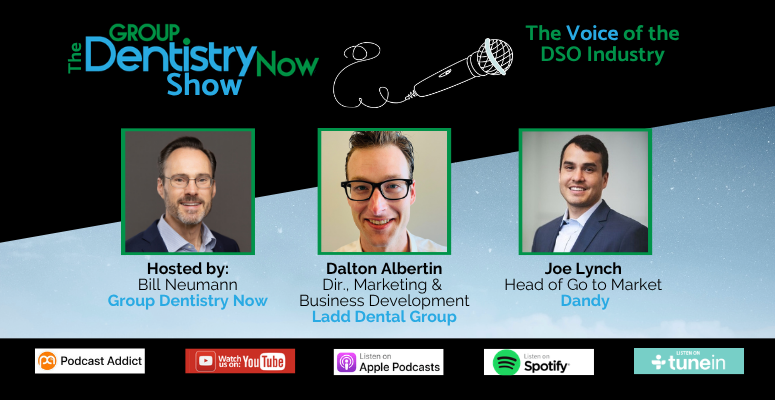
Welcome to The Group Dentistry Now Show: The Voice of the DSO Industry!
From Analog to Digital: Scaling Technology in Group Dentistry with Dandy & Ladd Dental Group
Joe Lynch, Head of Go to Market at Dandy & Dalton Albertin, Director of Marketing & Business Development at Ladd Dental Group share their thoughts on:
- change management: analog to digital
- clinician-led digital transformation
- technology = retention, recruiting & efficiency
To learn more about the world’s largest digital dental lab, Dandy visit https://www.meetdandy.com/
To learn more about Ladd Dental Group visit https://ladddental.com/
Subscribe to our channel for more episodes and stay updated on the latest DSO news, insights, and events!
If you like our podcast, please give us a ⭐⭐⭐⭐⭐ review on iTunes https://apple.co/2Nejsfa and a Thumbs Up on YouTube.
Choose your favorite listening app below and subscribe today so you don’t miss an episode! Full transcript is also provided below. See all of our podcasts HERE.
 |
 |
 |
 |
 |
 |
DSO Podcast Transcript – From Analog to Digital: Scaling Technology in Group Dentistry with Dandy & Ladd Dental Group
Welcome to the Group Dentistry Now Show, the voice of the DSO industry. Join us as we talk with industry leaders about their challenges, successes, and the future of group dentistry. With over 200 episodes and listeners in over 100 countries, we’re proud to be ranked the number one DSO podcast. For the latest DSO news, analysis and events, and to subscribe to our DSO weekly e-newsletter, visit groupdentistrynow.com. We hope you enjoy today’s show.
Bill Neumann (00:38):
Hey, everyone. Welcome to the Group Dentistry Now Show. I’m Bill Neumann, and we appreciate you joining us today. Going to hit on a couple of key topics, and I think these are all extremely timely. We’re going to talk about the war for dental talent. So I think we can all empathize with some of the challenges that the DSOs and group practices and solo practices are having with anywhere from the front desk to the clinicians that work in the groups. I mean, it’s amazing. I thought it was something that was a COVID issue, but it’s a lot more than that. It continues on. Also, talk a little bit about leveraging technology and how you can use that from a recruitment and retention standpoint. And then also, I think some of the challenges as you scale up when you’re implementing change, and in this case, I think we’re going to talk about the change when it comes to going from an analog type of practice to embracing digital.
(01:40):
And maybe doing that with one location isn’t as big a challenge, but when you have five, 10, 20, et cetera locations, how do you roll something like that out? How do you get buy-in from the clinicians? And again, I think there’s going to be a lot here we can talk about. So we’re going to hit all those topics and probably more. I’m really excited to have these two guests here. We have Joe Lynch, who is the head of GoToMarket with Dandy. Joe, thanks for joining us.
Joe Lynch (02:11):
Thanks for having me.
Bill Neumann (02:13):
And then we have Dalton Alberton. Dalton, you may, if you’re on LinkedIn, you probably see Dalton. He does a lot of creative posts on LinkedIn and really kind of keeps us up to date on what’s going on, not just at Lad Dental, which is his group where he’s the marketing and business development manager, but he really keeps us up to date on a lot of things going on in the industry. So Dalton, it’s great. I wanted to have you on probably a couple years back and we weren’t ever able to make it happen. So thank you, Dandy and Joe for helping us get Dalton onto the podcast.
Dalton Albertin (02:47):
Absolutely. Really, really excited to get to meet you, Bill. Been doing a lot of … See a lot of your activity as well, and think you guys do a really good job at Group Dentistry Now. I look at the first of every month to see you guys compile the list of DSOs and their acquisitions. We’re a big fan of Tusk as well. And as we get more into the meat of this content, so much for us is about relationships and partnering with organizations that kind of understand and are doing things the right way. And I think you do that. Tusk does that. Dandy does that and happy to be on this platform to provide some insight on that.
Bill Neumann (03:28):
Yeah. Thank you, Dalton. I appreciate that. And I’ll tip my hat to Kim Larson here at Group Dentistry now. She’s the one that goes through that painstaking data collection every month of getting all those DSO deals together. And I watch her put that together. It’s a lot of work, but yeah, it’s a good resource for the industry, for sure. I think a lot of people appreciate it. So thanks. Why don’t we start off with some introductions as far as a little bit about your backgrounds and then talk about the organizations that you represent. And Joe, maybe we’ll kick it off with you. I was kind of going through your bio and you really have to talk about your years at the US Navy. I’m sure a lot of people, because he had a really interesting job there for sure that I think a lot of us probably wouldn’t want to do.
(04:17):
But anyway, I’ll let you kind of kick off your background and then a little bit about Dandy. I mean, Dandy’s an incredible, kind of what Dalton said, a really incredible organization. I’ve seen you grow rapidly, I think like a lot of people in the industry. And what you’re doing is really unique and it’s making a huge impact on the industry as a whole and I think the practices that you serve.
Joe Lynch (04:41):
Yeah. Well, started my career in the Navy, as you highlighted there. I started my career diffusing bombs underwater and on land as a special operations officer. Found my way to Dandy via management consulting, running a nonprofit, and then another startup focused on radiology before really joining the operations team at Dandy. For those of you who don’t know, Dandy is the world’s first digital dental lab and today the largest digital dental lab. But we really help dentists do two things. One, transition to digital dentistry, and then two, make the acceleration, not just in initial onboarding and clinical workflows, but really expand their practice scope and build systems around their practice that allow them to progress into further treatments like implants, surgical guides, dentures, and really maximize their return on digital investment.
Bill Neumann (05:39):
Thanks, Joe. I think you sold yourself a little short there with that. We could probably do a podcast just on diffusing bombs, but maybe we’ll hold that off for another one. It might be a different podcast.
Joe Lynch (05:53):
Different podcast. But as you know, the reality of having patients chairside and running clinical support here is, it’s not a bomb, but it’s a highly stressful situation. And I really do think it’s about building systems for clinicians to have real time lab technician access. So listen, they can diffuse their own patient situations as the time comes up.
Bill Neumann (06:17):
Yeah. Well, well put. Dalton, a little bit about your background before you started at LAD. And you have an interesting role there too, because a lot of times you don’t see marketing and business development in one role. I mean, a lot of times they’re separated and we can talk a little bit about that demarcation. A lot of times marketing and sales or business development kind of butt heads. So it’s kind of nice to see you handling both roles.
Dalton Albertin (06:44):
Yeah. Well, in Ladd Dental Group, we started almost 50 years ago and it was my in- laws. Dr. John and Tisa Ladd started in Kokomo, Indiana. So it’s been amazing to see the growth and development of that business. I played tennis for Ball State and after graduating, actually sold spinal implants for about five years, ultimately for Zimmer Biomet before pivoting into dental. So it was interesting kind of having the medical background before pivoting into dental and kind of seeing how the MD space moved with family care and specialty and seeing how hospitals were really, I think, smart in going up and partnering with a lot of the surgeons and specialties, which then brought about bringing on the referral networks from there. So I thought that that was kind of an interesting insight to bring and being able to wear both hats I’ve really enjoyed. My wife, Mary Lad, runs the business.
(07:47):
We try and keep a lot of the money in the practices, so we do wear a lot of hats. So I am doing both marketing and business development. But what that allows is I think when we’re doing our interviews and talking with interested dental students or dentists that are out in their career looking for different options, I think I’m able to speak about the brand and the company at a really kind of grassroots level and answer any kind of granular questions, not just from a marketing standpoint, but actually from a more business operation standpoint.
Bill Neumann (08:25):
I think that’s important is when you think about it from the clinician’s perspective, whether they’re looking to partner to sell to a group practice or to a DSO or you’re a young clinician looking to join a group, there are more options than ever that doesn’t always make it easy. Sometimes it makes it more difficult to try and … Everybody’s a DSO now. We have two locations up to 1800 locations and every model seems very, very different. Even if we were comparing somebody that had 10 locations in the same geography as somebody else that might have 10 locations, the culture is different, the outweigh the acquisitions are. So talk a little bit about Dalton, what you think makes LAD different and how you really want to be perceived or are perceived in the market.
Dalton Albertin (09:21):
Absolutely, Bill. And you’re really astute with talking about how many different options there are now for prospective dentists. And for us, one of the things that we have really prided ourselves on is our operational density. We are only in the state of Indiana or the Hoosier state. We love being here in this state and for the foreseeable future, have no aspirations of leaving this state. For us, the prism we look through is how can we provide the most value to our dentists and to our offices? And so for us, when we can keep a core nucleus that allows us to refer patients in a group dentistry model better, it allows us to vertically integrate things easier. Even staffing and training and mentorship are a lot easier because of our kind of condensed model. I would say the other thing that makes us unique from a DSO perspective is we have a very specific buy box and we are pretty slow growth.
(10:19):
For us, an acquisition or two per year is really healthy and really good. We don’t want to outgrow our infrastructure or our capital. Even reading today, Tusk had a little article out about zombie DSOs. And I think this conversation’s going to get louder and louder as I think a lot of the groups that were super aggressive with the roll-up strategy maybe didn’t take into consideration how much of a people business this is. And you need to underwrite pretty conservatively because through these acquisitions, they all don’t cash flow and make money right out of the gate. So for us, it’s really being strategic from a footprint standpoint and from a financial standpoint.
Bill Neumann (11:06):
Yeah. And I think that’s … We see a lot of that now, or we don’t see a lot of it now because these are a lot of groups that are privately held. So there is this appearance that everything is great when behind the scenes there was incredible growth right during pre- COVID and even coming out of COVID until interest rates started to kick up. And so money was basically free. And so growth was fueled through acquisition. And now I feel like we’re going through the digestion phase where we’re looking at what was acquired. And in a lot of cases, practices are being sold off for a lot less than what they had purchased them for because they didn’t fit the culture.
(11:56):
There are a lot of different reasons. So it’s kind of fascinating to see the industry mature. And I think it’s maturing in a better way for patients and for the clinicians that work for these DSOs. I think we’re going to see some kind of bumps in the roads and some groups maybe that we thought were doing things really, really well. And maybe we come to find out that maybe they weren’t built the best way. So I think slow growth, there’s a huge focus on organic growth. We heard culture get kicked around quite a bit and people yelling that they had the best culture, normally the ones that yell about it that allowed us maybe don’t. So I think it’s fascinating, but I think we’ll come out on the other side at some point with much better models. And again, you want models that are built for the patients and you want them built for the future and not just this short-term vision.
(12:49):
So it’s great to see you’re building things like that. Dalton, is it all acquisition or are there any de novos?
Dalton Albertin (12:58):
Great question. So Dr. Lad founded Lad Dental Group solely on De Novo. Our last four practices have been acquisition, but we’re open to both. For us, more so it’s partnering with the right doctor. So either the doctor looking to sell really aligns with us, we view the world the same way, or if we have a doctor that really likes our group and we just have to find them a location, we are very open to De Novo as well. So it is nice. We like to be in areas of need. One of the things we do look for is the build out has already been paid for when you’re doing an acquisition. And that is nice, especially today’s costs are very high. The barrier to entry is getting higher and higher with equipment costs and technology costs. So if we can do an acquisition, we maybe slightly prefer that, but we are open to both models and have thankfully been successful with both models.
(14:01):
So I think for us, it’s more so the right person or the right fit than it is the right specific office.
Bill Neumann (14:08):
Excellent. Let’s switch gears. We talked about the battle for talent and it still continues on. And I think you have to be a lot smarter, if that makes sense. You have to have a strategy for sure. It’s challenging, I think, with both … We talked about whether it’s the front desk, whether it’s dental assistants, hygienists, clinicians, all the above, it can be really challenging. And it’s not just finding the right people, it’s keeping them, keeping them happy. So we’ll start off with you, Dalton. What is your experience like with talent and what’s your strategy?
Dalton Albertin (14:49):
Great question. And I think talent or just overall the headwind of just the labor market has been one of the real big drivers of office consolidation. And I think why the rise of DSOs has been so loud. For us, we are all about building pipelines and going back to an earlier point, all about building relationships. So for us, we’re really excited. We partnered this year with Accelerated Academy. So we have our first 10-week course with them that started in January, have some really good students and have really enjoyed that program. We’re partnered with IU School of Dentistry, Ivy Tech, Ross. So for us, it’s all about and why we like this operational density. For us, we can build more relationships. We can continue to partner with assistants that see the world the same way we do. The one caveat or the one thing that we see a little bit is the narrative of a doctor that maybe doesn’t want to train their assistant.
(15:54):
For us, and part of our DSO model is to help and to aid into that dental assistant development. However, there’s no greater thing than need to be partnering with your doctor and treating their patient exactly how they want the patient to be treated. So for us, I do think I would like to see that conversation change a little bit of, I’m open to training my assistant as long as they have the right mentality, if that makes sense.
Bill Neumann (16:24):
Yeah. Yeah. I think that sure does. And I think that goes to the whole building the right culture in your group as well. Joe, what’s your experience? I mean, what are you seeing across … Because you work with all shapes and sizes of groups. Do you see most of them challenged with talent? And if so, is it more clinicians or is it front desk because I’m sure-
Joe Lynch (16:50):
All over.
Bill Neumann (16:52):
Is it? Okay. Yeah. It’s
Joe Lynch (16:53):
All over
Bill Neumann (16:54):
Al.
Joe Lynch (16:55):
Yeah. And I was actually, I was going to compliment Dalton and Lad. They invest a lot in training. And I think from the groups that we work with and that we see, there’s a couple of things that are true across the groups that are being successful right now. And one is people, which we talked about earlier, it’s people and systems. And so on the people side, it’s not just filling roles. It’s really optimizing and building pipelines to select the clinicians and the rest of the clinical staff that is the right fit for the culture at the DSO that you’re building. And then the second is the best DSOs that we work with are heavily, heavily investing into training. DSOs in general hire primarily new grads, but in order to hit the growth targets that we’re hearing around the market, six to 8%, same store sales, you really need to invest in training those inexperienced associates and new grads and turning them into confident, complex clinicians.
(18:00):
And that means investing in technology, investing in onsite training, and then building the staff around them that allows those clinicians to know that they’re supported in the office. So retaining good hygienists, specialists, and designing career paths for those folks across the entire group, because really like the skill compounds over a year and many years. And so the best DSOs that we’re working with, and Dalton and Latter, obviously one of those, they’re investing heavily so that they’re … It’s not the absolute skill today. It’s the, where will that clinician be in five years or 10 years as they grow into their group and maybe open a de novo of their own under your DSO?
Bill Neumann (18:47):
So Dalton, on the clinician side of things, you’re going up against a lot of the large groups out there. So you’re competing to a degree. I mean, they’re in your market. So talk, what’s that discussion look like and how do you feel like you can maybe overcome some of the benefits that a larger group may have?
Dalton Albertin (19:09):
Well, Bill, that’s a great question. And I think for us, it depends on the doctor that we’re interviewing or engaging with. If it’s a fourth year dental student looking to get out, it’s the mentorship that we provide. A lot of our doctors, thankfully, are actually 50 and over. So the amount of clinical experience we have, and even the really great lab tech Robert at Dandy mentioned when they were out for one of our group trainings of just for a DSO, how tenured a lot of our providers are. And with that, and through the lens of group dentistry, one of the things we pride ourselves on is clinical mentorship. We are and really proud to be on Denicon’s cloud-based management system. So all of our docs can look at x-rays in real time. It makes the referral process really smooth and really easy. So Bill, I think on that, it depends a little bit of the doctor that we’re engaging with and what they’re looking for, but I think for us, it’s mentorship and it’s relationships.
(20:07):
So I think one of the things that stands out when we’re interviewing doctors and taking them through the office is how my wife and I know the name of every single person in the company. I mean, we’re close to 175 now, but when we go through from getting greeted by the treatment coordinator to the sterilization tech to everybody in the office, greeting them by name, understanding how important their role is to the office and understanding our doctors can’t produce without really good trained teams. So understanding that provides value to those doctors that get it.
Bill Neumann (20:41):
I don’t think we can underestimate the value of training and mentorship. I know they go hand in hand, but it is amazing how even some of the larger platforms out there don’t have as much structure when it comes to this as when it comes to training and mentorship as they probably should. And I think younger clinicians, from what I understand and you hear, are coming out of dental school with less hands-on experience than they’ve ever had. And so they’re in need of that mentorship especially. So I think that’s really key. And so it’s great that you provide that. And it’s certainly a hole that a lot of, I think groups for whatever reason haven’t figured out exactly how to fill, how to really address that. Dalton, from these practice, you started out with de novos, you’re acquiring practices as well. Talk about that integration process and how you actually take them from … The idea is you want to grow those practices.
(21:49):
So how do you integrate? What are you integrating? What are you centralizing? And how do you build that cohesive culture? Because when you’re acquiring a practice, you’re also, you’re acquiring a different culture too.
Dalton Albertin (22:02):
100%, 100%. And for us, the first thing that we look to do is add capacity. And we look to add capacity in a couple different ways. First and foremost, it’s through staff. Normally the offices, especially from an acquisition standpoint, we’re going to be looking to add more staff. We’re going to be looking to add more insurances or build to our network and also add more equipment. So normally for us, we want offices with at least six ops, so that’s part of our buy box. We do want some capacity built in. So for us, being able to take that office from how it’s currently performing and to increase it through us, my marketing kind of verbiage that I really like is nothing brings a crowd like a crowd. So for us, we get in there, we start taking their insurances, we start asking for referrals, we start bringing in technology.
(22:56):
We incorporate really cool systems like a Dandy, which massively increases the patient experience. And one of the things that we’ve been so grateful for about Dandy is their pricing structure. So for us, and going back to earlier, we are very strategic with how we deploy capital and we don’t want to outgrow our infrastructure. So for us, having a partner like Dandy where we’re not forking over a big amount of CapEx upfront, but just coming through and having a lab spend budget has made that a really cool experience. And that’s just how we look at doing a lot of things. We do probably the biggest change that we make in any practice that we acquire is changing the practice management system. We will put them on Denicon. That is one of the things that we centralize everywhere. Outside of that, a lot of things we try and keep at the office level.
(23:47):
We are really bullish on practice managers. We like boots on the ground. The practice manager and the doctor really run their office and we support those two. We support everybody, but really go through the practice manager and the doctor to make sure they have what they need.
Bill Neumann (24:02):
Well, this is a great segue into why Joe’s on the podcast with us here. And you talked about bringing technology in, right? One of the big benefits to helping these groups scale up. And so before you partnered with Dandy, you were analog at Lab Dental. So maybe take us through that transition, why you partnered with Dandy. You talked about their pricing structure. And then Joe, I’d love to get your feedback on that and kind of get your perspective on how many groups are still analog out there and what that transition looks like from your perspective. But Dalton, why don’t we kick things off with you and why you made that decision, what the process was like?
Dalton Albertin (24:49):
Well, first and foremost, Joe, I got to give your marketing team and sales team big kudos. They were really good at getting in front of a lot of our practice managers. A lot of them brought the technology to us. And for us, we are as provider driven and provider centric as this. We have quarterly in- person provider meetings. We got everybody together and just said, “Hey, after going through the demo, who would be interested in using this? ” And literally just did a show of hands. Because the technology speaks for itself, every doctor wanted it in their office. We were not going to force them. If they didn’t want it, we were going to mandate that they use it. For us, we want our doctors to use and implement the tools that they want. That’s part of our value prop is we do want to be clinically led in every way.
(25:40):
So the fact that our doctors all wanted to utilize Dandy and also the fact that Dandy’s customer service is so good. If you are curious about anything, you will get a rep within 90 seconds communicating back with you. For some of our older doctors, that was really, really important. So I think that made the implementation aspect way easier just because we could trust what we were using and trust is the most important word in dentistry.
Joe Lynch (26:11):
Completely agree on trust being the most important word.
Bill Neumann (26:14):
Yeah. I agree with you. And so trust being also of the support, Delton talked about the 90 seconds, which is important. We hear a lot of promises in the industry and there’s the salesperson that is there to sell and then they let customer service, right? The customer support team take care of the rest and cross their fingers and hope that they can help see it time and time again. So to have that trust, the support behind it, especially at scale, not everybody can offer that. So it’d be great to hear from your perspective, Joe. Talk a little bit about what that support looks like. And also I’m curious, how do you take somebody from analog to digital? What does that arc look like?
Joe Lynch (27:08):
Yeah. Let me, I think, answer the first question, which is, what does trust look like at scale and specifically between a clinic and their lab? I guess in a word, it’s the relationship between, or in a sentence, it’s the relationship between a doctor and their lab technician. Technology has allowed us to scale that relationship. So you can reach a technician in 90 seconds or less with Dandy, but more importantly, it’s not about being able to talk to someone. It’s about getting the answer that you need, being able to get visibility to where an order is, or to make adjustments to a design one-on-one with a lab technician. And fundamentally, that’s how you build trust. It’s delivering a great product time after time so that clinicians trust you. And when a doctor places an order, they know what they’re going to get. And time and time again, as we think about what it means for a practice to go digital or for a DSO to go digital, there’s a couple things that we have seen that need to be true for us to be successful.
(28:13):
One, there is an ongoing tension between standardization and clinical autonomy. And Dalton just obviously said, it’s like DSOs want to be clinician first. And where some of the rollouts fail and what we’ve learned from our customers is that when it’s framed as standardization, it feels like a loss of control. And so the most successful organizations actually frame it as we’re going to standardize the infrastructure, but we’re going to empower the clinician to make their own choice. And when a clinician makes their own choice, Dalton is saying, “Hey, clinicians raise their hand to join, Daniel. We see this time and time again at the groups that we work with. We’re standardizing the workflow. We’re removing friction and we’re making it easy to build trust with a lab technician.” That removes variability in the system, which in turn drives more and more trust creation over time. And so when we roll this out with our groups, we do three things differently.
(29:13):
One, we work with the leadership team to treat the rollout as an operating model shift. It’s not a tech implementation. It’s not a, we’re going to put a scanner in the office. It’s, we’re going to change how we operate and we’re going to train you along the way and then work with you for those first 30 days one-on-one with a trainer. And then obviously you’ll have your lab technician relationship thereafter. Second, adoption happens at the clinical level. It can’t be a top-down mandate. It has to be something that a clinician opts into. And if the clinician doesn’t want to opt into it, we know that we’re not going to be successful and the clinician won’t find value in it at that time, but we’ll generate proof points with other doctors and drive word of mouth tends to be the strongest signal that a practice will be successful with Dandy And then finally, Dalton talked about pricing, but it’s really about aligning unit economics for both the practice, the DSO, and Dandy.
(30:10):
The best groups know how digital’s going to impact case acceptance. They know how it’s going to impact the patient experience, and they’re able to articulate that and drive the ROI through the full DSO. And that overall really just means it’s a trust building exercise from the sales process through the actual case delivery. Time and time again, I think Danny’s been successful in doing that.
Bill Neumann (30:33):
So yeah, I think when you’re rolling out something digital and you’ve got different clinicians, different levels of comfort with change, what was the most challenging for you? I mean, was it working with some of the clinicians maybe that were older and weren’t necessarily interested in moving to digital? Or just talk a little bit about that. What were some of the bigger
Dalton Albertin (30:57):
Challenges?
(30:58):
Great question. And for us going into change management, I honestly thought it was going to be harder to drive that. Now, we did proactively get all of our doctors to agree and say that they wanted it, which allowed us to keep them accountable to that. I would say really the only thing that came up early, early on was for the difficult maybe impressions or imaging. Maybe an older doctor or very experienced assistant would want to go to the analog route as opposed to learning a little bit more of the fine-tuned aspects of taking that digital image. But really outside of that five to 10% caseload, the adoption has exceeded our expectation. I really am grateful for Assad and Robert who did a great job of partnering with us on what our lab spend should be. That helped to really establish and provide even more trust and showed it was a true partnership.
(31:54):
They just weren’t looking for revenue upfront. They wanted this to be a long-term successful partnership, and it really showed.
Bill Neumann (32:02):
Joe, from your perspective, what do you see are some of the challenges when, again, you’re moving from analog to digital? Is it the comfort where maybe taking a complicated digital impression, right? Sounds simpler to me, but if they’re used to taking impressions, the analog way with impression material or however they’re doing that, it can be a real shift. So is it more just the educational process, the getting over that fear of doing something new? Where do you see maybe some of the challenges, some of the more common challenges?
Joe Lynch (32:46):
Yeah, it’s a great question. I’d say there’s two common challenges. One is just fear of change, which we talked about there. There’s doctors who’ve been taking analog impressions for a long time. They may have considered going digital in the past, or they’ve tried digital in the past, but never got over that initial adoption curve. And the way that we think about that is that this is a long-term relationship. And so we invest in sending trainers out to the practice. We’ll spend a day with the practice and actually walk through all of the specific flows and help them overcome that initial hurdle. And then second is we’ve built the product in a way that it’s easy to follow along. So if you forget the steps that they’re prompted right in front of you, we’ll walk a clinician or an assistant who may be taking the impression through each step of the scanning and ordering workflow so that there’s really, it’s about raising the floor and ensuring that yes, training is important, but at any given time, you can get the help and support you need.
(33:52):
And sometimes that comes via the product, other times it comes via a live support interaction or in speaking to another clinician inside of the practice who may have been trained by Dandy as well. So we think about this as a long-term relationship and really at any given stage, we’re going to find clinicians who want more assistance. And so we’ll invest there, we’ll send trainers out to the field or have a lab technician available within 90 seconds.
Bill Neumann (34:23):
Any tips, Joe, for groups out there? If they’re looking to embrace digital, like, “Hey, this is what we see works best.” What can a DSO do to really support their clinicians and really support Dandy in making this as easy a transition as possible?
Joe Lynch (34:45):
Yeah. And I think Dalton said it best is this has to be clinician led. It’s a partnership. And if clinicians are bought into the change and see the value in the change, by and large, they will adopt the change. And so the three things that we see DSOs who scale digitally, the things that they do well is, again, it’s an operating model shift. This isn’t just a different way of taking impressions. It’s how we’re going to run the practice. We’re going to update our workflows and our processes around digital adoption. Second, we’re going to coach and train folks at the clinical level, assistants, hygienists, and doctors on how to take great digital impressions and send them to the lab. And then third, really explain the unit economics of why the transition to digital makes sense and why it makes sense now. At the end of the day, I think every DSO wants to be innovative, but the real lift comes on change management.
(35:45):
And find a great partner who is going to help you make that change management so that you don’t have to put the work entirely on your leadership team because ultimately, one, it’s a lot of work, but two, clinicians will help train other clinicians when they see the value delivered in their practice.
Bill Neumann (36:02):
Dalton, do you see younger … You talked to a lot of young clinicians, right? You’re at the dental schools. I mean, do you see this as a recruiting tool? I mean, are the younger clinicians going, “Hey, what kind of technology are you using in your practices?” Talk a little bit about that.
Dalton Albertin (36:19):
Absolutely. And it varies student to student, but it’s definitely getting louder and louder. I believe IU is getting a scanner here in the next couple months. They haven’t had one for at least their general program. So students are excited there, but we thankfully have a really, really good relationship with IU and we’ll have a lot of their third and fourth year students rotate through our office, which is really awesome for us. It’s a way for us to build a relationship with them and vice versa. They get to experience our equipment and technology in a way for us to get to know each other. And one of the feedback we hear so consistently is how fun it has been to be able to work with technology like a Dandy or an Overjet and some of the things that just haven’t been incorporated in school yet. So yeah, I would say tech is a big driver.
(37:11):
And another one for us from a kind of efficiency standpoint and from an AR standpoint, which again, doctors care a lot about what that collection percentage is, AirPay. AirPay is another technology you can really talk and lean on. It goes into our conversation on human capital as well, which has been difficult to find and retain. So yeah, I think tech is a huge, huge driver in doctor recruiting.
Bill Neumann (37:39):
And Dalton, what’s your strategy as you roll out this technology? You always kind of want to walk that fine line of clinical autonomy, so letting the clinician make the decisions and also bringing technologies that make the practice more efficient and also delivering better impressions so you can have better fitting restorations with technology. So that’s ultimately you want things, you want to be profitable, you want to deliver the best patient care, but sometimes you have clinicians that might be maybe pulled into it a little bit. So how do you let the clinicians understand that this is for them and also that they’re not necessarily being forced into anything?
Dalton Albertin (38:27):
Yeah, there can be a massage process. And to Joe’s comment earlier, clinician to clinician training as well. So all of our doctors have a group text thread together. They’ll text different things back and forth. So I think a lot of times that also helps drive adoption, provide more trust, especially maybe for some of those older doctors that are more of that kind of analog era. So I think for us, it’s staying relational, keeping the communication open. And if we pick the right products, those products will speak for themselves. So getting adoption into a DANDI has not been hard because it’s so good. Doing adoption for cone beams or digital x-rays, those things, as long as we’re partnering with the right vendors, normally our doctors are pretty engaged. We won’t just at Ladd Dental, we won’t force a doctor to use any product. I mean, we do like to go through Patterson, but again, we are vendor agnostic as long as the doctor has the tools that they want to use, we’re happy.
Bill Neumann (39:30):
Excellent. As we start to wrap up the conversation here, I’d just like to get final thoughts from both of you, just where you think technology is headed and we can focus on what you do at Dandy and digital impressions and scanning and just kind of where you’re taking really labs in the … I’d say let’s just look at maybe, what do we see in the next year? I mean, because if we kind of go beyond that, I don’t even know if I would be able to understand what that all looks like. Technology’s moving so quickly, what a dental practice is going to look like in the next five years. Who knows? But maybe if we take just a look into the next year, what type of innovations do we see? And we’ll start with you, Joe. What’s Dandy have in store for the rest of the year?
Joe Lynch (40:21):
Yeah, so much. But I’ll say it’s really, Dandy’s thesis has been that we integrate the hardware, software, and then the manufacturing components to actually just deliver a great restoration. And so for us, we were just talking about impression quality as one area for improvement. Today, we are using AI at point of chairside. For clinicians to actually go back and understand the quality of the skin, we’ll analyze and diagnose it in real time, and then allow the clinician to go back and re-prep or adjust the prep, so that every single time that we know that they’re submitting a great impression and they know that they’re submitting a great impression that we as the lab can work with. I think that’s the start of it. From there, we are working on other use cases with AI to drive real-time patient simulations and show sort of the effects of treatment and what that might look like in terms of driving case acceptance at the practice level.
(41:27):
And then really continuing to explore ways to drive down remake rate and increase value to customers.
Bill Neumann (41:36):
And Joe, if anyone wants to reach out to you to learn more or find out more about Dandy, what’s the best way to do that?
Joe Lynch (41:44):
Yeah, you can find us at meetdandy.com. We’re online always.
Bill Neumann (41:50):
Excellent. And we’ll drop your LinkedIn handle in the show notes. So if people want to learn more about your exploits in the Navy, they can do that.
Joe Lynch (41:59):
Anytime.
Bill Neumann (42:01):
And Dalton, kind of final thoughts from you from a technology standpoint, and maybe you can talk a little bit about Dandy and then just maybe some other rollouts that you may be doing at LAD. What does 2026 look like for you? And maybe you can talk about some acquisitions that you may have in the pipeline.
Dalton Albertin (42:23):
Yeah, great question. I mean, for us, one of the things we are excited about is we’re going to do a big aligner campaign this year. So we’ve gotten our first couple starts at our Westfield office with Dr. Trillitt and are really excited about that. So I think from a same store sales perspective, being able to offer this type of a treatment that we haven’t done before could be a potentially a big boost, at least it’s some of the offices. For us, I’m sure all of our doctors won’t necessarily want to do that treatment modality, and we are A- okay with that. But for some of our locations, it’s going to be a really big tailwind. And just technology in general, I really think for us, that is our way partnering with the vendors that get it. Some of the ones that we talked about earlier, and I think when we can partner and incorporate with those types of companies, it allows the acquisition or de novo to go a lot smoother.
(43:18):
I think it’s really difficult in a people business to do all of these things on your own. So I think it’s all about partnering internally in your own company, putting the right people in the right seats, and then really doing a good job of due diligence of partnering with the dental providers that truly understand how to put the patient first and do it the right way.
Bill Neumann (43:40):
Well, thanks, Dalton. And you can certainly find Dalton on LinkedIn. We’ll drop his LinkedIn handle on the show notes right at the end of the show. You’ll make sure you have that in. Any acquisitions this year, Dalton?
Dalton Albertin (43:55):
I think so. One to two is what it’s looking like it’s going to be. And really just solo offices. So for us, if we get to 12 GP locations by the end of the year, that will be a good number for us. But for us, Bill, it’s a little bit more so operationally focused than it is rooftop focused. So organic growth is really important to us. And really, the rise of the zombie DSO, I think is just getting started. So I think that this is going to be a conversation throughout 2026 and potentially beyond.
Bill Neumann (44:30):
Yeah, I think that’s a great way to finish things off. Yeah, be focused on each individual location you have and making sure that each practice is running and is finely tuned. And that’s by leveraging technologies and partners like Danny can really, really help. And I think we covered all those topics. We were talking about the challenges when it comes to retention and recruiting, embracing technology, scaling up technology, which can be a challenge too. I think we covered everything really well. So thank you, Joe and Dalton. Great conversation and thanks everybody for watching this episode. Until next time, this is The Group Dentistry Now Show.
Thank you for joining us today. Don’t forget to subscribe to the podcast to stay up to date on the latest DSO News, insights, and events. Also, subscribe to our DSO weekly e-newsletter at groupdentistrynow.com.