

Sponsored Content
Dental Service Organizations (DSOs) are under increasing pressure to scale efficiently while maintaining clinical consistency, provider engagement, and financial performance across growing networks.
And yet, despite significant investments in new technologies, service lines, and vendors, many initiatives fail to gain traction.
Not because the product doesn’t work.
But because the partner behind it doesn’t.
The Hidden Variable in DSO Success
When DSOs evaluate new technologies or services, the focus often centers on:
- Product features
- Cost
- Vendor comparisons
These factors matter, but they are rarely what determine long-term success.
The real differentiator is far less visible: The partner’s ability to drive adoption, alignment, and execution across the organization.
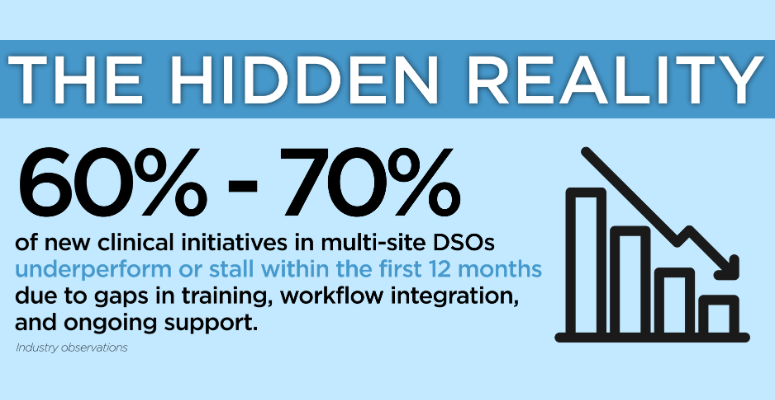
Industry observations suggest that as many as 60–70% of new clinical initiatives in multi-site organizations underperform or stall within the first 12 months, not due to product limitations, but due to gaps in training, workflow integration, and ongoing support.
Because in a DSO environment, success isn’t defined by what you buy.
It’s defined by what actually gets implemented and sustained across dozens or hundreds of locations.
Not All DSOs Are Built to Scale the Same Way
A critical reality often overlooked in vendor selection is this: DSOs vary dramatically in their internal infrastructure.
Some organizations are highly resourced with:
- Dedicated training teams
- Standardized clinical protocols
- Structured onboarding systems
- Centralized operational leadership
These DSOs are designed to absorb and operationalize change efficiently. But many DSOs and large group practices operate without this level of infrastructure. They face:
- Inconsistent workflows across locations
- Variability in provider confidence and experience
- Limited internal training capabilities
- Difficulty scaling new services across the network
For these organizations, the risk is not choosing the wrong product. It’s choosing a partner that cannot bridge the gap between strategy and execution.
The Cost of a Price-Driven Decision
Procurement teams are often tasked with optimizing cost, and understandably so. But when decisions are made primarily on price, DSOs often encounter predictable downstream challenges:
- Slow or stalled adoption
- Low utilization rates
- Provider hesitation or resistance
- Staff disengagement
- Inconsistent patient outcomes
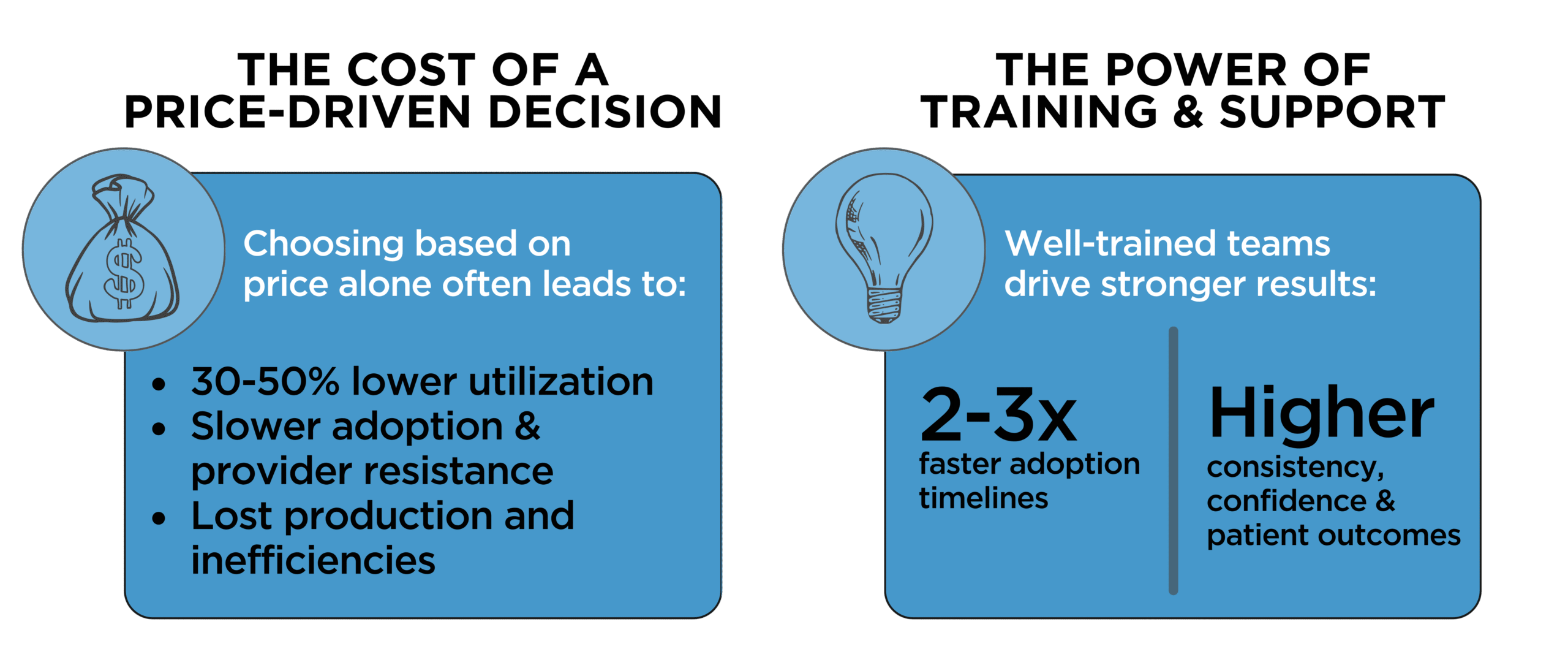
In fact, DSOs that prioritize upfront cost over implementation support often experience slower adoption rates and lower utilization, sometimes 30–50% compared to supported models, ultimately reducing the expected return on investment.
In many cases, what appears to be a lower-cost solution becomes significantly more expensive over time due to:
- Lost production
- Underutilized services
- Re-training efforts
- Operational inefficiencies
By contrast, organizations that prioritize implementation support and adoption infrastructure consistently outperform those that prioritize price alone.
Expanding the Evaluation Criteria: A Framework for DSO Leaders
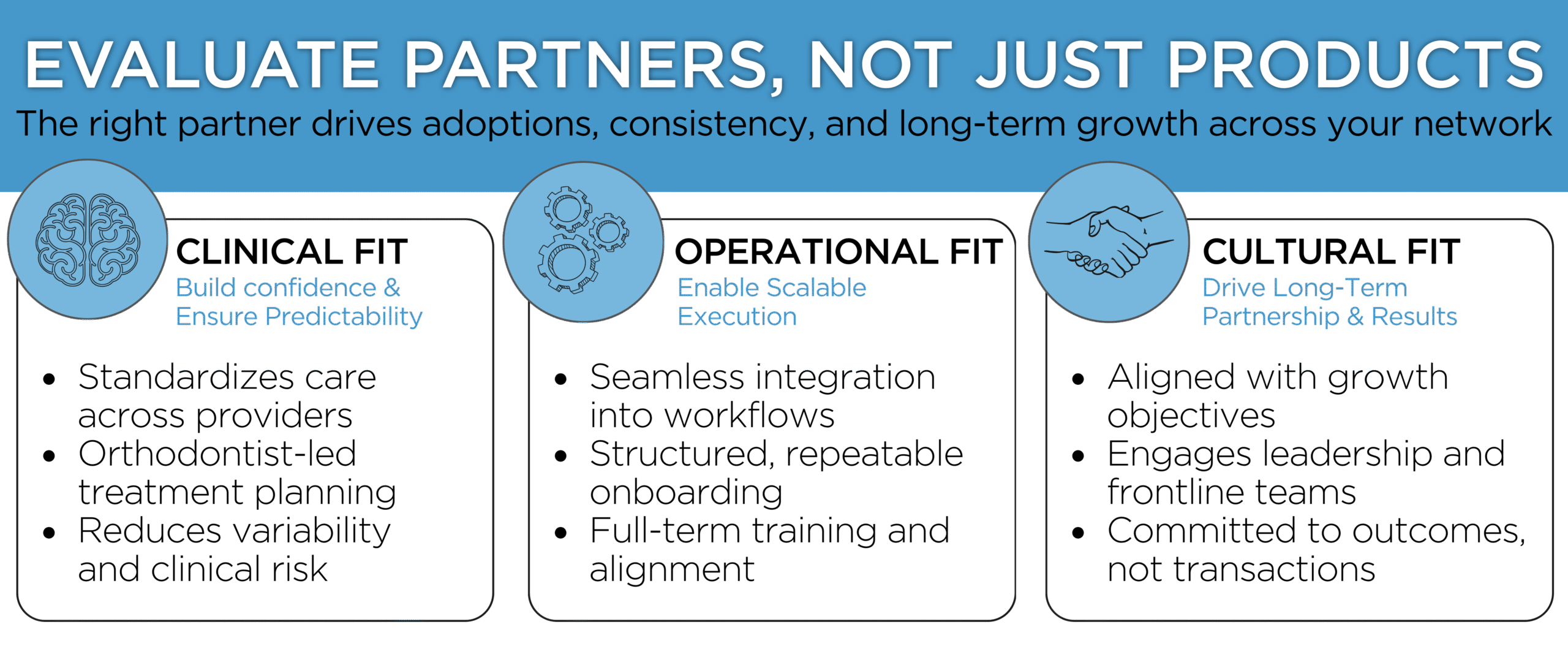
To drive better outcomes, DSOs must shift from evaluating vendors to evaluating partners. Three dimensions should anchor every decision:
1. Clinical Fit: Driving Confidence and Predictability
Clinical confidence is the foundation of adoption. Without it, even the most promising service line will struggle to scale. DSOs should evaluate whether a partner can:
- Standardize care delivery across providers
- Support case selection and treatment planning
- Provide access to experienced clinical oversight
- Reduce variability in outcomes
This is especially critical in areas like orthodontic integration within general practice.
Models that incorporate specialist-led treatment planning, where each case is reviewed by an orthodontist consistently, reduce clinical uncertainty and accelerate provider adoption.
The result:
- Greater provider confidence
- More predictable outcomes
- Reduced clinical risk
2. Operational Fit: Enabling Scalable Execution
Even the strongest clinical model will fail without operational alignment. DSOs must assess:
- How easily can this be deployed across multiple locations?
- Does it integrate into existing workflows or disrupt them?
- Is onboarding structured, repeatable, and scalable?
Successful partners go beyond product delivery. They provide:
- Full-team training (not just clinicians)
- Clear, repeatable workflows
- Administrative and clinical alignment
- Ongoing reinforcement, not one-time onboarding
Organizations that implement structured onboarding and ongoing partner support frequently see 2–3x faster adoption timelines compared to those relying solely on internal rollout efforts.
3. Cultural Fit: The Multiplier Effect
Clinical and operational alignment are essential, but cultural alignment is often what determines longevity.
DSOs should evaluate whether a partner:
- Understands their growth strategy
- Aligns with their clinical philosophy
- Engages both leadership and frontline teams
- Is committed to long-term success, not short-term transactions
Transactional vendors deliver products. Strategic partners deliver outcomes.
They stay engaged beyond implementation, adapting alongside the organization, and maintaining accountability for performance.
Training and Support: The True Growth Engine
Across DSOs, especially those without robust internal education infrastructure, one factor consistently separates high-performing implementations from underperforming ones:
Training and ongoing support.
Effective partners provide:
- Structured onboarding programs
- Role-specific training for the entire team
- Continuous education to reinforce adoption
- Accessible support for real-time problem solving
Research across healthcare service adoption consistently shows that provider confidence is one of the strongest predictors of utilization, often outweighing product features or pricing in long-term success.
Because in practice:
Well-trained teams are more confident.
Confident teams are more consistent.
Consistent teams drive better clinical and financial outcomes.
Orthodontic Integration: A Case Study in Scalable Growth
Clear aligner therapy represents a significant growth opportunity for DSOs.
Demand continues to rise across patient demographics, and integrating orthodontics into general practice can drive:
- Increased case acceptance
- Expanded treatment plans
- New revenue streams
But access to aligners alone does not guarantee success. DSOs must solve for:
- Clinical oversight
- Provider confidence
- Team alignment
- Workflow integration
DSOs that successfully integrate orthodontic services into general practice often report:
- Increased case acceptance rates
- Higher patient lifetime value
- Improved treatment plan acceptance across restorative cases
However, these outcomes are most consistently achieved in models that combine clinical oversight with structured implementation and ongoing support.
These models allow general dentists to deliver orthodontic care with confidence, without requiring them to become specialists, removing one of the largest barriers to adoption across multi-site organizations.
From Vendor Selection to Strategic Partnership
As DSOs continue to grow in size and complexity, the stakes of partner selection increase.
Leading organizations are shifting their approach:
- From vendor selection → partner selection
- From price comparison → value creation
- From one-time implementation → ongoing performance
Because ultimately, the product doesn’t determine success. The partner does.
Final Thought
In today’s DSO environment, many solutions look similar on the surface. But outcomes are not driven by features alone.
They are driven by:
- The clinical expertise behind the model
- The operational systems supporting it
- The depth of the partnership sustaining it
In DSOs, success isn’t determined by what you buy.
It’s determined by what your teams actually use and sustain at scale.
And that ultimately comes down to one decision: The partner you choose.
If your organization is evaluating new service lines or technologies, consider this: Don’t just evaluate the product. Evaluate the partner behind it and their ability to drive adoption at scale.
Organizations that prioritize implementation, alignment, and long-term partnership consistently outperform those that don’t.
If you’re ready to move beyond evaluating products and start building a scalable orthodontic program, learn more here