
Ranked the #1 DSO Podcast!
Welcome to The Group Dentistry Now Show: The Voice of the DSO Industry!
Revolutionizing Dental Equipment Ownership: The TotalOp Solution That’s Changing How DSOs Scale
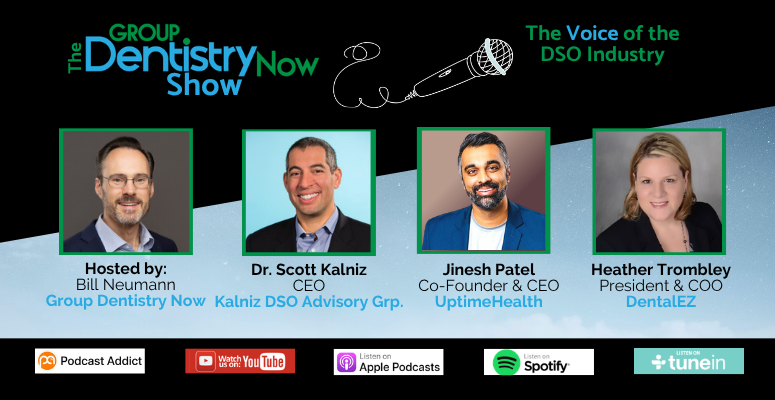
Heather Trombley, President & COO of DentalEZ, Jinesh Patel, Cofounder & CEO of UpTime Health and Dr. Scott Kalniz, CEO of Kalniz Consulting discuss:
- Shift from large capital purchases to predictable monthly subscriptions
- Smart connected equipment = predictive maintenance
- DentalEZ, Uptime Health & Darby partnership
To learn more about TotalOP visit https://dentalez.com/ & click on the TotalOp link.
To learn more about Uptime Health visit https://www.uptimehealth.com/
Connect with Dr. Scott Kalniz on LinkedIn – https://www.linkedin.com/in/scott-kalniz/
Subscribe to our channel for more episodes and stay updated on the latest DSO news, insights, and events!
If you like our podcast, please give us a ⭐⭐⭐⭐⭐ review on iTunes https://apple.co/2Nejsfa and a Thumbs Up on YouTube.
Choose your favorite listening app below and subscribe today so you don’t miss an episode! Full transcript is also provided below. See all of our podcasts HERE.
 |
 |
 |
 |
 |
 |
DSO Podcast Transcript – Revolutionizing Dental Equipment Ownership: The TotalOp Solution That’s Changing How DSOs Scale
Welcome to the Group Dentistry Now Show, the voice of the DSO industry. Join us as we talk with industry leaders about their challenges, successes, and the future of group dentistry. With over 200 episodes and listeners in over 100 countries, we’re proud to be ranked the number one DSO podcast. For the latest DSO News, analysis, and events, and to subscribe to our DSO weekly e-newsletter, visit groupdentistrynow.com. We hope you enjoy today’s show.
Bill Neumann (00:38):
Welcome everyone to the Group Dentistry Now Show. I’m Bill Neumann, and as always, we appreciate you tuning in. It’s always a pleasure to do these. It’s so much fun. I get to learn a lot, and we’ve got three relatively familiar faces on the podcast. We’ve had one of the three guests actually on before, and I’m kind of surprised we haven’t had the other two on. I have no idea why, but it’s great we finally have Jinesh Patel and Heather Trombley on. Dr. Scott Kalniz. And the funny thing is that Janesh has his own podcast, and I’ve been on his, and he has not been on mine yet, or ours. So it’s great to have everybody here. Probably no surprise we’re going to talk about equipment and operatories and technology and some new solutions. That’s going to be our topic of discussion here. Just coming off the Chicago mid-winter meeting, there’s always a lot of exciting things to see there.
(01:41):
And this year was no exception, a lot of buzz. I thought it was actually a really busy meeting, and we don’t normally expect that anymore. We have low expectations, but there was a lot going on, which I think is a great thing for the industry. So I think what I’d like to do first is just let everybody kind of introduce themselves. My assumption is that everybody knows everybody on the podcast, but that’s not always true. So Heather, why don’t we kick things off with you. You are the president and COO of Denalise. So if you wouldn’t mind a little bit about your background, and then if you don’t mind telling the audience a little bit about DentalEase.
Heather Trombley (02:23):
Sure. Thank you. So I’ve been with DentalEZ about 11 years now. It’s hard to believe running this organization. DentalEZ is a small, well, mid-sized, privately-owned company that really focuses on a number of products and portfolio for the general dentist. We have dental laboratories, we have your mechanical room products, we have handpieces, we have various and a sundry accessories that goes with that. We have teaching aids in the form of a Columbia Dentiform brand, and we also have Net and Workbenches, but it’s a broad portfolio. I’ve been with them 10 years, and I find myself in dental after a long and successful career in med device, where I was in charge of patient monitoring for GE for a number of years, and then also went into orthopedics. So my medical background and my med device background has served me really well here at Dental. And it’s a little bit of a precursor to some of the products you’re going to be hearing about today because I think there’s a lot we can learn from medical that’s good and adopt it in dental and really leverage technology in a better way.
(03:36):
And that’s what I’m doing here at DentalEZ.
Bill Neumann (03:39):
Excellent. Thanks, Heather. Jinesh Patel, co-founder and CEO of Uptime Health. And I knew Janesh when Uptime Health was a little startup, not so much anymore.
Jinesh Patel (03:51):
Still feels a little in my head relative to some of the other players out there. But no, I remember Bill, you’re one of the first people we met. Also, I told you I subscribed to the Group Dentistry Now newsletter just to learn about dentistry when I didn’t know much about it. But for those that don’t know me, I’m the co-founder and CEO of Uptime Health. We’re a software and technology platform that helps dental offices or actually any outpatient and ambulatory healthcare provider automate how they manage their equipment, their service, and their compliance around the equipment they use for patient care. We also have a services and call it a services marketplace. There’s not a better word for it just yet, where we help, whether it’s a private practice or a DSO, find surge resources for install warranty or repair support when something does fail. We do work with other groups like dentalees on projects like what we’re talking about Total Up.
(04:42):
It’s no longer a project. It’s actually a product in the market, but we’re always looking at how we can help move the industry forward when it comes to just equipment management and ownership. And I’m really excited to go over what Total Op is because it changes in my mind how dentistry can look at affording and buying and implementing new technology in a way that hasn’t been done really before in this industry. But to Heather’s point, has been tried and trrude at some level in the medical side. And that’s where I come from with my background as a biomedical engineer. So that thinks where me and Heather really vibe off each other quite well is we can take a lot of our learnings and apply them to dentistry.
Bill Neumann (05:14):
Thanks, Janesh. And why don’t you shout out your podcast as well? Oh,
Jinesh Patel (05:20):
I appreciate it. Yeah. So I also am the co-host of a podcast called The Open Wide Podcast with Dr. Scott Drucker. For those that also might know him, he used to be the co-founder of Supply Clinic, still running that company in more of an advisory capacity now, but we just talk about technology and random things happening in the dental space. Bill, you’ve always been an inspiration for us. That’s why we wanted to bring you on that podcast. You’re more additive to ours than I think I am to yours, so that’s why it was a one-way trade on that side.
Bill Neumann (05:47):
Not at all. Actually, I think Kim was probably more additive when she was on because she doesn’t come on many podcasts, so it was great to have Kim Larson on. And we’ve had Scott Kalus on before, but Scott has a really interesting background. First off, he’s a clinician, so a dentist by trade or training. But you also, see if I’ve got this right. You had Corner Dental, which was your first practice, then turned it into a group, then sold to a strategic partner, and then you decided to do it again and you started Elite Dental Partners, and now you’re doing consulting for a lot of different organizations. Did I sort of get that right?
Dr. Scott Kalniz (06:30):
You did get that, 100% right. Yes. Yes.
Bill Neumann (06:33):
Well, all right, you don’t have anything left to say, guess if I got right.
Dr. Scott Kalniz (06:37):
I have nothing left to say. I actually am the … My day job is with Beam Benefits, which is a venture-backed InsureTech company, and I’m their chief dental officer.
Bill Neumann (06:50):
Thanks, Scott. Yeah, and Scott does a lot. He advises for a lot of organizations, and his perspective is, I think, pretty unique in the industry. I mean, you do get a handful of clinician DSO founders, but they’re few and far between, and a lot of them are still running their groups. You’re able to now offer perspective because you’re not doing the day in and day out of running a DSO. So I think that’s great for a lot of organizations, like now this new Totalop, which you said, Janesh, that it went from a project to the real deal. And I think that happened in Chicago. So let’s maybe go back a couple of weeks. We’re at Chicago mid-winter, you’re launching TotalOp, you’re having conversations. Can you talk a little bit about what TotalOp is and then what the feedback was from the clinicians and the DSOs that you talked to in Chicago?
Jinesh Patel (07:53):
Yeah, I’m going to go over what it is high level. I’d love for Heather to give more of the feedback on how it was received in Chicago. Unfortunately, I wasn’t able to be there with the family wedding that happened, but Heather and a lot of our other team members that were part of this project coming to life were there and got a ton of great feedback. But from what it is high level, it’s a different way to buy or at least own equipment and bring it into your practice. No longer do you need to put down the entire payment and buy a operatory outright. We’re helping you subscribe to it at a much lower entry fee versus putting out tens of thousands of dollars just to open up a new op and having maybe your payback period be a few months down the line trying to get a loan to do that.
(08:32):
It really becomes, especially in this capital constrained environment, a tough decision for a lot of people to make. It’s do we invest in our future and our growth? Do we save and understand where rainy day might look like? And I will one, compliment Heather for coming up with this idea and bringing it to the forefront about being the manufacturer that raised their hand first to saying, “We can do this better. We can find different entry points to reduce the acquisition cost of new operatory and new equipment and help people just better manage it. ” So with this product, you don’t just get the operatory. You also get the service involved with it. You get software that helps you manage it. So it’s almost like a very carefree ownership experience, but with low upfront payment. And as the term comes to an end, you can look at potentially keeping that existing product you have or upgrading to the newer thing that Donalis has to offer.
(09:23):
I try and analogize it to an iPhone. It’s the easiest way for me to describe it to anybody who’s asking me. My iPhone right here, I think I pay 28 bucks a month for it over the course of four years or whatever it is that we signed up for. And at the end of that, I can either pay off the remainder of it if I haven’t paid it all off and own the product, or I can just upgrade to probably the iPhone 2020 or 22 by the time it all comes out. And I have that option, but then I also have AppleCare on top of it, which is this way that I don’t have to worry if something goes wrong. I know it’s going to get taken care of with almost no surprises that can come out with a product that has deficiencies sometimes or something breaks, you don’t realize it.
(10:03):
It’s all covered under the sun. So that’s how I’d think about now buying an operatory. So that’s how I’d describe it as and the types of products that are available. I think Heather can get into that very well, but I’d love her to go over the feedback and reception because from my understanding, it was really great and I don’t want to minimize any of it that Heather felt in the time.
Heather Trombley (10:21):
Thank you, Janesh. Yeah. What an app description. In a nutshell, the Total Op name really encompasses the fact that we understand as a manufacturer that dental equipment is a means to an end. It’s a set of tools that allows you to do procedures and allows you to actually generate positive patient outcomes. So our whole mission at Del E’s is to take away the noise and the pain and everything associated with that equipment and make it easy, simple, help you streamline operations, make it efficient. And Totalop is just one step further in really streamlining even the purchasing process. So rather than having to spend time thinking about all the different vendors and how you’re going to outfit your office and planning in your capital budget, also planning in your expense budget for all the repairs of all your equipment, here comes Total Up, a partnership of three strong companies that can bundle the entire experience, the lifecycle of owning that equipment from the manufacturer to the service arm, distribution, installation, the entire lifecycle through our three company partnership.
(11:30):
And we can take all of the must and fuss, all of the pain, all of the unplanned expenses, we can make it all go away.
(11:40):
The companies that bring Total Up to market take all the risks. So for us to describe Total Up, it’s really giving you a frictionless. I would take the word not only just a lower acquisition cost because you’re paying a monthly fee with no real capital upfront, but it’s a frictionless set of transactions that allows you to plan your equipment needs exactly how you’re growing organically. And I think that’s kind of the game changer. And using that description at Chicago and talking to a myriad of different folks from large DSOs to even a private practitioner who is thinking about getting into the dental concierge business, this model is very attractive to a whole host of independents to group practices because the needs are changing. People are really looking at how they grow for organic growth, what they need, how do you manage equipment depending on the size of your operation?
(12:37):
And TotalOp allows every practice, whatever the size, whatever the stature to scale accordingly and plan for organic growth. And so the reaction has been even better than we suspected because it appeals to a larger swath of the audience than we even expected.
Bill Neumann (12:57):
So Heather, you talked about the three organizations, Denali’s being one, Uptime being another, and who’s the third partner?
Heather Trombley (13:07):
So the third partner is Darby Dental. They actually have, and what makes this so powerful for them is they have a whole host of supplies and ascendries that are relevant for all of the same target audience as our equipment. And when they can provide this equipment as part of their bundle and package in some of their consumable business, it’s just one more value opportunity for the buyer to get in and really make those transactions and those purchasing decisions with less friction and simpler and better because you’re aggregating the spend with a confident and known and reliable distributor.
Bill Neumann (13:47):
Scott, it’d be great to get your feedback on this concept. It is new to the industry. It makes a lot of sense, especially for larger organizations. I think it could appeal to anyone really, quite frankly. I mean, Janesh had the analogy of the iPhone that appeals to one, the consumer and it’s super simple. And I think we’ve all become pretty accustomed to that when it comes to our cell phone. I think there’s very few people that probably buy their phones outright anymore. It’s probably similar to people leasing cars so that we’re accustomed to that in the consumer world, maybe not so much in our business lives. But Scott, from your perspective as somebody that’s run several DSOs before, have you seen anything like this and how do you think it would’ve benefited you at Elite or even as you were emerging as a small group?
Dr. Scott Kalniz (14:50):
It’s like the most exciting thing to happen to dentistry in quite some time. Obviously you have AI and all these other things that are coming to market, but at the end of the day, it’s dental chairs, it’s dental equipment, it’s everything that helps a practice run. So as a single practitioner back in the day, if a piece of equipment broke, especially if it was in the utility, your vac or compressor, you’re done and had to cancel the day and that day is gone. A dental chair is the same as an airline seat. And I use this analogy all the time. If you have to cancel a patient, your patient doesn’t show up, the airline took off with an empty seat, they’re never getting that revenue back, you are never getting that revenue back. And the opportunity now to partner with these great companies, Dentalese, Uptime, Darby, great equipment, you know it’s always going to be up and running.
(15:53):
And so yeah, from a single practitioner to a multi-location on the boards of several DSOs, we don’t want anything to go down. That’s a fire drill, it’s unexpected CapEx maintenance or CapEx, and now you’re spending, you don’t know. It could be tens of thousands of dollars. And when you scale that out to 50, 100, or a thousand locations, it’s real money that you could have used to buy other practice, partner with other practices or grow in other ways. And one thing that we all know too, from a single dentist all the way up to a large DSO, we have empty operatories, but we don’t necessarily want to write that 30 or $40,000 check to equip them. Now, we know also that an operatory generates about three to $500,000 of revenue, depending on the mix of procedures that you’re doing, and sometimes it’s even more than that.
(16:55):
And so what Dentalese has created is an opportunity to outfit your operatories instead of them just being a store room, now they’re actually creating value. And the simple math is three to $500,000 and your margin is going to be higher on that additional op because you’ve already taken care of your fixed costs. So call it 40% instead of 20 to 30%. So 20% of even the low end, 300,000 is $60,000 and 60,000 of EBITDA times an eight to 10 multiple, you’re talking about real money. Now extrapolate that out times how many operatories you have out there. And it allows you to almost infinitely scale without writing these huge checks. So when Heather was describing what this is, I was like, “You’ve just solved a million issues that are happening in dentistry right now from the single dentist all the way up to the thousand plus location
Bill Neumann (18:14):
DSO.” So Janesh talked about this a little bit earlier, Heather, gives you credit for this idea, the total op. So what did you see in the market, or is this some experience maybe you had on the medical side of things when you were working over there that led you to believe that this was a good model for dentistry?
Heather Trombley (18:37):
Well, Bill, it’s a great question. So I think it kind of came to me in two ways, if you will. The first part was enabling our equipment at Dentally’s to be smart enough to take on some of these risks around repair and maintenance. So we’ve got technology embedded in all our devices that allow us to know what’s happening, the operating characteristics. We know if it’s hit its run and duty cycle, we know when we can schedule preventative maintenance. So we had to adopt some technology that exists in other industries into dental first, and that has been working in our program, in our product since 2020. But the big reveal to me really came from when I asked Scott, Dr. Scott Hellen is here to join and advise me a little bit about the practice and the operational challenges of dentistry. And instead of thinking about smartifying equipment and knowing what its scenario is, he really taught and advised me about the organic growth, the true organic and scalable growth that can happen when you leverage the smart technology that we’ve got through this partnership.
(19:48):
So now, not only do we know about the devices, what’s happening to them, when we have a maintenance event, it automatically, without human intervention, can schedule a ticket with Uptime Health through its uptime services partnership. It can proactively schedule maintenance. We can proactively send parts, and it really creates an ecosystem that allows TotalOpt to happen because all of the elements of these partnerships come together to take that risk, to take the unplanned expense out of it. And so it was understanding the unique needs of the challenge of the dental owners and the fact that you have the clinicians also running the business that allowed me to see that if we expand just the smart products into a solution that solves problems about taking the noise away of running the dental practice, we would be onto something. And so that’s what we’ve been working on the last year is to take smart products and actually have a solution that matters to the dental community.
Dr. Scott Kalniz (20:54):
And let me just chime in here real quickly. So the reason this works and that DentalEase can do this and nobody else can, is because Heather has created this Aris Intel connected device that goes into all of their equipment. And Janesse held up his iPhone, right? It’s just like your iPhone. You get two-way communication, you get instant updates. Nobody would buy a phone right now if it was just a dumb phone that you bought it and it never changed. Same with cars now. And so what Heather really has created is the ability for your dental equipment to be smart. And we can talk later about ultimately what that unlocks. But as a former chief dental officer of a large DSO, I think about, wow, we can connect this to your electronic health record. And if I’m overseeing a hundred or a thousand or 5,000 dentists, how do you know what’s going on in the chair now?
(21:56):
And this is just in its simplest form that does this today, is the chair up? Meaning probably my dentist is talking to the patient or is the chair down, which we can say, “All right, most likely they’re working on the patient.” When you attach that to the EHR, it’s, okay, Dr. A is doing a crown prep because I know that through all the information I’m getting, and it’s taking that doctor two hours to do that crown prep, where the average for all of my other doctors is an hour or an hour and a half, whatever the numbers are, right? Now I can pinpoint which doctors maybe need additional training and certain procedures and all of that. So it really becomes the data that it’s creating is critical to how you’re operating your practice. Retaining and recruiting new doctors, right? Who wouldn’t want to work with brand new connected devices and equipment that you know is always going to be working?
(22:59):
That was always, again, the worst thing you show up up, compressor’s down or chair is broken. You can work around a broken chair. Compressor, you can’t. And what Heather really has built and then the partnership with Uptime, it keeps everything moving. There was an older commercial, not older, a couple years ago with IBM. Guy shows up at a huge building and says, “Hey, I’m here to fix the elevator. Guy front desk has nothing wrong with the elevator.” Well, there is or there’s going to be. And this technology allows that to get out in front of anything breaking.
Jinesh Patel (23:38):
Yeah. And can I add one more thing just on top of all of this in terms of where this might have came from and why it’s the right time? In my mind, it’s not just about having a good idea, but the idea has to have a good moment in time for it to flourish. If Heather came up with this idea 10 years ago, it probably wouldn’t work for a couple of reasons, Mark, to the Aris idea where the connected equipment needs to be smarter, more available to do proactive maintenance and service management. But at the same time, it took two other companies to come together, Uptime Health Included, but also Darby. So there’s three companies that have to come together to make this work. And the last thing is there has to be a need for people to change their behavior. I think whenever I came into dentistry, which was like three and a half, four years ago now, I was going to all these DSO shows and watching that growth for a DSO is all through M&A.
(24:31):
And then over the last two years, the focus became same store growth because maybe it was the capital markets were getting more difficult, interest rates were higher, but growth meant something different now. It wasn’t just guaranteed, it had to be done differently. And if you think about same store growth, to Scott’s point, outfit a new operatory. You can grab more revenue that way, especially of the patient base, but it took a lot of upfront capital. And if capital’s already hard to get in this newer world, well, how are you supposed to do that? And it’s the perfect time for those that are trying to figure out, how do I expand my same store growth when it comes to a single location, adding more operatories, doing it affordably, it is the right moment in time for people to lift their heads up and say, “We need to do something different.” And I think introducing this to the market now is the perfect moment.
(25:19):
I think the other headwind that’s kind of in the favor of this kind of idea is the connected technology. Heather and Scott both talked about Aris Intel, but it’s the data that we’re trying to use to benefit the owner of the equipment. We see AI and all these other database tools working with other kinds of clinical operation improvement, but when it comes to equipment management and service management, which again, something breaks, you’re losing revenue, it’s like that plain seed analogy, or it’s creating operational disruption, which creates burnout for your team. There’s a lot of things that we don’t think about. And it’s the first time we can say we can use that data. We can use the intelligence of the machine to improve operational support, keep uptime high, and make sure you’re not losing revenue, which again, benefits the same store growth story because it’s just less down hours in a given day.
(26:07):
So I think it’s just the right time for this. And this is why I think this is going to work really well. We’re going to get a lot of feedback and we had our data great reception in Chicago, but I’m looking forward to seeing the continued feedback throughout this year.
Bill Neumann (26:19):
So again, a lot of things going on with this solution, so hopefully I can break it down. So we’ve got Aris Intel. So this is the smart technology that Denali’s has to make the equipment communicate with something else. In this case, could be uptime. And so Heather, can you explain a little bit about what’s connected? It’s the dental chair, what is connected on your end? And then what’s the message that it’s sending to, and maybe Janesh can say what he gets on his end at Uptime, and then maybe Scott, you can tell me how that benefits you as a DSO owner. So we start with Heather, go to Janesh and then Scott, does that make sense?
Heather Trombley (27:05):
Sure. So I promise not to get in the weeds here, I could go on and on about this, but every device that we are launching at Denali’s has some form of smarts built into it, but smarts mean different things for different device. You want your mechanical room to be always on, always up, running. It is just the workhorse. So those smarts are all sensors and technology that diagnose if there’s anything not operating correctly in that unit and warns, triggers alerts when parameters start to reach a level before an event happens so that we can get in front of it. And then of course, we’ve all been talking about clinical AI. Imagine using AI machine learning on the backend so that this becomes predictive. So that’s kind of the table stakes. And so your utility room is focused on that level of smart ability. And then of course, again, to use Janesh’s example, all that data can go to your phone, it can go to Uptime’s phone, it can go to your independent dealer tech’s phone, it can go wherever it needs to go.
(28:14):
And oh, by the way, you can send commands back to your mechanical room devices as well, should you choose to turn it off if you left it on overnight. But as we get more and more sophisticated in smarts, the smart changes. So you heard Scott talk about the chair. Well, yes, we can know about the diagnostic and operating conditions of the chair. We can understand the pump and the hydraulic cylinders, and we know how the board, the electronic board is performing, and we can measure all those inputs and outputs. But now we’re able to start to connect certain usage characteristics about those devices and send that data off, not only to service and providers like Uptime, but to integrate into your practice management system so that you have an advanced level of analytics. So yes, we in fact have a smart chair that not only does the diagnostic and operational conditions, but has now and will have smarter and smarter features about the usage.
(29:15):
And then you tie it to the handpiece when the handpiece is removed from its holder and you start to know that in that chair you’re running a handpiece. And again, your analytics about those procedures become very rich, which brings me to handpieces. Our handpieces are smart enabled too. We know runtime, we know cycle time, little bit different in terms of the diagnostic and operating conditions you want to know, but our brand new electric that we launched in Chicago has a heat sensor at the end that can actually prevent a patient burn. I mean, these are smarts applied in a way that really makes things simpler and easy for the dental practice. And not only that, it has embedded RFID technology to help you track, trace, and think about all the sterilization and all the automatic processing you can do when you know everything about that handpiece because of its embedded RFID.
(30:08):
So Billyer, the answer depends on the products, but every single product Denali’s launches and will launch has increasingly level of smarts that not only get to the operating conditions, but to the usage and the clinical environment. So we can be part of the data set that allows the practice to leverage that data for organic growth to help scale its growth. And so all of that is accomplished through what we call as Aris Intel inside.
Bill Neumann (30:40):
And Aris, hands off to uptime. And then what are you doing in Uptime? How are you taking that information? And are you sending out a tech? Does the tech have the parts that are needed? What does that look like?
Jinesh Patel (30:56):
That’s exactly it. And also to Heather’s benefit on what AIRS can do, it’s more than just, as she mentioned, how is the equipment performing data, but how can we use that for other things that might benefit you from the clinical practice? We mainly care about the things around the equipment and its performance. So the data we look at, we’ve worked with Dental East to identify things that we can get over the airwaves through the IoT connectivity, whether it’s error codes, ambient temperature sensors, voltage line readings, whatever it needs to be that we believe can create some kind of diagnostic value with what’s going on with this machine or what could be a problem with this machine. So we can better inform technicians that do get dispatched for service with the right information so they could do their job quicker. An example, let’s say an error code ABC, and I’m making some stuff up, Heather, so just know there’s probably no error code to ABC and dental use.
(31:44):
Intel tool, but as a generic example, let’s say one of the products throws this error log and it’s going over this IoT gateway. UptimeHealth will look at that and say, “What does this error mean?” Maybe it’s a component malfunction or maybe it’s an overheating of some sensor. Based on our work with Denali’s and what Aris is telling us, we then know what the resolution should or could be with better certainty than not having any information at all. And then we package that information and give it to the technician. So we can say, “You’re going to expect air code ABC. Therefore, you should bring this component with you when you go out on site because most likely it solves the problem 90% of the time.” And in doing such a simple connection, what we’ve actually done is decrease the load of the owner to communicate that information because normally they’d have to call in and say, “Here’s what’s wrong, here’s what I’m seeing.” There’d be a lot of back and forth to get as much detail as possible.
(32:36):
And a lot of times the detail provided is unhelpful because the clinician’s just trying to get back to their work because now they’ve lost an operatory and their day’s also a little bit out of whack. So now we’re getting their information from the machine so we can utilize less time from the actual clinician. The other thing is giving the tech better information makes the repair happen way faster because without it, what they might do is come out to your site, look at what’s going on, realize that they need this part, and most likely they won’t have it in their truck, and then they have to come back tomorrow or later in the day. And it just increases the number of hours this machine is down and unuseful and losing revenue for your business. So the more first time fixes we can have, the quicker those resolutions because the data is just right their fingertips, the better everyone has it.
(33:21):
And as the data accumulates and we get richer and richer, because I think the other thing that we shouldn’t ignore is the idea that this data compounds in its usefulness. It’s not just what we can do today, but over time, this becomes more predictive to the IBM analogy, right? I’m here to fix your elevator. Well, nothing’s broken. Well, it’s about to be. The more data we have that feeds through the system, we then become predictive. And instead of waiting for that error code to show itself, if we see some trends and other kind of sensors that could eventually do a failure, we might be able to get that out there before there’s ever even a down moment and make a planned down moment versus an unplanned down event. So that’s the kind of data we receive and what we do with it. And the main idea is we dispatch technicians to provide information.
(34:09):
The other stuff that happens is it’s just better usability and visibility for the end user. So within our tool, you can see these trends and charts if you really want to. You can see all the equipment you have through DentalEase in this program. You can then also manage it better. So we’re going to also teach you how to just take care of your machines, whether it’s your handpieces and ensuring you’re lubricating them, whether it’s your chairs and doing all the right compliance events or whatever it might be. Our goal is to help you just better manage it now that we know more about the equipment. So that’s the kind of usefulness we’ll get with this sensor fusion.
Dr. Scott Kalniz (34:43):
And what’s really interesting what Janesh just said about that predictive nature, that’s how we’re trained as dentists. We don’t want to wait for your tooth to completely shatter before we fix it. We want to, “Hey, you’ve got some cracks, big filling, let’s fix it before it breaks.” But what Totalop does with all the technology around it is it really brings dentistry into the 21st century. We’re no longer these barbers that just happened to pull teeth on the side. And the beauty is too, it works when you want it to work. It’s simple. It sounds simple, but it works. When you turn on your computer, your iPad, your TV, you just want it to work. And your day is ruined when your dental equipment doesn’t work. And one interesting thing too, if you keep thinking through all of the things that Heather’s talking about and Janesh, a lot of other countries have more stringent sterilization protocols in terms of how they follow the equipment and what equipment is used on each individual person in case there happened to be a breakdown, you can contact them.
(35:57):
Well, when Heather was talking about handpieces and other instruments, we know that this patient got this group of instruments and it went through this sterilization cycle that passed past the sterilization, everything worked well. But in a catastrophic situation where maybe it doesn’t and you need to contact people, it really just creates that streamlined operational efficiency. And it’s not here yet in the States, but we know it’s coming. And then the last point that I’ll make is at Chicago on the clinical side, it was the integration, medical dental integration. It is probably besides AI, the number one thing that’s talked about because we have salivary testing and we know that your oral health impacts the rest of your body, all of that. And once you have a smart chair and you’re gathering the information, it’s not a leap to start gathering biometric data. When I go to the gym every day, I hold my watch up to the treadmill and it connects it.
(37:13):
It knows how fast I’m running, it knows my heart rate, my pulse ox, and all of that information. So now imagine having that in your EHR that hopefully one day will connect with a physician or even better, right? Hey, you’re doing a big procedure, you notice your patient’s heart rate’s going up or whatever. You can say, “Hey, Joe, you’re doing okay. You need more anesthetic. What’s going on? ” These are all things that will be done with smart technology in our lifetime. And the other medical dental integration part is, believe it or not, more people go to the dentist and the physician, and that’s not a very high bar, but the dental chair is the most important piece of real estate in the whole medical system because for most people, well, half the population, they should go to the dentist twice a year and you’re usually sitting at a dental chair for 45 minutes to an hour at a time.
(38:15):
So imagine capturing all of this data, now you can capture it longitudinally. Again, this is future state a little bit, but not that far away. And now we’re really getting to an exciting part here. So again, the Aris Intel, the total op unlocks the ability for that to happen in a very low cost, affordable way.
Bill Neumann (38:43):
Great. So I want to focus now on the low cost affordable way side of things. We talked a lot about the technology side of it, which is exciting, right? Really interesting. But I think a lot of people are like, “Okay, what’s this going to cost me? ” We talked a lot about the focus, and Janesse, you touched on this. When you first got into the industry, it was all about growth through acquisition. Money was cheap. You’re able to just go out and buy a bunch of practices, duct tape them together and sell them to the next person and then walk away. At least that was the idea. And it worked with a couple of groups and it doesn’t work anymore. So the industry’s a lot smarter. So now everything’s focused on organic growth. We have a lot of constraints on capital, so we have to be a lot smarter with our cash outlay, which means we have to do an operatory or de novo and we’re going to be investing quite a bit with equipment.
(39:39):
Take me through, and Heather, if you want to kick this off, take me through the steps. If I’m going to work with you in Total Up, what does that look like? And then what does that cash outlay look like? I want to know, is it something that I’ve got a predictable monthly fee so my CFO is really happy and knows that, “Hey, it’s going to cost me X amount for the next 36 months, just like the iPhone.”
Heather Trombley (40:07):
Yeah. So I will kick it off and then I’d like to hand it off to Janesh and Scott both. But we’ve built this flexibly so that not seen one dental office, you’ve seen one dental office, right? That’s kind of the humorous analogy we have in the marketplace, but everybody’s got to have a chair. They’ve got to have dental units. Every office has a mechanical room, probably should have some redundancy in the mechanical room. So we have some general assumptions and guidelines. And the bottom line is simply this. You can outfit it high end, you can outfit it middle end, you can choose your kind of delivery, you like rear delivery, you like chair amount of delivery, still all within the doctor’s choice. But within those choices, as long as you’ve got the smart equipment, we can tell you generally speaking, okay, give or take, but this tells you the rough perspective of why this is such a low barrier to entry and why it makes such economical advantage to consider this if you are looking to expand and grow.
(41:13):
Your operatory, we heard from Scott’s between three and $500,000 of extra revenue a year every time you employ a new set of assets. I can tell you that give or take, you’re going to be into an additional operatory between maybe 1,000 and $1,500 a month, 1,000 to $1,500 a month, depending on your equipment needs for your 300,000 on the small side of revenue. If you’re outfitting a de novo, let’s say you’re an eight office group, you can multiply that by eight, throw in a little bit more for the mechanical room, but you get economies of scale. So I don’t know. Let’s just for argument’s sake, say it’s $10,000 a month, but that $10,000 a month to your point, Bill, is fixed. We price it out. We know what smart equipment you’ve chosen. We know what utility room you’ve chosen for that de novo. We know our service rates for that.
(42:09):
So we quote into that one per month fee, all of it. And that way, whatever your fixed price is for the equipment, the financing, the service, the proactive maintenance, all of it’s built in. And so in year three, if you have an event, there’s no cash out of pocket at all. Your subscription, your one monthly fee covers the entire lifespan of that equipment for seven years. And that’s one of the biggest benefits of TotalOp is that the three companies assume the risk of owning and managing that equipment over the seven years over that lifecycle and not the practice. So it’s in our interest to make it as streamlined and smooth as possible because that one fixed fee has to cover it all.
Bill Neumann (42:57):
Excellent. Janesh.
Jinesh Patel (42:58):
Yeah. And on top of the service that Heather mentioned that was included, it’s also parts and everything else that’s included. So it’s completely almost mindless from the side of once you buy it or once you subscribe to it, what you need to do to manage it, it’s managed for you. I think the other thing that we continue to hear, but we want to make sure that we harp on is the ability to generate ROI from a subscription of any kind, whether it’s software or in this case, equipment. You will get your ROI within one month of install. If we’re going by the numbers that we’re talking about here, month one, by the time you probably make your next monthly payment, you’re already seeing revenue positive impact from this move. And instead of call it the $100,000 you might have laid out for capital if you’re a small group that might’ve bought you a handful of arbitraries, now you can think about technically doing dozens at the same time.
(43:50):
So if we’re going to expand certain offices, if we’re going to owe de novo, I think the idea was flexibility. I think Heather mentioned that, but not just from the product side, but how we want the consumer to feel about their way of utilizing this subscription. It’s not just, you can only do it a certain way and this is how it’s going to benefit my practice. There’s lots of different ways. And this is early innings. I’m expecting to learn a ton, especially in 2026 about how people are utilizing it, what’s the best way? And we can start creating more playbooks that we can give to users, but at this moment it’s more like, let’s talk to the early adopters that really want to figure out how to get the biggest bang for their buck and we’re going to work with them to get that done.
(44:27):
So that’s what makes me excited. It’s a great moment in time. There’s a lot of learnings to be had, but the goal is within the first month, you’re already getting your ROI right back.
Bill Neumann (44:36):
Excellent. So we’re going to have a lot of flexibility. PFO would
Dr. Scott Kalniz (44:38):
Love it. Oh, sorry to interrupt.
Bill Neumann (44:41):
Yep, go ahead.
Dr. Scott Kalniz (44:42):
Yeah, the CFOs love it. The CFOs that we’ve talked to at midsize and large size and growing DSOs, because to their point, it’s a fixed monthly fee. You buy this equipment, you’re done. You never have to think about it again. Where I’ve been involved in conversations at the board level, “Hey, what is this? Over the year you spent an extra 250,000 in cash, what was that? ” “Oh, well, we had a couple things break and we didn’t know. “And that does not even include the opportunity cost of that lost day that we already talked about. So the idea of the infinite ability to scale, so if your operatory is 1,000 or $1,500, that payback, it could be the first day instead of writing that big check and waiting months to get paid back.
Bill Neumann (45:34):
I like it. I’m taking a lot of notes here. So I think about the flexibility that you have right now and you’re going to really learn from some of these early adopters. The predictability, which I think is huge, it’s going to get the CFOs certainly excited when they know they’re going to have this predictable, not just from the cash outlay for the operatory, but the fact that they’re not going to have to worry about any issues if something goes down because that’s figured in as well. And of course, being connected with uptime, if something is down, it’s going to be a relatively short period of time. And in some cases, you’re going to predict it and you’re going to be able to offset anything being down. That’s where we want to get to at some point where we’re at that point. So I think that’s really something to keep in mind as well.
(46:29):
Got a couple minutes left before the podcast is over, so maybe wrap up with some final thoughts. And what I’d really like to get from you all is, I’m sure you’re going to create a lot of excitement with this. There’s going to be a lot of people going, okay, sounds really interesting. They’re flexible. I’ve got some ideas. So who do I talk to? Where do I find out more? So let’s start with you, Janesh. You can kick off the end of the podcast.
Jinesh Patel (46:58):
Well, great. So look, my parting message in general is there’s a lot of excitement around this idea. We’ve been hearing a lot about it. Even though I wasn’t at Chicago Midwinter, I was getting text and questions about what is this new thing that you guys are launching. So that shows me that there’s real excitement. And in my mind, it’s one of those things where if you’re not doing it today, you’re most likely going to do it in the future, but every moment you wait to look at adopting this new way of buying and subscribing to equipment, your competitors are doing it. So I would be ahead of the curve on this. It just makes an extreme amount of sense, especially if you’re just doing an ROI based calculation. So I want people to think about themselves being early adopters and not waiting too far in the future to do that.
(47:38):
I mean, the other thing about who you get in touch with, well, Heather, myself, anyone from Darby, we’re all going to be very useful individuals when it comes to educating you on this TotalOp package, but I talked to your Darby reps first and foremost. They’re going to be seen as our, call it market leading arm and our sales arm for the total op package. So I’d really lean on them, but otherwise, we don’t mind fueling those initial calls and questions and getting you to the right person.
Bill Neumann (48:05):
Great. Heather?
Heather Trombley (48:07):
Yeah, well stated. So Janesh is right. Darby is our sales and marketing arm, so they should be your first stop. But Janesha’s team is trained on this product and they even know how to look at that data and perhaps just press a button and solve it. So they can actually help get it started. Our sales reps, our Denali’s sales reps in the field known as DSX, they can come in and do an equipment assessment to support, okay, you’re trying to accomplish these two operatories. Let’s make sure we understand it. You’re doing a de novo. So any of the three companies can get you plugged in absolutely positively, but the headstart would be get Darby involved right now and they can begin to frame up the questions that you need to ask to be able to consolidate and then really start a dialogue about what this might mean for you.
Jinesh Patel (49:03):
Heather, can I add one more last thought? Sorry, Bill, I just thought about when it came to look this initial excitement, and I think we’re all excited about the feedback that we got at Chicago, but it’s also safe to say that we are learning and building this in real time, which means we want to do it the right way. We’re going to do it with intentionality. So even if you say yes, but you wait a couple months from now, you might now be in acute. So even if you wish you wanted to move on it today, we’re going to try our hardest to process and move people through our TotalOp package and how we do the install and service and deployment of it, but you almost find yourself in a wait line, just like when something brand new comes out, like a new iPhone or new Tesla or whatever it might be, sometimes there’s a queue.
(49:44):
So get yourself in front of the queue is my main message, please as well.
Bill Neumann (49:48):
And what we’ll do is we’ll make sure we drop in Janesh’s, Dr. Kaltus and Heather’s contact information just in case you want to learn more. Scott’s great about giving his time and his advice being a DSO entrepreneur. And Janesh can certainly talk about uptime and the benefits to that and Heather, of course, about Denali’s and their equipment. And I think just last couple thoughts here, and again, drop all the contact information and the show notes for everybody. And of course, Darby should be the point if you’re really interested in total up, but you kind of look at the focus on organic growth. And I think this total ops solution is really a great way to kind of focus on organic growth without these giant capital outlays investments in that. So hey, we want to grow, we might not have the capital or we might have it, but we can deploy it more effectively.
(50:47):
Maybe there is an acquisition that we can take that capital instead of investing in an operatory or two and maybe buying that practice down the street or something else. And then I think standardization is another thing. What a great opportunity. Once you kind of dial in on what that package is, that operatory solution is that you want, then you know exactly what that is going to cost you for all your additional operatories if you expand at any new locations that you happen to have any de novos that you might build out. So it really makes a lot of sense and it is amazing that this hasn’t been done before. But I think to Janesh’s point earlier, probably we weren’t ready for it yet. Now the industry’s ready for it and I think it’s certainly exciting. I appreciate everybody being on the podcast today and everybody checking out the Group Dentistry Now show.
(51:46):
It’s always great to have a new thing to talk about. And I think we’re going to hear more and more about this total ops solution as 2026 goes on and maybe we’ll have you back on at the end of the year. And by that time, you’ll probably have a lot more points of data and probably have some packages that kind of bubble to the top as far as like, “Hey, these seem to be the top solutions that people are looking at.” But thank you all for being on Heather, Janesh and Scott, and thanks everybody for watching us. Until next time, this is The Group Dentistry Now Show.
Thank you for joining us today. Don’t forget to subscribe to the podcast to stay up to date on the latest DSO News, insights, and events. Also, subscribe to our DSO weekly e-newsletter at groupdentistrynow.com.