
Ranked the #1 DSO Podcast!
Welcome to The Group Dentistry Now Show: The Voice of the DSO Industry!
Building a 27-Year Partnership: How Pearl Street Dental Partners Preserves Private Practice Culture in Group Dentistry
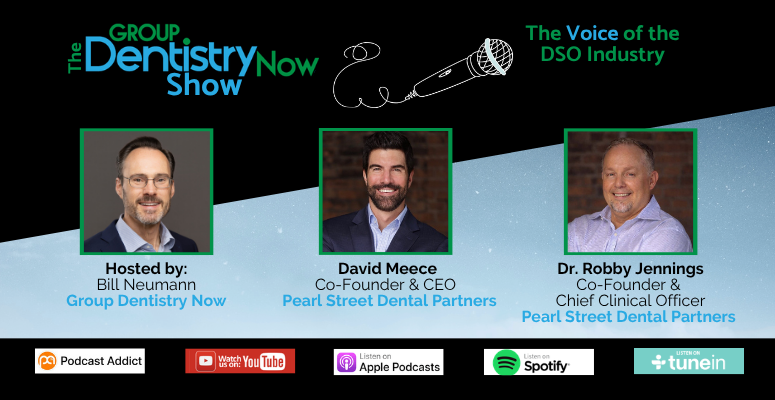
The Co-Founders of Pearl Street Dental Partners, David Meese, CEO & Dr. Robby Jennings, Chief Clinical Officer discuss:
- Their 27-year partnership
- Choosing culturally aligned partners
- Their deep strategic partnership with Ivoclar
- Much more
To learn more about Pearl Street Dental Partners visit https://www.pearlstreetdentalpartners.com/
Thank you to Ivoclar for sponsoring this podcast. To learn more about Ivoclar Learning Pathways visit: https://dso.pub/4dD237R
Subscribe to our channel for more episodes and stay updated on the latest DSO news, insights, and events!
If you like our podcast, please give us a ⭐⭐⭐⭐⭐ review on iTunes https://apple.co/2Nejsfa and a Thumbs Up on YouTube.
Choose your favorite listening app below and subscribe today so you don’t miss an episode! Full transcript is also provided below. See all of our podcasts HERE.
 |
 |
 |
 |
 |
 |
DSO Podcast Transcript – Building a 27-Year Partnership: How Pearl Street Dental Partners Preserves Private Practice Culture in Group Dentistry
Welcome to the Group Dentistry Now Show, the voice of the DSO industry. Join us as we talk with industry leaders about their challenges, successes, and the future of group dentistry. With over 200 episodes and listeners in over 100 countries, we’re proud to be ranked the number one DSO podcast. For the latest DSO news, analysis and events and to subscribe to our DSO weekly e-newsletter, visit groupdentistrynow.com. We hope you enjoy today’s show.
Ivoclar ad (00:39):
Driving consistency across a multi-location group is not easy. Creating real change takes more than great materials. It takes the right partner and that’s where Ivoclar comes in. We combine industry leading products with clinical education and ongoing support to help dental groups accelerate adoption through Learning Pathways, our complimentary on- demand webinar series as part of our Advantage program, delivering practical, CE accredited education for group practices. This 10 course program helps clinicians make confident decisions and deliver consistent high quality patient care across each practice. Scan the QR code to explore the full course series and get your team started today.
Bill Neumann (01:26):
Hey everyone. Welcome to the Group Dentistry Now Show. I’m Bill Newman and as always, we appreciate you checking in and we’ve had a ton of podcasts that we’ve recorded lately and have had to try and get through all those and it’s been great. Just tons of great conversation. And this is going to be really, I think, an interesting conversation for a couple different reasons. We have two co-founders here. One comes from the business side of things. He’s a lawyer and then the other is a clinician and it’s going to be interesting to David, who’s the CEO, the lawyer, claims that he and Robbie, the clinician, are an old married couple. So I really kind of like that setup and we’ll get to know them a lot better and the organization that they’ve built over a long period of time. So we have David Meese, who’s the CEO of Pearl Street Dental Partners along with Dr. Robby Jennings, who is the chief clinical officer.
(02:33):
They’re both co-founders and really a pleasure to have you both here.
David Meese (02:38):
Oh, thanks for having us. Thrilled to be here. Yeah. My joke about being an old married couple, we definitely finish each other’s sentences and after 27 years of doing this together, feel like we kind of share the same brain sometimes, but between the two of us, we should be able to get you some answers today.
Bill Neumann (02:56):
Awesome. Yeah, this will be great. And why don’t we start with you, David, a little bit about your background and then Robbie and a little bit about yours.
David Meese (03:06):
Yeah. So you mentioned I’m a lawyer. I’m a recovering attorney, been recovering for 26 years from a two-year legal career. I got into dentistry very randomly. Wanted my career to be about taking care of people. Got this idea about something that might work in dental and God really smiled on me by putting Dr. Jennings in my path early on and we became best friends and business partners and been doing this ever since.
Bill Neumann (03:43):
Thanks, David. How about you, Robbie? What’s your story?
Dr. Robby Jennings (03:46):
Yeah, Dr. Robbie Jennings. I graduated from Baylor Dental School back when it was Baylor in the late ’90s and shortly after graduating kind of crossed paths with David. I’d gotten a little taste of corporate dentistry as it was in the ’90s and knew that wasn’t something that I thought was very attractive for young doctors. And so he and I got together and started kind of hatching a plan to change the path for young doctors as they got into ownership and different options for them. I still practice. I practice out in Tyler, Texas, out in East Texas. I’m a general dentist. And then David and I have done this together for 27 years and it’s been just a fantastic partnership that we try to replicate every chance we get. We’re spoiled because it’s been a great relationship, but our goal is still to find more of those partnerships and relationships and continue to grow the company.
Bill Neumann (04:38):
And Pearl Street Dental Partners, did you mention it was 27 years? Is that right?
David Meese (04:45):
Yeah. So Pearl Street, the name didn’t come about until 2019 when we went through our first private equity transaction. Prior to that, we were known as Dental Management Strategies, wasn’t a forward facing name, but have been doing this since 1999, really started our major growth phase as I mentioned in 2019, and that’s when we became known as Pearl Street and had six locations at the time and now sit at 54 and still growing.
Bill Neumann (05:16):
So let’s go back to those early days. What was 1999 like in dentistry? How did you two meet? And David, I guess, how did you decide that dentistry was something that you wanted to get involved in?
David Meese (05:32):
Yeah, so I didn’t love practicing law. Again, wanted my career to be about taking care of people, felt like it was probably too late to go back to med school or dental school at that point. Had an early mentor, man by the name of Dr. Larry Cunningham, who I think had a vision and a heart for being able to have group dentistry being a thing. This was kind of pre DSO world. And so that was my entry into the space, but really didn’t know what I was doing other than I wanted to help young dentists get from graduating dental school into owning their own practice. Again, as Robbie mentioned, we kind of joined forces early on and became partners. It’s been an incredible blessing. Honestly, the Pearl Street story is just a series of blessings. The exact right human beings have come into our lives at the exact right moment.
(06:28):
And I consider that starting with Robbie and he mentioned we were kind of spoiled. I keep waiting for us to have our first disagreement in 26 plus years other than maybe who the Cowboys should draft. But we’ve kind of gone into every partnership since then, assuming it was going to be like ours and have been blessed that it really has been. Early on when we were getting this thing started, we quickly learned that not every dentist wanted to own their own practice. That was an assumption we had made. Some did want to own, but they wanted to do it with us. Some didn’t want to own anything and some wanted to own a piece of multiple practices. So it really became that our model was tailored to the individual doctor, their short-term and long-term goals, forged some really awesome relationships early on, deep friendships with some of those early docs, almost all of whom are still part of the Pearl Street family to this day and kind of just looked up and had multiple locations and a nice little kind of lifestyle business going.
(07:37):
And honestly, that was when the DSO world started to spring up around us around, this is around maybe 2005, 2006, and we didn’t like it. Honestly, still don’t like a lot about it. I think we’re very opposed to the corporatization of dentistry. And so we decided, “You know what? We don’t want to become that. Let’s just circle our wagons, take care of our litle family of practices. Robbie’s got daughters, I’ve got daughters that’s finished raising our kids.” And so we pressed pause for about a decade. And it wasn’t until 2018 when we had kids about to go off to college, we kind of looked at each other and said, “Okay, what’s the next adventure here? And let’s see if we can grow this thing and prove to the world that you can do it differently, really preserve the private practice of dentistry, but with the collaborative power and peace of mind and security that comes from a partnership that we had enjoyed all these years.
(08:37):
And so people told us we couldn’t scale that, which meant we had to because they told us we couldn’t. And so that was when we started our big growth phase in 2019 and it’s been quite a ride since then.
Bill Neumann (08:52):
It’s one of the best motivating factors or things when somebody tells you you can’t do something. It just seems like, well, you just want to do it regardless of whether you can or not, you’re going to make it happen. So it’s great that you did that. And yeah, you talk about 1999 and I saw a stat that the ADA Health Policy Institute had that in 99, 66 or 67% of all dentists practiced solo and their definition was one location, one doctor. And fast forward to today and that’s about 33% practice solo. Now that doesn’t mean that everybody works … The other two thirds work for a DSO. Some are working in one location with multiple clinicians, but certainly things have changed quite a bit since 1999 the way doctors want to work now or even can, a lot of them want to work in a scenario where there are multiple clinicians, they’re looking for mentorship, they don’t want to work on an island like they used to.
(10:03):
So it’s really, really changed a lot. Robbie, you said you were working in corporate dentistry, you didn’t like it and that’s really one thing that led to partnering with David and kind of creating your own group practice and not necessarily a DA. So can you talk a little bit, not necessarily about who you worked for, but what that situation was like and then what you’re building now. Why is Pearl Street different?
Dr. Robby Jennings (10:32):
Yeah, I love that. I started out working for a classmate’s father who had multiple practices, just a few practices in the Dallas area, did that for a little bit in a really busy office just a few months. And then he came to me one day and said, Hey, guess what? I’ve sold to a corporate group. They’ll be in here Monday, good luck. And it’s gone. And so I got a taste, all the negative stereotypes you hear, all the corporate kind of muddying of the clinical waters and the things that had to change and the focus on cost and the things that just felt wrong. That wasn’t why I was practicing dentistry. I was in healthcare because I wanted to care for people and I wanted to take care of them the best way I knew how. And it just felt like there was a lot of noise as that relationship evolved.
(11:20):
And so I had just a taste of what I thought private practice felt like, and then I got a taste of corporate dentistry really early on. And so my early conversations with David were about, listen, we’ve got to find a way to thread this needle and be able to take advantage of some of these things that come with being part of a group. But at the same time, we’ve still got to allow our doctors to have the clinical autonomy they need to take care of their patients and do it in a way that they can feel good about at the end of the day. And so it’s been an evolution. It’s been a conversation since day one. We still are trying to get better every day and kind of define what that looks like. It’s changed over the years, obviously, but I think at the end of the day, the most important thing for us is that our doctors feel like they have full clinical autonomy to take care of their patients and they know that we’ve got their backs and we’re here to support them any way we can.
Bill Neumann (12:10):
This leads into, and you’re perfect for this. We have CEO and chief clinical officer here talking about operational and clinical alignment and really a pretty big challenge with a lot of organizations out there. I think we hear about it quite a bit and probably one of the reasons why some DSOs get a rather bad rap because the dentists feel like maybe they’re promised something and then they get in and it’s something much different. So can you talk a little bit about how you’re aligned and maybe what things you do together and what things are kind of separated out? Oh, David, maybe you can kick that off.
David Meese (12:52):
Yeah, it’s interesting. I think we solve for probably 90% of this issue on the front end when it comes to who we’re choosing to partner with. We are an extremely hyper-committed people first business. Robbie and I have always believed that in dentistry, profitability is an outcome, not a pursuit. It’s a result of being really good at this other thing, taking care of people, patients, staff, each other. I’ve always believed that if we’re good at that part, the financial success would flow out of that. And so we have intentionally partnered with people who care about the same things. And so for us, it’s been fairly easy because we’re so relationship-based, wear our heart on our sleeve when we’re talking with potential partners because we want them to get to know us and what makes us tick and we really want to get to know them as people and their spouses, all this stuff pre-close to make sure that there’s just good cultural, missional alignment and a similar ethos in those practices to what we care about and believe in.
(14:05):
And so we kind of start off on third base from an alignment perspective because of that commitment. But then honestly, any partnership, once you get in, you have to figure things out and all of our partners, our partnerships are a little bit different because they all need something different from us. And so we are a very much a pull function when it comes to our centralized services, the centers of excellence that we built out, it’s where do the doctors need and want the help and then where do they want us to stay out of the sandbox? And so our identity has become that, I think you have some DSOs on both extremes where you’ve got the groups that say, “Hey, we have a lot of help available to you, but you have no choice but whether to use it. ” You have to plug into our system, you’re kind of our identity now.
(14:59):
And then the other extreme, which is, “Hey, we’re not going to impose a bunch of stuff on you, but we also don’t have a lot of help to provide.” So we’re trying to be this middle ground where we have best in class solutions to make our partners’ lives easier to remove that administrative burden, but it’s elective. It’s where do they want us and where do they feel like they’ve got it and don’t need or want our help. And our commitment to that I think has been the key to our success. It’s a little bit more work than being cookie cutter, but being cookie cutter just isn’t in our DNA. And so that’s how we’ve solved for that. I think you’re right that some groups have, I think DSOs become a bit of a four-letter word because of that misalignment where, hey, there’s these corporate initiatives and stuff that’s kind of being pushed down on these practices that don’t necessarily want it.
(15:53):
That’s just antithetical to everything that we are. To be a good partner in our view, we have to give our doctors information for decision making, vetted solutions that they can then choose to avail themselves of or not.
Bill Neumann (16:11):
Yep. Robbie, go ahead.
Dr. Robby Jennings (16:13):
Yeah, I think that he touched on the most important part of that. We offer solutions and that’s the way it’s presented to our doctors, our partners from the very first meeting we ever have before they’ve ever decided to join Pearl Street and that continues on throughout the partnership. We do the legwork for a lot of our practices to offer them solutions and do the homework on potential technologies or materials or initiatives, whatever they might be interested in. But in a lot of cases, we’re doing the work for them and then reporting back to them. Like David touched on, every practice is different and the goals for our doctors is different. Their timelines are different. The way they practice is different, frankly. And so we have to be a little unique and a little bespoke depending on which practice we’re talking to, but we have the team in place to kind of do a lot of the legwork and be able to provide those solutions for them to choose from.
(17:04):
I think we’ve always handled any clinical initiatives in that manner where we bring the information to our doctors. We talk to them about why we think this would be a good idea, but the reality is at the end of the day, they still get to decide, is this a fit for me? Is this a fit for my practice? And if they say, no, that’s okay. We will continue to work with them and we’ll move on to the next idea. I think they enjoy having thought partners and we do too, frankly. We enjoy having lots of smart people around the table. And so we enjoy the collaborative nature of all of these partnerships, frankly. And I don’t know that we could do it any other way
Bill Neumann (17:42):
Along the same lines, what do you see doctor partners looking for today? Is it any different than maybe it was four or five years ago? And then part two is what are younger clinicians fresh out of dental school looking more for their first career or maybe second job? What are they looking for?
David Meese (18:10):
Yeah, I’ll take the first one. Robbie, you can talk to the second one. Robbie and our instrumental in developing our doctor academy and a lot of the cool stuff we have for these younger docs. But to your first question about what are partners looking for in our case, I think the vast majority of our partners are entrepreneurs at heart and they have reached a bandwidth limitation of some kind with regard to their career and the growth of their practice or practices and they’re genuinely looking for a partner to be able to expand their ability. A one plus one equals three situation. Our average doctor age in the Pearl Street family is kind of a mid-career doctor. We have folks all over the career timelines, but on average, these are mid-career partners that have the benefit of time, have the benefit of three, four, five bytes at the apple with regard to transactions in the future and they really just want to be able to keep moving forward without it adding more weight or burden to their shoulders and taking away from family and the rest of their lives, et cetera.
(19:21):
So I think more and more we’re seeing doctors that genuinely care about maximizing their practice. I think we have more and more in our group that want additional practices outside the four walls of their existing practice and we have the ability to go do that together, which is appealing to an entrepreneurial doctor. And then I think specifically inside the practice we see a lot of common kind of choke points with regard to revenue cycle management, recruiting for additional providers or team members, marketing are things that we see our partners specifically wanting help with right off the bat.
Dr. Robby Jennings (20:03):
Yeah, I think that’s important. And the optionality that comes with Being Partners with us is a big deal for all of our doctors, frankly, our partner doctors and the new doctors. Like David mentioned, I work directly with our newer younger doctors who are recent graduates in a lot of cases. And what we recognized really post- COVID was that for a lot of them, a lot of their training in dental school had moved to a more virtual, les hands-on approach, which we saw some really dramatic limitations with some of these doctors that were really smart, really talented, really confident doctors that just needed additional help. And so in a lot of cases, they already recognize that and we’re asking about, “Okay, well, what do you do to help me grow and support me clinically, help me with my clinical confidence once I’m part of Pearl Street?” And so we’ve worked really hard and been very intentional about developing our Doctor Academy program, which is specifically for our new grads coming right out of school, but certainly include some of our younger doctors as well.
(21:07):
And it’s a series of hands-on training sessions built around the things that our doctors all struggle with or acknowledge they need more help with. We mix in some travel, we go on a mission trip with that group every year, go to Mexico, kind of builds an interesting bond with those new doctors. A lot of times they’ve come from schools all over the country and they immediately feel like they have classmates again. I tell them all the time, a lot of them have had classmates around them since they were five years old. They graduate dental school and all of a sudden they’re expected to go out into the world and sit next to a 50-year-old dentist or maybe be in a practice by themselves and this way they’re still connected and they’ve got a group that grows together and trains together, travels together and it’s been a really important kind of next step for us.
(21:55):
And I think a lot of our younger doctors would acknowledge that that’s been a big part of their growth. Also, mentoring is an important function. In our case, we often have mentor doctors that are not in the practice with our doctors. They’re actually practicing in different locations. One of the interesting things about Pearl Street is that we have a ton of doctors who want to teach, who want to help and will raise their hand to volunteer to mentor some of these younger doctors. And so that continues to build the bonds within the family, but it also gives the young doctors another resource they can reach out to with clinical questions or life questions, frankly. But we’ve been very intentional about building that out because consistently all of our young doctors raised their hand and said, “Well, what are you going to do for me once I get out?
(22:40):
Because I’ve got a long way to go as far as clinical growth.” And so far that’s been well received and we continue to try to get better every day, but it’s been a great program so far.
Bill Neumann (22:53):
And do you see that helping out when it comes to recruitment and retention, that clinical focus that you have, that focus on education and ongoing training?
Dr. Robby Jennings (23:04):
It certainly doesn’t hurt. Yeah, it’s one of the things that everybody asks about and the fact that we’ve got a well developed kind of strategy for that and one that feels like it’s customizable depending on their strengths or their areas they want to continue to improve. And then also the fact that we’ve developed kind of an extended program moving forward. So after they’ve gotten through that two-year academy, they still got opportunities to continue to follow their clinical passions and train and grow in the areas they’re most interested in and we’re going to support them through that as well. And so yeah, it’s definitely moves the needle a litle bit when I’m talking to young doctors about possibilities and possible employment with us.
Bill Neumann (23:44):
Excellent. So I’d be remiss if I didn’t mention Ivaklar and thank them for sponsoring this and this really ties right into what we’re discussing here. How does Ivaklar’s support as a partner really help you when it comes to educating and training your clinicians?
Dr. Robby Jennings (24:03):
Well, obviously Ivoclar’s had a long history of clinical excellence and so I’ve been exposed to their products for years. They really stepped up as discussions about what our Doctor Academy program was going to look like, raised their hand and said, “We want to be involved in this. We want to help. We will sponsor, we will host, we will do anything you’d like for us to do, but please let us participate in this. ” And they’ve been just fantastic partners. They hosted us last fall. I mentioned our mission trip with our young doctors to Mexico. We also took a trip to Buffalo, New York where the headquarters are and did a full day CE and happened to go to Buffalo Bill’s Miami Dolphins football game with our young doctors as well. And so that was fantastic. They’re obviously all connected with Iva Clark at this point, love their materials just based on the people they met and the materials and techniques they were exposed to.
(24:55):
And so we’ve built that bridge. Additionally, they’ve sponsored our family gathering. We have a family gathering every year where we host all of our employees and doctors from all over in Dallas. It was just a couple of weeks ago and they’re one of our primary sponsors in that event as well. And so they provide CE speakers for us in addition to just different educational elements and things to support Pearl Street and who we are and what we do. They align with us culturally. They’re just a perfect fit. And so we’ve really enjoyed working with them.
Bill Neumann (25:27):
Let’s talk a little bit about your culture. It’s interesting and you both have been in the game a long time and I don’t know if you remember when interest rates were near zero and people were buying their growth in a lot of cases and everything was great, right? Everybody was super smart and DSOs could do no wrong, or at least that’s what investors thought. But there was a lot of talk about culture. I would say six, seven, eight years ago and nobody really talks much about it now, but it’s certainly important. So I don’t know if sometimes it’s hard to enunciate, what is your culture? We have a culture, what is it? So can you talk a little bit about what that looks like or what the Pearl Street culture is?
David Meese (26:18):
Yeah, it’s interesting. I think most times at these conferences or whatever, when I hear people talking about culture, it’s typically in the context of a branded group where all the locations look the same, they all do the same thing, they have all the exact same systems. And so you have a cohesive culture or almost brand. Whereas in our case where we’re an invisible DSO or non-branded, patients don’t know we exist, it’s a conglomeration, it’s a partnership of very diverse practice types with regard to demographic, the procedure mix, et cetera. And so for us, culture really has to do with core values and a shared, again, ethos or mission where this is about people first. I can tell you that when Robbie and I are meeting with prospective partners and these seller meetings or whatever, one of the first things that we look for is whether or not they bring up a concern for their staff.
(27:27):
If somebody doesn’t bring that up, it’s usually a red flag for me and Robbie because it kind of tells us, “Oh, they’re not that worried about their people. And so I’m not sure this is a great fit with the Pearl Street culture because we’re so people first oriented.” But it’s interesting because our practices are all kind of their own thing, we talk about clinical autonomy, they also still preserve operational autonomy in a lot of respects and certainly we don’t want to disrupt the existing culture because we partnered with them for a reason, because we fell in love with what they built and believe that they care about the same things we do. So we don’t step in and try to impose a Pearl Street culture on the practices. What we’re really doing is trying to partner with people who have a shared culture and values with us.
(28:17):
And so we’ve been very blessed in that regard and I think like attracts like. And so we’ve been an attractive option for people that care about those things as well. And I think we’ve done a good job of making sure that we continue to base our decisions on the human beings that we’re going to be doing life with on day two and not get blinded by a spreadsheet or by numbers. We’re basing our decisions on the people and that’s enabled us to keep a common culture throughout our practices.
Bill Neumann (28:52):
So as you look at growth over the years, we talked a litle bit or I mentioned it a little earlier, there was a lot of acquisitional growth we saw when interest rates were low and you even mentioned you took a pause for a while when you were growing. So what are you doing now? When you look at growth, what does that look like for Pearl Street?
David Meese (29:18):
In 2024, we took a pretty intentional approach to building out some infrastructure in advance of future growth. We were still doing M&A, but slowed a little bit on M&A in order to really focus on building out our centers of excellence. And now we are, I think, mashing the accelerator again on M&A because we built out all that stuff in advance. I think there’s a lot of groups right now that are kind of in the opposite place where they kept maybe acquiring practices but didn’t really build out a platform and those groups don’t have buyers anymore. The days you’re talking about are over. And so at In order for DSOs to be able to transact, they have to be able to show, hey, post-partnership, these practices are much healthier. There’s real organic growth happening inside the four walls. We’re not just an M&A machine. And so we really set about trying to prove that out and build that and invest in that and now are acquiring into that.
(30:26):
And so we actually anticipate … The other problem, of course, is that because of the interest rates and the other things you mentioned, some of these groups are on the wrong side of their incurrence tests. They can’t draw on their DDTLs. They don’t have the ability to grow at the moment from a lending perspective. We’re blessed to be in a great position there and believe that there’s still a lot of doctors out there who want the help and want the kind of partnership that we can provide. And so we’re very optimistic about our inorganic growth through M&A here over the next 24 months while continuing to really perform on the organized side.
Bill Neumann (31:04):
And is it all acquisitions or do you do any de novos?
David Meese (31:10):
We have sprinkled in some de novos. Originally, Marabi and I started this, there was quite a bit of de novo activity. But here in this last growth phase over the last seven years or so, de novos for us have been more opportunistic than an actual part of our model. And it was more so based on is there an associate doctor maybe that we really love and that would like to go do something with us from a de novo perspective or just location-wise, something that we really believe in. But our core model is a JV partnership model where a true partnership model where there’s never a situation where something’s good for one partner and bad for the other. We’re all in the same boat all rising with the same tide. And our doctors typically retain local ownership and have ownership at ParentCo, Class A shares of Pearl Street.
(32:02):
So that is our core model, but de novos are still something we’re interested in doing. And frankly, I think if we end up with a de novo real meaningful part of our strategy, it will be because we have partnered with someone who’s gotten the de novo thing really figured out and wants to keep executing on that, and we can just help them do that.
Bill Neumann (32:20):
Yeah, makes sense. Back to the clinical side of things. One, I think a real big key component to a successful DSO is really having a well thought out educational platform for your clinicians. The younger ones, the established ones, you talked about mentorship. We have a lot of emerging groups on this that listen to this podcast. We have a lot of docs that are going from one location to two to three. And as you start to scale up and you can’t be everywhere as a clinician, you can’t be at every location. You have to really delegate and also figure out different systems. Can you talk us through what is your education? You talked about the partnership with Ivoclar. So you aim on good partners like Ivar to provide education, whether it’s hands-on, you said you went up to Buffalo or whether it’s online or virtual training.
(33:21):
How do you do that? Do you have online training that you have your own LMS? What does that look like?
Dr. Robby Jennings (33:27):
We do. The answer is yes. It’s a combination of all those things. We do have an LMS system that’s a resource for everybody in our family as far as training goes. We work with several of our vendor partners. I have a clerk, certainly a big one, just to make sure that we are providing the right continuing education opportunities for all of our doctors. And then we also outsource some. When you have a family full of really clinically excellent doctors and you know there’s a doctor raising your hand asking about taking a certain type of course, we kind of lean on our partners to make suggestions and talk us through kind of classes they may have gone through before, what worked for them, what didn’t. And so really the interesting thing about our family of practices, and David touched on this earlier, is that because we all rise with the same tide, all of our doctors, all of our clinicians care about all the other doctors, clinicians, and practices in the family.
(34:23):
And so they all enjoy the mentoring aspect, but also just being able to speak into what educational options are out there and what worked really well for them. And so it’s a little bit of everything. We do have some structured CE throughout the year. I mentioned our family gathering. A lot of times that’s an opportunity for us to make sure that our doctors are able to develop relationships with our vendor partners that we think would be meaningful, whether it’s because they have a particular product or whether it’s just a fact that there’s a cultural alignment there and we feel like that’s somebody they should get to know. And so we certainly take advantage of family gathering to do a lot of that. And again, some of it is just good old-fashioned legwork. Like David mentioned, we’ve got different relationships with every one of our practices and all of our doctors need and want something a little bit different.
(35:11):
And so knowing what those relationships look like and continuing to work with those doctors can be really meaningful. As we’ve grown, one of the things that we’ve had to really be strategic about is leaning on some of our more senior doctors to be vocal leaders, to be clinical leaders within our family. In a lot of cases, that means we’re coaching the coaches on some of the things that they’re going to turn around and kind of message to the rest of the family. And so again, we’re really fortunate because we’re so particular about our partnerships upfront, we know that there’s a lot of cultural alignment. And so those doctors in a lot of cases are really excited to help out and pitch in where they can to make Pearl Street the family stronger and better. And so we’ve been really blessed in that regard.
Bill Neumann (36:00):
Excellent. I love that you call it a family gathering. That’s pretty cool. You normally hear retreat or doctor partner or something or other, but that’s pretty
David Meese (36:14):
Cool.People make point us for it, Bill. They say, why do you keep calling it a family? And it’s like, we don’t know what else to call. It’s how we operate. I think family, they don’t always 100% agree with each other all the time, but they love each other and they have each other’s back. And I would say that’s really how we are as well. I think it helps also, just so you know, we don’t bat a thousand. We’ll swing and miss on an idea or an initiative. And the good thing is our doctors all know that our heart’s in the right place. And so even if we try something that doesn’t work out, it’s all okay. There’s no us versus them feeling inside the Pearl Street family. And I think it’s because of a commitment to operating like family, honestly. And just real quickly, back to your point that you’re just on about the kind of clinical leadership piece of this thing, we really believe that as the consolidation movement continues in our industry and you’re talking about these emerging groups, highly encourage those groups to remember that I think as the cream rises to the top in this space and the wheat gets separated from the shaft, if you will, the groups that are clinically led are going to be the ones that thrive.
(37:31):
And private equity is great and for valuations and all that stuff. But I think a lot of times these groups tend to lose sight of their purpose, which is patient care, taking care of people. And so having clinical leadership, developing leaders amongst your clinical team I think is going to be key for the next wave of this space in general. So we’re committed to hopefully being one of those that remains true to that.
Bill Neumann (38:00):
Yeah. Focus on the clinicians and the patients that you serve and hopefully the rest will follow. If you’ve got a good COO and a good CEO and you’ve got all that together, as long as you’re focused on the clinicians, I think, and the patients. So I think it’s great. As we start to wrap things up here, I always kind of ask a crystal ball question. So what is the next 24 months? So you can set it out however far you’d like, but we’re kind of in this interesting time where we had, and I touched on it a couple of times, the low or no interest rates, now we’re in a relatively steady state of interest rates. However, we’ve got all this other uncertainty out there and I think some of the patients that we serve are feeling that as well. So if we go out 24, 36 months, what kind of initiatives do you have and what do you think Pearl Street looks like in two, three years?
(39:06):
Why don’t we start with you, Robbie?
Dr. Robby Jennings (39:09):
Yeah, it’s a great question. It’s interesting because I think people are always going to need dentistry and we’ve been very intentional with most of our practices. And again, they’ve kind of developed their magic on their own, but making sure that we’re providing a consistent level of care so that if times change, the economy gets tough, we’re still going to be there to take care of our patients. We may not be selling as many high-end cosmetic cases during those times, but we’re still necessary part of taking care of our patients and being parts of their lives. And so I think as we continue to grow and move forward, I can see us expanding maybe our footprint just a little bit, but I think the focus is always going to be on the clinical aspects of what we’re doing. And as David mentioned earlier, as long as we continue to focus on that and taking care of people, I honestly believe that we’ll be fine.
(40:00):
Whatever it looks like, we’re going to figure it out. That’s kind of what we do. And so I’m really confident we’ll continue to be able to do that. Thanks.
David Meese (40:09):
Yeah. And I think from just an industry standpoint and more specifically, I guess, goals for Pearl Street and how those two things overlap over the next 24 months or so. I think we’ll continue to see consolidation in our space. I do think you’ll start to see some of the more successful groups maybe gobbling up some groups that are stuck or some smaller groups wanting to join larger organizations that have already built out a lot of the stuff that maybe they’re now facing, having to go figure out. But that’ll be a good thing for our space. I think, again, the cream will rise to the top here. As far as Pearl Street’s concerned, people always ask us how big are we trying to get? We never assumed we’d be this big. We’re really not trying to get bigger. We’re always trying to get better and we believe that if we continue to get better, the market will dictate that we grow.
(41:01):
And that has been the case so far. Been very blessed by that, trying to be good stewards of that blessing. As Robbie mentioned, we are now for the first time venturing out into some new geographies. We’ve been based solely in Texas and Oklahoma and we’re moving into some other areas or one other area of the country that we think shares some of the common value system and population tailwinds, et cetera, that we experience in Texas. And so excited to go prove out our model, still maintaining regional density, but maybe multi-regional as we continue to try to expand Pearl Street’s influence in the space and take care of more people and touch more lives.
Bill Neumann (41:44):
Excellent. Well, appreciate both your time. Great conversation. It’s a lot of fun to learn the history. I mean, I had no idea you’d been around as long as you had. I’m sure I’m probably not the first person to say that, but it’s a great story and hope to see you doing it in another 20 years. If people want to learn more about Pearl Street Dental Partners, what’s the easiest way to do that?
David Meese (42:13):
Yeah, I think obviously you can just go to pearlstreet.com, you click on the About Us page, you can get a decent feel for who and what we are, but also just reach out to us directly. We love talking to people in the space with no agenda. We tell people all the time, even when we’re in a process with a partnership, if we get eliminated from contention, still use us. Call us, let us be a sounding board. We want the good guys in our space to win and so the more relationships we can form and people we can help, the better. So reach out to us directly anytime.
Bill Neumann (42:46):
Okay. And is LinkedIn your email address, what’s the best way to do that?
David Meese (42:51):
You can find both of us on LinkedIn. Also on our website, you’ve got, I think my personal email’s on there. If not, you can reach us through the company email. But yeah, any or all of those, I think we’ve got a social media presence now on Instagram as well. So we’ve come out from under a rock officially here over the last couple of years, so be able to find us.
Bill Neumann (43:16):
Well, excellent. And Robbie and David, I really appreciate the time. What we’ll do, we’ll drop your LinkedIn handles and also your website address in the show notes and people can reach out to you there. But really, really appreciate the conversation and also thank you very much to Ivaklar for sponsoring this podcast, getting you two on the podcast. You did a great job and really appreciate the information and hope to see you in person soon.
David Meese (43:46):
Likewise. Thanks for having us. It was a pleasure. All right.
Bill Neumann (43:49):
Thank
Ivoclar ad (43:49):
You.
Bill Neumann (43:49):
Take
David Meese (43:49):
Care.
Bill Neumann (43:50):
Yep. Thank you, Robbie. And thank you everybody for watching us today. Until next time, this is The Group Dentistry Now Show.
Ivoclar ad (43:58):
Driving consistency across a multi-location group is not easy. Creating real change takes more than great materials. It takes the right partner and that’s where Ivoclar comes in. We combine industry leading products with clinical education and ongoing support to help dental groups accelerate adoption through Learning Pathways, our complimentary on- demand webinar series as part of our Advantage program, delivering practical CE accredited education for group practices. This 10 course program helps clinicians make confident decisions and deliver consistent, high quality patient care across each practice. Scan the QR code to explore the full course series and get your team started today.
Thank you for joining us today. Don’t forget to subscribe to the podcast to stay up to date on the latest DSO News, insights, and events. Also, subscribe to our DSO weekly e-newsletter at groupdentistrynow.com.