
Ranked the #1 DSO Podcast!
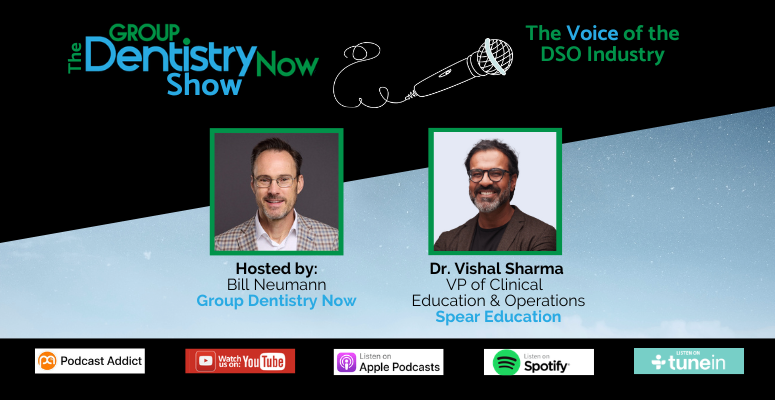
Welcome to The Group Dentistry Now Show: The Voice of the DSO Industry!
Transforming Associate Development and Retention Through Structured Education
Dr. Vishal Sharma, VP of Clinical Education & Operations at Spear Education shares his thoughts on:
- DSOs failing at clinical education
- Education as a performance & retention lever
- $3,500 per day associate production
To learn more about Spear Education visit: https://www.speareducation.com/
You can also contact Dr. Sharma via email: vsharma@speareducation.com or on LinkedIn: https://www.linkedin.com/in/dr-vishal-sharma-78527543/
Subscribe to our channel for more episodes and stay updated on the latest DSO news, insights, and events!
If you like our podcast, please give us a ⭐⭐⭐⭐⭐ review on iTunes https://apple.co/2Nejsfa and a Thumbs Up on YouTube.
Choose your favorite listening app below and subscribe today so you don’t miss an episode! Full transcript is also provided below. See all of our podcasts HERE.
 |
 |
 |
 |
 |
 |
DSO Podcast Transcript – Transforming Associate Development and Retention Through Structured Education
Bill Neumann (00:11):
Hi everyone and welcome to the Group Dentistry Now Show. I am Bill Neumann and always appreciate everybody tuning in. Over 250 episodes, so a lot of great content and today is no different. We’re really going to focus today on clinical education and our DSOs really, are they doing what they should do when it comes to clinical education or are they falling short? I have my own opinions on that. Dr. Sharma probably has his own opinions on that. So we’re going to discuss that and really dive deep into what does clinical education really mean to an organization as well as to the individual clinicians that actually work at the organization, in some cases their partners there. But we have with us Dr. Vishal Sharma. He is the vice president of clinical education and operations at Spear Education. Dr. Sharma, prior to joining Spear, oversaw 580 practices as a director of clinical operations for Dental Corp. You may have heard of them before there.
(01:20):
They’re actually doing some acquisition work down here in the States now and you continue to practice dentistry today in Calgary. Also a resident faculty member of CDOCS international lecturer known for his expertise in digital technology and orthodontics. So Dr. Sharmit, it’s nice to have you here.
Dr. Vishal Sharma (01:43):
Bill, it’s a pleasure to be on your podcast and I look forward to this really interesting discussion topic.
Bill Neumann (01:49):
Excellent. And we have a lot of listeners up in Canada too, so we’re not just US listeners. We’ve got quite a few group practices that are fans. And I worked closely with a couple of Canadians in my younger days in the dental industry and one that is now over a one, two, three dentist and still keep in touch with him and see him on a regular basis. So strong affinity to Canada and we’d love to get your thoughts north of the border and then what’s going on south of the border here when it comes to clinical education. But first off, a little bit more about your background, maybe your role at Dental Corp. And since we’re focused on clinical education, maybe some of the things that you saw there when it came to clinical education and mentorship.
Dr. Vishal Sharma (02:39):
Yeah. So I partnered with DentalCorp, rolled in my five practices that I’d acquired since 2009 into a DSO framework, and then shortly after took on the role of their director of clinical operations. So really energetic organization, young leadership team, growth oriented. As you mentioned, they’ve now expanded down into the US, so cross-border DSO. And education, which is really my passion, one of the challenges that we saw was that implementing things that independent dentists were successful with, technology, protocols, workflows. When you had to scale that, that’s where the difficulty came in place. So we tried building our own educational platform. Obviously that is a very onerous and heavy lift. There was some success with that, but reinventing the wheel in any aspect, especially with dental education may not be the best way to focus efforts for a DSO. So we created a hybrid component where there was a lot of internal education.
(03:40):
It’s a big network. There’s a lot of great dentists and educators who we could leverage for that, but also partnering with outside sources, OEMs or educational institutes like Spear Education to fill in some of the gaps that we couldn’t create internally. That seemed to be a really good recipe for us. So I learned a lot in that role going from an independent dentist to learning about the machinations of a large corporation, corporate lingo, how boardrooms and meetings work. It was a really informative and transformative experience for me, one that I was apreciative of.
Bill Neumann (04:14):
So you made the move to Spear Education. Can you talk a little bit about making that move and the reason behind it and what your role is currently?
Dr. Vishal Sharma (04:24):
Yeah. 2018, I had the opportunity to give my first solo presentation on digital dentistry. It was probably a terrible presentation. I don’t even know if I knew what keynote was at the time, but as with anything else, when you first dip your toe into it, you’re going to start to become more comfortable and you’re going to grow. And I grew into a position where that education, I became very passionate about it. So I still currently teach workshops. I just came back from Toronto this weekend doing a four-day digital workshop. I’ll be heading to Scottsdale later this week to do that. So that still is a persisting passion of mine. When I had the opportunity with teaching underneath the Spear umbrella, when I had the opportunity to step into more of a leadership role where I could support our incredible faculty on developing education and work with a really enthusiastic, capable team on shaping what the future of dental education would be, I jumped at that opportunity.
(05:23):
It was certainly my passion. I enjoy clinical dentistry. I still really enjoy being chairside and interacting with patients, but being able to frame and shape what continued education looks like to me was a great opportunity. And Bill, when I look back on my career and I see the trajectory and the impact that certain individuals have had and the impact of CE and how consequential that’s been for my personal career growth, I’m immensely grateful for those opportunities. So to be able to be on the other side to help give back, just an opportunity that I’m so thankful for and I really enjoy working with a very capable and energetic spear team.
Bill Neumann (06:01):
Excellent. Well, as we start to get into some of the Q&A, it’s something that maybe before we start things off, I’m not a dentist, but I came from a company that made clinical products. And so I understand enough about how certain products work, how dentists use them. And one thing that I’ve noticed is that DSOs, and again, I’m generalizing, but a lot of DSOs, including larger ones, don’t have a structured educational curriculum, especially when it comes to clinical. And in fact, some are just giving stipends out and saying, “Get your education the way you did before you joined us.” And I find that pretty surprising. And so the reason I kind of lay that foundation, and you can prove me wrong if, and again, I’m generalizing, but there are some larger organizations that I would have thought would’ve had something structured and don’t for a variety of reasons.
(07:10):
I think one, because especially if they’re not run by clinicians and it’s certainly not top of mind. But we talk about the focus that the industry’s had on same store growth or organic growth. Let’s talk about how education really aligns so much clinical education when it comes to same store growth, organic growth. And also another big challenge that I think we’ve seen is certainly a lot of people now talk about it because of COVID, but I think it was even pre – COVID is recruitment. Recruitment’s been a real, real challenge for quite a long time now in the industry. So I think education to me just seems so important to getting people just like, “Hey, what are you going to provide for me? ” That’s one of the things when you talk about the S in support, clinical education is part of that S. Can you talk a little bit about what you’ve found out there?
(08:08):
Have you seen the same thing that we’re seeing where there isn’t a lot of structure around clinical education?
Dr. Vishal Sharma (08:14):
Yeah, I would wholeheartedly agree with that, Bill, that we do see a lack of structure. And I think if we look back to previous years or decades of dentistry, you can see why that has occurred. So as an independent dentist, which a lot of the chief dental officers who are leading these organizations were independent at one point, they look back on their career and when they took continued education, it wasn’t a pathway or a program. They were able to self-identify a need. So from my perspective or my personal experience, many years ago we saw a need for clear aligner therapy. So we invested in clear aligner therapy. We bought the appropriate technology, eventually scanners. And I went out on weekends and I learned as much as I could and I brought my team along where we could. You can implement the same thing once years later we had a component where implants were necessity, then we incorporated that.
(09:08):
So there was a lot of self-identification as to what those pain points were. And the chief dental officers who were in charge of the education for these DSOs, they probably had a very similar trajectory to mine where they were able to effectively self-identify their pain points or shortcomings. I think the challenge for dentists today, early career dentists today is first of all, that the profession is so much more complex than it was in 2004 when I graduated. Now you have to understand clear aligner therapy, implantology, cosmetics. You throw Botox into that. There’s social media, which brings a whole new array of pressures onto early career dentists showing them what they should be accomplishing and I think leaving them with feelings of inadequacy. So it’s a very, very different profession. And because it’s so much more complex and because coming out of dental school, we’re seeing that dentists just aren’t as prepared as they were certainly 40 years, 30, 20 years ago where dentistry was not as complex.
(10:12):
Having a more sequential, structured, systematic pathway I think is going to be the path forward for them succeeding. And some of our CDOs that we work closely with who are of my vintage are still utilizing techniques and their thought processes revolve around what was succesful for them when they were in their developmental years as opposed to what the new challenges are for early career dentists. And it’s not the same recipe for success. So I think that’s where the disconnect comes in. And obviously I’m happy to be part of trying to find a solution to that.
Bill Neumann (10:52):
So we talk about associate development and certainly an important topic for sure. Are DSOs paying more attention to that now? And if so, what are some strategies around that? I’ve heard this another common theme that I’ve heard too is, and you pointed it out earlier, because of the complexities, dentists coming out of dental school two, three, five years of experience don’t feel prepared to do certain things. They don’t have a high confidence level or a comfort level. Are you seeing that as well?
Dr. Vishal Sharma (11:36):
We’re certainly seeing that readiness gap. There’s no doubt.Dental school provides a great base for competence, but it leaves that readiness gap for real world challenges. As you step into private practice, there’s more complex treatment planning, patient communication becomes more difficult. We have financial conversations with patients for the first time. Early career dentists now need to balance time management and productivity expectations. So the reality is dentists are coming out and they have to figure out a lot of these challenges on their own. And the associates that are most satisfied that have the highest retention rates are working within DSOs that have figured that component out, that associate development is no longer a perk. It’s really a prerequisite. It should be ingrained infrastructure within your organization to be able to support that transition and facilitate and fill that gap that we now see between university, between dental school and the challenges of private practice.
Bill Neumann (12:45):
So if a DSO or a group practice doesn’t address this gap, this need for mentorship and ongoing clinical education. Is there a point where that actually becomes a retention risk where, and it might even be a recruitment risk where a young clinician might not even want to join an organization if there isn’t some type of educational pathway where they don’t have a mentorship plan in place. Are you seeing that? Some of the younger clinicians that are even looking for careers or just the amount of time they stay with an organization, can you tie that back to some type of educational pathway?
Dr. Vishal Sharma (13:27):
Yeah. And Bill, we’re seeing statistics that support that a staggering stat and a figure is 30% of associates in 2025 left their DSO position. So that turnover is significant. I think what we’re seeing right now is that mentorship, that clinical development, being a partner in their career growth, as I mentioned before, it’s no longer a perk. It is an expectation of early career dentists. So if they’re not feeling supported, if they don’t have the educational curriculum and the mentorship to become more proficient at their craft, to become more profitable at their craft, what we’re going to start to see is they become disenfranchised. So confidence starts to lack, engagement starts to drop off, and that’s when we start to see that risk of turnover. So if we’re not supporting those associates on their career path, matching their expectations, developing not only their clinical skillset, but non-clinical development as well, we’re going to start to see that they become disengaged and that retention risk starts to increase significantly.
(14:40):
And the challenge, of course, with that retention risk is multi-focused. It’s costly for one component. It’s terrible for morale. It obviously creates some challenges with continuity of care and patient confidence. So now you start to risk not only losing associates, other team members who get tired of that continual turnover cycle, but also you’re going to start to see patient attrition, which severely impacts the return on investment or the growth of those practices.
Bill Neumann (15:12):
Yeah, of course that’s the big focus right now is same store organic growth as well. So I think the DSOs that maybe aren’t paying as much attention to clinical education as they should be or don’t have any sufficient structure in place because again, I think we continue to see it here and when we have conversations with groups, both large and small. Again, it’s not just an organization that’s too small maybe to have the structure. There’s some large organizations that maybe have inconsistent clinical education. So let’s talk a little bit about positive side of things. The DSOs, the group practices out there that are doing things the right way, what does that right way look like? What is a good strategy for clinical education in 2026? What should groups be looking to build out for their younger associates and actually even the more tenured dentists that are still looking to maybe get a little bit maybe expand out into a specialty or two or do something maybe that they haven’t done before?
Dr. Vishal Sharma (16:26):
Yeah, that’s a great question. And we’re starting to see a few of the DSOs implement these programs effectively. And really what it is a formal pathway. So you want to align those learnings to the career stage Bill, like you just mentioned. So if you’re tenured, obviously the skillset at advancement that you want to be focusing on is quite different than that first three to five years. But especially in that first three to five years where those are the areas or that tenure is where we’re at most risk for turnover, what we need is a structured milestone-driven plan. And the DSOs that are doing this well, we’re seeing that. So they have clearly defined milestones. They’re building access to both clinical and non-clinical growth and developmental pathways. They’re encouraging peer learning, developing community, which I think is important to ensure that our early career dentists feel satisfied with their career choice as opposed to being unmotivated and having some level of regret with the career path that they’ve gone into.
(17:27):
You want those programs to measure progress, measure engagement. And at Spear, what we’ve done is we’re focusing on these educational entry points. We have a foundations membership and these are things that DSOs can implement simplistically and this infrastructure is already built so they’re not having the onus of having to build that from scratch themselves. So having an aligning pathway that is based on their career stage I think is really important, but really focusing on that early career dentist, that first three to five years with a structured program is going to be important for associate development and retention.
Bill Neumann (18:08):
So let’s talk a little bit about Spear Education, the platform itself, and specifically when it comes to multi-site group practices, somebody that might have multiple locations, what are some strategies? If I’m running maybe multiple brands or I’ve got a single brand, I don’t think it really matters, but what are some strategies as far as you’ve got a huge library of content right now. So are they able to pick and choose what’s best for them? Or do you actually have based on how young a clinician is, “Hey, here are some things that are some categories or some courses that are well aligned with dentists that are a year out of dental school and two years out. ” How do you really come up with that strategy?
Dr. Vishal Sharma (18:58):
Well, Spear has always been renowned for decades for developing clinical excellence and we’ve taken those learnings and that skillset, but we now understand that with demographic changes, paradigm shifts within the profession of dentistry, earlier career dentists aren’t necessarily aspiring immediately towards clinical excellence. They want to be able to effectively do a filling and complete it confidently. They want to understand the difference between diagnosing a filling versus a crown, and they want to have the clinical confidence and the communication confidence to be able to execute that effectively. So we’re taking our learnings on clinical excellence and applying it under a different lens. So to circle back to your question, Bill, I think you need both. You want to obviously provide the clinician with some level of autonomy to investigate all aspects of dentistry and find out what interests them most effectively. But to fill that confidence gap and that skill gap that we see between dental school and real world clinical dentistry, you also need to continue on with the structured pathway.
(20:04):
And so we’ve developed blended learning programs, which are different than the historical watch a webinar or go to a workshop, implement a certain percentage of what you’ve learned, and that would be successful. So now what we’re incorporating is on – demand asynchronous videos that are high impact that will show you specific skill sets to elevate your dentistry, your communication, your leadership skills, all of the above. To decrease the onus of travel or the inconvenience of travel, we now have hybrid models where we’re sending models and exercises that clinicians can do right from their clinic, right from the comfort of their home or in their clinics so they don’t have to travel. And there is a feedback mechanism with that where they’re able to get in very quick time feedback on those clinical skillsets. We have, of course, virtual study club sessions where you’re developing that community where you can bring cases to very experienced world-class faculty where they can provide constructive feedback on those treatment plans or on clinical outcomes.
(21:11):
And they’re able to share their journey as well and talk about some of the learnings that they’ve had. And then with these blended learning programs, ultimately it’s going to culminate in a live workshop. There really is no substitute in dental education for being immersed in a high impact, high energy environment where you are surrounded with your peers with exceptional faculty. But we’re finding that combining a lot of those other modalities makes the ramp time to incorporate these skillsets much faster. And we’re able to incorporate a higher percentage of these skills as well utilizing that multifocal attack and that multi-pronged approach. So in answer to your question, yeah, our Discover membership allows access to 1500 videos in a variety of different disciplines. But if you’re just picking a la carte, sometimes we’re not able to implement those as effectively, which is where a structured program with certain gates credentialed with proper feedback mechanism and mentorship and support coaching and guidance where that really serves a different role than just the a la carte component that I really was brought up on.
(22:26):
So yeah, both approaches work really effectively, but we’ve been focusing heavily on that structured blended learning program.
Bill Neumann (22:35):
And what about from a reporting standpoint? Because well, I’m sure this question will come up for anybody that’s looking at Spear. You’ve probably heard this before. What can I as somebody who’s managing, maybe I’m a clinical director like you were, I want to see progress of some of our younger associates. What kind of data can they see maybe at the region or the top level of the organization?
Dr. Vishal Sharma (23:07):
Yeah, one of the things we’re starting to se from a metrics perspective is very quickly as these programs commence, we’re able to effectively see all associates get up to about a $2,800 per day production level. So that’s what we se within the midst of the program. At the conclusion of the program, we’re starting to see the vast majority of associates hit and exceed $3,500 per day in production. So that’s sort of been the goal that we’ve looked at. And those numbers we know from our internal polling satisfies the profitability requirements and growth requirements of DSOs, including that same store of growth that a lot of the clinical leaders are beholden to. But simultaneously, Bill, when we hit those numbers as associates, we start to see career satisfaction go up, confidence levels go up. And when those two things occur, when the clinician feels confident and validated clinically and they also are productive and profitable, our retention rates certainly go through the roof.
(24:11):
So that’s the winning combination from that perspective. So the numbers that we look at are very quickly 2,800 per day. As service mix increases, as our capacity to work more efficiently increases, we hit 3,500 per day. And then after that component, when you’re at those numbers, it’s almost a bit of a choose your own adventure at that point. Now an associate may want to focus on an aligner track.One may be more inclined to proceed with implantology, one may be cosmetic. So now once you have that base foundational skillset, which is something we really heavily focus on in our program, apropriately named foundations, now you’re able to go on to the more advanced education, something Spear has been synonymous with for decades. But that foundational aspect is something we’re immensely excited about and proud of and it should accomplish those aforementioned goals.
Bill Neumann (25:04):
Excellent. I’ll put you on the spot here. You’ve got a lot of courses, you have a lot of education. What is one course that you just are like, “This is my favorite.” Do you have a favorite right now?
Dr. Vishal Sharma (25:18):
We’re building a new course right now called Core Foundations. And what it is is it’s a two-day workshop that will combine a lot of the educational components of Spear’s core workshop. So it’s not as comprehensive as our treatment planning with confidence. And then we get into at the very culmination of that, our advanced treatment planning course, but it takes tidbits of all of that. So now if you take that course on a Friday, Saturday, on Monday, it’s going to be able to be implemented. Our digital team run by Dr. Tom Leonard, very bright guy, a guy that I really enjoy working with. Tom is developing all of the asynchronous videos to support these workshops. So when you go home, you not only have the resources that support what you learned in person, but there are resources that will bring your entire clinical team along as well, but your hygienists, your assistants, and your treatment coordinators can watch.
(26:17):
So that’s something that I’m really excited about because I think it’s new curriculum, it’s new education. And the future of dentistry is what I’m really excited about. If you put me on the spot in terms of our existing courses, Dr. Greg Kinzer and Dr. Bob Winter, Dr. Jeff Rose, our senior faculty all teach incredible courses. I think Dr. Winter’s restorative design course has been a perennial favorite for many, many years. And anyone who comes out of that, including myself, when they have the opportunity to take it, they feel it’s quite transformative. So that would be our legacy course, restorative design, but our new foundation core workshops are something that I’m really excited to see implemented and launched.
Bill Neumann (27:05):
Excellent. So as we start to wrap things up, I’d just like to get your feedback on a couple things. One would be as we’re about halfway through the year right now. So maybe some strategies for DSOs, what would be your recommendations just in general? Certainly you can wrap in education, but we’ve had some challenges with the economy the past couple of years now. Canada and the US I think have had similar issues when it comes to economic conditions. So we’ve got some patient flow might be down, treatment acceptance may be down in some cases. And so you’ve got a lot of groups out there that maybe are not spending the money investing as much as they maybe should. And I don’t necessarily think that that’s a good idea either. So the investment in education I think is still paramount, especially just like we talked about recruitment and retention.
(28:04):
You need dentists to understand how to do dentistry. You need them to be engaged. They want membership. They want to be part of something bigger than just working on an island. That’s why they’re working for a group. So I think there’s a lot of reasons that point to value in a structured educational program. But just some guidance, what do you think given the economic, the current economy, what would you say to a DSO? Could be somebody that has five or 10, we have a ton of them that are five, 10, 15 locations doctor-owned and led. Just some guidance for them.
Dr. Vishal Sharma (28:43):
One of the things that I’ve found that a lot of the leaders that I’ve worked with, including when I was in this role in Canada, were so concerned about patient acquisition. And in a downward trending economy or flat economy, focusing on what happens after the patients arrive can be more consequential than the number of patients coming through the door. I read a statistic that said that if the patient has not committed to treating a treatment or at least book their next patient, it’s over 40% never really come back. So those are hugely consequential, negatively impactful numbers. So we know that confident clinicians will diagnose more comprehensively. They will present treatment more effectively. They’re going to be able to build trust with patient’s bill and that is going to increase case acceptance. So ultimately, education becomes both a performance component, but also a retention lever. So if you can focus as a DSO on more comprehensive associate diagnosis with fewer gaps in that diagnosis, you have stronger patient communication and your associates are able to execute that treatment more effectively.
(29:55):
We’re going to see higher retention, better production, and consequently Certainly that same sort of growth that you mentioned before that CEOs and CFOs and CDOs are seeking, we’re going to accomplish that. And so building those programs, those developmental programs as critical infrastructure as part of your standard operating procedures and not as a perk would be the advice that I would give the small DSOs, the growing DSOs and emerging DSOs, or even some of the legacy larger ones that are doing a little bit of this already. So we see that the organizations that have that, you’re able to create confidence and competence in your associates. Yo provide them with career growth opportunities that will attract other high talent associates and you’re going to retain your better talent as well. So that would be sort of my suggestion is focusing on that clinical education through a systematic comprehensive pathway that will ensure that when a patient comes in, you’re maximizing that patient, making sure that they’re as satisfied as they can be, which leads to higher patient retention, higher case acceptance.
(31:07):
Consequently, there’s a downstream effect on the associates who are more competent and capable and efficient. They’re going to be more satisfied because they’re more productive and they’re able to execute that production in a more cohesive, consistent, confident manner. And then even the rest of the team, hygienists, assistants, we’re seeing challenges with turnovers and lack of availability there. They’re going to be more likely to stay and have a higher level of retention. So for same store growth, return on investment, investing in education is absolutely critical to that, but you want to do so in an aspect that is a structured program, not piecemeal education. That piecemeal education still serves a great role in dentists who understand what their pain points are, more experienced dentists, but for the vast majority of those early career dentists, developing the proper infrastructure to ensure that you have better retention and more productivity is important.
Bill Neumann (32:08):
Excellent. So if anyone in the audience would like to learn more about Spear Education or contact you, what are the best ways to do that?
Dr. Vishal Sharma (32:19):
We have lots of contact opportunities on our website. Amy Fletcher, who I work closely with is very active in the DSO space. So we’ll be at Dykema in a couple weeks. My email address I’m also easily to find on LinkedIn and I’m hyper responsive is vsharma@speareducation.com. And I’d leave you with the aspect that for DSOs that are looking for support, we find that DSOs are brilliant at scaling operations and Spear is exceptional at scaling clinical excellence. When we can partner together, the associate wins, the patients are going to win, and hopefully both organizations win. So reach out for a conversation. We’re happy to talk about your organization specifically what challenges there are. We can offer some solutions internally to help support that, but we also have many external support components that can help those DSOs solve those pain points that we all want to solve.
Bill Neumann (33:16):
Well, thank you, Dr. Sharma. Great conversation. It’s something I’m passionate about as well, clinical education. And I think that when you can tie it to ROI, of course, when it comes especially to the larger organizations, that means a lot. We’ll make sure we drop your LinkedIn handle and your email address. And if you just want to go to their website, it’s super easy. It’s speareducation.com. We’ll place that in the show notes as well. And you mentioned Amy Fletcher, she’ll be at Dykema, which is coming up very, very shortly. It’ll be a big show. A lot of the groups will be there and you can certainly have a conversation with her and she can talk to you about the different options available for your organization. So again, everybody, thank you for joining us today and watching this episode. And thanks Dr. Sharma and Speer for being a part of this conversation.
(34:11):
Until next time, this is the Group Dentistry Now Show.