

Sponsored Content
For multi-location dental organizations, clinical consistency and operational efficiency are inseparable from enterprise performance. In today’s DSO environment, preventive and non-invasive/minimally invasive care models are no longer philosophical, they are operational.
Increasingly, they are being evaluated through the lens of governance, calibration, and long-term patient value. What’s more, when DSOs provide preventive and non-invasive/minimally invasive services, they are creating a lifelong partnership with their patients.
“This shift is being driven in part by a deeper understanding of caries as a disease process rather than an event requiring surgical correction,” said Dr. Haley Abivardi, Co-Founder and Co-CEO of vVARDIS, a Swiss high-growth healthcare company, active in the development of innovative dental products such as Curodont® Repair Fluoride Plus.
“For DSOs, early intervention with products such as Curodont® has become a point of alignment between clinical integrity and business performance,” said Dr. Goly Abivardi, Co-Founder and Co-CEO of vVARDIS.
The Clinical Foundation for Minimally Invasive Caries Management
Clinical studies evaluating non-surgical techniques demonstrate the ability to stop or slow early enamel lesion progression. Thanks to the findings of these studies, biomimetic technologies such as Curodont have been incorporated into more DSO workflows as adjunctive tools under defined diagnostic criteria.
Modern caries management at scale is grounded in several well-established principles:
- Prevention and remineralization should precede surgical intervention whenever possible.
- Standardized classification systems enable consistent lesion staging and treatment pathways.
- Caries is best managed as a disease process, not an invasive restorative trigger.
- Non-invasive restorative therapies are appropriate for non-cavitated lesions under ADA guidance.
- Minimally invasive protocols are supported by global consensus on carious tissue management.
“Across a network of supported offices, consistency is important,” says Dr. Robert Mongrain, DDS, Director of Clinical Advocacy, Heartland Dental. “When supported doctors began focusing on early lesion intervention, Curodont gave us an additional option to support clinical decision making for early intervention rather than waiting and watching. With a rational science-based decision tree that documented the clinical benefit of this new therapy, we saw rapid adoption among our support doctors and their teams to the benefit of our patients. I am excited to say we are entering a new era of clinical dentistry.”
 “Across a network of supported offices, consistency is important,” says Dr. Robert Mongrain, DDS, Director of Clinical Advocacy, Heartland Dental. “When supported doctors began focusing on early lesion intervention, Curodont gave us an additional option to support clinical decision making for early intervention rather than waiting and watching. With a rational science-based decision tree that documented the clinical benefit of this new therapy, we saw rapid adoption among our support doctors and their teams to the benefit of our patients. I am excited to say we are entering a new era of clinical dentistry.”
Why Non-Invasive Dentistry Is Good Business for DSOs
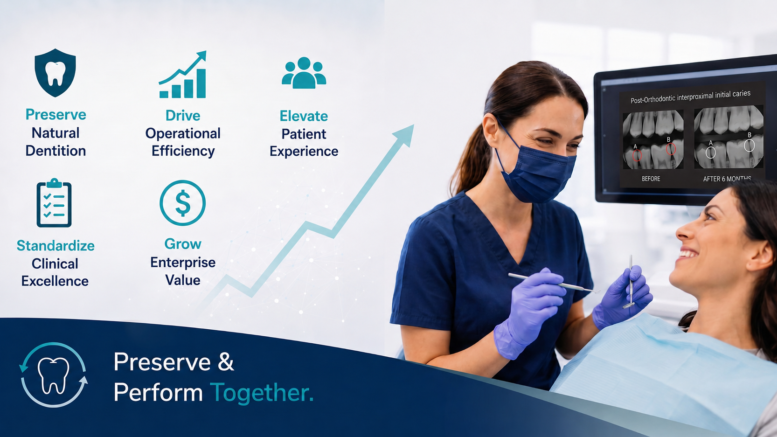
The business case for non-invasive/minimally invasive dentistry is not separate from the clinical case. Rather, it’s a direct extension of it. When implemented at scale, this supports multiple enterprise priorities simultaneously. For example:
- Reduces Clinical Variability: Standardized non-invasive protocols reduce discretionary treatment thresholds and support enterprise-wide calibration.
- Preserves Long-Term Patient Value: Stabilizing and repairing early enamel lesions helps maintain natural dentition and aligns with patient expectations for conservative care.
- Enhances Hygiene-Centered Treatment Models: Non-invasive interventions integrate naturally into hygiene recall workflows.
“For hygiene teams, non-invasive caries management with Curodont changes the conversation,” says Tammy Filipiak, RDH, MS,FADHA, VP of Hygiene Support and Clinical Operations, Smile Brands. “We’re no longer limited to observation or referral and waiting to see the consequence of the disease when a surgical intervention is required. In our organization, we’ve seen Curodont procedure adoption steadily increase, and this leads to elevated patient care/productivity as well as provider satisfaction through implementation of innovative treatment options.”
 “For hygiene teams, non-invasive caries management with Curodont changes the conversation,” says Tammy Filipiak, RDH, MS,FADHA, VP of Hygiene Support and Clinical Operations, Smile Brands. “We’re no longer limited to observation or referral and waiting to see the consequence of the disease when a surgical intervention is required. In our organization, we’ve seen Curodont procedure adoption steadily increase, and this leads to elevated patient care/productivity as well as provider satisfaction through implementation of innovative treatment options.”
Implementation Considerations
Successful adoption of new, innovative protocols depends on clearly defined diagnostic thresholds, scalable training, workflow compatibility, and measurable compliance metrics.
“For us, implementation wasn’t about introducing a new product or procedure. It was about aligning with two clinically proven partners, Curodont and Pearl, whose strong outcomes, scalability, and ease of adoption made it possible to integrate seamlessly across our organization,” says Dr. Greg Kerbel, DDS, Chief Clinical Officer, P4D. Pearl AI builds confidence in early detection, while Curodont empowers clinicians to act, instead of “watch,” thus bridging the gap between diagnosis and treatment.”
 “For us, implementation wasn’t about introducing a new product or procedure. It was about aligning with two clinically proven partners, Curodont and Pearl, whose strong outcomes, scalability, and ease of adoption made it possible to integrate seamlessly across our organization,” says Dr. Greg Kerbel, DDS, Chief Clinical Officer, P4D. Pearl AI builds confidence in early detection, while Curodont empowers clinicians to act, instead of “watch,” thus bridging the gap between diagnosis and treatment.”
Strategic Implications for DSO Leadership
For DSO executive leadership, the adoption of minimally invasive caries management throughout the organization is not simply a clinical decision, it’s an operational one.
The ability to introduce a new standard of care successfully across a distributed network depends on whether it can be implemented consistently, measured reliably, and sustained over time without adding friction to existing workflows.
This is where many clinical innovations fall short. They show promise at the chairside but fail to translate at scale due to variability in diagnosis, inconsistent training, or lack of integration into hygiene and doctor workflows.
In contrast, non-invasive caries management, when protocol-driven, delivers a rare combination of clinical alignment and operational feasibility.
“Any time you introduce a new clinical approach at scale, the question is whether it can be operationalized, says Christin Lisenby, Vice President of Dental Hygiene for Dental Care Alliance. “What we’ve seen is that when non-invasive caries management is built around clear protocols and integrated into existing workflows, adoption follows.” Christin adds, “In our case, we’ve seen Curodont utilization more than double across targeted markets year over year, reflecting meaningful clinical adoption and improved consistency in diagnosis and treatment planning.”
 “Any time you introduce a new clinical approach at scale, the question is whether it can be operationalized, says Christin Lisenby, Vice President of Dental Hygiene for Dental Care Alliance. “What we’ve seen is that when non-invasive caries management is built around clear protocols and integrated into existing workflows, adoption follows.” Christin adds, “In our case, we’ve seen Curodont utilization more than double across targeted markets year over year, reflecting meaningful clinical adoption and improved consistency in diagnosis and treatment planning.”
From a leadership perspective, the implications of non-invasive caries management extend beyond treatment philosophy. Standardized early intervention protocols create opportunities to reduce downstream variability, improve documentation consistency, and introduce measurable performance indicators.
These protocols also support a more proactive, elevated care model, which can enhance patient satisfaction while creating new avenues for hygiene production within existing visit structures.
Equally important, these progressive patient care models enable DSOs to shift from reactive dentistry to managed disease progression; an approach that aligns with long-term enterprise value and emerging expectations from patients, payers, and providers alike.
Ultimately, for DSOs willing to invest in structured implementation, non-invasive dentistry such as that enabled by vVARDIS, represents more than an incremental improvement, it becomes an integral part of a DSOs clinical infrastructure and a catalyst for same store growth across the organization.Top of Form
“Because Curodont provides DSOs with clinical and operational alignment, we’ve successfully partnered with over 130 US organizations of every size,” said Jim Conte, vVARDIS’ Senior Director of Strategic Accounts for North America. “In fact, the 10 largest DSOs have reported excellent clinical results and high patient acceptance, helping unlock the hygiene chair for greater productivity. This level of success is very rare in the dental consumable market.”

About the Author:
David Hood, MBA, is a dental marketing executive with nearly 20 years of experience, spanning across large corporations, growth-stage companies, and startups. Currently the Marketing Director NAM for vVARDIS, his marketing experience includes imaging equipment, practice management software, orthodontics, at-home oral healthcare devices, and non-invasive caries management technologies. Having marketed to every major dental specialty and DSO, he brings deep expertise in go-to-market strategy, product marketing, demand generation, professional education, and commercial growth. His passion lies in helping innovative dental solutions reach the clinicians and patients who can benefit most. Contact David at David.Hood@vVARDIS.com. Connect with him on LinkedIn.
References
- Featherstone JDB. The science and practice of caries prevention. J Am Dent Assoc. 2000.
- Pitts NB, Ekstrand KR. ICDAS methods. Community Dent Oral Epidemiol. 2013.
- Fontana M, Young DA. Defining dental caries. J Dent Res. 2010.
- ADA Council on Scientific Affairs. Nonrestorative treatments. JADA. 2018.
- Schwendicke F et al. Managing carious lesions. Adv Dent Res. 2016.
- Meyer-Lueckel H, Paris S. Resin infiltration. J Dent Res. 2008.