
Ranked the #1 DSO Podcast!
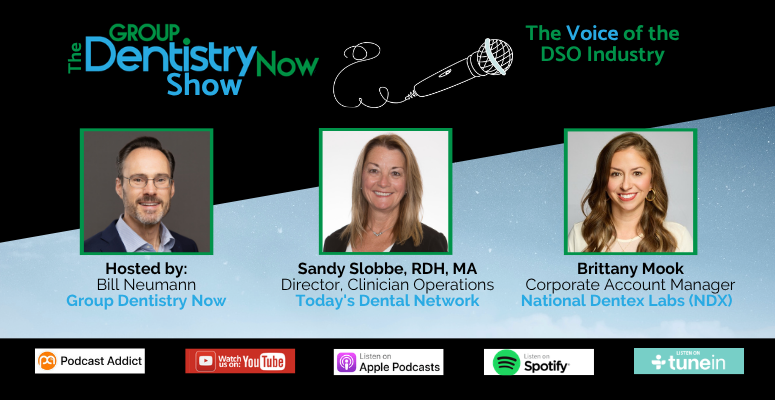
Welcome to The Group Dentistry Now Show: The Voice of the DSO Industry!
The Evolution of Dental Labs: How Technology is Transforming DSO-Lab Partnerships
Brittany Mook, Corporate Account Manager from NDX & Sandy Slobbe, RDH, MA from Today’s Dental Network share their thoughts on:
- Digital adoption acceleration
- The hidden cost of remakes
- Lab standardization
To learn more about National Dentex Labs (NDX) visit: https://nationaldentex.com/. You can learn more about the DSO Lab Program here: https://nationaldentex.com/dso-lab-program
You can also connect with Brittany Mook here: brittany.mook@nationaldentex.com or call her at 931.581.5390.
You can contact Sandy Slobbe here: sandy.slobbe@tdn.care or call her at 813.482.8787.
Subscribe to our channel for more episodes and stay updated on the latest DSO news, insights, and events!
If you like our podcast, please give us a ⭐⭐⭐⭐⭐ review on iTunes https://apple.co/2Nejsfa and a Thumbs Up on YouTube.
Choose your favorite listening app below and subscribe today so you don’t miss an episode! Full transcript is also provided below. See all of our podcasts HERE.
 |
 |
 |
 |
 |
 |
DSO Podcast Transcript – The Evolution of Dental Labs: How Technology is Transforming DSO-Lab Partnerships.
Bill Neumann (00:00):
Hey everyone, welcome to the Group Dentistry Now Show. I’m Bill Neumann. We appreciate you joining us today and we’re going to talk about the evolving relationship between dental labs, dentists, and DSOs. And I think a lot of that change in the relationships has really been driven by technology and really happy to have on the show today, Brittany Mook. She is the corporate accounts director for National Dentex Lab NDX. Brittany, thanks for joining us.
Brittany Mook (00:45):
Thank you for having us.
Bill Neumann (00:46):
And we have Sandy Slobbe. She is the director of clinical operations for TDM, which is today’s dental network. Sandy, thank you for joining us today.
Sandy Slobbe (00:56):
Happy to be here. Thanks for inviting me.
Bill Neumann (00:59):
I really appreciate you both joining us and you’re going to get a great perspective. NDX has been around for quite a long time and has really evolved as a lab. And we really want to talk about that evolution today. Labs are not the way they used to be, and it’s not that picture of a solo lab tech in a dusty room taking an impression and creating restorations. There’s a lot more to it now, and technology’s played a really big role. So Brittany, why don’t we kick things off with you a little bit about your background, your role at NDX, and can you paint a picture of really where NDX started and what you’re doing now as an organization?
Brittany Mook (01:41):
Yeah, absolutely. So as Bill said, my name is Brittany Mook. I have been in the dental segment for over 10 years. Almost that entire career, I’ve actually been tied to technologies. So I started off with CAD/CAM entry into dentistry, and then now with NDX, obviously with the technology side with labs. Three of those years in dental have been managing DSOs. And so what I do now is I work with our partner DSOs and prospect DSOs in making sure that the agreements and contracts and partnerships are both beneficial to each NDX and the customer, as well as managing the relationship with the group, whether it’s on a practice level or a corporate level with these groups. NDX is unique in its terms for labs that some people consider us the DSO of labs. We started as a segmented group of labs and individually owned labs, and over the course of the years, we have come together to create NDX as a whole.
(02:51):
And we have over 40 labs across the US that we own. A lot of those labs are still operated by the original people who owned the labs prior to purchase. So there’s still kind of that local mom-and-pop feel. And then we also have our own lab that we own wholly overseas where we’re able to truly have that NDX experience, but sometimes at a more cost-effective for our customers. So we have the ability to, and this is what a lot of doctors are looking for and ask for, to have that local lab feel and have those touches along with our sales force, because we also have over 50 reps on the ground in the offices every single week providing that second layer of support for our customers to really create that unique customer experience and to really be that customer service provider for our groups and for our offices.
Bill Neumann (03:52):
Thanks, Brittany. Sandy, a little bit about your background and role at Today’s Dental Network and a little bit about today’s dental network, if you don’t mind.
Sandy Slobbe (04:04):
Sure. Yeah, happy. Similar to Brittany though, I’ve been in the dental sector multiple decades, so probably going on about 30 years. And I started my career as a dental assistant, moved into dental hygiene, did that for approximately 18 years, and then actually moved out into the operational world and really served with several different DSOs across the nation in multiple different capacities actually, which is how I was introduced to NDX. And I’m sure we’ll touch on that a little bit later. But as I mentioned, served in many different roles, opened up my own consulting business. And then it was probably about five years ago because TDN is a relatively new DS. So in fact, our birthday, our five-year birthday is on July 19th, and I was supporting a group up in Georgia when the executive team came to me and asked me if I would help with the M&A process when we were actually becoming TDN.
(05:01):
So I came in, supported the diligence, and then at that point they asked me really to come in and execute on the 100-day plan. And then five years later, of course you’re still here. And even within TDN, my role has changed significantly, obviously supporting the hygiene program. But then you really can’t just have hygiene segmented or siloed because it really touches everything. So it really kind of transformed in overseeing multiple practices. So as I mentioned, TDN, it really is a success story. When you’re looking at the growth of a DSO, as I mentioned, I work from small from three up to 350 locations. TDN now is at 39. So five years ago, as I mentioned, Dr. Kevin Krause, he is a practicing dentist, entrepreneur at heart, amazing clinician, and he had a vision to. Well, he started his one dental practice and then believe and grew that to about eight locations.
(05:57):
And at that time, as you can imagine, it became an administrative burden to manage all of it together. So he determined to partner. So he was looking to try to figure out who best to partner with. And at that time, he just really couldn’t find anybody that met his vision, his philosophy, his standards of care. And so he decided to create his own. And what he did was he partnered with a husband and wife team periodontist orthodontist team, and they created TDN, and it’s just been explosive since then. And I think the coolest piece about TDN in my experience, as I mentioned, I’ve been in the industry 30 plus years, so I’ve really had the privilege of knowing a lot of incredible doctors and clinicians and leaders. What I think is so interesting about TDN is the doctors are exceptional. They truly are. So we are heavily multi-specialty, meaning we’re probably about 70% specialty.
(06:50):
We’re PEDO all the way up through proths. And so obviously then about 30% GP. But the way we’re growing is truly by word of mouth. If they’re noticing, if Dr. Kevin Krause works there, I want to work there. Well, you know what? If Dr. Ritter works there, I want to work there. So it’s been an easier transition because a lot of the doctors within the sector are wanting to come to TDN just because they know the group, they know the standards. With that being said, we’re still experiencing a lot of the growth of being a newer DSO. So some of the standards, the implementation, the scalability, we’re still really working on, which is why I so appreciate partners that are flexible and easy to work with us because we’re able to change, which of course is the beauty of it as well too, because we do have the flexibility to still.
(07:41):
We’re nimble enough that if we’re seeing some changes in the industry or if we’re seeing changes internally within our own four walls, we’re able to manage to that very quickly. So it’s really been fun. And as mentioned, we have the full support network, but we run relatively lean. So we really rely heavily on our vendor partners. We rely heavily on our leadership team as well as our operational team because again, the doctors do great within their four walls, and then we just help manage it on the outside of it.
Bill Neumann (08:16):
Is the growth mostly through acquisitions or de novos, combination acquisitions? It’s
Sandy Slobbe (08:20):
All acquisition. We have not to date explored the Denovo model.
Bill Neumann (08:26):
Okay. And you said you have 39 locations. How many doctors? What’s the doctor count? Oh, I
Sandy Slobbe (08:34):
Think now we’re close to about 60 or so. Yeah, and we’re spread across Florida. So we go all the way up from Jacksonville down to Vero Beach over to Sarasota and then up to Inverness. Primarily, yeah, our major density is in the Sarasota area.
Bill Neumann (08:49):
Got it. Okay. And so with 60 doctors, I’m imagining they all do things a little bit differently, a multi-specialty, so they probably have different needs when it comes to a lab, and probably not just your needs, but different – Yeah. Yeah. So Brittany, talk a little bit about how that works. You’ve got a lot of different personalities and techniques and everybody’s. Labs are tough because they want the lab that they want. So how does that work, Sandy and Brittany? Brittany, you obviously have a lot to offer. You have a lot of different labs in your network, which is probably a great thing for the doctors. And then Sandy, you’re probably trying to consolidate how many labs they’re using, make sure they’re not using all over the place. And so that can be a challenge too. But Brittany, when you work with a TDN, what’s that experience like with 60 doctors?
Brittany Mook (09:45):
No, absolutely. So we actually have a lab in Sarasota. So that’s how the relationship started with TDN, is that there were already existing doctors that were happy with the work that NDX was doing and submitting. And so that kind of started the conversation. But what that allows us to do is our local reps are phenomenal. They’re really great at working with the doctor, identifying what their needs are, what their specific preferences are, what type of work they typically like to see. And then our reps are really great at disseminating, okay, you should use this lab or this lab. Or let’s say you’re doing all on X, you need to be using one of our full arch labs. So they’re really great at having that offering for the doctor. And what’s beneficial to the DSO is that across the board, the pricing’s the same. It’s loaded in, the pricing’s the same, the billing will not change.
(10:44):
Everything about it creates it as one lab, but with that customization of that local lab feel or that specialty lab.
Bill Neumann (10:54):
What’s the experience like on your side of things, Sandy, when you’re trying to get some buy-in from the doctors that maybe don’t use a lab that’s in the NDX group of labs? Do you mandate or is it something that you just, because of the relationship that you have and the pricing, they tend to use NDX?
Sandy Slobbe (11:20):
No, I think it’s been an evolution, honestly, Bill. And because as you mentioned, it’s a marriage. A lab is probably the closest marriage within the practice that the doctors really have once they’re committed, because they usually try quite a few, and once they find one that they like that they’re so busy throughout the day, they really don’t have time to continue to explore something else. So it’s challenging to make that change. And as you mentioned, because we do have several different specialists, and again, they’ve all obviously got all opinions. TDN does not mandate at all. That has been one of the joys and frustrations, honestly, about this particular role because in previous life, especially with some of the larger DSOs, it is already standardized. It’s like we’ve gone for a vetting committee, we have a lab committee, and we might be able to identify and negotiate best pricing, and here’s the standard that we work within.
(12:16):
And we have those parameters set up that is not TDN, not yet today. However, we are, to your point, trying to narrow that focus so we are able to work with desired labs. So I think as you’re talking about that transition, what we did at the very beginning was like, who is everybody really working with? And then we are fortunate, again, that the doctors are extremely receptive, and what we’re able to share is the why behind NDX and why they are the preferred lab. And as Brittany mentioned, it’s not just one lab under one roof. We really have the ability, if they’re needing something specialized, they have the ability to do it within NDX. And the interesting part is that I don’t think all the doctors even realized that they were already working with NDX. So once we shared, yes, that is a part of them and yes, that is a part of them, the transition was a little bit easier.
(13:10):
We still have some outliers obviously for different particular cases, but for the most part, it wasn’t as challenging as I thought it was going to be to get them all at least open to the idea. And again, NDX has been a wonderful partner. So if there is some sort of hesitation, the doctors are extremely communicative as is NDX. So we’ve been able to get them together. We’ve been able to provide them the whys, the hows. We just recently had a networking event that NDX sponsored. They’ve allowed us to come into the lab or considering, so they’re able to see the why behind it. And frankly, even be able to try out some of the particular cases so that way it really is allowing the doctors in this particular case to try something different without the risk because it’s just been such an open relationship.
Bill Neumann (14:06):
Go ahead, Burt. Yep. No, go for
Brittany Mook (14:08):
It. The lab side of it and the challenges as getting doctors to switch or trying something new, at the end of the day, it comes down to chairside and workflow. So if a doctor goes in, and as we all know, something doesn’t fit, it puts a kind of a wrinkle in the rest of your day and you have to reappoint and you’re spending those operational dollars on something that you expected to work the first time. So NDX understands that. So a lot of that, what we try to do is on the forefront of it to make sure that we are providing the first time exactly what the doctor’s expecting or what the practice is expecting, because that’s one of the biggest pinch points clinically in an office, as you all know.
Sandy Slobbe (14:52):
And just piggybacking on that too, if I can really quick, Bill, by an operational perspective, obviously clinically it’s really important because they want it to fit because it rocks the world if things start falling apart. But by an operational perspective, one of the things that I really appreciated from NDX throughout my career, which is why I was excited that TD entering with them as well, is we have quarterly business reviews. And that allows me to the visibility of what does the remakes look like? What do the redos look like? And then we’re able to really even narrow it down and drill it down and partner with some of the field reps and go in going, okay, is this a scanning issue? Is this a training issue? Is it a lab issue? What’s actually going on? So we’re able to see where the outliers are so we can actually have immediate almost intervention and be able to take care of that because ultimately at the end of the day, it’s patient experience.
Bill Neumann (15:44):
I’d love to build on this a little bit more because we talked about partnership a lot. We’ve been using that word quite a bit. And we have vendors and we have partners, and we hope that all of our vendors are partners as well. It’s not always the case. Sometimes it becomes very transactional where it’s what’s the lowest price and vice versa. So sometimes it’s transactional from the DSO perspective and sometimes from the vendor perspective too. They can’t offer more than just whatever that solution is, like the restoration and that’s it. But I know NDX offers quite a bit more than that. You talked about the business reviews, but I think there’s a lot more that labs now are required to offer than just, “Hey, here’s your restoration the way you asked for it.” Brittany, can you talk a little bit about maybe some of the other things that you do as an organization?
(16:39):
And then I’d love to get Sandy’s feedback on that as well.
Brittany Mook (16:42):
Yeah, no, absolutely. I’ve worked in several different segments in dental with the DSO space, and I feel like the lab segment is the easiest one. As you mentioned, build, get pinwheeled into what’s your lowest price. And sometimes that conversation takes place frequently, but a lot of it is built on, we can give you the lowest price, but let’s talk about functionally and operationally and clinically what the impact’s going to be. Because obviously boots on the ground, reps in there, we have our local labs offer pickup and delivery. We also have a lot of our lab techs in some markets travel, so they’ll go chairside with a lot of the doctors and patients. What we also offer is, as she mentioned, the remakes and the turnaround times and how do we identify opportunities and the training and education that NDX offers beyond that. So we have an entire team of iOS training reps.
(17:48):
That team’s experience is significant. They have multiple years of experience. They’re trained on every single, I guess, digital workflow out there. So whether it’s just a simple crown procedure all the way to an all-inx or a digital denture procedure, they’re able to get into the office and it really help and train. So as she said, identifying remakes. We monitor that on a monthly basis. And if we see a surplus of remakes, obviously that’s not only a costing TDN chairside time, but it’s also impacting our lab operationally as well. So we have the ability to take our iOS team and send somebody in and say, “Hey, what’s really going on? Where’s the opportunity and how can we improve?” And that’s one of the benefits of that. As we’ve mentioned, we did a meet and greet event recently with TDN where the local lab was able to attend as well as the local rep and myself.
(18:42):
And it was able to open up the conversations with a lot of doctors who may not have tried NDX, but also may not have tried certain workflows where they just weren’t comfortable with it. And NDX has the ability, I think we were talking some full arch with a few of the doctors with TDN. And NDX has the ability to customize training for our DSOs. So if a DSO comes to me and says, “Hey, we’re really toing a strategic focus on digital dentures this year.” NDS can say, “Okay, what does that workflow look like for you and what is your expectations out of that?” And then we can tailor our education and training for the DSO and support them through this process. That way you can have maybe a beginner and intermediate and advanced training courses. And we can do anything from webinar to live in-person, and then also pre-recorded training and suggestions.
(19:37):
And that isn’t just limited to the share side. We also talk about case acceptance, how those conversations take place. We have practice management, what does the practice management look like? How can we help you optimize that? And it really adds a overall value of this isn’t just your lowest price, this is what NDS can offer to truly create that partnership, not just a vendor relationship with our DSOs.
Bill Neumann (20:08):
Yeah. And I’m actually on your website right now, nationaldentechs.com. And I mean, you have a ton of education. So you’ve got the on-demand CE, but you have a lot of local courses too. And then I’m sure, like you mentioned, you can customize training for specific DSOs. You talked about the full arch for today’s dental network. Sandy, what’s the importance? I’d love to talk about education a little bit more because I think a lot of the clinicians become part of DSOs and group practices because they’re looking for the S, the support. And part of that is the ongoing clinical education, looking for newer solutions. As the industry moves from analog to digital, there’s this really quick learning curve and you have some maybe older clinicians, and I think even younger dentists that aren’t necessarily trained digitally in dental school, they get out and there’s all these great solutions that they just aren’t even really aware of.
(21:12):
So how important is education to you, Sandy?That’s
Sandy Slobbe (21:17):
Kind of my hot button, I think if you will, because even again, taking off the objective part, which of course is really important, the quality of the restoration. But the subjective piece is so critically important to me, especially throughout my career, because as I mentioned earlier, we run lean. So I really am heavily dependent upon that. And it’s not just one segment. It touches everything. So when you’re looking at the training, yeah, we might be able to train the doctor on a new technique, but we still have a dental assistant. We still have the office manager that’s in there. Do they all understand it? What does that support look like? Because one of the challenges that I’ve seen throughout my career is it does get siloed, it does get segmented, and all of a sudden you wonder why things don’t work. Integration doesn’t work. And regardless of the initiative that you’re trying to implement, it really is a practice involvement because of similar, we brought in new technology and the dental assistant liked it, but the doctor didn’t, so it’s not going to get used or vice versa.
(22:15):
The doctor loves it, asks the dental assistant to do it. Well, they don’t know how to use that particular piece. And then if they do, okay, what does the repair look like? The office manager gets pulled in. So when you’re looking at education, which is again, one of the things I really liked about this was you talked about treatment plan acceptance. When we look at operations, obviously the lab is an important part of my job, but there’s 900 other things that I’m doing throughout the day as well too. And customer service is a big one. The employee engagement is certainly going to be a big one. Treatment plan acceptance always is a big one because we know the industry is changing with regards to patient flow, whether that be new patient flows, existing patients keeping retention, the competition has increased. So how do we maximize not only the patient experience so they want to continue to come to you, but the employee experience so they want to continue to stay with you?
(23:07):
And education’s been huge. And then plus coupling that because then you also have to have revenue growth. So NDX in particular, they’ve offered to come to our office manager meeting, so they’ve got speakers available. So again, outside traditional dentistry, which as I talked about earlier, they also, with regards to our doctors, we are multi-specialty. And when we first came in and I started having the conversations, I wasn’t sure, honestly, the level of support and engagement that I was going to get because typically a lot of the DSOs are higher GP, let’s just say 70% GP, 30% specialty if they have that. And that tends to be, I think, a little bit easier by a lab perspective because there’s a lot more opportunity. But when you’re looking at ortho, there’s probably not a whole lot of lab to be done. When you’re looking at pedo, if you’re looking at endo, there’s probably not a lot of lab work.
(24:00):
So I wasn’t sure where we were going to fall on the priority and the attention. And it’s been such a pleasant surprise because the initial conversations were, well, why don’t we do this for your specialty group? How can we help with internal referrals? How can we help with external referrals? How can we help with additional engagement? How do we help with the networking? As Brittany mentioned that she supported that networking event to help that internally. And now that we have the relationships built, okay, so now how do we do the training? We just integrated some scanners into a location and they came in and they sat knee to knee with the doctors and walked them through it. The continued follow-up to see what that looks like. Then of course we have the reporting. So education is huge and that partnership, and I know we are saying that word a lot because I don’t have the time to completely just focus on it.
(24:53):
And I think a lot of DSOs are in that same piece. We’re looking to the experts that can go in, partner with the doctors independently because the docs and the office managers and the dental assistants and the hygienists, frankly, need all of that and then be able to report back to operations, but here’s what we’ve seen. Here’s what we recommend as the next step. So it really is not just a lab partner, it’s almost more of a business partner to help us succeed in multiple factions.
Bill Neumann (25:20):
Brittany, I’m curious from your perspective, you work with a lot of group practices and DSOs. What are some of the trends that you’re seeing when it comes to technology that you can offer and dentist adoption of that? Wt does that look like? It’s moving so quickly.
Brittany Mook (25:38):
It is. I feel like even just in the last year it has changed significantly. Obviously I’ve been part of the DSO segment for several years and DSOs, topic of conversation always when you’re talking technology is the capital expenditure budget. Do you have the capital expenditure budget to invest in that technology? And if you don’t, how are you going to get into that? Because we talked about staff and doctors’ experience. Technology plays a key role in that. And workflow and how it impacts your day-to-day activities does that as well. And one of the benefits of a lot of specifically NDX with technology is we have the ability to partner and identify what scanner or technology works best within your workflow. We aren’t a lab that does one scanner, take it or leave it, but we offer a wide variety of scanners, especially for our DSOs. So let’s say you’re doing specific to clear aligners, we have scanners that can assist with that clear aligners.
(26:43):
If you’re doing any kind of full arch or digital denturists, we offer that as well. So it kind of helps customize and tailor that to the experience of the practice and the workflow that they are specifically maybe focusing on or that’s adding value to their chairside. And then NDX is just the secondary layer of partnering as a lab and then the traditional and digital submissions to that. Since I’ve been with NDX coming up on two years, and I have seen specifically with my groups, a slow migration where when you deal with a private practice, a lot of the private practices, about 70% of them were doing digital submissions. And when you look at a DSO, usually it’s 30 to 40%. And over the course of the last year, it’s significant ground where your average DSO is usually sending about 60 to 70% traditionally. And that’s just within the span of the last year watching the data.
(27:36):
So it’s been really interesting that there’s been a very quick adoption in the DSO space to that digital and technology side. And I think it’s just going to continue to grow from there. My anticipation probably in the next few years, every office will probably have a scanner, if not one, maybe two. I know with TDN, we have multiples placed in some of their offices because obviously there’s a need and a workflow for a scanner in just about every touch within the practice.
Bill Neumann (28:08):
And Sandy, is that something that dentists just think that’s the way it should be? I expect when I join an organization that we’re going to be doing digital dentistry, I’m going to have a scanner or two in an office and have access to that. Is that an expectation now?
Sandy Slobbe (28:25):
Yeah, it is, especially with the new associates that are joining the team. So you’ve got the younger doctors that are joining, and I believe that’s the way they’re being taught. So when they’re walking in, I think some of the interviewing questions certainly is what technology do you have available? Since we are more affiliation versus de novo based, depending on what we’re partnering with, sometimes the more senior doctors, that is a bit of more of a transition because they’re used to type of the analog type of impressions, they’re comfortable with that. However, with that said, they’re all really excited about it because they’re still taking their CE, they’re still learning about it. They’re wanting to increase the workflow. As mentioned, it’s certainly much more comfortable for the patient. We’re always looking at the patient experience. And so what we’re finding, I think the biggest transition there with some of our more senior doctors is, yeah, I’m all in, but is the dental assistant going to do it?
(29:20):
How do we train the dental assistant so that way they’re really comfortable with it? So they’re able to either step out, look at it, and then obviously review the case and make sure that it’s ready for submission. But the easy answer is yes. I think that it’s where the industry is going. I was actually surprised that we still had as much non-digital as we had. So again, during some of our reviews, NDX was able to share that with me. So it was a really good conversation. Even with where we do have some scanners, I just assumed they were being used routinely. So getting that feedback on a routine basis, because obviously that helps with procurement as well too. And when we’re all looking at cost control initiative It is, especially if we have the technology in the office already, it certainly makes it a lot easier when you have the data to be able to support the conversations.
Bill Neumann (30:07):
And that’s during those quarterly business reviews, you get that feedback?
Sandy Slobbe (30:12):
Yes. And we get a report sent out routinely too.
Brittany Mook (30:18):
Yeah, NDX has the ability. We break down all of our business with the DSO based on monthly spend, based on office spend, based on segment. So you can identify whether it’s fixed, whether it’s removables, dentures and implants and so on. And NDX partners with all major implant providers too. So we can help assist through the OEM process. We have partnerships available with all those groups. So then you can view what’s OEM, what’s not, as well as the turnaround times and the remakes. But as she mentioned, the digital versus analog and offices having digital but may not be using it. We usually use that as an opportunity to say, “Is there a reason or is there a chance for additional training in this office? What are they not submitting traditionally?” So maybe they’re submitting all of their fixed work digitally, but they’re not submitting any of their implant and there’s doing analog on implants.
(31:13):
So how can we support the office and say, “Okay, how do we get you to where your workflow and your efficiencies are taking advantage of this digital platform?”
Bill Neumann (31:25):
I have a couple of wrap up questions for you. This great conversation, but I’m kind of curious, let’s start off with maximizing the lab relationship. I’d love to get that perspective from both of you. Sandy, if you have some. Our audience is really made up of broad spectrum. So we’ve got a lot of large DSOs, we’ve got a lot of emerging groups, doctors that may have five to about 30 locations. I know you have some solo practitioners as well. So any tips from you, Sandy, with your experience with working with NDX? What’s the best way to manage and take the best advantage of a relationship with a lab, whether you’ve got a group of labs you work with or just one?
Sandy Slobbe (32:08):
Ideal, it’s a great question. And I think it’s truly transparency, honesty, collaboration. And so what I found I have throughout my career is really just talking about needs, not only needs by the DSO perspective, but what is the needs and the wants by the lab perspective. Obviously they want our business and we want to have great customer service, but sometimes just sharing the pain points that I’m experiencing within the practice, again, very transparent that they’ll be like, “Hey, we have a solution for this.” So I think when you’re looking at building the relationship, I think it’s to almost what we talked about throughout the whole segment is don’t look at it as a vendor. Look at it truly as a partner. If somebody can help, because we’re all at the same time, I say it on many different fragments, but we’re all just jumping off of different springboards trying to achieve the exact same result.
(32:57):
So we’re all looking to do well in the industry, to be successful, help a great patient experience, work with customer service. And at the same time, either one, the DSO does not want to feel taken advantage of, but nor does the lab. It truly is a relationship when you’re looking at it and finding it. And maybe not every lab is going to be the right fit, and that is absolutely okay. And I think having those really transparent conversations, open, honest, the professional feedback, being able to share if something isn’t working right, being able to share what is working right. So how do we best capitalize on it? But more so than just lab, because again, it goes very siloed and that’s one vertical of the dental practice. But I’ve partnered with NDX, other labs, and they’re like, “Hey, we’re looking for M&A opportunities.” And they’re like, “Well, hey, did you know that Dr.
(33:47):
Jones is looking for a partner with?” And so it’s so much bigger, and I think it’s getting out of our traditional comfort zone and going, “Hey, this is all they can do,” and looking at it throughout the industry. And that crosses many different businesses that we all work together with. But I think it’s taking it out of the fixed or the removable appliance and knowing that there’s a much bigger world out there and just really having open, transparent conversations. Again, the innovation I think is key. The lab members certainly know what’s going on. They got their finger on the pulse of the industry. So being able to have that dialogue is helpful when you’re looking to grow in multiple different facets.
Brittany Mook (34:27):
Yes. Sandy hit the nail on the head. With lab, it’s really easy to get pigeonholed into you’re just a lab provider or we’re looking just for the lowest price. And truly NDX has availability to be, I guess, pivot more and to offer more and to partner better with our customers than a lot of groups out there because of what we offer and what we have as an organizational structure. So that has the benefit of those multiple different labs. We’ve talked about with Sandy offering events at our local lab that just simply are partnered with. We partnered with other, I guess, technology groups, implant groups. We’ve talked about doing referral events, and it’s not just NDX because lab touches so many points within a practice and within dentistry that we have the ability to really customize and work with our partners and truly make a partnership, not just a vendor experience with that.
Bill Neumann (35:34):
All right, last question here. We’re about halfway through the year, a little over halfway through the year, which is amazing. So what does the rest of the year look like for NDX? Anything interesting going on that the audience should be aware about?
Brittany Mook (35:52):
Not that I’m aware of.
Bill Neumann (35:55):
So you’re going to be a lot of the different DSO shows and events, I’m sure, and you’re focused on training and education, and do you just anticipate technology to continue to grow? And do you feel that there’s going to be more adoption from just dentists in general? Where do we sit? You had some percentages. You talked a little bit about actually solo’s adopting technology more than DSOs, but now it seems like DSOs have caught up. Where do we sit as far as digital dentistry? I mean, are we 70%, 60%? Where does it stand?
Brittany Mook (36:34):
I think if you look at the DSO segment as a whole, probably in that 55 to 60% range with NDX in business that we’re doing digitally, it’s adopting much faster, as I said in the last year. It’s been quite interesting. And obviously because NDX now has our technology program where we are doing scanner placements. So the NDX is focused on the remainder of the year to partner with our current DSOs as well as our prospect DSOs in implementing a scanner and helping a lot of the DSOs get up to speed on what that digital integration looks like. And so that’s kind of the focus throughout the remainder of the year. And I really foresee in the next probably 18 months to two years that you will see a significant increase in technology because it’s becoming easier with the scanner placements, with labs. And it’s going to be interesting to see how that changes the cheerside, how that changes the turnaround times, how that changes the remakes.
(37:46):
I think that the lab partnership in the next 18 months is going to shift, and I think it’s going to shift for the better because we’re all going to be able to be more efficient with what we’re doing.
Bill Neumann (37:56):
Excellent. Brittany, if people want to reach out to you directly, what’s the best way to contact you? The website is nationaldentechs.com, so that’s easy enough. We’ll put that in the show notes. But what’s the best way to get in touch with you, Brittany?
Brittany Mook (38:09):
Probably to email me my name, brittany.milk@nationaldentex.com. Or I always have my cell phone on me and I can provide cell phone number. That number is 931-581-5390. And I can help disseminate to your point of contact. I cover the Southeast majority of it, but I do have three other partners that cover the rest of the US. All of us have been in this DSO segment for quite a while, and so they all have experience with DSOs and obviously NDX and the partnerships that we can provide.
Bill Neumann (38:48):
Excellent. Thank you, Brittany. And Sandy, tell us a little bit about what the rest of 2026 looks like for today’s dental network, and then how do people contact you?
Sandy Slobbe (39:00):
I think we’re still focusing on growth. So as I suspect, every DSO is not only by a partnership perspective acquisition, but obviously same store growth, but customer service. I think we’re really focusing a lot on though, kind of what Brittany was alluding to too, there’s just so much change in technology and now how do we maximize on it with the advent of AI and how is that revolutionizing dentistry? I think it’s really wrapping our arms around that, trying to figure out where we need to integrate because there’s so much that what do we choose? Because as we talked about, even with labs, there’s a lot that we can pick from, but the integration part is going to be absolutely so critical for the success of any type of organization. So it’s vetting through the technology that we’re looking at, vetting through the AI foresight, looking ahead into 27, 28, and what does the industry and trying to predict what the industry is looking like.
(39:57):
We know there’s changes in the patient flow. So I think it’s doing a lot of analysis right now, pausing, trying to do some systemization, standardization as much as we can, even though we’re so multi-specialty, to really work together and maximize some of the benefits without the industry that we can actually use together that we can just, I’m trying to think of the word, the scalability of it really. And so I think it’s really going to be wrapping our arms around how do we continue to grow? And then obviously we’re getting ready for budget season and getting ready to plan for 2027 as well too. I’m the same, so you can reach me at sandy.slobi@tdn, tomdavidnancy.care. If anybody’s looking to get in touch with me and happy to share my cell phone as well too. It’s 813-482-8787. And again, I know we’re all working towards the same goal.
(40:50):
As I mentioned, it’s just every DSO, it’s the same springboard. We’re just trying to do it. And so sharing best practices, I’ve been fortunate throughout the industry that I’ve got wonderful colleagues that you’re able to just talk because even if you’re sharing your secret sauce, it’s different within every DSO. And we’re all just trying to get through the day at the end of the day and really provide exceptional care. So happy to network with anybody.
Bill Neumann (41:14):
Yeah, thank you both. Great way to finish things off. Again, at nationaldentech.com. And if you want to learn more about today’s dental network, it’s TDN.care, so dot C-A-R-E. We’ll drop those URLs in the show notes and email addresses if you want to reach out to Sandy or Brittany. And we appreciate everybody listening in today. Until next time, this is the Group Dentistry Now show.