
Ranked the #1 DSO Podcast!
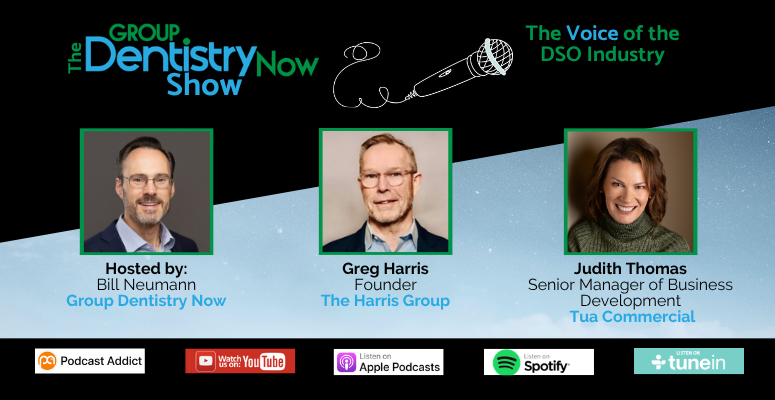
Welcome to The Group Dentistry Now Show: The Voice of the DSO Industry!
Capital Strategy for 2027: Rethinking Dental Equipment Finance with Operating Leases
Judith Thomas, Senior Development Manager of Tua Commercial & Greg Harris, Founder of The Harris Group discuss:
- The rise of operating leases in dentistry
- The pace of technology change
- Useful life vs. competitive life
To learn more about Tua Commercial you can reach out to Judith at jthomas@tuafinancial.com or call her at 916.259.6153. You can also visit https://tuafinancial.com/
To connect with Greg you can find him on LinkedIn here: https://www.linkedin.com/in/gregory-harris-thg9b3832/
Subscribe to our channel for more episodes and stay updated on the latest DSO news, insights, and events!
If you like our podcast, please give us a ⭐⭐⭐⭐⭐ review on iTunes https://apple.co/2Nejsfa and a Thumbs Up on YouTube.
Capital Strategy for 2027: Rethinking Dental Equipment Finance with Operating Leases Transcript:
Bill Neumann (00:11):
Hi everyone. Welcome to the Group Dentistry Now Show. I’m Bill Neumann, and as always, thanks for checking in, whether you’re watching us on YouTube or listening in on Spotify, Apple, or Google. We appreciate it. We’re in Q4, as we start to look at 2027, we’re going to talk today about commercial lending and capital strategy for 2027. And I think you’re going to find this podcast, this conversation really relevant. And the approach that Judith and Greg are going to propose, maybe you might not be familiar with, maybe you will be, but I think we’re going to start to see this type of strategy become more and more prevalent. And I think after this podcast, it’s going to make a lot of sense to you. But without further ado, we have Judith Thomas. She is with Tua Commercial. They’re a division of Tua Financial. She’s the senior development manager.
(01:12):
So Judith, thanks for joining us.
Judith Thomas (01:15):
Oh, pleasure to be here. Thank you for having me. So just a little about myself. I’m not new to dentistry. I just joined Tua though after 25 years of being with dentistry. And what they’re doing made a lot of sense for me. It’s a long journey in dentistry and been a part of some of the most transformative years in dentistry following the technology and what they’re proposing for dentistry. It’s not a new concept. I’m here leading their commercial lending arm. And then I’d like to say my introducing this to dentistry wasn’t, I think the first thought for dentistry. Operating leases, which is something that we’ll talk a little bit about, has been used by leading industries throughout the world for years. And it’s just a way to keep up with technology advance without using your cash, which is a way to stay competitive and still be able to have access as you need it.
(02:32):
And I’ll throw a little bone to Harold Burdette from Burdette Dental Lab. He threw this out to me and asked me several years ago when I was working for Stratasys why we in dentistry don’t have this as an option while the dental, not the dental industry, but the medical industry has done this for many years when it comes to technology. And it’s about access. Ownership is always an option, access is not. So you’ll hear that. I’ve had an incredible ride in dentistry for over 25 years and have really, what technology has done for our industry is undeniable and continuing to have access is something that we’ll absolutely have to have. Having ownership of it is something that we have to really take a look at. As dentistry continues to evolve, the financial strategy must evolve alongside it. That’s what success is going to look like as we move forward in dentistry.
(03:43):
That’s what we should look forward to in 2027. So we’ll spend some time talking about that today.
Bill Neumann (03:50):
Thanks, Judith. And like you mentioned, you’ve been in the industry for, what’d you say, 25 years? So is there one thing that you can tell us about yourself that maybe people in the industry might not know?
Judith Thomas (04:06):
About me, gosh, I’ve been in the industry so long that I’d like to say that people probably know everything about me. I’m in sales. I talk a lot, but I would say something about me is I love to travel and I made a lifelong commitment to hiking in just about every national park, a commitment to hiking every national park in the United States. I’m at number 34 right now. I don’t like the cold, and I learned that the one state that has more national parks than any other state in the union is Alaska. Go figure. But I’m on my way.
Bill Neumann (04:48):
There you go. That’s great. And Greg, thanks for being on as well. We have Greg Harris, the Harris Group. He’s the founder there, and I know Greg from DIA, the Dental Innovation Alliance. So it’s good to have you on. Greg, a little bit about your background in the industry, and you’re not going to get away without telling us that one thing that people in the industry don’t know about you.
Greg Harris (05:16):
Thanks, Bill. And I’m 30 some years. My first year in dentistry was 1988, so most of the folks watching today were maybe before high school even. So I’ve been very fortunate to be involved in what we do since the ’80s. Every year is more influential than the year prior, but I would say to you as a veteran of the space, we’re in uncharted territory, so I’ll throw that out. Most of what I do is help companies with new things enter the North American market. And so therefore I look at all aspects of both the customer, the solution, the supplier, and how do we make it fit and work as the criteria for success changes and there’s no more fast changing and demanding criteria than in the DSO side. And so now Bill, the unique thing about me, I think I’m a privileged husband and a proud father, and I very much enjoy at this stage of my life the relationship side and the friends we’ve accumulated in the last three some years.
(06:49):
Pretty wonderful spot to be.
Bill Neumann (06:52):
Well, that is very nice. And both of you touched on something. I mean, this being in the industry since 2003, I mean, it’s a big family. So I think that there are people in the industry that we all are fortunate to call friends, which is a cool thing. So when I got into the industry, didn’t realize that, although I think we probably all heard once you get into the dental industry, you never leave. That’s something that seems like we’re told when we get in and seems to be true in all our cases. So let’s get into some discussion around capital strategy for 2027. You’ve both been in the industry for a while, so you’ve seen the changes from the analog days, the use of film, and now we’ve got CAD/CAM and digital scanning and we’ve got AI everything, and it seems like tech is moving so quickly now.
(07:50):
I mean, it’s very, very difficult to keep up with it. Let’s talk about what you’ve seen, both seen as what’s changed the most and maybe what things might still be lagging in the industry.
Judith Thomas (08:04):
Well, I think from my perspective, some of the things that have changed the most is just the digital workflow. We have gone from analog to digital and it’s not an option. When I started in the industry, everything was analog and I introduced some of the earliest digital technology. When I started with 3M years ago, Patterson was rolling out the CEREC and then I ended up rolling out Lava Zirconia, and that was some of the beginning stages of it. And it was an option at that time. And now when we look at digital technology, it’s not an option and now it’s all integrated. So it’s not these closed systems. Everything we do is integrated. So as one part of it changes, another part of it changes. Some things that we still struggle with though is when we’re adopting this technology, we have to look at some of the things that are going to challenge us.
(09:24):
And it’s not just acquiring the technology. Certainly I’ll talk about acquiring the technology, the finances, that’s going to determine your commitment. But if you think about it, how you adopt the technology, it’s going to determine your return on the technology. Adoption requires the skillsets of your employees or the lack of it or the access to it. What is the skilled labor? And then today is the technology as you adopt it, you got to have a plan for refreshing it. The technology that you get today, you will be replacing and we have to go into it with a plan, but I see one of the biggest gaps and it’s really about the integration and that plan for the next step.
Bill Neumann (10:35):
Greg, anything from your side?
Greg Harris (10:39):
I think what I echo having started off at the beginning as well. And I think one of the things that’s changed is product versus process and that traditionally in dentistry, you bought something that made something. So a CEREC made a crown, you got a lava crown, even most recently, Ivaclar and their wonderful mill denture, you bought a piece of capital equipment and you got something. As we moved more towards purchasing of iOS, face scanners, CBCT, and I’m basing this on spending a fair amount of time trying to digitize a 500 practice group and running into those things that Judith has spoke about, which is change management’s a big deal.
(11:41):
What’s starting to happen though is a lot of what we have to invest in now is the infrastructure side or the software or dealing with aged things that no longer are as interesting as they once were. And remember you’re attracting two crowds when you’re in the DSO world, you’re attracting patients in which that drives everything we do, but there’s also the providers and everyone stood outside of the dental school and said, “Come work here.” And they said, “What do you got?” And so I think those things are interesting and what you have now may be three years old and it was state of the art at the time and it no longer is. And so again, perhaps not sunsetting with your equipment as an asset, especially with some of the changes in the accounting side. I think this refreshed technology, refreshed equipment may be appealing to patients and to providers that you’re trying to attract to your group.
Bill Neumann (12:55):
Yeah, I think that makes a lot of sense. So Judith talked about this gap that we have. So you probably have some practices or groups that have the latest and greatest technology and then others that don’t. But of course, is that going to be latest and greatest in two or three years because things are moving so quickly. And if you are outright buying something and you’re paying it off in seven years and the average lifespan now, this is something that I guess really is the term that I think Judith, you brought up, useful life versus competitive life. I’d love to talk a little bit about the difference there because when you think about, hey, I’m just going to… I mean, this is the way I work. It’s like, hey, I’m going to use something until it just stops working. That’s kind of the drive my car until the wheels fall off, so to speak.
(13:53):
So that’s buying your car and just running it into the ground versus somebody that may be leasing a new car every two to three years. Can you talk a little bit about that, the useful life versus competitive life?
Judith Thomas (14:05):
Yeah. And it’s something to think about too here. What Greg mentioned about sunsetting technology, this is something not only for the DSO to think about, everybody in the dental ecosystem, including dental manufacturers, this is something that we have to think about as we move forward. As we’re evolving and this technology is creating better workflows and better solutions for our patients and better solutions for just our workflows, for our staffing, this technology will sunset, meaning it’s useful life, it’s still working, it’s functioning great, but it’s no longer going to be talking with the software. It’s no longer going to be integrating upstream with the manufacturer it needs to connect with. The intraoral scanner may not connect with the dental laboratory who is manufacturing for you, or it’s not going to be as efficient as the office down the road. It’s not going to be as productive or provide you the same quality that someone else down the road or that you’re working with is providing, even though it’s functioning well.
(15:42):
So useful life is where it’s providing you that volume quality efficiency that you expected from it or that allows you to be competitive or provide the quality of care that patients are coming into the office to receive. So even though it still functions, it’s just not competitive within today’s market. So that’s the difference between a useful life of the equipment that we’re seeing today. So you can run it into the ground, but that doesn’t necessarily help your business.
Bill Neumann (16:30):
Go ahead Greg.
Greg Harris (16:33):
You saw me take a big breath, so you knew there was a barrage on the way, but there’s so many things here. I mean, that process and process, much of what we’re working on, much of where the AI is impacting us is not so much on the equipment, but as Judith says, connecting that equipment to the workflow, keeping track of the specifics for each patient, getting PMS systems swapping out. Things are moving fast on that front as well. We now, as a regular behavior in some of the projects I’m working on, instead of tackling the core software within the business, we’re actually hacking over every night at midnight into a secure server. We’re using things like tools like Claude in which to extract. And so our existing systems are becoming adequate because Claude is making up the difference and a wholesale change of 500 offices on software is just unheard of.
(17:40):
The other piece I want to put in here too is what’s also accelerated or changed the rules, not in the DSO world, but in overall world is specifically the DSO side, which is at what point are you in your growing, in your running and your selling of or getting out? And what point in the path are you with your financial partners? Because in the beginning you have lots of cash and EBITDA isn’t quite as important. As you get into that three and four year process, EBITDA starts to be a concern. And so again, with some of the accounting, and I ask everyone here to take a look at it on your own basis, but quite a few changes from a CFO’s perspective have made leasing less impactful or less negative on EBITDA and have moved things around, but it does depend on the acquirer or the financial institute lending you some money as well.
(18:48):
So all of these things start to speak to financial management is as important as all of the other things you’ve had prior, people, process, pricing, branding, market placement, acquisition, and not to mention attracting capable providers who stay for more than a shared period.
Bill Neumann (19:18):
Yeah. And retention and recruitment are still one of the biggest challenges in the industry. It’s not a COVID phenomenon. It continues on. It’s an industry-wide and probably beyond the industry-wide issue with talent. So I think getting back to some of these words that we’re using, which might be a little foreign to people when it comes to lending, we’re talking in equipment and technology access, that word access. So we’re talking about access to new technologies, access to the latest and greatest solutions out there versus ownership. Now, Judith, if we took a look at the dental industry now, other healthcare verticals have adopted and other verticals outside of healthcare have adopted operating leases. Dentistry really isn’t there yet. When you look at dentistry today, I mean, is it 5% of the market is doing operating leases? Is there a percentage? Do you have any sense as to where we are as an industry compared to where, let’s say, hospital systems are?
Judith Thomas (20:36):
Wow, that’s great. I don’t know that there is any number on it today. I can tell you it’s very low. And I’ve sold capital equipment now for a couple of decades, Bill, and the operating lease has never been on the table. And as I mentioned early on in this, I had a lab owner ask me why we don’t consider it, why we as manufacturers don’t consider offering this as an option because it really enables especially when we’re introducing something new to the industry, never been here before, technology or application where we have to create a market and reduce the risk. It’s a great option in that situation, and it’s also a great option for reducing risk of obsolescence. So I don’t really have a number for you. I can tell you that while the dental industry is ahead in a lot of ways when we look at what we’ve done with some of the digital workflows, I just moved over from 3D printing and what we’ve done with mass customized printing in the dental industry, we’re far ahead of every other industry in the world in that sense, which is impressive.
(22:22):
But what we’ve done as far as allowing ourself to manage our access to technology, we’re decades behind. I think back when I first started in my career with dental in 2001 with 3M, they leased every single laptop computer they provided to their employees. And looking at other industries that are moving very fast today, I have a very close and personal insight on what’s happening right now with the build out of data centers across the world. It’s a very fast competitive industry and these build outs are going to take four, five, six years, but they are definitely not buying that equipment that’s essential for building out. They’re buying the buildings, but everything that goes into building the buildings is leased 100% of it. And what they’re using today, they know is not going to be part of building those data centers in three to four years from now.
(23:30):
They know the technology’s going to change. It’s the same thing that’s happening in dentistry. So I think that we have to change our strategy. That’s why I joined Tua. I sold the equipment. I had a close personal experience. I could see technology that was purchased and I could see it sitting around way beyond its usable life. I could see it’s holding people back from opportunities. Cash, I see people say, “Oh, I can buy with cash.” Cash is an opportunity lost if it’s in equipment. While you might avoid paying interest payments, you have to think about what opportunity cash could provide you. No matter what stage you are in your business, if you’re flush with cash, just remember what cash can mean for you. If you don’t have skilled labor available, you’re going to pay a premium for it. So reflecting back when I said that straight up data centers, they don’t have certain skilled labor.
(24:42):
They have to pay more, a lot more. I see it to recruit, and we see that in dentistry. And that’s also where you see in the medical industry with these hospitals, they would rather pay more to recruit that top talent that’s going to run the hospitals, that top surgeon that’s going to make the difference to have them in the building than that piece of diagnostic hardware. They would rather lease it and be able to recruit the talent. So having the cash for things like that are much more important and allow them that. So it’s about having a financial strategy attached to everything you’re doing in your business. So let’s step aside from just even talking about an operating lease and think about term loans, cash, operating leases, and everything you would do in your business and setting a plan, a financial strategy that fits each and every plan that you have for your business.
Bill Neumann (25:57):
Greg, you said you were working with a 500 location group right now. I mean, on the operating lease side of things, I mean, is this something that is foreign to them and foreign to other large groups as well? Are they a little bit more familiar with this and what’s their view?
Greg Harris (26:19):
Complicated question, Bill. I think leases for facility have been around forever and you have a department and they manage that effectively. And I’ll bring up some of the casualties of war that we’re going through now, which is getting rid of non-producing locations and how do you transition that lease versus if you owned it, but if you owned it, you couldn’t afford to run a business with 500 locations. So there’s this historical aspect of how we do things. And I’ll ask the group that’s watching and I’ll ask you, Bill, do you lease cars or do you buy them? And you sound like you have a 240 DL Volvo that you’ve had for 28 years and it’s brown. Sorry about that. I was just assuming. But the biggest issue was there’s a need for revenue in this time. We are in this weird time when 2025 we said next year it’ll be better.
(27:28):
It’s 2026 now, it’s over. We’re now planning for 27. And I think I saw you multiple times at Dykema, the whole industry saying we don’t know. And so being somewhat risk averse, there’s an interest in the lease. And when I speak to manufacturers, I say, “Okay, I’m going to buy 500 of these. We’re going to lease them, and when they come due, I’m going to give them back to you.” And they say, “Are you going to get a new one?” And yes, I’m going to need a new one. So I’ll only mention that is historically or culturally, you yourself buy cars or lease cars, then you probably don’t consider an operating lease is as interesting. I think you should start to look into it because the world’s changing. And I’ll also say to you, I’ve leased cars for 25 years. So every three years or every 24 months right now, because the world’s an exciting place for guys that lease, I get a brand new car, but remember, I didn’t buy new tires, new brakes or new shocks on any car in the last 25 years.
(28:35):
And think of any time you’ve done that. I’m always under warranty. I don’t have a depreciation factor. I have a zero value at the end. I hand them the keys and they have an opportunity to lease me a new one. And I think we are going to see more and more of our partners, that’s the manufacturer side, that may be least consignment. I know that sounds crazy, but wouldn’t that be interesting? And so I think financial creativity is on the way for everyone for five offices or 500, looking at ASC, the 842, looking at all these accounting things to see what fits you best and comparing it to where you are on your life cycle of ownership from the investor side. If you’re late in the game, EBITDA’s king. If you’re early, then perhaps cash is the way to go. But when you get most of us are right in that middle piece, we’re at that two years, that three years, that’s where being strategic counts.
(29:40):
You need to have cash in which to attract, to invest and to grow. And that perhaps CapEx is no longer that strategy and you take it off the table by looking at some creative solutions.
Bill Neumann (29:59):
It was an Brown 240, it was a silver 240 DL almost. Pretty accurate there.
Greg Harris (30:07):
I was very close.
Bill Neumann (30:08):
Very close. Silver doesn’t get as dirty, so that was the thought process there. It doesn’t look as dirty. Judith, you mentioned something about your three curves. Can you talk a little bit about what these three curves are and how that relates to our conversation?
Judith Thomas (30:30):
Yeah. So the three curves are where technology is. When you first get it and it’s driving your business, and then when it starts, one involves the life cycle too, is where it plateaus and starts to fall off. And when you’ve invested in the technology through a loan and you’re tethered to it, and so it’s past its usable life and it’s fallen off, it’s no longer serving your business, and it’s lost its usable life. So it’s no longer taking you forward in driving your business. So I think our CEO, Barry Trexler, excuse me, wrote an article for you that you published based on a meeting that he hosted with about a dozen DSOs where he captured some feedback from them. And that’s kind of where this whole to a commercial came about. This is how I ended up joining to a financial. And it was really about the need to have these operating leases.
(31:59):
How can they manage this technology that they need for their businesses, but not have it hold their businesses back? Just as Greg just mentioned, they need to have that flexibility with their cash flow. They also need to have the technology to remain competitive, but they have to have the cash flow to attract talent or to manage the change management, to train the talent that may need to be trained. So all these things that they need to manage.
(32:46):
That’s kind of where that curve comes in. It’s like how is this technology driving your business and where is it? It’s just a visual. It really tells a story. And if technology isn’t driving your business, you got to think about your game plan. There is a game plan that you can play and most successful businesses are going to play that game.
Bill Neumann (33:23):
You mentioned that article that Barry wrote on group dentistry now. It’s called The Intelligent DSO in 2027, What Dental Groups Need to Succeed. So I’ll make sure we drop a link to that in the show notes so people can read that. That was a really good piece he put together. I want to get back to what Greg was talking about, the analogy, which I think works well, the hidden cost of ownership. So in my case, it’s the hidden cost of owning the old Volvo and changing the tires and the timing belt and the brakes and all the other shocks, all the things that start to fail in a vehicle as they get older. Same thing happens. And I would say more when it comes to technology and equipment in a dental office. And maybe it is an analogy that makes a lot of sense because even driving an older car, you don’t have all the new gadgets, you may just get bored with it and you’re kind of stuck with it so that you’ve got that.
(34:24):
And I think it’s the same thing. So you may think about it in dentistry. It’s not just like I’ve got an older piece of equipment or a technology that maybe isn’t quite as useful as something newer, but you both touched on it when it comes to recruiting challenges like that. Young clinicians want new technology. In fact, they may not even look at your DSO or your practice if you don’t have the latest and greatest that they either learned on in dental school or didn’t have the opportunity to learn on in dental school, but have heard about and are interested in. Judith, can you talk a little bit about that hidden cost of ownership?
Judith Thomas (35:08):
Yeah. I mean the cost of ownership, as you mentioned, there’s the obvious that we talked about, those things that Greg clearly laid out that we’ve all had to endure that he hasn’t. But being tied to technology that has gone beyond its useful life, you can miss these opportunities to pivot your business when opportunity is there. What if there’s a new technology that’s transformative and you just don’t have the cash or the ability, the borrowing power to do this? What if there’s a new practice, if you’re a DSO that you could acquire and it’s a great opportunity, but you’ve tied up all your cash flow into technology that you thought would attract the talent, but you don’t have the money to acquire the practice that could be a great addition or even the ability to hire or attract the talent to staff it. Now what do you do?
(36:25):
That’s the missed opportunity there. So there’s ways
Bill Neumann (36:33):
Around
Judith Thomas (36:33):
It. And there’s also ways if you do find yourself in that situation to back out of it. And this is where understanding what options are out there. There’s things like a sale leaseback. If you made these decisions and you’re like, “Wow, that wasn’t the best decision to tie up all my money in this, but I still want this technology. I still need this technology.” But maybe they had a point there. Leasing is probably the best thing to do in this situation. You can do a sale lease back and free up that cash. So it’s not the end of the road, but ownership is not always the best way to go with technology. Technology, it’s not that technology’s a bad thing. It’s not that technology should be looked at as necessarily an investment in your business. Maybe it’s more of an operating cost, a cost of business versus an investment in the business like talent of new building and new operatory.
Bill Neumann (37:52):
Greg, anything you want to add?
Greg Harris (37:55):
I think for Judith though, you mentioned the leaseback. I think explaining that a little bit more in detail, because I think it’s an exciting solution that Tua has specifically that attracted me to this, is the fact that, especially for those people in the middle, meaning not year one and not year five of their investment journey, but they’re in that year two and year three where you want to pivot, but the cupboards are empty. What is it that a leaseback could do for them, Judith?
Judith Thomas (38:34):
Yeah. Okay. Well, first of all, I think those who aren’t familiar with the way an operating lease works to begin with, the operating lease, your leaser, they own the equipment. You have predictable cost and you have the ability many times to upgrade as needed throughout the lease and you have access to the equipment and you can upgrade at the end of the lease. You have fair market value buyout at the end of the lease, or if there’s no value in it, its usable life is gone and it’s time to move on to the next latest, greatest.
(39:27):
You don’t own it, so you don’t have the responsibility of that piece of equipment that’s really obsolete at that time. So that’s the beauty of an operating lease to begin with. Now what a sale lease back is, I have bought this equipment, so I just bought 25 intraoral scanners, and we know that many of these intraoral scanners now have a usable life of maybe two to three years. Now that I’m learning about this operating lease and I also see where I need to invest my money in other areas of my business, I think that an operating lease may have been the better option in retrospect. Looking backwards, now that I heard this podcast or somebody else has really let me know about an operating lease, you can use a sale lease back and to a commercial, we’ll go and buy that equipment back for you.
(40:34):
We’ll put it into a lease. So now you have that lease and we own your equipment and now you have that cash flow that you can invest in other areas of your business. So we basically turned your investment back into a lease. It’s just working with different tools and knowing that they’re out there.
(41:01):
This is nothing new. These tools have been around and many other industries have utilized them for years. And what may have been a smart investment maybe going out the gate, you may have said, we’re going to buy this. Things change in your business and you may pivot and say, all right, that decision no longer serves us. We need that cash. A lease now serves us better. So just another tool in your financial strategy.
Bill Neumann (41:41):
That’s a great option. I would say probably for the majority of the people listening and in the industry right now that don’t have some type of operating lease, all is not lost if you’re hearing this podcast and you’re thinking, wow, I just bought everything and I’m going to have to sit on it for a while. You don’t have to. So there is that option where it can actually be sold to Tua, Tua buys it and then it’s leased back. So that’s that sale leaseback. Beyond the financial side of things, that’s really kind of the start. You invest in that technology. In 2027, I’d love to get both your perspectives on this. What should leaders be looking for when it comes to technology? And I’ll just throw one out there because there are so many different solutions. It’s overwhelming, I am sure for leaders when it comes to technology.
(42:41):
Again, I can go back to the AI, everything’s AI now, and it all sounds great, but you can’t choose everything. And again, it can get overwhelming to the point where you just kind of shut down. But I think the one thing that really is important to look at is with, it’s not so much about the solution, it’s about a lot of it as important is the support and the education and the onboarding. That piece, I think a lot of times companies, you get a lot of these newer companies that come in and they want the DSO business, but they can’t support it. And I’ve heard of groups getting burned. So I’d say that’s one thing to look at. I’d love to get your thoughts on maybe some other things to keep in mind.
Greg Harris (43:33):
I might jump in here, Judith, and just to add to Bill’s point, there’s usability as well. I think the other thing we saw out of, again, taking 500 offices, 50 offices or five offices, you’re always given the best office when you’re going to implement a new innovation. And so that office that’s capable, that has leadership, it’s self-guided, it’s self-participating, they’re enthusiastic and they’re capable, and you bring it in and it works great. And then you start to roll it out to the second and third office, and then finally the fourth and fifth or the sixth. And there’s where you see the challenges arise. And so I’m making a point here is one of the reasons we want to move along in newness of equipment is because if you’ve gotten, and Bill, I hate to leave you out on this, but if you get into a 2026 car, they have this car play thing, they have things you get in, they detect my coffee’s hot, they see my hair’s messy.
(44:40):
I mean, the car does everything for me. And whereas older stuff is a little more quirky and difficult. And I also bring that up is as we start to bring people from outside of dentistry to participate in our buildings for our cost reasons, because experienced people cost more or are gainfully employed, so therefore we’re doing more self-training and the older stuff was harder to use, plain and simple. And so again, that 36 month, 24 month sunsetting of stuff means the next thing also means I can lessen the experience necessary or minimum level of experience by the people I’m hiring, which makes me more competitive in marketplaces. I can start to hire personality. And I think everybody on this call knows what I’m talking about. The happy person in the practice makes a difference. And the happy person without experience used to be handcuffed by an older workflow.
(45:45):
As we move it down, I’ll add this, I am pretty sure that most of what we do in imaging is going to come from this thing in the next 24 months. And from photogrammetry on, I think we’re going to get simpler and simpler. Therefore, we can bring in our kids’ friends can come and work and have a great employment. And that’s a whole nother discussion because there’s less jobs going to be available to them in other sectors. So I think that was a mouthful of what I’ve just shared, but I think newer stuff isn’t just better, it’s simpler. And therefore, to your point, Bill, I don’t need a behemoth of a company to have 250 soldiers in the field to call on my clinics. The onboarding is as simple for those, again, on this call that went to T-Mobile and got a new iPhone 18, how long did it take you to hack your old phone over?
(46:52):
Whereas before, you would book a day off and have a camel back on to have enough resource to get through changing phones. So remember the speed of everything is supported by a temporary financial solution.
Bill Neumann (47:14):
Judith, I’d love to, as we start to wrap things up here, get some final takeaways. And also if people want to reach out directly to you or learn more about Tua commercial, what’s the best way to do that?
Judith Thomas (47:30):
Okay, just some final thoughts on that. I agree with Greg’s point on that. I’ve been in dentistry for a long time and I’ve done a lot of integration and training and looking forward with technology and dentistry. Things will tend to get easier. So anything that lowers that learning curve is going to be worth looking at. Tua commercial, I’ll just leave you with some final thoughts on what we’re doing. We really are doing some things differently, and that’s what really excites me about being with them. I’ve been fortunate to be involved in a lot of things in dentistry and seeing some major transformations in dentistry. The introduction of zirconia, which people told me would never replace metal, journeys like that, the introduction of intraoral scanners and 3D printing. So it’s been a wonderful journey for me in dentistry and just seeing how even not only transforming the workflows, but how it’s transformed the lives of patients.
(48:52):
And at the end of the day, that’s what we do in dentistry, and it’s amazing to watch. I love what we’re doing here because Tua is all about access, ensuring that we have access to this technology and really approaching the financial strategies with a different mindset. And we’re just going out there and looking at it very differently than I think I’ve ever seen anybody else do it. And we touch every corner of the dental ecosystem, partnering with manufacturers and strategies to create better access to their technologies, creating that refresh plan, knowing that they’re going to be coming out with new technologies, helping them to prepare and helping them to prepare their customers for that, knowing what they’re placing today is going to be replaced. It’s not just selling the customer on something that the customer plans to keep forever, and helping DSOs be able to plan for integration of platforms that Greg talked about.
(50:18):
You can launch with one office, two offices, you start where it’s easy, but how do you plan to take a platform across 50? You got to plan for this, and that’s a financial strategy. These are things that we do. We can help with phase integrations, and we not only have operating leases and sale lease back, but we have some very creative solutions around patient financing, so allowing patients to have access. And there are some things that we’ve done and some things that we have on the horizon. So I hope we’ve provided some information today and some thoughts around how you’re looking at your financial strategy, how you’re looking at your business and thinking about your plan and your strategy with each part of your plan, what is your financial strategy? And maybe I’ve given you some thoughts today and different strategies, different tools that you can use.
(51:33):
And if you want to reach out to me and talk to me about some of these ideas and pick my brain a little further, I’d love to talk with you. You can reach out to me via email, text message. I’m not sure if we’re going to put that here at the end.
Bill Neumann (51:52):
You can shout it out because we have some people listening and then we’ll make sure we put it in the show notes as well.
Judith Thomas (51:59):
Okay. Well, you can always find me on LinkedIn, but you can get me at 916-259-6153. That is my cell phone. You can call me, text me anytime, or you can get me at jthomas, that’s J-T-H-O-M-A-S, @tuafinancial.com, T-U-A financial.com. Love to hear from you and send me your questions anytime.
Bill Neumann (52:32):
Thank you, Judith. And Greg, if people want to learn more about the Harris Group or they want to get in touch with you and find out how you’re helping out a 500 location group, and maybe they don’t have 500 locations, but they need help too, what’s the best way to get in touch with you?
Greg Harris (52:52):
The best way is to go to the Harris Group. And I think, Bill, what I’ll do is get that over to you so you can put that in the bottom so the folks, after they’ve finished with us, they can look down and click and find me.
Bill Neumann (53:09):
Okay, that sounds great. Well, wonderful. Well, thank you both. Great conversation today, and thank you everybody for watching the podcast, or maybe you’re just listening in. Either way, we appreciate it. Until next time, this is The Group Dentistry Now Show.