
Ranked the #1 DSO Podcast!
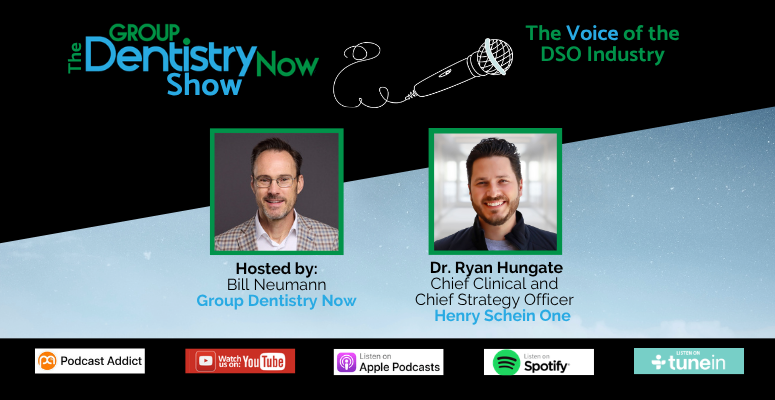
Welcome to The Group Dentistry Now Show: The Voice of the DSO Industry!
From System of Record to System of Action: How AI Is Transforming Dental Practice Operations
Dr. Ryan Hungate, Chief Clinical and Chief Strategy Officer at Henry Schein One, joins the show to discuss:
- Technology evolving from data storage to intelligent systems
- Why dentists hate insurance
- The reality of dental charting
- Much more
To learn more about Henry Schein One visit: https://www.henryscheinone.com/
You can read Dr. Hungate’s most recent article on Group Dentistry Now : From System of Record To System of Action: What Dental Technology Is Becoming – Group Dentistry Now
You can also connect with Ryan on LinkedIn here: https://www.linkedin.com/in/ryanjhungate/
Subscribe to our channel for more episodes and stay updated on the latest DSO news, insights, and events!
If you like our podcast, please give us a ⭐⭐⭐⭐⭐ review on iTunes https://apple.co/2Nejsfa and a Thumbs Up on YouTube.
From System of Record to System of Action: How AI Is Transforming Dental Practice Operations Transcript:
Bill Neumann (00:11):
Hey everyone. Welcome to the Group Dentistry Now show. I’m Bill Neumann, and as always, we appreciate you joining us. It’s great to have Dr. Ryan Hungate with us. And Ryan and I go back quite a ways actually. It’s good. I haven’t seen him in a while, but he’s got his new hat on. He’s going to have to tell you about that with the cool logo. I ran into Ryan before he was at Henry Shime I, and he is now the chief clinical and chief strategy officer there. So good to have you on. And you have your own podcast as well, so we want to make sure we let people know where they can find you. But how about for the folks that don’t know you, a little bit about your background?
Dr. Ryan Hungate (00:57):
Yeah, no problem. First, thanks for having me. This is always fun to catch up and if we get to do it in a more professional setting, that’s absolutely fantastic. Usually it’s over a quick sip at one of these conferences that we have, Bill. So this is good stuff. Well, yeah, so a little bit about me. I’m an orthodontist, so got to go through the same fun misery that now we think of fondly called dental school. Went to ortho school out at USC. So I’m hoping that my Trojans have a good year in football this year. We’ll see. They have quite the gauntlet coming up. But transitioned out of that quickly into a startup that I had called Simplify. Grew that for just shy of 10 years, got to just shy of about 10,000 locations here in the United States and internationally and sold it to Vine, retired for about 48 hours.
(01:47):
And I say that a little bit tongue in cheek, it was a little longer than that, but got a call from the great Mark Milotec and he said, “I hear you have unfinished business.” And said, “We have some cool stuff brewing over here at Henry Shine one.” And I said, “Look, I really want to be able to change things if I can. I don’t want this to be your daddy’s and your grandpa’s dentrix anymore. I want to really move this thing forward.” And he said, “Well, what are your ideas?” I gave them to him and the next thing I know I’m out there at Henry Shine one helping build the vision and execute on that. And then also make some amazing partnerships that allow us to execute even faster. And hopefully everybody out there is seeing that and experiencing it today.
Bill Neumann (02:30):
And you have some unique experience outside the dental industry. You worked for a stint at Apple. Can you talk a little bit about that experience and how you’ve brought some of those learnings over to the dental industry?
Dr. Ryan Hungate (02:43):
Yeah, it predated all of that other stuff I just talked about. It’s interesting. I always say I worked at that little company at one point in time and it was a pretty cool time when I was there. It was 2007, 2008. So the iPhone had just come out for all the Apple historians. Actually, ironically, I think in about 50 minutes we might see the first Apple foldable and I’m sure they’ll drain my wallet again this year. But what’s interesting is I started at a lowly Apple retail store. I quickly figured out a couple of our biggest problems were I can’t find anybody to help me and also that people would hang around too long. So I started to triage people as they walked into the store or strategically route them to somebody who knew what they were talking about and then lightly kick you out without you knowing once you’ve dropped about six or $700 in the store, it turns out that you’re done spending money.
(03:28):
So grew that really quickly. Next thing I know, I’m out in Cupertino reporting directly to a gentleman named Ron Johnson who was the SVP of Apple Retail at the time, really cool guy who was also previously the CEO of Target. He’s the reason that Target feels really nice and open and bright versus maybe your Walmart experience out there and learned a lot from them and really just really how software can influence workflow and became extremely passionate about that. It was about that time at Apple that a lot of my friends were getting into dental school or medical school and they were showing me their software. Some of it still looks a little similar I would say to when that happened. And I was like, “You know what? Apple’s making beautiful design. The design is having amazing effect on workflows and maybe I can go in there and change that up.” So decided to go to dental school after that and try to change things and been trying to change stuff ever since.
Bill Neumann (04:23):
Yeah. And I think we’re getting to a point, to your point earlier about how some things still look like the way they did 10 or 15 years ago. I think the dental industry is catching up, which can be a little daunting if you are running a group practice or if you’re a solo practitioner. Everything’s AI now and I think it can be really, really overwhelming. You penned an article for us, it’s called From System of Record to System of Action, What Dental Technology is Becoming. And this is really interesting and I want to dive into this because we talked about when you reference a point where when we went to digital, so we took the files off the wall and we put them into a computer and it was really a system of record, but it didn’t do anything really more than that. There wasn’t anything beyond maybe making it easier to find things.
(05:24):
So maybe talk a little bit about that transition and then this next transition, which I think is so much more important and it’s already making practices more efficient. Although again, I think it’s so overwhelming that people, they don’t know the tools that they probably already have in front of them.
Dr. Ryan Hungate (05:47):
No, you’re a hundred percent right. So let’s start by talking about what practice management software is even today, but depending on what platform you’re on, it’s evolved, like you’re saying. So it was, is a system of record. And I would even argue that when we switched from paper to digital back in 1995 when it was really cool, we lost something. We lost some of that personal touch. It was magic when a doctor could grab a chart before they walked in the room, read over it, know a little bit about you, walk in, act like they knew everything about you and gave you that personal touch. And you’re like, “My doctor loves me and they remember me. This is fantastic.” No, they just looked at your chart five seconds before they walked in there and you felt that. Well, now that’s behind the screen. So unless I have a mechanism where I look at that screen before I walk into the operatory, and a lot of these are open operatories, I kind of have a gate that I have to get through.
(06:44):
So we lost that personal touch and it’s even worse when you say, “Oh, how’s it going buddy? Oh crap, you were here yesterday and you dropped five grand in my practice and I don’t remember you.” I mean, hell, the person that you buy a really nice purse from in the mall remembers you to text you forever. We just don’t do a good job as practitioners because we see a lot of patients on that stuff. So we lost something there. But at the end of it, really, if you think about legacy PMS, and some of those still exist in vast majority, it’s a system of record. It’s a ledger. You put information in and when you want to know something, you go pull a report. That was genuinely revolutionary in 1996, but think about what it asks of the practice. It assumes somebody has time, the training, and the instinct to go looking for the right thing at the right moment.
(07:32):
So in most offices, that person doesn’t even exist anymore or they exist and they’re also answering the phone, checking a patient in and chasing a claim from last November or something crazy like that. A system of action, which is what you’re talking about, which is what I’m excited about, inverts that. Instead of you querying the software, asking the software for something, the software brings the thing to you. And increasingly, it now handles the first three steps before it even does that. So your Thursday afternoon has a two-hour hole in the hygiene column. The old model was you find out Thursday morning when you look at the schedule and your stomach drops. The new model is on Monday, the system already knew, already identified the 11 patients with unscheduled treatment who live within 15 minutes, already reached out. And what shows up on your screen is here’s what I did, here’s what’s left to do, do you want me to keep going?
(08:38):
So for a DSO executive or even a single location practice, that’s the whole ballgame. You cannot scale judgment by hiring more people who have it, who already have that. You can scale if the system carries that intelligence. The software should be the one asking you questions, not the other way around.
Bill Neumann (09:05):
So I’m curious, we have the capability now, we’ve moved from this reactive situation, reactive to proactive. Are groups leveraging it like they should or is it kind of all over the map? Tell me a little bit about what your experience is. You work with big and small, all different shapes and sizes.
Dr. Ryan Hungate (09:30):
Everybody’s dipping their toe in right now, and that’s what’s so cool about this. I always tell people AI is the dumbest it’s ever going to be today. And I don’t know if you saw the news recently, but Astra, OpenAI’s Astra model is now deemed as AGI, meaning that it is now officially as smart as all the humans combined, which is pretty wild. So we’ve hit that moment, which I think everybody, it’s about two years before we though. I think most people were saying it was 2028. It was the other day. It just solved an insane math equation. There’s a huge controversy around that too, because it’s using other people’s, they’re standing on the shoulders of giants, which all AI does. What I found is that DSOs or even single location practices are looking at their biggest problem and they’re reaching out and saying, “How can AI help me with this problem?” That is RCM, that’s a huge piece.
(10:33):
How can I help that process? And it’s interesting because a lot of these, at Henry Schein one, we have an insane amount of data. We’re probably the only one out there that has a threshold where you can actually train models on it. So we have a lot of these really cool companies like the Anthropics of the world, like the OpenAIs, like the Amazons of the world reaching out to us and saying, “Hey, you want to make a cool LLM for X, Y, and Z?” What I think a lot of people aren’t doing yet is they’re not saying, “Okay, I want to tackle the RCM problem, but how does the PRM, the getting the patient in the door, tie to the RCM, tie to the clinical and tie back to the RCM? And if my AI is able to oversee all of those things, if I have a platform that can actually harness, they call them harnesses now, where it can actually bring all those different AIs together and intelligently understand what is happening over the horizontal view of the practice, you’re going to get a different effect in your practice.
(11:31):
So I’m not saying that everybody should just jump in both feet first in the deep end and go nuts because it’s more of an implementation problem there than it is on, hey, will this eventually work better together? Yes, it will eventually work better together. That’s what you want to get to. I think it’s smart how they’re approaching it right now. They’re saying, I’m going to probably start with the clinical AI with imaging, then I’m going to move over to this small piece of RCM, maybe it’s eligibilities, then I’m going to open it up to claim narratives, then I’m going to eventually open it up to reconciliation, which is kind of the way they’re going. And eventually, because everything talks to everything, now you can become intelligent, which is what I was talking about originally. So that’s what you’re seeing everybody do right now. There’s going to be people that go faster and they’re going to have a huge first mover advantage by doing the work and figuring this out before everybody else.
(12:19):
I think everybody else will get there out of just sheer necessity or their business will hurt so bad that they’re either going to just have to have the high priced things in their practice or hire less people. It’s going to be interesting to see what happens to the people who don’t decide to hop on that train. I’m a firm believer that AI will not replace people. I think AI will replace people who don’t use AI.
Bill Neumann (12:47):
Yeah, I think that’s a great way to look at it. So you talked a little bit about in diagnostic AI, that was kind of our first experience with AI in dentistry or dental specific AI. So I think people are relatively comfortable with diagnostic AI. So that’s where we all got started. But now we’re talking about the type of AI that’s going to impact you operationally. And so when you move, we’ve got diagnostic down or we’re comfortable with it, and so we move over to something that’s going to impact us through the practice management software operationally. What’s that first area that people tend to focus? Is it filling those scheduling gaps? Is it a revenue cycle? Or does it depend on what’s your biggest pain point?
Dr. Ryan Hungate (13:38):
Yeah, it’s revenue cycle, believe it or not. So I would say it’s funny, Bill, I’m still trying to convince people that it’s okay to let somebody else besides your front desk person that’s been there for 20 years touch your schedule. Restaurants have figured that out in a big way. I could scream to the rooftop that 70% of patients just book with the first person that says yes and allows you to book. It’s just people have a specific way about their schedule and it’s like holy hallowed ground that nobody can touch. So we’re still fighting that battle. I think those walls are breaking down and most people will say it’s easier for me to now say, Hey, I’m not just trying to fill your schedule, I’m trying to fill them with the right kind of patient. So like I said earlier, it’s, hey, I want to find a patient that lives within 15 minutes of the practice that has a serious amount of treatment that needs to be done, not it’s just another single filling or whatever might be.
(14:38):
Of course we’re wanting to get them in too, but it can prioritize these specific things. That’s so difficult for a human being to look through the entire book and find that and find the most likely person to pay, the person with the most insurance left. There’s so many factors that AI can look at simultaneously and put things in the right place. So I think scheduling is a fantastic one. The one that they look at though, it’s really interesting. In revenue cycle, you find out if you are right.
(15:09):
The whole thing we’re trying to help people with, because the payer said yes or no, the claim paid or it didn’t, the patient showed up or they didn’t, that closed loop at the end of the day is what makes a system trainable and more importantly, trustworthy. So what’s really cool about this that we’re finding is that you can measure it, you can audit it, and a denial rate, for example, is not a matter of opinion. So the place where we’ve been pointing people to on the revenue cycle side is eligibility is the place I’d start. And I say that as someone who’s spent an enormous amount of time inside verification of benefits, and it is a rabbit hole that I didn’t think was as deep as it is, and I still haven’t found the bottom of this thing. It is the most expensive, least glamorous, most soul sucking work in dentistry.
(16:01):
Someone on your team sits on hold for 20 minutes to learn a frequency limitation, writes it on a sticky note, and that information is gone forever the moment the patient leaves. Now multiply that across a hundred locations. That’s not a workflow problem. That’s an institutional memory problem, believe it or not. And it’s exactly what these systems are good at. So the next piece after that I’d start to look at is then claims, right? Most denials are predictable from the claim itself plus that payer’s behavior history. Now, again, you have to have a threshold of data. We’re going to submit over 140 million claims this year. Nobody else even comes close to that besides maybe one of the clearing houses. This means that most denials are preventable before submission, not appealable after. And then finally you get to that piece where we were talking about, which is scheduling because the schedule is that it is the P&L and everything else downstream is just arithmetic from that.
Bill Neumann (17:06):
So there’s a lot. Here’s another question. Your experience, so all DSOs are doing some are really into their AI, they’re using it, others are maybe just dipping their toe, scheduling revenue cycle, diagnostic probably. Would you say the majority of at least DSOs are or?
Dr. Ryan Hungate (17:31):
Almost every single one I know has grabbed onto some sort of diagnostic. So they’re on one of the big three and there’s a fourth one out there or they found some other solution. What’s interesting is that DSOs will believe, and they should, that if you look at your doctor base as a whole, they miss 30% of their diagnoses. There’s doctors listening right now that are like, “I don’t miss any of them. I believe you. I legitimately believe you.” The stats will say that when you look at every single doctor, it’s 30%. That’s fine. You’re the one that doesn’t know. The thing that the really smart DSOs are understanding now is that this is not about finding more. Sure, you can have 2000 locations and just watch your overall numbers go up because you’re going to find more things that you are missing. Sure, done. And that’s why some of them move really fast to adopt it.
(18:26):
On the other side, let’s say that you’re a 10 location DSO. In that case, you’ve got a bunch of doctors that you have to talk to. You’re probably very clinically based. Your doctors might even still be running the practice. This isn’t about finding more stuff or finding anything. It’s about finding a common language between you and the patient and actually being able to show somebody instead of a giant gray and black smudge, “Hey, do you see this red thing? Remember in kindergarten you learn that red is bad? Yeah, it’s still bad here. In yellow, you see this yellow thing? This means it’s going to be bad.” So we all understand stoplights. We can all see measurements and we can see when that measurement gets bad from bone loss. This is a way for us to communicate with patients and increase treatment acceptance rates. So the next place that we’re going at Henry Schein one is not just about the AI treatment presentation, it’s also about transparency on other things.
(19:24):
So the reason you do, for example, eligibility, it’s so that I can present the right treatment cost to the patients. I can say, “Hey, today you owe me $60. The patient portion is going to be $360. I worked with a third party financing firm. I already have you pre-approved. This is how you’re going to be able to afford it if you want to.” Because we now know that half of the battle is the affordability and the other half is trust. We think trust plus affordability equals patient acceptance. And then after that, what’s neat is that you also see an increase in treatment completion rates because people will a lot of times say, “Oh yeah, I’ll sign it. I agree. I’ll do this. I’m going to pay for everything. I’ll do it all.” And they’re saying yes because they accidentally walked into a really nice store and they’re going to put something on layaway and all they’re like, “I got to get out of the store because I can’t afford anything in this store and I’m really embarrassed right now and I will do anything, I’ll sign anything to get the hell out of here.” We see that all the time.
(20:23):
A good example is RPD completion rates. Treatment acceptance, national acceptance rate’s 54%. National completion rate for RPDs, 11%. That’s a problem. So we have to actually truly convince our patients that these things are necessary and that they can afford them and that will make it so they come back, they complete the treatment and we can actually deliver that treatment. It’s fantastic. So you put all those things together and that’s what we think that clinical AI, the imaging side is one small piece of that, but it just is in a bigger story of transparency for that patient and trust and then eventually leading to affordability.
Bill Neumann (21:03):
Yeah, that makes a ton of sense. I mean on the treatment acceptance side of it, I mean it definitely seems to me that being a patient and not being a dentist and they show me and I’m trying really hard because I’m in the industry and I’m like, I’m sorry, I don’t see it. Right? Yeah. So it definitely makes sense and the color coding’s great, but you’re taking it from, okay, I’ve got a problem. And then the second piece, which again ties into what we’re talking about today is operational AI. Do I have the money? Am I eligible? How much money is there for me? Oh wait, I actually do have it. Or maybe I have a little bit and maybe that’s when patient financing comes in. Oh, and by the way, we can offer this and that to make sure we take care of this problem today.
Dr. Ryan Hungate (21:58):
Yeah. Look, there’s a reason that doctors hate insurance companies and it’s not because they’re not doing their job. They are getting patients to our offices. People still, if you have dental insurance, which I think the number is 30% of the United States doesn’t have it or maybe it’s higher than that now, they’re getting patients to our practices. The problem is the opaque part after that. There’s no transparency on how I file a claim. Heck, when I graduated dental school, I didn’t even know that you had to file claims to get paid. I had no clue. I thought it was magic because I would drop the patient off at the desk and they would take care of the finance stuff and I would go back and I would type my note, which was how I got my points. Then all of a sudden you go to practice, you’re like, I have to file what?
(22:42):
I have to take this set of pictures during what to actually get paid? Oh my God, I forgot to take a picture and now I get paid $0. These are the things that we always kid around and say, why don’t we teach our kids how to file their taxes in high school? It’s why don’t we teach our dental students how to file claims in dental school or even better yet, hire and fire and things like that. So I think the thing that we’re really trying to move towards is just helping people with consistency at the end of the day, not just detection, because a lot of the things we do in dental practices is really reactive and we don’t have time to create great SOPs. Some of the great DSOs do this and they have huge teams of people that do it, but they have to get to a certain threshold to be able to afford these things.
(23:29):
And this is where even the smaller DSOs, even the mid-sized DSOs can’t put those numbers up to actually be able to afford these things. And even more now when people are looking at their bottom line possibly for the first time ever instead of just flipping it over each time and buying more practices, I think people are really going to focus on treatment acceptance and treatment completion.
Bill Neumann (23:50):
There’s all sorts of interesting things going on. You’ve got advancements in technology like ambient listening, automated charting. Talk a little bit about those types of changes and how you see groups implementing those to, whether it’s better patient experience or it’s just better for the providers.
Dr. Ryan Hungate (24:11):
Yeah. Look, ask any dentist what they do after the last patient leaves and you’ll get the same answer with a slightly different tone of resignation charting. Notes they meant to finish at lunch. It’s an hour give or take, and it’s the hour that’s supposed to belong to their family. That’s the worst part. Ambient documentation, the exam gets captured as it actually happens, structured into a beautiful note, your style of note, presented for review and signed off by you. That gives you that hour back, at least an hour back. And by the way, they’re good notes. They’re not like, I got to get the hell out of here notes. That alone would justify it. Retention is a real cost and burnout is a retention problem. So that’s the other thing. I hate it. I hate it so much when you talk to a dentist and you say, “Hey, I see you have a little one.
(25:14):
Are you excited to bring them into dentistry and get them excited about dentitry?” They’re like, “Hell no. Hell, I wouldn’t do it again.” And I’m just like, “What other profession out there is the grass so much greener on the other side?” And what they’re talking about is not the actual dentistry they’re doing. It’s the management of people that they didn’t think about. It’s the business side of it they didn’t think about. It’s the insurance side they didn’t think about. So this is where things like, and it’s the note taking, for example. And here’s the part I think leaders underappreciate. Clinical documentation is the raw material of the revenue cycle. The note is where the claim comes from. So when notes are thin or written, let’s say six hours later from memory, you get super vague narratives, missing justifications and denials that look like billing problems, but are actually documentation problems.
(26:15):
So better notes, they aren’t just a provider experience win, and that’s huge. So if you’re taking notes by the end of the year, it’s because you love to take notes. Don’t be that person. They are also a huge cash win and also down the line, a medical legal win. So there’s two honest caveats here, right? Consent and disclosure matter. We got to make sure about that, but we help you with that stuff. And you should be super explicit with patients, not clever about it. And the provider has to actually read and own the note. The moment ambient charting becomes this rubber stamping thing, I think you’ve traded some risk for a far worse one, but at the same time, you are saving so much. Just read your brief note. It summarizes it. It puts it in the exact format you want it. Hell, you could put it in a SOAP note.
(27:04):
The only people that actually do SOAP notes are oral surgeons out there. If you want to do a SOAP note as a general dentist now, you can even do a SOAP note. So just remember that the note is the front end of the revenue cycle. You fix the note and you fix things, let’s say three departments down the road.
Bill Neumann (27:23):
So for the groups in the audience that are listening and they’re like, “Man, I’m only scratching the surface. I want to do these things.” Do you have training and education? What’s the best way to move forward and go from dipping the toe to really taking advantage of all the technology that’s available now?
Dr. Ryan Hungate (27:47):
Look, it’s interesting. We have a new problem. We are now producing features faster than ever before, which used to be the problem we had. Okay. I want this faster. I want it out the door. Software is now getting, I would say, easy to produce. You have to be responsible and secure it. So we focus an incredible amount on security. We focus an incredible amount on enterprise value. So it needs to be able to not just handle your one location, it needs to be able to handle your 3000 locations. So there’s a night and day difference between those two. But the bigger thing that I think a lot of people don’t realize is that when you’re bringing things out very quickly, you have to go above and beyond to let your customers know what the hell you just did. Because let’s say I roll out five things in a month now, a lot of times people are just like, “Well, I didn’t adopt the last five from the previous month.” So this is where we just have to get so much better, Bill, and we are getting a lot better at one implementation, auto conversion.
(29:01):
And then the last piece is just making it so either that technology is completely invisible and it just makes you magically more money, makes happier patients, it lets you go home earlier that day, or it’s so damn easy to use like the ambient voice technology. You don’t really have to learn anything. You just have to click a button and it starts to take a note for you. Same with our Pareo voice stuff, right? Same button, you didn’t ever have to unclick it. It just knows that you transitioned to Perio and you start talking about Perio. You just open the Pareo window and now it’s thinking Pareo and Pareo documentation. So this is the flow that you have to build over time, and you really have to just help educate people on how to do that. Now, the beautiful thing about Henry Schein one is that we have the people to do that and we have an amazing team.
(29:46):
A lot of people are building a lot of software out there and there’s a lot of really cool software, but then when you’re a DSO or hell, even a single location practice and you’re like, “Hey, do me a favor and introduce me to my dedicated business persons that’s going to help me. My relationship person’s going to help me educate on that.” And they’re like, “Oh, that’s the same person that’s also going to take your cancel questions. That’s also going to be your salesperson. Oh, and by the way, they’re also the CEO.” And you’re just like, “That’s not good. I’m going to need to call you at all different times of the day. I’m a DSO. I want to be able to make those calls and I need it customized just for my specific culture.” With Henry Chang one, we can do that because one, we’ve been around a while and we know that that’s what people need.
(30:28):
And two, we have the actual scale to be able to accomplish that. So we’re really focusing on that bill and making sure that that is at the forefront of how we roll things out. And I hope that the DSO executives and anybody else listening understand that when you’re choosing a platform now, you have to pick it because you’re not going to have a lack of features. You’re just not. People are going to speed up and people are going to release really cool stuff. It’s how does that company really truly partner with us and hope that we adopt all of it? Because I know that our DSOs are going to be more successful when people adopt our software the right way. So we are going to do our job to make sure that that happens come hell or high water.
Bill Neumann (31:13):
And I think your point is really valid about how using a lot of this technology, we talked about training, there’s really not a lot of training involved. Like you said, you press a button, but you have to change a habit. So you have to go from doing it the way you used to do it to leveraging this technology, which could just be instead of charting, taking those notes or remembering to take those to actually remembering to push that button and making your life easier. So it’s really changing a habit versus this big educational process.
Dr. Ryan Hungate (31:51):
Yeah. Change is a bit, I always used to say it, simplify. I still say it today. Change is the devil whether it’s good or bad to most of these dental practices. Hopefully they’re all doing well enough and most of them are that the doctor is super successful, they have their car paid off, they had the college paid off, they’re possibly thinking about a vacation home and it’s a pretty good life. So any change is kind of a threat to that life. So you darn well better have a software that makes that life better without a lot of headache. And that’s where we’re really focusing now in that making that product so beautiful and easy to use that it can accomplish that.
Bill Neumann (32:32):
So everything we’ve talked about is happening now. This technology all works now, people are using it now. What’s the next frontier? Talk a little bit about predictive dentistry and what that might look like.
Dr. Ryan Hungate (32:47):
Yeah. So I think most leaders are evaluating AI as a software purchase and five years from now they’ll realize it was an operating model decision. So here’s what I mean. So if eligibility claims follow up and a large share of scheduling coordination stop being human tasks, then the front office role as it exists today, largely defined by execution, becomes a role defined by exception handling and patient relationships. That’s a different skill or maybe it’s they finally get to exercise the skill they love to do anyway. So different skills, hopefully different comp for them, different training, probably however many you need for those locations. There’s just different people doing different things within that org. Again, I think the more they enable themselves with AI, the more valuable they’re going to be over time. So nobody’s org chart in my opinion is ready for that. Everybody’s technology roadmap is.
(33:59):
The second thing, and this is the one I want a DSO board to hear, is that a competitive advantage shifts from who has the best software to who has the best data and the cleanest workflow to apply it. The software is going to converge. It’s just going to happen. Everyone will have super capable models within a few years because the models themselves are becoming more of a utility. What won’t converge is the quality of your clinical documentation, the integrity of your patient records and whether your operations are consistent enough for a system to learn from. So basically the unglamorous work, clean data, standardized workflows, discipline documentation turns out to be the actual moat that you are going to put up. So groups that spent, let’s say the last three years on that are going to look like geniuses and it’ll be presented as an AI success story when it was really a fundamental story.
(35:00):
Now on the nose, if you want to know what’s going to happen the rest of this year and maybe next year, I think that there’s going to be a huge focus on treatment presentation and treatment acceptance rates because we’ve looked for a long time. It’s funny, Dr. White told me one time that RCM is just the Coumadin for DSOs. And I love that because it’s basically saying, look, give me the blood I already have, get it flowing good, but I have this much level of work that I’m going to do. And he also coined it as saying, look, doctors will do everything to make their practice more successful except work more. And look, that hits home because look, if I walk up to every doctor and said, no, it’s going to be really easy.You’re going to work Saturdays, you’re going to work full day Fridays, you’re going to work full day Wednesdays.
(35:52):
They’re going to look at me and go, no, I’m not going to do that. But if I can say, look, doc, right now your treatment acceptance rate is 54% and that’s the national average. Hell, let’s say it’s 70%. If I can just increase that treatment acceptance rate and treatment completion rate by 5%, just five, just a small amount, and I think we can do it by 10, 20, 30%, it is an insane amount of revenue coming into that practice. And we’re already going to do our job with AI scheduling and everything else that gets you the right patients in the right place. So imagine now patients, right place, patients who can pay, the patients who you want. Now understanding what you’re talking about, saying yes more, affording more. I mean, I truly believe that the golden age of dentistry is getting ready to happen at least at the end of this year and then all of 27, all of 28.
(36:49):
It’s going to be a good time to be a dentist and it’s going to be a good time to own practices. You’re going to see a real boom in our industry.
Bill Neumann (37:00):
Well, that’s good. That’s good news because we’ve had a little malaise in the industry over the past couple of years. So I think we’re looking for that good news, the golden age. I like that. So I’d be remiss without asking this question here because there’s responsibility that we have with all this technology. So what part of dentistry do you think should really remain human? I mean, we’re not going to automate everything, but there’s a lot that can be automated. You talk about it more as a tool, which I totally agree. It’s going to help the people, the front desk staff, the clinicians, everybody really, but there are things that are going to be automated that were once done by humans. So how do you balance that?
Dr. Ryan Hungate (37:48):
So let’s level up a little bit on that one. So I’d give leaders a simple test. Before you turn anything on, answer four questions. Where is the human checkpoint? Who is accountable when it’s wrong? How would you audit a decision six months from now? So who the heck did what? And where did the training data come from? So meaning does it actually fit your model? Does it actually fit your culture? Or am I trying to inflict this DSO’s ways on this DSO? That’s the problem. So if you can’t answer those, you don’t have a governance problem later. You have one now, you just haven’t met it yet. So the framing I use is actually three tiers. First of all, automate the deterministic, the work with a right answer, eligibility lookups, claim scrubbing, appointment reminders. There’s no judgment being exercised. So there’s no judgment being surrendered here.
(38:58):
Augment that judgment. The model surfaces, ranks, flags, and a human decides. So basically if it’s a judgment call, you want to augment it. Treatment planning, diagnosis, anything where you are weighing trade-offs for a specific person, never automate the relationship. And I want to be specific about one risk because I live in this every single day. On the billing side, an AI that optimizes toward reimbursement will find its way to upcoding. That is not a clever feature. That is a false claims act problem with your name on it. So coding automation needs guardrails that are more conservative than a human’s not less, if that makes sense. So precisely because it operates at volume. So imagine you’re the DSO that’s like, “Look, I don’t want to ever look at my claims. I want you to compose them and build them for me.” Absolutely. We can look at that, but the problem is that speed multiplies whatever direction you are pointed.
(40:10):
So that’s a really big deal when it comes to the claims side of things. So make sure that you always have a human in the loop there. The last piece, what stays human forever? Diagnosis ownership, the consent conversation, and the moment you have to sit down and tell someone something they didn’t want to hear. Nobody in this profession got into it for the charting. They got into it for those things. That’s the stuff we love. So if you look at it as a whole, automation doesn’t create integrity problems. It scales the ones you already have. So just remember that as you are implementing these technologies throughout your ecosystem.
Bill Neumann (40:53):
Well, great conversation. I think you sum up things really nicely in this article. Again, I’ll drop a link to it in the show notes. It’s called From System of Record to System of Action. What Dental Technology is Becoming? We covered a lot of that today, but you go really deep into this. And if people want to contact you, Ryan, what’s the best way to reach out to you? And if they want to find out more about what Henry Shine I is up to, what’s the best way to do that?
Dr. Ryan Hungate (41:22):
Yeah, so check me out on LinkedIn. I’m on there all the time doing my thing, but then otherwise just check us out on dentrixascend.com, henryshein.com. I like to say it’s not your daddy’s Dentrix or Dentrix Ascend anymore. We are doing some really cool stuff and we’ve got some beautiful technologies that you should definitely check out. And I always know whenever I hear that doctor talking about their life isn’t what they want it to be, I know they haven’t applied the right technology just yet.
Bill Neumann (41:55):
That’s a great way to finish things off. Well said. Well, thanks, Ryan. Good to see you again, and thank you everybody for watching this podcast today. Until next time, this is the Group Dentistry Now Show.