

By Dr. Ryan Hungate, Chief Clinical and Strategy Officer, Henry Schein One
When dental practices went digital, the work itself did not change much. What changed was the filing. Charts that used to live in a wall of folders moved onto a server, and finding one took four seconds instead of four minutes. That was a real improvement, and nobody would go back. But the software was doing the same thing the folders did. It was remembering.
That is worth sitting with, because it describes nearly the entire history of dental technology to this point. We spent three decades teaching computers to store what we had already decided and already done. The chart, the ledger, the schedule, the imaging archive: all of it captured the past with increasing fidelity. None of it participated in the present.
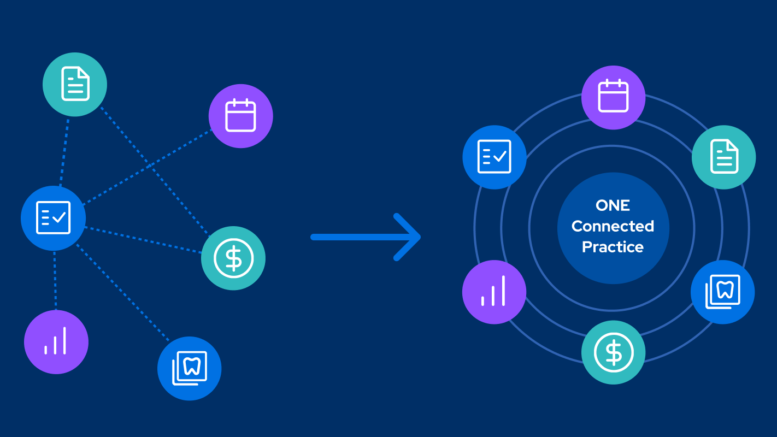
We are now watching that change, and the clearest way to describe the shift is this. Dental software is moving from a system of record to a system of action.
The system of record did exactly what we asked of it
The era we are leaving deserves a defense, because it is fashionable to be dismissive about it, and that is unfair.
A system of record has three jobs: capture information accurately, keep it safe, and give it back when asked. Judged on those terms, dental software succeeded. It made practices auditable, claims submittable, patient histories portable, and group practice possible at scale. It was passive by design, and the design was correct. When storage is expensive, and computers cannot interpret anything, the responsible thing to build is a very good filing cabinet.
It also produced something nobody was optimizing for: one of the richest longitudinal datasets in healthcare. Every radiograph, every probing depth, every restoration, every recall interval kept or missed, accumulated patient by patient for twenty-five years. We built that asset as a byproduct of documentation. It is now the raw material for everything that follows.
Three capabilities arrived at roughly the same time
The reason this shift is happening now, rather than in 2015, is that three separate things matured close enough together to combine.
Perception came first. Models can now read a radiograph or listen to a conversation and extract structured meaning from it. Next came prediction. Given enough longitudinal records, patterns emerge that no individual clinician can see, because no individual clinician observes fifty thousand patients over a decade. And then execution, which is the least discussed and the most consequential. Software has begun to be trusted to initiate things on its own rather than wait to be told.
That third capability is the actual dividing line. A system of record waits, but a system of action notices and then does something. Every category below is some version of that same move.
The schedule as inventory
Let’s start with the front door to the clinic, scheduling. Chair time is the practice’s perishable inventory, and we have historically managed it with intuition and a spreadsheet.
Scheduling intelligence will change that in three ways. It’ll score no-show and cancellation risk per patient and appointment, so confirmation effort goes where it matters instead of uniformly. It will match appointment type to provider, operatory, and time of day based on how that practice actually performs rather than how the template says it should. And when a hole opens at 2 p.m. on Tuesday, it will identify the right patient to fill it, meaning the one whose treatment is due, whose insurance resets soon, and who has historically said yes to short notice.
None of this is glamorous. All of it compounds, because the schedule is the mechanism through which every other improvement reaches a patient.
The unglamorous revolution in eligibility
Nobody gives keynotes about benefit verification. It may be the clearest example of the shift in the whole practice.
The old workflow was a person, a phone, a hold queue, and a portal login for each payor. The new solution returns coverage detail, remaining benefit, and plan limitations before the patient arrives. Increasingly, the technology predicts what a specific plan will actually pay for a specific procedure.
Notice what happened there. Verification was a lookup with a question asked and an answer retrieved. Prediction is an action with the system evaluating a claim before submission and flagging the one likely to be denied, with the reason, while it can still be corrected. The practice moves from managing denials to preventing them.
For the patient, the visible result is an accurate number before treatment instead of a surprise afterward. Financial surprise is one of the most corrosive things that happens in a dental practice, and most of it traces back to a front desk making a good-faith estimate with incomplete information.
Imaging: from an archive to a measurement
Radiographic AI is the most mature example, and it is instructive because of how the value has shifted from where people first expected it.
FDA-cleared modules now detect caries, calculus, periapical radiolucencies, measure periodontal bone levels, and segment CBCT volumes. The early framing was that these tools would catch what a clinician missed, and they do catch things. But the more durable value has turned out to be consistency rather than detection.
Ask two dentists to grade an interproximal lesion, and you will often get two answers. Ask the same dentist on a Monday morning and a Friday afternoon, and you may get two answers. That variability is human and expected, and it has always made comparison across time nearly impossible. A model that measures bone level to a tenth of a millimeter, the same way, every time, gives us something dentistry has never really had: a stable baseline. The question stops being “does this look worse than it did two years ago” and becomes a number with a direction.
There is a second effect that shows up in the operatory rather than the literature. When a patient sees a lesion outlined and quantified on their own image, the conversation changes. Hesitant patients accept treatment they had declined twice, not because anyone argued more persuasively, but because showing beats telling. Whatever we call that, it is not a diagnostic improvement. It is the software participating in the encounter.
The note that writes itself
Documentation has been the standing tax on clinical work. Recent analyses put after-hours documentation at roughly fifty minutes per clinician per workday. That is a week of unpaid labor every month, and it is the single most reliable complaint from clinicians in any specialty.
Ambient listening documentation removes most of it. The system listens to the visit and drafts the note. Voice-driven periodontal charting has arrived alongside it, so a hygienist can call out six-point measurements without an assistant transcribing or the clinician breaking sterility to type.
The obvious benefit is time. The more interesting one is attention: the clinician gets to look at and engage with the patient for the duration of the exam. We gave that up to typing on computers and barely noticed.
But the effect that matters most to a practice owner is downstream. Ambient notes are more complete and far more consistent than dictated or typed ones, because they do not degrade at 4:30 on a Thursday. Consistent documentation produces cleaner coding, which produces fewer denials, which produces better data, which is what every predictive capability in this article depends on. Documentation quality was always a compliance concern. It is becoming a performance input.
From detection to prediction
The furthest-reaching change is also the least mature, and it warrants careful description. And it must be stated up front: no aspect of this replaces the clinician.
Dentistry has claimed prevention as its identity for a century while practicing reactively. We detect disease that has already occurred and repair it. Our primary prevention tool has been an interval, and the six-month recall is a historical convention rather than a finding. It is applied to a nineteen-year-old with no restorations and to a sixty-year-old smoker with a history of bone loss, identically.
Longitudinal modeling makes it possible to treat risk as a variable instead of an assumption. With enough connected history, patterns emerge around which lesions progress and which remain static, which patients are on a periodontal trajectory before it is clinically obvious, and which will likely need what, and roughly when. Risk-stratified recall follows with intervals set by an individual’s actual trajectory rather than by convention.
This work is early. The evidence base is uneven, the models need validation against outcomes rather than against expert opinion, and the potential for confidently wrong predictions is real. Any claim of certainty here deserves suspicion. But directionally, this is the one that changes what the profession is. Everything else in this article makes existing dentistry more efficient. This changes what we are practicing.
What the record becomes
Look across those five domains and the same structural change appears in each. The record stopped being the output and is becoming the input.
For thirty years, the point of documentation was documentation. You charted because you had to, and the chart’s purpose was fulfilled the moment it was stored. Now, each of these capabilities reads the accumulated record and produces something forward-looking from it. The data has become fuel.
Which means the practices that maintained disciplined records for years, out of nothing but professional conscientiousness, are about to be rewarded for it in ways they never anticipated. And practices with inconsistent coding, duplicate patients, and thin notes will find that these tools work poorly for them and will probably conclude the technology is overhyped. It will not be the technology.
What it asks of us
Three things, and they are not primarily technical.
First, we have calibrated trust. Knowing when to accept an AI finding and when to override it is becoming a genuine clinical skill, and it does not come naturally. Automation bias is well-documented across medicine, with people deferring to confident machines, especially when tired. The clinician who accepts every flag has outsourced diagnosis. The one who dismisses every flag has bought an expensive decoration. The skill lives in between, and we should be teaching it.
Next we must consider explicit governance. A system that can act needs boundaries that someone actually decided on. Which actions can it take unsupervised, which require confirmation, and which should never be automated? Most practices have never had that conversation, because until recently, there was nothing to decide.
Finally, there is data discipline. The unglamorous prerequisite. Everything above degrades in exact proportion to how poorly the underlying record was kept. Practices must become stewards of excellent data, information, and records.
What does not change
The human relationship with patients and nearly everything that makes dentistry difficult.
No model will restore a molar, manage an anxious patient, or decide whether a borderline lesion should be watched for another year in this person’s mouth based on what is known about their history, compliance, and life. Those judgments are the practice of dentistry, and they are becoming a larger share of the job, not a smaller one, as the administrative layer thins out.
We spent thirty years teaching our software to remember what we did. The next decade is about teaching it to help us decide what to do. The practices that benefit most will be the ones that stay firmly in the loop while the technology matures.

 About the author: Dr. Ryan Hungate, Chief Clinical and Strategy Officer, is revolutionizing revenue cycle management and integrating our diverse products into the unified Henry Schein One platform. As an orthodontist and the founder of Simplifeye, a company that streamlines dental practice operations with cutting-edge technology, Dr. Hungate is most passionate about making the RCM process for all dentists invisible.